- Market Value (2025): USD 116.1 Mn
- Estimated Value (2026): USD 121.3 Mn
- Forecast Value (2036): USD 188.6 Mn
- CAGR (2026-2036): 4.5%
What is the Deadweight Testers Market forecast to be worth by 2036?
USD 121.3 million in 2026 to USD 188.6 million by 2036 at a 4.5% CAGR.
- Worth USD 116.1 million in 2025, the deadweight testers market draws most of its revenue from accredited laboratories and aerospace test benches.
- Revenue will move from USD 121.3 million in 2026 to USD 188.6 million by 2036 as gauge populations in plants and hangars keep growing.
- A 4.5% CAGR will hold from 2026 to 2036, since replacement of worn piston-cylinder units adds to first-time purchases.
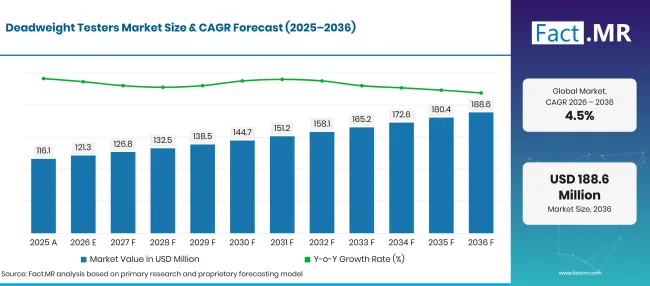
Deadweight Testers Market Forecast Global | Source: Fact.MR
| Year | Basis | Market Value (USD million) |
|---|---|---|
| 2025 | Actual | 116.1 |
| 2026 | Estimate | 121.3 |
| 2036 | Forecast | 188.6 |
| CAGR 2026 to 2036 | Forecast period | 4.5% |
Source: Fact.MR analysis. Updated Oct 26, 2026
What are the defining numbers behind Deadweight Testers Market growth?
The 2026 to 2036 period adds USD 67.3 million in new value, led by laboratory and hydraulic test demand.
- Demand Drivers in the Market
- Aircraft fleets are growing, and every airframe carries hydraulic, fuel and pneumatic gauges that need periodic checks. The FAA forecasts the total U.S. commercial fleet to increase from 6,949 aircraft in 2025 to 10,677 in 2046 [1]. Repair stations use hydraulic deadweight testers to verify the gauges and transducers removed from these aircraft.
- Quality systems such as ISO/IEC 17025 ask laboratories to show an unbroken chain of comparisons back to national standards. A deadweight tester gives that chain a primary link, since its output depends on mass and piston area that can be certified separately.
- National metrology work keeps pressure science moving, yet physical piston gauges stay in daily use. In June 2025, NIST reported a definitive measurement of the optical pascal and said the method could one day let industry set up its own optical pressure scales [2]. Until such systems reach shop floors, laboratories will keep relying on piston-cylinder references.
- Process plants run thousands of gauges and transmitters on steam, oil, gas and water lines. Drift in a single reading can trip a safety valve too early or hide an overpressure event, so maintenance teams calibrate on fixed cycles.
- Hydraulic test benches in automotive and energy plants reach pressures well above what handheld electronic calibrators cover. Oil-operated deadweight testers fill that gap at a lower cost per point than automated controllers.
- Key Segments Analyzed
- By Product Type: Hydraulic Deadweight Testers will hold 58.4% share in 2026, as oil and water units reach the high pressures that industrial gauges and transmitters require.
- By Application: Calibration Laboratories will account for 39.7% share in 2026, owing to accreditation rules that call for a primary pressure reference on the bench.
- By End-User: Aerospace will capture 28.6% share in 2026, given that hydraulic systems on every aircraft need gauges checked during scheduled maintenance.
- Analyst Opinion at Fact.MR
- Shambhu Nath Jha, Principal Consultant at Fact.MR, states, “A deadweight tester earns its place because its accuracy comes from physics that an auditor can check, not from software. Laboratories will keep buying them as the anchor of their pressure chain, even as electronic calibrators take over routine field checks. Suppliers that pair certified masses with fast recertification service will hold the strongest position with aerospace and accredited buyers.”
- Strategic Implications
- Manufacturers should offer dual-range piston-cylinder sets and recertification turnaround times that keep a laboratory’s reference out of service for days, not weeks.
- Calibration laboratory managers should match piston ranges to the gauges they see most often, since a tester run near the bottom of its range carries higher uncertainty.
- Aircraft maintenance providers should budget for water-operated testers where hydraulic fluid contamination of oxygen or fuel system gauges must be avoided.
- Distributors in Brazil and other growing industrial bases should build local mass recertification capacity, because shipping weight sets abroad adds cost and downtime.
- Japan will lead the group at 5.6%, where precision manufacturers renew pressure references to keep strict factory tolerances. Brazil follows at 5.2% as oil, gas and petrochemical output in states such as Rio de Janeiro lifts gauge counts. The United Kingdom will grow at 4.0%, helped by aerospace maintenance and a large base of accredited laboratories. Germany posts 3.6% with steady demand from machine builders and automotive test benches. For the United States, a 3.3% pace reflects a mature installed base that turns over through replacement.
How does the Deadweight Testers Market break down by segment?
Hydraulic Deadweight Testers will lead Product Type at 58.4%; Calibration Laboratories will head Application at 39.7%; Aerospace will top End-User at 28.6%.
What leads the Product Type segment?
Hydraulic units take 58.4% of 2026 sales.
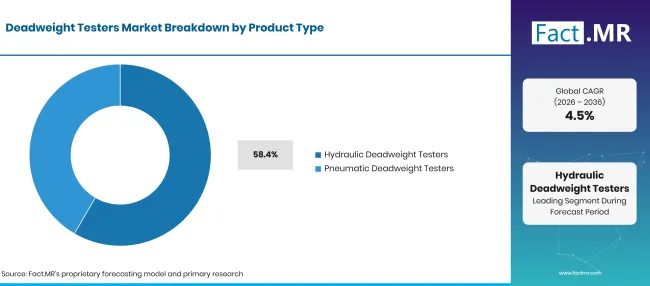
Deadweight Testers Market Breakdown Product Type | Source: Fact.MR
| Product Type | Share (2026) |
|---|---|
| Hydraulic Deadweight Testers (Leading segment) | 58.4% |
| Other segments combined | 41.6%* |
| Total | 100.0% |
Source: Fact.MR analysis. Updated Oct 26, 2026
Most industrial gauges, transmitters and pressure sensors operate at pressures that gas cannot reach safely on a bench. Oil-operated testers cover these ranges, and water-operated versions serve users who must keep oil away from the device under test. Dual piston-cylinder designs let one base cover both low and high ranges. The upper end of the scale is wide. NIST calibrates customer piston gauges from 10 kPa to 280 MPa, which shows how far hydraulic references extend in traceable practice [3]. Pneumatic testers serve lower ranges and vacuum, where clean gas avoids contamination of sensitive instruments.
Which application holds first place?
Calibration Laboratories account for 39.7% of 2026 revenue.
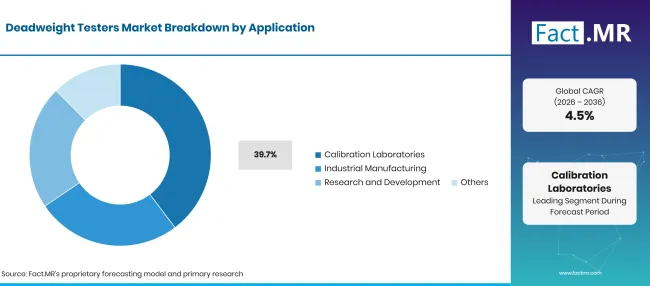
Deadweight Testers Market Breakdown Application | Source: Fact.MR
| Application | Share (2026) |
|---|---|
| Calibration Laboratories (Leading segment) | 39.7% |
| Other segments combined | 60.3%* |
| Total | 100.0% |
Source: Fact.MR analysis. Updated Oct 26, 2026
Accredited calibration rooms keep a deadweight tester as the top of their in-house pressure chain and send it out only for periodic recertification. Each tester then serves as the reference for hundreds of working instruments, including automated controllers and other pressure calibration equipment. Industrial manufacturing users place testers next to production lines to check gauges before installation. Research and development teams use them when validating new transducer designs, often alongside a pressure cycle test system that checks fatigue life.
How does End-User shape demand?
Aerospace represents 28.6% of 2026 demand.
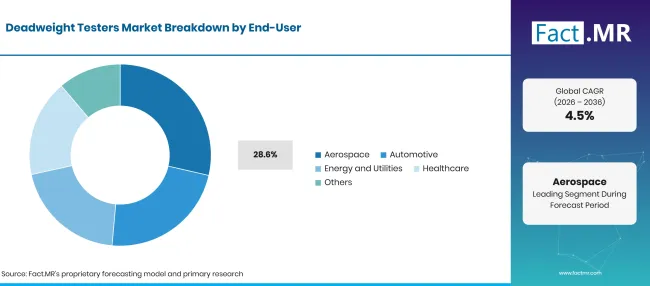
Deadweight Testers Market Breakdown End User | Source: Fact.MR
| End-User | Share (2026) |
|---|---|
| Aerospace (Leading segment) | 28.6% |
| Other segments combined | 71.4%* |
| Total | 100.0% |
Source: Fact.MR analysis. Updated Oct 26, 2026
Aircraft hydraulic, fuel and landing gear systems carry gauges and transducers that must be checked on fixed maintenance intervals. Repair stations need traceable records for each check, so they prefer references whose accuracy an auditor can trace directly. Fleet growth adds to this workload. The FAA forecasts mainline passenger jets, including regional jets, to grow from 4,626 in 2025 to 6,890 in 2046 [1]. Automotive, energy and utilities and healthcare buyers form the rest of demand, with energy users checking gauges on lines protected by a pressure relief valve.
What is accelerating Deadweight Testers Market adoption, and what is holding it back?
Accreditation rules and growing aircraft and process gauge populations keep laboratories buying piston-cylinder references. Electronic calibrators, trained operator needs and the cost of mass recertification slow uptake in routine field work.
Drivers Impact Analysis
| DRIVER | (~) % IMPACT ON CAGR | GEOGRAPHIC RELEVANCE | IMPACT TIMELINE |
|---|---|---|---|
| Accreditation demand for traceable primary pressure references | +1.3% | Global | Short term (<= 2 years) |
| Aircraft fleet growth and scheduled hydraulic gauge checks | +1.1% | North America, Western Europe, East Asia | Medium term (2-4 years) |
| Calibration cycles for process gauges and transmitters in plants | +0.9% | Global | Short term (<= 2 years) |
| High-pressure bench testing in automotive and energy production | +0.7% | East Asia, Western Europe, Latin America | Medium term (2-4 years) |
Source: Fact.MR analysis. Updated Oct 26, 2026
Opportunity Impact Analysis
| OPPORTUNITY | (~) % IMPACT ON CAGR | GEOGRAPHIC RELEVANCE | IMPACT TIMELINE |
|---|---|---|---|
| Water-operated testers for oxygen and fuel system instruments | +0.6% | North America, Western Europe | Medium term (2-4 years) |
| Local mass recertification and repair services | +0.5% | Latin America, South Asia & Pacific | Long term (>= 4 years) |
| Dual-range piston-cylinder sets for mixed laboratory workloads | +0.4% | Global | Medium term (2-4 years) |
Source: Fact.MR analysis. Updated Oct 26, 2026
Restraints Impact Analysis
| RESTRAINT | (~) % IMPACT ON CAGR | GEOGRAPHIC RELEVANCE | IMPACT TIMELINE |
|---|---|---|---|
| Electronic pressure calibrators in routine field checks | -0.5% | Global | Short term (<= 2 years) |
| Shortage of trained operators and careful piston handling | -0.3% | Global | Medium term (2-4 years) |
| Recertification cost of masses and piston-cylinder assemblies | -0.2% | Global | Long term (>= 4 years) |
Source: Fact.MR analysis. Updated Oct 26, 2026
Which countries are scaling the Deadweight Testers Market through 2036?
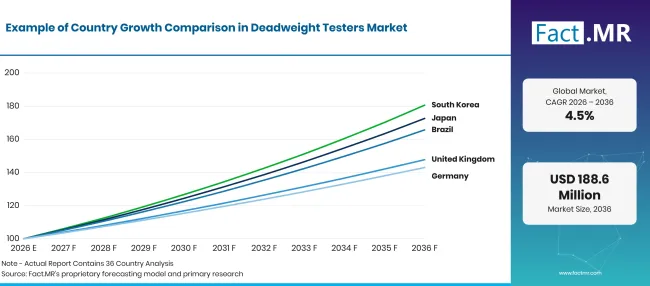
Deadweight Testers Market Growth Index | Source: Fact.MR
| Country | CAGR (2026 to 2036) |
|---|---|
| Japan | 5.6% |
| Brazil | 5.2% |
| United Kingdom | 4.0% |
| Germany | 3.6% |
| United States | 3.3% |
Source: Fact.MR analysis. Updated Oct 26, 2026
What supports Japan’s adoption?
5.6% CAGR, driven by precision manufacturing and frequent renewal of pressure references.
Japanese factories run tight tolerance checks on hydraulic and pneumatic equipment, and many keep JCSS-traceable pressure references in-house. Output trends shape how many instruments enter these checks. METI reported that the original industrial production index for August 2026 rose 2.7% from a year earlier [4]. Domestic makers supply oil and water testers that span low ranges to several hundred megapascals.
How is Brazil scaling demand?
5.2% CAGR, backed by oil, gas and petrochemical activity that adds gauges to calibrate.
Industrial output in Brazil grew 0.6% in 2025, according to IBGE, with Rio de Janeiro up 5.1% as extractive activity expanded [5]. Offshore platforms and refineries in that state use large numbers of pressure gauges on wellhead, separator and pipeline service. Local calibration laboratories are adding hydraulic references so that operators do not ship instruments abroad for checks.
What is supporting the United Kingdom’s adoption?
4.0% CAGR, helped by aerospace maintenance and accredited laboratory demand.
The Office for National Statistics estimated that UK production output rose 0.2% in 2025, the first annual rise since 2021 [6]. Manufacturing output grew 0.9% in the fourth quarter of 2025 [6]. Aircraft maintenance providers and engine test cells add steady demand, and UKAS-accredited laboratories keep pressure balances as their top reference for gauges and transmitters.
How is Germany developing demand?
3.6% CAGR, reflecting machine building and automotive test bench needs.
German machine builders and car makers keep large fleets of hydraulic test benches that need traceable pressure checks. Destatis reported that capital goods output rose 1.3% in May 2026 from the prior month, while the automotive industry grew 3.6% [7]. Domestic manufacturers of pressure instruments also run their own laboratories, which creates steady replacement demand for pressure balances.
How does the United States perform?
3.3% CAGR, as a mature installed base renews through replacement.
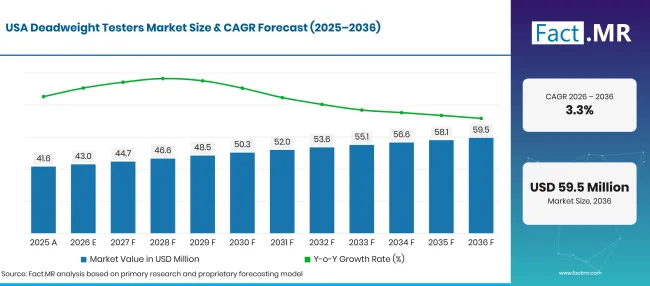
Deadweight Testers Market Forecast Usa | Source: Fact.MR
NIST maintains national pressure standards from 10^-7 Pa to 280 MPa and offers calibrations for customer piston gauges [3]. Many U.S. testers trace to these standards through accredited commercial laboratories. Demand comes mainly from replacing worn piston-cylinder units in aerospace repair stations, oil and gas service companies and defense laboratories, with fewer first-time buyers than in Japan or Brazil.
Who leads the Deadweight Testers Market?
Competition splits into two camps. Specialist pressure metrology houses, led by Fluke Corporation through its Fluke Calibration piston gauges and P3000 to P3200 testers, WIKA with its CPB5800 hydraulic and CPB3500 pneumatic balances, and AMETEK with Type T and PK II units, compete on certified uncertainty and recertification service.
Industrial gauge makers such as Ashcroft, Nagano Keiki and SIKA sell rugged oil and water testers for plant and workshop use, where durability counts for more than fine uncertainty. Pressure on both camps comes from electronic calibrators. Additel released the ADT715 precision pressure indicator in May 2025 [8], the ADT760A automated controller in March 2026 [9] and the ADT710 automated gauge calibration system in June 2026 [10]. Mensor introduced the CPH6670 portable electric pressure calibrator in October 2026 [11]. Deadweight suppliers will win where audit-proof traceability counts more than test speed.
Which companies are the key providers?
Key companies include Fluke Corporation; WIKA Alexander Wiegand SE & Co. KG; Mensor LP; AMETEK, Inc.; Ashcroft Inc.; Nagano Keiki Co., Ltd.; and SIKA Dr. Siebert & Kühn GmbH & Co. KG.
- Fluke Corporation
- WIKA Alexander Wiegand SE & Co. KG
- Mensor LP
- AMETEK, Inc.
- Ashcroft Inc.
- Nagano Keiki Co., Ltd.
- SIKA Dr. Siebert & Kühn GmbH & Co. KG
Bibliography
- [1] Federal Aviation Administration. (2026). FAA Aerospace Forecast Fiscal Years 2026 to 2046: Full Forecast Document and Tables.
- [2] National Institute of Standards and Technology. (2025, June 26). Research Under Pressure: NIST Scientists Make Definitive Measurement of the Optical Pascal.
- [3] National Institute of Standards and Technology. (2026, May 11). Pressure/Vacuum Calibrations.
- [4] Ministry of Economy, Trade and Industry, Japan. (2026, October 15). Indices of Industrial Production: Revised Report for August 2026.
- [5] Instituto Brasileiro de Geografia e Estatística. (2026, February 10). Produção industrial fecha 2025 com avanço em 10 dos 18 locais pesquisados [Industrial production closes 2025 with gains in 10 of the 18 locations surveyed].
- [6] Office for National Statistics. (2026, February 12). Index of Production, UK: December 2025.
- [7] Statistisches Bundesamt (Destatis). (2026, July 7). Produktion im Mai 2026: +0,9 % zum Vormonat [Production in May 2026: +0.9% on the previous month].
- [8] Additel Corporation. (2025, May 29). Additel Launches the New ADT715 Precision Pressure Indicator.
- [9] Additel Corporation. (2026, March 3). Additel Announces the New ADT760A Automated Pressure Controller and Introduces the Simplified ADT760S.
- [10] Additel Corporation. (2026, June 3). Additel Launches the New ADT710 Automated Gauge Calibration System.
- [11] Mensor LP. (2026, October 12). Introducing the CPH6670 Portable Electric Pressure Calibrator.
- [12] Additel Corporation. (2025, March 18). Additel Introduces New Handheld Pressure Pumps for Precision Calibration.
This Report Answers
- Revenue for deadweight testers is split by product type, application and end-user for 2026 to 2036.
- Hydraulic testers, calibration laboratories and aerospace buyers are traced to the operating reasons behind their 2026 lead.
- Japan, Brazil, the United Kingdom, Germany and the United States are compared on industrial output and calibration infrastructure.
- Profiles group suppliers into metrology specialists and industrial gauge makers, with the electronic challenge set out alongside.
- Drivers, opportunities and restraints carry an estimated impact on the CAGR and a time frame.
What does the Deadweight Testers Market cover?
Deadweight testers, also called pressure balances or piston gauges, fall within the Deadweight Testers Market. Each one produces a reference pressure from calibrated masses acting on a piston of known effective area.
Both oil or water operated hydraulic models and gas operated pneumatic models are tracked. Demand is followed across calibration laboratories, industrial manufacturing, research and development, aerospace, automotive, energy and utilities and healthcare.
What is included in the scope?
Complete testers sold with a base, piston-cylinder assembly, mass set and built-in pressure generation count toward revenue. Dual-range models and vacuum options are included when shipped as part of the instrument.
Testers bought by third-party laboratories that offer calibration services are counted at the equipment sale. Water-operated units for oxygen and fuel system instruments are also included.
What is excluded from the scope?
Electronic calibrators, digital pressure indicators and MEMS sensors that do not use the deadweight principle are excluded. Calibration labor and recertification fees are also outside the revenue base.
Hand pumps sold on their own are excluded, such as hydraulic units rated to 10,000 psi [12]. Spare mass sets and replacement piston-cylinder assemblies count only when sold with a complete tester.
How Was the Analysis Built?
The analysis draws on 120+ sources, 35+ company portfolios, 25+ countries, and more than 20 industry interviews.
- Primary Research: Primary research includes discussions with manufacturers, service providers, technology developers, distributors, end users, and subject-matter experts. These conversations examine purchasing priorities, product adoption, operational challenges, approval requirements, competitive positioning, and the factors that influence wider market acceptance.
- Desk Research: Desk research covers government statistics, regulatory publications, company filings, trade data, technical studies, industry associations, standards, public policy, and other authoritative sources. Every source used in the analysis is documented in the bibliography.
- Market Sizing and Forecasting: Market estimates combine historical performance, demand indicators, pricing and volume trends, segment shares, company participation, country-level growth, adoption patterns, investment activity, and barriers to market expansion.
- Data Validation and Update Cycle: Findings are validated by comparing primary interviews with public data, company activity, regulatory changes, trade patterns, and industry developments. Regular updates review new product launches, capacity changes, partnerships, approvals, and shifts in commercial adoption.
Segmentation
What is the report’s scope and coverage?
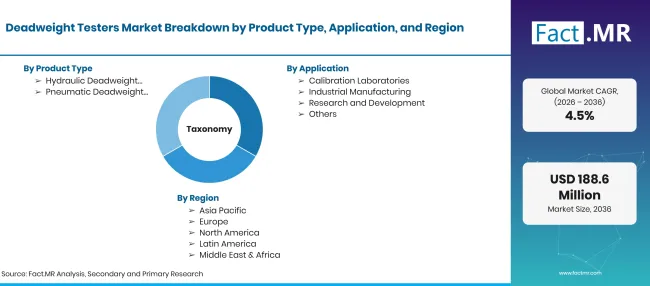
Deadweight Testers Market Taxonomy | Source: Fact.MR
| Attribute | Details |
|---|---|
| Quantitative Units | USD million in 2026 to USD million by 2036 at CAGR |
| Market Definition | Instruments that generate a known reference pressure by loading calibrated masses onto a piston-cylinder assembly, sold for calibrating gauges, transducers and transmitters. Values cover complete hydraulic and pneumatic testers at the manufacturer level. |
| Product Type | Hydraulic Deadweight Testers; Pneumatic Deadweight Testers |
| Application | Calibration Laboratories; Industrial Manufacturing; Research and Development; Others |
| End-User | Aerospace; Automotive; Energy and Utilities; Healthcare; Others |
| Regions Covered | North America; Latin America; Western Europe; Eastern Europe; East Asia; South Asia & Pacific; Middle East & Africa |
| Countries Covered | Japan; Brazil; United Kingdom; Germany; United States |
| Companies Profiled | Fluke Corporation; WIKA Alexander Wiegand SE & Co. KG; Mensor LP; AMETEK, Inc.; Ashcroft Inc.; Nagano Keiki Co., Ltd.; SIKA Dr. Siebert & Kühn GmbH & Co. KG |
| Forecast Period | 2026 to 2036 |
| Approach | Hybrid top-down and bottom-up approach using installed gauge and transmitter populations; calibration laboratory counts; aircraft fleet data; replacement cycles of piston-cylinder units; and supplier portfolio review. |
Source: Fact.MR analysis. Updated Oct 26, 2026
How is the market segmented?
-
By Product Type
- Hydraulic Deadweight Testers
- Pneumatic Deadweight Testers
-
By Application
- Calibration Laboratories
- Industrial Manufacturing
- Research and Development
- Others
-
By End-User
- Aerospace
- Automotive
- Energy and Utilities
- Healthcare
- Others
-
By Region
- North America
- Latin America
- Western Europe
- Eastern Europe
- East Asia
- South Asia & Pacific
- Middle East & Africa
Frequently Asked Questions
How big is the deadweight testers market in 2026?
What is the CAGR of the deadweight testers market from 2026 to 2036?
Which product type leads the deadweight testers market?
Which application leads the deadweight testers market?
Which end-user leads the deadweight testers market?
Which country will grow the most in the deadweight testers market?
Who are the main companies in the deadweight testers market?
What is the difference between hydraulic and pneumatic deadweight testers?
Who worked on this report


Preview the report firsthand - request a free sample
Free SampleGet the brochure for pricing and purchase details
Download PDF