- Market Value (2025): USD 448.3 Mn
- Estimated Value (2026): USD 474.4 Mn
- Forecast Value (2036): USD 834.4 Mn
- CAGR (2026-2036): 5.8%
What is the Dissolved Oxygen Probe Market forecast to be worth by 2036?
USD 474.4 million in 2026 to USD 834.4 million by 2036 at a 5.8% CAGR.
- The dissolved oxygen probe market was valued at USD 448.3 million in 2025.
- Demand will increase from USD 474.4 million in 2026 to USD 834.4 million by 2036.
- From 2026 to 2036, the market is forecast to rise 5.8% CAGR. This growth will come as continuous water-quality monitoring and automated process control become more common.
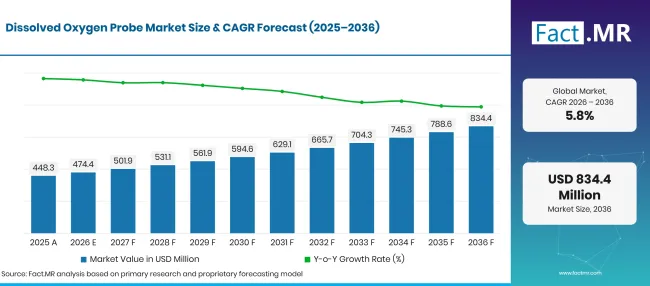
Dissolved Oxygen Probe Market Forecast Global | Source: Fact.MR
| Year | Basis | Market Value (USD million) |
|---|---|---|
| 2025 | Estimated | 448.3 |
| 2026 | Estimate | 474.4 |
| 2036 | Forecast | 834.4 |
| CAGR 2026 to 2036 | Forecast period | 5.8% |
Source: Fact.MR analysis. Updated Oct 27, 2026
What are the defining numbers behind Dissolved Oxygen Probe Market growth?
The market will add USD 360.0 million by 2036. Growth will be driven by aquaculture oxygen control, continuous water-quality monitoring, and closer oversight of wastewater treatment and industrial processes.
- Demand Drivers in the Market
- On April 23, 2025, the U.S. Environmental Protection Agency published its revised Field Measurement of Dissolved Oxygen procedure (LSASDPROC-106-R6), describing methods and considerations for measurements in surface water, treated wastewater, and selected gas-media applications [1].
- In April 2025, Emerson announced its Rosemount 490A digital optical dissolved oxygen sensor with Modbus connectivity for integration with monitoring and control systems. Its described applications include water treatment and industrial processes.
- Aquaculture farms need reliable oxygen readings to manage aeration and protect fish stocks. Singapore’s aquaculture monitoring initiatives use water-quality sensors to track changing conditions.
- Wastewater treatment plants use dissolved oxygen readings to regulate aeration and maintain biological treatment performance. Automated monitoring systems help operators respond to changing process conditions. They also help manage energy use more effectively.
- Research published in January 2026 examined optical and electrochemical sensors, predictive models and IoT-based monitoring for aquaculture. These developments point to growing opportunities for connected probes. Such probes provide real-time oxygen data and support automated farm management.
- Key Segments Analyzed
- By Product Type: Optical DO Probes will account for 58.7% of the market in 2026. Their lower maintenance needs suit regular water testing and industrial monitoring.
- By Application: Aquaculture will make up 38.2% of the market in 2026. Fish farms need consistent oxygen readings to maintain water conditions and protect stock.
- By End-User: Environmental Agencies will represent 31.4% of the market in 2026. This is driven by routine water-quality checks and monitoring of aquatic ecosystems.
- Analyst Opinion at Fact.MR
- Shambhu Nath Jha, Principal Consultant at Fact.MR, states, “Demand for dissolved oxygen probes is set to grow as aquaculture, environmental monitoring and wastewater treatment require consistent oxygen readings. Optical probes are gaining ground due to their lower maintenance needs, while electrochemical models remain important for routine testing. Over the coming years, wider adoption of continuous monitoring and automated process control will create steady opportunities.”
- Strategic Implications
- Probe manufacturers gain a stronger position by demonstrating consistent readings, practical calibration methods and manageable upkeep. This applies across optical and electrochemical models used in different settings.
- In aquaculture, dissolved oxygen probes can be linked with aeration systems, real-time alerts and remote monitoring. This gives farm operators a faster response to sudden changes in oxygen levels.
- Environmental monitoring programmes rely on probes that withstand field conditions and maintain data consistency. These probes also need calibration routines suited to extended water-quality studies.
- Wastewater treatment facilities benefit from continuous oxygen readings. These give operators a clearer picture of aeration efficiency and biological treatment performance.
- Industrial sensor makers need to design probes around real operating demands. These range from repeated cleaning and sterilisation to compatibility with existing plant controls and instrumentation.
Germany’s dissolved oxygen probe market is forecast to grow at a CAGR of 4.2% from 2026 to 2036, driven by environmental testing and industrial measurement needs. Brazil is set to expand at 5.0%, with aquaculture and water-quality checks creating fresh demand. The United States leads at 6.5%, reflecting wider use of continuous monitoring across water management and industry. The United Kingdom is forecast to grow at 4.6%. [3] Japan is set to record 5.9% growth, supported by environmental assessment and industrial process monitoring. [4]
How does the Dissolved Oxygen Probe Market break down by segment?
Optical DO Probes lead Product Type at 58.7%; Aquaculture leads Application at 38.2%; Environmental Agencies lead End-User at 31.4%.
Which Product Type leads?
Optical DO Probes account for 58.7% of the market in 2026.
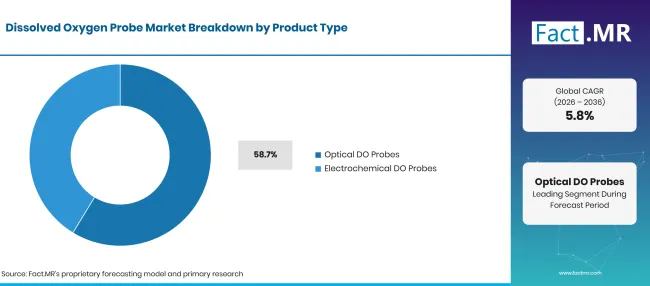
Dissolved Oxygen Probe Market Breakdown Product Type | Source: Fact.MR
| Product Type | Share (2026) |
|---|---|
| Optical DO Probes (Leading segment) | 58.7% |
| Other segments combined | 41.3%* |
| Total | 100.0% |
Source: Fact.MR analysis. Updated Oct 27, 2026
Reduced servicing needs and reliable readings make Optical DO Probes a practical choice for applications that require frequent oxygen measurement. Their optical sensing technology avoids electrolyte replacement and reduces routine maintenance compared with many electrochemical models.
This makes them particularly useful in aquaculture farms, wastewater facilities and environmental monitoring programmes. In these settings, equipment downtime and inconsistent readings complicate daily operations. Their suitability for continuous monitoring further strengthens their position in settings that depend on stable water-quality data.
What supports Aquaculture within Application?
Aquaculture accounts for 38.2% of the market in 2026.
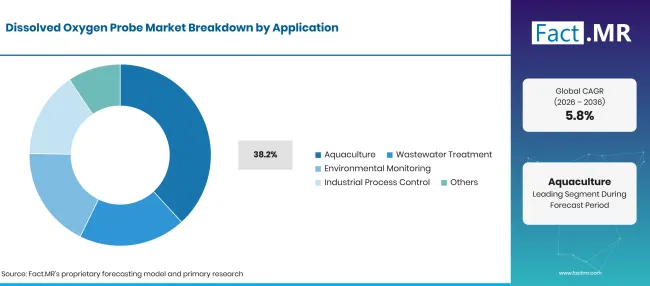
Dissolved Oxygen Probe Market Breakdown Application | Source: Fact.MR
| Application | Share (2026) |
|---|---|
| Aquaculture (Leading segment) | 38.2% |
| Other segments combined | 61.8%* |
| Total | 100.0% |
Source: Fact.MR analysis. Updated Oct 27, 2026
The need to maintain safe oxygen levels for fish and other aquatic species makes aquaculture a major application for dissolved oxygen probes. Fish farms rely on regular oxygen readings to manage aeration and prevent oxygen depletion. These readings also help reduce stock losses during sudden changes in water conditions.
As intensive farming increases the need for close water-quality control, dependable monitoring equipment becomes part of everyday farm management. These practical requirements give aquaculture a stronger demand base than individual applications such as environmental research or industrial process monitoring.
How does End-User shape demand?
Environmental Agencies account for 31.4% of the market in 2026.
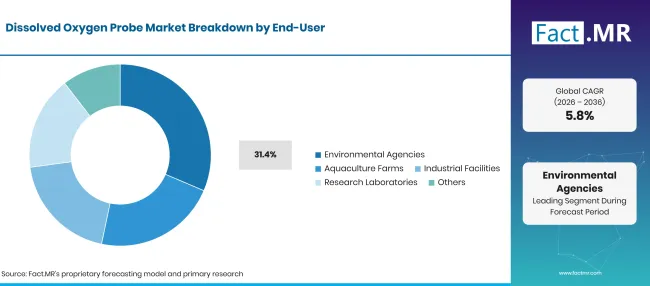
Dissolved Oxygen Probe Market Breakdown End User | Source: Fact.MR
| End-User | Share (2026) |
|---|---|
| Environmental Agencies (Leading segment) | 31.4% |
| Other segments combined | 68.6%* |
| Total | 100.0% |
Source: Fact.MR analysis. Updated Oct 27, 2026
Routine water-quality assessments and the need to track changes in aquatic ecosystems place Environmental Agencies at the forefront of dissolved oxygen probe use. These organisations monitor rivers, lakes, coastal waters and other natural environments to identify oxygen depletion and assess conditions affecting aquatic life.
Their work often involves repeated field measurements across multiple locations. This makes dependable probes and consistent readings essential for long-term monitoring programmes. Unlike end-users with narrower operational needs, environmental agencies use oxygen data for broader ecosystem assessments and water-quality oversight. This sustains demand across varied monitoring activities.
What is accelerating Dissolved Oxygen Probe Market adoption, and what is holding it back?
Rising scrutiny of water quality and aquaculture conditions is boosting demand for dissolved oxygen probes. Optical sensing, remote access and automation links aid this growth. Yet high costs, calibration, fouling, harsh environments and skill requirements still hold back some users.
Drivers Impact Analysis
| DRIVER | (~) % IMPACT ON CAGR | GEOGRAPHIC RELEVANCE | IMPACT TIMELINE |
|---|---|---|---|
| Expansion of continuous water-quality monitoring programmes | +1.8% | Global | Medium term (2–4 years) |
| Greater use of dissolved oxygen monitoring in aquaculture operations | +1.2% | Asia-Pacific, Latin America, Global | Medium term (2–4 years) |
| Increased monitoring requirements in wastewater treatment and receiving waters | +0.8% | Europe, North America, Asia-Pacific | Short to medium term (≤4 years) |
| Adoption of optical sensors and connected process-monitoring systems | +0.4% | Global | Medium to long term (≥2 years) |
Source: Fact.MR analysis. Updated Oct 27, 2026
Opportunity Impact Analysis
| OPPORTUNITY | (~) % IMPACT ON CAGR | GEOGRAPHIC RELEVANCE | IMPACT TIMELINE |
|---|---|---|---|
| Integration of DO probes with remote monitoring, telemetry and automated aeration | +0.7% | Global | Medium term (2–4 years) |
| Development of low-maintenance optical probes for water and wastewater applications | +0.5% | Global | Medium term (2–4 years) |
| Expansion of sensor-based oxygen monitoring in aquaculture farms | +0.4% | Latin America, Asia-Pacific | Medium to long term (≥2 years) |
| Process-compatible probes for biotechnology and industrial applications | +0.2% | North America, Western Europe, East Asia | Long term (≥4 years) |
Source: Fact.MR analysis. Updated Oct 27, 2026
Restraints Impact Analysis
| RESTRAINT | (~) % IMPACT ON CAGR | GEOGRAPHIC RELEVANCE | IMPACT TIMELINE |
|---|---|---|---|
| Initial equipment costs and the expense of integrating sensors with existing systems | -0.4% | Global | Short term (≤2 years) |
| Calibration, cleaning and maintenance requirements | -0.3% | Global | Short to medium term (≤4 years) |
| Fouling, sensor ageing and exposure to demanding operating conditions | -0.2% | Global | Medium term (2–4 years) |
| Limited technical expertise and monitoring budgets among smaller operators | -0.1% | Emerging markets | Medium term (2–4 years) |
Source: Fact.MR analysis. Updated Oct 27, 2026
Which countries are scaling the Dissolved Oxygen Probe Market through 2036?
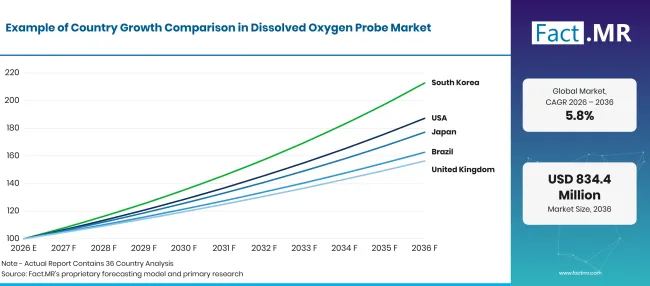
Dissolved Oxygen Probe Market Growth Index | Source: Fact.MR
| Country | CAGR (2026 to 2036) |
|---|---|
| Germany | 4.2% |
| Brazil | 5.0% |
| United States | 6.5% |
| United Kingdom | 4.6% |
| Japan | 5.9% |
Source: Fact.MR analysis. Updated Oct 27, 2026
What supports adoption in the United States?
6.5% CAGR, supported by federal water-quality programs and routine continuous monitoring.
The U.S. Geological Survey identifies dissolved oxygen as an established water-quality parameter measured in environmental monitoring. This supports the technical importance of dependable field measurements without quantifying probe purchases [2].
How is Japan developing demand?
5.9% CAGR, linked to public water-quality assessment and precision-focused industrial monitoring.
Japan’s Ministry of the Environment publishes results from its public-water monitoring programmes. This gives the country an official reference point for judging water conditions. They value instruments that give consistent results and work smoothly with existing monitoring equipment.
What is supporting adoption in Brazil?
5.0% CAGR, driven by aquaculture operations that depend on continuous oxygen measurement.
Dissolved oxygen monitoring helps aquaculture operators assess oxygen availability in production water and inform aeration decisions. Real-time sensors help farmers spot changes early and decide when to run aeration. A BNDES-supported project built through Embrapa’s BRS Aqua work has shown equipment that measures dissolved oxygen with other parameters.
How is the United Kingdom scaling demand?
4.6% CAGR, led by wider storm-overflow and receiving-water monitoring.
In England, water and sewerage companies are beginning to install continuous receiving-water-quality monitors during the 2025–2030 investment period, focusing on high-priority assets. Defra guidance identifies dissolved oxygen, ammonia, temperature, pH and turbidity among the monitoring parameters [3].
What supports adoption in Germany?
4.2% CAGR, backed by Germany’s mature water-management base and steady replacement demand.
German treatment plants, industrial sites and environmental agencies already run well-developed measurement systems. Instrument upgrades and replacement purchases are potential demand channels at established water-treatment and industrial-monitoring sites; their relative contribution to market growth is not independently quantified. When buyers choose a probe, they look at measurement range, reliability in site conditions, calibration routines and compatibility with their monitoring setup.
Who leads the Dissolved Oxygen Probe Market?
Buyers in the dissolved oxygen probe market choose from a mix of water-analysis specialists, laboratory instrument makers and industrial sensor manufacturers. Hach offers optical sensing for water and process use. Thermo Fisher Scientific Inc. provides probes for both field and laboratory work. Xylem competes through its YSI brand, while Hanna Instruments Inc., HORIBA, Mettler-Toledo International Inc. and Jenco Instruments, Inc. cover a wide range of measurement needs.
Endress+Hauser, KROHNE and ABB are strong in industrial and water-treatment instrumentation. Hamilton Company stands out in bioprocess analytics. Sensorex Corporation (a Halma company), In-Situ, DKK-TOA and DwyerOmega (Omega Engineering) add further choice. Companies set themselves apart through sensing technology, measurement stability, maintenance needs, fit with the application, system integration and after-sales support.
Which companies are the key providers?
Key companies include Hach Company; Thermo Fisher Scientific Inc.; Xylem Inc.; Hanna Instruments Inc.; HORIBA, Ltd.; Mettler-Toledo International Inc.; Jenco Instruments, Inc.; Endress+Hauser; Hamilton Company; ABB; KROHNE Messtechnik GmbH; Sensorex Corporation (a Halma company); In-Situ Inc.; DKK-TOA Corporation; and DwyerOmega (Omega Engineering).
- Hach Company
- Thermo Fisher Scientific Inc.
- Xylem Inc.
- Hanna Instruments Inc.
- HORIBA, Ltd.
- Mettler-Toledo International Inc.
- Jenco Instruments, Inc.
- Endress+Hauser
- Hamilton Company
- ABB
- KROHNE Messtechnik GmbH
- Sensorex Corporation (a Halma company)
- In-Situ Inc.
- DKK-TOA Corporation
- DwyerOmega (Omega Engineering)
Bibliography
- [1] U.S. Environmental Protection Agency. (2025, April 23). Field measurement of dissolved oxygen (LSASDPROC-106-R6). https://www.epa.gov/quality/field-measurement-dissolved-oxygenEPA source
- [2] U.S. Geological Survey, Water Science School. (2026, August 24). Dissolved oxygen and water. U.S. Department of the Interior. https://www.usgs.gov/water-science-school/science/dissolved-oxygen-and-waterUSGS source
- [3] Department for Environment, Food & Rural Affairs. (2025, March 24). Storm overflows: policy and guidance. GOV.UK. https://www.gov.uk/government/publications/storm-overflows-policy-and-guidance/storm-overflows-policy-and-guidanceDEFRA source
- [4] Ministry of the Environment, Government of Japan. (2026, March 27).[FY2024 public-water and groundwater quality monitoring results]. Japan Ministry of the Environment source
This Report Answers
- How is the dissolved oxygen probe market divided by product type, application and end-user?
- Why do optical DO probes account for 58.7% of the market in 2026?
- What operational requirements make aquaculture the leading application segment?
- How do environmental agencies use dissolved oxygen probes in water-quality monitoring?
- Which factors explain the different growth rates across Germany, Brazil, the United States, the United Kingdom and Japan?
- Which manufacturers compete across environmental monitoring, aquaculture, wastewater treatment and industrial process control?
- How do optical and electrochemical sensing technologies differ in terms of maintenance, measurement requirements and application suitability?
- What opportunities and restraints influence the adoption of dissolved oxygen probes through 2036?
What does the Dissolved Oxygen Probe Market cover?
Dissolved oxygen probes measure the amount of oxygen present in water or other process liquids. The readings help users assess aquatic conditions, monitor treatment processes and manage oxygen-dependent industrial operations. Optical and electrochemical technologies serve different measurement requirements. Selection depends on operating conditions, maintenance expectations and measurement performance.
The market covers probe products used in aquaculture, wastewater treatment, environmental monitoring, industrial process control and other applications. Demand comes from environmental agencies, aquaculture farms, industrial facilities and research laboratories.
What is included in the scope?
New optical and electrochemical dissolved oxygen probes used for water-quality assessment and process measurement are included.
The scope covers probes deployed in field monitoring, laboratory analysis, aquaculture systems, wastewater treatment facilities and industrial applications. Probe technologies are assessed by product type, application and end-user, alongside country-level growth and the competitive landscape.
What is excluded from the scope?
Standalone water-quality instruments that do not include dissolved oxygen measurement are excluded. General-purpose laboratory equipment and unrelated chemical analysis instruments are outside the market.
So are sensors designed exclusively for parameters such as pH, turbidity or conductivity, unless they form part of a product offering that includes a dissolved oxygen probe. Water-treatment infrastructure, aquaculture facilities and wastewater treatment plants themselves are not counted as probe-market revenue. Consumables and unrelated accessories are excluded unless specifically classified as part of the probe product.
How Was the Analysis Built?
The analysis draws on 120+ sources, 35+ company portfolios, 25+ countries, and more than 20 industry interviews.
- Primary Research: Primary research includes discussions with manufacturers, service providers, technology developers, distributors, end users, and subject-matter experts. These conversations examine purchasing priorities, product adoption, operational challenges, approval requirements, competitive positioning, and the factors that influence wider market acceptance.
- Desk Research: Desk research covers government statistics, regulatory publications, company filings, trade data, technical studies, industry associations, standards, public policy, and other authoritative sources. Every source used in the analysis is documented in the bibliography.
- Market Sizing and Forecasting: Market estimates combine historical performance, demand indicators, pricing and volume trends, segment shares, company participation, country-level growth, adoption patterns, investment activity, and barriers to market expansion.
- Data Validation and Update Cycle: Findings are validated by comparing primary interviews with public data, company activity, regulatory changes, trade patterns, and industry developments. Regular updates review new product launches, capacity changes, partnerships, approvals, and shifts in commercial adoption.
Segmentation
What is the report’s scope and coverage?
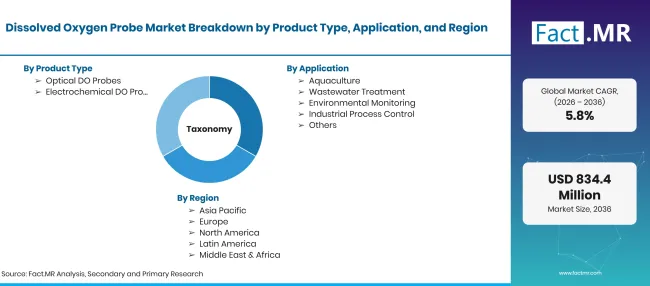
Dissolved Oxygen Probe Market Taxonomy | Source: Fact.MR
| Attribute | Details |
|---|---|
| Quantitative Units | USD million |
| Market Definition | Probes and sensors designed to measure the concentration of dissolved oxygen in water and process liquids for environmental monitoring, aquaculture, wastewater treatment, industrial process control and research applications. |
| Product Type | Optical DO Probes; Electrochemical DO Probes |
| Application | Aquaculture; Wastewater Treatment; Environmental Monitoring; Industrial Process Control; Others |
| End-User | Environmental Agencies; Aquaculture Farms; Industrial Facilities; Research Laboratories; Others |
| Regions Covered | North America; Latin America; Western Europe; Eastern Europe; East Asia; South Asia & Pacific; Middle East & Africa |
| Countries Covered | Germany; Brazil; United States; United Kingdom; Japan |
| Companies Profiled | Hach Company; Thermo Fisher Scientific Inc.; Xylem Inc.; Hanna Instruments Inc.; HORIBA, Ltd.; Mettler-Toledo International Inc.; Jenco Instruments, Inc.; Endress+Hauser; Hamilton Company; ABB; KROHNE Messtechnik GmbH; Sensorex Corporation (a Halma company); In-Situ Inc.; DKK-TOA Corporation; DwyerOmega (Omega Engineering) |
| Forecast Period | 2026 to 2036 |
| Approach | Hybrid top-down and bottom-up approach. It considers water-quality monitoring requirements, aquaculture applications, wastewater treatment, industrial process measurement, product technology, segment shares, country-level growth and company portfolios. |
Source: Fact.MR analysis. Updated Oct 27, 2026
How is the market segmented?
-
By Product Type
- Optical DO Probes
- Electrochemical DO Probes
-
By Application
- Aquaculture
- Wastewater Treatment
- Environmental Monitoring
- Industrial Process Control
- Others
-
By End-User
- Environmental Agencies
- Aquaculture Farms
- Industrial Facilities
- Research Laboratories
- Others
-
By Region
- North America
- Latin America
- Western Europe
- Eastern Europe
- East Asia
- South Asia & Pacific
- Middle East & Africa
Frequently Asked Questions
How large is the Dissolved Oxygen Probe Market in 2026?
The market is valued at USD 474.4 million in 2026 and is forecast to reach USD 834.4 million by 2036
Which product type leads the Dissolved Oxygen Probe Market?
Which application leads the Dissolved Oxygen Probe Market?
Which end-user leads the Dissolved Oxygen Probe Market?
Which country will grow the most in the Dissolved Oxygen Probe Market?
Who are the main companies in the Dissolved Oxygen Probe Market?
Who worked on this report


Preview the report firsthand - request a free sample
Free SampleGet the brochure for pricing and purchase details
Download PDF