- Base Value(2025): 0.8 Bn
- Estimated Value(2026): 0.9 Bn
- Forecast Value (2036): 2.4 Bn
- CAGR (2026 - 2036): 9.7%
Drivetrain Vibration and Condition Monitoring Sensor Systems Market Forecast and Outlook By FACT.MR
The market was valued at USD 0.8 billion in 2025. Demand is estimated to reach USD 0.9 billion in 2026 and is forecast to expand to USD 2.4 billion by 2036. FACT.MR projects a CAGR of 9.7% during the forecast period.
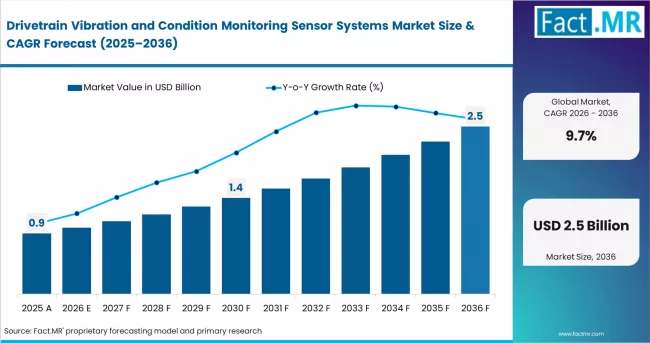
Drivetrain Vibration And Condition Monitoring Sensor Systems Market Value Analysis | Source: Fact.MR
Summary of Drivetrain Vibration and Condition Monitoring Sensor Systems Market
- Market Definition
- Drivetrain vibration and condition monitoring systems detect mechanical faults and support predictive maintenance across vehicles and industrial equipment.
- Demand Drivers
- Electrified drivetrains require continuous vibration monitoring for performance stability.
- Industrial automation is increasing adoption of predictive maintenance systems.
- Fleet operators are using monitoring systems to reduce downtime and maintenance costs.
- Key Segments Analyzed
- By Device Category: Torsional dampers are expected to account for 44.0% share in 2026, supported by drivetrain stability requirements.
- By Vehicle Type: Passenger vehicles are projected to hold 42.0% share in 2026, driven by production volume.
- By Geography: China leads growth at 4.2% CAGR, supported by manufacturing scale.
- Analyst Opinion at FACT.MR
- Shambhu Nath Jha, Senior Analyst at Fact.MR, notes that drivetrain monitoring is shifting from a diagnostic add-on to a standard reliability feature across modern vehicle platforms. Electrified and high-performance systems require continuous monitoring to manage performance, detect faults early, and support system durability. As vehicle architectures become more complex, drivetrain monitoring plays a central role in maintaining operational stability and meeting evolving safety and performance expectations across automotive applications.
- Strategic Implications
- Expand sensor integration across EV drivetrain systems to support real-time monitoring, improve performance stability, and meet evolving safety requirements as vehicle architectures become more complex.
- Focus on predictive maintenance solutions for industrial equipment, enabling early fault detection, reduced downtime, and improved operational efficiency across manufacturing and processing environments.
- Develop cost-efficient products for high-volume vehicle segments, balancing performance and affordability to support wider adoption without increasing system cost pressure.
- Methodology
- Market sizing combines vehicle production data with industrial machinery deployment trends.
- Analysis includes OEM sourcing strategies and supplier shipment patterns across key regions.
- Forecasts reflect adoption trends in electrification and industrial automation influencing monitoring system demand.
| Metric | Value |
|---|---|
| Estimated Value in 2026 | USD 0.9 billion |
| Forecast Value in 2036 | USD 2.4 billion |
| Forecast CAGR (2026 to 2036) | 9.7% |
Source: Fact.MR analysis. Updated Apr 23, 2026
The market is expected to generate USD 1.5 billion in absolute opportunity between 2026 and 2036. Growth is supported by increasing adoption of predictive maintenance systems and rising drivetrain electrification. Sensor integration is expanding across automotive, industrial, and off-highway equipment. Higher system costs and integration complexity continue to limit penetration in entry-level vehicle categories.
China is projected to grow at 4.2% CAGR, supported by industrial production and automotive scale. India follows at 4.0%, driven by commercial vehicle demand and infrastructure expansion. The United States records 3.9%, supported by industrial monitoring adoption. Germany grows at 3.8%, reflecting engineering-led demand. Japan registers 3.7%, supported by precision manufacturing and reliability-focused applications.
Segmental Analysis
Drivetrain Vibration and Condition Monitoring Sensor Systems Market Analysis by Device Category
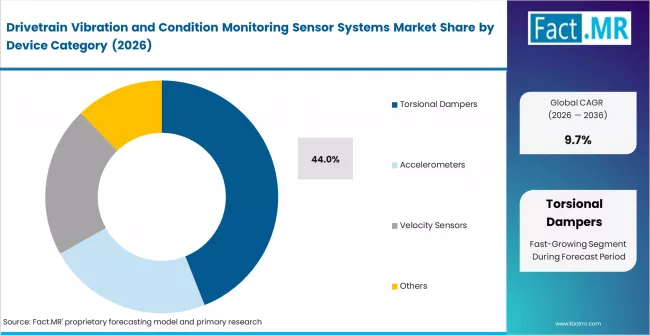
Drivetrain Vibration And Condition Monitoring Sensor Systems Market Analysis By Device Category | Source: Fact.MR
Torsional dampers are expected to account for 44.0% share of the drivetrain vibration and condition monitoring sensor systems market in 2026, as they play a key role in reducing rotational vibration and improving drivetrain stability. These components support durability by minimizing stress on shafts, gears, and connected systems, which becomes critical as powertrain complexity increases. Integration of monitoring capabilities within dampers is also improving fault detection and enabling predictive maintenance across automotive and industrial applications. Demand is supported by the need for smoother operation, reduced wear, and longer component life in high-performance systems.
- SKF development: SKF introduced advanced vibration monitoring solutions for rotating equipment in 2024, strengthening predictive maintenance capabilities by enabling continuous tracking of equipment condition and early identification of performance deviations [1]. These solutions support improved operational reliability across both automotive and industrial systems.
- Industrial trend: Increasing adoption of predictive maintenance in manufacturing is driving demand for vibration monitoring systems integrated into drivetrain components. Manufacturers are focusing on reducing unplanned downtime, improving asset utilization, and extending equipment life. This shift is encouraging wider deployment of sensors that can provide real-time data and support condition-based maintenance strategies.
- System integration: Monitoring-enabled dampers play a key role in detecting early-stage faults such as imbalance, misalignment, and wear. These systems help reduce unexpected failures, improve system stability, and support consistent performance across applications. Integration within drivetrain components also simplifies system architecture and enhances overall monitoring efficiency in both vehicles and industrial machinery.
Drivetrain Vibration and Condition Monitoring Sensor Systems Market Analysis by Vehicle Type
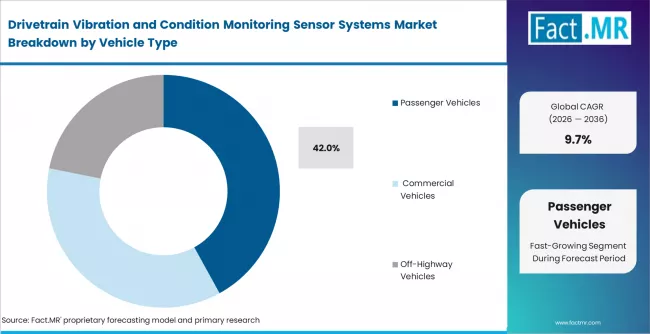
Drivetrain Vibration And Condition Monitoring Sensor Systems Market Analysis By Vehicle Type | Source: Fact.MR
Passenger vehicles are projected to account for 42.0% share of the market in 2026, supported by high production volumes and increasing focus on drivetrain reliability. Monitoring systems are being integrated to detect vibration, imbalance, and wear, helping improve vehicle performance and reduce maintenance needs. As vehicle platforms evolve, especially with electrification, drivetrain monitoring becomes more important for ensuring smooth operation and long-term durability. OEMs are increasing sensor deployment to support predictive maintenance and enhance user experience through reduced noise and vibration.
- Continental expansion: Continental AG expanded drivetrain monitoring solutions in 2024 to improve integration within automotive platforms and strengthen coordination between sensing and control systems [2]. This supports more accurate detection of vibration, imbalance, and performance variations, which is important as vehicle systems become more complex and electrified.
- Market trend: OEMs are increasing sensor integration across drivetrain systems to improve durability and reduce unexpected failures over the vehicle lifecycle. Higher sensor density enables continuous monitoring of key parameters such as vibration, temperature, and load, supporting predictive maintenance and reducing reliance on scheduled servicing. This approach improves operational efficiency and helps manage long-term maintenance planning.
- Reliability focus: Monitoring systems detect early-stage faults such as imbalance, wear, and misalignment, allowing timely intervention before issues escalate. This helps extend vehicle life, maintain consistent performance, and reduce repair costs. Improved fault detection also supports better driving experience through reduced noise and smoother operation across different driving conditions.
Drivers, Restraints, and Opportunities
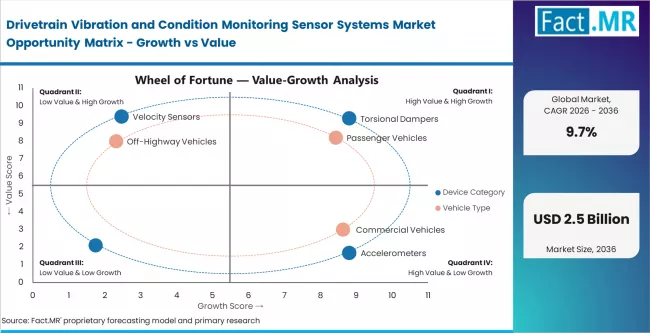
Drivetrain Vibration And Condition Monitoring Sensor Systems Market Opportunity Matrix Growth Vs Value | Source: Fact.MR
Market growth remains steady, supported by rising focus on predictive maintenance and drivetrain reliability across automotive and industrial systems. Demand is closely linked to vehicle production and the deployment of industrial machinery, where monitoring systems help reduce downtime and improve operational efficiency. The current market size reflects a gradual integration phase, as monitoring technologies are added alongside existing systems instead of being fully embedded across all platforms.
System architecture is shifting toward integrated solutions that combine multiple sensing functions within a single platform. Basic vibration sensors are being replaced by multi-parameter systems capable of continuous diagnostics, including temperature, speed, and load monitoring. These systems improve fault detection and support planned maintenance cycles. Higher costs limit adoption in price-sensitive segments, while premium vehicles and industrial applications continue to adopt advanced monitoring solutions where performance and reliability requirements justify the investment.
- Predictive Maintenance Demand: Industrial operators are increasing investment in monitoring systems to reduce downtime and maintenance costs.
- EV Drivetrain Evolution: Electrified drivetrains require different vibration monitoring approaches, increasing demand for specialized sensors.
- Asia Industrial Growth: Manufacturing expansion in China and India is increasing adoption of condition monitoring systems in industrial equipment.
Regional Analysis
The drivetrain vibration and condition monitoring sensor systems market is assessed across North America, Europe, Asia Pacific, Latin America, and Middle East & Africa. Demand patterns vary by industrial activity, vehicle production, and adoption of monitoring systems. The full report provides market attractiveness analysis.
.webp "Top Country Growth Comparison Drivetrain Vibration And Condition Monitoring Sensor Systems Market Cagr (2026 2036)")
Top Country Growth Comparison Drivetrain Vibration And Condition Monitoring Sensor Systems Market Cagr (2026 2036) | Source: Fact.MR
| Country | CAGR (2026 to 2036) |
|---|---|
| China | 4.2% |
| India | 4.0% |
| USA | 3.9% |
| Germany | 3.8% |
| Japan | 3.7% |
Source: Fact.MR analysis. Updated Apr 23, 2026
Source: Fact.MR (FACTMR) analysis, based on proprietary forecasting model and primary research
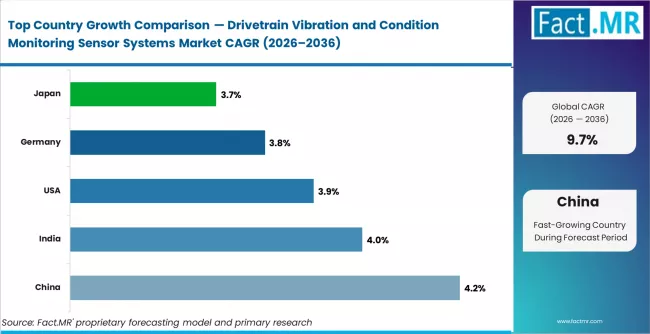
Drivetrain Vibration And Condition Monitoring Sensor Systems Market Cagr Analysis By Country | Source: Fact.MR
Asia Pacific Drivetrain Vibration and Condition Monitoring Sensor Systems Market Analysis
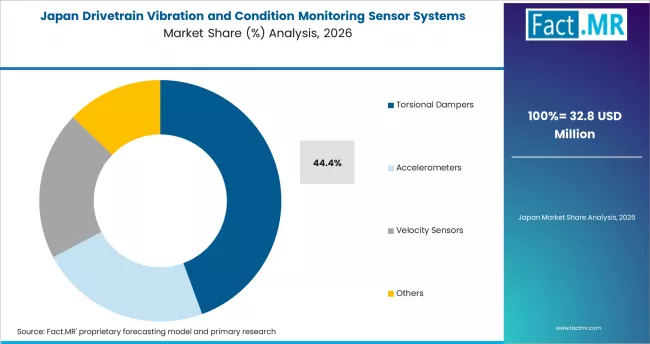
Drivetrain Vibration And Condition Monitoring Sensor Systems Market Japan Market Share Analysis By Device Category | Source: Fact.MR
Asia Pacific operates as a production-driven region where automotive manufacturing and industrial output define demand. Denso Corporation and Toyota Motor Corporation influence regional supply chains and sensor integration.
- China: China continues to lead demand supported by large-scale manufacturing and industrial automation. Industrial modernization initiatives in 2024 increased adoption of condition monitoring systems across production facilities. Automotive production expansion in 2025 strengthened integration of vibration monitoring sensors. The market in China is expected to grow at 4.2% CAGR, reflecting steady industrial demand [3].
- India: India shows gradual expansion driven by infrastructure development and logistics demand. Government infrastructure investments in 2024 increased deployment of heavy machinery equipped with monitoring systems. Commercial vehicle production expanded in 2025, supporting adoption of vibration monitoring solutions. Demand is projected to rise at 4.0% CAGR, supported by industrial and transport sector growth [4].
- Japan: Japan is projected to exapnd at 3.7% CAGR in the drivetrain vibration and condition monitoring sensor systems market through 2036, supported by strong industrial automation and advanced automotive manufacturing. Demand is shaped by high standards for precision, reliability, and system durability across both vehicle and machinery applications. Established OEM presence and focus on quality control continue to support steady adoption of monitoring systems. Growth remains stable as the market relies more on system refinement and performance improvement than large-scale expansion.
North America Drivetrain Vibration and Condition Monitoring Sensor Systems Market Analysis
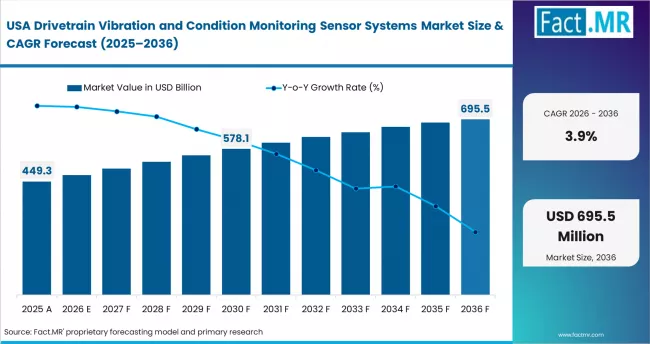
Drivetrain Vibration And Condition Monitoring Sensor Systems Market Country Value Analysis | Source: Fact.MR
North America represents a mature market with strong adoption of predictive maintenance systems across industries.
- U.S.: The United States market is supported by investments in smart manufacturing and digital monitoring systems. Industrial automation programs in 2024 increased adoption of vibration monitoring across production facilities. Automotive OEMs expanded integration of monitoring systems. The market is expected to reach at 3.9% CAGR, supported by operational efficiency initiatives [5].
Europe Drivetrain Vibration and Condition Monitoring Sensor Systems Market Analysis
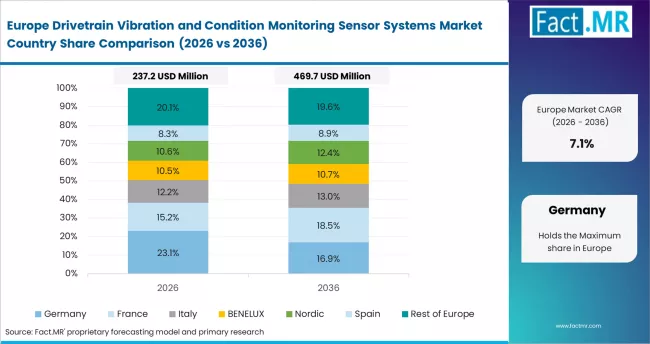
Drivetrain Vibration And Condition Monitoring Sensor Systems Market Europe Country Market Share Analysis, 2026 & 2036 | Source: Fact.MR
Europe operates as an engineering-focused market where reliability standards drive adoption of monitoring technologies.
- Germany: Germany remains a key demand center supported by strong automotive and industrial sectors. Manufacturing modernization initiatives in 2024 increased adoption of condition monitoring systems. Automotive OEMs expanded integration of drivetrain monitoring technologies. Growth is projected at 3.8% CAGR, reflecting stable demand driven by engineering-led applications [6].
FACTMR's analysis of drivetrain vibration and condition monitoring sensor systems market consists of country-wise assessment that includes China, India, USA, Germany, and Japan. Readers can find insights on industrial demand, vehicle production trends, and supplier positioning.
Competitive Aligners for Market Players
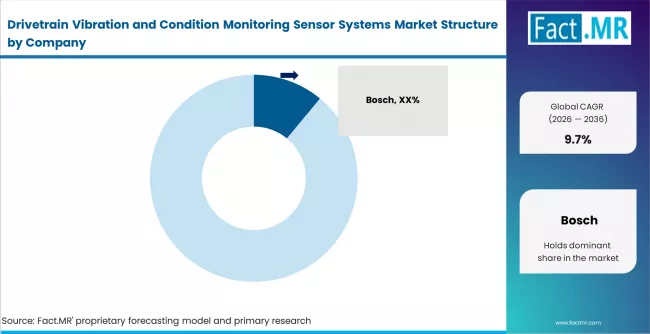
Drivetrain Vibration And Condition Monitoring Sensor Systems Market Analysis By Company | Source: Fact.MR
The market remains moderately fragmented, with a mix of global and regional suppliers competing across automotive and industrial applications. Competition is defined by sensing accuracy, durability under varying operating conditions, and the ability to integrate monitoring systems into existing drivetrain architectures. Suppliers must meet strict validation, testing, and performance benchmarks before entering OEM programs, which limits rapid entry and favors those with proven reliability. Consistent product performance remains critical, as monitoring systems directly influence system stability and maintenance outcomes.
Companies with strong engineering depth and established OEM relationships hold clear advantages in this environment. Bosch, Continental, and SKF benefit from stable supply networks, technical expertise, and experience across multiple drivetrain applications. Their ability to deliver integrated solutions, support validation processes, and align with platform-level requirements strengthens their position in long-term sourcing programs. Broad product portfolios also allow them to serve both automotive and industrial demand with consistent performance standards.
OEMs retain strong bargaining power through multi-sourcing strategies and extended qualification cycles. This approach reduces dependence on a single supplier and ensures flexibility in sourcing decisions. Supplier differentiation increasingly depends on performance consistency, system compatibility, and integration capability, while pricing plays a secondary role. Suppliers continue to invest in product development, system-level integration, and localized support to maintain competitiveness and secure ongoing contracts.
Key Players
- Bosch
- Continental AG
- AVL List GmbH
- Denso Corporation
- Delphi Technologies
- ABB
- Regal Rexnord Corporation
- Bently Nevada
- Caterpillar Inc.
- SKF
Bibliography
- [1] SKF, Condition Monitoring Solutions Update, 2024
- [2] Continental AG, Automotive Monitoring Systems Update, 2024
- [3] International Energy Agency (IEA), Industrial Automation Outlook, 2024
- [4] Government of India, Infrastructure Investment Report, 2024
- [5] U.S. Department of Energy, Smart Manufacturing Program Update, 2024
- [6] European Commission, Industrial Digitalization Report, 2024
This Report Addresses
- Provides detailed intelligence on drivetrain monitoring sensor systems, covering vibration sensing, condition monitoring, and integration across automotive and industrial applications.
- Covers market size from USD 0.9 billion in 2026 to USD 2.4 billion by 2036, reflecting steady adoption linked to predictive maintenance and system reliability needs.
- Identifies growth opportunities across automotive platforms and industrial machinery, where monitoring systems support performance optimization and downtime reduction.
- Offers segment and regional forecasts with clear analysis of demand trends across key countries and manufacturing hubs.
- Evaluates competitive strategies of key players, focusing on engineering capability, OEM alignment, and system integration strength.
- Tracks product innovation and monitoring technologies, including multi-parameter sensing and real-time diagnostic systems.
- Analyzes regulatory and operational impact, highlighting how safety standards and maintenance requirements influence adoption.
- Delivered in multiple formats including PDF and structured datasets, enabling easier access for technical, operational, and commercial use.
Drivetrain Vibration and Condition Monitoring Sensor Systems Market Definition
Drivetrain vibration and condition monitoring sensor systems are devices used to measure vibration, noise, and mechanical stress within drivetrain components such as shafts, gears, and bearings. These systems help detect early signs of wear or imbalance, allowing timely maintenance and preventing system failure. They are widely used in vehicles and industrial machinery where reliability and uptime are critical. Their primary function is to support predictive maintenance and improve performance by continuously monitoring drivetrain health.
Drivetrain Vibration and Condition Monitoring Sensor Systems Market Inclusions
The report covers global and regional market size, forecasts from 2026 to 2036, and segment analysis by device category and vehicle type. It includes demand trends across automotive, industrial, and off-highway sectors. The study also evaluates pricing trends, supplier positioning, and integration of monitoring systems within drivetrain assemblies.
Drivetrain Vibration and Condition Monitoring Sensor Systems Market Exclusions
The scope excludes full predictive maintenance software platforms and industrial IoT analytics systems. It does not include sensors used outside drivetrain applications such as engine-only or cabin monitoring systems. The focus remains strictly on vibration and condition monitoring components embedded within drivetrain systems.
Drivetrain Vibration and Condition Monitoring Sensor Systems Market Research Methodology
- Primary Research
- Interviews with OEM engineers, industrial operators, and sensor suppliers.
- Desk Research
- Uses automotive production data, industrial automation reports, and company disclosures.
- Market-Sizing and Forecasting
- Hybrid model using vehicle production, industrial deployment, and sensor integration rates.
- Data Validation and Update Cycle
- Validated using supplier shipment data and OEM sourcing trends, updated annually.
Segmentation
Scope of Report
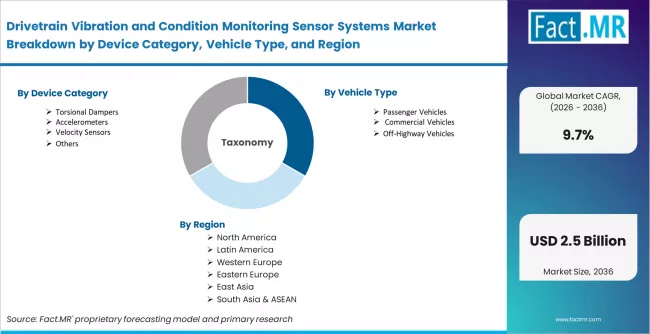
Drivetrain Vibration And Condition Monitoring Sensor Systems Market Breakdown By Device Category Vehicle Type And Region | Source: Fact.MR
| Attribute | Details |
|---|---|
| Quantitative Units | USD 0.9 billion (2026) to USD 2.4 billion (2036), at a CAGR of 9.7% |
| Market Definition | Drivetrain vibration and condition monitoring sensor systems used to detect vibration, mechanical stress, and early-stage faults in drivetrain components such as shafts, gears, and bearings, enabling predictive maintenance and improving operational reliability across automotive and industrial applications globally. |
| Device Category Segmentation | Torsional Dampers, Accelerometers, Velocity Sensors, Others |
| Vehicle Type Segmentation | Passenger Vehicles, Commercial Vehicles, Off-Highway Vehicles |
| Application Coverage | Vibration monitoring, condition-based maintenance, fault detection, drivetrain performance optimization, predictive maintenance systems, and reliability enhancement across vehicles and industrial machinery |
| Regions Covered | North America, Europe, Asia Pacific, Latin America, Middle East & Africa |
| Countries Covered | USA, Canada, Germany, UK, France, Italy, Spain, China, Japan, South Korea, Taiwan, Singapore, India, Brazil, Mexico, Argentina, GCC Countries, South Africa, Israel |
| Key Companies Profiled | Bosch, Continental AG, AVL List GmbH, Denso Corporation, Delphi Technologies, ABB, Regal Rexnord Corporation, Bently Nevada, Caterpillar Inc., SKF |
| Forecast Period | 2026 to 2036 |
| Approach | Hybrid top-down and bottom-up model using vehicle production volumes, industrial equipment deployment, sensor integration rates per drivetrain system, average selling prices, and primary interviews with OEMs, industrial operators, and component suppliers |
Source: Fact.MR analysis. Updated Apr 23, 2026
Drivetrain Vibration and Condition Monitoring Sensor Systems Market Segments
-
By Device Category:
- Torsional Dampers
- Accelerometers
- Velocity Sensors
- Others
-
By Vehicle Type:
- Passenger Vehicles
- Commercial Vehicles
- Off-Highway Vehicles
-
By Region:
- North America
- United States
- Canada
- Europe
- Germany
- United Kingdom
- France
- Italy
- Spain
- Asia Pacific
- China
- Japan
- South Korea
- Taiwan
- Singapore
- Latin America
- Brazil
- Mexico
- Argentina
- Middle East & Africa
- GCC Countries
- South Africa
- Israel
- North America
Frequently Asked Questions
How large is the drivetrain vibration and condition monitoring sensor systems market in 2025?
What is the estimated market size in 2026?
What will the market size be by 2036?
What is the expected CAGR for this market?
What are drivetrain vibration and condition monitoring sensor systems?
Why are these systems important in vehicles?
Where are these systems commonly used?
Which device category is expected to lead the market?
Which vehicle type dominates the market?
Which region is growing the fastest?
What is driving demand for these systems?
How does electrification affect this market?
What are the main challenges in this market?
How is industrial automation influencing demand?
What opportunities exist for companies in this market?
Who worked on this report


Preview the report firsthand - request a free sample
Free SampleGet the brochure for pricing and purchase details
Download PDF