Dust and Emission Control Chemicals for Ore Handling Market

Dust and Emission Control Chemicals for Ore Handling Market Size and Share Forecast Outlook 2026 to 2036

Dust and emission control chemicals for ore handling market is projected to grow from USD 387.0 million in 2026 to USD 859.0 million by 2036, at a CAGR of 8.3%. Water-based surfactant suppressants will dominate with a 28.0% market share, while crushing & primary crushing stations will lead the process segment with a 32.0% share.

Dust and Emission Control Chemicals for Ore Handling Market Forecast and Outlook 2026 to 2036

The global dust and emission control chemicals for ore handling market is projected to reach USD 859.00 million by 2036. The market is valued at USD 387.00 million in 2026 and is set to rise at a CAGR of 8.3% during the assessment period. By chemical class, water-based surfactant suppressants hold a leading 28% share. Crushing & primary crushing stations represent the dominant process at 32%, while hard-rock mining (ore) is the primary end-use mining sector, accounting for 41.00% market share.

Key Takeaways from the Dust and Emission Control Chemicals for Ore Handling Market

  • Market Value for 2026: USD 387.00 Million
  • Market Value for 2036: USD 859.00 Million
  • Forecast CAGR (2026-2036): 8.3%
  • Leading Chemical Class Share (2026): Water-Based Surfactant Suppressants (28%)
  • Leading Process Share (2026): Crushing & Primary Crushing Stations (32%)
  • Leading End-Use Mining Share (2026): Hard-Rock Mining (ore) (41.00%)
  • Key Players in the Market: Ecolab, BASF, Solvay, Clariant, PQ Corporation, Kemira, SNF
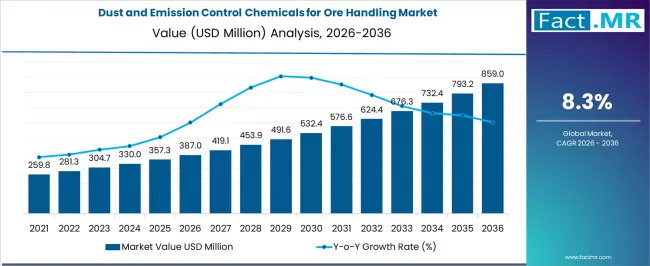
Dust And Emission Control Chemicals For Ore Handling Market Market Value Analysis

Defining trends involve the shift from simple water spraying to advanced, engineered chemical formulations that provide longer-lasting dust suppression, reduce water consumption, and minimize secondary environmental impacts. Innovation is rapidly advancing in bio-based, non-corrosive polymer blends and smart application systems that adjust chemical dosage based on real-time dust monitoring. Integration of these chemical solutions with holistic site water management and material flow plans is becoming critical for operational compliance and community relations.

Regulatory frameworks imposing stricter airborne particulate matter (PM10, PM2.5) limits and workplace safety standards (OSHA, MSHA) are primary market drivers. Policies enforcing visual emission standards and protecting local water quality from runoff further catalyze adoption. The economic imperative to minimize product loss (ore fines), reduce equipment wear, and avoid regulatory fines positions these chemicals as essential for efficient and socially responsible mining operations.

Dust and Emission Control Chemicals for Ore Handling Market

Metric Value
Market Value (2026) USD 387.00 Million
Market Forecast Value (2036) USD 859.00 Million
Forecast CAGR (2026-2036) 8.3%

Category

Category Segments
Chemical Class Water-based surfactant suppressants, Polymer binder & tackifier blends, Hygroscopic salt solutions (e.g., CaCl₂, MgCl₂ variants), Foaming dust suppressants, Bio-based & green dust-control chemistries, Encapsulating & film-forming polymers, Specialty additives & adjuvants (anti-freeze, flow aids)
Process Crushing & primary crushing stations, Conveyors & transfer points, Stockpiles & yards, Screening & fines processing areas, Mobile equipment spray systems
End-Use Mining Hard-rock mining (ore), Mineral concentrates (feed handling), Coal & bulk material handling, Aggregates & construction materials, Specialty ores (rare earth & battery metals streams)
Region North America, Latin America, Western Europe, Eastern Europe, East Asia, South Asia & Pacific, MEA

Segmental Analysis

By Chemical Class, Which Technology Offers a Balance of Effectiveness, Safety, and Material Compatibility?
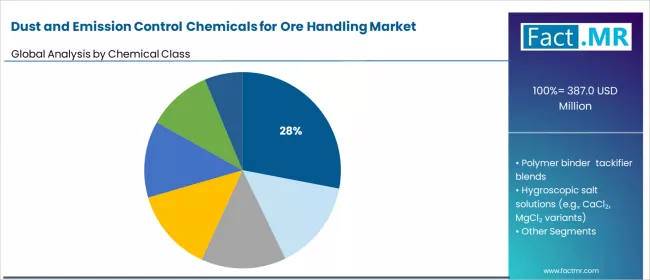
Dust And Emission Control Chemicals For Ore Handling Market Analysis By Chemical Class

Water-based surfactant suppressants lead the segment with a 28% share. This dominance is due to their ability to significantly lower the surface tension of water, allowing it to penetrate and bind fine dust particles more effectively than plain water. They are generally non-corrosive, safe to handle, and compatible with a wide range of ore types and downstream processes, providing a versatile and reliable first-line solution for controlling airborne dust at multiple points in the material handling chain.

By Process, Which Stage Generates the Greatest Volume of Fugitive Dust?
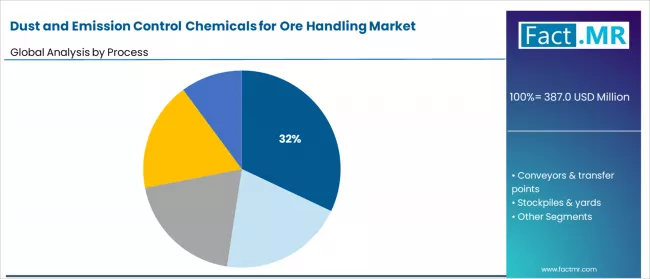
Dust And Emission Control Chemicals For Ore Handling Market Analysis By Process

Crushing & primary crushing stations command the largest process share at 32%. This is the stage where large ore fragments are subjected to immense mechanical force, generating the highest volume of coarse and fine particulate matter. Controlling dust at this source is critical for protecting worker health, preventing equipment damage, and meeting emission point source regulations. It requires robust, high-performance chemical suppression systems integrated into the crushing circuit, driving significant chemical consumption.

By End-Use Mining, Which Sector Faces the Most Stringent Operational and Community Scrutiny?
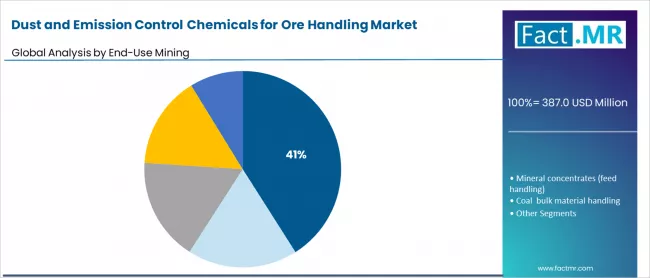
Dust And Emission Control Chemicals For Ore Handling Market Analysis By End Use Mining

Hard-rock mining (ore) represents the leading end-use sector at 41.00%. This encompasses base and precious metal mining operations, which often process sulfide-bearing ores where dust can lead to acid generation concerns. These mines face intense regulatory and community scrutiny regarding airborne silica dust (a health hazard) and visual impacts. The high value of the product also makes controlling dust (to prevent metal loss) an economic priority, creating a strong demand for advanced, reliable chemical control systems.

What are the Drivers, Restraints, and Key Trends of the Dust and Emission Control Chemicals for Ore Handling Market?

The global tightening of ambient air quality standards drives market growth and enforceable workplace exposure limits for respirable crystalline silica and other particulates. Increasing mining activity in closer proximity to communities elevates the importance of visual dust control. The expansion of dry, water-scarce mining regions necessitates efficient dust suppression to conserve water. Automation of material handling also requires consistent, reliable dust control to protect sensitive equipment and sensors.

A significant restraint is the operational cost of chemical programs, especially for large, low-margin operations like coal and aggregates. The potential for certain chemicals (e.g., chlorides) to corrode equipment or contaminate process water or final product can limit their use. Variable performance under extreme weather conditions (heavy rain, freezing temperatures) can challenge some formulations. Furthermore, a lack of skilled personnel for optimal application and monitoring can reduce system effectiveness.

Key trends include the development of "smart" suppression systems using IoT sensors to trigger chemical spray only when and where needed. There is a strong shift towards biodegradable, non-halogenated, and nutrient-free formulations to protect surrounding ecosystems. The use of drones for applying suppressants to stockpiles and difficult-to-access areas is emerging. Additionally, chemical suppliers are increasingly offering total solution contracts, including monitoring, application equipment, and chemical supply.

Analysis of the Dust and Emission Control Chemicals for Ore Handling Market by Key Countries
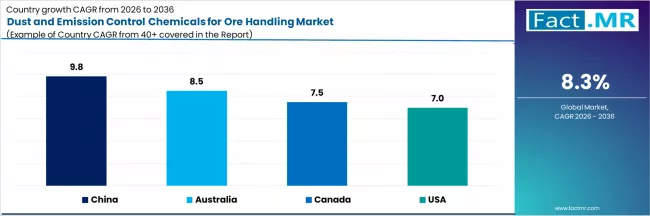
Dust And Emission Control Chemicals For Ore Handling Market Cagr Analysis By Country

Country CAGR (2026-2036)
China 9.80%
Australia 8.50%
Canada 7.50%
USA 7.00%
Chile 6.50%

How does China's Massive Mining Scale and Environmental Policy Enforcement Drive Market Leadership?

China leads with a 9.80% CAGR, driven by the sheer scale of its mining industry and the rigorous enforcement of its Blue Sky anti-pollution campaigns. Stricter dust emission standards around mining and processing facilities are mandating upgrades from basic water spraying to advanced chemical suppression systems. Domestic production of a wide range of industrial chemicals supports the widespread adoption of cost-effective solutions across its vast coal, metal, and mineral mining sectors.

Why is Australia's Arid Climate and Export-Oriented Mining a Key Driver?

Australia's 8.50% growth is fueled by its large-scale mining operations in arid regions where water conservation is critical and dust generation is high. The industry's focus on reducing water usage and maintaining a social license to operate near communities drives investment in efficient, long-lasting polymer tackifiers and foam suppressants. The high value of its mineral exports also justifies investment in controlling product loss as dust.

What Role does Canada's Stringent Workplace Safety and Climate Extremes Play?

Some of the world’s strictest occupational health and safety regulations, particularly for silica dust, underpin Canada’s 7.50% growth. The extreme cold in many mining regions necessitates the use of specialty anti-freeze additives and chloride-based solutions that remain effective at low temperatures. The diverse mining sector, from oil sands to potash to hard rock, requires a wide array of tailored chemical solutions.

How does the USA's Mined Land Reclamation and Regulatory Framework Influence Adoption?
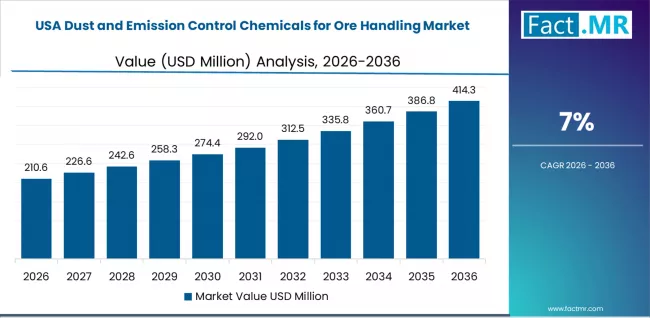
Dust And Emission Control Chemicals For Ore Handling Market Country Value Analysis

The USA's 7.00% growth is sustained by comprehensive regulations under MSHA and state-level environmental agencies governing airborne particulates. Liability for post-closure reclamation and ongoing community relations push mines to adopt effective dust control from the outset. The strong presence of chemical manufacturing and service companies provides easy access to advanced technologies for both large and small mining operations.

What Factors Underpin Chile's Copper Industry and Water Scarcity Concerns?

Chile's 6.50% growth is anchored in its massive copper mining industry operating in the Atacama Desert, the world's driest region. The extreme focus on water efficiency makes traditional suppression with water alone infeasible. This drives demand for highly efficient hygroscopic salts and encapsulating polymers that maximize dust control with minimal water use, protecting both the environment and the water balance of mining operations.

Competitive Landscape of the Dust and Emission Control Chemicals for Ore Handling Market
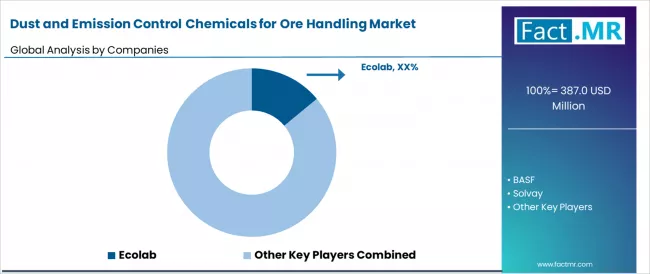
Dust And Emission Control Chemicals For Ore Handling Market Analysis By Company

The competitive landscape features global industrial chemical and water treatment specialists competing with regional players. Leaders like Ecolab and BASF compete by offering integrated water and dust management services, combining chemical expertise with application technology and site monitoring.

Specialty chemical companies like Solvay, Clariant, PQ Corporation, Kemira, and SNF compete with deep expertise in specific polymer, surfactant, and coagulant chemistries tailored for dust suppression and soil stabilization. Competition intensifies around providing site-specific formulations, demonstrating total cost-benefit analysis including water savings, and offering reliable supply and technical support in remote mining locations.

Key Players in the Dust and Emission Control Chemicals for Ore Handling Market

  • Ecolab
  • BASF
  • Solvay
  • Clariant
  • PQ Corporation
  • Kemira
  • SNF

Scope of Report

Items Values
Quantitative Units USD Million
Chemical Class Water-based surfactants, Polymer binders, Hygroscopic salts, Foaming agents, Bio-based chemistries, Encapsulating polymers, Specialty additives
Process Crushing stations, Conveyors & transfer, Stockpiles & yards, Screening, Mobile equipment
End-Use Mining Hard-rock mining, Mineral concentrates, Coal & bulk, Aggregates, Specialty ores
Key Countries China, Australia, Canada, USA, Chile
Key Companies Ecolab, BASF, Solvay, Clariant, PQ Corporation, Kemira, SNF
Additional Analysis Analysis of suppression longevity, water reduction efficacy, corrosion potential, impact on downstream processing (e.g., flotation), freeze-thaw stability, and environmental fate of residual chemicals.

Dust and Emission Control Chemicals for Ore Handling Market by Segments

  • Chemical Class :

    • Water-based surfactant suppressants
    • Polymer binder & tackifier blends
    • Hygroscopic salt solutions (e.g., CaCl₂, MgCl₂ variants)
    • Foaming dust suppressants
    • Bio-based & green dust-control chemistries
    • Encapsulating & film-forming polymers
    • Specialty additives & adjuvants (anti-freeze, flow aids)
  • Process :

    • Crushing & primary crushing stations
    • Conveyors & transfer points
    • Stockpiles & yards
    • Screening & fines processing areas
    • Mobile equipment spray systems
  • End-Use Mining :

    • Hard-rock mining (ore)
    • Mineral concentrates (feed handling)
    • Coal & bulk material handling
    • Aggregates & construction materials
    • Specialty ores (rare earth & battery metals streams)
  • Region :

    • North America

      • USA
      • Canada
    • Latin America

      • Chile
      • Peru
      • Brazil
      • Argentina
      • Mexico
      • Rest of Latin America
    • Western Europe

      • Germany
      • UK
      • France
      • Italy
      • Spain
      • BENELUX
      • Rest of Western Europe
    • Eastern Europe

      • Russia
      • Poland
      • Czech Republic
      • Rest of Eastern Europe
    • East Asia

      • China
      • Japan
      • South Korea
      • Rest of East Asia
    • South Asia & Pacific

      • Australia
      • India
      • Indonesia
      • Rest of South Asia & Pacific
    • MEA

      • South Africa
      • Saudi Arabia
      • Rest of MEA

Table of Content

  1. Executive Summary
    • Global Market Outlook
    • Demand to side Trends
    • Supply to side Trends
    • Technology Roadmap Analysis
    • Analysis and Recommendations
  2. Market Overview
    • Market Coverage / Taxonomy
    • Market Definition / Scope / Limitations
  3. Market Background
    • Market Dynamics
      • Drivers
      • Restraints
      • Opportunity
      • Trends
    • Scenario Forecast
      • Demand in Optimistic Scenario
      • Demand in Likely Scenario
      • Demand in Conservative Scenario
    • Opportunity Map Analysis
    • Product Life Cycle Analysis
    • Supply Chain Analysis
    • Investment Feasibility Matrix
    • Value Chain Analysis
    • PESTLE and Porter’s Analysis
    • Regulatory Landscape
    • Regional Parent Market Outlook
    • Production and Consumption Statistics
    • Import and Export Statistics
  4. Global Market Analysis 2021 to 2025 and Forecast, 2026 to 2036
    • Historical Market Size Value (USD Million) Analysis, 2021 to 2025
    • Current and Future Market Size Value (USD Million) Projections, 2026 to 2036
      • Y to o to Y Growth Trend Analysis
      • Absolute $ Opportunity Analysis
  5. Global Market Pricing Analysis 2021 to 2025 and Forecast 2026 to 2036
  6. Global Market Analysis 2021 to 2025 and Forecast 2026 to 2036, By Chemical Class
    • Introduction / Key Findings
    • Historical Market Size Value (USD Million) Analysis By Chemical Class, 2021 to 2025
    • Current and Future Market Size Value (USD Million) Analysis and Forecast By Chemical Class, 2026 to 2036
      • Water-based surfactant suppressants
      • Polymer binder tackifier blends
      • Hygroscopic salt solutions (e.g., CaCl₂, MgCl₂ variants)
      • Foaming dust suppressants
      • Bio-based green dust-control chemistries
      • Encapsulating film-forming polymers
      • Specialty additives & adjuvants (anti-freeze, flow aids)
    • Y to o to Y Growth Trend Analysis By Chemical Class, 2021 to 2025
    • Absolute $ Opportunity Analysis By Chemical Class, 2026 to 2036
  7. Global Market Analysis 2021 to 2025 and Forecast 2026 to 2036, By Process
    • Introduction / Key Findings
    • Historical Market Size Value (USD Million) Analysis By Process, 2021 to 2025
    • Current and Future Market Size Value (USD Million) Analysis and Forecast By Process, 2026 to 2036
      • Crushing & primary crushing stations
      • Conveyors & transfer points
      • Stockpiles & yards
      • Screening & fines processing areas
      • Mobile equipment spray systems
    • Y to o to Y Growth Trend Analysis By Process, 2021 to 2025
    • Absolute $ Opportunity Analysis By Process, 2026 to 2036
  8. Global Market Analysis 2021 to 2025 and Forecast 2026 to 2036, By End-Use Mining
    • Introduction / Key Findings
    • Historical Market Size Value (USD Million) Analysis By End-Use Mining, 2021 to 2025
    • Current and Future Market Size Value (USD Million) Analysis and Forecast By End-Use Mining, 2026 to 2036
      • Hard-rock mining (ore)
      • Mineral concentrates (feed handling)
      • Coal bulk material handling
      • Aggregates & construction materials
      • Specialty ores (rare earth battery metals streams)
    • Y to o to Y Growth Trend Analysis By End-Use Mining, 2021 to 2025
    • Absolute $ Opportunity Analysis By End-Use Mining, 2026 to 2036
  9. Global Market Analysis 2021 to 2025 and Forecast 2026 to 2036, By Region
    • Introduction
    • Historical Market Size Value (USD Million) Analysis By Region, 2021 to 2025
    • Current Market Size Value (USD Million) Analysis and Forecast By Region, 2026 to 2036
      • North America
      • Latin America
      • Western Europe
      • Eastern Europe
      • East Asia
      • South Asia and Pacific
      • Middle East & Africa
    • Market Attractiveness Analysis By Region
  10. North America Market Analysis 2021 to 2025 and Forecast 2026 to 2036, By Country
    • Historical Market Size Value (USD Million) Trend Analysis By Market Taxonomy, 2021 to 2025
    • Market Size Value (USD Million) Forecast By Market Taxonomy, 2026 to 2036
      • By Country
        • USA
        • Canada
        • Mexico
      • By Chemical Class
      • By Process
      • By End-Use Mining
    • Market Attractiveness Analysis
      • By Country
      • By Chemical Class
      • By Process
      • By End-Use Mining
    • Key Takeaways
  11. Latin America Market Analysis 2021 to 2025 and Forecast 2026 to 2036, By Country
    • Historical Market Size Value (USD Million) Trend Analysis By Market Taxonomy, 2021 to 2025
    • Market Size Value (USD Million) Forecast By Market Taxonomy, 2026 to 2036
      • By Country
        • Brazil
        • Chile
        • Rest of Latin America
      • By Chemical Class
      • By Process
      • By End-Use Mining
    • Market Attractiveness Analysis
      • By Country
      • By Chemical Class
      • By Process
      • By End-Use Mining
    • Key Takeaways
  12. Western Europe Market Analysis 2021 to 2025 and Forecast 2026 to 2036, By Country
    • Historical Market Size Value (USD Million) Trend Analysis By Market Taxonomy, 2021 to 2025
    • Market Size Value (USD Million) Forecast By Market Taxonomy, 2026 to 2036
      • By Country
        • Germany
        • UK
        • Italy
        • Spain
        • France
        • Nordic
        • BENELUX
        • Rest of Western Europe
      • By Chemical Class
      • By Process
      • By End-Use Mining
    • Market Attractiveness Analysis
      • By Country
      • By Chemical Class
      • By Process
      • By End-Use Mining
    • Key Takeaways
  13. Eastern Europe Market Analysis 2021 to 2025 and Forecast 2026 to 2036, By Country
    • Historical Market Size Value (USD Million) Trend Analysis By Market Taxonomy, 2021 to 2025
    • Market Size Value (USD Million) Forecast By Market Taxonomy, 2026 to 2036
      • By Country
        • Russia
        • Poland
        • Hungary
        • Balkan & Baltic
        • Rest of Eastern Europe
      • By Chemical Class
      • By Process
      • By End-Use Mining
    • Market Attractiveness Analysis
      • By Country
      • By Chemical Class
      • By Process
      • By End-Use Mining
    • Key Takeaways
  14. East Asia Market Analysis 2021 to 2025 and Forecast 2026 to 2036, By Country
    • Historical Market Size Value (USD Million) Trend Analysis By Market Taxonomy, 2021 to 2025
    • Market Size Value (USD Million) Forecast By Market Taxonomy, 2026 to 2036
      • By Country
        • China
        • Japan
        • South Korea
      • By Chemical Class
      • By Process
      • By End-Use Mining
    • Market Attractiveness Analysis
      • By Country
      • By Chemical Class
      • By Process
      • By End-Use Mining
    • Key Takeaways
  15. South Asia and Pacific Market Analysis 2021 to 2025 and Forecast 2026 to 2036, By Country
    • Historical Market Size Value (USD Million) Trend Analysis By Market Taxonomy, 2021 to 2025
    • Market Size Value (USD Million) Forecast By Market Taxonomy, 2026 to 2036
      • By Country
        • India
        • ASEAN
        • Australia & New Zealand
        • Rest of South Asia and Pacific
      • By Chemical Class
      • By Process
      • By End-Use Mining
    • Market Attractiveness Analysis
      • By Country
      • By Chemical Class
      • By Process
      • By End-Use Mining
    • Key Takeaways
  16. Middle East & Africa Market Analysis 2021 to 2025 and Forecast 2026 to 2036, By Country
    • Historical Market Size Value (USD Million) Trend Analysis By Market Taxonomy, 2021 to 2025
    • Market Size Value (USD Million) Forecast By Market Taxonomy, 2026 to 2036
      • By Country
        • Kingdom of Saudi Arabia
        • Other GCC Countries
        • Turkiye
        • South Africa
        • Other African Union
        • Rest of Middle East & Africa
      • By Chemical Class
      • By Process
      • By End-Use Mining
    • Market Attractiveness Analysis
      • By Country
      • By Chemical Class
      • By Process
      • By End-Use Mining
    • Key Takeaways
  17. Key Countries Market Analysis
    • USA
      • Pricing Analysis
      • Market Share Analysis, 2025
        • By Chemical Class
        • By Process
        • By End-Use Mining
    • Canada
      • Pricing Analysis
      • Market Share Analysis, 2025
        • By Chemical Class
        • By Process
        • By End-Use Mining
    • Mexico
      • Pricing Analysis
      • Market Share Analysis, 2025
        • By Chemical Class
        • By Process
        • By End-Use Mining
    • Brazil
      • Pricing Analysis
      • Market Share Analysis, 2025
        • By Chemical Class
        • By Process
        • By End-Use Mining
    • Chile
      • Pricing Analysis
      • Market Share Analysis, 2025
        • By Chemical Class
        • By Process
        • By End-Use Mining
    • Germany
      • Pricing Analysis
      • Market Share Analysis, 2025
        • By Chemical Class
        • By Process
        • By End-Use Mining
    • UK
      • Pricing Analysis
      • Market Share Analysis, 2025
        • By Chemical Class
        • By Process
        • By End-Use Mining
    • Italy
      • Pricing Analysis
      • Market Share Analysis, 2025
        • By Chemical Class
        • By Process
        • By End-Use Mining
    • Spain
      • Pricing Analysis
      • Market Share Analysis, 2025
        • By Chemical Class
        • By Process
        • By End-Use Mining
    • France
      • Pricing Analysis
      • Market Share Analysis, 2025
        • By Chemical Class
        • By Process
        • By End-Use Mining
    • India
      • Pricing Analysis
      • Market Share Analysis, 2025
        • By Chemical Class
        • By Process
        • By End-Use Mining
    • ASEAN
      • Pricing Analysis
      • Market Share Analysis, 2025
        • By Chemical Class
        • By Process
        • By End-Use Mining
    • Australia & New Zealand
      • Pricing Analysis
      • Market Share Analysis, 2025
        • By Chemical Class
        • By Process
        • By End-Use Mining
    • China
      • Pricing Analysis
      • Market Share Analysis, 2025
        • By Chemical Class
        • By Process
        • By End-Use Mining
    • Japan
      • Pricing Analysis
      • Market Share Analysis, 2025
        • By Chemical Class
        • By Process
        • By End-Use Mining
    • South Korea
      • Pricing Analysis
      • Market Share Analysis, 2025
        • By Chemical Class
        • By Process
        • By End-Use Mining
    • Russia
      • Pricing Analysis
      • Market Share Analysis, 2025
        • By Chemical Class
        • By Process
        • By End-Use Mining
    • Poland
      • Pricing Analysis
      • Market Share Analysis, 2025
        • By Chemical Class
        • By Process
        • By End-Use Mining
    • Hungary
      • Pricing Analysis
      • Market Share Analysis, 2025
        • By Chemical Class
        • By Process
        • By End-Use Mining
    • Kingdom of Saudi Arabia
      • Pricing Analysis
      • Market Share Analysis, 2025
        • By Chemical Class
        • By Process
        • By End-Use Mining
    • Turkiye
      • Pricing Analysis
      • Market Share Analysis, 2025
        • By Chemical Class
        • By Process
        • By End-Use Mining
    • South Africa
      • Pricing Analysis
      • Market Share Analysis, 2025
        • By Chemical Class
        • By Process
        • By End-Use Mining
  18. Market Structure Analysis
    • Competition Dashboard
    • Competition Benchmarking
    • Market Share Analysis of Top Players
      • By Regional
      • By Chemical Class
      • By Process
      • By End-Use Mining
  19. Competition Analysis
    • Competition Deep Dive
      • Ecolab
        • Overview
        • Product Portfolio
        • Profitability by Market Segments (Product/Age /Sales Channel/Region)
        • Sales Footprint
        • Strategy Overview
          • Marketing Strategy
          • Product Strategy
          • Channel Strategy
      • BASF
      • Solvay
      • Clariant
      • PQ Corporation
      • Kemira
      • SNF
  20. Assumptions & Acronyms Used
  21. Research Methodology

List Of Table

  • Table 1: Global Market Value (USD Million) Forecast by Region, 2021 to 2036
  • Table 2: Global Market Value (USD Million) Forecast by Chemical Class, 2021 to 2036
  • Table 3: Global Market Value (USD Million) Forecast by Process, 2021 to 2036
  • Table 4: Global Market Value (USD Million) Forecast by End-Use Mining, 2021 to 2036
  • Table 5: North America Market Value (USD Million) Forecast by Country, 2021 to 2036
  • Table 6: North America Market Value (USD Million) Forecast by Chemical Class, 2021 to 2036
  • Table 7: North America Market Value (USD Million) Forecast by Process, 2021 to 2036
  • Table 8: North America Market Value (USD Million) Forecast by End-Use Mining, 2021 to 2036
  • Table 9: Latin America Market Value (USD Million) Forecast by Country, 2021 to 2036
  • Table 10: Latin America Market Value (USD Million) Forecast by Chemical Class, 2021 to 2036
  • Table 11: Latin America Market Value (USD Million) Forecast by Process, 2021 to 2036
  • Table 12: Latin America Market Value (USD Million) Forecast by End-Use Mining, 2021 to 2036
  • Table 13: Western Europe Market Value (USD Million) Forecast by Country, 2021 to 2036
  • Table 14: Western Europe Market Value (USD Million) Forecast by Chemical Class, 2021 to 2036
  • Table 15: Western Europe Market Value (USD Million) Forecast by Process, 2021 to 2036
  • Table 16: Western Europe Market Value (USD Million) Forecast by End-Use Mining, 2021 to 2036
  • Table 17: Eastern Europe Market Value (USD Million) Forecast by Country, 2021 to 2036
  • Table 18: Eastern Europe Market Value (USD Million) Forecast by Chemical Class, 2021 to 2036
  • Table 19: Eastern Europe Market Value (USD Million) Forecast by Process, 2021 to 2036
  • Table 20: Eastern Europe Market Value (USD Million) Forecast by End-Use Mining, 2021 to 2036
  • Table 21: East Asia Market Value (USD Million) Forecast by Country, 2021 to 2036
  • Table 22: East Asia Market Value (USD Million) Forecast by Chemical Class, 2021 to 2036
  • Table 23: East Asia Market Value (USD Million) Forecast by Process, 2021 to 2036
  • Table 24: East Asia Market Value (USD Million) Forecast by End-Use Mining, 2021 to 2036
  • Table 25: South Asia and Pacific Market Value (USD Million) Forecast by Country, 2021 to 2036
  • Table 26: South Asia and Pacific Market Value (USD Million) Forecast by Chemical Class, 2021 to 2036
  • Table 27: South Asia and Pacific Market Value (USD Million) Forecast by Process, 2021 to 2036
  • Table 28: South Asia and Pacific Market Value (USD Million) Forecast by End-Use Mining, 2021 to 2036
  • Table 29: Middle East & Africa Market Value (USD Million) Forecast by Country, 2021 to 2036
  • Table 30: Middle East & Africa Market Value (USD Million) Forecast by Chemical Class, 2021 to 2036
  • Table 31: Middle East & Africa Market Value (USD Million) Forecast by Process, 2021 to 2036
  • Table 32: Middle East & Africa Market Value (USD Million) Forecast by End-Use Mining, 2021 to 2036

List Of Figures

  • Figure 1: Global Market Pricing Analysis
  • Figure 2: Global Market Value (USD Million) Forecast 2021 to 2036
  • Figure 3: Global Market Value Share and BPS Analysis by Chemical Class, 2026 and 2036
  • Figure 4: Global Market Y to o to Y Growth Comparison by Chemical Class, 2026 to 2036
  • Figure 5: Global Market Attractiveness Analysis by Chemical Class
  • Figure 6: Global Market Value Share and BPS Analysis by Process, 2026 and 2036
  • Figure 7: Global Market Y to o to Y Growth Comparison by Process, 2026 to 2036
  • Figure 8: Global Market Attractiveness Analysis by Process
  • Figure 9: Global Market Value Share and BPS Analysis by End-Use Mining, 2026 and 2036
  • Figure 10: Global Market Y to o to Y Growth Comparison by End-Use Mining, 2026 to 2036
  • Figure 11: Global Market Attractiveness Analysis by End-Use Mining
  • Figure 12: Global Market Value (USD Million) Share and BPS Analysis by Region, 2026 and 2036
  • Figure 13: Global Market Y to o to Y Growth Comparison by Region, 2026 to 2036
  • Figure 14: Global Market Attractiveness Analysis by Region
  • Figure 15: North America Market Incremental Dollar Opportunity, 2026 to 2036
  • Figure 16: Latin America Market Incremental Dollar Opportunity, 2026 to 2036
  • Figure 17: Western Europe Market Incremental Dollar Opportunity, 2026 to 2036
  • Figure 18: Eastern Europe Market Incremental Dollar Opportunity, 2026 to 2036
  • Figure 19: East Asia Market Incremental Dollar Opportunity, 2026 to 2036
  • Figure 20: South Asia and Pacific Market Incremental Dollar Opportunity, 2026 to 2036
  • Figure 21: Middle East & Africa Market Incremental Dollar Opportunity, 2026 to 2036
  • Figure 22: North America Market Value Share and BPS Analysis by Country, 2026 and 2036
  • Figure 23: North America Market Value Share and BPS Analysis by Chemical Class, 2026 and 2036
  • Figure 24: North America Market Y to o to Y Growth Comparison by Chemical Class, 2026 to 2036
  • Figure 25: North America Market Attractiveness Analysis by Chemical Class
  • Figure 26: North America Market Value Share and BPS Analysis by Process, 2026 and 2036
  • Figure 27: North America Market Y to o to Y Growth Comparison by Process, 2026 to 2036
  • Figure 28: North America Market Attractiveness Analysis by Process
  • Figure 29: North America Market Value Share and BPS Analysis by End-Use Mining, 2026 and 2036
  • Figure 30: North America Market Y to o to Y Growth Comparison by End-Use Mining, 2026 to 2036
  • Figure 31: North America Market Attractiveness Analysis by End-Use Mining
  • Figure 32: Latin America Market Value Share and BPS Analysis by Country, 2026 and 2036
  • Figure 33: Latin America Market Value Share and BPS Analysis by Chemical Class, 2026 and 2036
  • Figure 34: Latin America Market Y to o to Y Growth Comparison by Chemical Class, 2026 to 2036
  • Figure 35: Latin America Market Attractiveness Analysis by Chemical Class
  • Figure 36: Latin America Market Value Share and BPS Analysis by Process, 2026 and 2036
  • Figure 37: Latin America Market Y to o to Y Growth Comparison by Process, 2026 to 2036
  • Figure 38: Latin America Market Attractiveness Analysis by Process
  • Figure 39: Latin America Market Value Share and BPS Analysis by End-Use Mining, 2026 and 2036
  • Figure 40: Latin America Market Y to o to Y Growth Comparison by End-Use Mining, 2026 to 2036
  • Figure 41: Latin America Market Attractiveness Analysis by End-Use Mining
  • Figure 42: Western Europe Market Value Share and BPS Analysis by Country, 2026 and 2036
  • Figure 43: Western Europe Market Value Share and BPS Analysis by Chemical Class, 2026 and 2036
  • Figure 44: Western Europe Market Y to o to Y Growth Comparison by Chemical Class, 2026 to 2036
  • Figure 45: Western Europe Market Attractiveness Analysis by Chemical Class
  • Figure 46: Western Europe Market Value Share and BPS Analysis by Process, 2026 and 2036
  • Figure 47: Western Europe Market Y to o to Y Growth Comparison by Process, 2026 to 2036
  • Figure 48: Western Europe Market Attractiveness Analysis by Process
  • Figure 49: Western Europe Market Value Share and BPS Analysis by End-Use Mining, 2026 and 2036
  • Figure 50: Western Europe Market Y to o to Y Growth Comparison by End-Use Mining, 2026 to 2036
  • Figure 51: Western Europe Market Attractiveness Analysis by End-Use Mining
  • Figure 52: Eastern Europe Market Value Share and BPS Analysis by Country, 2026 and 2036
  • Figure 53: Eastern Europe Market Value Share and BPS Analysis by Chemical Class, 2026 and 2036
  • Figure 54: Eastern Europe Market Y to o to Y Growth Comparison by Chemical Class, 2026 to 2036
  • Figure 55: Eastern Europe Market Attractiveness Analysis by Chemical Class
  • Figure 56: Eastern Europe Market Value Share and BPS Analysis by Process, 2026 and 2036
  • Figure 57: Eastern Europe Market Y to o to Y Growth Comparison by Process, 2026 to 2036
  • Figure 58: Eastern Europe Market Attractiveness Analysis by Process
  • Figure 59: Eastern Europe Market Value Share and BPS Analysis by End-Use Mining, 2026 and 2036
  • Figure 60: Eastern Europe Market Y to o to Y Growth Comparison by End-Use Mining, 2026 to 2036
  • Figure 61: Eastern Europe Market Attractiveness Analysis by End-Use Mining
  • Figure 62: East Asia Market Value Share and BPS Analysis by Country, 2026 and 2036
  • Figure 63: East Asia Market Value Share and BPS Analysis by Chemical Class, 2026 and 2036
  • Figure 64: East Asia Market Y to o to Y Growth Comparison by Chemical Class, 2026 to 2036
  • Figure 65: East Asia Market Attractiveness Analysis by Chemical Class
  • Figure 66: East Asia Market Value Share and BPS Analysis by Process, 2026 and 2036
  • Figure 67: East Asia Market Y to o to Y Growth Comparison by Process, 2026 to 2036
  • Figure 68: East Asia Market Attractiveness Analysis by Process
  • Figure 69: East Asia Market Value Share and BPS Analysis by End-Use Mining, 2026 and 2036
  • Figure 70: East Asia Market Y to o to Y Growth Comparison by End-Use Mining, 2026 to 2036
  • Figure 71: East Asia Market Attractiveness Analysis by End-Use Mining
  • Figure 72: South Asia and Pacific Market Value Share and BPS Analysis by Country, 2026 and 2036
  • Figure 73: South Asia and Pacific Market Value Share and BPS Analysis by Chemical Class, 2026 and 2036
  • Figure 74: South Asia and Pacific Market Y to o to Y Growth Comparison by Chemical Class, 2026 to 2036
  • Figure 75: South Asia and Pacific Market Attractiveness Analysis by Chemical Class
  • Figure 76: South Asia and Pacific Market Value Share and BPS Analysis by Process, 2026 and 2036
  • Figure 77: South Asia and Pacific Market Y to o to Y Growth Comparison by Process, 2026 to 2036
  • Figure 78: South Asia and Pacific Market Attractiveness Analysis by Process
  • Figure 79: South Asia and Pacific Market Value Share and BPS Analysis by End-Use Mining, 2026 and 2036
  • Figure 80: South Asia and Pacific Market Y to o to Y Growth Comparison by End-Use Mining, 2026 to 2036
  • Figure 81: South Asia and Pacific Market Attractiveness Analysis by End-Use Mining
  • Figure 82: Middle East & Africa Market Value Share and BPS Analysis by Country, 2026 and 2036
  • Figure 83: Middle East & Africa Market Value Share and BPS Analysis by Chemical Class, 2026 and 2036
  • Figure 84: Middle East & Africa Market Y to o to Y Growth Comparison by Chemical Class, 2026 to 2036
  • Figure 85: Middle East & Africa Market Attractiveness Analysis by Chemical Class
  • Figure 86: Middle East & Africa Market Value Share and BPS Analysis by Process, 2026 and 2036
  • Figure 87: Middle East & Africa Market Y to o to Y Growth Comparison by Process, 2026 to 2036
  • Figure 88: Middle East & Africa Market Attractiveness Analysis by Process
  • Figure 89: Middle East & Africa Market Value Share and BPS Analysis by End-Use Mining, 2026 and 2036
  • Figure 90: Middle East & Africa Market Y to o to Y Growth Comparison by End-Use Mining, 2026 to 2036
  • Figure 91: Middle East & Africa Market Attractiveness Analysis by End-Use Mining
  • Figure 92: Global Market - Tier Structure Analysis
  • Figure 93: Global Market - Company Share Analysis

- FAQs -

How big is the dust and emission control chemicals for ore handling market in 2026?

The global dust and emission control chemicals for ore handling market is estimated to be valued at USD 387.0 million in 2026.

What will be the size of dust and emission control chemicals for ore handling market in 2036?

The market size for the dust and emission control chemicals for ore handling market is projected to reach USD 859.0 million by 2036.

How much will be the dust and emission control chemicals for ore handling market growth between 2026 and 2036?

The dust and emission control chemicals for ore handling market is expected to grow at a 8.3% CAGR between 2026 and 2036.

What are the key product types in the dust and emission control chemicals for ore handling market?

The key product types in dust and emission control chemicals for ore handling market are water-based surfactant suppressants, polymer binder tackifier blends, hygroscopic salt solutions (e.g., cacl₂, mgcl₂ variants), foaming dust suppressants, bio-based green dust-control chemistries, encapsulating film-forming polymers and specialty additives & adjuvants (anti-freeze, flow aids).

Which process segment to contribute significant share in the dust and emission control chemicals for ore handling market in 2026?

In terms of process, crushing & primary crushing stations segment to command 32.0% share in the dust and emission control chemicals for ore handling market in 2026.

Dust and Emission Control Chemicals for Ore Handling Market