Dustless Seed Treatment Binding Systems Market
Dustless Seed Treatment Binding Systems Market Size and Share Forecast Outlook 2026 to 2036
Dustless seed treatment binding systems market is projected to grow from USD 0.3 billion in 2026 to USD 1.3 billion by 2036, at a CAGR of 13.9%. Polymer-Based Dust Suppression Binders will dominate with a 41.0% market share, while cereals & grains will lead the seed type segment with a 44.0% share.
Dustless Seed Treatment Binding Systems Market Forecast and Outlook 2026 to 2036
The global dustless seed treatment binding systems market is projected to reach USD 1.28 billion by 2036. The market is valued at USD 0.35 billion in 2026 and is set to rise at a CAGR of 13.9% during the assessment period. By binding technology type, polymer-based dust suppression binders hold a leading 41% share. The cereals & grains seed type segment represents a dominant 44% share, while the functional benefit of dust reduction & operator safety accounts for a 47% market share.
Key Takeaways from the Dustless Seed Treatment Binding Systems Market
- Market Value for 2026: USD 0.35 Billion
- Market Value for 2036: USD 1.28 Billion
- Forecast CAGR (2026-2036): 13.9%
- Leading Binding Technology Type Share (2026): Polymer-Based Dust Suppression Binders (41%)
- Leading Seed Type Share (2026): Cereals & Grains (44%)
- Leading Functional Benefit Share (2026): Dust Reduction & Operator Safety (47%)
- Key Players in the Market: BASF SE, Bayer CropScience, Clariant AG, Croda International, Solvay SA
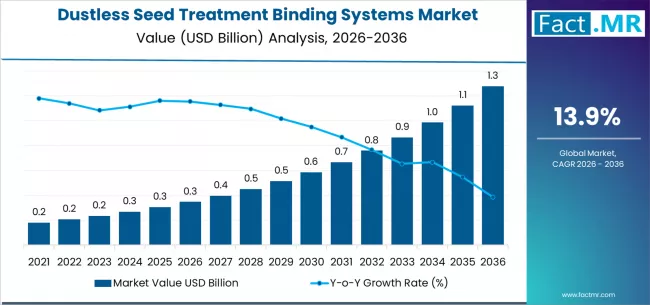
A central trend is the shift towards multifunctional binder systems that provide dust control while also enhancing the adhesion of biological inoculants and micronutrients. Innovation is progressing in bio-based polymers that offer effective performance alongside improved environmental profiles. The integration of these binders into automated seed treatment lines is becoming critical for achieving consistent seed quality and meeting industrial safety standards.
Regulatory frameworks focusing on operator exposure limits to pesticide dust and environmental protection from treated seed dust-off are significant market drivers. Policies, particularly in North America and Europe, that mandate risk mitigation measures for seed handling directly accelerate the adoption of advanced binding systems. These regulations are compelling seed treatment applicators and seed companies to invest in higher-performance binder technologies.
Dustless Seed Treatment Binding Systems Market
| Metric | Value |
|---|---|
| Market Value (2026) | USD 0.35 Billion |
| Market Forecast Value (2036) | USD 1.28 Billion |
| Forecast CAGR (2026-2036) | 13.9% |
Category
| Category | Segments |
|---|---|
| Binding Technology Type | Polymer-Based Dust Suppression Binders, Bio-Based & Biodegradable Binders, Wax & Lipid-Based Systems, Mineral & Clay-Based Binders, Others |
| Seed Type | Cereals & Grains, Oilseeds & Pulses, Vegetables, Forage & Specialty Seeds, Others |
| Functional Benefit | Dust Reduction & Operator Safety, Uniform Active Ingredient Retention, Improved Flowability & Plantability, Moisture Stability & Shelf Life, Others |
| Region | North America, Latin America, Western Europe, Eastern Europe, East Asia, South Asia & Pacific, MEA |
Segmental Analysis
By Binding Technology, Which System Offers the Most Reliable Performance?
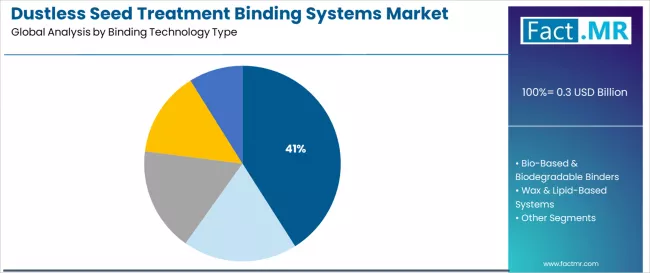
Polymer-based dust suppression binders lead the segment with a 41% share. This dominance is attributed to their superior film-forming properties and consistent performance across diverse seed shapes and treatment formulations. These synthetic polymers provide a strong, flexible coating that effectively locks in active ingredients while withstanding the abrasion encountered during handling, packaging, and planting operations.
By Seed Type, Which Category Demands the Highest Volume of Binders?
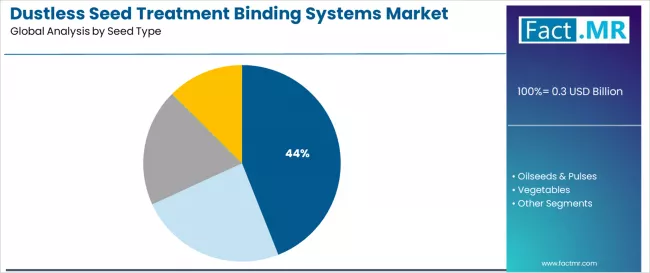
Cereals and grains command a 44% share. The immense global volume of treated corn, wheat, rice, and soybean seed creates the foundational demand. The high-throughput, industrial-scale treatment of these seeds necessitates binders that ensure operator safety in large facilities and prevent the loss of valuable crop protection and nutritional coatings during mechanical planting.
By Functional Benefit, What is the Primary Purchasing Driver?
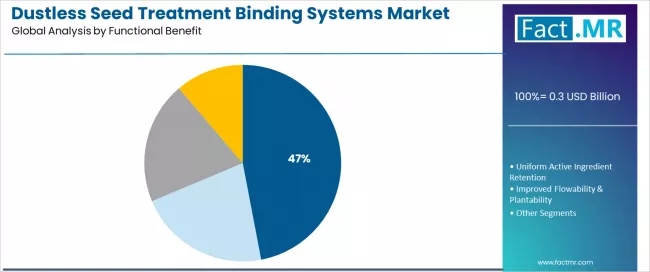
Dust reduction and operator safety is the leading functional benefit at 47%. This priority stems from stringent workplace health regulations and the need to minimize environmental contamination from treatment facilities. Reducing dust also preserves the integrity of the treatment recipe on the seed, ensuring the farmer receives the full intended dose of protectants and biologicals.
What are the Drivers, Restraints, and Key Trends of the Dustless Seed Treatment Binding Systems Market?
Market expansion is driven by tightening global regulations on worker exposure to pesticide dust and environmental standards for particulate emissions from seed treatment plants. The increasing complexity of seed treatment recipes, incorporating multiple biologicals and sensitive chemicals, requires advanced binders for stable application. The growth of contract seed treatment services professionalizes demand for high-quality, reliable binding systems.
A key restraint is the added cost per unit of seed, which can be a barrier for low-margin crop segments. Compatibility issues between novel binder chemistries and certain biological or chemical actives can limit formulation flexibility. The need for specialized application equipment or adjustments in treatment process parameters can slow adoption by smaller operators.
Significant trends include the development of colorless and low-dust powders for easier handling. The emergence of binder systems with built-in seed lubricity properties enhances plantability. There is a growing research focus on binders that act as primers, improving the germination environment for the seed itself.
Analysis of the Dustless Seed Treatment Binding Systems Market by Key Countries
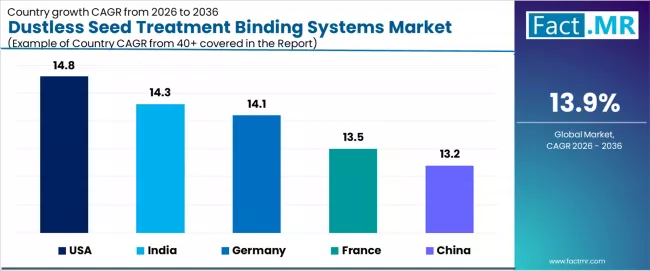
| Country | CAGR (2026-2036) |
|---|---|
| USA | 14.80% |
| India | 14.30% |
| Germany | 14.10% |
| France | 13.50% |
| China | 13.20% |
How does the USA's Industrial Seed Sector Fuel Demand for Advanced Binders?
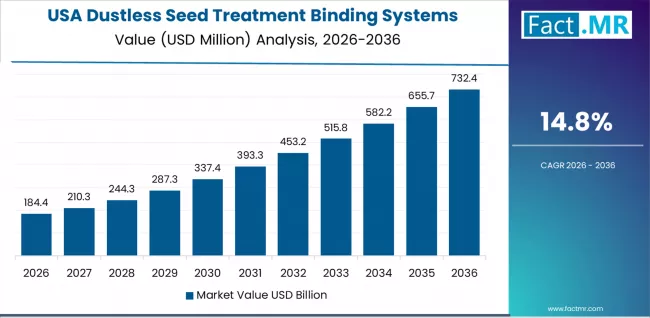
The USA leads with a 14.80% CAGR, driven by its large-scale, professional seed treatment industry serving the vast corn, soybean, and cotton belt. Strict OSHA regulations on particulate exposure govern commercial treatment facilities. The high value of proprietary seed traits and sophisticated treatment packages creates a zero-tolerance attitude towards dust loss, pushing continuous adoption of next-generation polymer binder technologies.
Why is India's Rapidly Modernizing Seed Industry a High-Growth Market?
India's 14.30% growth is propelled by the rapid expansion of commercial seed treatment for hybrid crops and increasing government focus on seed quality standards. The growth of contract treatment services for vegetables and field crops demands solutions that improve safety for workers in often densely populated facilities. Cost-effective, high-performance binders are critical for ensuring smallholder farmers receive fully potent, dust-free seed.
What drives Germany's Precision-Focused Demand in Seed Technology?
Germany's 14.10% CAGR reflects its position as a hub for advanced seed technology and stringent EU environmental regulations. German seed companies and treatment specialists prioritize binders that ensure precise active ingredient retention and absolute minimal dust for worker safety and environmental compliance. This focus on precision and quality overrides pure cost considerations, supporting premium product adoption.
How does France's Seed Export Orientation Influence Binder Specifications?
France's 13.50% growth is linked to its role as a major seed exporter, particularly for cereals and corn. Export standards and the long supply chains involved necessitate binders that provide exceptional seed flowability, dust control, and coating stability during extended transport and storage. French seed companies invest in binding systems that protect their product's integrity and reputation in international markets.
What Factors Underpin Steady Growth in China's Domestic Seed Sector?
China's 13.20% growth is supported by the consolidation and modernization of its domestic seed industry. As Chinese seed companies increase their investment in proprietary breeding and seed treatments, they require modern binder technologies to protect their intellectual property and ensure treatment efficacy. Government policies promoting seed quality and agricultural sustainability further encourage the adoption of dust control systems.
Competitive Landscape of the Dustless Seed Treatment Binding Systems Market
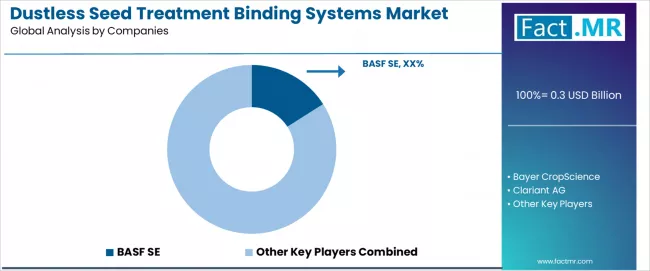
The market is served by a combination of global specialty chemical companies and agrochemical leaders with seed treatment divisions. Firms like BASF SE, Clariant AG, Croda International, and Solvay SA compete based on advanced polymer and material science, offering a range of binder chemistries for different seed types and treatment formulations. Their expertise lies in tailoring product performance for dust control, adhesion, and compatibility.
Agrochemical giants like Bayer CropScience compete from a position of vertical integration, developing binder systems optimized for their proprietary seed treatment products and applied through their treatment equipment recommendations. Competition centers on technical performance data, regulatory support for product safety claims, and the ability to provide comprehensive technical service to large seed company clients and commercial treaters.
Key Players in the Dustless Seed Treatment Binding Systems Market
- BASF SE
- Bayer CropScience
- Clariant AG
- Croda International
- Solvay SA
Scope of Report
| Items | Values |
|---|---|
| Quantitative Units | USD Billion |
| Binding Technology Type | Polymer-Based Dust Suppression Binders, Bio-Based & Biodegradable Binders, Wax & Lipid-Based Systems, Mineral & Clay-Based Binders, Others |
| Seed Type | Cereals & Grains, Oilseeds & Pulses, Vegetables, Forage & Specialty Seeds, Others |
| Functional Benefit | Dust Reduction & Operator Safety, Uniform Active Ingredient Retention, Improved Flowability & Plantability, Moisture Stability & Shelf Life, Others |
| Key Countries | USA, India, Germany, France, China |
| Key Companies | BASF SE, Bayer CropScience, Clariant AG, Croda International, Solvay SA |
| Additional Analysis | Analysis of binder compatibility with chemical and biological actives, seed treatment application technology synergy, environmental and toxicological profiling of binder polymers, and cost-in-use models for commercial seed treaters. |
Dustless Seed Treatment Binding Systems Market by Segments
-
Binding Technology Type :
- Polymer-Based Dust Suppression Binders
- Bio-Based & Biodegradable Binders
- Wax & Lipid-Based Systems
- Mineral & Clay-Based Binders
- Others
-
Seed Type :
- Cereals & Grains
- Oilseeds & Pulses
- Vegetables
- Forage & Specialty Seeds
- Others
-
Functional Benefit :
- Dust Reduction & Operator Safety
- Uniform Active Ingredient Retention
- Improved Flowability & Plantability
- Moisture Stability & Shelf Life
- Others
-
Region :
-
North America
- USA
- Canada
-
Latin America
- Brazil
- Mexico
- Argentina
- Rest of Latin America
-
Western Europe
- Germany
- UK
- France
- Spain
- Italy
- BENELUX
- Rest of Western Europe
-
Eastern Europe
- Czech Republic
- Poland
- Russia
- Rest of Eastern Europe
-
East Asia
- China
- Japan
- South Korea
- Rest of East Asia
-
South Asia & Pacific
- India
- Indonesia
- Australia
- Rest of South Asia & Pacific
-
MEA
- GCC Countries
- Turkiye
- Saudi Arabia
- Rest of MEA
-
Table of Content
- Executive Summary
- Global Market Outlook
- Demand to side Trends
- Supply to side Trends
- Technology Roadmap Analysis
- Analysis and Recommendations
- Market Overview
- Market Coverage / Taxonomy
- Market Definition / Scope / Limitations
- Market Background
- Market Dynamics
- Drivers
- Restraints
- Opportunity
- Trends
- Scenario Forecast
- Demand in Optimistic Scenario
- Demand in Likely Scenario
- Demand in Conservative Scenario
- Opportunity Map Analysis
- Product Life Cycle Analysis
- Supply Chain Analysis
- Investment Feasibility Matrix
- Value Chain Analysis
- PESTLE and Porter’s Analysis
- Regulatory Landscape
- Regional Parent Market Outlook
- Production and Consumption Statistics
- Import and Export Statistics
- Market Dynamics
- Global Market Analysis 2021 to 2025 and Forecast, 2026 to 2036
- Historical Market Size Value (USD Million) Analysis, 2021 to 2025
- Current and Future Market Size Value (USD Million) Projections, 2026 to 2036
- Y to o to Y Growth Trend Analysis
- Absolute $ Opportunity Analysis
- Global Market Pricing Analysis 2021 to 2025 and Forecast 2026 to 2036
- Global Market Analysis 2021 to 2025 and Forecast 2026 to 2036, By Binding Technology Type
- Introduction / Key Findings
- Historical Market Size Value (USD Million) Analysis By Binding Technology Type, 2021 to 2025
- Current and Future Market Size Value (USD Million) Analysis and Forecast By Binding Technology Type, 2026 to 2036
- Polymer-Based Dust Suppression Binders
- Bio-Based & Biodegradable Binders
- Wax & Lipid-Based Systems
- Mineral & Clay-Based Binders
- Others
- Polymer-Based Dust Suppression Binders
- Y to o to Y Growth Trend Analysis By Binding Technology Type, 2021 to 2025
- Absolute $ Opportunity Analysis By Binding Technology Type, 2026 to 2036
- Global Market Analysis 2021 to 2025 and Forecast 2026 to 2036, By Seed Type
- Introduction / Key Findings
- Historical Market Size Value (USD Million) Analysis By Seed Type, 2021 to 2025
- Current and Future Market Size Value (USD Million) Analysis and Forecast By Seed Type, 2026 to 2036
- Cereals & Grains
- Oilseeds & Pulses
- Vegetables
- Forage & Specialty Seeds
- Cereals & Grains
- Y to o to Y Growth Trend Analysis By Seed Type, 2021 to 2025
- Absolute $ Opportunity Analysis By Seed Type, 2026 to 2036
- Global Market Analysis 2021 to 2025 and Forecast 2026 to 2036, By Functional Benefit
- Introduction / Key Findings
- Historical Market Size Value (USD Million) Analysis By Functional Benefit, 2021 to 2025
- Current and Future Market Size Value (USD Million) Analysis and Forecast By Functional Benefit, 2026 to 2036
- Dust Reduction & Operator Safety
- Uniform Active Ingredient Retention
- Improved Flowability & Plantability
- Moisture Stability & Shelf Life
- Dust Reduction & Operator Safety
- Y to o to Y Growth Trend Analysis By Functional Benefit, 2021 to 2025
- Absolute $ Opportunity Analysis By Functional Benefit, 2026 to 2036
- Global Market Analysis 2021 to 2025 and Forecast 2026 to 2036, By Region
- Introduction
- Historical Market Size Value (USD Million) Analysis By Region, 2021 to 2025
- Current Market Size Value (USD Million) Analysis and Forecast By Region, 2026 to 2036
- North America
- Latin America
- Western Europe
- Eastern Europe
- East Asia
- South Asia and Pacific
- Middle East & Africa
- Market Attractiveness Analysis By Region
- North America Market Analysis 2021 to 2025 and Forecast 2026 to 2036, By Country
- Historical Market Size Value (USD Million) Trend Analysis By Market Taxonomy, 2021 to 2025
- Market Size Value (USD Million) Forecast By Market Taxonomy, 2026 to 2036
- By Country
- USA
- Canada
- Mexico
- By Binding Technology Type
- By Seed Type
- By Functional Benefit
- By Country
- Market Attractiveness Analysis
- By Country
- By Binding Technology Type
- By Seed Type
- By Functional Benefit
- Key Takeaways
- Latin America Market Analysis 2021 to 2025 and Forecast 2026 to 2036, By Country
- Historical Market Size Value (USD Million) Trend Analysis By Market Taxonomy, 2021 to 2025
- Market Size Value (USD Million) Forecast By Market Taxonomy, 2026 to 2036
- By Country
- Brazil
- Chile
- Rest of Latin America
- By Binding Technology Type
- By Seed Type
- By Functional Benefit
- By Country
- Market Attractiveness Analysis
- By Country
- By Binding Technology Type
- By Seed Type
- By Functional Benefit
- Key Takeaways
- Western Europe Market Analysis 2021 to 2025 and Forecast 2026 to 2036, By Country
- Historical Market Size Value (USD Million) Trend Analysis By Market Taxonomy, 2021 to 2025
- Market Size Value (USD Million) Forecast By Market Taxonomy, 2026 to 2036
- By Country
- Germany
- UK
- Italy
- Spain
- France
- Nordic
- BENELUX
- Rest of Western Europe
- By Binding Technology Type
- By Seed Type
- By Functional Benefit
- By Country
- Market Attractiveness Analysis
- By Country
- By Binding Technology Type
- By Seed Type
- By Functional Benefit
- Key Takeaways
- Eastern Europe Market Analysis 2021 to 2025 and Forecast 2026 to 2036, By Country
- Historical Market Size Value (USD Million) Trend Analysis By Market Taxonomy, 2021 to 2025
- Market Size Value (USD Million) Forecast By Market Taxonomy, 2026 to 2036
- By Country
- Russia
- Poland
- Hungary
- Balkan & Baltic
- Rest of Eastern Europe
- By Binding Technology Type
- By Seed Type
- By Functional Benefit
- By Country
- Market Attractiveness Analysis
- By Country
- By Binding Technology Type
- By Seed Type
- By Functional Benefit
- Key Takeaways
- East Asia Market Analysis 2021 to 2025 and Forecast 2026 to 2036, By Country
- Historical Market Size Value (USD Million) Trend Analysis By Market Taxonomy, 2021 to 2025
- Market Size Value (USD Million) Forecast By Market Taxonomy, 2026 to 2036
- By Country
- China
- Japan
- South Korea
- By Binding Technology Type
- By Seed Type
- By Functional Benefit
- By Country
- Market Attractiveness Analysis
- By Country
- By Binding Technology Type
- By Seed Type
- By Functional Benefit
- Key Takeaways
- South Asia and Pacific Market Analysis 2021 to 2025 and Forecast 2026 to 2036, By Country
- Historical Market Size Value (USD Million) Trend Analysis By Market Taxonomy, 2021 to 2025
- Market Size Value (USD Million) Forecast By Market Taxonomy, 2026 to 2036
- By Country
- India
- ASEAN
- Australia & New Zealand
- Rest of South Asia and Pacific
- By Binding Technology Type
- By Seed Type
- By Functional Benefit
- By Country
- Market Attractiveness Analysis
- By Country
- By Binding Technology Type
- By Seed Type
- By Functional Benefit
- Key Takeaways
- Middle East & Africa Market Analysis 2021 to 2025 and Forecast 2026 to 2036, By Country
- Historical Market Size Value (USD Million) Trend Analysis By Market Taxonomy, 2021 to 2025
- Market Size Value (USD Million) Forecast By Market Taxonomy, 2026 to 2036
- By Country
- Kingdom of Saudi Arabia
- Other GCC Countries
- Turkiye
- South Africa
- Other African Union
- Rest of Middle East & Africa
- By Binding Technology Type
- By Seed Type
- By Functional Benefit
- By Country
- Market Attractiveness Analysis
- By Country
- By Binding Technology Type
- By Seed Type
- By Functional Benefit
- Key Takeaways
- Key Countries Market Analysis
- USA
- Pricing Analysis
- Market Share Analysis, 2025
- By Binding Technology Type
- By Seed Type
- By Functional Benefit
- Canada
- Pricing Analysis
- Market Share Analysis, 2025
- By Binding Technology Type
- By Seed Type
- By Functional Benefit
- Mexico
- Pricing Analysis
- Market Share Analysis, 2025
- By Binding Technology Type
- By Seed Type
- By Functional Benefit
- Brazil
- Pricing Analysis
- Market Share Analysis, 2025
- By Binding Technology Type
- By Seed Type
- By Functional Benefit
- Chile
- Pricing Analysis
- Market Share Analysis, 2025
- By Binding Technology Type
- By Seed Type
- By Functional Benefit
- Germany
- Pricing Analysis
- Market Share Analysis, 2025
- By Binding Technology Type
- By Seed Type
- By Functional Benefit
- UK
- Pricing Analysis
- Market Share Analysis, 2025
- By Binding Technology Type
- By Seed Type
- By Functional Benefit
- Italy
- Pricing Analysis
- Market Share Analysis, 2025
- By Binding Technology Type
- By Seed Type
- By Functional Benefit
- Spain
- Pricing Analysis
- Market Share Analysis, 2025
- By Binding Technology Type
- By Seed Type
- By Functional Benefit
- France
- Pricing Analysis
- Market Share Analysis, 2025
- By Binding Technology Type
- By Seed Type
- By Functional Benefit
- India
- Pricing Analysis
- Market Share Analysis, 2025
- By Binding Technology Type
- By Seed Type
- By Functional Benefit
- ASEAN
- Pricing Analysis
- Market Share Analysis, 2025
- By Binding Technology Type
- By Seed Type
- By Functional Benefit
- Australia & New Zealand
- Pricing Analysis
- Market Share Analysis, 2025
- By Binding Technology Type
- By Seed Type
- By Functional Benefit
- China
- Pricing Analysis
- Market Share Analysis, 2025
- By Binding Technology Type
- By Seed Type
- By Functional Benefit
- Japan
- Pricing Analysis
- Market Share Analysis, 2025
- By Binding Technology Type
- By Seed Type
- By Functional Benefit
- South Korea
- Pricing Analysis
- Market Share Analysis, 2025
- By Binding Technology Type
- By Seed Type
- By Functional Benefit
- Russia
- Pricing Analysis
- Market Share Analysis, 2025
- By Binding Technology Type
- By Seed Type
- By Functional Benefit
- Poland
- Pricing Analysis
- Market Share Analysis, 2025
- By Binding Technology Type
- By Seed Type
- By Functional Benefit
- Hungary
- Pricing Analysis
- Market Share Analysis, 2025
- By Binding Technology Type
- By Seed Type
- By Functional Benefit
- Kingdom of Saudi Arabia
- Pricing Analysis
- Market Share Analysis, 2025
- By Binding Technology Type
- By Seed Type
- By Functional Benefit
- Turkiye
- Pricing Analysis
- Market Share Analysis, 2025
- By Binding Technology Type
- By Seed Type
- By Functional Benefit
- South Africa
- Pricing Analysis
- Market Share Analysis, 2025
- By Binding Technology Type
- By Seed Type
- By Functional Benefit
- USA
- Market Structure Analysis
- Competition Dashboard
- Competition Benchmarking
- Market Share Analysis of Top Players
- By Regional
- By Binding Technology Type
- By Seed Type
- By Functional Benefit
- Competition Analysis
- Competition Deep Dive
- BASF SE
- Overview
- Product Portfolio
- Profitability by Market Segments (Product/Age /Sales Channel/Region)
- Sales Footprint
- Strategy Overview
- Marketing Strategy
- Product Strategy
- Channel Strategy
- Bayer CropScience
- Clariant AG
- Croda International
- Solvay SA
- Others
- BASF SE
- Competition Deep Dive
- Assumptions & Acronyms Used
- Research Methodology
List Of Table
- Table 1: Global Market Value (USD Million) Forecast by Region, 2021 to 2036
- Table 2: Global Market Value (USD Million) Forecast by Binding Technology Type, 2021 to 2036
- Table 3: Global Market Value (USD Million) Forecast by Seed Type, 2021 to 2036
- Table 4: Global Market Value (USD Million) Forecast by Functional Benefit, 2021 to 2036
- Table 5: North America Market Value (USD Million) Forecast by Country, 2021 to 2036
- Table 6: North America Market Value (USD Million) Forecast by Binding Technology Type, 2021 to 2036
- Table 7: North America Market Value (USD Million) Forecast by Seed Type, 2021 to 2036
- Table 8: North America Market Value (USD Million) Forecast by Functional Benefit, 2021 to 2036
- Table 9: Latin America Market Value (USD Million) Forecast by Country, 2021 to 2036
- Table 10: Latin America Market Value (USD Million) Forecast by Binding Technology Type, 2021 to 2036
- Table 11: Latin America Market Value (USD Million) Forecast by Seed Type, 2021 to 2036
- Table 12: Latin America Market Value (USD Million) Forecast by Functional Benefit, 2021 to 2036
- Table 13: Western Europe Market Value (USD Million) Forecast by Country, 2021 to 2036
- Table 14: Western Europe Market Value (USD Million) Forecast by Binding Technology Type, 2021 to 2036
- Table 15: Western Europe Market Value (USD Million) Forecast by Seed Type, 2021 to 2036
- Table 16: Western Europe Market Value (USD Million) Forecast by Functional Benefit, 2021 to 2036
- Table 17: Eastern Europe Market Value (USD Million) Forecast by Country, 2021 to 2036
- Table 18: Eastern Europe Market Value (USD Million) Forecast by Binding Technology Type, 2021 to 2036
- Table 19: Eastern Europe Market Value (USD Million) Forecast by Seed Type, 2021 to 2036
- Table 20: Eastern Europe Market Value (USD Million) Forecast by Functional Benefit, 2021 to 2036
- Table 21: East Asia Market Value (USD Million) Forecast by Country, 2021 to 2036
- Table 22: East Asia Market Value (USD Million) Forecast by Binding Technology Type, 2021 to 2036
- Table 23: East Asia Market Value (USD Million) Forecast by Seed Type, 2021 to 2036
- Table 24: East Asia Market Value (USD Million) Forecast by Functional Benefit, 2021 to 2036
- Table 25: South Asia and Pacific Market Value (USD Million) Forecast by Country, 2021 to 2036
- Table 26: South Asia and Pacific Market Value (USD Million) Forecast by Binding Technology Type, 2021 to 2036
- Table 27: South Asia and Pacific Market Value (USD Million) Forecast by Seed Type, 2021 to 2036
- Table 28: South Asia and Pacific Market Value (USD Million) Forecast by Functional Benefit, 2021 to 2036
- Table 29: Middle East & Africa Market Value (USD Million) Forecast by Country, 2021 to 2036
- Table 30: Middle East & Africa Market Value (USD Million) Forecast by Binding Technology Type, 2021 to 2036
- Table 31: Middle East & Africa Market Value (USD Million) Forecast by Seed Type, 2021 to 2036
- Table 32: Middle East & Africa Market Value (USD Million) Forecast by Functional Benefit, 2021 to 2036
List Of Figures
- Figure 1: Global Market Pricing Analysis
- Figure 2: Global Market Value (USD Million) Forecast 2021 to 2036
- Figure 3: Global Market Value Share and BPS Analysis by Binding Technology Type, 2026 and 2036
- Figure 4: Global Market Y to o to Y Growth Comparison by Binding Technology Type, 2026 to 2036
- Figure 5: Global Market Attractiveness Analysis by Binding Technology Type
- Figure 6: Global Market Value Share and BPS Analysis by Seed Type, 2026 and 2036
- Figure 7: Global Market Y to o to Y Growth Comparison by Seed Type, 2026 to 2036
- Figure 8: Global Market Attractiveness Analysis by Seed Type
- Figure 9: Global Market Value Share and BPS Analysis by Functional Benefit, 2026 and 2036
- Figure 10: Global Market Y to o to Y Growth Comparison by Functional Benefit, 2026 to 2036
- Figure 11: Global Market Attractiveness Analysis by Functional Benefit
- Figure 12: Global Market Value (USD Million) Share and BPS Analysis by Region, 2026 and 2036
- Figure 13: Global Market Y to o to Y Growth Comparison by Region, 2026 to 2036
- Figure 14: Global Market Attractiveness Analysis by Region
- Figure 15: North America Market Incremental Dollar Opportunity, 2026 to 2036
- Figure 16: Latin America Market Incremental Dollar Opportunity, 2026 to 2036
- Figure 17: Western Europe Market Incremental Dollar Opportunity, 2026 to 2036
- Figure 18: Eastern Europe Market Incremental Dollar Opportunity, 2026 to 2036
- Figure 19: East Asia Market Incremental Dollar Opportunity, 2026 to 2036
- Figure 20: South Asia and Pacific Market Incremental Dollar Opportunity, 2026 to 2036
- Figure 21: Middle East & Africa Market Incremental Dollar Opportunity, 2026 to 2036
- Figure 22: North America Market Value Share and BPS Analysis by Country, 2026 and 2036
- Figure 23: North America Market Value Share and BPS Analysis by Binding Technology Type, 2026 and 2036
- Figure 24: North America Market Y to o to Y Growth Comparison by Binding Technology Type, 2026 to 2036
- Figure 25: North America Market Attractiveness Analysis by Binding Technology Type
- Figure 26: North America Market Value Share and BPS Analysis by Seed Type, 2026 and 2036
- Figure 27: North America Market Y to o to Y Growth Comparison by Seed Type, 2026 to 2036
- Figure 28: North America Market Attractiveness Analysis by Seed Type
- Figure 29: North America Market Value Share and BPS Analysis by Functional Benefit, 2026 and 2036
- Figure 30: North America Market Y to o to Y Growth Comparison by Functional Benefit, 2026 to 2036
- Figure 31: North America Market Attractiveness Analysis by Functional Benefit
- Figure 32: Latin America Market Value Share and BPS Analysis by Country, 2026 and 2036
- Figure 33: Latin America Market Value Share and BPS Analysis by Binding Technology Type, 2026 and 2036
- Figure 34: Latin America Market Y to o to Y Growth Comparison by Binding Technology Type, 2026 to 2036
- Figure 35: Latin America Market Attractiveness Analysis by Binding Technology Type
- Figure 36: Latin America Market Value Share and BPS Analysis by Seed Type, 2026 and 2036
- Figure 37: Latin America Market Y to o to Y Growth Comparison by Seed Type, 2026 to 2036
- Figure 38: Latin America Market Attractiveness Analysis by Seed Type
- Figure 39: Latin America Market Value Share and BPS Analysis by Functional Benefit, 2026 and 2036
- Figure 40: Latin America Market Y to o to Y Growth Comparison by Functional Benefit, 2026 to 2036
- Figure 41: Latin America Market Attractiveness Analysis by Functional Benefit
- Figure 42: Western Europe Market Value Share and BPS Analysis by Country, 2026 and 2036
- Figure 43: Western Europe Market Value Share and BPS Analysis by Binding Technology Type, 2026 and 2036
- Figure 44: Western Europe Market Y to o to Y Growth Comparison by Binding Technology Type, 2026 to 2036
- Figure 45: Western Europe Market Attractiveness Analysis by Binding Technology Type
- Figure 46: Western Europe Market Value Share and BPS Analysis by Seed Type, 2026 and 2036
- Figure 47: Western Europe Market Y to o to Y Growth Comparison by Seed Type, 2026 to 2036
- Figure 48: Western Europe Market Attractiveness Analysis by Seed Type
- Figure 49: Western Europe Market Value Share and BPS Analysis by Functional Benefit, 2026 and 2036
- Figure 50: Western Europe Market Y to o to Y Growth Comparison by Functional Benefit, 2026 to 2036
- Figure 51: Western Europe Market Attractiveness Analysis by Functional Benefit
- Figure 52: Eastern Europe Market Value Share and BPS Analysis by Country, 2026 and 2036
- Figure 53: Eastern Europe Market Value Share and BPS Analysis by Binding Technology Type, 2026 and 2036
- Figure 54: Eastern Europe Market Y to o to Y Growth Comparison by Binding Technology Type, 2026 to 2036
- Figure 55: Eastern Europe Market Attractiveness Analysis by Binding Technology Type
- Figure 56: Eastern Europe Market Value Share and BPS Analysis by Seed Type, 2026 and 2036
- Figure 57: Eastern Europe Market Y to o to Y Growth Comparison by Seed Type, 2026 to 2036
- Figure 58: Eastern Europe Market Attractiveness Analysis by Seed Type
- Figure 59: Eastern Europe Market Value Share and BPS Analysis by Functional Benefit, 2026 and 2036
- Figure 60: Eastern Europe Market Y to o to Y Growth Comparison by Functional Benefit, 2026 to 2036
- Figure 61: Eastern Europe Market Attractiveness Analysis by Functional Benefit
- Figure 62: East Asia Market Value Share and BPS Analysis by Country, 2026 and 2036
- Figure 63: East Asia Market Value Share and BPS Analysis by Binding Technology Type, 2026 and 2036
- Figure 64: East Asia Market Y to o to Y Growth Comparison by Binding Technology Type, 2026 to 2036
- Figure 65: East Asia Market Attractiveness Analysis by Binding Technology Type
- Figure 66: East Asia Market Value Share and BPS Analysis by Seed Type, 2026 and 2036
- Figure 67: East Asia Market Y to o to Y Growth Comparison by Seed Type, 2026 to 2036
- Figure 68: East Asia Market Attractiveness Analysis by Seed Type
- Figure 69: East Asia Market Value Share and BPS Analysis by Functional Benefit, 2026 and 2036
- Figure 70: East Asia Market Y to o to Y Growth Comparison by Functional Benefit, 2026 to 2036
- Figure 71: East Asia Market Attractiveness Analysis by Functional Benefit
- Figure 72: South Asia and Pacific Market Value Share and BPS Analysis by Country, 2026 and 2036
- Figure 73: South Asia and Pacific Market Value Share and BPS Analysis by Binding Technology Type, 2026 and 2036
- Figure 74: South Asia and Pacific Market Y to o to Y Growth Comparison by Binding Technology Type, 2026 to 2036
- Figure 75: South Asia and Pacific Market Attractiveness Analysis by Binding Technology Type
- Figure 76: South Asia and Pacific Market Value Share and BPS Analysis by Seed Type, 2026 and 2036
- Figure 77: South Asia and Pacific Market Y to o to Y Growth Comparison by Seed Type, 2026 to 2036
- Figure 78: South Asia and Pacific Market Attractiveness Analysis by Seed Type
- Figure 79: South Asia and Pacific Market Value Share and BPS Analysis by Functional Benefit, 2026 and 2036
- Figure 80: South Asia and Pacific Market Y to o to Y Growth Comparison by Functional Benefit, 2026 to 2036
- Figure 81: South Asia and Pacific Market Attractiveness Analysis by Functional Benefit
- Figure 82: Middle East & Africa Market Value Share and BPS Analysis by Country, 2026 and 2036
- Figure 83: Middle East & Africa Market Value Share and BPS Analysis by Binding Technology Type, 2026 and 2036
- Figure 84: Middle East & Africa Market Y to o to Y Growth Comparison by Binding Technology Type, 2026 to 2036
- Figure 85: Middle East & Africa Market Attractiveness Analysis by Binding Technology Type
- Figure 86: Middle East & Africa Market Value Share and BPS Analysis by Seed Type, 2026 and 2036
- Figure 87: Middle East & Africa Market Y to o to Y Growth Comparison by Seed Type, 2026 to 2036
- Figure 88: Middle East & Africa Market Attractiveness Analysis by Seed Type
- Figure 89: Middle East & Africa Market Value Share and BPS Analysis by Functional Benefit, 2026 and 2036
- Figure 90: Middle East & Africa Market Y to o to Y Growth Comparison by Functional Benefit, 2026 to 2036
- Figure 91: Middle East & Africa Market Attractiveness Analysis by Functional Benefit
- Figure 92: Global Market - Tier Structure Analysis
- Figure 93: Global Market - Company Share Analysis
- FAQs -
How big is the dustless seed treatment binding systems market in 2026?
The global dustless seed treatment binding systems market is estimated to be valued at USD 0.3 billion in 2026.
What will be the size of dustless seed treatment binding systems market in 2036?
The market size for the dustless seed treatment binding systems market is projected to reach USD 1.3 billion by 2036.
How much will be the dustless seed treatment binding systems market growth between 2026 and 2036?
The dustless seed treatment binding systems market is expected to grow at a 13.9% CAGR between 2026 and 2036.
What are the key product types in the dustless seed treatment binding systems market?
The key product types in dustless seed treatment binding systems market are polymer-based dust suppression binders, bio-based & biodegradable binders, wax & lipid-based systems, mineral & clay-based binders and others.
Which seed type segment to contribute significant share in the dustless seed treatment binding systems market in 2026?
In terms of seed type, cereals & grains segment to command 44.0% share in the dustless seed treatment binding systems market in 2026.