- Market Value (2025): USD 327.2 Mn
- Estimated Value (2026): USD 340.3 Mn
- Forecast Value (2036): USD 503.8 Mn
- CAGR (2026-2036): 4.0%
What is the Dyed Veneer Sheets Market forecast to be worth by 2036?
USD 340.3 million in 2026 to USD 503.8 million by 2036 at a 4.0% CAGR.
- The dyed veneer sheets market was valued at USD 327.2 million in 2025, with natural dyed sheets for home furniture forming the core of that base.
- Revenue will grow from USD 340.3 million in 2026 to USD 503.8 million by 2036 as cabinet makers, interior fit-out firms and specialty retailers widen their coloured wood ranges.
- A 4.0% CAGR reflects steady furniture and refurbishment work, with faster gains in Japan and Brazil than in the United States.
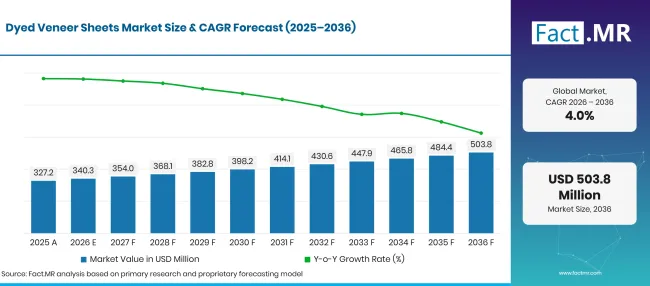
Dyed Veneer Sheets Market Forecast Global | Source: Fact.MR
| Year | Basis | Market Value (USD million) |
|---|---|---|
| 2025 | Actual | 327.2 |
| 2026 | Estimate | 340.3 |
| 2036 | Forecast | 503.8 |
| CAGR 2026 to 2036 | Forecast period | 4.0% |
Source: Fact.MR analysis. Updated Nov 2, 2026
What are the defining numbers behind Dyed Veneer Sheets Market growth?
The 2026 to 2036 period adds USD 163.5 million in new value, led by residential furniture and specialty store sales.
- Demand Drivers in the Market
- Brazilian households kept buying home goods in 2025, with IBGE reporting a 4.5% rise in retail sales volume for the furniture and appliances group, even as furniture alone fell 4.3% [1]. That split pushes furniture brands to compete on finish and colour, which favours dyed veneer faces over plain stock.
- UK furniture manufacturing turnover rose to GBP 10,313.1 million in 2025 from GBP 9,857.4 million in 2024, according to the Office for National Statistics [2]. A larger production base gives veneer suppliers more cabinet, joinery and contract furniture lines to serve.
- Wood interiors are spreading in public buildings. Japan’s Forestry Agency reports that 61.7% of public school facilities built in fiscal 2024 were non-wooden structures with wood interiors [3], a pattern that opens room for coloured panels and wall cladding.
- Compliance work on composite substrates keeps buyers attentive to certified products. In October 2026 the U.S. Environmental Protection Agency added ISO 12460-2:2024 as a quality-control test method for formaldehyde emissions from composite wood products [4], and veneered panels that pass these tests will find easier entry into furniture supply chains.
- Key Segments Analyzed
- By Product Type: Natural Dyed Veneer Sheets will hold 56.8% share in 2026, since buyers want the real grain of a single species with a colour that no natural log offers.
- By Application: Furniture will account for 38.5% of 2026 value, as cabinets, wardrobes and tables use more square metres of face veneer than any other end use.
- By Distribution Channel: Specialty Stores will capture 65.7% of 2026 sales, given that carpenters and designers compare shade, figure and thickness in person before they buy.
- By End-User: Residential will represent 51.2% of 2026 demand, supported by kitchen, bedroom and storage furniture in new and refurbished homes.
- Analyst Opinion at Fact.MR
- Shambhu Nath Jha, Principal Consultant at Fact.MR, states, “Colour is now the main reason a furniture maker picks one veneer supplier over another, and shade consistency across batches will separate premium producers from commodity sellers. Natural dyed sheets will keep their lead in residential furniture, while reconstituted products will gain ground in hotel, office and transport interiors where hundreds of panels must match. Suppliers that pair through-dyeing know-how with certified substrates and a strong specialty dealer network will capture most of the new value through 2036.”
- Strategic Implications
- Manufacturers should invest in dye penetration control and spectral shade checks, since batch-to-batch colour drift is the most common reason for rejected veneer lots.
- Distributors and specialty stores should hold physical sample libraries alongside online catalogues, because screen colours seldom match the real sheet.
- Furniture and interior buyers should specify shade codes and substrate emission class at the order stage to avoid rework on large projects.
- Investors should look for producers with reconstituted veneer capacity and access to certified timber, which will gain from contract interiors and stricter sourcing checks.
Japan leads the five-country set at 5.0%, helped by wood interiors in public and commercial buildings that offset a smaller housing pipeline. Brazil follows at 4.2%, a 0.8-point gap explained by a large domestic furniture industry that competes on finish. The United Kingdom at 3.8% trails Brazil by 0.4 points, with rising furniture output feeding joinery and contract work. Germany posts 3.3%, held back by a slow housing cycle even as permits recover. The United States closes the range at 3.0%, where a mature cabinet sector and fewer home completions keep growth measured.
How does the Dyed Veneer Sheets Market break down by segment?
Natural Dyed Veneer Sheets will lead Product Type at 56.8%; Furniture will head Application at 38.5%; Specialty Stores will hold Distribution Channel at 65.7%; Residential will lead End-User at 51.2% in 2026.
Which Product Type leads?
Natural Dyed Veneer Sheets hold 56.8% of 2026 sales.
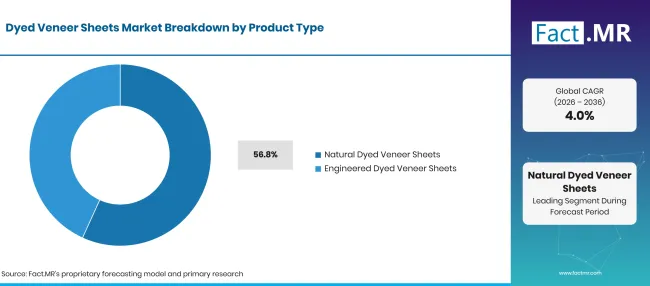
Dyed Veneer Sheets Market Breakdown Product Type | Source: Fact.MR
| Product Type | Share (2026) |
|---|---|
| Natural Dyed Veneer Sheets (Leading segment) | 56.8% |
| Other segments combined | 43.2%* |
| Total | 100.0% |
Source: Fact.MR analysis. Updated Nov 2, 2026
Furniture makers and designers choose single-species sheets because the dye colours real figure, so oak rays, ash cathedrals and walnut streaks stay visible after colouring. Each log takes dye differently, which gives the product a natural variation that premium residential buyers value in kitchens, wardrobes and feature walls. Engineered dyed veneer sheets are made by slicing, dyeing and re-gluing veneer into a new block, which produces repeatable figure and colour. Hotels, offices, airports and retail chains use them when large wall areas must match from panel to panel. Producers of these sheets also sell into engineered wood panel lines, where the veneer forms the visible face.
What supports Furniture within Application?
Furniture takes 38.5% of 2026 revenue.
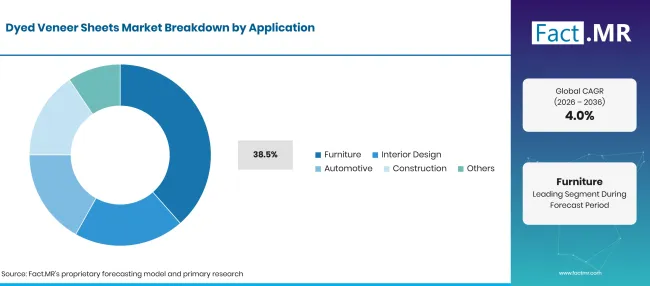
Dyed Veneer Sheets Market Breakdown Application | Source: Fact.MR
| Application | Share (2026) |
|---|---|
| Furniture (Leading segment) | 38.5% |
| Other segments combined | 61.5%* |
| Total | 100.0% |
Source: Fact.MR analysis. Updated Nov 2, 2026
Cabinets, wardrobes, tables and bedroom sets use large areas of face veneer, and dyed sheets let a brand offer grey, black, smoked or pastel finishes on the same carcass. That flexibility helps manufacturers refresh collections without changing species or tooling, and it links demand closely to the wider home furniture cycle. Interior design work uses dyed veneer for wall cladding, ceilings and fixed joinery. Construction applications rely on veneered panels, and Japan imported 1.49 million cubic metres of plywood in 2024, up 6.6% from the previous year [5]. Automotive interiors add a smaller niche for trim and dashboard inlays that need fade-resistant colour, often finished with specialised wood coatings.
How does Distribution Channel shape demand?
Specialty Stores capture 65.7% of 2026 value.
| Distribution Channel | Share (2026) |
|---|---|
| Specialty Stores (Leading segment) | 65.7% |
| Other segments combined | 34.3%* |
| Total | 100.0% |
Source: Fact.MR analysis. Updated Nov 2, 2026
Shade, figure and sheet thickness are hard to judge from a photograph, so carpenters, cabinet shops and designers visit dealers who stock full bundles and can match sequences. Specialty stores also give advice on glue, backing and finishing, which reduces failure risk for small workshops. Online stores widen reach for hobby users and small shops ordering sample packs or standard sizes, though colour differences between screen and sheet limit large online orders. Supermarkets and hypermarkets carry only a narrow DIY range, often next to wood stain products for home refinishing.
What role does Residential demand play within End-User?
Residential accounts for 51.2% of 2026 demand.
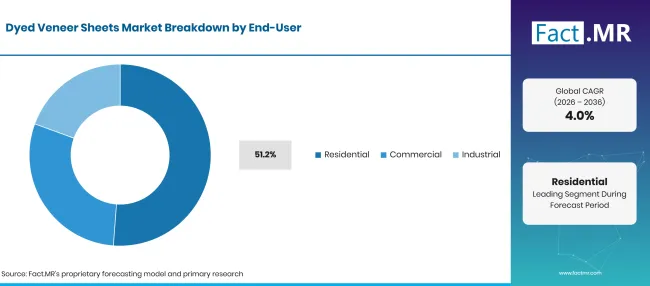
Dyed Veneer Sheets Market Breakdown End User | Source: Fact.MR
| End-User | Share (2026) |
|---|---|
| Residential (Leading segment) | 51.2% |
| Other segments combined | 48.8%* |
| Total | 100.0% |
Source: Fact.MR analysis. Updated Nov 2, 2026
Home kitchens, wardrobes, bedroom furniture and feature walls drive most orders, and homeowners now ask for coloured wood that matches flooring and stone tops. In the United States, 1,358,700 housing units were started in 2025, a figure close to the 2024 level [6], which keeps a steady pipeline of new kitchens and built-in storage. Commercial users such as hotels, offices and shops buy dyed veneer in larger, coordinated lots and favour engineered sheets for colour repeat. Industrial demand comes from furniture component makers, boat and vehicle interior fitters, and producers of wood and laminate flooring who use veneer as a wear layer.
What is accelerating Dyed Veneer Sheets Market adoption, and what is holding it back?
Demand will rise with furniture output, refurbishment of homes and hotels, and buyer interest in wood surfaces that come in fashion colours. Reconstituted products widen use in large contract interiors where every panel must match. Growth faces limits from uneven dye uptake between logs, fading under sunlight, and swings in timber and dye costs that small producers find hard to pass on.
Drivers Impact Analysis
| DRIVER | (~) % IMPACT ON CAGR | GEOGRAPHIC RELEVANCE | IMPACT TIMELINE |
|---|---|---|---|
| Rising use of decorative wood surfaces in residential furniture | +1.2% | Global | Short term (<=2 years) |
| Demand for customised colours and consistent veneer finishes | +0.9% | Europe, East Asia, North America | Medium term (2-4 years) |
| Wider adoption of engineered and reconstituted dyed veneers | +0.6% | North America, Europe, Asia Pacific | Medium term (2-4 years) |
| Expansion of decorative veneer in automotive and architectural interiors | +0.4% | Europe, Japan, China | Long term (>=4 years) |
Source: Fact.MR analysis. Updated Nov 2, 2026
Opportunity Impact Analysis
| OPPORTUNITY | (~) % IMPACT ON CAGR | GEOGRAPHIC RELEVANCE | IMPACT TIMELINE |
|---|---|---|---|
| Customised dyed veneer collections for furniture manufacturers | +0.7% | Global | Short term (<=2 years) |
| Engineered veneer production with repeatable colour patterns | +0.6% | Europe, North America, Asia Pacific | Medium term (2-4 years) |
| Water-based dyeing and certified wood sourcing | +0.4% | Europe, North America, Japan | Medium term (2-4 years) |
| Coloured veneers in transport and architectural interiors | +0.3% | Germany, Japan, China, United States | Long term (>=4 years) |
Source: Fact.MR analysis. Updated Nov 2, 2026
Restraints Impact Analysis
| RESTRAINT | (~) % IMPACT ON CAGR | GEOGRAPHIC RELEVANCE | IMPACT TIMELINE |
|---|---|---|---|
| Colour variation from differences in natural wood absorption | -0.5% | Global | Short term (<=2 years) |
| Light and moisture exposure affecting veneer appearance | -0.4% | Global | Short term (<=2 years) |
| Fluctuations in wood availability and processing costs | -0.3% | Europe, Asia Pacific, North America | Medium term (2-4 years) |
| Technical requirements for bonding, finishing and surface protection | -0.2% | Global | Long term (>=4 years) |
Source: Fact.MR analysis. Updated Nov 2, 2026
Which countries are scaling the Dyed Veneer Sheets Market through 2036?
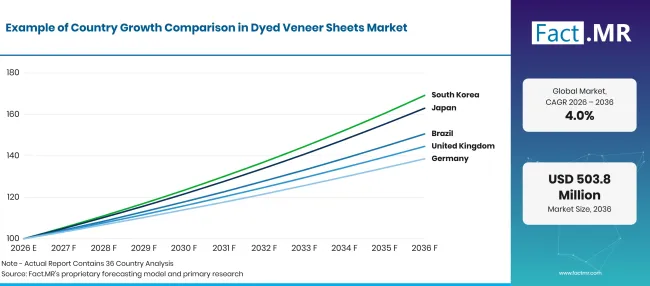
Dyed Veneer Sheets Market Growth Index | Source: Fact.MR
| Country | CAGR (2026 to 2036) |
|---|---|
| Japan | 5.0% |
| Brazil | 4.2% |
| United Kingdom | 3.8% |
| Germany | 3.3% |
| United States | 3.0% |
Source: Fact.MR analysis. Updated Nov 2, 2026
How does Japan perform?
5.0% CAGR, driven by wood interiors in non-residential buildings and precise finishing standards.
New housing starts in Japan fell 6.5% to about 740,000 units in 2025 [3], so growth leans on offices, schools, hotels and transport hubs that use wood for walls and ceilings. Japanese exports of plywood and related products reached JPY 8.6 billion in 2025, up 16.5% [7], a sign of a processing base that can add coloured faces to export panels. Architects here specify tight shade tolerances, which suits reconstituted dyed products.
How is Brazil developing demand?
4.2% CAGR, backed by a large domestic furniture industry that competes on finish.
Brazil’s furniture makers in the south and southeast supply both home and contract buyers, and coloured veneer helps them set mid-range lines apart. Construction materials retail volume eased 0.2% in 2025 [1], so suppliers will find more growth in furniture refreshes and fit-outs than in new building. Local plantation timber gives producers a cost base for natural dyed sheets.
What supports United Kingdom adoption?
3.8% CAGR, helped by a recovering furniture manufacturing base and active joinery trade.
UK furniture manufacturing turnover stood at GBP 10,330.2 million in 2023 before a dip in 2024 and a recovery in 2025 [2]. Bespoke kitchen makers, shopfitters and hotel refurbishment contractors are the main buyers of dyed veneer. Contract clients often ask for certified timber and low-emission boards, so suppliers with documented chains of custody will win more specifications.
What is supporting Germany’s adoption?
3.3% CAGR, as housing permits recover from a low base.
Germany approved 19,500 dwellings in January 2026, up 8.4% on a year earlier, with single-family homes up 12.6% [8]. Permits for the first half of 2026 reached 126,300 dwellings, a rise of 15.1%, and conversions of existing buildings grew 12.1% in June [9]. The country’s kitchen and office furniture makers buy coloured veneer for export lines, and recovering permits will lift domestic orders from 2027.
What is supporting United States adoption?
3.0% CAGR, reflecting a mature cabinet sector and fewer new home completions.
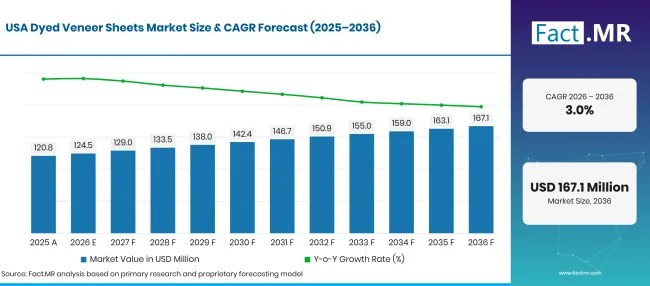
Dyed Veneer Sheets Market Forecast Usa | Source: Fact.MR
Housing completions fell 7.9% to 1,497,800 units in 2025 [6], which slows demand for new kitchens and built-ins. Cabinet shops and architectural woodwork firms still buy dyed veneer for refurbishment, hospitality and office projects. Formaldehyde rules for composite wood push buyers toward certified substrates, and suppliers of flexible dyed veneer and edgebanding serve a wide base of small workshops.
Who leads the Dyed Veneer Sheets Market?
Three groups shape supply. Specialist dyeing houses such as CWP Coloured Wood Products and ALPI compete on through-dyeing and reconstituted veneer, selling colour systems that architects can specify by code.
CWP’s Interior Veneer was used in Forest Night and Birchbark Stripes shades on the walls of Scandic Helsinki Aviacongress, a hotel interior published in September 2025 [11], and in Light Wood and Forest Night shades at Helsinki Airport’s Plaza and West Pier, published in January 2026 [12]. Large Indian panel groups such as Greenlam Industries and CenturyPly sell decorative veneer through wide dealer networks, and Greenlam’s Q4 and FY25 result update lists decorative, natural, teak and engineered veneer within its Veneer and Allied Products segment at Behror, Rajasthan [10]. North American converters such as Cedan Industries and FormWood Industries offer dyed species, flexible backed sheets and reconstituted veneer to cabinet and millwork shops. Competition will turn on shade repeatability, certified timber and how quickly suppliers can deliver matched bundles to specialty dealers.
Which companies are the key providers?
Key companies in the Dyed Veneer Sheets Market include CWP Coloured Wood Products, ALPI, Greenlam Industries, CenturyPly, Cedan Industries and FormWood Industries.
- CWP Coloured Wood Products
- ALPI
- Greenlam Industries
- CenturyPly
- Cedan Industries
- FormWood Industries
Bibliography
- [1] Instituto Brasileiro de Geografia e Estatística. (2026, February 13). Vendas no varejo fecham 2025 com alta de 1,6%.
- [2] Office for National Statistics. (2026, October 15). UKProdTO: 31 Manufacture of Furniture TOTAL (£m).
- [3] Forestry Agency, Japan. (2026, June 2).
- [4] U.S. Environmental Protection Agency. (2026, October 23). EPA Finalizes Updates to Formaldehyde Emission Standards, Adds New Quality Control Test Method for Composite Wood Products.
- [5] Forestry Agency, Japan. (2026, June 2).
- [6] U.S. Census Bureau. (2026, February 18). Monthly New Residential Construction, December 2025.
- [7] Forestry Agency, Japan. (2026, June 2).
- [8] Statistisches Bundesamt. (2026, March 18). Baugenehmigungen für Wohnungen im Januar 2026: +8,4 % zum Vorjahresmonat.
- [9] Statistisches Bundesamt. (2026, August 18). Baugenehmigungen für Wohnungen im Juni 2026: +13,8 % zum Vorjahresmonat.
- [10] Greenlam Industries. (2025, June 2). Result Update Q4 & FY25: Bettering Expanding Horizons.
- [11] CWP Coloured Wood Products. (2025, September 1). Scandic Helsinki Aviacongress: Interior Design by Fyra.
- [12] CWP Coloured Wood Products. (2026, January 1). Helsinki Airport’s Plaza and West Pier: PES Architects.
This Report Answers
- How large is dyed veneer sheet revenue in 2026, and what will it reach by 2036?
- Why do natural dyed sheets keep their lead over engineered products?
- How do furniture makers, fit-out firms and vehicle trim suppliers use coloured veneer differently?
- What share of buying runs through specialty stores, and how fast are online channels gaining?
- Which of Japan, Brazil, the United Kingdom, Germany and the United States offers the strongest growth, and why?
- Which producers control through-dyeing and reconstituted veneer capacity, and how do they compete?
What does the Dyed Veneer Sheets Market cover?
Dyed veneer sheets are thin slices of wood soaked or pressure-treated with dyes to reach a set colour while keeping the grain. The study covers natural dyed sheets cut from a single species and engineered sheets made by slicing, dyeing and re-gluing veneer into a new block.
Value is counted at the first point of sale by veneer producers and converters, across furniture, interior design, automotive, construction and other uses, and through specialty, online, mass retail and other channels.
What is included in the scope?
Natural dyed veneer sheets in raw, sanded or paper and fleece backed form.
Engineered and reconstituted dyed veneer sold as sheets or matched bundles.
Dyed veneer used as the face layer on panels, doors and furniture components when sold as veneer.
Sales to residential, commercial and industrial buyers in all seven regions.
What is excluded from the scope?
Undyed natural veneer and veneer coloured only by surface stain applied after pressing.
Decorative laminates, printed wood-grain papers, foils and other synthetic surfaces.
Finished furniture, solid wood panels and plywood sold as complete boards.
Dyeing equipment, adhesives, finishing chemicals and installation services.
How Was the Analysis Built?
The analysis draws on 120+ sources, 35+ company portfolios, 25+ countries, and more than 20 industry interviews.
- Primary Research: Primary research includes discussions with manufacturers, service providers, technology developers, distributors, end users, and subject-matter experts. These conversations examine purchasing priorities, product adoption, operational challenges, approval requirements, competitive positioning, and the factors that influence wider market acceptance.
- Desk Research: Desk research covers government statistics, regulatory publications, company filings, trade data, technical studies, industry associations, standards, public policy, and other authoritative sources. Every source used in the analysis is documented in the bibliography.
- Market Sizing and Forecasting: Market estimates combine historical performance, demand indicators, pricing and volume trends, segment shares, company participation, country-level growth, adoption patterns, investment activity, and barriers to market expansion.
- Data Validation and Update Cycle: Findings are validated by comparing primary interviews with public data, company activity, regulatory changes, trade patterns, and industry developments. Regular updates review new product launches, capacity changes, partnerships, approvals, and shifts in commercial adoption.
Segmentation
What is the report’s scope and coverage?
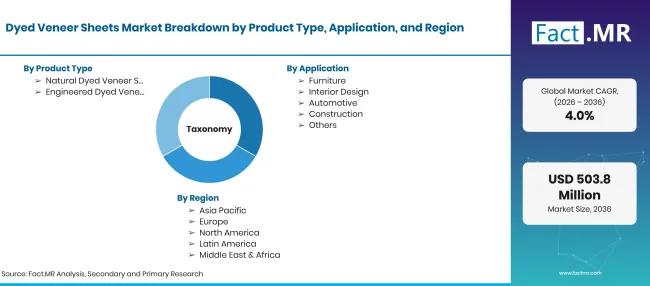
Dyed Veneer Sheets Market Taxonomy | Source: Fact.MR
| Attribute | Details |
|---|---|
| Quantitative Units | USD million |
| Market Definition | Natural and engineered wood veneer sheets treated with dyes to achieve specific colours while retaining visible grain, sold for decorative surfaces. |
| Product Type | Natural Dyed Veneer Sheets; Engineered Dyed Veneer Sheets |
| Application | Furniture; Interior Design; Automotive; Construction; Others |
| Distribution Channel | Specialty Stores; Online Stores; Supermarkets/Hypermarkets; Others |
| End-User | Residential; Commercial; Industrial |
| Regions Covered | North America; Latin America; Western Europe; Eastern Europe; East Asia; South Asia & Pacific; Middle East & Africa |
| Countries Covered | Japan; Brazil; United Kingdom; Germany; United States |
| Companies Profiled | CWP Coloured Wood Products; ALPI; Greenlam Industries; CenturyPly; Cedan Industries; FormWood Industries |
| Forecast Period | 2026 to 2036 |
| Approach | Supply-side sizing of dyed veneer output by producer and region, cross-checked against furniture, housing and interior fit-out activity in each country. |
Source: Fact.MR analysis. Updated Nov 2, 2026
How is the market segmented?
-
By Product Type
- Natural Dyed Veneer Sheets
- Engineered Dyed Veneer Sheets
-
By Application
- Furniture
- Interior Design
- Automotive
- Construction
- Others
-
By Distribution Channel
- Specialty Stores
- Online Stores
- Supermarkets/Hypermarkets
- Others
-
By End-User
- Residential
- Commercial
- Industrial
-
By Region
- North America
- Latin America
- Western Europe
- Eastern Europe
- East Asia
- South Asia & Pacific
- Middle East & Africa
Frequently Asked Questions
How large is the dyed veneer sheets market in 2026?
What growth rate will the dyed veneer sheets market record?
Which product type leads?
Which application leads?
Which distribution channel leads?
Which end-user leads?
Which country will grow quickest?
Who are the main companies?
What holds the market back?
Who worked on this report


Preview the report firsthand - request a free sample
Free SampleGet the brochure for pricing and purchase details
Download PDF