- Market Value (2025): USD 117.3 Bn
- Estimated Value (2026): USD 122.7 Bn
- Forecast Value (2036): USD 192.3 Bn
- CAGR (2026-2036): 4.6%
What is the Earthquake-Resistant Building Materials Market forecast to be worth by 2036?
USD 122.7 billion in 2026 is projected to reach USD 192.3 billion by 2036 at 4.6% CAGR.
- The Earthquake-Resistant Building Materials Market crossed a valuation of USD 117.3 billion in 2025 across new construction and retrofit spending channels.
- Demand is projected to increase from USD 122.7 billion in 2026 to USD 192.3 billion by 2036 across earthquake-prone construction regions.
- The market is forecast to record a 4.6% CAGR from 2026 to 2036, supported by tighter structural performance requirements across contractor and public agency projects.
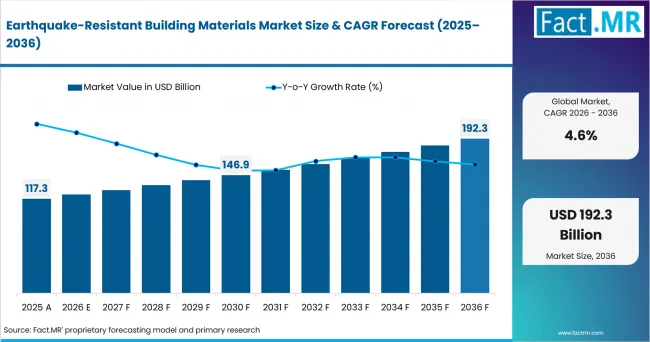
Earthquake Resistant Building Materials Market Market Value Analysis | Source: Fact.MR
What are the defining numbers behind Earthquake-Resistant Building Materials Market growth?
USD 69.6 billion absolute opportunity by 2036, led by Cementitious materials and Residential applications alongside Contractor procurement.
- Demand Drivers in the Market
- Structural engineers need documented ductility and connection performance because earthquake loads expose weak links between frames and non-structural building elements.
- General contractors need compatible mortars and anchors supported by installation routes that reduce rework during reinforcement and structural repair programs.
- Public agencies need repair systems shaped by code compliance and inspection evidence across schools and transport assets exposed to seismic hazards.
- Developers need lighter structural assemblies owing to schedule pressure and foundation constraints across dense urban sites in active seismic zones.
- Key Segments Analyzed
- By Material Type: Cementitious is expected to garner 35.1% share in 2026, supported by broad use in structural frames and retrofit overlays.
- By Application: Residential is projected to account for 24.7% share in 2026, owing to housing reconstruction and safer urban development programs.
- By Construction Type: New Build is anticipated to capture 46.1% share in 2026, supported by seismic design requirements applied before construction begins.
- By Buyer: Contractor is estimated to represent 30.5% share in 2026, attributable to direct responsibility for installation quality and material coordination.
- By Performance: Structural is forecast to account for 29.2% share in 2026, driven by life-safety requirements and verified load-transfer performance.
- Analyst Opinion at Fact.MR
- Shambhu Nath Jha, Senior Analyst at Fact.MR states, “Earthquake resistance is an assembly problem because material strength alone does not protect a weak connection. Procurement is expected to favor systems supported by test records and clear installation guidance available for engineering review before approval. Suppliers should combine ductile materials with anchors and repair products that work together under defined structural details.”
- Strategic Implications
- Material producers should publish system-level test evidence that connects product properties with practical structural details used by engineering teams.
- Contractors should qualify compatible anchors and repair mortars before mobilization so field substitutions do not weaken approved seismic load paths.
- Developers should budget for inspection and documentation during design because late seismic revisions often create expensive structural rework during construction.
- Public agencies should standardize approved repair assemblies for common building types so post-event procurement decisions move faster without losing technical control.
As construction activity accelerates across Central Asia, Sika expanded its regional manufacturing network with the opening of a production facility in Ust-Kamenogorsk in August 2025. Equipped with mortar and concrete-admixture lines and a modern laboratory, the facility is designed to support projects that demand controlled material performance and repeatable site execution.
India is expected to record a 6.4% CAGR between 2026 and 2036, driven by housing delivery and expanding infrastructure programs. China is projected to post a 5.7% CAGR during the forecast period, supported by a vast active construction base and seismic design needs. Australia is anticipated to advance at a 4.4% CAGR over the assessment period, owing to formal building controls and continuing residential work. The United Kingdom is estimated to record a 4.1% CAGR by 2036, shaped by repair activity and specialist structural products. The United States is forecast to post a 3.9% CAGR across the 2026 to 2036 forecast window, reinforced by code adoption and active construction spending.
How does the Earthquake-Resistant Building Materials Market break down by segment?
Cementitious materials account for 35.1% in 2026, Residential applications garners 24.7%.
Which Material Type dominates?
Cementitious materials account for 35.1% share in 2026
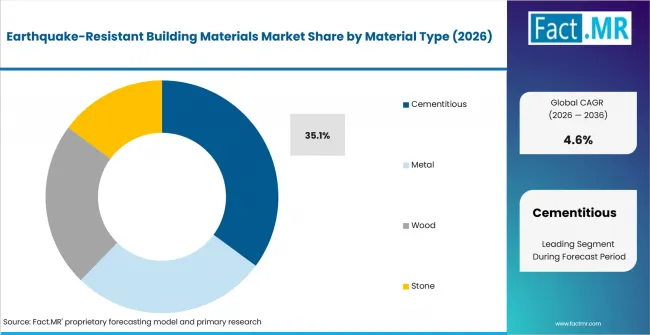
Earthquake Resistant Building Materials Market Analysis By Material Type | Source: Fact.MR
Cementitious materials are expected to garner 35.1% share in 2026 supported by their role in frames and repair overlays. Metal systems follow where ductility and connection detailing control structural response during repeated lateral movement across building frames. Wood serves lightweight structural designs while Stone remains relevant in heritage repair and selected masonry applications. In January 2026 the World Steel Association reported 1,803.8 million tonnes of crude steel production across 70 reporting countries during 2025. Broad steel availability supports engineered seismic assemblies across construction regions that rely on standardized structural sections and reinforcement products.
Which Application is projected to account for the largest share?
Residential leads with 24.7% share in 2026
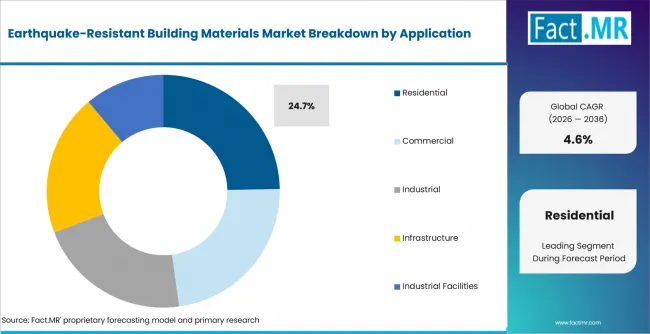
Earthquake Resistant Building Materials Market Analysis By Application | Source: Fact.MR
Residential applications are projected to account for 24.7% share in 2026 owing to housing reconstruction and safer urban development needs. Commercial buildings require continuity planning that limits closure time after structural damage and protects critical interior systems. Industrial and Infrastructure projects place more weight on operational continuity and site-specific engineering constraints across critical facilities and transport assets. In June 2025, the World Bank reported that 1.8 billion people were living in inadequate housing conditions worldwide. Safer housing demand keeps residential specifications central to material selection across fast-growing urban areas exposed to earthquake risk.
How does Construction Type shape demand?
New Build projects record 46.1% share in 2026
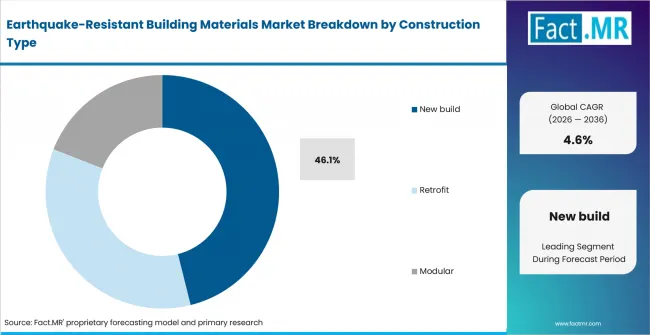
Earthquake Resistant Building Materials Market Analysis By Construction Type | Source: Fact.MR
New Build is anticipated to capture 46.1% share in 2026 shaped by the ability to integrate seismic detailing before structural work begins. Retrofit projects address vulnerable existing buildings where reinforcement must fit occupied sites and established structural layouts. Modular construction supports repeatable connections and off-site quality checks before assemblies reach active projects with demanding installation schedules. In March 2025, the World Bank approved additional funding for 2,800 resilient rural housing units in earthquake-hit areas of Türkiye. Planned reconstruction creates direct material demand before projects enter the repair stage or require emergency strengthening after another event.
What supports Contractor procurement within Buyer?
Contractors account for 30.5% share in 2026
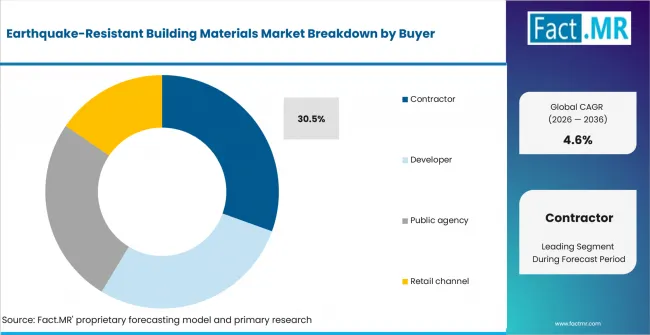
Earthquake Resistant Building Materials Market Analysis By Buyer | Source: Fact.MR
Contractor procurement is estimated to represent 30.5% share in 2026 attributable to direct control over installation sequencing and field coordination. Developers focus on project cost and schedule risk while Public Agencies place greater weight on documented compliance and inspection records. Retail Channel access serves smaller repair packages and local contractors needing familiar formats in shorter order cycles. In May 2025, Hilti stated that seismic design needs extend across anchoring and modular support bracing in earthquake-prone regions. Coordinated procurement carries more value because connections and support systems must perform together under approved structural details.
Which Performance category is forecast to record the largest share?
Structural performance holds 29.2% share in 2026
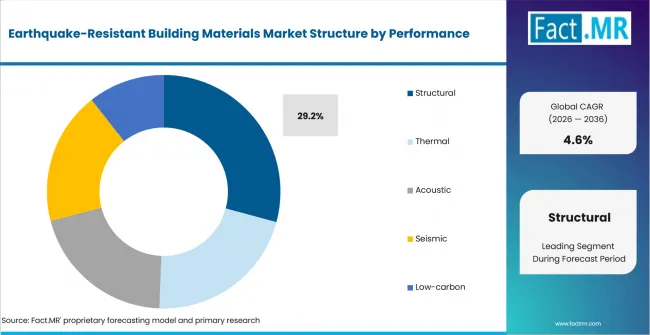
Earthquake Resistant Building Materials Market Analysis By Performance | Source: Fact.MR
Structural performance is forecast to account for 29.2% share in 2026 driven by life-safety objectives and reliable load transfer during ground movement. Thermal and Acoustic functions remain relevant where building envelopes and interior systems must meet ordinary occupancy requirements alongside structural safety. Seismic performance covers products selected specifically for earthquake movement while Low-Carbon criteria influence projects that track material impact. In May 2025, UNDRR reported that earthquakes account for 25.6% of global economic disaster losses. The risk profile keeps structural performance central to earthquake-resistance spending across public assets and private building projects.
What is accelerating Earthquake-Resistant Building Materials Market adoption, and what is holding it back?
Seismic-code enforcement is the primary driver, testing and qualification cost remains the primary restraint on market adoption.
Drivers Impact Analysis
| Driver | (~) % Impact on CAGR | Geographic Relevance | Impact Timeline |
|---|---|---|---|
| Seismic code enforcement and resilient reconstruction | +0.7% | Asia Pacific and North America | Medium term (2–4 years) |
| Urban housing replacement and safer reconstruction | +0.6% | India and China | Long term (4+ years) |
| Structural retrofit of vulnerable building stock | +0.5% | Europe and North America | Medium term (2–4 years) |
| Ductile steel and connection specification | +0.4% | Global seismic zones | Medium term (2–4 years) |
| Lightweight and modular structural engineering | +0.3% | Australia and Asia Pacific | Long term (4+ years) |
Source: Fact.MR analysis. Updated Jul 8, 2026
- Seismic code enforcement: Public authorities are tightening design and inspection expectations after costly earthquake events expose weak building details. In July 2025, the U.S. Geological Survey estimated average annual earthquake losses of USD 14.7 billion across nine U.S. regions. Adoption is expected to favor materials backed by test evidence and installation procedures that inspectors verify on site.
- Housing reconstruction: Governments need safer housing supply while urban populations keep expanding into areas with material seismic exposure. Demand is projected to expand for cementitious and reinforcement systems suited to repeatable housing designs across large public programs.
- Structural retrofit demand: Existing masonry and reinforced-concrete buildings often need targeted strengthening without complete demolition or long closure periods. Retrofit packages combine repair mortars with anchors and externally applied reinforcement around known weak details. Procurement is anticipated to favor suppliers that document compatibility across the complete repair assembly instead of selling isolated products.
- Ductile connection design: Earthquake performance depends on how structural members transfer force through joints and anchors during repeated movement. In May 2026, Nippon Steel documented seismic isolation devices and buckling-restrained braces that absorb earthquake energy within engineered structural systems. Specification is estimated to reward products that fit tested connection details and common contractor installation methods.
- Lightweight construction systems: Lower structural mass reduces selected seismic demands while prefabrication improves dimensional control before site installation begins. Modular assemblies also shift more quality checks into controlled production environments that engineering teams audit before shipment. Adoption is forecast to expand where material systems arrive with defined connection details and clear site assembly sequences.
Opportunity Impact Analysis
| Opportunity | (~) % Impact on CAGR | Geographic Relevance | Impact Timeline |
|---|---|---|---|
| Integrated retrofit packages for older structures | +0.5% | Europe and North America | Medium term (2–4 years) |
| Low-carbon cementitious strengthening systems | +0.4% | Europe and Asia Pacific | Long term (4+ years) |
| Seismic-ready modular assemblies | +0.3% | Australia and Asia Pacific | Medium term (2–4 years) |
| Specification and installation documentation | +0.2% | Global urban projects | Short term (≤2 years) |
Source: Fact.MR analysis. Updated Jul 8, 2026
- Integrated retrofit packages: Older buildings create demand for systems that combine surface repair with anchoring and structural reinforcement under one engineered method. In February 2025, Simpson Strong-Tie detailed earthquake retrofit solutions for foundations and wall-to-floor connections across vulnerable homes. Opportunity is expected to favor providers that give contractors compatible components and clear installation guidance within one retrofit sequence.
- Lower-carbon cementitious systems: Project teams are seeking structural performance while public procurement increasingly asks for material impact information and durability evidence. Suppliers pair repair mortars with supplementary cementitious content when formulations retain required bond and strength properties under project specifications. Opportunity is projected to expand where verified performance records support both structural repair and material-impact goals without weakening approval confidence.
- Seismic-ready modular assemblies: Factory-built frames and panels create a route for repeatable connections that arrive with defined tolerances and installation sequences. In July 2025, Housing Australia cited a 490-dwelling regional development built entirely with modular construction technologies. Demand is anticipated to favor modular suppliers that integrate bracing and anchoring details before delivery to active construction sites.
- Specification document support: Engineering teams need traceable product data when several contractors and inspectors share responsibility for complex structural packages. Product data libraries connect test reports and approved details with installation sequences for each project condition. Opportunity is estimated to increase for suppliers that make technical evidence easy to review before procurement and accessible during field installation.
Restraints Impact Analysis
| Restraint | (~) % Impact on CAGR | Geographic Relevance | Impact Timeline |
|---|---|---|---|
| Testing and qualification cost | -0.5% | Global | Medium term (2–4 years) |
| Construction input price volatility | -0.4% | Global | Short term (≤2 years) |
| Installer skill and inspection gaps | -0.3% | Emerging construction markets | Medium term (2–4 years) |
| Varied project approval pathways | -0.2% | Multi-jurisdiction projects | Long term (4+ years) |
Source: Fact.MR analysis. Updated Jul 8, 2026
- Testing and qualification cost: Seismic systems require tests covering anchors and substrates under defined loading conditions before engineers accept unfamiliar products for structural work. Smaller suppliers face high evidence costs when qualification programs must cover several building types across different code environments. Adoption is forecast to remain selective where testing expenses cannot be recovered across enough projects and repeat specifications.
- Input price volatility: Steel and cementitious products depend on energy-intensive supply chains that shift project budgets during long procurement cycles. In February 2025, the National Bureau of Statistics of China reported that qualified construction enterprise profits fell 9.8% during 2024. Procurement teams are expected to maintain alternate specifications where price exposure threatens schedules and project affordability.
- Installer skill gaps: Material performance falls below design expectations when surface preparation or anchor installation is inconsistent across active worksites. Field training and inspection therefore become part of the commercial offer for technical reinforcement systems and structural repair packages. Adoption is projected to slow where qualified installers remain scarce outside major construction centers and infrastructure corridors.
- Varied approval pathways: Building rules and engineering practices differ across jurisdictions even when products address similar seismic failure modes and building types. Suppliers must maintain separate evidence packages and local technical support for national and municipal approval environments. Expansion is anticipated to remain slower where project approval relies on case-by-case interpretation without established product acceptance routes.
Which countries are scaling Earthquake-Resistant Building Materials Market fastest?
India 6.4%, China 5.7%, Australia 4.4%, United Kingdom 4.1%, and United States 3.9% over the 2026 to 2036 assessment period.
The Earthquake-Resistant Building Materials Market is segmented into North America and Europe alongside Asia Pacific and Latin America while the Middle East & Africa completes geographic coverage.
| Country | CAGR |
|---|---|
| India | 6.4% |
| China | 5.7% |
| Australia | 4.4% |
| United Kingdom | 4.1% |
| United States | 3.9% |
| Germany | 3.6% |
| Japan | 3.3% |
Source: Fact.MR analysis. Updated Jul 8, 2026
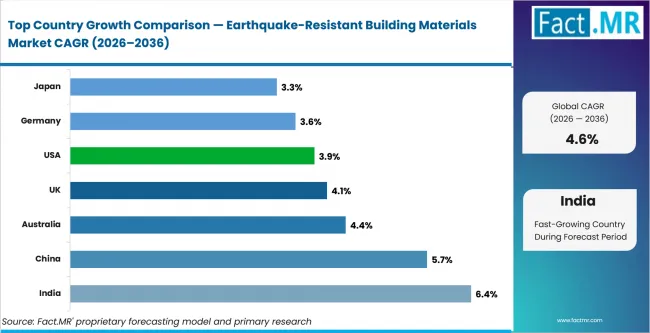
Earthquake Resistant Building Materials Market Cagr Analysis By Country | Source: Fact.MR
What is powering India's market expansion?
6.4% CAGR, driven by housing delivery and infrastructure construction across earthquake-prone urban and regional corridors.
India’s market is expanding because widespread seismic exposure intersects with continued housing and infrastructure delivery across major development corridors. In March 2025 the Press Information Bureau reported that 59% of India’s land area is prone to earthquakes. The market is expected to record a 6.4% CAGR between 2026 and 2036 due to housing delivery and infrastructure construction. Domestic material suppliers provide engineering teams with specification pathways for seismic reinforcement across residential and infrastructure projects.
How is China scaling earthquake-resistant material demand?
5.7% CAGR, supported by construction scale and seismic design requirements across major urban development corridors.
China’s demand base remains substantial because extensive construction activity keeps seismic design compliance relevant across large urban project pipelines. The National Bureau of Statistics reported 6,333.21 million square meters of buildings under construction during the first half of 2025. Demand is projected to post a 5.7% CAGR during the forecast period due to qualification requirements across large building portfolios. Material suppliers can improve specification access when structural systems combine documented seismic performance with compatibility across standardized project specifications.
What supports the Australia outlook?
4.4% CAGR, owing to formal building controls and continuing construction activity across regulated project delivery channels.
Australia’s outlook is supported by active residential construction and formal compliance pathways that favor materials with documented structural performance. The Australian Bureau of Statistics reported that total dwelling commencements rose 8.0% during the December 2025 quarter. The market is anticipated to advance at a 4.4% CAGR over the assessment period due to continuing project delivery and formal compliance processes. Engineers and certifiers provide a clear specification route for tested materials where projects require documented earthquake actions and connection behavior.
What underpins United Kingdom growth?
4.1% CAGR, supported by repair activity and specialist structural systems used across complex building upgrades.
United Kingdom demand is developing through complex retrofit work where specialist reinforcement systems support structural upgrades within existing building portfolios. Office for National Statistics data showed that repair and maintenance output increased 3.4% during the first quarter of 2026. The market is estimated to record a 4.1% CAGR by 2036 due to specialist reinforcement requirements across complex structural upgrades. Suppliers gain opportunities where retrofit teams require documented compatibility with existing structures and clearly defined installation procedures.
How is the United States developing demand?
3.9% CAGR, backed by code adoption and active construction spending across higher-risk states and public assets.
United States demand is anchored in large construction volumes and code-based specifications across states with significant seismic exposure. The U.S. Census Bureau reported construction spending at an annualized rate of USD 2,210.2 billion during May 2026. FEMA also tracks building code adoption across state and territorial jurisdictions to assess current hazard-resistant code coverage. Demand is forecast to post a 3.9% CAGR across the forecast window due to seismic specifications concentrated in higher-risk states and public assets.
Who leads the Earthquake-Resistant Building Materials Market?
Sika and Hilti lead direct strengthening and anchoring coverage, while Simpson Strong-Tie and Tata Steel strengthen retrofit connectivity and ductile reinforcement.
Key players such as Sika compete across repair mortars and structural strengthening systems that raise seismic resistance in concrete and masonry structures. Hilti adds seismic anchoring design and modular support bracing for earthquake-prone regions where system compatibility affects inspection and installation quality. Simpson Strong-Tie supports retrofit work through structural connectors and earthquake reinforcement solutions designed around common weak points in existing buildings. Competition among these suppliers centers on tested assemblies and installer support across difficult repair conditions.
ArcelorMittal and Nippon Steel provide structural steel products aligned with ductility and seismic resistance requirements. Tata Steel adds ductile reinforcement for earthquake-prone construction while Knauf contributes gypsum-board systems and tested partition solutions for non-structural performance. Their competition centers on documented system behavior and local technical support together with products that fit project-specific approval routes. Provider positioning over the forecast period is expected to depend on reliable test evidence and application guidance supported by regional supply access.
Which companies are the key providers?
Sika AG, Hilti Group, Simpson Strong-Tie Company Inc., ArcelorMittal, Nippon Steel Corporation, Tata Steel Limited, Knauf Group
- Sika AG
- Hilti Group
- Simpson Strong-Tie Company Inc.
- ArcelorMittal
- Nippon Steel Corporation
- Tata Steel Limited
- Knauf Group
Bibliography
- Australian Bureau of Statistics. (2026, April 8). Building Activity, Australia, December 2025. Australian Bureau of Statistics.
- Federal Emergency Management Agency. (2026, June 15). Building Code Adoption Tracking. Federal Emergency Management Agency.
- Hilti Group. (2025, May 8). A holistic approach to building safety. Hilti Group.
- Housing Australia. (2025, July 30). Housing Australia releases National Housing Infrastructure Facility Review. Housing Australia.
- National Bureau of Statistics of China. (2025, February 28). Statistical Communiqué of the People’s Republic of China on the 2024 National Economic and Social Development. National Bureau of Statistics of China.
- National Bureau of Statistics of China. (2025, July 16). Investment in Real Estate Development in the First Half of 2025. National Bureau of Statistics of China.
- Nippon Steel Corporation. (2026, May 13). Nippon Steel Group’s Construction Methods and Products to Support Datacenters and Semiconductor Factories. Nippon Steel Corporation.
- Office for National Statistics. (2026, May 14). Construction output in Great Britain: March 2026, new orders and construction output price indices, January to March 2026.
- Press Information Bureau. (2025, March 21). Making India More Disaster-Resilient. Government of India.
- Press Information Bureau. (2026, June 9). Infrastructure at the Core of India’s Development. Government of India.
- Sika AG. (2025, August 4). Sika opens a new plant for concrete admixtures and mortars in Kazakhstan. Sika AG.
- Simpson Strong-Tie. (2025, February 5). Earthquake Retrofit Solutions. Simpson Strong-Tie.
- United Nations Office for Disaster Risk Reduction. (2025, May 27). GAR 2025 Hazards: Earthquakes. United Nations Office for Disaster Risk Reduction.
- U.S. Census Bureau. (2026, July 1). Monthly Construction Spending, May 2026. U.S. Census Bureau.
- U.S. Geological Survey. (2025, July 8). Engineering and Risk. U.S. Geological Survey.
- World Bank. (2025, March 18). World Bank Extends Additional Funding to Türkiye for Construction of Rural Homes in Earthquake-Hit Areas. World Bank.
- World Bank. (2025, June 16). Resilient Housing Reconstruction Technical Knowledge Exchange in Japan. World Bank.
- World Steel Association. (2026, January 23). December 2025 crude steel production and 2025 global crude steel production totals. World Steel Association.
This Report Addresses
- The report provides strategic intelligence on earthquake-resistant building materials across Material Type and Application choices that shape structural specification and procurement decisions.
- Regional outlook evaluates India and China alongside Australia while the United Kingdom and United States complete the country growth comparison.
- Competitive analysis profiles Sika and Hilti alongside Simpson Strong-Tie and ArcelorMittal before assessing three additional active providers.
- Material assessment covers Cementitious and Metal systems alongside Wood and Stone products used within defined earthquake-resistance specifications.
- Application assessment covers Residential and Commercial projects together with Industrial and Infrastructure uses and Industrial Facilities requirements.
What does the Earthquake-Resistant Building Materials Market cover?
Cementitious and Metal materials alongside Wood and Stone products used in buildings designed or upgraded for earthquake resistance.
The market covers structural and non-structural building materials specified to reduce failure risk during earthquake loading. Coverage includes materials used in frames and walls alongside anchors and repair assemblies that support verified seismic performance.
The market differs from general construction materials because revenue must be tied to an earthquake-resistance function or documented seismic specification. Commodity products remain outside the boundary when sold without structural performance evidence or a defined seismic application.
What is included in the scope?
Earthquake-resistant materials used in new buildings and retrofit projects across defined structural and non-structural applications.
Coverage includes Cementitious and Metal systems alongside Wood and Stone materials under defined earthquake-resistance specifications. Applications span Residential and Commercial projects alongside Industrial sites and Infrastructure assets including Industrial Facilities with dedicated structural requirements. New Build and Retrofit work is included with Modular construction and procurement by Contractors and Developers alongside Public Agencies and Retail Channels. Performance assessment also considers Structural and Thermal requirements while adjacent seismic-resistant self-healing concrete provides context for cementitious repair performance. Acoustic and Seismic functions remain covered while Light gauge steel framing informs lightweight assemblies that depend on repeatable structural connections. Low-Carbon criteria are included when they affect system selection while Non-shrink grouts provide adjacent anchoring and retrofit context.
What is excluded from the scope?
General construction commodities and complete building revenue without defined earthquake-resistance functions remain outside the market scope.
The scope excludes general commodity concrete and structural steel sold without an earthquake-resistance specification or defined structural safety function. Standalone non-shrink grouts remain adjacent products unless they form part of a documented anchoring or retrofit package. Finished buildings and engineering consultancy fees are also excluded from material revenue calculations because the market boundary follows material and system sales.
How was the analysis built?
100+ public sources, 30+ company portfolios, 20+ countries, and 15+ expert interviews support the analysis.
- Primary Research:
- Primary research includes interviews with structural engineers and contractors alongside material distributors and public procurement specialists. It also includes input from retrofit consultants and building-product managers involved in seismic specification and project delivery. Interview findings are used to test specification priorities and practical installation constraints before forecast assumptions are finalized.
- Desk Research:
- Desk research reviews construction statistics and disaster-risk publications alongside building-code documents and company product portfolios. Technical catalogs and official project announcements are evaluated to confirm material scope and provider activity across earthquake-resistance applications. Source comparisons also confirm whether suppliers remain active in seismic strengthening and construction material applications across current regional portfolios.
- Market-Sizing and Forecasting:
- Forecasting uses market values and segment shares together with construction activity and retrofit intensity across exposed regions. Models also consider material attachment rates and project mix alongside replacement cycles and average selling prices for structural product systems. Country models are reconciled with the global total before the final forecast path is locked.
- Data Validation and Update Cycle:
- Forecast assumptions are tested through provider checks and technical interviews that review specification behavior and project adoption. Portfolio mapping and country construction indicators support validation while official statistical releases and company announcements inform scheduled updates. Each update cycle checks whether new regulations or portfolio changes alter the market boundary or regional adoption assumptions.
Segmentation
What is the report’s scope and coverage?
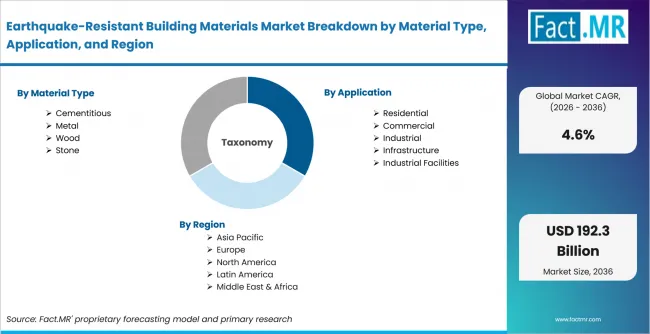
Earthquake Resistant Building Materials Market Breakdown By Material Type, Application, And Region | Source: Fact.MR
| Attribute | Details |
|---|---|
| Quantitative Units | USD Billion |
| Market Definition | Building materials and structural systems specified for new construction or retrofit applications to improve earthquake resistance across frames, connections, walls and non-structural assemblies |
| Material Type | Cementitious, Metal, Wood, Stone |
| Application | Residential, Commercial, Industrial, Infrastructure, Industrial Facilities |
| Construction Type | New Build, Retrofit, Modular |
| Buyer | Contractor, Developer, Public Agencies, Retail Channel |
| Performance | Structural, Thermal, Acoustic, Seismic, Low-Carbon |
| Regions Covered | North America, Europe, Asia Pacific, Latin America, Middle East & Africa |
| Countries Covered | United States, Canada, Germany, United Kingdom, France, Italy, Spain, India, China, Japan, South Korea, Australia, Brazil, Argentina, Mexico, Chile, UAE, Saudi Arabia, South Africa |
| Key Companies Profiled | Sika AG, Hilti Group, Simpson Strong-Tie Company Inc., ArcelorMittal, Nippon Steel Corporation, Tata Steel Limited, Knauf Group |
| Forecast Period | 2026 to 2036 |
| Approach | Hybrid top-down and bottom-up approach using construction activity, seismic exposure, retrofit intensity, material attachment rates, project mix, replacement cycles, average selling prices, provider validation and country-level reconciliation |
Source: Fact.MR analysis. Updated Jul 8, 2026
How is the market segmented?
-
By Material Type:
- Cementitious
- Metal
- Wood
- Stone
-
By Application:
- Residential
- Commercial
- Industrial
- Infrastructure
- Industrial Facilities
-
By Construction Type:
- New Build
- Retrofit
- Modular
-
By Buyer:
- Contractor
- Developer
- Public Agencies
- Retail Channel
-
By Performance:
- Structural
- Thermal
- Acoustic
- Seismic
- Low-Carbon
-
By Region:
- North America
- United States
- Canada
- Europe
- Germany
- United Kingdom
- France
- Italy
- Spain
- Asia Pacific
- India
- China
- Japan
- South Korea
- Australia
- Latin America
- Brazil
- Argentina
- Mexico
- Chile
- Middle East & Africa
- UAE
- Saudi Arabia
- South Africa
- North America
Frequently Asked Questions
What share is Cementitious estimated to capture?
How much Application share could Residential account for?
What share is New Build forecast to record?
How large is the Contractor share estimated to be?
What share could Structural performance garner?
Which country is projected to post the fastest CAGR?
What CAGR is China expected to record?
What growth rate is estimated for Australia?
What CAGR is forecast for the United Kingdom?
What pace is the United States projected to maintain?
What is estimated to be the main market driver?
What factor is expected to restrain adoption most?
Why are Cementitious materials projected to remain important?
Why are Contractors estimated to influence procurement strongly?
Who worked on this report


Preview the report firsthand - request a free sample
Free SampleGet the brochure for pricing and purchase details
Download PDF