Seismic-Resistant Self-Healing Concrete Market

Seismic-Resistant Self-Healing Concrete Market Size and Share Forecast Outlook 2026 to 2036

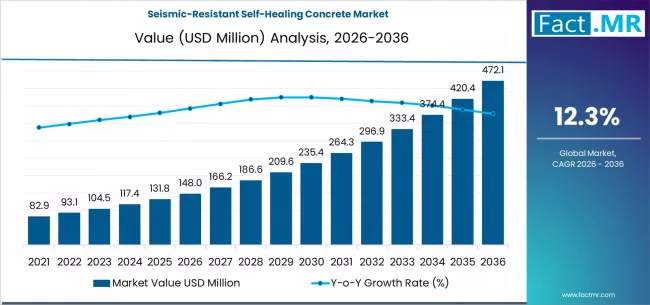
Seismic-resistant self-healing concrete market is projected to grow from USD 148.0 million in 2026 to USD 472.1 million by 2036, at a CAGR of 12.3%. Microcapsule-Based Healing Agents will dominate with a 36.0% market share, while autogenous healing enhancement will lead the mechanism segment with a 41.0% share.

Seismic-Resistant Self-Healing Concrete Additives Market Forecast and Outlook 2026 to 2036

The global market for seismic-resistant self-healing concrete additives is projected to grow from USD 148.00 million in 2026 to USD 472.13 million by 2036, advancing at a 12.3% CAGR. This robust growth is propelled by the escalating need for resilient urban infrastructure capable of withstanding seismic events while minimizing lifecycle maintenance costs and downtime.

The market transcends traditional concrete reinforcement by introducing multi-functional additives that impart an autonomic repair capability to one of the world's most widely used construction materials.

Key Takeaways from the Seismic-Resistant Self-Healing Concrete Additives Market

  • Market Value for 2026: USD 148.00 Million
  • Market Value for 2036: USD 472.13 Million
  • Forecast CAGR (2026 to 2036): 12.3%
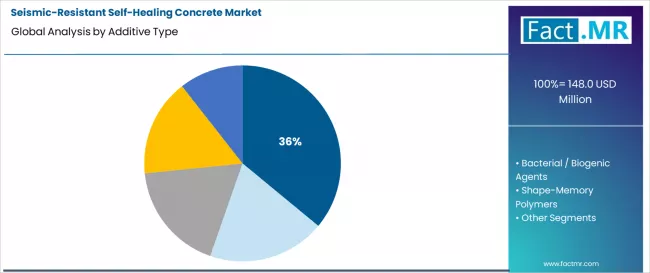
  • Leading Additive Type Segment (2026): Microcapsule-Based Healing Agents (36%)
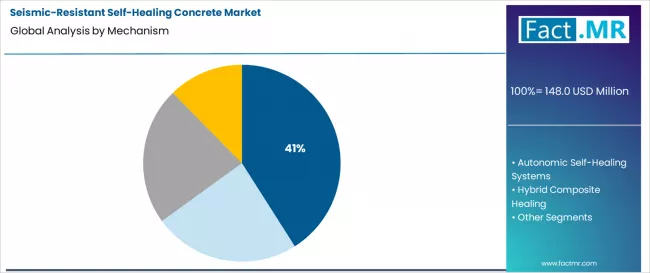
  • Leading Mechanism Segment (2026): Autogenous Healing Enhancement (41%)
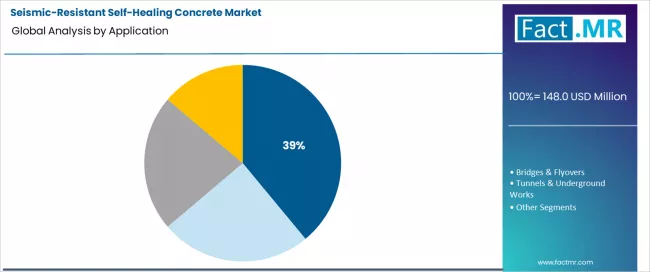
  • Leading Application Segment (2026): High-Rise & Infrastructure (39%)
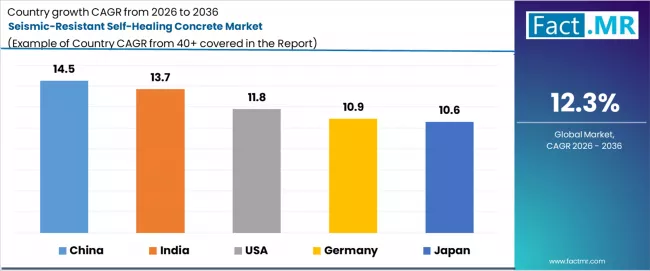
  • Key Growth Countries: China (14.50% CAGR), India (13.70% CAGR), USA (11.80% CAGR), Germany (10.90% CAGR), Japan (10.60% CAGR)
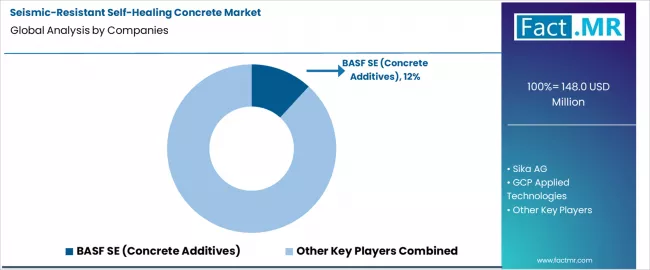
  • Key Players in the Market: BASF SE, Sika AG, GCP Applied Technologies, MAPEI S.p.A., W. R. Grace & Co.

Seismic Resistant Self Healing Concrete Market Market Value Analysis

This innovation addresses the critical vulnerability of concrete to microcracking under cyclical stress, a primary failure precursor in earthquakes. Growth is driven by stringent updates to building codes in seismically active regions, the rising economic valuation of infrastructure durability, and the integration of smart material concepts into civil engineering.

China's 14.50% CAGR reflects its massive infrastructure development pace coupled with a strategic focus on incorporating advanced materials to enhance longevity and safety. The market evolution is characterized by a shift from passive reinforcement to active damage management, where the material itself becomes a dynamic participant in structural health monitoring and preservation, fundamentally altering the asset management paradigm for critical infrastructure.

Metric

Metric Value
Market Value (2026) USD 148.00 Million
Market Forecast Value (2036) USD 472.13 Million
Forecast CAGR (2026 to 2036) 12.3%

Category

Category Segments
Additive Type Microcapsule-Based Healing Agents, Bacterial / Biogenic Agents, Shape-Memory Polymers, Nano-Mineral Fibers & Powders, Others
Mechanism Autogenous Healing Enhancement, Autonomic Self-Healing Systems, Hybrid Composite Healing, Seismic Microcrack Mitigation
Application High-Rise & Infrastructure, Bridges & Flyovers, Tunnels & Underground Works, Industrial Flooring & Foundations
Region North America, Latin America, Western Europe, Eastern Europe, East Asia, South Asia & Pacific, MEA

Segmental Analysis

By Additive Type, Which Technology Offers the Most Direct Path to Commercialization?

Seismic Resistant Self Healing Concrete Market Analysis By Additive Type

Microcapsule-based healing agents lead the segment with a 36% share. This technology involves embedding microscopic capsules containing healing agents like polymers or minerals into the concrete mix. Upon crack formation, the capsules rupture and release their contents to seal the fissure.

Its leadership is due to its relative simplicity, compatibility with existing batching processes, and the immediate, demonstrable healing action it provides. This makes it the most readily integrable and scalable solution for current construction projects seeking enhanced durability without radically altering established concrete production protocols.

By Mechanism, Which Process Leverages the Innate Properties of Concrete Most Effectively?

Seismic Resistant Self Healing Concrete Market Analysis By Mechanism

Autogenous healing enhancement is the dominant mechanism at 41%. This approach focuses on optimizing the concrete's own ability to self-heal through continued hydration of unreacted cement particles or carbonation of calcium hydroxide.

Additives in this category, such as specific nano-powders or super-absorbent polymers, are designed to control water availability and promote these natural chemical processes. Its prominence stems from its passive, continuous, and material-efficient nature, offering a sustained repair capability over the structure's lifespan without relying on encapsulated agents that are consumed upon first use.

By Application, Where is the Financial and Safety Imperative for Self-Healing Most Acute?

Seismic Resistant Self Healing Concrete Market Analysis By Application

High-rise & infrastructure represents the largest application segment at 39%. The immense capital investment, dense occupancy, and catastrophic consequences of failure in tall buildings and core public infrastructure create an unparalleled business case for self-healing technologies.

In these applications, the potential savings in inspection, repair, and disaster mitigation dwarf the cost of additive. The ability to autonomously address early-stage cracking from seismic tremors or long-term loading is viewed as a critical risk mitigation and asset preservation strategy, justifying premium material specifications.

What are the Drivers, Restraints, and Key Trends of the Seismic-Resistant Self-Healing Concrete Additives Market?

The foremost market driver is the global trend toward performance-based seismic design codes, which shift focus from merely preventing collapse to ensuring continued functionality and minimal damage after an earthquake. This paradigm directly incentivizes materials that reduce damage.

Growing emphasis on sustainable construction and lifecycle assessment favors technologies that extend service life and reduce the need for carbon-intensive repair materials and activities. The rising economic cost of infrastructure downtime further pushes asset owners to invest in resilient materials that ensure faster recovery and operational continuity post-event.

A significant restraint is the challenge of quantifying long-term performance and return on investment for these novel additives within the conservative construction industry. The lack of standardized test methods to reliably predict healing efficiency over decades hinders specification by engineers.

The incorporation of certain additives, particularly biological agents or sensitive microcapsules, can complicate concrete batching, placement, and curing processes, requiring specialized knowledge and potentially affecting other fresh or hardened concrete properties if not meticulously formulated.

Key trends include the development of multi-stage healing systems that address cracks of different sizes at different times, combining, for example, instantaneous chemical healing for microcracks with longer-term biological mineralization for larger fissures. There is a strong trend toward integrating self-healing additives with digital monitoring systems using embedded sensors to track crack formation and verify healing activity in real-time.

Another trend is the use of locally sourced or waste-derived materials, such as specific industrial slags or bio-based healing agents, to improve the environmental and economic profile of the additives. Research is focusing on stimuli-responsive systems where the healing mechanism can be activated or enhanced on demand, such as by applying an electrical field after a seismic event.

Analysis of the Seismic-Resistant Self-Healing Concrete Additives Market by Key Countries

Seismic Resistant Self Healing Concrete Market Cagr Analysis By Country

Country CAGR (2026 to 2036)
China 14.50%
India 13.70%
USA 11.80%
Germany 10.90%
Japan 10.60%

How is China's Mega-Infrastructure Development and Resilience Planning Driving Adoption?

China's leading 14.50% CAGR is fueled by its ongoing development of mega-infrastructure projects in seismically active zones and its national strategy for building disaster-resilient cities. State-backed research institutes actively develop and promote advanced construction materials.

The scale of public works allows for the incorporation of innovative additives into project specifications, creating a massive testbed and adoption pathway. The focus is on technologies that enhance the longevity and reduce the maintenance burden of these strategic assets.

What is the Impact of India's Rapid Urbanization and Evolving Building Code Enforcement?

India's 13.70% growth stems from its massive urban expansion and increasing enforcement of seismic building codes, especially in high-risk zones. The growing awareness of seismic vulnerability among developers and regulators is creating demand for enhanced construction materials.

The market seeks cost-optimized, robust additive solutions that can be reliably used in diverse regional conditions and with varying levels of on-site supervision, emphasizing simplicity and proven performance to gain trust in a price-sensitive yet rapidly modernizing market.

Why is the USA's Focus on Retrofitting and Lifecycle Cost Economics a Key Factor?

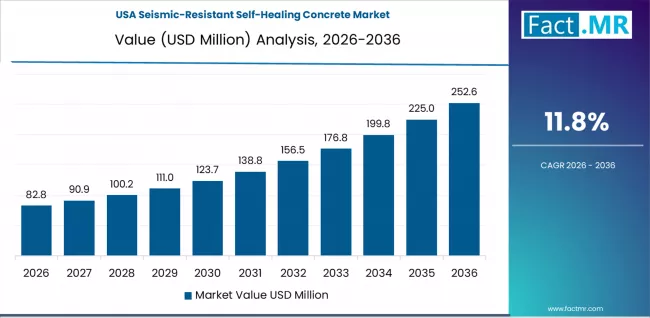
Seismic Resistant Self Healing Concrete Market Country Value Analysis

The USA's 11.80% growth is characterized by a significant focus on retrofitting aging critical infrastructure and a strong economic model that prioritizes lifecycle costs over initial capital expenditure.

For transport departments and facility owners, self-healing concrete presents a value proposition of reduced future repair costs and extended service intervals. Adoption is often driven by public-private partnerships and demonstrations on high-visibility projects, with success hinging on clear data showing long-term maintenance savings.

How is Germany's Engineering Precision and Sustainable Construction Leadership Shaping Demand?

Germany's 10.90% CAGR reflects its engineering excellence and leadership in sustainable construction standards. The demand is for highly characterized, predictable additive systems with comprehensive technical data sheets and environmental product declarations.

German adoption is methodical, relying on extensive laboratory and field validation to ensure additives meet precise performance criteria for durability and are compatible with the country's high standards for concrete quality and sustainable resource use.

What Role does Japan's Seismic Technology Leadership and Focus on Functional Recovery Play?

Japan's 10.60% growth occurs in the world's most seismically advanced market, where building codes already emphasize damage control. The focus has shifted toward ensuring rapid functional recovery of structures.

This drives demand for self-healing additives that work in concert with other seismic damping and isolation technologies to minimize business interruption. Japanese innovation is at the forefront, often exploring sophisticated biomimetic or polymer-based healing systems for application in premium and critical infrastructure projects.

Competitive Landscape of the Seismic-Resistant Self-Healing Concrete Additives Market

Seismic Resistant Self Healing Concrete Market Analysis By Company

Global specialty chemical and construction material conglomerates with deep R&D capabilities and established channels to concrete producers and engineering firms dominate the competitive landscape.

Competition centers on proprietary formulations, securing intellectual property around specific healing mechanisms, and building a portfolio of successful case studies and technical approvals.

Success increasingly depends on collaborative development with leading universities and research bodies, the ability to provide complete system solutions that include dosage guidelines and compatibility data with other admixtures, and effective engagement with standards organizations to shape future material specifications.

Key Players in the Seismic-Resistant Self-Healing Concrete Additives Market

  • BASF SE
  • Sika AG
  • GCP Applied Technologies
  • MAPEI S.p.A.
  • W. R. Grace & Co.

Scope of Report

Items Values
Quantitative Units USD Million
Additive Type Microcapsule-Based Healing Agents, Bacterial / Biogenic Agents, Shape-Memory Polymers, Nano-Mineral Fibers & Powders, Others
Mechanism Autogenous Healing Enhancement, Autonomic Self-Healing Systems, Hybrid Composite Healing, Seismic Microcrack Mitigation
Application High-Rise & Infrastructure, Bridges & Flyovers, Tunnels & Underground Works, Industrial Flooring & Foundations
Key Countries China, India, USA, Germany, Japan
Key Companies BASF SE, Sika AG, GCP Applied Technologies, MAPEI S.p.A., W. R. Grace & Co.
Additional Analysis Long-term durability and healing efficiency studies under cyclical loading; compatibility and synergy analysis with other concrete admixtures; life cycle cost-benefit modeling for infrastructure projects; impact on concrete's fire resistance and other durability parameters; development of non-destructive testing methods to evaluate healing in situ; analysis of regulatory pathways and building code acceptance for novel self-healing materials.

Market by Segments

  • Additive Type :

    • Microcapsule-Based Healing Agents
    • Bacterial/Biogenic Agents
    • Shape-Memory Polymers
    • Nano-Mineral Fibers & Powders
    • Others
  • Mechanism :

    • Autogenous Healing Enhancement
    • Autonomic Self-Healing Systems
    • Hybrid Composite Healing
    • Seismic Microcrack Mitigation
  • Application :

    • High-Rise & Infrastructure
    • Bridges & Flyovers
    • Tunnels & Underground Works
    • Industrial Flooring & Foundations
  • Region :

    • North America
      • USA
      • Canada
    • Latin America
      • Brazil
      • Mexico
      • Chile
      • Rest of Latin America
    • Western Europe
      • Germany
      • France
      • UK
      • Italy
      • Spain
      • BENELUX
      • Rest of Western Europe
    • Eastern Europe
      • Russia
      • Poland
      • Czech Republic
      • Rest of Eastern Europe
    • East Asia
      • China
      • Japan
      • South Korea
      • Rest of East Asia
    • South Asia & Pacific
      • India
      • ASEAN
      • Australia
      • Rest of South Asia & Pacific
    • MEA
      • GCC Countries
      • Turkiye
      • Rest of MEA

References

  • De Belie, N., & Gruyaert, E. 2023. Self-Healing Phenomena in Cement-Based Materials. RILEM State-of-the-Art Reports.
  • Federation Internationale du Beton. 2022. Guidelines for the Use of Self-Healing Concrete. fib Bulletin.
  • Jonkers, H. M., & Schlangen, E. 2024. Bacteria-Based Self-Healing Concrete. Journal of Advanced Concrete Technology.
  • Li, V. C., & Herbert, E. 2022. Robust Self-Healing Concrete for Sustainable Infrastructure. Journal of Advanced Concrete Technology.
  • National Institute of Standards and Technology. 2023. Measurement Science for Self-Healing Cementitious Materials. NIST Special Publication.
  • Pacheco-Torgal, F., & Labrincha, J. A. 2023. Biotech Cementitious Materials: Some Aspects of an Innovative Approach. Construction and Building Materials.
  • Qian, S., & Zhou, J. 2024. Microfluidic Fabrication of Microcapsules for Self-Healing Concrete. Materials & Design.
  • Van Tittelboom, K., & De Belie, N. 2023. Self-Healing Concrete Through Incorporation of Encapsulated Healing Agents. Smart Materials and Structures.
  • Wang, J., & Van Breugel, K. 2022. Promising Cementitious Composites for Sustainable Infrastructure. Cement and Concrete Research.
  • White, S. R., & Sottos, N. R. 2024. Autonomic Healing of Polymer Composites. Nature.

Table of Content

  1. Executive Summary
    • Global Market Outlook
    • Demand to side Trends
    • Supply to side Trends
    • Technology Roadmap Analysis
    • Analysis and Recommendations
  2. Market Overview
    • Market Coverage / Taxonomy
    • Market Definition / Scope / Limitations
  3. Market Background
    • Market Dynamics
      • Drivers
      • Restraints
      • Opportunity
      • Trends
    • Scenario Forecast
      • Demand in Optimistic Scenario
      • Demand in Likely Scenario
      • Demand in Conservative Scenario
    • Opportunity Map Analysis
    • Product Life Cycle Analysis
    • Supply Chain Analysis
    • Investment Feasibility Matrix
    • Value Chain Analysis
    • PESTLE and Porter’s Analysis
    • Regulatory Landscape
    • Regional Parent Market Outlook
    • Production and Consumption Statistics
    • Import and Export Statistics
  4. Global Market Analysis 2021 to 2025 and Forecast, 2026 to 2036
    • Historical Market Size Value (USD Million) Analysis, 2021 to 2025
    • Current and Future Market Size Value (USD Million) Projections, 2026 to 2036
      • Y to o to Y Growth Trend Analysis
      • Absolute $ Opportunity Analysis
  5. Global Market Pricing Analysis 2021 to 2025 and Forecast 2026 to 2036
  6. Global Market Analysis 2021 to 2025 and Forecast 2026 to 2036, By Additive Type
    • Introduction / Key Findings
    • Historical Market Size Value (USD Million) Analysis By Additive Type, 2021 to 2025
    • Current and Future Market Size Value (USD Million) Analysis and Forecast By Additive Type, 2026 to 2036
      • Microcapsule-Based Healing Agents
      • Bacterial / Biogenic Agents
      • Shape-Memory Polymers
      • Nano-Mineral Fibers & Powders
      • Others
    • Y to o to Y Growth Trend Analysis By Additive Type, 2021 to 2025
    • Absolute $ Opportunity Analysis By Additive Type, 2026 to 2036
  7. Global Market Analysis 2021 to 2025 and Forecast 2026 to 2036, By Mechanism
    • Introduction / Key Findings
    • Historical Market Size Value (USD Million) Analysis By Mechanism, 2021 to 2025
    • Current and Future Market Size Value (USD Million) Analysis and Forecast By Mechanism, 2026 to 2036
      • Autogenous Healing Enhancement
      • Autonomic Self-Healing Systems
      • Hybrid Composite Healing
      • Seismic Microcrack Mitigation
    • Y to o to Y Growth Trend Analysis By Mechanism, 2021 to 2025
    • Absolute $ Opportunity Analysis By Mechanism, 2026 to 2036
  8. Global Market Analysis 2021 to 2025 and Forecast 2026 to 2036, By Application
    • Introduction / Key Findings
    • Historical Market Size Value (USD Million) Analysis By Application, 2021 to 2025
    • Current and Future Market Size Value (USD Million) Analysis and Forecast By Application, 2026 to 2036
      • High-Rise & Infrastructure
      • Bridges & Flyovers
      • Tunnels & Underground Works
      • Industrial Flooring & Foundations
    • Y to o to Y Growth Trend Analysis By Application, 2021 to 2025
    • Absolute $ Opportunity Analysis By Application, 2026 to 2036
  9. Global Market Analysis 2021 to 2025 and Forecast 2026 to 2036, By Region
    • Introduction
    • Historical Market Size Value (USD Million) Analysis By Region, 2021 to 2025
    • Current Market Size Value (USD Million) Analysis and Forecast By Region, 2026 to 2036
      • North America
      • Latin America
      • Western Europe
      • Eastern Europe
      • East Asia
      • South Asia and Pacific
      • Middle East & Africa
    • Market Attractiveness Analysis By Region
  10. North America Market Analysis 2021 to 2025 and Forecast 2026 to 2036, By Country
    • Historical Market Size Value (USD Million) Trend Analysis By Market Taxonomy, 2021 to 2025
    • Market Size Value (USD Million) Forecast By Market Taxonomy, 2026 to 2036
      • By Country
        • USA
        • Canada
        • Mexico
      • By Additive Type
      • By Mechanism
      • By Application
    • Market Attractiveness Analysis
      • By Country
      • By Additive Type
      • By Mechanism
      • By Application
    • Key Takeaways
  11. Latin America Market Analysis 2021 to 2025 and Forecast 2026 to 2036, By Country
    • Historical Market Size Value (USD Million) Trend Analysis By Market Taxonomy, 2021 to 2025
    • Market Size Value (USD Million) Forecast By Market Taxonomy, 2026 to 2036
      • By Country
        • Brazil
        • Chile
        • Rest of Latin America
      • By Additive Type
      • By Mechanism
      • By Application
    • Market Attractiveness Analysis
      • By Country
      • By Additive Type
      • By Mechanism
      • By Application
    • Key Takeaways
  12. Western Europe Market Analysis 2021 to 2025 and Forecast 2026 to 2036, By Country
    • Historical Market Size Value (USD Million) Trend Analysis By Market Taxonomy, 2021 to 2025
    • Market Size Value (USD Million) Forecast By Market Taxonomy, 2026 to 2036
      • By Country
        • Germany
        • UK
        • Italy
        • Spain
        • France
        • Nordic
        • BENELUX
        • Rest of Western Europe
      • By Additive Type
      • By Mechanism
      • By Application
    • Market Attractiveness Analysis
      • By Country
      • By Additive Type
      • By Mechanism
      • By Application
    • Key Takeaways
  13. Eastern Europe Market Analysis 2021 to 2025 and Forecast 2026 to 2036, By Country
    • Historical Market Size Value (USD Million) Trend Analysis By Market Taxonomy, 2021 to 2025
    • Market Size Value (USD Million) Forecast By Market Taxonomy, 2026 to 2036
      • By Country
        • Russia
        • Poland
        • Hungary
        • Balkan & Baltic
        • Rest of Eastern Europe
      • By Additive Type
      • By Mechanism
      • By Application
    • Market Attractiveness Analysis
      • By Country
      • By Additive Type
      • By Mechanism
      • By Application
    • Key Takeaways
  14. East Asia Market Analysis 2021 to 2025 and Forecast 2026 to 2036, By Country
    • Historical Market Size Value (USD Million) Trend Analysis By Market Taxonomy, 2021 to 2025
    • Market Size Value (USD Million) Forecast By Market Taxonomy, 2026 to 2036
      • By Country
        • China
        • Japan
        • South Korea
      • By Additive Type
      • By Mechanism
      • By Application
    • Market Attractiveness Analysis
      • By Country
      • By Additive Type
      • By Mechanism
      • By Application
    • Key Takeaways
  15. South Asia and Pacific Market Analysis 2021 to 2025 and Forecast 2026 to 2036, By Country
    • Historical Market Size Value (USD Million) Trend Analysis By Market Taxonomy, 2021 to 2025
    • Market Size Value (USD Million) Forecast By Market Taxonomy, 2026 to 2036
      • By Country
        • India
        • ASEAN
        • Australia & New Zealand
        • Rest of South Asia and Pacific
      • By Additive Type
      • By Mechanism
      • By Application
    • Market Attractiveness Analysis
      • By Country
      • By Additive Type
      • By Mechanism
      • By Application
    • Key Takeaways
  16. Middle East & Africa Market Analysis 2021 to 2025 and Forecast 2026 to 2036, By Country
    • Historical Market Size Value (USD Million) Trend Analysis By Market Taxonomy, 2021 to 2025
    • Market Size Value (USD Million) Forecast By Market Taxonomy, 2026 to 2036
      • By Country
        • Kingdom of Saudi Arabia
        • Other GCC Countries
        • Turkiye
        • South Africa
        • Other African Union
        • Rest of Middle East & Africa
      • By Additive Type
      • By Mechanism
      • By Application
    • Market Attractiveness Analysis
      • By Country
      • By Additive Type
      • By Mechanism
      • By Application
    • Key Takeaways
  17. Key Countries Market Analysis
    • USA
      • Pricing Analysis
      • Market Share Analysis, 2025
        • By Additive Type
        • By Mechanism
        • By Application
    • Canada
      • Pricing Analysis
      • Market Share Analysis, 2025
        • By Additive Type
        • By Mechanism
        • By Application
    • Mexico
      • Pricing Analysis
      • Market Share Analysis, 2025
        • By Additive Type
        • By Mechanism
        • By Application
    • Brazil
      • Pricing Analysis
      • Market Share Analysis, 2025
        • By Additive Type
        • By Mechanism
        • By Application
    • Chile
      • Pricing Analysis
      • Market Share Analysis, 2025
        • By Additive Type
        • By Mechanism
        • By Application
    • Germany
      • Pricing Analysis
      • Market Share Analysis, 2025
        • By Additive Type
        • By Mechanism
        • By Application
    • UK
      • Pricing Analysis
      • Market Share Analysis, 2025
        • By Additive Type
        • By Mechanism
        • By Application
    • Italy
      • Pricing Analysis
      • Market Share Analysis, 2025
        • By Additive Type
        • By Mechanism
        • By Application
    • Spain
      • Pricing Analysis
      • Market Share Analysis, 2025
        • By Additive Type
        • By Mechanism
        • By Application
    • France
      • Pricing Analysis
      • Market Share Analysis, 2025
        • By Additive Type
        • By Mechanism
        • By Application
    • India
      • Pricing Analysis
      • Market Share Analysis, 2025
        • By Additive Type
        • By Mechanism
        • By Application
    • ASEAN
      • Pricing Analysis
      • Market Share Analysis, 2025
        • By Additive Type
        • By Mechanism
        • By Application
    • Australia & New Zealand
      • Pricing Analysis
      • Market Share Analysis, 2025
        • By Additive Type
        • By Mechanism
        • By Application
    • China
      • Pricing Analysis
      • Market Share Analysis, 2025
        • By Additive Type
        • By Mechanism
        • By Application
    • Japan
      • Pricing Analysis
      • Market Share Analysis, 2025
        • By Additive Type
        • By Mechanism
        • By Application
    • South Korea
      • Pricing Analysis
      • Market Share Analysis, 2025
        • By Additive Type
        • By Mechanism
        • By Application
    • Russia
      • Pricing Analysis
      • Market Share Analysis, 2025
        • By Additive Type
        • By Mechanism
        • By Application
    • Poland
      • Pricing Analysis
      • Market Share Analysis, 2025
        • By Additive Type
        • By Mechanism
        • By Application
    • Hungary
      • Pricing Analysis
      • Market Share Analysis, 2025
        • By Additive Type
        • By Mechanism
        • By Application
    • Kingdom of Saudi Arabia
      • Pricing Analysis
      • Market Share Analysis, 2025
        • By Additive Type
        • By Mechanism
        • By Application
    • Turkiye
      • Pricing Analysis
      • Market Share Analysis, 2025
        • By Additive Type
        • By Mechanism
        • By Application
    • South Africa
      • Pricing Analysis
      • Market Share Analysis, 2025
        • By Additive Type
        • By Mechanism
        • By Application
  18. Market Structure Analysis
    • Competition Dashboard
    • Competition Benchmarking
    • Market Share Analysis of Top Players
      • By Regional
      • By Additive Type
      • By Mechanism
      • By Application
  19. Competition Analysis
    • Competition Deep Dive
      • BASF SE (Concrete Additives)
        • Overview
        • Product Portfolio
        • Profitability by Market Segments (Product/Age /Sales Channel/Region)
        • Sales Footprint
        • Strategy Overview
          • Marketing Strategy
          • Product Strategy
          • Channel Strategy
      • Sika AG
      • GCP Applied Technologies
      • MAPEI S.p.A.
      • W. R. Grace & Co.
      • Others
  20. Assumptions & Acronyms Used
  21. Research Methodology

List Of Table

  • Table 1: Global Market Value (USD Million) Forecast by Region, 2021 to 2036
  • Table 2: Global Market Value (USD Million) Forecast by Additive Type, 2021 to 2036
  • Table 3: Global Market Value (USD Million) Forecast by Mechanism, 2021 to 2036
  • Table 4: Global Market Value (USD Million) Forecast by Application, 2021 to 2036
  • Table 5: North America Market Value (USD Million) Forecast by Country, 2021 to 2036
  • Table 6: North America Market Value (USD Million) Forecast by Additive Type, 2021 to 2036
  • Table 7: North America Market Value (USD Million) Forecast by Mechanism, 2021 to 2036
  • Table 8: North America Market Value (USD Million) Forecast by Application, 2021 to 2036
  • Table 9: Latin America Market Value (USD Million) Forecast by Country, 2021 to 2036
  • Table 10: Latin America Market Value (USD Million) Forecast by Additive Type, 2021 to 2036
  • Table 11: Latin America Market Value (USD Million) Forecast by Mechanism, 2021 to 2036
  • Table 12: Latin America Market Value (USD Million) Forecast by Application, 2021 to 2036
  • Table 13: Western Europe Market Value (USD Million) Forecast by Country, 2021 to 2036
  • Table 14: Western Europe Market Value (USD Million) Forecast by Additive Type, 2021 to 2036
  • Table 15: Western Europe Market Value (USD Million) Forecast by Mechanism, 2021 to 2036
  • Table 16: Western Europe Market Value (USD Million) Forecast by Application, 2021 to 2036
  • Table 17: Eastern Europe Market Value (USD Million) Forecast by Country, 2021 to 2036
  • Table 18: Eastern Europe Market Value (USD Million) Forecast by Additive Type, 2021 to 2036
  • Table 19: Eastern Europe Market Value (USD Million) Forecast by Mechanism, 2021 to 2036
  • Table 20: Eastern Europe Market Value (USD Million) Forecast by Application, 2021 to 2036
  • Table 21: East Asia Market Value (USD Million) Forecast by Country, 2021 to 2036
  • Table 22: East Asia Market Value (USD Million) Forecast by Additive Type, 2021 to 2036
  • Table 23: East Asia Market Value (USD Million) Forecast by Mechanism, 2021 to 2036
  • Table 24: East Asia Market Value (USD Million) Forecast by Application, 2021 to 2036
  • Table 25: South Asia and Pacific Market Value (USD Million) Forecast by Country, 2021 to 2036
  • Table 26: South Asia and Pacific Market Value (USD Million) Forecast by Additive Type, 2021 to 2036
  • Table 27: South Asia and Pacific Market Value (USD Million) Forecast by Mechanism, 2021 to 2036
  • Table 28: South Asia and Pacific Market Value (USD Million) Forecast by Application, 2021 to 2036
  • Table 29: Middle East & Africa Market Value (USD Million) Forecast by Country, 2021 to 2036
  • Table 30: Middle East & Africa Market Value (USD Million) Forecast by Additive Type, 2021 to 2036
  • Table 31: Middle East & Africa Market Value (USD Million) Forecast by Mechanism, 2021 to 2036
  • Table 32: Middle East & Africa Market Value (USD Million) Forecast by Application, 2021 to 2036

List Of Figures

  • Figure 1: Global Market Pricing Analysis
  • Figure 2: Global Market Value (USD Million) Forecast 2021-2036
  • Figure 3: Global Market Value Share and BPS Analysis by Additive Type, 2026 and 2036
  • Figure 4: Global Market Y to o to Y Growth Comparison by Additive Type, 2026 to 2036
  • Figure 5: Global Market Attractiveness Analysis by Additive Type
  • Figure 6: Global Market Value Share and BPS Analysis by Mechanism, 2026 and 2036
  • Figure 7: Global Market Y to o to Y Growth Comparison by Mechanism, 2026 to 2036
  • Figure 8: Global Market Attractiveness Analysis by Mechanism
  • Figure 9: Global Market Value Share and BPS Analysis by Application, 2026 and 2036
  • Figure 10: Global Market Y to o to Y Growth Comparison by Application, 2026 to 2036
  • Figure 11: Global Market Attractiveness Analysis by Application
  • Figure 12: Global Market Value (USD Million) Share and BPS Analysis by Region, 2026 and 2036
  • Figure 13: Global Market Y to o to Y Growth Comparison by Region, 2026 to 2036
  • Figure 14: Global Market Attractiveness Analysis by Region
  • Figure 15: North America Market Incremental Dollar Opportunity, 2026 to 2036
  • Figure 16: Latin America Market Incremental Dollar Opportunity, 2026 to 2036
  • Figure 17: Western Europe Market Incremental Dollar Opportunity, 2026 to 2036
  • Figure 18: Eastern Europe Market Incremental Dollar Opportunity, 2026 to 2036
  • Figure 19: East Asia Market Incremental Dollar Opportunity, 2026 to 2036
  • Figure 20: South Asia and Pacific Market Incremental Dollar Opportunity, 2026 to 2036
  • Figure 21: Middle East & Africa Market Incremental Dollar Opportunity, 2026 to 2036
  • Figure 22: North America Market Value Share and BPS Analysis by Country, 2026 and 2036
  • Figure 23: North America Market Value Share and BPS Analysis by Additive Type, 2026 and 2036
  • Figure 24: North America Market Y to o to Y Growth Comparison by Additive Type, 2026 to 2036
  • Figure 25: North America Market Attractiveness Analysis by Additive Type
  • Figure 26: North America Market Value Share and BPS Analysis by Mechanism, 2026 and 2036
  • Figure 27: North America Market Y to o to Y Growth Comparison by Mechanism, 2026 to 2036
  • Figure 28: North America Market Attractiveness Analysis by Mechanism
  • Figure 29: North America Market Value Share and BPS Analysis by Application, 2026 and 2036
  • Figure 30: North America Market Y to o to Y Growth Comparison by Application, 2026 to 2036
  • Figure 31: North America Market Attractiveness Analysis by Application
  • Figure 32: Latin America Market Value Share and BPS Analysis by Country, 2026 and 2036
  • Figure 33: Latin America Market Value Share and BPS Analysis by Additive Type, 2026 and 2036
  • Figure 34: Latin America Market Y to o to Y Growth Comparison by Additive Type, 2026 to 2036
  • Figure 35: Latin America Market Attractiveness Analysis by Additive Type
  • Figure 36: Latin America Market Value Share and BPS Analysis by Mechanism, 2026 and 2036
  • Figure 37: Latin America Market Y to o to Y Growth Comparison by Mechanism, 2026 to 2036
  • Figure 38: Latin America Market Attractiveness Analysis by Mechanism
  • Figure 39: Latin America Market Value Share and BPS Analysis by Application, 2026 and 2036
  • Figure 40: Latin America Market Y to o to Y Growth Comparison by Application, 2026 to 2036
  • Figure 41: Latin America Market Attractiveness Analysis by Application
  • Figure 42: Western Europe Market Value Share and BPS Analysis by Country, 2026 and 2036
  • Figure 43: Western Europe Market Value Share and BPS Analysis by Additive Type, 2026 and 2036
  • Figure 44: Western Europe Market Y to o to Y Growth Comparison by Additive Type, 2026 to 2036
  • Figure 45: Western Europe Market Attractiveness Analysis by Additive Type
  • Figure 46: Western Europe Market Value Share and BPS Analysis by Mechanism, 2026 and 2036
  • Figure 47: Western Europe Market Y to o to Y Growth Comparison by Mechanism, 2026 to 2036
  • Figure 48: Western Europe Market Attractiveness Analysis by Mechanism
  • Figure 49: Western Europe Market Value Share and BPS Analysis by Application, 2026 and 2036
  • Figure 50: Western Europe Market Y to o to Y Growth Comparison by Application, 2026 to 2036
  • Figure 51: Western Europe Market Attractiveness Analysis by Application
  • Figure 52: Eastern Europe Market Value Share and BPS Analysis by Country, 2026 and 2036
  • Figure 53: Eastern Europe Market Value Share and BPS Analysis by Additive Type, 2026 and 2036
  • Figure 54: Eastern Europe Market Y to o to Y Growth Comparison by Additive Type, 2026 to 2036
  • Figure 55: Eastern Europe Market Attractiveness Analysis by Additive Type
  • Figure 56: Eastern Europe Market Value Share and BPS Analysis by Mechanism, 2026 and 2036
  • Figure 57: Eastern Europe Market Y to o to Y Growth Comparison by Mechanism, 2026 to 2036
  • Figure 58: Eastern Europe Market Attractiveness Analysis by Mechanism
  • Figure 59: Eastern Europe Market Value Share and BPS Analysis by Application, 2026 and 2036
  • Figure 60: Eastern Europe Market Y to o to Y Growth Comparison by Application, 2026 to 2036
  • Figure 61: Eastern Europe Market Attractiveness Analysis by Application
  • Figure 62: East Asia Market Value Share and BPS Analysis by Country, 2026 and 2036
  • Figure 63: East Asia Market Value Share and BPS Analysis by Additive Type, 2026 and 2036
  • Figure 64: East Asia Market Y to o to Y Growth Comparison by Additive Type, 2026 to 2036
  • Figure 65: East Asia Market Attractiveness Analysis by Additive Type
  • Figure 66: East Asia Market Value Share and BPS Analysis by Mechanism, 2026 and 2036
  • Figure 67: East Asia Market Y to o to Y Growth Comparison by Mechanism, 2026 to 2036
  • Figure 68: East Asia Market Attractiveness Analysis by Mechanism
  • Figure 69: East Asia Market Value Share and BPS Analysis by Application, 2026 and 2036
  • Figure 70: East Asia Market Y to o to Y Growth Comparison by Application, 2026 to 2036
  • Figure 71: East Asia Market Attractiveness Analysis by Application
  • Figure 72: South Asia and Pacific Market Value Share and BPS Analysis by Country, 2026 and 2036
  • Figure 73: South Asia and Pacific Market Value Share and BPS Analysis by Additive Type, 2026 and 2036
  • Figure 74: South Asia and Pacific Market Y to o to Y Growth Comparison by Additive Type, 2026 to 2036
  • Figure 75: South Asia and Pacific Market Attractiveness Analysis by Additive Type
  • Figure 76: South Asia and Pacific Market Value Share and BPS Analysis by Mechanism, 2026 and 2036
  • Figure 77: South Asia and Pacific Market Y to o to Y Growth Comparison by Mechanism, 2026 to 2036
  • Figure 78: South Asia and Pacific Market Attractiveness Analysis by Mechanism
  • Figure 79: South Asia and Pacific Market Value Share and BPS Analysis by Application, 2026 and 2036
  • Figure 80: South Asia and Pacific Market Y to o to Y Growth Comparison by Application, 2026 to 2036
  • Figure 81: South Asia and Pacific Market Attractiveness Analysis by Application
  • Figure 82: Middle East & Africa Market Value Share and BPS Analysis by Country, 2026 and 2036
  • Figure 83: Middle East & Africa Market Value Share and BPS Analysis by Additive Type, 2026 and 2036
  • Figure 84: Middle East & Africa Market Y to o to Y Growth Comparison by Additive Type, 2026 to 2036
  • Figure 85: Middle East & Africa Market Attractiveness Analysis by Additive Type
  • Figure 86: Middle East & Africa Market Value Share and BPS Analysis by Mechanism, 2026 and 2036
  • Figure 87: Middle East & Africa Market Y to o to Y Growth Comparison by Mechanism, 2026 to 2036
  • Figure 88: Middle East & Africa Market Attractiveness Analysis by Mechanism
  • Figure 89: Middle East & Africa Market Value Share and BPS Analysis by Application, 2026 and 2036
  • Figure 90: Middle East & Africa Market Y to o to Y Growth Comparison by Application, 2026 to 2036
  • Figure 91: Middle East & Africa Market Attractiveness Analysis by Application
  • Figure 92: Global Market - Tier Structure Analysis
  • Figure 93: Global Market - Company Share Analysis

- FAQs -

How big is the seismic-resistant self-healing concrete market in 2026?

The global seismic-resistant self-healing concrete market is estimated to be valued at USD 148.0 million in 2026.

What will be the size of seismic-resistant self-healing concrete market in 2036?

The market size for the seismic-resistant self-healing concrete market is projected to reach USD 472.1 million by 2036.

How much will be the seismic-resistant self-healing concrete market growth between 2026 and 2036?

The seismic-resistant self-healing concrete market is expected to grow at a 12.3% CAGR between 2026 and 2036.

What are the key product types in the seismic-resistant self-healing concrete market?

The key product types in seismic-resistant self-healing concrete market are microcapsule-based healing agents, bacterial / biogenic agents, shape-memory polymers, nano-mineral fibers & powders and others.

Which mechanism segment to contribute significant share in the seismic-resistant self-healing concrete market in 2026?

In terms of mechanism, autogenous healing enhancement segment to command 41.0% share in the seismic-resistant self-healing concrete market in 2026.
Seismic-Resistant Self-Healing Concrete Market