- Market Value (2025): USD 2539.4 Mn
- Estimated Value (2026): USD 2740.0 Mn
- Forecast Value (2036): USD 5860.9 Mn
- CAGR (2026-2036): 7.9%
What is the Eco-Efficient Baking Lines Market forecast to be worth by 2036?
The Eco-Efficient Baking Lines Market is projected to reach USD 5,860.9 million by 2036, from USD 2,740.0 million in 2026, at a 7.9% CAGR.
- The market stood at USD 2,539.4 million in 2025.
- Demand is valued at USD 2,740.0 million in 2026 and is forecast to reach USD 5,860.9 million by 2036.
- Growth is projected at 7.9% CAGR from 2026 to 2036. Bakeries are evaluating coordinated line upgrades that reduce resource use at the production rate they can actually sustain.
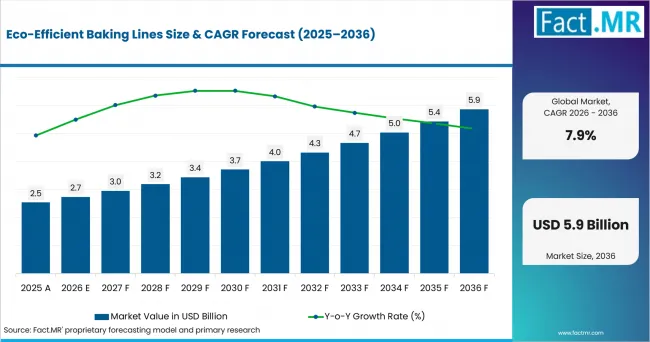
Eco Efficient Baking Lines Value Analysis | Source: Fact.MR
What are the defining numbers behind Eco-Efficient Baking Lines Market growth?
The absolute opportunity between 2026 and 2036 is USD 3,120.9 million. The additional revenue comes from replacing or extending production lines with a demonstrable operating advantage. A new oven is most valuable when the surrounding equipment can use its capacity without creating another bottleneck.
- Demand Drivers in the Market
- Bakeries renewing long-serving equipment can combine capacity replacement with better thermal control. Procurement then moves beyond oven purchase price to energy use per unit of acceptable product.
- Mixed production schedules leave equipment running between recipes or during downstream interruptions. Coordinated industrial controls can reduce avoidable idle operation while maintaining the conditions needed to restart reliably.
- The U.S. Department of Energy's process-heating guidance emphasizes a system approach to heat generation, use and loss. For baking plants, this supports assessing the complete thermal process before specifying a replacement line.
- Hygienic equipment design remains a purchasing requirement when resource use is reduced. The FDA's equipment provisions address adequate cleaning and maintenance, so a low-water cleaning concept still needs to deliver the required sanitary result.
- Key Segments Analyzed
- Within Line Type, the Bread lines segment holds a 31.0% share in 2026. Regular production runs allow coordinated handling, proofing and baking improvements to influence recurring operating costs.
- The High-efficiency ovens segment leads Efficiency Lever with 29.0% of 2026 revenue. Oven performance directly affects the heat required to achieve the intended product condition.
- For Fuel / Heat, 34.0% of 2026 revenue comes from the Gas direct-fired segment. Existing gas infrastructure and familiar baking profiles support replacement decisions within established plants.
- The leading Automation segment is Fully automatic, accounting for 48.0% in 2026. Linked operations can hold the process sequence steady and reduce manual variation between stages.
- Analyst Opinion at Fact.MR
- Shambhu Nath Jha, Senior Consultant, Fact.MR.“A bakery should buy against the resource cost of good product leaving the line. Rated oven efficiency has limited value if upstream variation produces rejects or the packing end repeatedly stops production. The supplier has to show how the stages work together at the customer's normal product mix.”
- Strategic Implications
- Equipment suppliers should define acceptance tests around recipe mix, sustained output, reject rates and utility use. Demonstration runs need to resemble normal production rather than an unusually favorable operating point.
- Plant owners should map the constraint before replacing equipment. More baking capacity may require changes to proofing, cooling or packing to produce useful additional throughput.
- Engineering teams should plan metering and cleaning access during design. Retrofitting either after installation can disrupt production and weaken the operating case.
How does the Eco-Efficient Baking Lines Market break down by segment?
The market is segmented by Line Type, Efficiency Lever, Fuel / Heat, and Automation.
Why do Bread lines lead Line Type?
The Bread lines segment holds a 31.0% share of the Line Type category in 2026. Bread manufacture combines repeated process stages whose timing must remain coordinated. Changes in dough delivery or proofing can alter how the oven is loaded, affecting both quality and resource consumption.
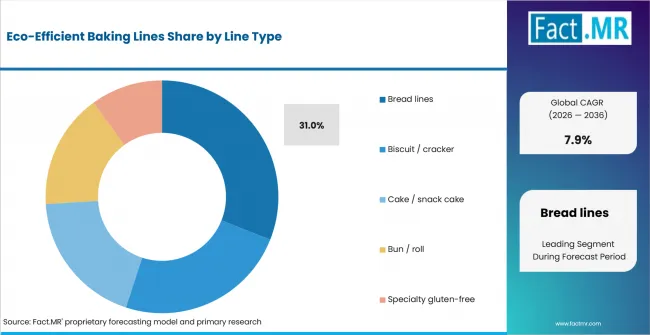
Eco Efficient Baking Lines Analysis By Line Type | Source: Fact.MR
A buyer can therefore assess the line through a recurring production cycle. Among food-processing equipment, bread-line investment has a clear link between operating discipline and usable output. Specialty products may require greater flexibility, but the economic comparison still needs to account for time spent changing and restarting recipes.
Why do High-efficiency ovens lead Efficiency Lever?
The High-efficiency ovens segment holds a 29.0% share of the Efficiency Lever category in 2026.
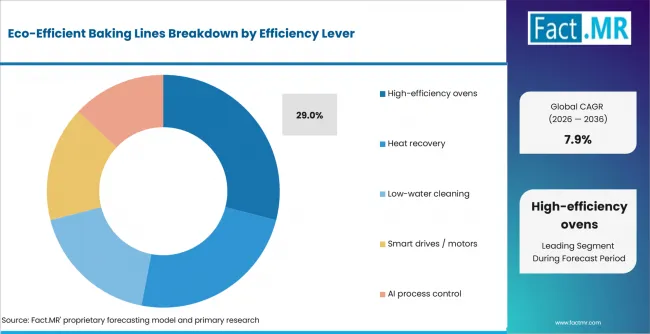
Eco Efficient Baking Lines Analysis By Efficiency Lever | Source: Fact.MR
The oven converts purchased energy into the required product condition, while also losing heat through exhaust, openings and its structure. Improving this balance can affect every production run, provided the product profile is preserved.
The operator needs control of the relevant baking zones and conditions across different loads. A more efficient oven cannot simply remove heat without considering moisture loss, crust development and the finished product. The useful specification is the baking result at a stated output and utility demand.
Why does the Gas direct-fired segment lead Fuel / Heat?
The Gas direct-fired segment holds a 34.0% share of the Fuel / Heat category in 2026.
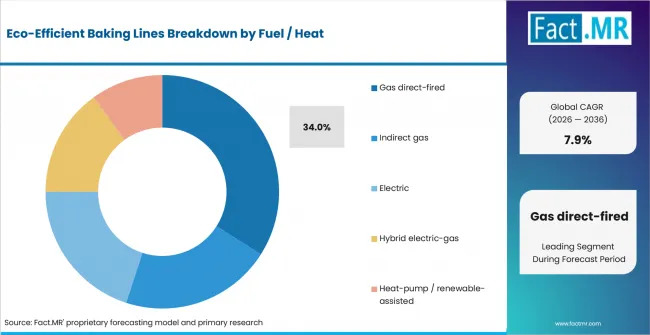
Eco Efficient Baking Lines Analysis By Fuel Heat | Source: Fact.MR
An existing plant may have gas supply, combustion expertise and recipes already matched to direct-fired equipment. Retaining that heat source can reduce the scope of a replacement project when electrical infrastructure or recipe redevelopment would otherwise be substantial.
Leadership in this category does not establish that gas is the lowest-cost option at every site. Electric and hybrid alternatives need to be compared using available capacity, tariffs, process requirements and operating hours. Future-ready utilities can be valuable even when the immediate investment retains a familiar heat source.
Why does the Fully automatic segment lead Automation?
The Fully automatic segment holds a 48.0% share of the Automation category in 2026.
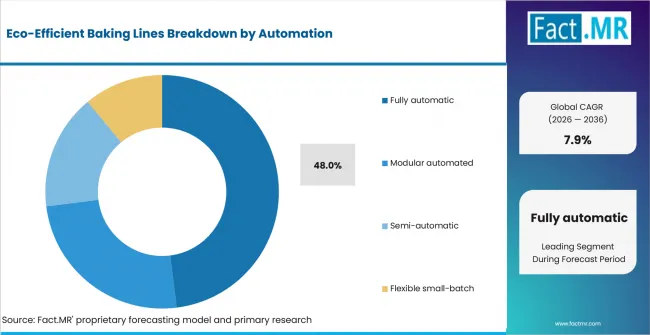
Eco Efficient Baking Lines Analysis By Automation | Source: Fact.MR
Automatic coordination can control transfers between processing stages and reduce variation caused by manual interventions. It also makes process information available for troubleshooting when output or quality drifts.
The commercial benefit depends on how the line responds to disturbances. A smart factory interface is useful when operators can identify an upstream cause, adjust the process and restore steady production. Automation that leaves the plant dependent on specialist support for routine changes can be less attractive to the buyer.
What is accelerating Eco-Efficient Baking Lines Market adoption, and what is holding it back?
The investment case strengthens when energy, cleaning and rejected product are measured against saleable output. This can reveal losses that are hidden when a bakery compares only monthly utility bills or equipment nameplate ratings.
Installation disruption remains a serious constraint. A new line has to fit the building, utilities and production calendar, and customers may have limited time to validate recipes before normal supply resumes. Suppliers capable of managing that transition can influence the decision as much as the equipment's stated efficiency.
Fact.MR estimates the following directional effects on CAGR. The factors interact, so their impacts should not be added together.
Drivers Impact Analysis
| Factor | (~) % Impact on CAGR | Geographic Relevance | Impact Timeline |
|---|---|---|---|
| Replacement of inefficient thermal equipment | +1.0% | USA, Europe | 2026 to 2031 |
| Reduction of idle line operation | +0.7% | UK, Germany | 2026 to 2030 |
| Lower reject rates through coordinated control | +0.6% | Global | 2027 to 2033 |
Replacement demand becomes more compelling when a bakery can show persistent losses under normal operation. The resulting purchase may cover several linked stages rather than one isolated machine.
Opportunity Impact Analysis
| Factor | (~) % Impact on CAGR | Geographic Relevance | Impact Timeline |
|---|---|---|---|
| Hybrid heat readiness during line renewal | +0.6% | Europe, USA | 2028 to 2036 |
| Integrated recipe and utility monitoring | +0.5% | Germany, UK | 2026 to 2031 |
| Resource-efficient cleaning redesign | +0.4% | France, Italy | 2027 to 2032 |
Virtual commissioning can help engineering teams examine control sequences before installation. The value is reduced integration uncertainty, with final acceptance still dependent on the physical line and food process.
Restraints Impact Analysis
| Factor | (~) % Impact on CAGR | Geographic Relevance | Impact Timeline |
|---|---|---|---|
| Production losses during installation | -0.7% | Global | 2026 to 2036 |
| Electrical capacity and utility constraints | -0.5% | Europe, USA | 2027 to 2034 |
| Recipe requalification across product ranges | -0.4% | Global | 2026 to 2032 |
A favorable operating-cost model may still fail if the factory cannot absorb the installation outage. Staged conversion and a realistic recipe-validation plan can therefore determine whether an approved project proceeds.
Which countries are scaling the Eco-Efficient Baking Lines Market through 2036?
- USA: Equipment renewal can combine thermal improvements with the sanitary and maintenance requirements of established bakery plants.
- UK: Energy assessment and action-plan review encourage qualifying businesses to connect identified savings with investment decisions.
- Germany: Integrated process control offers a route to reduce thermal losses while maintaining tightly specified baking conditions.
- Italy: Biscuit and specialty bakery producers need efficiency improvements that preserve the recipe's texture and moisture profile.
- France: Cleaning, utility demand and product changeovers can be considered together when a bakery modernizes its line.
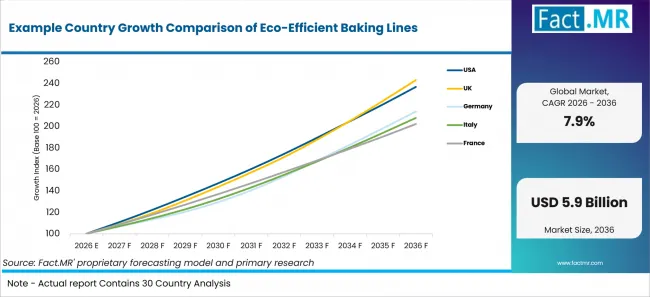
Example Country Growth Comparison Of Eco Efficient Baking Lines | Source: Fact.MR
Country CAGR (2026-2036)
| Country | CAGR (2026-2036) |
|---|---|
| USA | 9.0% |
| UK | 9.3% |
| Germany | 7.9% |
| Italy | 7.6% |
| France | 7.3% |
What is driving USA's growth through 2036?
The USA is forecast to expand at 9.0% CAGR through 2036.
DOE guidance gives plant engineers a basis for examining process-heating losses, while FDA equipment requirements keep sanitation and maintainability central to renewal decisions. These are complementary considerations in an operating bakery.
The commercial route is an equipment project that the maintenance and production teams can both support. Better insulation or burner control may strengthen the operating case, but the new arrangement also needs accessible surfaces, maintainable components and enough room for routine service. This favors suppliers that can fit an upgrade into the existing production environment.
What is driving UK's growth through 2036?
UK growth is projected at 9.3% CAGR from 2026 to 2036.
Current ESOS guidance requires relevant organizations to assess energy-saving opportunities and review progress against action plans. It does not require every bakery to purchase a new line, but it creates a structured occasion to examine avoidable consumption. [3]
A bakery running several product schedules can find that idle periods and repeated warm-up cycles weaken its economics. Controls, scheduling and equipment replacement may address different parts of the loss. Suppliers gain a clearer route to a purchase order when they connect the proposed change to an identified operating problem.
What is driving Germany's growth through 2036?
Germany carries a 7.9% CAGR forecast through 2036.
The EU best-available-techniques conclusions for food, drink and milk industries provide a relevant efficiency framework for installations within their scope. Their application is installation-specific, rather than a universal mandate for a particular oven technology.
In a tightly coordinated bakery, zone control and stable transfers can help reduce unnecessary process variation. Procurement is likely to favor a supplier that can demonstrate the required bake across the expected load range. The investment becomes easier to assess when the promised efficiency is linked to a measured process condition.
What is driving Italy's growth through 2036?
Italy is expected to record 7.6% CAGR over the forecast period. For biscuit, cracker and specialty bakery applications, a change in heat delivery can alter the finished product. The purchase therefore begins with recipe and process constraints rather than a generic move to a different fuel.
The EU food-industry BAT conclusions provide an efficiency context for applicable plants. Fact.MR expects equipment demand to emerge where manufacturers can improve heat use without sacrificing texture, shape or moisture control. Pilot trials and agreed production tests can make that tradeoff concrete before the line is ordered.
What is driving France's growth through 2036?
France's projected CAGR is 7.3% through 2036. A line modernization can address water use during cleaning alongside the energy used in baking and utilities. The EU food-industry BAT framework is relevant to that combined resource assessment for installations within its coverage.
The practical purchasing problem is to maintain hygienic access and an effective cleaning process while reducing unnecessary consumption. A design that saves water but lengthens the changeover may not improve factory output. Suppliers can differentiate by demonstrating how cleaning, recipe transitions and restart conditions fit into the same production schedule.
Who Leads the Eco-Efficient Baking Lines Market?
Key players in the Eco-Efficient Baking Lines Market include Bühler, GEA, Baker Perkins, Reading Bakery Systems, Rondo, and AMF Bakery Systems.
Competition spans thermal engineering, dough and batter handling, automation and service. Baker Perkins operates within Coperion's food-equipment portfolio following the integration of the former Schenck Process Food and Performance Materials business. This connects the baking brand with a wider range of process-equipment capabilities.
A complete-line supplier is judged on how its equipment connects to upstream preparation and downstream packaging automation. Customers also weigh local maintenance support, spare-parts access and recipe assistance. An isolated efficiency claim is less persuasive when the seller cannot explain the transition to sustained production.
Which companies are the key providers?
The key providers are Bühler, GEA, Baker Perkins, Reading Bakery Systems, Rondo, and AMF Bakery Systems.
- Bühler
- GEA
- Baker Perkins
- Reading Bakery Systems
- Rondo
- AMF Bakery Systems
Bibliography
- U.S. Department of Energy and Industrial Heating Equipment Association. (2015). Improving Process Heating System Performance: A Sourcebook for Industry, Third Edition. U.S. Department of Energy.
- U.S. Food and Drug Administration. (n.d.). 21 CFR 117.40: Equipment and utensils. Electronic Code of Federal Regulations.
- Environment Agency. (2026). Energy savings opportunity scheme: find out if you qualify and how to comply. UK Government.
- European Commission. (2019). Implementing Decision (EU) 2019/2031 establishing best available techniques conclusions for the food, drink and milk industries. Official Journal of the European Union.
- Coperion. (2024). The company formerly known as Schenck Process FPM has officially transitioned its name to Coperion. Coperion GmbH.
This Report Answers
- How can line coordination reduce resource cost per unit of saleable bakery output?
- Which line types, efficiency approaches, heat sources and automation levels lead in 2026?
- Where do installation outages and recipe trials constrain investment?
- What mechanisms support demand in the USA, UK, Germany, Italy and France?
- How do complete-line integration and service influence supplier selection?
What does the Eco-Efficient Baking Lines Market cover?
The market covers commercial baking lines and integrated line upgrades sold with functions intended to improve energy, water or process-resource efficiency. It includes coordinated production equipment for bread, biscuits and crackers, cakes and snack cakes, buns and rolls, and specialty gluten-free products.
What is included in the scope?
Included efficiency functions are high-efficiency ovens, heat recovery, low-water cleaning, smart drives and motors, and AI process control when incorporated into the baking line. Heat categories are direct and indirect gas, electric, hybrid electric-gas, and heat-pump or renewable-assisted arrangements.
Fully automatic, modular automated, semi-automatic and flexible small-batch configurations are included. Commercial value is counted at the line or attributable integrated-upgrade level, with equipment components counted once.
What is excluded from the scope?
Domestic ovens, retail baking appliances, ordinary ingredient sales and bakery-product revenues are excluded. Standalone energy consulting, utility supply and unrelated packaging machines are outside the line total.
Separately sold heat-recovery systems are assessed as a related category. When such a system is included in a complete baking-line contract, its value should not be added again when comparing the two markets.
How Was the Analysis Built?
- Primary Research: Relevant perspectives include bakery engineering directors, production supervisors, thermal-equipment designers, sanitation teams and line integrators. Commercial questions concern sustained throughput, utility demand, recipe validation and the available installation window.
- Desk Research: Technical evidence includes process-heating guidance, sanitary equipment requirements, energy-assessment guidance, food-industry BAT conclusions and manufacturer ownership information. These inform operating mechanisms and project constraints.
- Market Sizing and Forecasting: The assessment considers line installations and replacements, contract value, operating hours, product mix and the value of integrated efficiency upgrades. Energy savings are site-dependent operating variables, separate from equipment-market revenue.
- Data Validation and Update Cycle: Review checks forecast reconciliation, segment totals and consistent country coverage. Equipment boundaries are examined to prevent duplication of separately sold heat recovery or packaging equipment, while competitive review distinguishes brands from their parent businesses.
What is the report's scope and coverage?
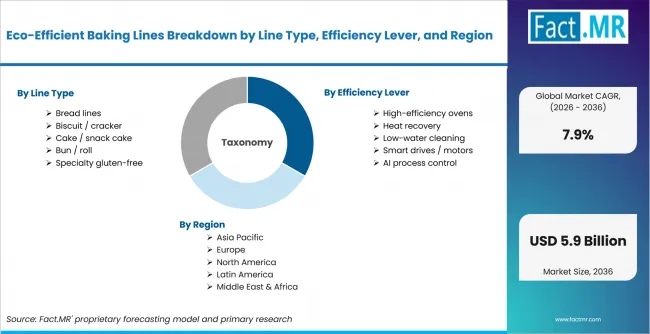
Eco Efficient Baking Lines Breakdown By Line Type, Efficiency Lever, And Region | Source: Fact.MR
| Attribute | Details |
|---|---|
| Quantitative Units | USD million |
| Market Definition | Commercial baking lines and integrated upgrades that improve energy, water or process-resource efficiency. |
| Segments Covered | Line Type; Efficiency Lever; Fuel / Heat; Automation |
| Regions Covered | Global |
| Countries Covered | USA; UK; Germany; Italy; France |
| Key Companies | Bühler, GEA, Baker Perkins, Reading Bakery Systems, Rondo, and AMF Bakery Systems |
| Historical Period | 2021 to 2025 |
| Base Year | 2025 |
| Forecast Period | 2026 to 2036 |
| Market Value, 2026 | USD 2,740.0 million |
| Market Value, 2036 | USD 5,860.9 million |
| CAGR, 2026-2036 | 7.9% |
| Absolute Opportunity | USD 3,120.9 million |
| Approach | Line-investment analysis combining equipment revenue with throughput, product-mix and resource-use considerations. |
How is the market segmented?
-
By Line Type
- Bread lines
- Biscuit / cracker
- Cake / snack cake
- Bun / roll
- Specialty gluten-free
-
By Efficiency Lever
- High-efficiency ovens
- Heat recovery
- Low-water cleaning
- Smart drives / motors
- AI process control
-
By Fuel / Heat
- Gas direct-fired
- Indirect gas
- Electric
- Hybrid electric-gas
- Heat-pump / renewable-assisted
-
By Automation
- Fully automatic
- Modular automated
- Semi-automatic
- Flexible small-batch