- Market Value (2025): USD 665.5 Mn
- Estimated Value (2026): USD 740.0 Mn
- Forecast Value (2036): USD 2139.3 Mn
- CAGR (2026-2036): 11.2%
What is the Heat-Recovery Baking Systems Market forecast to be worth by 2036?
The Heat-Recovery Baking Systems Market is projected to reach USD 2,139.3 million by 2036, from USD 740.0 million in 2026, at an 11.2% CAGR.
- The market stood at USD 665.5 million in 2025.
- Demand is valued at USD 740.0 million in 2026 and is forecast to reach USD 2,139.3 million by 2036.
- Growth is projected at 11.2% CAGR from 2026 to 2036. Bakeries are evaluating recovery during oven renewal and utility upgrades, particularly where a dependable heat demand operates alongside production.
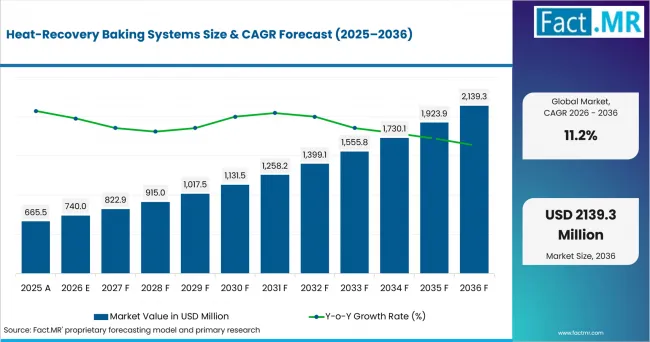
Heat Recovery Baking Systems Value Analysis | Source: Fact.MR
What are the defining numbers behind Heat-Recovery Baking Systems Market growth?
The absolute opportunity between 2026 and 2036 is USD 1,399.3 million. Equipment spending includes retrofit heat exchangers, integrated oven-recovery packages and systems that upgrade or store recovered heat. The purchasing case improves when the site can use the output for much of the baking schedule and install the equipment without compromising oven operation.
- Demand Drivers in the Market
- Oven replacement creates an opportunity to specify exhaust connections, controls and recovery equipment together. Designing these interfaces during the project can make reuse of rejected heat more practical than adding ductwork after commissioning.
- Plants reviewing process-heating losses can identify useful recovery duties before purchasing another heat source. The U.S. Department of Energy's sourcebook treats recovery within a system assessment of heat generation, use and loss.
- Simultaneous demand for hot water, combustion-air preheating or proofing heat gives an industrial bakery a destination for recovered energy. A stable receiving duty supports additional heat-exchanger and control purchases.
- Lower-temperature streams can become candidates for heat pumps where direct reuse cannot meet the required temperature. Equipment demand then depends on the temperature lift and electricity needed to serve the receiving process.
- Key Segments Analyzed
- Within Recovery Source, the Oven exhaust segment holds a 43.0% share in 2026. Operating ovens provide a recurring heat stream near the process that generates it.
- The Combustion air preheat segment leads Recovered Heat Use with 31.0% of 2026 revenue. The receiving duty can operate at the same time as the combustion process supplying recoverable heat.
- For Bakery Line, 33.0% of 2026 revenue comes from the Bread segment. Repeated baking schedules provide a basis for matching heat availability with recurring plant demand.
- The leading System Type segment is Air-to-air exchanger, accounting for 34.0% in 2026. Direct transfer between separated air streams can serve suitable preheating duties without an intermediate water circuit.
- Analyst Opinion at Fact.MR
- Shambhu Nath Jha, Senior Consultant, Fact.MR
- “The useful number is heat delivered to a process that needs it, when it needs it. Suppliers should demonstrate that match through the bakery's operating schedule and cleaning cycle. Recovery equipment earns its place when it displaces purchased energy without destabilising the oven or creating a maintenance burden that consumes the saving.”
- Strategic Implications
- Bakery operators should map heat availability and receiving demand over a representative production week before selecting exchanger capacity.
- Recovery suppliers should include access for cleaning, bypass operation and pressure-drop control in the initial design and commercial proposal.
- System integrators should measure useful heat delivered and auxiliary electricity so plant teams can assess performance through industrial controls.
How does the Heat-Recovery Baking Systems Market break down by segment?
The market is segmented by Recovery Source, Recovered Heat Use, Bakery Line, and System Type.
Why does the Oven exhaust segment lead Recovery Source?
The Oven exhaust segment holds a 43.0% share of the Recovery Source category in 2026.
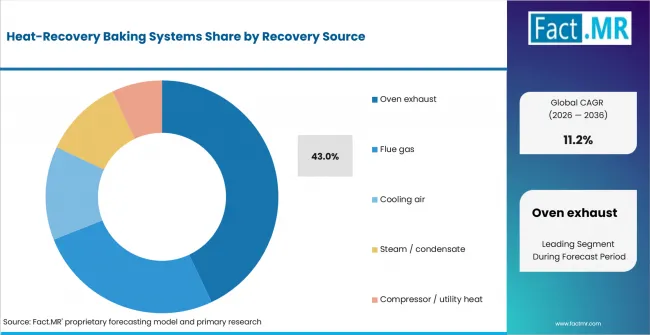
Heat Recovery Baking Systems Analysis By Recovery Source | Source: Fact.MR
Baking removes heat through exhaust while the oven operates, creating a recurring point at which recovery can be assessed. Its proximity to the oven can support duties such as air preheating, although routing and available space determine the practical installation. The project must retain the exhaust conditions needed for the baking process.
The distinction from flue gas depends on oven design. Where process or chamber exhaust is physically separate from the combustion flue circuit, each stream can be evaluated on its own characteristics. Where they are combined, the same stream belongs to one recovery-source category. Moisture, deposits and cleaning access influence the exchanger arrangement.
Why does the Combustion air preheat segment lead Recovered Heat Use?
The Combustion air preheat segment holds a 31.0% share of the Recovered Heat Use category in 2026.
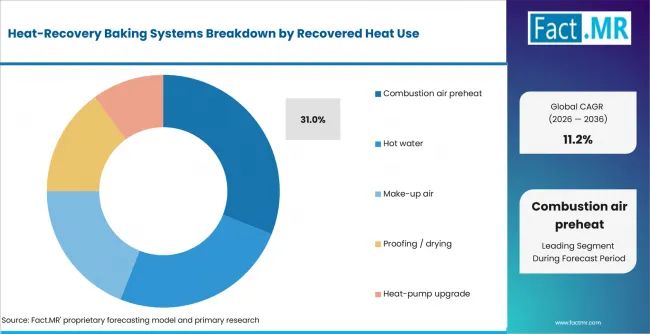
Heat Recovery Baking Systems Analysis By Recovered Heat Use | Source: Fact.MR
Combustion-air preheating offers a close timing relationship between heat production and heat use: the receiving burner is operating while its associated process generates recoverable heat. This can reduce the mismatch that arises when recovered energy is sent to an unrelated or seasonal demand. DOE process-heating guidance includes combustion-air preheating among heat-recovery approaches.
The installation must remain compatible with the burner and its controls across the intended operating range. Changes in incoming air temperature can require adjustment of the combustion system. Buyers therefore need a coordinated proposal that considers the oven, airflow, control settings and bypass conditions rather than evaluating the heat exchanger in isolation.
Why does the Bread segment lead Bakery Line?
The Bread segment holds a 33.0% share of the Bakery Line category in 2026.
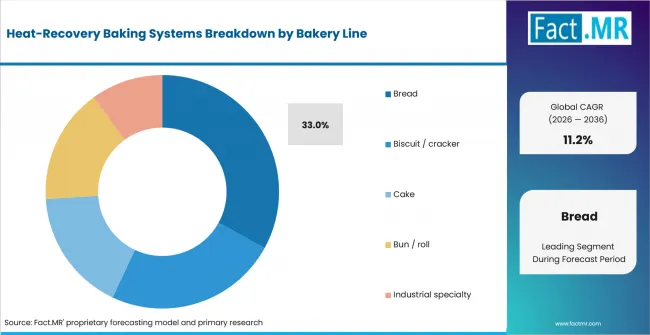
Heat Recovery Baking Systems Analysis By Bakery Line | Source: Fact.MR
Recurring bread production can provide a reasonably predictable sequence of baking, proofing and cleaning duties. That schedule gives engineers a starting point for matching heat output with a useful destination. The economic case depends on actual operating hours and the persistence of the receiving load.
Recipe and shift changes still alter the balance. A recovery system sized for full production may have less useful demand during shorter runs or extended stoppages. Integration with food processing equipment should therefore consider the site's production pattern and utility network, including what happens when the intended heat user stops.
Why does the Air-to-air exchanger segment lead System Type?
The Air-to-air exchanger segment holds a 34.0% share of the System Type category in 2026.
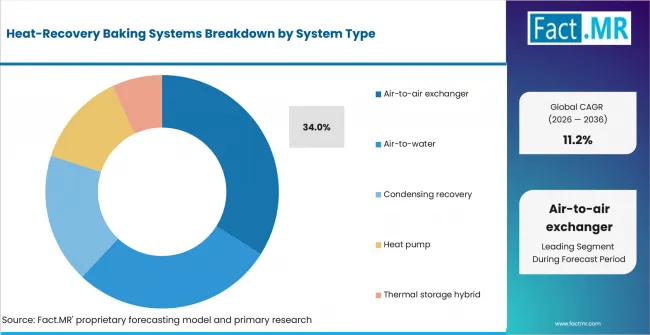
Heat Recovery Baking Systems Analysis By System Type | Source: Fact.MR
An air-to-air exchanger can transfer heat between separated streams for suitable ventilation or combustion-air duties. Its appeal is a direct thermal connection without the additional pumps and distribution equipment of a water loop. The choice is attractive when source and receiving airflows are compatible and reasonably close to each other.
Temperature approach, leakage control, fouling and pressure drop influence the net benefit. The exchanger should preserve the required separation between streams and provide practical inspection access. A more elaborate system can be justified when hot-water demand, heat upgrading or storage creates greater usable recovery than a direct air connection.
What is accelerating Heat-Recovery Baking Systems Market adoption, and what is holding it back?
Heat recovery becomes more attractive when bakeries can convert waste heat into usable energy for another process. The business case depends on where the recovered heat is used, how much is lost during transfer, and the additional power required for fans or pumps. Smart factory monitoring can help operators track whether a recovery system is producing meaningful energy savings.
Adoption can be limited by fouling, restricted duct space, corrosion from condensation, and the need to maintain stable oven pressure. Hygiene requirements also make retrofits more complex because any modification must preserve sanitary conditions within food-production areas.
Fact.MR estimates the following directional effects on CAGR. These factors interact and should not be added together.
Drivers Impact Analysis
| Factor | (~) % Impact on CAGR | Geographic Relevance | Impact Timeline |
|---|---|---|---|
| Recovery integrated with oven replacement | +0.9% | Germany, USA, UK | 2026 to 2033 |
| Concurrent demand for useful process heat | +0.8% | Global | 2026 to 2036 |
| Energy assessments identifying recovery duties | +0.6% | UK, Netherlands, France | 2026 to 2032 |
Source: Fact.MR analysis. Updated Sep 10, 2026
Opportunity Impact Analysis
| Factor | (~) % Impact on CAGR | Geographic Relevance | Impact Timeline |
|---|---|---|---|
| Heat-pump upgrading of lower-temperature streams | +0.7% | Germany, Netherlands, France | 2028 to 2036 |
| Retrofits serving hot-water and proofing loads | +0.6% | Global | 2027 to 2035 |
| Thermal storage improving timing alignment | +0.4% | USA, UK, Germany | 2029 to 2036 |
Source: Fact.MR analysis. Updated Sep 10, 2026
Restraints Impact Analysis
| Factor | (~) % Impact on CAGR | Geographic Relevance | Impact Timeline |
|---|---|---|---|
| Mismatch between heat supply and useful demand | -0.8% | Global | 2026 to 2036 |
| Fouling and maintenance access limitations | -0.6% | Global | 2026 to 2034 |
| Ductwork cost and auxiliary power demand | -0.5% | Global | 2026 to 2033 |
Source: Fact.MR analysis. Updated Sep 10, 2026
The main negative effect is a limited destination for the recovered heat. Installation constraints and maintenance requirements then reduce the benefit of projects that are thermally feasible but operationally difficult.
Which countries are scaling the Heat-Recovery Baking Systems Market through 2036?
- Germany: Oven and utility engineering projects can integrate recovery while preserving the process conditions required by industrial bakeries.
- USA: Plant-level process-heating assessments support selection of recovery projects with a defined receiving duty and operating benefit.
- UK: Energy assessments and action planning can turn identified baking losses into specified equipment projects.
- France: Industrial food-site efficiency programmes support matching recovered heat with recurring hot-water or process-heating needs.
- Netherlands: Energy-saving obligations strengthen attention to qualifying measures and their project-level payback.
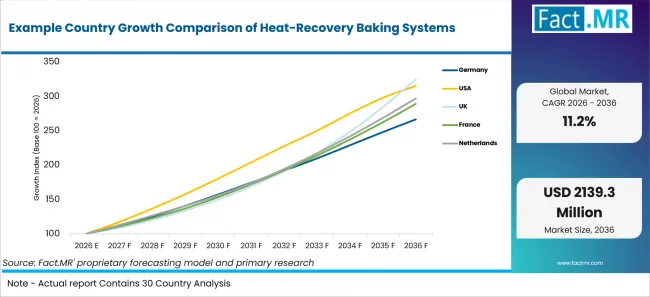
Example Country Growth Comparison Of Heat Recovery Baking Systems | Source: Fact.MR
Country CAGR (2026-2036)
| Country | CAGR (2026-2036) |
|---|---|
| Germany | 10.3% |
| USA | 12.2% |
| UK | 12.5% |
| France | 11.2% |
| Netherlands | 11.5% |
Source: Fact.MR analysis. Updated Sep 10, 2026
What is driving Germany's growth through 2036?
Germany is forecast to grow at 10.3% CAGR.
The EU's food, drink and milk BAT framework provides an environmental-performance context for industrial installations within its scope. For bakery investment, the practical implication is to consider energy performance alongside the wider process when an oven or utility system is renewed.
The purchasing opportunity is strongest where the recovery supplier can work with the oven and burner engineering team. A retrofit that changes exhaust resistance or introduces a difficult cleaning point can undermine the intended benefit. Integrated design and demonstrated operation through load changes can therefore influence supplier selection.
What is driving USA's growth through 2036?
USA demand is projected to increase at 12.2% CAGR.
DOE's process-heating sourcebook supports evaluation of the whole thermal system, including the recovery of heat that would otherwise be rejected. This provides an engineering basis for screening oven-exhaust opportunities against other efficiency measures.
A bakery can then prioritise a project whose receiving demand is available for much of the operating year. Combustion-air preheating and recurring process-water duties offer different installation and control requirements. Buyers need a site-specific comparison that includes auxiliary power, maintenance and the production interruption required for commissioning.
What is driving UK's growth through 2036?
UK is projected to record 12.5% CAGR. The Environment Agency's ESOS guidance addresses energy assessment and action planning for qualifying organisations. It supports a route from identifying an energy-saving opportunity to recording an implementation plan, while the scheme itself does not prescribe a heat-recovery purchase for every bakery.
The equipment sale depends on converting the assessment into a defined scope: heat source, destination, installation window and accountable performance measure. Suppliers can assist by distinguishing the heat-exchanger rating from the useful annual output expected under the bakery's schedule. That distinction makes competing project proposals more comparable.
What is driving France's growth through 2036?
France is forecast to expand at 11.2% CAGR.
French industrial food installations within the applicable thresholds operate in the context of the EU food, drink and milk BAT framework. Fact.MR's demand assessment focuses on the resulting project opportunities where process renewal and energy-performance objectives coincide.
Recurring hot-water and proofing demand can offer a more persistent destination than building heating alone. Seasonal variation therefore matters when selecting the receiving duty. A bakery with several thermal users may benefit from a control arrangement that allocates recovery to the demand available at the time, provided that the additional pipework and equipment remain economically justified.
What is driving Netherlands's growth through 2036?
Netherlands growth is projected at 11.5% CAGR.
RVO explains that the energy-saving obligation requires qualifying business locations to take energy-saving measures with a payback of five years or less. This creates a concrete project-evaluation context, although applicability and the qualifying measure must be established for the individual site.
For baking recovery, the decisive inputs include usable operating hours, displaced energy, added electricity and installation cost. Monitoring useful output can support the plant's ongoing assessment of the measure. Condition monitoring also helps identify deterioration from fouling before it erodes the assumed operating benefit.
Who Leads the Heat-Recovery Baking Systems Market?
Key players in the Heat-Recovery Baking Systems Market include GEA, Bühler, AMF Bakery Systems, Reading Bakery Systems, Baker Perkins, and Kaak.
Suppliers compete through integration with baking equipment, thermal design, access for maintenance and the ability to preserve product and oven performance. Baker Perkins operates within Coperion's food-related equipment portfolio following the transition of the former Schenck Process Food and Performance Materials business. Its brand presence should be read in that corporate context.
A strong commercial proposal establishes the heat stream, expected receiving demand and limits of operation. Buyers also need clarity on the division of responsibility between oven, burner, exchanger and controls suppliers. Commissioning support and a practical plan for bypassing or cleaning recovery equipment can influence the purchase as much as nominal thermal capacity.
Which companies are the key providers?
The key providers are GEA, Bühler, AMF Bakery Systems, Reading Bakery Systems, Baker Perkins, and Kaak.
- GEA
- Bühler
- AMF Bakery Systems
- Reading Bakery Systems
- Baker Perkins
- Kaak
Bibliography
- U.S. Department of Energy and Industrial Heating Equipment Association. (2015). Improving Process Heating System Performance: A Sourcebook for Industry, Third Edition. U.S. Department of Energy.
- U.S. Food and Drug Administration. (n.d.). 21 CFR 117.40: Equipment and utensils. Electronic Code of Federal Regulations.
- European Commission. (2019). Commission Implementing Decision (EU) 2019/2031: Best available techniques conclusions for the food, drink and milk industries. Official Journal of the European Union.
- Environment Agency. (2026). Energy Savings Opportunity Scheme (ESOS). Government of the United Kingdom.
- Netherlands Enterprise Agency. (2026). Energy Saving Obligation. RVO.
- Coperion. (2024). The company formerly known as Schenck Process FPM has officially transitioned its name to Coperion. Coperion GmbH.
This Report Answers
- What revenue and absolute opportunity are projected for baking heat recovery?
- Why do oven exhaust, combustion-air preheating, bread lines and air-to-air systems lead their categories?
- How do heat-source timing and receiving demand affect equipment selection?
- What drives demand in Germany, USA, UK, France and Netherlands?
- Which integration and maintenance capabilities influence competition?
What does the Heat-Recovery Baking Systems Market cover?
The market covers commercial equipment and integrated systems that capture heat associated with baking operations and deliver it to a useful thermal duty. Analysis distinguishes the originating stream, recovered-heat use, bakery line and system type. Buyers include industrial bakeries, baking-line manufacturers and process-utility integrators.
What is included in the scope?
Recovery from oven exhaust, distinct combustion flue gas, cooling air, steam or condensate, and bakery compressor or utility heat is included. Destinations encompass combustion-air preheating, hot water, make-up air, proofing or drying, and heat-pump upgrading.
Air-to-air, air-to-water, condensing, heat-pump and thermal-storage hybrid systems are included when configured for baking heat recovery. Each originating stream is assigned once; physically combined oven and combustion exhaust is not counted in both source categories. Integrated packages include their dedicated recovery controls and heat-transfer components.
What is excluded from the scope?
Complete baking-line and oven revenue is excluded apart from a separately identifiable recovery system. General building heating, unrelated industrial heat recovery, purchased fuel and the monetary value of saved energy are outside equipment-market revenue.
Heat pumps and storage equipment are included only for their baking-recovery application. The same package is not counted again under each component or receiving duty, and broader eco-efficient baking-line expenditure is not added in full to the recovery system's value.
How Was the Analysis Built?
- Primary Research: Relevant respondents include bakery utility engineers, oven and burner specialists, heat-exchanger suppliers, plant maintenance managers and energy assessors. The research framework examines source conditions, receiving loads, fouling, retrofit windows and the commercial acceptance of proposed recovery duties.
- Desk Research: Engineering context comes from process-heating guidance, sanitary equipment rules, industrial food-sector BAT information and national energy-assessment or saving requirements. Corporate sources establish relevant brand relationships in the baking-equipment supply chain.
- Market Sizing and Forecasting: Sizing uses new and replacement ovens, recovery retrofit rates, system configuration, package value and the number of technically suitable thermal duties. Source and receiving-load coincidence inform the adoption assessment; energy savings are treated as a purchase driver rather than market revenue.
- Data Validation and Update Cycle: Validation checks consistent recovery-source assignment, the treatment of integrated systems and country assumptions. Updates examine useful operating hours, maintenance experience, energy economics and changes in the range of feasible heat destinations
Segmentation
What is the report's scope and coverage?
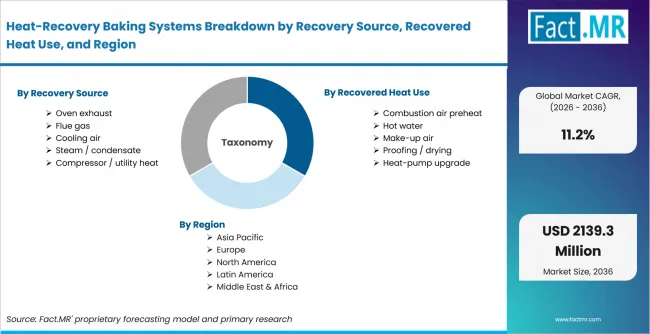
Heat Recovery Baking Systems Breakdown By Recovery Source, Recovered Heat Use, And Region | Source: Fact.MR
| Attribute | Details |
|---|---|
| Quantitative Units | USD million |
| Market Definition | Equipment that captures heat from baking and associated utilities for reuse in defined thermal duties. |
| Segments Covered | Recovery Source; Recovered Heat Use; Bakery Line; System Type |
| Regions Covered | Global |
| Countries Covered | Germany; USA; UK; France; Netherlands |
| Key Companies | GEA, Bühler, AMF Bakery Systems, Reading Bakery Systems, Baker Perkins, and Kaak |
| Historical Period | 2021 to 2025 |
| Base Year | 2025 |
| Forecast Period | 2026 to 2036 |
| Market Value, 2026 | USD 740.0 million |
| Market Value, 2036 | USD 2,139.3 million |
| CAGR, 2026-2036 | 11.2% |
| Absolute Opportunity | USD 1,399.3 million |
| Approach | Oven and utility project analysis combining retrofit incidence, source-use compatibility, system configuration and recovery-package revenue. |
Source: Fact.MR analysis. Updated Sep 10, 2026
How is the market segmented?
-
By Recovery Source
- Oven exhaust
- Flue gas
- Cooling air
- Steam / Condensate
- Compressor / Utility heat
-
By Recovered Heat Use
- Combustion air preheat
- Hot water
- Make-up air
- Proofing / drying
- Heat-pump upgrade
-
By Bakery Line
- Bread
- Biscuit / cracker
- Cake
- Bun / roll
- Industrial specialty
-
By System Type
- Air-to-air exchanger
- Air-to-water
- Condensing recovery
- Heat pump
- Thermal storage hybrid
Frequently Asked Questions
What is the Heat-Recovery Baking Systems Market value in 2026?
At what CAGR is the market projected to grow?
What is the projected market value by 2036?
Which segment leads the Recovery Source category?
Which segment leads the Recovered Heat Use category?
Which segment leads the Bakery Line category?
Which segment leads the System Type category?
What makes a recovery project attractive?
Who are the key providers?
Who worked on this report


Preview the report firsthand - request a free sample
Free SampleGet the brochure for pricing and purchase details
Download PDF