Eco-Friendly Metalworking Fluids and Additives Market
Eco-Friendly Metalworking Fluids and Additives Market Size and Share Forecast Outlook 2026 to 2036
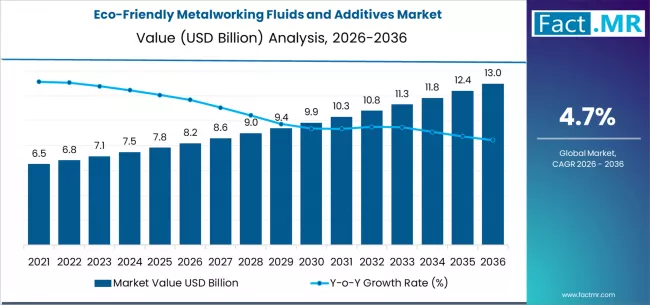
Eco-friendly metalworking fluids and additives market is projected to grow from USD 8.2 billion in 2026 to USD 13.0 billion by 2036, at a CAGR of 4.7%. Water-miscible and synthetic soluble fluids will dominate with a 34.0% market share, while biodegradable corrosion inhibitors & rust preventives will lead the additive function segment with a 26.0% share.
Eco-Friendly Metalworking Fluids and Additives Market Forecast and Outlook 2026 to 2036
The global eco-friendly metalworking fluids and additives market is projected to reach USD 12.98 billion by 2036. The market is valued at USD 8.20 billion in 2026 and is set to rise at a CAGR of 4.7% during the assessment period.
By product type, water-miscible and synthetic soluble fluids hold a leading 34% share. Biodegradable corrosion inhibitors & rust preventives represent the dominant additive function at 26%, while bio-esters & vegetable-oil derivatives is the primary chemistry at 30.0%. Automotive manufacturing & Components is the leading end-use industry at 34.0%.
Key Takeaways from the Eco-Friendly Metalworking Fluids and Additives Market
- Market Value for 2026: USD 8.20 Billion
- Market Value for 2036: USD 12.98 Billion
- Forecast CAGR (2026-2036): 4.7%
- Leading Product Type Share (2026): Water-miscible and synthetic soluble fluids (34%)
- Leading Additive Function Share (2026): Biodegradable corrosion inhibitors & rust preventives (26%)
- Leading Chemistry Share (2026): Bio-esters & vegetable-oil derivatives (30.0%)
- Leading End-Use Industry Share (2026): Automotive manufacturing & Components (34.0%)
- Key Players in the Market: Quaker Houghton, FUCHS, Blaser Swisslube, Klüber Lubrication, TotalEnergies SE, ExxonMobil, Shell plc., Castrol Limited
Defining trends involve the development of high-performance, low-toxicity additive packages compatible with closed-loop recycling systems. Innovation is focused on creating bio-based and readily biodegradable chemistries that match the extreme pressure and cooling performance of conventional synthetics. Integration of these fluids into comprehensive, service-based fluid management programs is becoming a key competitive strategy.
Regulatory pressures on VOC emissions, worker safety (occupational exposure limits), and wastewater discharge standards are primary market drivers. The manufacturing sector’s sustainability goals and the need to reduce the environmental footprint of production processes act as significant catalysts, creating sustained demand for high-performance, environmentally compliant metalworking solutions.
Eco-Friendly Metalworking Fluids and Additives Market
| Metric | Value |
|---|---|
| Market Value (2026) | USD 8.20 Billion |
| Market Forecast Value (2036) | USD 12.98 Billion |
| Forecast CAGR (2026-2036) | 4.7% |
Category
| Category | Segments |
|---|---|
| Product Type | Water-miscible and synthetic soluble fluids, Neat cutting oils (biobased esters & EALs), Semi-synthetic & micro-emulsion biodegradable fluids, Additive concentrates & specialty green packages, Coolant & system treatment chemistries |
| Additive Function | Biodegradable corrosion inhibitors & rust preventives, Low-toxicity biocides & bio-safe preservatives, Low-VOC extreme-pressure & anti-wear additives, Emulsifiers & biodegradable surfactants & wetting agents, Defoamers & anti-foam & filtration aids, Reclaimer & stabiliser packages (recycle-friendly chemistries) |
| Chemistry | Bio-esters & vegetable-oil derivatives, Readily biodegradable glycols & polyalkylene esters, Low-amine, low-VOC solvent systems, Ionic & task-specific green additives, Re-refined & reclaimed fluid blends, Specialist polymeric dispersants |
| End-Use Industry | Automotive manufacturing & Components, Aerospace & High-precision Engineering, General engineering & fabrication (heavy machinery), Medical & food-grade machining (NSF or FDA sensitive), Others (electronics, tooling, energy) |
| Region | North America, Latin America, Western Europe, Eastern Europe, East Asia, South Asia & Pacific, MEA |
Segmental Analysis
By Product Type, Which Formulation Dominates for Versatility and Waste Reduction?
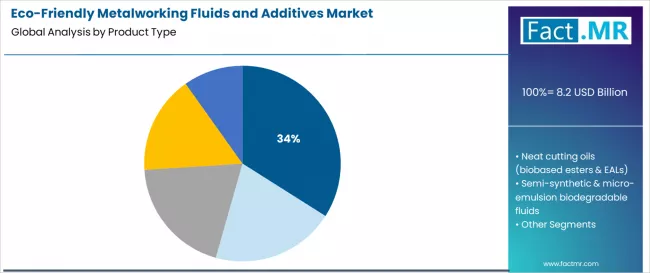
Water-miscible and synthetic soluble fluids lead the segment with a 34% share. This dominance is due to their extensive use in high-volume machining operations, offering excellent cooling properties and a lower overall oil consumption compared to neat oils. Their compatibility with central coolant systems and greater ease of treating wastewater streams make them a focal point for formulating eco-friendly, high-performance alternatives.
By Additive Function, Which Package is Critical for Fluid Longevity and Part Protection?
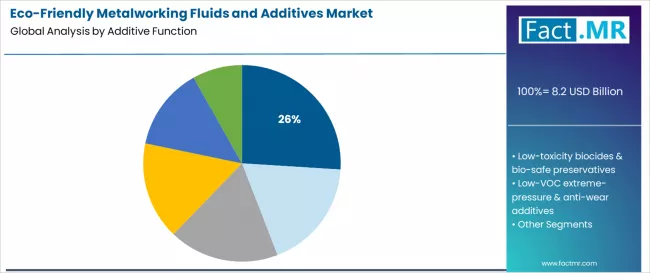
Biodegradable corrosion inhibitors & rust preventives command the largest additive function share at 26%. Protecting both machine tools and finished workpieces from corrosion is a fundamental requirement. Developing effective inhibitors that are non-toxic, readily biodegradable, and compatible with other green additives is a core technical challenge and a primary value driver in fluid formulations.
By Chemistry, Which Base Offers a Sustainable Performance Foundation?
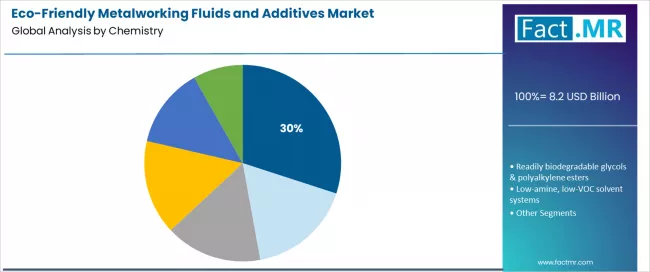
Bio-esters & vegetable-oil derivatives represent the leading chemistry at 30.0%. These renewable base stocks provide inherent lubricity, good environmental profiles, and are increasingly performing at parity with petroleum-derived alternatives. They serve as the foundational building blocks for formulating both neat oils and water-miscible fluids that meet stringent eco-certifications.
By End-Use Industry, Which Sector Drives Volume and Innovation?
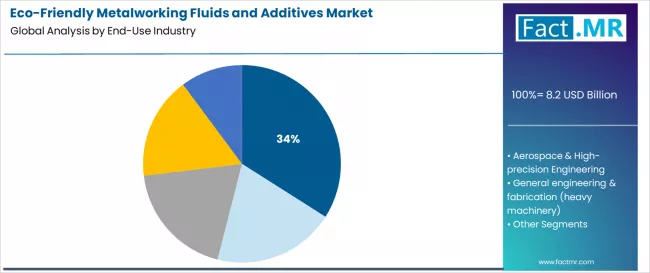
Automotive manufacturing & Components is the leading end-use industry at 34.0%. This sector's high-volume production, diverse machining operations, and strong focus on supply chain sustainability mandates drive significant demand. The need for fluids that ensure worker safety, reduce disposal costs, and maintain part quality in operations like machining engine blocks and transmission components makes it a key innovation and adoption driver.
What are the Drivers, Restraints, and Key Trends of the Eco-Friendly Metalworking Fluids and Additives Market?
Globally tightening regulations on worker exposure to mist, VOCs, and specific fluid ingredients drive market growth. Corporate sustainability reporting and goals to reduce hazardous waste generation compel manufacturers to adopt greener alternatives. The growth of industries with sensitive downstream processes, like medical device manufacturing, increases demand for ultra-clean, food-grade compatible fluids.
A significant restraint is the performance gap perceived in some severe machining applications compared to traditional chlorinated, sulphurised, or boron-based additives. The higher raw material cost of bio-based and specialty low-toxicity chemistries impacts total fluid cost. Managing microbial growth in biodegradable water-miscible fluids without conventional biocides remains a technical and cost challenge.
Key trends include the development of drop-in green additive concentrates that allow formulators to upgrade existing products. There is a strong focus on multifunctional additives that combine lubrication, corrosion inhibition, and antimicrobial properties. The market is shifting towards a service model centered on fluid monitoring, maintenance, and recycling to extend sump life and reduce total waste volume.
Analysis of the Eco-Friendly Metalworking Fluids and Additives Market by Key Countries

| Country | CAGR (2026-2036) |
|---|---|
| India | 7.00% |
| China | 6.00% |
| USA | 4.50% |
| Germany | 4.00% |
How does India's Manufacturing Growth and Evolving Regulations Drive Market Expansion?
India leads with a 7.00% CAGR, driven by the rapid expansion of its automotive, general engineering, and capital goods manufacturing base. Increasing enforcement of environmental and worker safety regulations, combined with the cost pressures of waste disposal, is accelerating the shift from commodity fluids to more efficient, longer-life, and environmentally preferable products in both large and small-scale workshops.
Why is China's Industrial Modernization and Environmental Policy a Key Driver?
China’s 6.00% growth is fueled by its dual goals of advancing high-value manufacturing and reducing industrial pollution. Government policies promoting green manufacturing and upgrading traditional industries create demand for advanced, safer metalworking fluids. The scale of China's automotive, machinery, and electronics sectors provides a massive volume base for adopting next-generation eco-friendly formulations.
What Role does the USA's Mature Regulatory Environment and Advanced Manufacturing Play?
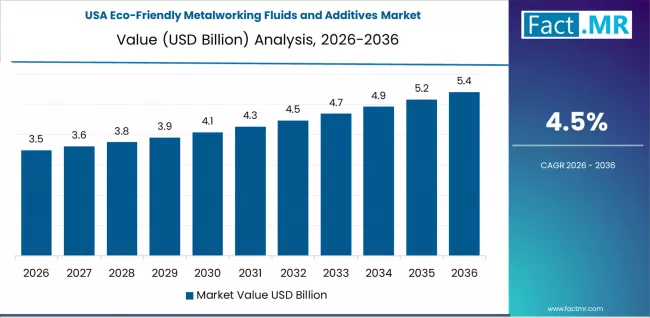
The USA's 4.50% growth is underpinned by stringent OSHA exposure limits and EPA regulations governing fluid disposal. Demand is driven by the need for compliance in the large automotive and aerospace sectors, retrofitting of older systems, and the strong presence of OEMs and tier-1 suppliers who mandate the use of approved, safer chemistries in their global supply chains.
How does Germany's Engineering Precision and Strict Chemical Regulations Influence the Market?
Germany’s 4.00% growth reflects its leadership in high-precision manufacturing and the world's most stringent regulations on chemical safety (REACH) and worker protection. The market demands ultra-high-performance fluids for aerospace and automotive engineering that simultaneously meet exceptional technical requirements and rigorous toxicological and environmental standards, driving innovation in premium synthetic and bio-based esters.
Competitive Landscape of the Eco-Friendly Metalworking Fluids and Additives Market
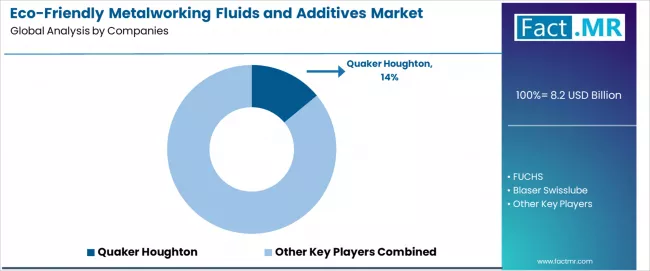
Global metalworking fluid specialists competing with integrated oil majors characterize the competitive landscape. Dedicated specialists like Quaker Houghton, Blaser Swisslube, and Klüber Lubrication compete on deep application expertise, extensive R&D in bio-based chemistries, and strong technical service networks focused on fluid management and optimization for specific machining processes.
Integrated players like FUCHS, TotalEnergies SE, ExxonMobil, Shell plc., and Castrol Limited leverage their scale, base stock production, and broad industrial lubricant portfolios to serve large multi-plant manufacturers. Competition revolves around product performance data, the completeness of regulatory documentation and certifications, and the ability to provide comprehensive fluid lifecycle management services including recycling and disposal.
Key Players in the Eco-Friendly Metalworking Fluids and Additives Market
- Quaker Houghton
- FUCHS
- Blaser Swisslube
- Klüber Lubrication
- TotalEnergies SE
- ExxonMobil
- Shell plc.
- Castrol Limited
Scope of Report
| Items | Values |
|---|---|
| Quantitative Units | USD Billion |
| Product Type | Water-miscible and synthetic soluble fluids, Neat cutting oils (biobased esters & EALs), Semi-synthetic & micro-emulsion biodegradable fluids, Additive concentrates & specialty green packages, Coolant & system treatment chemistries |
| Additive Function | Biodegradable corrosion inhibitors & rust preventives, Low-toxicity biocides & bio-safe preservatives, Low-VOC extreme-pressure & anti-wear additives, Emulsifiers & biodegradable surfactants & wetting agents, Defoamers & anti-foam & filtration aids, Reclaimer & stabiliser packages (recycle-friendly chemistries) |
| Chemistry | Bio-esters & vegetable-oil derivatives, Readily biodegradable glycols & polyalkylene esters, Low-amine, low-VOC solvent systems, Ionic & task-specific green additives, Re-refined & reclaimed fluid blends, Specialist polymeric dispersants |
| End-Use Industry | Automotive manufacturing & Components, Aerospace & High-precision Engineering, General engineering & fabrication (heavy machinery), Medical & food-grade machining (NSF or FDA sensitive), Others (electronics, tooling, energy) |
| Key Countries | India, China, USA, Germany |
| Key Companies | Quaker Houghton, FUCHS, Blaser Swisslube, Klüber Lubrication, TotalEnergies SE, ExxonMobil, Shell plc., Castrol Limited |
| Additional Analysis | Analysis of additive synergy and treat rates, performance benchmarking in specific operations (grinding, turning, stamping), regulatory certification pathways and costs, total cost of ownership models including waste disposal, and competitive assessment against conventional synthetic and mineral oil-based fluids. |
Eco-Friendly Metalworking Fluids and Additives Market by Segments
-
Product Type :
- Water-miscible and synthetic soluble fluids
- Neat cutting oils (biobased esters & EALs)
- Semi-synthetic & micro-emulsion biodegradable fluids
- Additive concentrates & specialty green packages
- Coolant & system treatment chemistries
-
Additive Function :
- Biodegradable corrosion inhibitors & rust preventives
- Low-toxicity biocides & bio-safe preservatives
- Low-VOC extreme-pressure & anti-wear additives
- Emulsifiers & biodegradable surfactants & wetting agents
- Defoamers & anti-foam & filtration aids
- Reclaimer & stabiliser packages (recycle-friendly chemistries)
-
Chemistry :
- Bio-esters & vegetable-oil derivatives
- Readily biodegradable glycols & polyalkylene esters
- Low-amine, low-VOC solvent systems
- Ionic & task-specific green additives
- Re-refined & reclaimed fluid blends
- Specialist polymeric dispersants
-
End-Use Industry :
- Automotive manufacturing & Components
- Aerospace & High-precision Engineering
- General engineering & fabrication (heavy machinery)
- Medical & food-grade machining (NSF or FDA sensitive)
- Others (electronics, tooling, energy)
-
Region :
-
North America
- USA
- Canada
-
Latin America
- Brazil
- Mexico
- Argentina
- Rest of Latin America
-
Western Europe
- Germany
- UK
- France
- Spain
- Italy
- BENELUX
- Rest of Western Europe
-
Eastern Europe
- Russia
- Poland
- Czech Republic
- Rest of Eastern Europe
-
East Asia
- China
- Japan
- South Korea
- Rest of East Asia
-
South Asia & Pacific
- India
- ASEAN
- Australia
- Rest of South Asia & Pacific
-
MEA
- Saudi Arabia
- UAE
- Turkiye
- Rest of MEA
-
Table of Content
- Executive Summary
- Global Market Outlook
- Demand to side Trends
- Supply to side Trends
- Technology Roadmap Analysis
- Analysis and Recommendations
- Market Overview
- Market Coverage / Taxonomy
- Market Definition / Scope / Limitations
- Market Background
- Market Dynamics
- Drivers
- Restraints
- Opportunity
- Trends
- Scenario Forecast
- Demand in Optimistic Scenario
- Demand in Likely Scenario
- Demand in Conservative Scenario
- Opportunity Map Analysis
- Product Life Cycle Analysis
- Supply Chain Analysis
- Investment Feasibility Matrix
- Value Chain Analysis
- PESTLE and Porter’s Analysis
- Regulatory Landscape
- Regional Parent Market Outlook
- Production and Consumption Statistics
- Import and Export Statistics
- Market Dynamics
- Global Market Analysis 2021 to 2025 and Forecast, 2026 to 2036
- Historical Market Size Value (USD Million) Analysis, 2021 to 2025
- Current and Future Market Size Value (USD Million) Projections, 2026 to 2036
- Y to o to Y Growth Trend Analysis
- Absolute $ Opportunity Analysis
- Global Market Pricing Analysis 2021 to 2025 and Forecast 2026 to 2036
- Global Market Analysis 2021 to 2025 and Forecast 2026 to 2036, By Product Type
- Introduction / Key Findings
- Historical Market Size Value (USD Million) Analysis By Product Type, 2021 to 2025
- Current and Future Market Size Value (USD Million) Analysis and Forecast By Product Type, 2026 to 2036
- Water-miscible and synthetic soluble fluids
- Neat cutting oils (biobased esters & EALs)
- Semi-synthetic & micro-emulsion biodegradable fluids
- Additive concentrates & specialty green packages
- Coolant & system treatment chemistries
- Water-miscible and synthetic soluble fluids
- Y to o to Y Growth Trend Analysis By Product Type, 2021 to 2025
- Absolute $ Opportunity Analysis By Product Type, 2026 to 2036
- Global Market Analysis 2021 to 2025 and Forecast 2026 to 2036, By Additive Function
- Introduction / Key Findings
- Historical Market Size Value (USD Million) Analysis By Additive Function, 2021 to 2025
- Current and Future Market Size Value (USD Million) Analysis and Forecast By Additive Function, 2026 to 2036
- Biodegradable corrosion inhibitors & rust preventives
- Low-toxicity biocides & bio-safe preservatives
- Low-VOC extreme-pressure & anti-wear additives
- Emulsifiers & biodegradable surfactants & wetting agents
- Defoamers & anti-foam & filtration aids
- Reclaimer & stabiliser packages (recycle-friendly chemistries)
- Biodegradable corrosion inhibitors & rust preventives
- Y to o to Y Growth Trend Analysis By Additive Function, 2021 to 2025
- Absolute $ Opportunity Analysis By Additive Function, 2026 to 2036
- Global Market Analysis 2021 to 2025 and Forecast 2026 to 2036, By Chemistry
- Introduction / Key Findings
- Historical Market Size Value (USD Million) Analysis By Chemistry, 2021 to 2025
- Current and Future Market Size Value (USD Million) Analysis and Forecast By Chemistry, 2026 to 2036
- Bio-esters & vegetable-oil derivatives
- Readily biodegradable glycols & polyalkylene esters
- Low-amine, low-VOC solvent systems
- Ionic & task-specific green additives
- Re-refined & reclaimed fluid blends
- Specialist polymeric dispersants
- Bio-esters & vegetable-oil derivatives
- Y to o to Y Growth Trend Analysis By Chemistry, 2021 to 2025
- Absolute $ Opportunity Analysis By Chemistry, 2026 to 2036
- Global Market Analysis 2021 to 2025 and Forecast 2026 to 2036, By End-Use Industry
- Introduction / Key Findings
- Historical Market Size Value (USD Million) Analysis By End-Use Industry, 2021 to 2025
- Current and Future Market Size Value (USD Million) Analysis and Forecast By End-Use Industry, 2026 to 2036
- Automotive manufacturing & Components
- Aerospace & High-precision Engineering
- General engineering & fabrication (heavy machinery)
- Medical & food-grade machining (NSF or FDA sensitive)
- Others (electronics, tooling, energy)
- Automotive manufacturing & Components
- Y to o to Y Growth Trend Analysis By End-Use Industry, 2021 to 2025
- Absolute $ Opportunity Analysis By End-Use Industry, 2026 to 2036
- Global Market Analysis 2021 to 2025 and Forecast 2026 to 2036, By Region
- Introduction
- Historical Market Size Value (USD Million) Analysis By Region, 2021 to 2025
- Current Market Size Value (USD Million) Analysis and Forecast By Region, 2026 to 2036
- North America
- Latin America
- Western Europe
- Eastern Europe
- East Asia
- South Asia and Pacific
- Middle East & Africa
- Market Attractiveness Analysis By Region
- North America Market Analysis 2021 to 2025 and Forecast 2026 to 2036, By Country
- Historical Market Size Value (USD Million) Trend Analysis By Market Taxonomy, 2021 to 2025
- Market Size Value (USD Million) Forecast By Market Taxonomy, 2026 to 2036
- By Country
- USA
- Canada
- Mexico
- By Product Type
- By Additive Function
- By Chemistry
- By End-Use Industry
- By Country
- Market Attractiveness Analysis
- By Country
- By Product Type
- By Additive Function
- By Chemistry
- By End-Use Industry
- Key Takeaways
- Latin America Market Analysis 2021 to 2025 and Forecast 2026 to 2036, By Country
- Historical Market Size Value (USD Million) Trend Analysis By Market Taxonomy, 2021 to 2025
- Market Size Value (USD Million) Forecast By Market Taxonomy, 2026 to 2036
- By Country
- Brazil
- Chile
- Rest of Latin America
- By Product Type
- By Additive Function
- By Chemistry
- By End-Use Industry
- By Country
- Market Attractiveness Analysis
- By Country
- By Product Type
- By Additive Function
- By Chemistry
- By End-Use Industry
- Key Takeaways
- Western Europe Market Analysis 2021 to 2025 and Forecast 2026 to 2036, By Country
- Historical Market Size Value (USD Million) Trend Analysis By Market Taxonomy, 2021 to 2025
- Market Size Value (USD Million) Forecast By Market Taxonomy, 2026 to 2036
- By Country
- Germany
- UK
- Italy
- Spain
- France
- Nordic
- BENELUX
- Rest of Western Europe
- By Product Type
- By Additive Function
- By Chemistry
- By End-Use Industry
- By Country
- Market Attractiveness Analysis
- By Country
- By Product Type
- By Additive Function
- By Chemistry
- By End-Use Industry
- Key Takeaways
- Eastern Europe Market Analysis 2021 to 2025 and Forecast 2026 to 2036, By Country
- Historical Market Size Value (USD Million) Trend Analysis By Market Taxonomy, 2021 to 2025
- Market Size Value (USD Million) Forecast By Market Taxonomy, 2026 to 2036
- By Country
- Russia
- Poland
- Hungary
- Balkan & Baltic
- Rest of Eastern Europe
- By Product Type
- By Additive Function
- By Chemistry
- By End-Use Industry
- By Country
- Market Attractiveness Analysis
- By Country
- By Product Type
- By Additive Function
- By Chemistry
- By End-Use Industry
- Key Takeaways
- East Asia Market Analysis 2021 to 2025 and Forecast 2026 to 2036, By Country
- Historical Market Size Value (USD Million) Trend Analysis By Market Taxonomy, 2021 to 2025
- Market Size Value (USD Million) Forecast By Market Taxonomy, 2026 to 2036
- By Country
- China
- Japan
- South Korea
- By Product Type
- By Additive Function
- By Chemistry
- By End-Use Industry
- By Country
- Market Attractiveness Analysis
- By Country
- By Product Type
- By Additive Function
- By Chemistry
- By End-Use Industry
- Key Takeaways
- South Asia and Pacific Market Analysis 2021 to 2025 and Forecast 2026 to 2036, By Country
- Historical Market Size Value (USD Million) Trend Analysis By Market Taxonomy, 2021 to 2025
- Market Size Value (USD Million) Forecast By Market Taxonomy, 2026 to 2036
- By Country
- India
- ASEAN
- Australia & New Zealand
- Rest of South Asia and Pacific
- By Product Type
- By Additive Function
- By Chemistry
- By End-Use Industry
- By Country
- Market Attractiveness Analysis
- By Country
- By Product Type
- By Additive Function
- By Chemistry
- By End-Use Industry
- Key Takeaways
- Middle East & Africa Market Analysis 2021 to 2025 and Forecast 2026 to 2036, By Country
- Historical Market Size Value (USD Million) Trend Analysis By Market Taxonomy, 2021 to 2025
- Market Size Value (USD Million) Forecast By Market Taxonomy, 2026 to 2036
- By Country
- Kingdom of Saudi Arabia
- Other GCC Countries
- Turkiye
- South Africa
- Other African Union
- Rest of Middle East & Africa
- By Product Type
- By Additive Function
- By Chemistry
- By End-Use Industry
- By Country
- Market Attractiveness Analysis
- By Country
- By Product Type
- By Additive Function
- By Chemistry
- By End-Use Industry
- Key Takeaways
- Key Countries Market Analysis
- USA
- Pricing Analysis
- Market Share Analysis, 2025
- By Product Type
- By Additive Function
- By Chemistry
- By End-Use Industry
- Canada
- Pricing Analysis
- Market Share Analysis, 2025
- By Product Type
- By Additive Function
- By Chemistry
- By End-Use Industry
- Mexico
- Pricing Analysis
- Market Share Analysis, 2025
- By Product Type
- By Additive Function
- By Chemistry
- By End-Use Industry
- Brazil
- Pricing Analysis
- Market Share Analysis, 2025
- By Product Type
- By Additive Function
- By Chemistry
- By End-Use Industry
- Chile
- Pricing Analysis
- Market Share Analysis, 2025
- By Product Type
- By Additive Function
- By Chemistry
- By End-Use Industry
- Germany
- Pricing Analysis
- Market Share Analysis, 2025
- By Product Type
- By Additive Function
- By Chemistry
- By End-Use Industry
- UK
- Pricing Analysis
- Market Share Analysis, 2025
- By Product Type
- By Additive Function
- By Chemistry
- By End-Use Industry
- Italy
- Pricing Analysis
- Market Share Analysis, 2025
- By Product Type
- By Additive Function
- By Chemistry
- By End-Use Industry
- Spain
- Pricing Analysis
- Market Share Analysis, 2025
- By Product Type
- By Additive Function
- By Chemistry
- By End-Use Industry
- France
- Pricing Analysis
- Market Share Analysis, 2025
- By Product Type
- By Additive Function
- By Chemistry
- By End-Use Industry
- India
- Pricing Analysis
- Market Share Analysis, 2025
- By Product Type
- By Additive Function
- By Chemistry
- By End-Use Industry
- ASEAN
- Pricing Analysis
- Market Share Analysis, 2025
- By Product Type
- By Additive Function
- By Chemistry
- By End-Use Industry
- Australia & New Zealand
- Pricing Analysis
- Market Share Analysis, 2025
- By Product Type
- By Additive Function
- By Chemistry
- By End-Use Industry
- China
- Pricing Analysis
- Market Share Analysis, 2025
- By Product Type
- By Additive Function
- By Chemistry
- By End-Use Industry
- Japan
- Pricing Analysis
- Market Share Analysis, 2025
- By Product Type
- By Additive Function
- By Chemistry
- By End-Use Industry
- South Korea
- Pricing Analysis
- Market Share Analysis, 2025
- By Product Type
- By Additive Function
- By Chemistry
- By End-Use Industry
- Russia
- Pricing Analysis
- Market Share Analysis, 2025
- By Product Type
- By Additive Function
- By Chemistry
- By End-Use Industry
- Poland
- Pricing Analysis
- Market Share Analysis, 2025
- By Product Type
- By Additive Function
- By Chemistry
- By End-Use Industry
- Hungary
- Pricing Analysis
- Market Share Analysis, 2025
- By Product Type
- By Additive Function
- By Chemistry
- By End-Use Industry
- Kingdom of Saudi Arabia
- Pricing Analysis
- Market Share Analysis, 2025
- By Product Type
- By Additive Function
- By Chemistry
- By End-Use Industry
- Turkiye
- Pricing Analysis
- Market Share Analysis, 2025
- By Product Type
- By Additive Function
- By Chemistry
- By End-Use Industry
- South Africa
- Pricing Analysis
- Market Share Analysis, 2025
- By Product Type
- By Additive Function
- By Chemistry
- By End-Use Industry
- USA
- Market Structure Analysis
- Competition Dashboard
- Competition Benchmarking
- Market Share Analysis of Top Players
- By Regional
- By Product Type
- By Additive Function
- By Chemistry
- By End-Use Industry
- Competition Analysis
- Competition Deep Dive
- Quaker Houghton
- Overview
- Product Portfolio
- Profitability by Market Segments (Product/Age /Sales Channel/Region)
- Sales Footprint
- Strategy Overview
- Marketing Strategy
- Product Strategy
- Channel Strategy
- FUCHS
- Blaser Swisslube
- Klüber Lubrication
- TotalEnergies SE
- ExxonMobil
- Shell plc.
- Castrol Limited
- Quaker Houghton
- Competition Deep Dive
- Assumptions & Acronyms Used
- Research Methodology
List Of Table
- Table 1: Global Market Value (USD Million) Forecast by Region, 2021 to 2036
- Table 2: Global Market Value (USD Million) Forecast by Product Type, 2021 to 2036
- Table 3: Global Market Value (USD Million) Forecast by Additive Function, 2021 to 2036
- Table 4: Global Market Value (USD Million) Forecast by Chemistry, 2021 to 2036
- Table 5: Global Market Value (USD Million) Forecast by End-Use Industry, 2021 to 2036
- Table 6: North America Market Value (USD Million) Forecast by Country, 2021 to 2036
- Table 7: North America Market Value (USD Million) Forecast by Product Type, 2021 to 2036
- Table 8: North America Market Value (USD Million) Forecast by Additive Function, 2021 to 2036
- Table 9: North America Market Value (USD Million) Forecast by Chemistry, 2021 to 2036
- Table 10: North America Market Value (USD Million) Forecast by End-Use Industry, 2021 to 2036
- Table 11: Latin America Market Value (USD Million) Forecast by Country, 2021 to 2036
- Table 12: Latin America Market Value (USD Million) Forecast by Product Type, 2021 to 2036
- Table 13: Latin America Market Value (USD Million) Forecast by Additive Function, 2021 to 2036
- Table 14: Latin America Market Value (USD Million) Forecast by Chemistry, 2021 to 2036
- Table 15: Latin America Market Value (USD Million) Forecast by End-Use Industry, 2021 to 2036
- Table 16: Western Europe Market Value (USD Million) Forecast by Country, 2021 to 2036
- Table 17: Western Europe Market Value (USD Million) Forecast by Product Type, 2021 to 2036
- Table 18: Western Europe Market Value (USD Million) Forecast by Additive Function, 2021 to 2036
- Table 19: Western Europe Market Value (USD Million) Forecast by Chemistry, 2021 to 2036
- Table 20: Western Europe Market Value (USD Million) Forecast by End-Use Industry, 2021 to 2036
- Table 21: Eastern Europe Market Value (USD Million) Forecast by Country, 2021 to 2036
- Table 22: Eastern Europe Market Value (USD Million) Forecast by Product Type, 2021 to 2036
- Table 23: Eastern Europe Market Value (USD Million) Forecast by Additive Function, 2021 to 2036
- Table 24: Eastern Europe Market Value (USD Million) Forecast by Chemistry, 2021 to 2036
- Table 25: Eastern Europe Market Value (USD Million) Forecast by End-Use Industry, 2021 to 2036
- Table 26: East Asia Market Value (USD Million) Forecast by Country, 2021 to 2036
- Table 27: East Asia Market Value (USD Million) Forecast by Product Type, 2021 to 2036
- Table 28: East Asia Market Value (USD Million) Forecast by Additive Function, 2021 to 2036
- Table 29: East Asia Market Value (USD Million) Forecast by Chemistry, 2021 to 2036
- Table 30: East Asia Market Value (USD Million) Forecast by End-Use Industry, 2021 to 2036
- Table 31: South Asia and Pacific Market Value (USD Million) Forecast by Country, 2021 to 2036
- Table 32: South Asia and Pacific Market Value (USD Million) Forecast by Product Type, 2021 to 2036
- Table 33: South Asia and Pacific Market Value (USD Million) Forecast by Additive Function, 2021 to 2036
- Table 34: South Asia and Pacific Market Value (USD Million) Forecast by Chemistry, 2021 to 2036
- Table 35: South Asia and Pacific Market Value (USD Million) Forecast by End-Use Industry, 2021 to 2036
- Table 36: Middle East & Africa Market Value (USD Million) Forecast by Country, 2021 to 2036
- Table 37: Middle East & Africa Market Value (USD Million) Forecast by Product Type, 2021 to 2036
- Table 38: Middle East & Africa Market Value (USD Million) Forecast by Additive Function, 2021 to 2036
- Table 39: Middle East & Africa Market Value (USD Million) Forecast by Chemistry, 2021 to 2036
- Table 40: Middle East & Africa Market Value (USD Million) Forecast by End-Use Industry, 2021 to 2036
List Of Figures
- Figure 1: Global Market Pricing Analysis
- Figure 2: Global Market Value (USD Million) Forecast 2021 to 2036
- Figure 3: Global Market Value Share and BPS Analysis by Product Type, 2026 and 2036
- Figure 4: Global Market Y to o to Y Growth Comparison by Product Type, 2026 to 2036
- Figure 5: Global Market Attractiveness Analysis by Product Type
- Figure 6: Global Market Value Share and BPS Analysis by Additive Function, 2026 and 2036
- Figure 7: Global Market Y to o to Y Growth Comparison by Additive Function, 2026 to 2036
- Figure 8: Global Market Attractiveness Analysis by Additive Function
- Figure 9: Global Market Value Share and BPS Analysis by Chemistry, 2026 and 2036
- Figure 10: Global Market Y to o to Y Growth Comparison by Chemistry, 2026 to 2036
- Figure 11: Global Market Attractiveness Analysis by Chemistry
- Figure 12: Global Market Value Share and BPS Analysis by End-Use Industry, 2026 and 2036
- Figure 13: Global Market Y to o to Y Growth Comparison by End-Use Industry, 2026 to 2036
- Figure 14: Global Market Attractiveness Analysis by End-Use Industry
- Figure 15: Global Market Value (USD Million) Share and BPS Analysis by Region, 2026 and 2036
- Figure 16: Global Market Y to o to Y Growth Comparison by Region, 2026 to 2036
- Figure 17: Global Market Attractiveness Analysis by Region
- Figure 18: North America Market Incremental Dollar Opportunity, 2026 to 2036
- Figure 19: Latin America Market Incremental Dollar Opportunity, 2026 to 2036
- Figure 20: Western Europe Market Incremental Dollar Opportunity, 2026 to 2036
- Figure 21: Eastern Europe Market Incremental Dollar Opportunity, 2026 to 2036
- Figure 22: East Asia Market Incremental Dollar Opportunity, 2026 to 2036
- Figure 23: South Asia and Pacific Market Incremental Dollar Opportunity, 2026 to 2036
- Figure 24: Middle East & Africa Market Incremental Dollar Opportunity, 2026 to 2036
- Figure 25: North America Market Value Share and BPS Analysis by Country, 2026 and 2036
- Figure 26: North America Market Value Share and BPS Analysis by Product Type, 2026 and 2036
- Figure 27: North America Market Y to o to Y Growth Comparison by Product Type, 2026 to 2036
- Figure 28: North America Market Attractiveness Analysis by Product Type
- Figure 29: North America Market Value Share and BPS Analysis by Additive Function, 2026 and 2036
- Figure 30: North America Market Y to o to Y Growth Comparison by Additive Function, 2026 to 2036
- Figure 31: North America Market Attractiveness Analysis by Additive Function
- Figure 32: North America Market Value Share and BPS Analysis by Chemistry, 2026 and 2036
- Figure 33: North America Market Y to o to Y Growth Comparison by Chemistry, 2026 to 2036
- Figure 34: North America Market Attractiveness Analysis by Chemistry
- Figure 35: North America Market Value Share and BPS Analysis by End-Use Industry, 2026 and 2036
- Figure 36: North America Market Y to o to Y Growth Comparison by End-Use Industry, 2026 to 2036
- Figure 37: North America Market Attractiveness Analysis by End-Use Industry
- Figure 38: Latin America Market Value Share and BPS Analysis by Country, 2026 and 2036
- Figure 39: Latin America Market Value Share and BPS Analysis by Product Type, 2026 and 2036
- Figure 40: Latin America Market Y to o to Y Growth Comparison by Product Type, 2026 to 2036
- Figure 41: Latin America Market Attractiveness Analysis by Product Type
- Figure 42: Latin America Market Value Share and BPS Analysis by Additive Function, 2026 and 2036
- Figure 43: Latin America Market Y to o to Y Growth Comparison by Additive Function, 2026 to 2036
- Figure 44: Latin America Market Attractiveness Analysis by Additive Function
- Figure 45: Latin America Market Value Share and BPS Analysis by Chemistry, 2026 and 2036
- Figure 46: Latin America Market Y to o to Y Growth Comparison by Chemistry, 2026 to 2036
- Figure 47: Latin America Market Attractiveness Analysis by Chemistry
- Figure 48: Latin America Market Value Share and BPS Analysis by End-Use Industry, 2026 and 2036
- Figure 49: Latin America Market Y to o to Y Growth Comparison by End-Use Industry, 2026 to 2036
- Figure 50: Latin America Market Attractiveness Analysis by End-Use Industry
- Figure 51: Western Europe Market Value Share and BPS Analysis by Country, 2026 and 2036
- Figure 52: Western Europe Market Value Share and BPS Analysis by Product Type, 2026 and 2036
- Figure 53: Western Europe Market Y to o to Y Growth Comparison by Product Type, 2026 to 2036
- Figure 54: Western Europe Market Attractiveness Analysis by Product Type
- Figure 55: Western Europe Market Value Share and BPS Analysis by Additive Function, 2026 and 2036
- Figure 56: Western Europe Market Y to o to Y Growth Comparison by Additive Function, 2026 to 2036
- Figure 57: Western Europe Market Attractiveness Analysis by Additive Function
- Figure 58: Western Europe Market Value Share and BPS Analysis by Chemistry, 2026 and 2036
- Figure 59: Western Europe Market Y to o to Y Growth Comparison by Chemistry, 2026 to 2036
- Figure 60: Western Europe Market Attractiveness Analysis by Chemistry
- Figure 61: Western Europe Market Value Share and BPS Analysis by End-Use Industry, 2026 and 2036
- Figure 62: Western Europe Market Y to o to Y Growth Comparison by End-Use Industry, 2026 to 2036
- Figure 63: Western Europe Market Attractiveness Analysis by End-Use Industry
- Figure 64: Eastern Europe Market Value Share and BPS Analysis by Country, 2026 and 2036
- Figure 65: Eastern Europe Market Value Share and BPS Analysis by Product Type, 2026 and 2036
- Figure 66: Eastern Europe Market Y to o to Y Growth Comparison by Product Type, 2026 to 2036
- Figure 67: Eastern Europe Market Attractiveness Analysis by Product Type
- Figure 68: Eastern Europe Market Value Share and BPS Analysis by Additive Function, 2026 and 2036
- Figure 69: Eastern Europe Market Y to o to Y Growth Comparison by Additive Function, 2026 to 2036
- Figure 70: Eastern Europe Market Attractiveness Analysis by Additive Function
- Figure 71: Eastern Europe Market Value Share and BPS Analysis by Chemistry, 2026 and 2036
- Figure 72: Eastern Europe Market Y to o to Y Growth Comparison by Chemistry, 2026 to 2036
- Figure 73: Eastern Europe Market Attractiveness Analysis by Chemistry
- Figure 74: Eastern Europe Market Value Share and BPS Analysis by End-Use Industry, 2026 and 2036
- Figure 75: Eastern Europe Market Y to o to Y Growth Comparison by End-Use Industry, 2026 to 2036
- Figure 76: Eastern Europe Market Attractiveness Analysis by End-Use Industry
- Figure 77: East Asia Market Value Share and BPS Analysis by Country, 2026 and 2036
- Figure 78: East Asia Market Value Share and BPS Analysis by Product Type, 2026 and 2036
- Figure 79: East Asia Market Y to o to Y Growth Comparison by Product Type, 2026 to 2036
- Figure 80: East Asia Market Attractiveness Analysis by Product Type
- Figure 81: East Asia Market Value Share and BPS Analysis by Additive Function, 2026 and 2036
- Figure 82: East Asia Market Y to o to Y Growth Comparison by Additive Function, 2026 to 2036
- Figure 83: East Asia Market Attractiveness Analysis by Additive Function
- Figure 84: East Asia Market Value Share and BPS Analysis by Chemistry, 2026 and 2036
- Figure 85: East Asia Market Y to o to Y Growth Comparison by Chemistry, 2026 to 2036
- Figure 86: East Asia Market Attractiveness Analysis by Chemistry
- Figure 87: East Asia Market Value Share and BPS Analysis by End-Use Industry, 2026 and 2036
- Figure 88: East Asia Market Y to o to Y Growth Comparison by End-Use Industry, 2026 to 2036
- Figure 89: East Asia Market Attractiveness Analysis by End-Use Industry
- Figure 90: South Asia and Pacific Market Value Share and BPS Analysis by Country, 2026 and 2036
- Figure 91: South Asia and Pacific Market Value Share and BPS Analysis by Product Type, 2026 and 2036
- Figure 92: South Asia and Pacific Market Y to o to Y Growth Comparison by Product Type, 2026 to 2036
- Figure 93: South Asia and Pacific Market Attractiveness Analysis by Product Type
- Figure 94: South Asia and Pacific Market Value Share and BPS Analysis by Additive Function, 2026 and 2036
- Figure 95: South Asia and Pacific Market Y to o to Y Growth Comparison by Additive Function, 2026 to 2036
- Figure 96: South Asia and Pacific Market Attractiveness Analysis by Additive Function
- Figure 97: South Asia and Pacific Market Value Share and BPS Analysis by Chemistry, 2026 and 2036
- Figure 98: South Asia and Pacific Market Y to o to Y Growth Comparison by Chemistry, 2026 to 2036
- Figure 99: South Asia and Pacific Market Attractiveness Analysis by Chemistry
- Figure 100: South Asia and Pacific Market Value Share and BPS Analysis by End-Use Industry, 2026 and 2036
- Figure 101: South Asia and Pacific Market Y to o to Y Growth Comparison by End-Use Industry, 2026 to 2036
- Figure 102: South Asia and Pacific Market Attractiveness Analysis by End-Use Industry
- Figure 103: Middle East & Africa Market Value Share and BPS Analysis by Country, 2026 and 2036
- Figure 104: Middle East & Africa Market Value Share and BPS Analysis by Product Type, 2026 and 2036
- Figure 105: Middle East & Africa Market Y to o to Y Growth Comparison by Product Type, 2026 to 2036
- Figure 106: Middle East & Africa Market Attractiveness Analysis by Product Type
- Figure 107: Middle East & Africa Market Value Share and BPS Analysis by Additive Function, 2026 and 2036
- Figure 108: Middle East & Africa Market Y to o to Y Growth Comparison by Additive Function, 2026 to 2036
- Figure 109: Middle East & Africa Market Attractiveness Analysis by Additive Function
- Figure 110: Middle East & Africa Market Value Share and BPS Analysis by Chemistry, 2026 and 2036
- Figure 111: Middle East & Africa Market Y to o to Y Growth Comparison by Chemistry, 2026 to 2036
- Figure 112: Middle East & Africa Market Attractiveness Analysis by Chemistry
- Figure 113: Middle East & Africa Market Value Share and BPS Analysis by End-Use Industry, 2026 and 2036
- Figure 114: Middle East & Africa Market Y to o to Y Growth Comparison by End-Use Industry, 2026 to 2036
- Figure 115: Middle East & Africa Market Attractiveness Analysis by End-Use Industry
- Figure 116: Global Market - Tier Structure Analysis
- Figure 117: Global Market - Company Share Analysis
- FAQs -
How big is the eco-friendly metalworking fluids and additives market in 2026?
The market size for the green cleaning chemicals for industrial maintenance market is projected to reach USD 2.4 billion by 2036.
What will be the size of eco-friendly metalworking fluids and additives market in 2036?
The green cleaning chemicals for industrial maintenance market is expected to grow at a 7.4% CAGR between 2026 and 2036.
How much will be the eco-friendly metalworking fluids and additives market growth between 2026 and 2036?
The key product types in green cleaning chemicals for industrial maintenance market are alkaline & heavy-duty degreasers, neutral general-purpose cleaners, acid descalers & rust removers, solvent-free & bio-based degreasers, disinfectants & sanitizers (green-certified), specialty (electronic-safe, afff alternatives) and additives & formulation blends.
What are the key product types in the eco-friendly metalworking fluids and additives market?
In terms of end-use industry, heavy manufacturing (metals, machinery) segment to command 26.0% share in the green cleaning chemicals for industrial maintenance market in 2026.
Which additive function segment to contribute significant share in the eco-friendly metalworking fluids and additives market in 2026?
The global environmental monitoring reagents for on-site water testing market is estimated to be valued at USD 532.0 million in 2026.