- Base Value(2025): 170.3 Bn
- Estimated Value(2026): 181.1 Bn
- Forecast Value (2036): 333.8 Bn
- CAGR (2026 - 2036): 6.3%
Ecotourism Market Forecast By Fact.MR
In 2025, the ecotourism market was valued at USD 170.3 billion. Based on Fact MR analysis, demand for ecotourism is estimated to grow to USD 181.1 billion in 2026 and USD 333.8 billion by 2036. FMR projects a CAGR of 6.3% during the forecast period.
The absolute dollar growth from 2026 to 2036 is USD 152.7 billion. This growth is driven by increasing global interest in sustainable and nature-based travel experiences, rising environmental awareness, and the expanding tourism infrastructure in emerging markets. The demand for responsible tourism practices and eco-friendly accommodations is further supporting market expansion. However, challenges such as environmental regulations, seasonal travel patterns, and geopolitical risks could affect growth in certain regions.
India leads with a CAGR of 7.8%, driven by its rich biodiversity, growing travel infrastructure, and rising domestic and international eco-tourism demand. France follows with 6.9%, supported by popular nature destinations and well-established tourism infrastructure. Germany grows at 6.4%, reflecting strong demand for sustainable travel experiences in Europe. The UK shows growth at 5.7%, fueled by increasing eco-conscious tourism among domestic and international travelers. The USA grows at 5.2%, driven by demand for national park visits and environmentally sustainable tourism options.
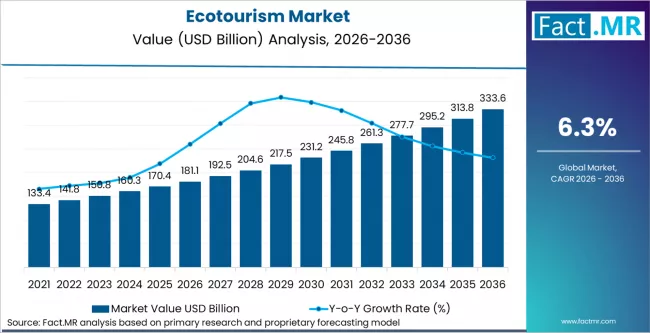
Ecotourism Market Market Value Analysis | Source: Fact.MR
Ecotourism Market Key Takeaways
| Metric | Value |
|---|---|
| Estimated Value in (2026E) | USD 181.1 billion |
| Forecast Value in (2036F) | USD 333.8 billion |
| Forecast CAGR (2026 to 2036) | 6.3% |
Ecotourism Market Definition
The ecotourism market involves travel focused on experiencing natural environments with the aim of conservation, education, and sustainable community benefit, where tourism activities are designed to minimise environmental impact and support local ecosystems and cultures.
Market Inclusions
This report covers global and regional market sizes for ecotourism over a defined forecast period, including key segments such as nature‑based travel, wildlife experiences, adventure‑linked ecotours, conservation‑focused tours, and distribution channels (tour operators, online travel platforms, specialty agencies).
Market Exclusions
The scope excludes mainstream leisure tourism not specifically aligned with environmental sustainability or conservation goals, traditional mass market travel packages, and hospitality services unrelated to ecotourism experiences.
Research Methodology
- Primary Research: Interviews were conducted with tour operators, ecotourism facilitators, conservation NGOs, and travel industry experts.
- Desk Research: Data was sourced from tourism reports, environmental agency publications, and travel association statistics.
- Market‑Sizing and Forecasting: A hybrid model combining top‑down tourism trend forecasts with bottom‑up travel and revenue data was used.
- Data Validation and Update Cycle: Findings were validated through expert review and aligned with recent adoption and market performance data.
Summary of the Ecotourism Market
- Market Definition
- The Ecotourism Market involves travel focused on experiencing natural environments with conservation, education, and sustainable community benefit, where tourism activities minimize environmental impact and support local ecosystems and cultures. The market includes wildlife reserves, national parks, marine protected areas, forest reserves, eco-lodges, traditional camping, and luxury eco-resorts.
- Demand Drivers
- Increasing global interest in sustainable and nature-based travel experiences.
- Rising environmental awareness and demand for responsible tourism practices.
- Expansion of tourism infrastructure in emerging markets supporting eco-travel growth.
- Growing popularity of eco-friendly accommodations, including eco-lodges and luxury eco-resorts.
- Policy support and conservation initiatives promoting wildlife reserves and protected areas.
- Key Segments Analyzed
- Destination Type: Wildlife Reserves (43.7% share in 2026), National Parks, Marine Protected Areas, Forest Reserves, Others.
- Accommodation Type: Eco-lodges (57.4% share in 2026), Traditional Camping, Luxury Eco-resorts.
- Activity Type: Wildlife Viewing, Nature Photography, Cultural Immersion, Adventure Activities, Conservation Research.
- End User: Eco-conscious travelers, adventure tourists, educational and research groups.
- Geography: South Asia, Western Europe, North America lead in value; India shows highest CAGR at 7.8%, followed by France (6.9%), Germany (6.4%), UK (5.7%), and USA (5.2%).
- Analyst Opinion at Fact MR
- Shambhu Nath Jha, Principal Consultant, Fact MR, opines, 'In this updated edition of the Ecotourism Market report, industry participants will observe that value creation is shifting from standard travel services toward immersive, sustainable, and conservation-focused experiences. Eco-lodges and wildlife reserves are no longer passive destinations but active contributors to environmental education, community benefit, and visitor satisfaction. Suppliers and operators that invest in certified eco-friendly accommodations, community engagement programs, and activity-specific offerings will capture margin expansion beyond conventional tourism services. The convergence of environmental stewardship with authentic travel experiences defines the competitive landscape through 2036.'
- Strategic Implications/Executive Takeaways
- Develop and expand eco-lodge and sustainable accommodation offerings in high-demand destinations.
- Integrate conservation, education, and community engagement into tourism packages.
- Target emerging markets such as India and Latin America with growing domestic and international eco-travel demand.
- Align operations with government and NGO sustainability certifications to enhance credibility.
- Offer differentiated, immersive experiences such as wildlife viewing, cultural immersion, and adventure activities.
- Leverage technology and online travel platforms to increase visibility and bookings among eco-conscious travelers.
- Methodology
- Primary Research: Interviews with tour operators, eco-tourism facilitators, conservation NGOs, and travel industry experts.
- Desk Research: Data sourced from tourism reports, environmental publications, and travel association statistics.
- Market Sizing & Forecasting: Hybrid model combining top-down tourism trend forecasts with bottom-up travel, occupancy, and revenue data.
- Data Validation: Findings validated through expert review, adoption data, and market performance figures; updated via proprietary Fact MR forecasting models.
Segmental Analysis
Ecotourism Market Analysis by Accommodation Type
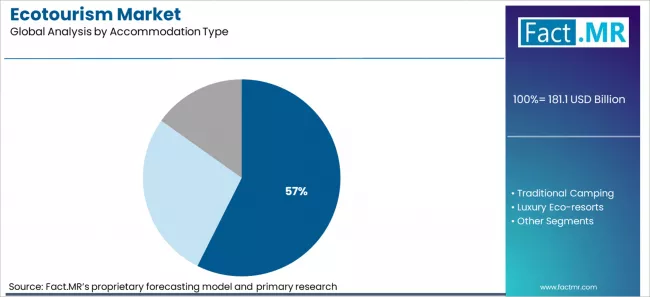
Ecotourism Market Analysis By Accommodation Type | Source: Fact.MR
Market Overview: Eco-lodges are expected to capture 57.4% of the ecotourism market share by 2026. Eco-lodges provide sustainable accommodation options designed to minimize environmental impact while offering tourists comfortable, nature-integrated stays. They are popular among travelers seeking environmentally responsible lodging with immersive experiences in natural settings.
Demand Drivers:
- Sustainable and Environmentally Friendly Practices: Eco-lodges implement eco-friendly infrastructure, renewable energy, and waste reduction strategies, attracting environmentally conscious travelers.
- Experiential Tourism Preference: Travelers increasingly seek immersive, nature-focused experiences, which eco-lodges provide through proximity to forests, wildlife, and natural landscapes.
- Growth in Responsible Travel Trends: Rising global awareness of sustainability and conservation encourages tourists to prefer eco-lodges over conventional hotels, boosting their market adoption.
Ecotourism Market Analysis by Destination Type
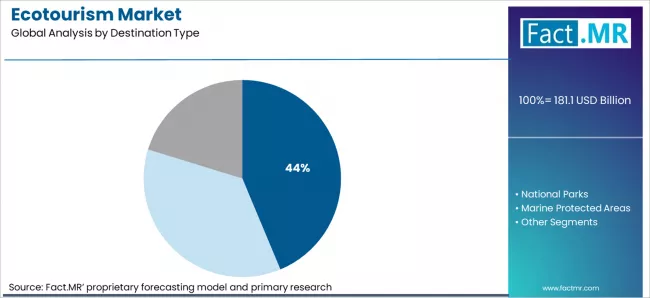
Ecotourism Market Analysis By Destination Type | Source: Fact.MR
Market Overview: Wildlife reserves are projected to hold 43.7% of the market share by 2026. Wildlife reserves offer opportunities for travelers to observe and experience biodiversity in protected environments, making them a key attraction in the ecotourism segment.
Demand Drivers:
- Conservation and Education Focus: Wildlife reserves provide educational and conservation-focused tourism experiences, appealing to travelers interested in learning about ecosystems and endangered species.
- Unique Nature Experiences: Access to diverse flora and fauna, safari experiences, and guided wildlife tours drives demand for ecotourism in these destinations.
- Support from Conservation Initiatives: Government and NGO efforts to promote wildlife conservation and sustainable tourism enhance the development and appeal of wildlife reserves for ecotourism.
Ecotourism Market Drivers, Restraints, and Opportunities
FMR analysts observe that the ecotourism market is a growth‑aligned, sustainability‑driven segment within global travel that reflects increasing consumer preference for nature‑based, low‑impact experiences. Historically, mass tourism dominated with little environmental accountability; as awareness of conservation and cultural preservation grew, structural demand emerged for tours and services that emphasize responsible interaction with natural and cultural assets. The 2026 valuation reflects this shift, with demand tied to both leisure travel trends and policy support for sustainable tourism development.
While traditional tourism volumes remain large, ecotourism experiences that integrate education, conservation contributions, and community engagement are gaining share. These higher‑value offerings often command premium pricing, contributing to market value growth even as overall travel volumes fluctuate with economic cycles. The segment exists because travelers increasingly factor environmental and social impact into destination choice, and host regions leverage ecotourism to support conservation and livelihoods.
- Sustainability and Experience Demand: Travelers are choosing authentic, nature‑focused trips that replace generic destinations with meaningful, low‑impact experiences.
- Policy and Conservation Standards: Protected area management and sustainability certification frameworks push destinations to offer certified ecotourism products that meet defined environmental criteria.
- Regional Biodiversity Appeal: In Latin America and Africa, rich biodiversity and community‑led initiatives drive higher ecotourism uptake, while Europe and North America emphasize green certification and responsible travel programs.
Regional Analysis
The market analysis covers key global regions, including South Asia, Western Europe, and North America. It is segmented geographically, with specific market dynamics for each region. The full report provides a detailed market attractiveness analysis.
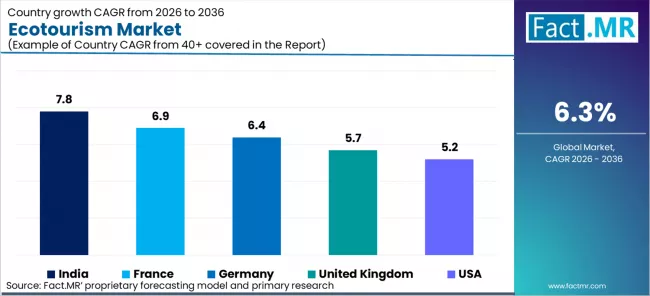
Ecotourism Market Cagr Analysis By Country | Source: Fact.MR
| Country | CAGR (2026-2036) |
|---|---|
| India | 7.8% |
| France | 6.9% |
| Germany | 6.4% |
| United Kingdom | 5.7% |
| USA | 5.2% |
Source: Fact MR (FMR) analysis, based on proprietary forecasting model and primary research
South Asia
India is a major market, driven by rising domestic and international travel, growing eco-resorts, and government support for sustainable tourism initiatives. Key players include Thomas Cook India, Cox & Kings, and Club Mahindra Holidays.
- India: Demand for ecotourism in India is projected to rise at 7.8% CAGR through 2036. Growth is supported by government tourism initiatives promoting eco-resorts (04-2025) and Club Mahindra’s expansion of eco-focused vacation properties (09-2025).
Western Europe
France, Germany, and the United Kingdom are key markets, supported by rising interest in nature-based travel, eco-certified accommodations, and environmental conservation programs.
- France: Demand for ecotourism in France is projected to rise at 6.9% CAGR through 2036. Growth is supported by government grants for eco-lodges (03-2025) and expansion of eco-tour operators like Voyageurs du Monde (08-2025).
- Germany: Demand for ecotourism in Germany is projected to rise at 6.4% CAGR through 2036. Growth is influenced by national sustainability tourism programs (02-2025) and TUI Group’s eco-resort investments (07-2025).
- United Kingdom: Demand for ecotourism in the UK is projected to rise at 5.7% CAGR through 2036. Growth is supported by government-backed eco-tourism campaigns (05-2025) and expansion by Responsible Travel Ltd. (09-2025).
North America
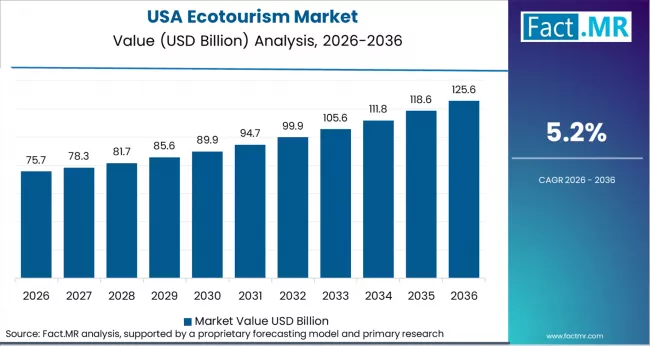
Ecotourism Market Country Value Analysis | Source: Fact.MR
The USA is a significant market, driven by nature tourism, national park visits, and eco-conscious travel trends.
- USA: Demand for ecotourism in the U.S. is projected to rise at 5.2% CAGR through 2036. Growth is supported by federal funding for national park programs (06-2025) and eco-lodge expansions by Wilderness Travel (10-2025).
Fact MR's analysis of the ecotourism market in South Asia, Western Europe, and North America consists of country-wise assessments that include India, France, Germany, the United Kingdom, and the USA. Readers can find detailed trends, regulatory updates, and company-specific investments shaping market growth in these countries.
What is the Competitive Structure and Buyer Behavior in the Ecotourism Market?
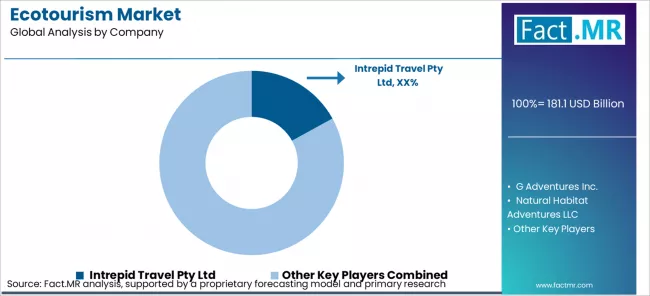
Ecotourism Market Analysis By Company | Source: Fact.MR
The ecotourism market is moderately fragmented, with specialist tour operators such as Intrepid Travel Pty Ltd, G Adventures Inc., Natural Habitat Adventures LLC, Wilderness Holdings Limited, and African Travel, Inc. holding notable share while numerous smaller regional and niche providers also compete. The primary competitive variables are depth of environmental and cultural engagement, destination authenticity, sustainability practice adherence, and overall traveler experience quality rather than price alone. Operators with well‑developed global networks, strong partnerships with local communities and conservation groups, and differentiated itineraries hold structural advantages, as they can offer diverse, high‑value experiences that align with consumer expectations and regulatory considerations in sensitive ecosystems.
Buyers, typically individual travelers and small groups seeking ecological and cultural immersion, exert leverage by comparing providers online, reviewing sustainability credentials, and prioritizing companies with transparent impact practices and credible certifications. To manage dependency, these buyers diversify their selections by destination, operator reputation, and ecological focus, which limits individual operators’ pricing power. As a result, competition centers on delivering authentic experiences, demonstrable ecological benefit, and reliable service rather than on price alone.
Key Players of the Ecotourism Market
- Intrepid Travel Pty Ltd
- G Adventures Inc.
- Natural Habitat Adventures LLC
- Wilderness Holdings Limited
- African Travel, Inc.
Report Scope
| Metric | Value |
|---|---|
| Quantitative Units | USD 181.1 billion (2026) to USD 333.8 billion (2036), at a CAGR of 6.3% |
| Market Definition | The ecotourism market includes global travel services and accommodations promoting sustainable experiences in natural and protected areas, emphasizing wildlife, conservation, and cultural engagement. |
| Destination Type | Wildlife Reserves, National Parks, Marine Protected Areas, Forest Reserves, Others |
| Accommodation Type | Eco-lodges, Traditional Camping, Luxury Eco-resorts |
| Activity Type | Wildlife Viewing, Nature Photography, Cultural Immersion, Adventure Activities, Conservation Research |
| End User | Eco-conscious Travelers, Adventure Tourists, Educational and Research Groups |
| Regions Covered | North America, Latin America, Europe, East Asia, South Asia, Oceania, Middle East & Africa |
| Countries Covered | United States, Canada, Mexico, Brazil, Germany, France, United Kingdom, Italy, Spain, China, India, Japan, South Africa, Australia, and 20+ other countries |
| Key Companies Profiled | Intrepid Travel Pty Ltd, G Adventures Inc., Natural Habitat Adventures LLC, Wilderness Holdings Limited, African Travel, Inc. |
| Forecast Period | 2026 to 2036 |
| Approach | Hybrid top-down and bottom-up modeling validated via interviews with tour operators, park authorities, and accommodation providers, supported by travel and occupancy data benchmarking. |
Bibliographies
- United Nations World Tourism Organization. (2023). Tourism and the sustainable development goals: Journey to 2030. United Nations World Tourism Organization.
- United Nations Environment Programme. (2023). Making tourism more sustainable: A guide for policy makers. United Nations Environment Programme.
- World Travel & Tourism Council. (2024). Nature-positive travel and tourism report. World Travel & Tourism Council.
- International Union for Conservation of Nature. (2023). Ecotourism and protected area conservation strategies. International Union for Conservation of Nature.
- Global Sustainable Tourism Council. (2024). Global sustainable tourism standards and destination certification framework. Global Sustainable Tourism Council.
- World Bank. (2023). Nature-based tourism and economic development in emerging markets. World Bank.
- Intrepid Travel. (2024). Integrated annual and sustainability report: Responsible travel and climate action. Intrepid Travel.
This report addresses
- Market intelligence enabling comprehensive assessment of leading countries and product segments across the Ecotourism Market globally.
- Market volume (sales units and revenue) estimates and 10-year revenue forecasts from 2026 to 2036, validated through tour operator data, occupancy surveys, and country-level tourism statistics.
- Growth opportunity mapping across destination types (Wildlife Reserves, National Parks, Marine Protected Areas, Forest Reserves, Others), accommodation types (Eco-lodges, Traditional Camping, Luxury Eco-resorts), and activity types (Wildlife Viewing, Nature Photography, Cultural Immersion, Adventure Activities, Conservation Research).
- Segment and regional revenue forecasts by destination, accommodation, activity, end use, and geography across 40+ countries.
- Competition strategy analysis covering sustainability practices, destination authenticity, traveler experience quality, regulatory compliance, including major players like Intrepid Travel Pty Ltd, G Adventures Inc., Natural Habitat Adventures LLC, Wilderness Holdings Limited, and African Travel, Inc.
- Product and regulatory compliance tracking aligned with eco-certifications, protected area guidelines, and environmental standards.
- Regulatory impact analysis addressing conservation policies, park management standards, and sustainable tourism frameworks across key markets.
- Report delivery in PDF, Excel, PowerPoint, and interactive dashboard formats for executive, operations, and planning use.
Ecotourism Market Key Segments
-
Destination Type
- Wildlife Reserves
- National Parks
- Marine Protected Areas
- Forest Reserves
- Others
-
Accommodation Type
- Eco-lodges
- Traditional Camping
- Luxury Eco-resorts
-
Activity Type
- Wildlife Viewing
- Nature Photography
- Cultural Immersion
- Adventure Activities
- Conservation Research
-
Region
- North America
- USA
- Canada
- Mexico
- Europe
- Germany
- UK
- France
- Italy
- Spain
- Nordic Countries
- BENELUX
- Rest of Europe
- Asia Pacific
- China
- Japan
- South Korea
- India
- Australia
- Rest of Asia Pacific
- Latin America
- Brazil
- Argentina
- Rest of Latin America
- Middle East and Africa
- Kingdom of Saudi Arabia
- United Arab Emirates
- South Africa
- Rest of Middle East and Africa
- Other Regions
- Oceania
- Central Asia
- Other Markets
- North America