- Market Value (2025): USD 3.0 Bn
- Estimated Value (2026): USD 3.2 Bn
- Forecast Value (2036):USD 5.8 Bn
- CAGR (2026-2036): 6.1%
What is the In Room Safes Market forecast to be worth by 2036?
USD 5.8 billion by 2036 at a 6.1% CAGR.
- The In Room Safes Market was valued at approximately USD 3.0 billion in 2025.
- Demand is projected to increase from USD 3.2 billion in 2026 to USD 5.8 billion by 2036.
- The market is forecast to expand at a 6.1% CAGR from 2026 to 2036.
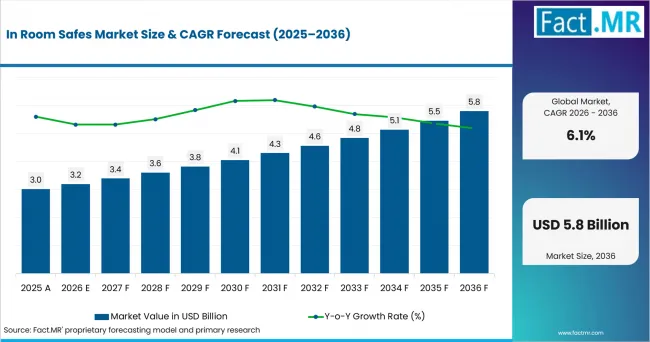
In Room Safes Market Value Analysis | Source: Fact.MR
What are the defining numbers behind In Room Safes Market growth?
An absolute opportunity of USD 2.6 billion is expected between 2026 and 2036.
- Demand Drivers in the Market
- Accommodation traffic supports room-equipment replacement and refurbishment. Germany recorded 497.5 million guest overnight stays in 2025, while Japan recorded 42.7 million international visitor arrivals. Higher room utilization increases the operating value of dependable guest-room equipment across hotels and related accommodation.
- Electronic hotel safes reduce dependence on physical keys by combining guest-set codes with controlled recovery. Vingcard's Elsafe Sentinel provides a 500-event audit trail, low-battery warning and UL-1037 certification, giving hotel staff a defined way to review access events and restore service when a guest forgets a code.
- Hotel groups and property developers often procure safes as part of room fit-out specifications. Global Safe states that its electronic safes are installed in more than 400,000 hotel rooms and can be configured for closets, drawers, walls and floor-bolted installations. This supports batch purchases during openings and renovation programs.
- Space efficiency directly influences product selection. Drawer, wall-mounted and cabinet-integrated formats allow hotel designers to place a safe inside existing furniture or unused room space, reducing the effect on luggage storage and usable floor area.
- Serviceability affects replacement decisions because a failed room safe creates a front-desk intervention. Audit records, battery alerts and secure override procedures reduce room downtime and make electronic models easier to manage across properties with frequent guest turnover.
- Key Segments Analyzed
- Electronic Digital Safes account for 44.8% of Product in 2026 because guest-set access codes, audit records and controlled emergency opening fit hotel operating workflows.
- Hotel Guest Room Security represents 76.3% of Application in 2026 because room-level protection is the primary repeated deployment across hotel inventories.
- Hospitality Industry accounts for 63.5% of End Use in 2026 as hotel chains and independent properties buy safes through room fit-out and replacement programs.
- Electronic Locking Technology holds 51.2% of Technology in 2026 because reprogrammable access and event records support temporary guest use and staff recovery.
- Built In Furniture Integration represents 69.7% of Formulation in 2026 because cabinet and wall installation conserve usable room space while allowing standardized room layouts.
- Direct OEM Sales account for 57.4% of Distribution Channel in 2026 because hotel groups and property developers buy against room-equipment specifications, warranty terms and service requirements.
- Analyst Opinion at Fact.MR
- Shambhu Nath Jha, Principal Consultant at Fact.MR, states, “Demand for in-room safes is tied to hotel room fit-outs and replacement cycles. Electronic models reduce operating friction by combining guest-set access with audit records and controlled emergency opening, while built-in formats fit the way hotel rooms are specified and renovated. Suppliers that can support chain specifications, installation and local service are better aligned with repeat procurement through 2036.”
- Strategic Implications
- Suppliers should organize hotel-safe ranges around laptop capacity, audit functions, emergency opening, battery service and cabinet dimensions so procurement teams can place products directly into room-equipment specifications.
- Sales teams should separate new-build demand from replacement cycles. Developers prioritize installation fit, while operating hotels place more weight on retrofit time, room downtime and service coverage.
- Regional distributors can add value through spare parts and trained service support because a malfunctioning safe creates a front-desk intervention and can affect room availability.
- Biometric or connected features should be paired with a defined enrollment and recovery process. Basic keypad systems remain relevant where operators prioritize acquisition cost and straightforward staff support.
How does the In Room Safes Market break down by segment?
The market is segmented by Product, Application, End Use, Technology, Formulation and Distribution Channel.
Why do Electronic Digital Safes lead Product?
Electronic Digital Safes are projected to account for a 44.8% share of Product in 2026.
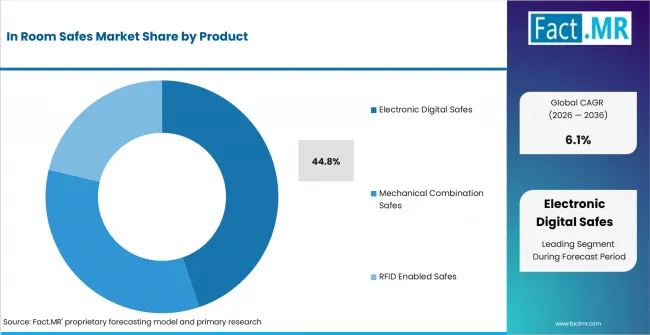
In Room Safes Market Analysis By Product | Source: Fact.MR
Electronic digital models lead because a guest can set a temporary code without carrying a separate key, while hotel staff retain controlled recovery procedures. This fits short-stay accommodation where access has to be reset between occupancies.
Vingcard's Elsafe Sentinel records up to 500 audit events, provides low-battery warning and is UL-1037 certified. For hotel buyers, these functions support two recurring tasks: investigating access events and restoring service without replacing the lock. Mechanical combination models remain relevant where operators prefer fewer electronic components, but they provide less operating visibility.
Why does Hotel Guest Room Security lead Application?
Hotel Guest Room Security is projected to account for a 76.3% share of Application in 2026.
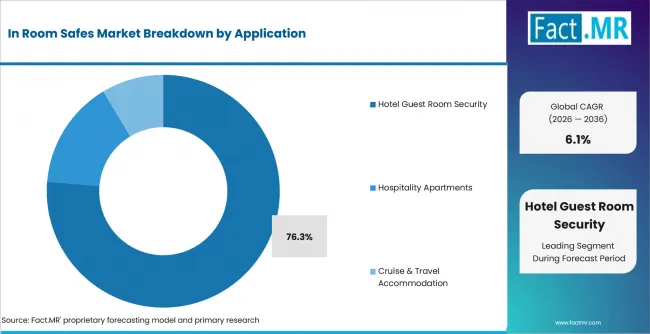
In Room Safes Market Analysis By Application | Source: Fact.MR
Hotel guest rooms lead because one property can deploy the same safe across a large share of its room inventory. Demand therefore scales with room openings and refurbishments, creating repeated unit purchases within a single project.
Guests use in-room safes for passports, cash, documents and small electronics during a stay. Hotels value designs that are intuitive for temporary users and easy for staff to reset between occupancies. Serviced apartments and travel accommodation share this requirement, but hotel rooms form the main repeated installation environment within the defined scope.
Why does Hospitality Industry lead End Use?
Hospitality Industry is projected to account for a 63.5% share of End Use in 2026.
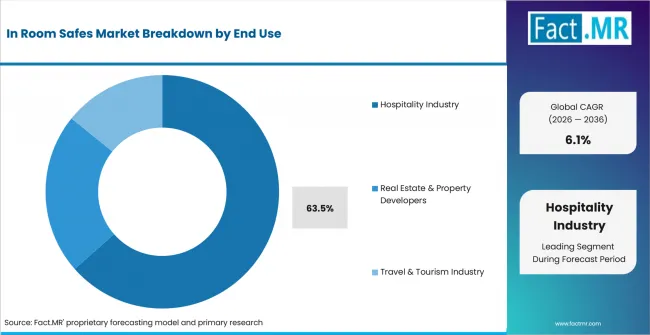
In Room Safes Market Analysis By End Use | Source: Fact.MR
Hospitality operators control the room where the safe is installed and carry responsibility for maintenance during the property's operating life. This creates direct demand for new rooms, renovations and replacements across hotel chains and independent properties.
Global Safe states that its units are installed in more than 400,000 hotel rooms. That installed base illustrates why suppliers compete on serviceability and replacement support in addition to the safe itself. Property developers can specify the equipment during construction, while the hospitality operator remains the recurring user after opening.
Why does Electronic Locking Technology lead Technology?
Electronic Locking Technology is projected to account for a 51.2% share of Technology in 2026.
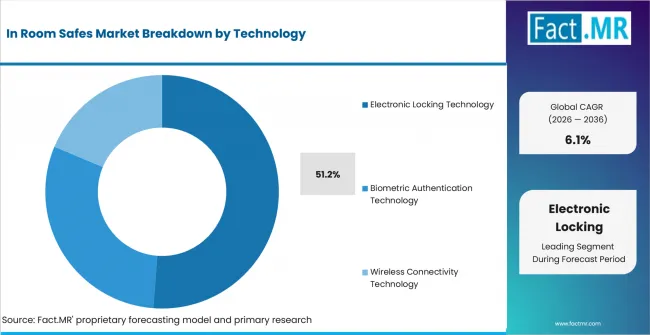
In Room Safes Market Analysis By Technology | Source: Fact.MR
Electronic locking leads because access can be reprogrammed between guests and logged for later review. The operating model suits hotels where temporary access and staff recovery are routine requirements.
Biometric systems offer another authentication route, but frequent guest turnover creates a need for quick enrollment and dependable recovery. Keypad-based electronic locks meet those requirements with a familiar workflow, supporting their larger share in 2026.
Why does Built In Furniture Integration lead Formulation?
Built In Furniture Integration is projected to account for a 69.7% share of Formulation in 2026.
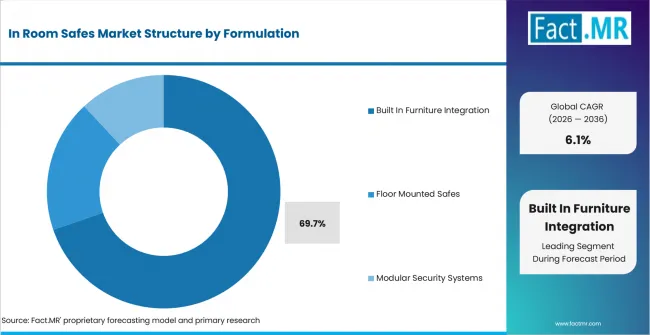
In Room Safes Market Analysis By Formulation | Source: Fact.MR
Built-in integration leads because a safe must fit within the room design without reducing usable floor area. Drawer, closet and wall formats can be placed inside casework or fixed furniture and standardized with cabinetry dimensions before rooms are completed.
Global Safe lists closet, drawer, recessed-wall and floor-bolted installation options across its hotel range. This gives developers and hotel engineers flexibility during room fit-out while preserving a common safe specification across multiple room types.
Why do Direct OEM Sales lead Distribution Channel?
Direct OEM Sales are projected to account for a 57.4% share of Distribution Channel in 2026.
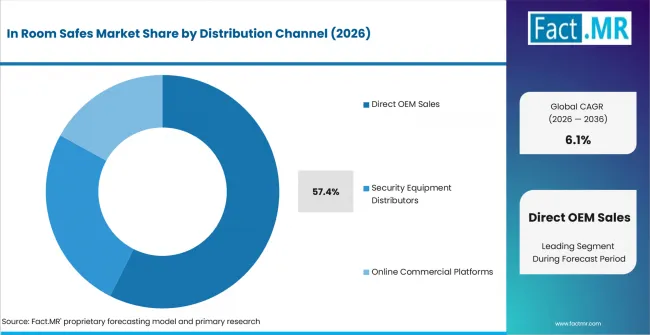
In Room Safes Market Analysis By Distribution Channel | Source: Fact.MR
Direct OEM sales lead because hotel chains and property developers often procure room equipment against a technical specification. Safe size, mounting method, locking system, finish, warranty and emergency-access process can be agreed before a batch is delivered.
Direct engagement also gives the manufacturer a role in installation guidance and after-sales support. Distributors remain important for regional stock and service, while online commercial platforms fit smaller replacement orders. Project-scale purchases favor direct coordination when the same safe must be installed across many rooms.
What is accelerating In Room Safes Market adoption, and what is holding it back?
Growth is supported by hotel room fit-outs, electronic locking and frequent room turnover, while long replacement cycles, budget sensitivity and maintenance requirements can constrain upgrades.
Drivers Impact Analysis
| Factor | (~) % Impact on CAGR | Geographic Relevance | Impact Timeline |
|---|---|---|---|
| Hotel openings and room renovation programs | +1.3% | Global; Germany; Brazil | Short term (≤ 2 years) |
| Electronic locking and audit functionality | +1.0% | USA; UK; Japan; Global | Short term (≤ 2 years) |
| Higher accommodation utilization | +0.8% | Germany; Brazil; USA; UK; Japan | Medium term (2–4 years) |
| Direct hotel-group procurement | +0.6% | Global | Medium term (2–4 years) |
Source: Fact.MR analysis. Updated Aug 21, 2026
Opportunity Impact Analysis
| Factor | (~) % Impact on CAGR | Geographic Relevance | Impact Timeline |
|---|---|---|---|
| Built-in cabinet and drawer formats | +0.7% | Global | Medium term (2–4 years) |
| Multi-property OEM standardization | +0.6% | USA; Europe; Asia | Medium term (2–4 years) |
| Biometric and connected safe options | +0.4% | USA; UK; Japan | Long term (≥ 4 years) |
| Regional service and replacement programs | +0.3% | Global | Long term (≥ 4 years) |
Source: Fact.MR analysis. Updated Aug 21, 2026
Restraints Impact Analysis
| Factor | (~) % Impact on CAGR | Geographic Relevance | Impact Timeline |
|---|---|---|---|
| Long safe replacement cycles | -0.9% | Global | Short term (≤ 2 years) |
| Budget sensitivity in economy properties | -0.7% | Price-sensitive hotel markets | Short term (≤ 2 years) |
| Battery and override maintenance requirements | -0.5% | Global | Medium term (2–4 years) |
| Higher cost of advanced authentication features | -0.3% | Global | Long term (≥ 4 years) |
Source: Fact.MR analysis. Updated Aug 21, 2026
Which countries are scaling the In Room Safes Market through 2036?
- Germany: Accommodation establishments recorded 497.5 million guest overnight stays in 2025. Persistent room use supports refurbishment and replacement demand for guest-room equipment installed across hotels and similar accommodation.
- Brazil: The country received about 9.3 million international tourists in 2025, 37.1% more than in 2024. Higher visitor flows support hotel occupancy and room investment in gateway cities and resort locations, increasing the relevance of standardized electronic safes during fit-outs and renovations.
- USA: The National Travel and Tourism Office forecasts 70.5 million international arrivals in 2026, up 3.2% from 2025. A mature hotel base creates demand through replacement cycles and property upgrades, where direct manufacturer relationships and service coverage influence procurement.
- UK: VisitBritain forecasts 45.5 million inbound visits in 2026, 4% above its 2025 estimate. Hotel operators serving this traffic continue to refresh room equipment, with electronic safes fitting properties that need standardized guest access and staff recovery procedures.
- Japan: Japan recorded 42.7 million international visitor arrivals in 2025, up 15.8% from 2024. Frequent room turnover in business and city hotels supports compact electronic safes that can be reset and serviced without extended room downtime.
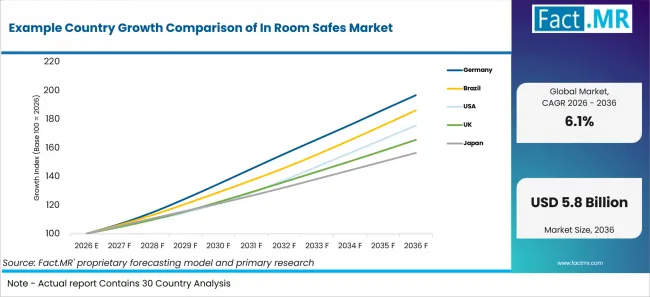
Example Country Growth Comparison Of In Room Safes Market | Source: Fact.MR
Country CAGR (2026-2036)
| Country | CAGR |
|---|---|
| Germany | 7.0% |
| Brazil | 6.4% |
| USA | 5.8% |
| UK | 5.2% |
| Japan | 4.6% |
Source: Fact.MR analysis. Updated Aug 21, 2026
What is driving Germany’s growth through 2036?
Germany is forecast to expand at a 7.0% CAGR from 2026 to 2036.
Germany combines a broad accommodation base with sustained room use. Destatis recorded 497.5 million guest overnight stays in 2025, including 413.7 million domestic guest nights. This creates an installed room base where refurbishment and replacement demand can recur without relying only on new hotel construction.
Room-safe suppliers can address this installed base through cabinet-compatible electronic models and replacement programs. Audit records, battery warnings and secure emergency opening reduce operational disruption when a room turns over between guests.
What is driving Brazil’s growth through 2036?
Brazil is forecast to expand at a 6.4% CAGR from 2026 to 2036.
Brazil received 9.3 million international tourists in 2025, 37.1% more than in 2024. Government data also show strong visitor flows through major gateways such as Sao Paulo and Rio de Janeiro, increasing utilization across hotels serving international and domestic travel demand.
For safe suppliers, the commercial route is tied to room investment. Hotel groups adding rooms or renovating properties can standardize one electronic safe model across multiple sites, creating direct OEM demand linked to installation fit, service coverage and warranty requirements.
What is driving USA’s growth through 2036?
The USA is forecast to expand at a 5.8% CAGR from 2026 to 2036.
The National Travel and Tourism Office expects international visitation to rise from 68.3 million in 2025 to 70.5 million in 2026. This supports room utilization across hotels while maintaining the case for periodic equipment replacement.
The market also benefits from a mature hospitality procurement system in which chain standards can be applied across many rooms. Direct manufacturer relationships, multi-year warranties and local service coverage influence buying decisions because operators need a repeatable process for installation and guest-access recovery.
What is driving the UK’s growth through 2036?
The UK is forecast to expand at a 5.2% CAGR from 2026 to 2036.
VisitBritain forecasts 45.5 million inbound visits in 2026, 4% above its 2025 estimate. Continued visitor growth supports accommodation demand and gives hotel operators a reason to maintain room standards through periodic refurbishment.
UK buyers are likely to balance digital functions with lifecycle cost. Keypad safes with audit records and controlled override support operational requirements without the enrollment burden of more complex authentication systems, preserving the relevance of electronic locking across varied hotel formats.
What is driving Japan’s growth through 2036?
Japan is forecast to expand at a 4.6% CAGR from 2026 to 2036.
Japan recorded 42.7 million international visitor arrivals in 2025, up 15.8% from 2024. The scale of inbound travel adds to domestic accommodation demand and supports continued room utilization across business, city and resort hotels.
Frequent room turnover increases the value of safes that are simple for guests and easy for staff to reset. Compact built-in units also fit smaller room footprints, supporting cabinet-integrated formats and electronic locks that can be serviced without extended room downtime.
Who Leads the In Room Safes Market?
Vingcard (ASSA ABLOY), Global Safe Corporation, Indel B, Conforti, Gunnebo AB, ARREGUI, JVD, Godrej Security Solutions, Dometic and other listed suppliers operate across the In Room Safes Market.
Vingcard participates through its Elsafe in-room safe portfolio. The current Elsafe Sentinel line provides a 500-event audit trail, low-battery warning and UL-1037 certification, supporting hotel requirements for temporary guest access, staff recovery and documented serviceability.
Global Safe Corporation competes through hotel-specific electronic safes and flexible installation options. The company states that its safes are installed in more than 400,000 hotel rooms worldwide and offers drawer, wall, compact and floor-bolted configurations. Indel B, Conforti, Gunnebo, ARREGUI and JVD also address hospitality and security procurement through regional product portfolios.
Competition depends on lock reliability, installation fit, secure override procedures, warranty terms and service coverage. Direct OEM relationships matter because hotel groups can standardize safe dimensions and functions across multiple properties, while regional service support affects how quickly a failed unit can be returned to operation.
Which companies are the key providers?
Key companies profiled include Vingcard (ASSA ABLOY); Global Safe Corporation; Indel B; Conforti; Gunnebo AB; ARREGUI; JVD; Godrej Security Solutions; FAS; Dometic; iTEC; Vitrifrigo; Minibar Systems; Technomax; Poitoux; and Stockinger Bespoke Safes.
- Vingcard (ASSA ABLOY)
- Global Safe Corporation
- Indel B
- Conforti
- Gunnebo AB
- ARREGUI
- JVD
- Godrej Security Solutions
- FAS
- Dometic
- iTEC
- Vitrifrigo
- Minibar Systems
- Technomax
- Poitoux
- Stockinger Bespoke Safes
Bibliography
- UN Tourism. (2025). International Tourist Arrivals Grew 5% in Q1 2025. United Nations Tourism.
- Federal Statistical Office of Germany. (2026). Tourism in Germany in 2025: Guest Overnight Stays. Government of Germany.
- Secretariat of Social Communication, Brazil. (2026). Brazil Closed 2025 with 9.3 Million International Tourists. Government of Brazil.
- National Travel and Tourism Office. (2026). International Visitor Forecast 2026-2030. U.S. Department of Commerce.
- VisitBritain. (2026). Inbound Tourism Forecast. British Tourist Authority.
- Japan National Tourism Organization. (2026). Visitor Arrivals, December and Annual 2025. Government of Japan.
- Vingcard. (2026). Elsafe Sentinel. ASSA ABLOY.
- ASSA ABLOY. (2026). Hospitality Access Solutions and Elsafe In-Room Safes. ASSA ABLOY.
- Global Safe Corporation. (2026). Hotel Safes and Product Features. Global Safe Corporation.
This Report Answers
- How demand for in-room safes develops across Product, Application, End Use, Technology, Formulation and Distribution Channel.
- Why Electronic Digital Safes, Hotel Guest Room Security and Hospitality Industry account for the stated 2026 segment shares.
- How room utilization, hotel fit-outs and electronic locking influence demand across Germany, Brazil, the USA, the UK and Japan.
- How the listed suppliers compete through installation fit, audit functionality, service support and hotel procurement relationships.
- Which room-security applications fall inside the market and which adjacent security products remain outside the scope.
What does the In Room Safes Market cover?
The In Room Safes Market covers compact security safes installed inside guest rooms and related accommodation spaces for temporary storage of valuables such as passports, cash, documents and small electronic devices during a stay.
Revenue is counted for products sold within the Product, Application, End Use, Technology, Formulation and Distribution Channel categories defined in the segmentation. Coverage includes hotel guest-room deployment together with the included apartment, resort, cruise and railway accommodation uses.
What is included in the scope?
The scope includes Electronic Digital Safes, Mechanical Combination Safes and RFID Enabled Safes sold for the included accommodation and property applications. Technology coverage includes electronic locking, biometric authentication and wireless connectivity as defined within the taxonomy.
Installation coverage includes built-in furniture integration, floor-mounted units and modular security systems. Demand is included through Direct OEM Sales, Security Equipment Distributors and Online Commercial Platforms together with their defined subchannels.
What is excluded from the scope?
The scope excludes bank vaults, safe-deposit lockers, institutional vault systems and general residential safes sold outside the covered accommodation or property applications. Hotel door locks and standalone building-access systems are outside the market unless integrated into an in-room safe product.
Standalone alarm systems, CCTV equipment, cybersecurity software and centralized luggage-storage systems are also excluded. Adjacent security products are included only when they form part of a covered in-room safe configuration.
How Was the Analysis Built?
The analysis draws on more than 120 sources, over 35 company portfolios and more than 20 industry interviews across at least 25 countries.
- Primary Research: Interviews with safe manufacturers, hotel procurement teams, hotel engineering teams, FF&E suppliers, security equipment distributors and property developers examine safe selection, installation requirements, replacement cycles and service priorities.
- Desk Research: The review covers national tourism and accommodation statistics, company product documentation, safe technical specifications, company disclosures and relevant security standards. Sources used in the article are recorded in the bibliography.
- Market Sizing and Forecasting: Estimates combine accommodation room stock, safe penetration, replacement cycles, average selling prices, product mix, procurement-channel mix and country lodging indicators.
- Data Validation and Update Cycle: Updates account for changes in hotel investment, tourism demand, safe technology, product portfolios and service requirements.
Segmentation
What is the report's scope and coverage?
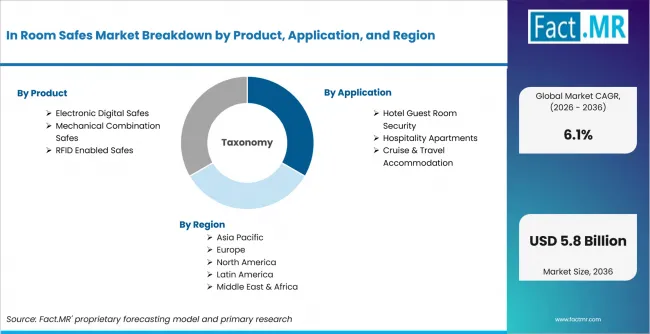
In Room Safes Market Breakdown By Product, Application, And Region | Source: Fact.MR
| Attribute | Details |
|---|---|
| Quantitative Units | USD billion |
| Market Definition | Compact in-room safes installed in guest rooms and related accommodation spaces to secure valuables |
| Segments Covered | Product; Application; End Use; Technology; Formulation; Distribution Channel |
| Regions Covered | North America; Latin America; Europe; East Asia; South Asia and Pacific; Middle East and Africa |
| Countries Covered | Germany; Brazil; USA; UK; Japan |
| Key Companies Profiled | Vingcard (ASSA ABLOY); Global Safe Corporation; Indel B; Conforti; Gunnebo AB; and others |
| Forecast Period | 2026 to 2036 |
| Base Year | 2025 |
| Market Value, 2026 | USD 3.2 billion |
| Market Value, 2036 | USD 5.8 billion |
| CAGR, 2026-2036 | 6.1% |
| Absolute Opportunity | USD 2.6 billion |
| Approach | Uses accommodation room stock, installed-safe penetration, replacement cycles, average selling prices, product mix, procurement-channel mix and country lodging activity. |
Source: Fact.MR analysis. Updated Aug 21, 2026
How is the market segmented?
-
By Product:
- Electronic Digital Safes
- Keypad Controlled Safes
- Biometric Safes
- Mechanical Combination Safes
- Dial Based Safes
- Dual Lock Systems
- RFID Enabled Safes
- Card Access Safes
- Wireless Smart Safes
- Electronic Digital Safes
-
By Application:
- Hotel Guest Room Security
- Luxury Hotels
- Business Hotels
- Hospitality Apartments
- Serviced Apartments
- Resort Rooms
- Cruise & Travel Accommodation
- Cruise Ship Cabins
- Railway Luxury Coaches
- Hotel Guest Room Security
-
By End Use:
- Hospitality Industry
- Hotel Chains
- Independent Hotels
- Real Estate & Property Developers
- Residential Developers
- Commercial Property Owners
- Travel & Tourism Industry
- Tour Operators
- Cruise Operators
- Hospitality Industry
-
By Technology:
- Electronic Locking Technology
- Microprocessor Based Systems
- Circuit Controlled Locks
- Biometric Authentication Technology
- Fingerprint Systems
- Multi Factor Authentication
- Wireless Connectivity Technology
- Bluetooth Enabled Safes
- WiFi Enabled Safes
- Electronic Locking Technology
-
By Formulation:
- Built In Furniture Integration
- Wall Mounted Safes
- Cabinet Integrated Safes
- Floor Mounted Safes
- Heavy Duty Floor Safes
- Portable Room Safes
- Modular Security Systems
- Expandable Lock Systems
- Smart Integration Modules
- Built In Furniture Integration
-
By Distribution Channel:
- Direct OEM Sales
- Hotel Equipment Contracts
- Real Estate Developer Sales
- Security Equipment Distributors
- Regional Distributors
- Specialized Security Dealers
- Online Commercial Platforms
- B2B Procurement Portals
- Manufacturer Direct Portals
- Direct OEM Sales
-
By Region:
- North America
- Latin America
- Western Europe
- Eastern Europe
- East Asia
- South Asia and Pacific
- Middle East & Africa
Frequently Asked Questions
What is the In Room Safes Market value in 2026?
At what CAGR is the market projected to grow?
What is the projected market value by 2036?
Which Product leads the market?
Which Application leads the market?
Which End Use leads the market?
Which Technology leads the market?
Which Formulation leads the market?
Which Distribution Channel leads the market?
Which country records the highest listed CAGR?
Which companies are included in the market assessment?
Who worked on this report


Preview the report firsthand - request a free sample
Free SampleGet the brochure for pricing and purchase details
Download PDF