- Market Value (2025): USD 389.4 Bn
- Estimated Value (2026): USD 415.5 Bn
- Forecast Value (2036): USD 794.7 Bn
- CAGR (2026-2036): 6.7%
What is the Home Improvement Market forecast to be worth by 2036?
USD 794.7 billion by 2036 at a 6.7% CAGR.
- The Home Improvement Market reached USD 389.4 billion in 2025.
- Demand is projected to increase from USD 415.5 billion in 2026 to USD 794.7 billion by 2036.
- The market is forecast to expand at a 6.7% CAGR from 2026 to 2036.
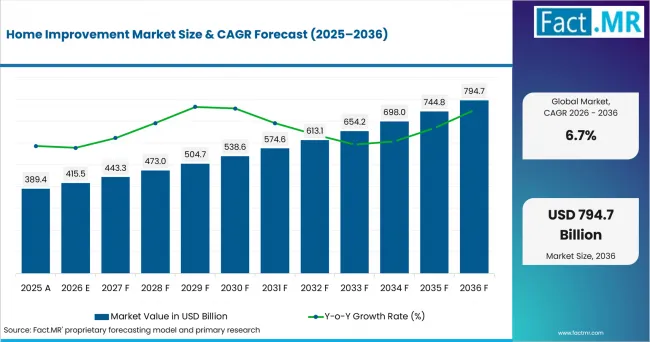
Home Improvement Market Value Analysis | Source: Fact.MR
What are the defining numbers behind Home Improvement Market growth?
An absolute opportunity of USD 379.2 billion is expected between 2026 and 2036.
- Demand Drivers in the Market
- Existing homes require recurring repair and replacement as roofs, plumbing systems, electrical components and interior finishes age. The American Housing Survey separately tracks remodeling and major replacements, including roofing, flooring, windows, plumbing, wiring and heating equipment. This creates a recurring demand base tied to the condition of the existing housing stock.
- Energy-efficiency policy is moving improvement budgets toward insulation, windows, heating systems and connected energy controls. The revised EU Energy Performance of Buildings Directive requires national building renovation plans, making existing-building upgrades part of long-term housing policy.
- Homeowners continue to spend on renovation even when housing transactions are slow because staying in place can shift expenditure toward repair and modernization. Harvard Joint Center for Housing Studies projects annual U.S. homeowner improvement and repair spending at about USD 519 billion through mid-2027, although growth is expected to remain modest.
- Public programs are widening access to improvement finance. Brazil expanded Reforma Casa Brasil to all 5,571 municipalities, with financing available for construction materials, labor and technical support. Germany continues to support energy-efficient renovation of existing homes through KfW programs.
- Technology is becoming part of the renovation decision as households combine physical upgrades with lighting controls, security systems and energy management. Japan expanded its fiscal 2025 Housing Market Trend Survey to capture renovation tax use and a wider set of energy-efficiency equipment, linking improvement activity more closely with building performance.
- Key Segments Analyzed
- Building Materials account for 62.8% of Product in 2026 because most renovation work requires physical inputs for structural repair, interior replacement or exterior improvement.
- Residential Renovation represents 55.4% of Application in 2026 as improvement budgets concentrate on upgrading existing living spaces and correcting building-condition issues.
- Homeowners hold 48.9% of End Use in 2026 because owner-occupiers directly initiate a large share of repair, decoration and modernization decisions.
- Smart Home Technology accounts for 41.6% of Technology in 2026 as renovation projects increasingly incorporate connected lighting, security and energy-control functions.
- Ready-to-Use Construction Materials represent 68.3% of Formulation in 2026 because pre-mixed and pre-finished products reduce preparation work at the point of installation.
- Retail Stores account for 52.7% of Distribution Channel in 2026 as homeowners and contractors value local product availability, physical comparison and project-based purchasing support.
- Analyst Opinion at Fact.MR
- Shambhu Nath Jha, Principal Consultant at Fact.MR, states, “Home improvement demand through 2036 will be shaped by the economics of improving existing homes and by the need to keep aging properties functional. Buyers are prioritizing projects that solve repair needs while improving energy performance or daily usability. Suppliers that combine dependable product availability with simpler installation and project support can capture spending across homeowner-led work and professionally managed renovation.”
- Strategic Implications
- Retailers should align local inventory with the repair profile of the housing stock they serve. Roofing, plumbing and interior replacement categories need different replenishment patterns from discretionary decoration projects.
- Material suppliers can reduce buyer friction by packaging compatible products around complete tasks such as wall finishing, flooring replacement or bathroom repair instead of selling each component as an isolated item.
- Smart-home providers should connect automation upgrades with renovation moments when walls, wiring or heating systems are already being opened or replaced. Installation timing can lower incremental labor and improve adoption.
- Remodelers and contractors can protect project conversion by offering phased work where households face financing pressure. Essential repair can be completed first, with decorative or automation upgrades scheduled as later phases.
How does the Home Improvement Market break down by segment?
The market is segmented by Product, Application, End Use, Technology, Formulation and Distribution Channel.
Why do Building Materials lead Product?
Building Materials are projected to account for a 62.8% share in 2026.
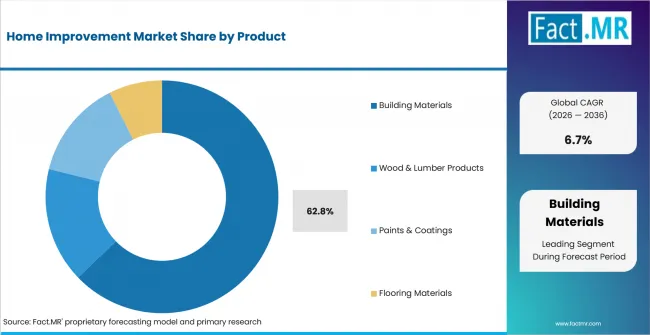
Home Improvement Market Analysis By Product | Source: Fact.MR
Building materials lead because renovation converts a design or repair decision into physical purchases. Structural fixes require cement, blocks or timber, while interior work adds surface finishes and replacement materials. The American Housing Survey includes roofing, flooring, windows, doors and other replacements among home-improvement activities, illustrating the material intensity of common projects.
Project baskets often extend across several material categories when homeowners renovate multiple parts of a property. This increases the amount of physical product purchased during a single improvement cycle.
Why does Residential Renovation lead Application?
Residential Renovation is projected to account for a 55.4% share in 2026.
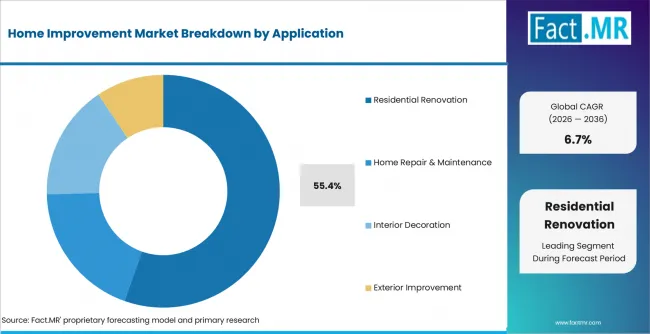
Home Improvement Market Analysis By Application | Source: Fact.MR
Residential renovation leads because it combines discretionary upgrades with necessary replacement. Kitchens, bathrooms and interior layouts can be modernized for comfort, while structural work addresses deterioration that cannot be postponed indefinitely.
Harvard Joint Center for Housing Studies expects U.S. homeowner improvement and repair spending to remain positive through mid-2027, although growth is projected to moderate. Renovation therefore remains active even when households delay moving.
Why do Homeowners lead End Use?
Homeowners are projected to account for a 48.9% share in 2026.
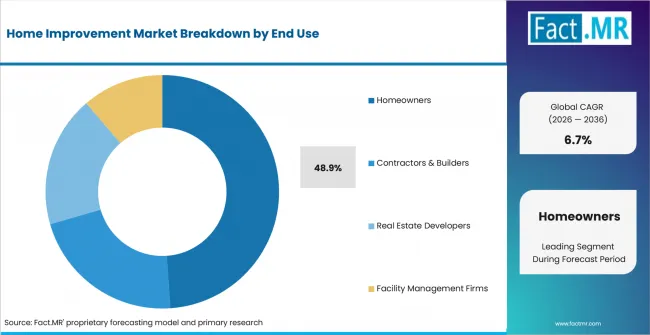
Home Improvement Market Analysis By End Use | Source: Fact.MR
Homeowners lead because they control the timing and budget for most improvements to owner-occupied properties. They decide when a worn component needs replacement and whether a repair should be expanded into a broader upgrade.
The American Housing Survey measures major improvements and replacements specifically for owner-occupied homes, linking property ownership directly with project spending across kitchens, roofing, windows, plumbing and other categories.
Why does Smart Home Technology lead Technology?
Smart Home Technology is projected to account for a 41.6% share in 2026.
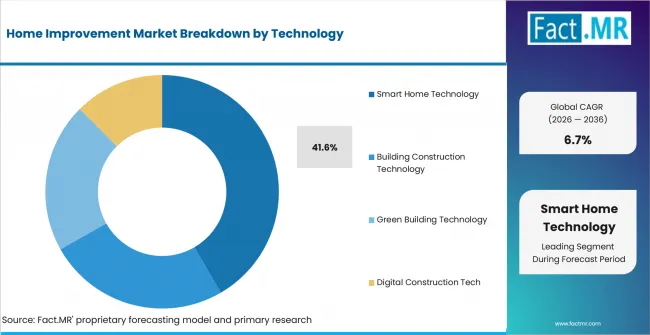
Home Improvement Market Analysis By Technology | Source: Fact.MR
Smart Home Technology leads because renovation creates a practical installation window for connected controls. Lighting circuits, security devices and heating controls can be integrated while electrical or interior work is already underway.
Policy is also shifting attention toward building performance. The EU Energy Performance of Buildings Directive requires national building renovation plans, while Japan has expanded housing-market measurement of energy-efficiency equipment. These developments increase the relevance of technologies that help households control energy use after an upgrade.
Why do Ready-to-Use Construction Materials lead Formulation?
Ready-to-Use Construction Materials are projected to account for a 68.3% share in 2026.
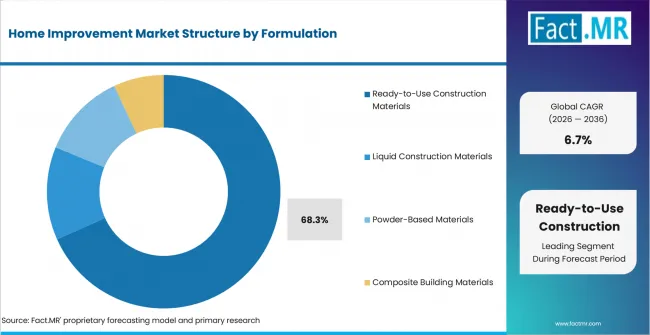
Home Improvement Market Analysis By Formulation | Source: Fact.MR
Ready-to-use formulations lead because they reduce measurement, mixing and preparation at the job site. Pre-mixed cement systems and pre-finished panels can shorten installation steps for homeowners as well as professional crews.
The operational benefit is strongest in smaller residential jobs where contractors move between sites and homeowners may perform part of the work themselves. Products that arrive closer to application condition reduce equipment needs and formulation errors.
Why do Retail Stores lead Distribution Channel?
Retail Stores are projected to account for a 52.7% share in 2026.
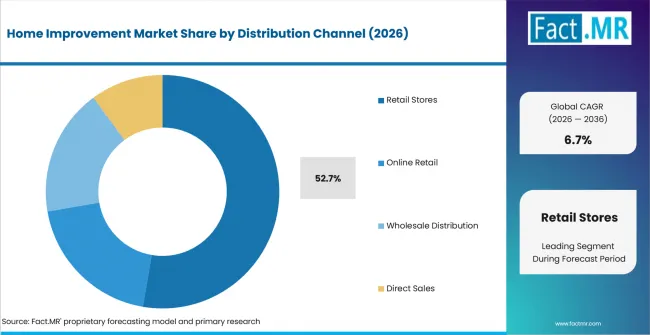
Home Improvement Market Analysis By Distribution Channel | Source: Fact.MR
Retail stores lead because home-improvement purchases often involve bulky products, color or finish comparison and immediate project needs. A physical store lets buyers combine materials with accessories while arranging pickup or local delivery.
Digital ordering is expanding, but stores remain relevant where buyers need advice or same-day access. Harvard’s remodeling outlook uses retail spending on building products as one of the indicators of renovation activity, reinforcing the connection between project demand and the retail channel.
What is accelerating Home Improvement Market adoption, and what is holding it back?
Adoption is supported by recurring repair cycles, energy-efficiency retrofits and smart-home upgrades, while project cost, financing pressure and skilled-trade availability can delay or phase household spending.
Drivers Impact Analysis
| Factor | (~) % Impact on CAGR | Geographic Relevance | Impact Timeline |
|---|---|---|---|
| Existing-home repair and renovation cycles | +1.6% | Global | Short term (<= 2 years) |
| Energy-efficiency retrofit policy | +1.4% | Germany; UK; USA | Short term (<= 2 years) |
| Homeowner project spending | +1.1% | Global | Medium term (2-4 years) |
| Smart-home upgrade demand | +0.9% | USA; Germany; Japan | Medium term (2-4 years) |
| Local availability of project materials | +0.6% | Global | Long term (>= 4 years) |
Source: Fact.MR analysis. Updated Aug 21, 2026
Opportunity Impact Analysis
| Factor | (~) % Impact on CAGR | Geographic Relevance | Impact Timeline |
|---|---|---|---|
| Energy retrofit packages | +1.0% | Global | Medium term (2-4 years) |
| Smart-home modernization | +0.8% | USA; UK; Germany | Medium term (2-4 years) |
| Ready-to-use material systems | +0.7% | Global | Long term (>= 4 years) |
| Store pickup and local project delivery | +0.5% | USA; Brazil; Japan | Long term (>= 4 years) |
Source: Fact.MR analysis. Updated Aug 21, 2026
Restraints Impact Analysis
| Factor | (~) % Impact on CAGR | Geographic Relevance | Impact Timeline |
|---|---|---|---|
| Project cost and labor expense | -1.1% | Global | Short term (<= 2 years) |
| Financing and housing turnover pressure | -0.9% | USA; UK; Germany | Short term (<= 2 years) |
| Skilled trade availability | -0.7% | Developed markets | Medium term (2-4 years) |
| Material price volatility | -0.5% | Global | Long term (>= 4 years) |
Source: Fact.MR analysis. Updated Aug 21, 2026
Which countries are scaling the Home Improvement Market through 2036?
- Germany: KfW adjusted federal efficient-building support in July 2026 and continues to finance the renovation of existing residential properties to defined efficiency-house standards. The program directly supports spending on heating systems, building-envelope work and associated installation.
- Brazil: Reforma Casa Brasil is available across all 5,571 municipalities. Eligible financing can cover construction materials, labor, project design and technical support, translating housing-quality policy into purchases for repair and renovation.
- USA: The American Housing Survey records major owner-occupied home improvements across kitchens, bathrooms, roofing, windows, plumbing, wiring and heating equipment. Harvard projects annual improvement and repair spending at about USD 519 billion through mid-2027, supporting a broad recurring project base.
- UK: Private housing repair and maintenance grew 2.9% in the three months to September 2025 and was the main positive contributor to construction growth. The 2026 Warm Homes Plan adds public support for measures such as insulation, solar systems, batteries and heat pumps.
- Japan: MLIT’s fiscal 2025 renovation survey measures refurbishment and renewal orders, while the Housing Market Trend Survey added questions on renovation tax use and expanded energy-efficiency equipment coverage. These mechanisms support spending on existing-home modernization.
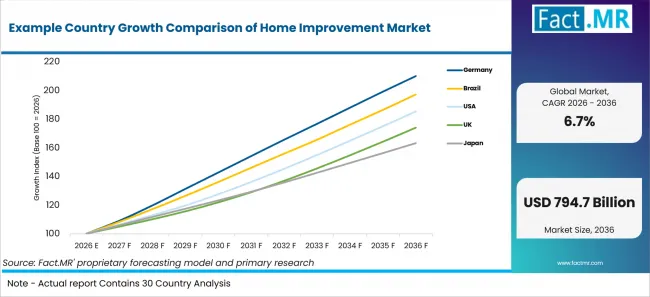
Example Country Growth Comparison Of Home Improvement Market | Source: Fact.MR
Country CAGR (2026-2036)
| Country | CAGR (2026-2036) |
|---|---|
| Germany | 7.7% |
| Brazil | 7.0% |
| USA | 6.4% |
| UK | 5.7% |
| Japan | 5.0% |
Source: Fact.MR analysis. Updated Aug 21, 2026
What is driving Germany’s growth through 2036?
Germany is forecast to expand at a 7.7% CAGR from 2026 to 2036.
Growth is supported by the need to improve the energy performance of existing homes. KfW adjusted federal efficient-building support on 21 July 2026 and continues financing for residential renovations that achieve defined efficiency-house standards.
KfW also raised the subsidized credit ceiling for residential renovation to as much as EUR 150,000 per dwelling. This keeps renovation finance connected to building-envelope work, heating replacement and related installation demand.
What is driving Brazil’s growth through 2036?
Brazil is forecast to expand at a 7.0% CAGR from 2026 to 2036.
Household access to renovation finance is improving through Reforma Casa Brasil. The Ministry of Cities states that eligible resources can be used for construction materials and labor as well as project and technical support.
The program is available across all 5,571 municipalities, broadening the geographic base for repair work and creating demand across electrical, plumbing, flooring, painting, window and roofing categories.
What is driving USA’s growth through 2036?
The USA is forecast to expand at a 6.4% CAGR from 2026 to 2036.
The U.S. market has a recurring project base because owners continue replacing worn components while upgrading kitchens, bathrooms and other living areas. The American Housing Survey tracks major improvements and replacements across a broad range of building systems.
Harvard Joint Center for Housing Studies projects annual homeowner improvement and repair spending at about USD 519 billion through mid-2027, with year-over-year growth expected to remain positive but modest. This supports steady materials and installation demand while increasing sensitivity to project cost.
What is driving UK’s growth through 2036?
The UK is forecast to expand at a 5.7% CAGR from 2026 to 2036.
Repair and maintenance remain meaningful components of construction activity. ONS reported that private housing repair and maintenance increased 2.9% in the three months to September 2025, making it the main positive contributor to construction growth during that period.
The Warm Homes Plan adds a policy route for residential upgrades through support for insulation, solar PV, batteries, smart controls and heat pumps. These measures can be installed alongside broader renovation work.
What is driving Japan’s growth through 2036?
Japan is forecast to expand at a 5.0% CAGR from 2026 to 2036.
Japan has an established statistical framework for renovation of existing buildings. MLIT’s Building Renovation and Renewal Survey measures refurbishment and renewal orders and publishes quarterly and annual results.
The fiscal 2025 Housing Market Trend Survey added renovation tax questions and expanded coverage of energy-efficiency equipment. Among households that renovated, 4.3% reported receiving or expecting to receive the renovation promotion income-tax measure, linking improvement activity with formal policy support.
Who Leads the Home Improvement Market?
The Home Depot, Inc., The Sherwin-Williams Company, DuPont de Nemours, Inc., Watsco, Inc., ABC Supply Co., Inc., Henkel Corporation, Andersen Corporation, Lutron Electronics Co., Inc., Builders FirstSource, Inc. and Masco Corporation are among the companies operating in the Home Improvement Market.
The Home Depot serves homeowner and professional project demand through a broad retail network. Its fiscal 2025 annual report lists 2,359 retail stores as of February 1, 2026, alongside more than 1,250 locations within its SRS businesses, giving the company substantial access to building-material and project-supply purchases.
Competition extends across product manufacturing, contractor-focused distribution and residential systems. Material suppliers influence product specification, while retailers and distributors influence product availability and project fulfillment.
Supplier selection depends on local availability, compatibility with contractor workflows and installation support. Manufacturers compete on product performance and ease of use, while channel companies compete on inventory depth, delivery and project-level service.
Which companies are the key providers?
Key companies profiled include The Home Depot, Inc.; The Sherwin-Williams Company; DuPont de Nemours, Inc.; Watsco, Inc.; ABC Supply Co., Inc.; Henkel Corporation; Andersen Corporation; Lutron Electronics Co., Inc.; Builders FirstSource, Inc.; and Masco Corporation.
- The Home Depot, Inc.
- The Sherwin-Williams Company
- DuPont de Nemours, Inc.
- Watsco, Inc.
- ABC Supply Co., Inc.
- Henkel Corporation
- Andersen Corporation
- Lutron Electronics Co., Inc.
- Builders FirstSource, Inc.
- Masco Corporation
Bibliography
- European Commission. (2026). Energy Performance of Buildings Directive and National Building Renovation Plans. Directorate-General for Energy.
- Federal Statistical Office of Germany. (2026). Building Permits, Total, Including Work on Existing Buildings. Government of Germany.
- Harvard Joint Center for Housing Studies. (2026). Remodeling Spending Poised for Further Slowdown. Harvard University.
- KfW. (2026). Adjustments in the Federal Funding for Efficient Buildings (BEG). KfW Banking Group.
- Ministry of Cities, Brazil. (2026). Reforma Casa Brasil: Frequently Asked Questions. Government of Brazil.
- Office for National Statistics. (2025). GDP Monthly Estimate, UK: September 2025. Government of the United Kingdom.
- Department for Energy Security and Net Zero. (2026). Warm Homes Plan. Government of the United Kingdom.
- U.S. Census Bureau and U.S. Department of Housing and Urban Development. (2024). 2023 Home Improvements. American Housing Survey.
- Ministry of Land, Infrastructure, Transport and Tourism, Japan. (2026). Building Renovation and Renewal Survey Report, Fiscal 2025. Government of Japan.
- Ministry of Land, Infrastructure, Transport and Tourism, Japan. (2026). Fiscal 2025 Housing Market Trend Survey. Government of Japan.
- The Home Depot, Inc. (2026). 2025 Annual Report. The Home Depot, Inc.
This Report Answers
- The report explains how home-improvement demand develops across Product, Application, End Use, Technology, Formulation and Distribution Channel.
- Segment analysis explains the operating reasons that shape purchasing across the main material, renovation, technology and channel categories.
- Country analysis examines the mechanisms shaping home-improvement demand in Germany, Brazil, the USA, the UK and Japan.
- Competitive analysis reviews retailers, material manufacturers and residential improvement suppliers operating across the covered market.
- The assessment connects housing repair, renovation policy, technology upgrades and distribution routes with purchasing behavior through 2036.
What does the Home Improvement Market cover?
The Home Improvement Market covers products, materials and improvement services purchased to repair, renovate, modernize or upgrade existing residential properties. The assessment includes building materials and renovation applications as well as technologies and formulations used in home-improvement projects.
Coverage extends across homeowner-led work and professional projects performed by contractors, builders or other service providers where the end use is residential improvement. Distribution includes retail stores, online channels, wholesale routes and direct manufacturer sales within the defined taxonomy.
What is included in the scope?
The scope includes building materials, wood and lumber products, paints and coatings, flooring materials and related project inputs used in residential improvement. It also covers home repair and maintenance, interior or exterior renovation, decoration work and qualifying smart-home upgrades installed as part of improvement activity.
Buyer coverage includes homeowners, contractors and builders, real estate developers and facility-management firms when they procure for residential improvement. Formulation coverage includes ready-to-use materials, liquid systems, powder-based products and composite building materials.
What is excluded from the scope?
The scope excludes materials purchased solely for the initial construction of a new residential building when no renovation or improvement activity is involved. Commercial-only construction projects are excluded when they do not relate to residential improvement.
Standalone household furniture, consumer appliances and decorative goods are outside the market unless they are integral to a covered renovation application. Real-estate transaction value, mortgage value and property-management services without a home-improvement component are also excluded.
How Was the Analysis Built?
The analysis draws on more than 120 sources, over 35 company portfolios and more than 20 industry interviews across at least 25 countries.
- Primary Research: Interviews with home-improvement retailers, building-material suppliers, remodelers, contractors, distributors and smart-home providers examine project demand, purchasing routes and product-selection criteria.
- Desk Research: The review covers housing-stock data, renovation expenditure, repair and maintenance output, energy-retrofit policy, building-material retail, company disclosures and relevant construction standards. Sources used in the analysis are recorded in the bibliography.
- Market Sizing and Forecasting: Estimates combine existing-housing activity, renovation intensity, building-material sales, average project values, segment shares, distribution mix and country-level growth. The model distinguishes renovation demand from new-build construction.
- Data Validation and Update Cycle: Public housing statistics, company activity and interview findings are reconciled before updates. The cycle accounts for changes in renovation policy, retail demand, housing turnover, material pricing and technology adoption.
Segmentation
What is the report's scope and coverage?
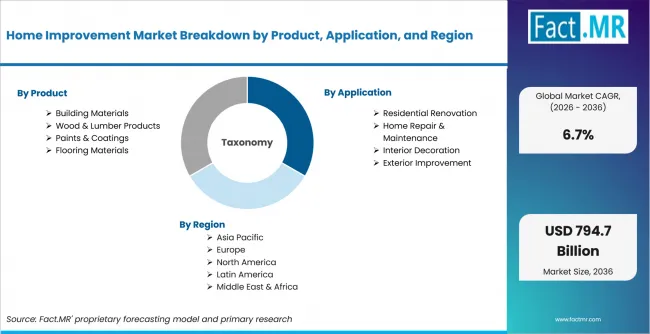
Home Improvement Market Breakdown By Product, Application, And Region | Source: Fact.MR
| Attribute | Details |
|---|---|
| Quantitative Units | USD billion |
| Market Definition | Products, materials and improvement services used to renovate, repair, modernize or upgrade existing residential properties within the covered segments |
| Segments Covered | Product; Application; End Use; Technology; Formulation; Distribution Channel |
| Regions Covered | North America; Latin America; Europe; East Asia; South Asia and Pacific; Middle East and Africa |
| Countries Covered | Germany; Brazil; USA; UK; Japan |
| Key Companies Profiled | The Home Depot, Inc.; The Sherwin-Williams Company; DuPont de Nemours, Inc.; Watsco, Inc.; ABC Supply Co., Inc.; and others |
| Forecast Period | 2026 to 2036 |
| Base Year | 2025 |
| Market Value, 2026 | USD 415.5 billion |
| Market Value, 2036 | USD 794.7 billion |
| CAGR, 2026-2036 | 6.7% |
| Absolute Opportunity | USD 379.2 billion |
| Approach | Combines existing-housing activity, renovation intensity, material demand, project values, technology adoption, distribution mix and country-level growth. |
Source: Fact.MR analysis. Updated Aug 21, 2026
How is the market segmented?
-
By Product
- Building Materials
- Cement & Concrete Products
- Bricks & Blocks
- Wood & Lumber Products
- Structural Wood Products
- Decorative Wood Products
- Paints & Coatings
- Interior Paint Systems
- Exterior Paint Systems
- Flooring Materials
- Hard Flooring
- Soft Flooring
- Building Materials
-
By Application
- Residential Renovation
- Interior Remodeling
- Structural Renovation
- Home Repair & Maintenance
- Plumbing Repairs
- Electrical Repairs
- Interior Decoration
- Wall Design
- Ceiling Design
- Exterior Improvement
- Facade Renovation
- Landscape Improvement
- Residential Renovation
-
By End Use
- Homeowners
- Urban Homeowners
- Rural Homeowners
- Contractors & Builders
- Residential Contractors
- Commercial Contractors
- Real Estate Developers
- Residential Developers
- Commercial Developers
- Facility Management Firms
- Residential Facility Managers
- Commercial Facility Managers
- Homeowners
-
By Technology
- Smart Home Technology
- Home Automation Systems
- Security Automation Systems
- Building Construction Technology
- Prefabrication Technology
- 3D Construction Printing
- Green Building Technology
- Energy Efficient Systems
- Sustainable Materials Tech
- Digital Construction Tech
- BIM Systems
- Project Management Tech
- Smart Home Technology
-
By Formulation
- Ready-to-Use Construction Materials
- Pre-Mixed Cement Systems
- Pre-Finished Panels
- Liquid Construction Materials
- Adhesive Formulations
- Sealant Formulations
- Powder-Based Materials
- Cementitious Powders
- Plaster Powders
- Composite Building Materials
- Fiber Reinforced Materials
- Hybrid Material Systems
- Ready-to-Use Construction Materials
-
By Distribution Channel
- Retail Stores
- Home Improvement Stores
- Specialty Stores
- Online Retail
- E-commerce Platforms
- Direct Brand Websites
- Wholesale Distribution
- Construction Material Wholesalers
- Contract Supply Chains
- Direct Sales
- Manufacturer Direct Sales
- Retail Stores
Frequently Asked Questions
What is the Home Improvement Market value in 2026?
At what CAGR is the market projected to grow?
What is the projected market value by 2036?
Which Product leads the market?
Which Application leads the market?
Which End Use leads the market?
Which Technology leads the market?
Which Formulation leads the market?
Which Distribution Channel leads the market?
Which country records the highest listed CAGR?
What is the primary driver in this market?
What is the main restraint?
Which companies are included in the market assessment?
Who worked on this report


Preview the report firsthand - request a free sample
Free SampleGet the brochure for pricing and purchase details
Download PDF