- Base Value(2025): 1.4 Bn
- Estimated Value(2026): 1.7 Bn
- Forecast Value (2036): 8.9 Bn
- CAGR (2026 - 2036): 18.3%
Electric Vehicle Battery Conditioners Market Forecast 2026 to 2036
In 2025, the electric vehicle battery conditioners market was valued at USD 1.4 billion. Based on Fact MR analysis, demand for electric vehicle battery conditioners is estimated to grow to USD 1.7 billion in 2026 and USD 8.9 billion by 2036. FMR projects a CAGR of 18.3% during the forecast period.
The absolute dollar growth from 2026 to 2036 is USD 7.2 billion. This rapid growth is driven by the increasing adoption of electric vehicles (EVs) and the growing need for maintaining the efficiency and lifespan of EV batteries. Battery conditioners play a crucial role in enhancing battery performance, extending battery life, and improving energy efficiency, all of which are critical for the widespread adoption of EVs. However, challenges such as the high cost of battery conditioning technology and competition from alternative battery management solutions may impact growth in certain regions.
As Tony Misewich, President and Chief Executive Officer of Gentherm, noted regarding advanced thermal management solutions for electric vehicles, ‘Gentherm is delivering the future of battery thermal management solutions at scale and we look forward to working together with the goal of accelerating electrification across global vehicle platforms.’
China leads with a CAGR of 20.0%, driven by its strong push for EV adoption, government incentives, and massive investments in EV infrastructure. India follows with 18.5%, supported by increasing demand for EVs and expanding battery production capabilities. Germany grows at 16.0%, benefiting from its leadership in the European automotive market and commitment to green technologies. South Korea shows growth at 15.8%, driven by high demand for EV technologies and battery solutions in the domestic automotive industry. The USA grows at 15.2%, reflecting steady demand for EVs and the increasing importance of efficient battery management technologies.
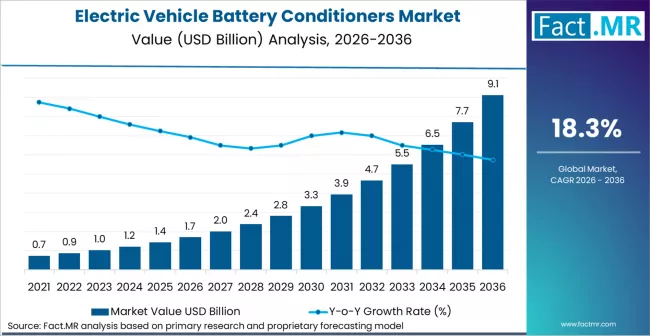
Electric Vehicle Battery Conditioners Market Market Value Analysis | Source: Fact.MR
Electric Vehicle Battery Conditioners Market
| Metric | Value |
|---|---|
| Estimated Value in (2026E) | USD 1.7 billion |
| Forecast Value in (2036F) | USD 8.9 billion |
| Forecast CAGR (2026 to 2036) | 18.3% |
Source: Fact.MR analysis. Updated Mar 6, 2026
Electric Vehicle Battery Conditioners Market Definition
The Electric Vehicle Battery Conditioners Market involves the production and sale of systems and devices that manage, regulate, or optimize the temperature and state‑of‑health of EV battery packs to improve performance, lifespan, and reliability.
Market Inclusions
This report covers global and regional market sizes for EV battery conditioners over a defined forecast period, including product types (thermal management systems, active conditioning units), vehicle segments (passenger EVs, commercial EVs, buses), and sales channels (OEM fitment and aftermarket solutions).
Market Exclusions
The scope excludes battery cells, packs, and related EV components not specific to conditioning functions, general cooling systems not designed for batteries, and unrelated vehicle electrification technologies.
Research Methodology
- Primary Research: Interviews were conducted with EV system engineers, battery thermal management specialists, and OEM procurement leads.
- Desk Research: Data was sourced from industry reports, automotive publications, and trade association statistics.
- Market‑Sizing and Forecasting: A hybrid model combining top‑down EV adoption forecasts with bottom‑up shipment and revenue data was used.
- Data Validation and Update Cycle: Findings were validated through expert review and aligned with recent production, adoption, and trade figures.
Summary of the Electric Vehicle Battery Conditioners Market
- Market Definition
- The Electric Vehicle (EV) Battery Conditioners Market includes the technologies and systems designed to regulate and optimize the temperature and health of EV batteries. These systems enhance battery performance, extend lifespan, and ensure operational reliability, crucial for efficient electric vehicle functioning.
- Demand Drivers
- Increasing EV Adoption: The rapid growth in electric vehicle adoption is driving demand for battery conditioning systems that improve battery efficiency and longevity.
- Focus on Battery Longevity and Performance: As EVs become more popular, maintaining battery health through efficient temperature control is essential for enhancing driving range and reducing maintenance costs.
- Government Incentives and Regulations: Many governments are incentivizing EV adoption and battery health management technologies to support sustainability and emissions reduction targets.
- Key Segments Analyzed
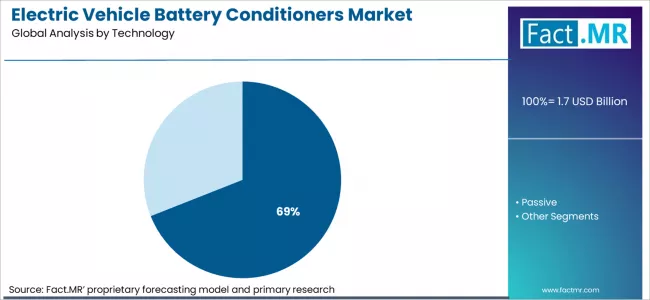
- Technology: Active thermal conditioning is expected to dominate, capturing 69% of the market by 2026, due to its ability to actively regulate battery temperatures, ensuring better performance and safety.
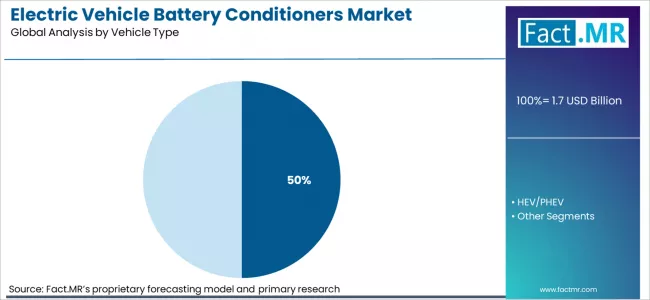
- Vehicle Type: Battery electric vehicles (BEVs) are expected to account for 50% of the market share by 2026, driven by their reliance on battery power.
- Geography: China leads with a CAGR of 20.0%, supported by its aggressive push for EV adoption and infrastructure development.
- Analyst Opinion at Fact MR
- Shambhu Nath Jha, Principal Consultant at Fact MR, noted, “The growing adoption of electric vehicles and the rising focus on battery health will significantly boost demand for advanced battery conditioning systems, particularly in regions with strong EV growth like China and India.”
- Strategic Implications/Executive Takeaways
- Invest in Active Thermal Conditioning: Manufacturers should focus on developing active thermal conditioning solutions that can efficiently regulate battery temperatures and improve the long-term performance of EV batteries.
- Focus on Emerging Markets: Expanding in regions like China and India, where EV adoption is rapidly increasing, will be crucial for market share capture.
- Improve System Integration: Collaborating with automakers to integrate advanced battery conditioners into EVs will enhance product value and strengthen market positioning.
- Methodology
- Primary Research: Interviews with EV system engineers, battery thermal management specialists, and OEM procurement leads.
- Desk Research: Data sourced from industry reports, automotive publications, and trade association statistics.
- Market Sizing & Forecasting: A hybrid model combining top-down EV adoption forecasts with bottom-up shipment and revenue data.
Segmental Analysis
Electric Vehicle Battery Conditioners Market Analysis by Technology
Electric Vehicle Battery Conditioners Market Analysis By Technology | Source: Fact.MR
- Market Overview: Active thermal conditioning is projected to capture 69% of the market share by 2026. Active thermal conditioning uses heating or cooling mechanisms to regulate the temperature of the battery during operation, optimizing performance and extending battery life in electric vehicles.
- Demand Drivers:
- Improved Battery Efficiency and Longevity: Active thermal conditioning ensures that batteries operate within the optimal temperature range, preventing overheating and improving their efficiency and lifespan. This is crucial for EV manufacturers aiming to enhance battery performance and reduce maintenance costs.
- Rising Demand for EVs: As the demand for electric vehicles continues to grow, active thermal conditioning systems are increasingly adopted to meet the challenges of maintaining battery health and ensuring reliable operation, particularly in extreme weather conditions.
- Technological Advancements in Battery Management: The development of more advanced battery management systems, which integrate active thermal conditioning to optimize performance, is driving its adoption across the market.
Electric Vehicle Battery Conditioners Market Analysis by Vehicle Type
Electric Vehicle Battery Conditioners Market Analysis By Vehicle Type | Source: Fact.MR
- Market Overview: Battery Electric Vehicles (BEVs) are expected to account for 50% of the market share by 2026. BEVs, which rely solely on battery power, require efficient battery management systems, including conditioners, to maintain battery performance and extend range.
- Demand Drivers:
- Growth in BEV Adoption: As BEVs become more popular due to advancements in battery technology and increasing environmental concerns, the need for battery conditioners to ensure optimal battery function grows.
- Focus on Range and Efficiency: Efficient battery conditioners help maintain the vehicle’s range and performance, addressing common concerns such as range anxiety and providing consistent power output for BEV users.
- Increasing Investment in Electric Infrastructure: As electric vehicle infrastructure improves globally, including more widespread charging stations, the demand for effective battery conditioners in BEVs grows, ensuring that the batteries perform optimally across various climates and driving conditions.
Electric Vehicle Battery Conditioners Market Drivers, Restraints, and Opportunities
FMR analysts observe that the electric vehicle (EV) battery conditioners market is a growth‑aligned, performance‑critical segment rooted in the increasing adoption of EVs and the need to preserve battery health, range, and safety. Historically, basic thermal management systems sufficed for early EV batteries; as pack sizes and energy densities rose, structural demand emerged for dedicated conditioners that manage temperature, balance cells, and extend usable life. The 2026 valuation reflects this evolution, with adoption tied to broader EV penetration, warranty expectations, and fleet usage patterns rather than optional accessories.
While demand for foundational battery management components remains large, advanced conditioners-integrated thermal systems and state‑of‑health optimizers-are gaining share because they improve efficiency and longevity. These higher‑value solutions command premium pricing, contributing to net market value growth even as unit volumes scale with EV production and retrofit cycles.
- Performance & Lifecycle Demand: EV OEMs and fleet operators adopt advanced battery conditioners to maintain optimal cell temperatures and extend cycle life, replacing basic passive cooling in high‑duty applications.
- Regulatory & Safety Standards: EV safety and performance standards push adoption of certified conditioning systems that meet defined thermal and degradation criteria.
- Regional EV Adoption: In Europe and China, strong EV penetration and stringent battery performance standards drive higher uptake of sophisticated conditioners compared with regions with slower electrification.
Regional Analysis
The market analysis covers key global regions, including East Asia, South Asia, Western Europe, and North America. It is segmented geographically, with specific market dynamics for each region. The full report provides a detailed market attractiveness analysis.
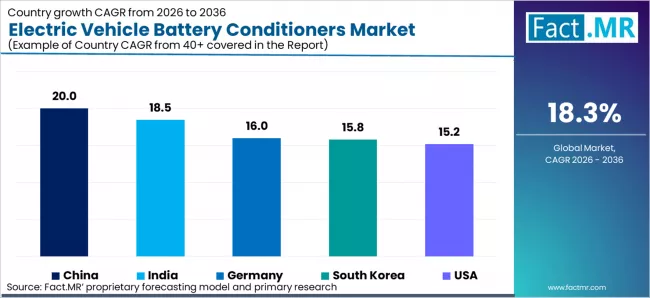
Electric Vehicle Battery Conditioners Market Cagr Analysis By Country | Source: Fact.MR
| Country | CAGR (2026-2036) |
|---|---|
| China | 20.0% |
| India | 18.5% |
| Germany | 16.0% |
| South Korea | 15.8% |
| USA | 15.2% |
Source: Fact.MR analysis. Updated Mar 6, 2026
Source: Fact MR (FMR) analysis, based on proprietary forecasting model and primary research.
East Asia:
In East Asia, China and South Korea lead the demand for electric vehicle battery conditioners, driven by the rapid growth in the electric vehicle (EV) market, government incentives for EV adoption, and the increasing focus on battery maintenance and longevity.
- China: Demand for electric vehicle battery conditioners in China is projected to rise at 20.0% CAGR through 2036. China’s rapid EV adoption, increased government incentives for EV owners, and focus on improving battery life and performance continue to fuel market growth.
- South Korea: Demand for electric vehicle battery conditioners in South Korea is projected to rise at 15.8% CAGR through 2036. South Korea’s strong EV manufacturing sector, rising government support for electric vehicle infrastructure, and growing demand for reliable battery maintenance contribute to steady market growth.
South Asia:
In South Asia, India is a major market for electric vehicle battery conditioners, supported by the growing adoption of electric vehicles, government initiatives to promote clean energy, and increasing investments in EV infrastructure.
- India: Demand for electric vehicle battery conditioners in India is projected to rise at 18.5% CAGR through 2036. India’s expanding electric vehicle market, growing consumer adoption, and government policies promoting EV infrastructure continue to drive strong market growth.
Western Europe:
In Western Europe, Germany is the key market for electric vehicle battery conditioners, driven by the country’s strong automotive industry, rising adoption of electric vehicles, and growing interest in battery health and performance.
- Germany: Demand for electric vehicle battery conditioners in Germany is projected to rise at 16.0% CAGR through 2036. Germany’s leading automotive industry, increased consumer focus on battery maintenance, and government support for EV adoption continue to fuel market growth.
North America:
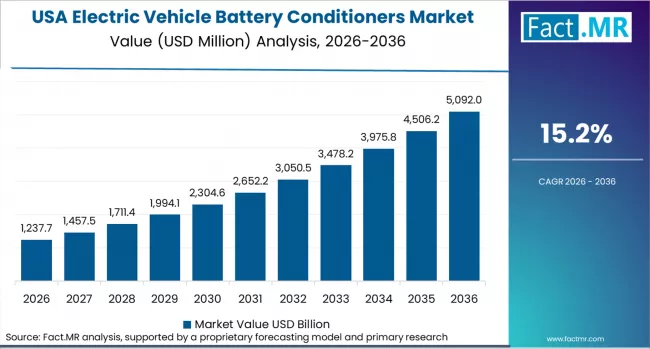
Electric Vehicle Battery Conditioners Market Country Value Analysis | Source: Fact.MR
In North America, the USA remains a significant market for electric vehicle battery conditioners, driven by the growing electric vehicle market, technological advancements in EV battery systems, and increasing demand for longer battery life.
- USA: Demand for electric vehicle battery conditioners in the U.S. is projected to rise at 15.2% CAGR through 2036. The USA’s expanding EV market, rising consumer preference for high-performance batteries, and increased focus on extending battery life continue to support steady market growth.
Fact MR's analysis of the Electric Vehicle Battery Conditioners Market in East Asia, South Asia, Western Europe, North America consists of country-wise assessments that include China, India, Germany, South Korea, and the USA. Readers can find detailed trends, regulatory updates, and company-specific investments shaping the market’s growth in these countries.
What is the Competitive Structure and Buyer Behavior in the Electric Vehicle Battery Conditioners Market?
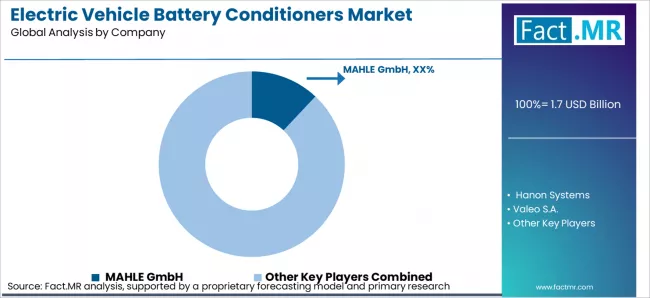
Electric Vehicle Battery Conditioners Market Analysis By Company | Source: Fact.MR
The electric vehicle battery conditioners market is moderately concentrated, with major automotive component suppliers such as MAHLE GmbH, Hanon Systems, Valeo S.A., Denso Corporation, Robert Bosch GmbH, Modine Manufacturing Company, and LG Electronics Inc. capturing a significant share. The primary competitive variables are thermal management performance, energy efficiency, system integration with vehicle battery management systems, and reliability under diverse operating conditions. Companies with deep engineering expertise, broad thermal systems portfolios, and established OEM relationships hold structural advantages, as they can deliver tailored solutions that meet stringent automotive quality standards and support global production requirements. Large electric vehicle manufacturers and tier‑1 suppliers exert strong buyer leverage by qualifying multiple vendors, negotiating long‑term supply and pricing agreements, and specifying detailed performance and warranty criteria. To manage supplier dependency, these buyers diversify approved suppliers and standardize component specifications across platforms, which limits individual suppliers’ pricing power. As a result, competition focuses on delivering superior performance, integration capability, and consistent post‑sale support rather than on price alone.
Recent Industry Developments
- CES 2026 Innovation Milestone: In early 2026, Valeo was named a CES Innovation Awards Honoree for its Compact 5-Ways Refrigerant Valve. This single unit replaces three solenoid valves and one check valve, enabling next-generation heat pumps to switch between heating and cooling in less than five seconds-dramatically reducing energy loss during battery pre-conditioning.
- Software-Defined Thermal Control: In February 2026, Marelli unveiled its "Intelligent Energy Management" system at the CTI Symposium. The system uses proprietary software and digital twin methodologies to coordinate thermal flows across the battery and propulsion domains, allowing the vehicle to "reuse" excess heat from the motors to warm the battery in cold climates.
- Launch of Blade Battery 2.0 Thermal Suite: On March 5, 2026, BYD showcased the Blade Battery 2.0 in its Yangwang U7 sedan. This new system features an upgraded thermal management architecture that supports ultra-fast charging and a 1,000+ km range by solving the "physics constraints" of traditional heat dissipation in high-voltage platforms.
Key Players of the Electric Vehicle Battery Conditioners Market
- MAHLE GmbH
- Hanon Systems
- Valeo S.A.
- Denso Corporation
- Robert Bosch GmbH
- Modine Manufacturing Company
- LG Electronics Inc.
Report Scope
| Metric | Value |
|---|---|
| Quantitative Units | USD 1.7 billion (2026) to USD 8.9 billion (2036), at a CAGR of 18.3% |
| Market Definition | The Electric Vehicle Battery Conditioners Market covers technologies used to regulate the temperature and maintain the health of electric vehicle (EV) batteries, enhancing performance and longevity. |
| By Voltage | 12 to 24 Volts, 24 to 48 Volts, Others |
| By Vehicle Type | BEV (Battery Electric Vehicles), HEV (Hybrid Electric Vehicles)/PHEV (Plug-in Hybrid Electric Vehicles) |
| By Technology | Active Thermal Conditioning, Passive |
| Regions Covered | North America, Latin America, Europe, East Asia, South Asia, Oceania, Middle East and Africa |
| Countries Covered | United States, Canada, Mexico, Brazil, Argentina, Germany, France, United Kingdom, Italy, Spain, China, India, Japan, South Korea, Indonesia, Australia, and 40+ countries |
| Key Companies Profiled | MAHLE GmbH, Hanon Systems, Valeo S.A., Denso Corporation, Robert Bosch GmbH, Modine Manufacturing Company, LG Electronics Inc. |
| Forecast Period | 2026 to 2036 |
| Approach | Hybrid top-down and bottom-up market modeling validated through primary interviews with manufacturers and supported by trade data benchmarking and market research. |
Source: Fact.MR analysis. Updated Mar 6, 2026
Bibliographies
- Garud, K. S., Tai, L. D., Hwang, S.-G., Nguyen, N.-H., & Lee, M.-Y. (2023). A review of advanced cooling strategies for battery thermal management systems in electric vehicles. Symmetry, 15(7), 1322.
- Hwang, F. S., & Authors. (2024). Review of battery thermal management systems in electric vehicles: Air-cooled, liquid-cooled, PCM-based, and thermoelectric systems. Renewable and Sustainable Energy Reviews.
- Dai, N., & Long, J. (2023). Research on fast-charging battery thermal management system based on refrigerant direct cooling. Scientific Reports, 13, Article 11707.
- Ali, Z. M., Jurado, F., & Gandoman, F. H. (2024). Advancements in battery thermal management for electric vehicles: Types, technologies, and control strategies including deep learning methods. Ain Shams Engineering Journal.
This report addresses:
- Market intelligence enabling comprehensive assessment of leading countries and product segments across the Electric Vehicle Battery Conditioners Market globally.
- Market volume (sales units) estimates and 10-year revenue forecasts from 2026 to 2036, validated through manufacturer shipment data, channel partner surveys, and country-level demand modeling.
- Growth opportunity mapping across voltage types (12 to 24 Volts, 24 to 48 Volts, Others), vehicle types (BEV, HEV/PHEV), technologies (Active Thermal Conditioning, Passive).
- Segment and regional revenue forecasts by voltage, vehicle type, technology, and geography across 40+ countries.
- Competition strategy analysis covering dealer network structure, recent developments, product portfolio, USPs, and market share analysis.
- Product and regulatory compliance tracking aligned with automotive safety standards, battery performance regulations, and industry certification requirements.
- Regulatory impact analysis addressing thermal management systems, vehicle performance standards, and sustainability mandates across key markets.
- Report delivery in PDF, Excel, PowerPoint, and interactive dashboard formats for executive, procurement, and operational planning use.
Segmentation
Electric Vehicle Battery Conditioners Market Key Segments
-
Voltage :
- 12 to 24 Volts
- 24 to 48 Volts
- Others
-
Vehicle Type :
- BEV (Battery Electric Vehicle)
- HEV/PHEV (Hybrid Electric Vehicle/Plug-in Hybrid Electric Vehicle)
-
Technology :
- Active Thermal Conditioning
- Passive
-
Region :
- North America
- USA
- Canada
- Mexico
- Europe
- Germany
- UK
- France
- Italy
- Spain
- Nordic Countries
- BENELUX
- Rest of Europe
- Asia Pacific
- China
- Japan
- South Korea
- India
- Australia
- Rest of Asia Pacific
- Latin America
- Brazil
- Argentina
- Rest of Latin America
- Middle East and Africa
- Kingdom of Saudi Arabia
- United Arab Emirates
- South Africa
- Rest of Middle East and Africa
- Other Regions
- Oceania
- Central Asia
- Other Markets
- North America
Frequently Asked Questions
How large is the demand for Electric Vehicle Battery Conditioners in the global market in 2026?
What will be the market size of Electric Vehicle Battery Conditioners in the global market by 2036?
What is the expected demand growth for Electric Vehicle Battery Conditioners in the global market between 2026 and 2036?
Which technology is expected to dominate the market?
Which region is expected to show the highest growth rate for Electric Vehicle Battery Conditioners?
How significant is the growth outlook for India in this market?
What is the growth outlook for Germany in the Electric Vehicle Battery Conditioners market?
What is the growth forecast for South Korea in the Electric Vehicle Battery Conditioners market?
What is the growth forecast for the United States in the Electric Vehicle Battery Conditioners market?
Which company is identified as a leading player in the Electric Vehicle Battery Conditioners market?
What are Electric Vehicle Battery Conditioners used for?
What does the Electric Vehicle Battery Conditioners market include in this report?
How is the market forecast developed in this report?
What is meant by the Electric Vehicle Battery Conditioners market in this report?
Who worked on this report


Preview the report firsthand - request a free sample
Free SampleGet the brochure for pricing and purchase details
Download PDF