- Base Value(2025): 5.6 Bn
- Estimated Value(2026): 6.1 Bn
- Forecast Value (2036): 13.7 Bn
- CAGR (2026 - 2036): 8.5%
Electric Power Steering Motors Market Forecast and Outlook 2026 to 2036
In 2025, the electric power steering motors market was valued at USD 5.6 billion. Based on Fact.MR analysis, demand for electric power steering motors is estimated to reach USD 6.1 billion in 2026 and USD 13.7 billion by 2036, reflecting a CAGR of 8.5% during the forecast period. Market expansion is supported by the transition away from hydraulic steering systems, rising penetration of electric and hybrid vehicles, and increased adoption of advanced driver assistance systems that require precise, software-controlled steering actuation.
The market adds approximately USD 8.1 billion in value over the forecast window, indicating acceleration driven by technology substitution rather than vehicle parc growth alone. Early-period growth is led by passenger car electrification and rapid EPS penetration in compact and mid-size segments. Mid-period gains align with wider deployment of EPS in light commercial vehicles and higher power motor adoption for SUVs and crossovers. In later years, value growth is increasingly shaped by steer-by-wire readiness and integration with autonomous driving architectures, lifting motor complexity and unit pricing even as mechanical content stabilizes.
China leads growth at 11.5% CAGR, supported by high EV production volumes and rapid EPS standardization. India follows at 10.6%, driven by regulatory efficiency mandates and compact vehicle electrification. Germany records 9.8% aligned with premium vehicle platforms and steering system innovation. Brazil posts 8.9% as EPS penetration expands beyond entry-level models. The United States grows at 8.1% through ADAS-driven steering upgrades, while the UK at 7.2% and Japan at 6.4% remain comparatively mature, constrained by high existing EPS penetration and longer platform cycles.
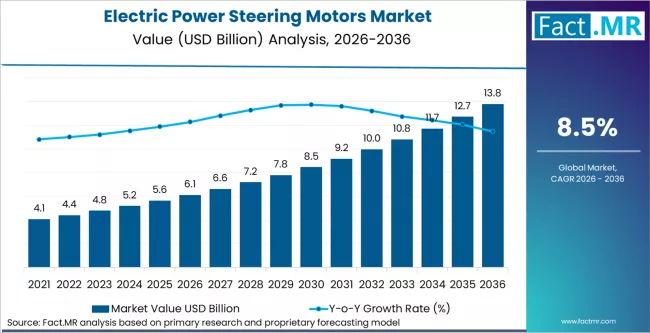
Electric Power Steering Motors Market Market Value Analysis | Source: Fact.MR
Electric Power Steering Motors Market
| Metric | Value |
|---|---|
| Market Value (2026) | USD 6.1 billion |
| Forecast Value (2036) | USD 13.7 billion |
| Forecast CAGR (2026-2036) | 8.5% |
Source: Fact.MR analysis. Updated Feb 27, 2026
Electric Power Steering Motors Market Definition
The electric power steering motors market covers electric motors used within electric power steering systems to assist vehicle steering through electronically controlled torque support. These motors replace hydraulic assistance and operate based on steering input, vehicle speed, and control unit signals. They reduce engine load and enable integration with driver assistance functions. Design, safety, and vehicle integration requirements for steering systems are regulated under motor vehicle safety frameworks issued by the US National Highway Traffic Safety Administration and UNECE vehicle construction regulations. [1] Electric power steering motors are supplied mainly for passenger and commercial vehicles.
Electric Power Steering Motors Market Inclusions
The report covers global and regional market size estimates in volume and value terms with a forecast period from 2026 to 2036. Segmentation includes motor type such as column assist and rack assist systems, power rating categories, application by vehicle type, and end use covering original equipment and replacement demand. The scope also includes regional demand patterns, pricing benchmarks, and international trade flows for automotive electric motor components.
Electric Power Steering Motors Market Exclusions
The scope excludes hydraulic power steering pumps, steering columns without electric assistance, and electronic control units sold separately from motors. Complete steering assemblies sold as integrated systems are not included. Motors used exclusively for autonomous steering actuators outside standard power steering architectures are excluded. Motorsport specific components, prototype motors without road certification, laboratory testing equipment, and vehicle software services are also outside the scope.
Electric Power Steering Motors Market Research Methodology
- Primary Research: Primary research involved interviews with electric motor manufacturers, automotive OEM suppliers, steering system integrators, and vehicle platform engineers.
- Desk Research: Desk research used steering system safety regulations issued by the US National Highway Traffic Safety Administration and UNECE, vehicle production data from national transport authorities, and company annual reports and technical product disclosures filed with securities regulators.
- Market Sizing and Forecasting: Market sizing applied a hybrid top down and bottom up model using vehicle production volumes, electric power steering penetration rates, and motor fitment configurations by vehicle segment.
- Data Validation and Update Cycle: Outputs were cross checked against vehicle registration data, regulatory compliance documentation, trade statistics, and OEM supply disclosures, with updates applied when verified public data sources issue revisions.
Summary of Electric Power Steering Motors Market
- Market Definition
- The electric power steering motors market covers electric motors integrated into electric power steering systems that provide electronically controlled steering assistance in passenger and commercial vehicles, replacing hydraulic steering mechanisms and enabling integration with driver assistance functions.
- Demand Drivers
- Vehicle electrification and the shift away from hydraulic steering systems increase OEM adoption of electric power steering motors to reduce parasitic engine load and improve efficiency.
- Mandatory vehicle safety and performance requirements [2] directly govern steering system design, motor reliability, and fail-safe performance across passenger and commercial vehicles.
- Global harmonisation of vehicle construction and steering regulations supports cross-platform EPS motor integration and multi-region OEM sourcing strategies.
- Key Segments Analyzed
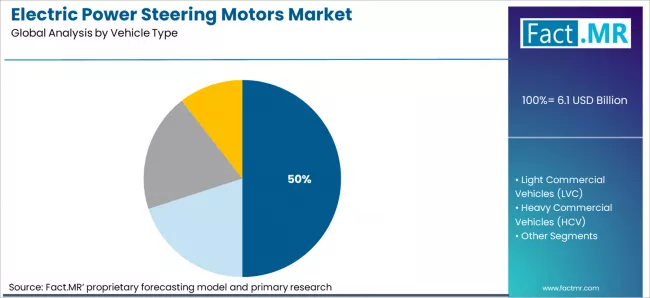
- Passenger cars account for about 50% of total demand, reflecting high production volumes and near-universal EPS penetration in compact, mid-size, and premium platforms.
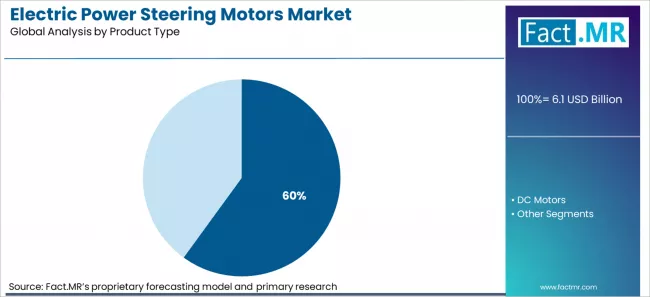
- AC motors lead with roughly 60% share due to higher efficiency, better thermal control, and suitability for continuous steering assistance under variable load conditions.
- China and India represent the fastest-growing regions driven by EV penetration and regulatory efficiency mandates, while Europe and Japan remain platform-upgrade and replacement-led.
- Analyst Opinion at Fact.MR
- Shambhu Nath Jha, Principal Consultant at Fact.MR, opines, ‘CXOs will find this report useful for understanding how OEM platform strategies, regulatory efficiency targets, and integration of EPS with advanced driver assistance systems are shaping long-term demand for electric power steering motors.’
- Strategic Implications / Executive Takeaways
- Suppliers should prioritise AC motor platforms compatible with ADAS and future steer-by-wire architectures.
- OEM-aligned development and early platform nomination remain critical for volume visibility.
- Regional production alignment in Asia Pacific supports cost control and supply continuity.
- Methodology
- Market sizing is based on vehicle production volumes, EPS penetration rates, and motor fitment data.
- Validation uses regulatory filings, vehicle safety frameworks, and OEM supply disclosures.
- Forecasts apply reproducible top-down and bottom-up automotive demand models grounded in verified data.
Segmental Analysis
Electric Power Steering Motors Market Analysis by Vehicle Type
Electric Power Steering Motors Market Analysis By Vehicle Type | Source: Fact.MR
Based on Fact.MR analysis, consumption of electric power steering motors in passenger cars is estimated to hold 50% share of the global market. Fact.MR analysts note that passenger cars lead due to high production volumes and widespread adoption of electric steering systems to replace hydraulic architectures. As per Fact.MR, this vehicle type addresses manufacturer requirements for improved fuel efficiency, packaging flexibility, and compatibility with driver assistance features such as lane keeping and parking support systems across mass-market and premium passenger car platforms worldwide today.
- Vehicle safety framework: Steering system performance and integration are governed by passenger vehicle safety regulations.
- Platform volume: Fact.MR analysts note passenger cars account for the largest share of global vehicle production.
- System integration: EPS supports electronic stability and driver assistance functions.
Electric Power Steering Motors Market Analysis by Product Type
Electric Power Steering Motors Market Analysis By Product Type | Source: Fact.MR
Based on Fact.MR analysis, consumption of AC electric power steering motors is estimated to hold 60% share of the global market. Fact.MR analysts note that AC motors lead due to higher efficiency, precise torque control, and suitability for continuous operation under variable steering loads. As per Fact.MR, this product type addresses OEM requirements for durability, thermal management, and integration with vehicle electronic control units used in modern electric steering systems across passenger and commercial vehicle platforms globally today.
- Energy efficiency context: Government vehicle efficiency programs support adoption of electrically efficient automotive components. [3]
- Motor control: Fact.MR analysts note AC motors enable advanced control algorithms.
- Thermal stability: AC designs perform reliably under sustained steering demand.
Electric Power Steering Motors Market Drivers, Restraints, And Opportunities
Fact.MR analysis indicates that the electric power steering (EPS) motors market exists as an essential automotive drivetrain electromechanical component segment, driven by global regulatory emphasis on vehicle fuel-efficiency, emissions reduction, and advanced safety systems. As per Fact.MR assessment, EPS motors replace hydraulic power steering pumps to reduce parasitic engine load, aligning with vehicle efficiency and emissions targets embedded in regulatory frameworks such as U.S. EPA Corporate Average Fuel Economy (CAFE) and greenhouse gas standards for light-duty vehicles, which mandate improved fleet fuel performance. [4] Fact.MR analysts observe that the current market scale is supported by widespread OEM adoption of EPS systems in passenger cars, SUVs, and light commercial vehicles, driven by the dual need to reduce fuel consumption and enhance driver assistance integration.
Fact.MR is of the opinion that current market dynamics reflect a transition in motor and control technologies as manufacturers seek tighter integration with vehicle electronic architectures and enhanced torque responsiveness. Based on Fact.MR assessment, traditional hydraulic steering systems remain in use in select entry-level or heavy-duty applications due to established cost structures, but EPS motors grow in segments where electric assist supports lane-keeping, automated parking, and driver assistance programmes. Advanced EPS motors that incorporate higher torque density, brushless designs, and integrated motor controllers typically carry higher per-unit pricing because of component and control complexity, meaning realised market value can increase even where shipment volumes grow at a measured pace. Fact.MR analysis suggests this combination of evolving application requirements and premium unit economics will shape near-term market evolution.
- Regulated fuel-efficiency standards: Fact.MR analysts note that compliance with U.S. EPA CAFE and greenhouse gas standards for light-duty vehicles influences OEM specification of electric power steering motors to reduce parasitic engine load and meet mandated efficiency thresholds.
- Shift toward integrated steering technologies: Based on Fact.MR assessment, increasing adoption of EPS systems with integrated torque feedback, vehicle dynamics control, and advanced driver assistance functions supports demand for higher-precision motors.
- Asia Pacific automotive production expansion: Fact.MR opines that growing light vehicle manufacturing in China, India, and Southeast Asia sustains regional demand for electric power steering motors across OEM and aftermarket channels, aligned with rising fleet electrification and feature adoption.
Regional Analysis
Based on regional assessment, the electric power steering motors sector is analyzed across North America, Europe, East Asia, South Asia, and other major automotive manufacturing regions, spanning more than 40 countries. Regional performance varies according to vehicle electrification trends, adoption of advanced steering systems, and regulatory focus on fuel efficiency and driving safety. The analysis also presents a comparative market attractiveness evaluation grounded in region-specific demand trends.
Electric Power Steering Motors Market CAGR Analysis by Country (2026-2036)
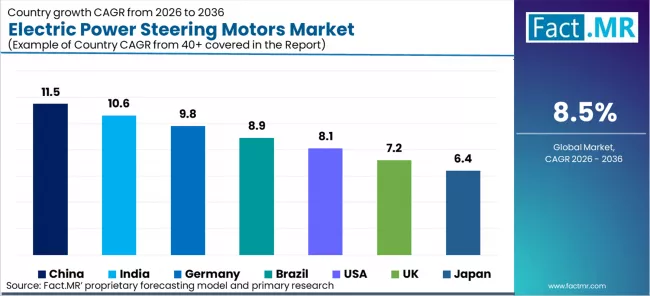
Electric Power Steering Motors Market Cagr Analysis By Country | Source: Fact.MR
| Country | CAGR |
|---|---|
| China | 11.5% |
| India | 10.6% |
| Germany | 9.8% |
| Brazil | 8.9% |
| United States | 8.1% |
| United Kingdom | 7.2% |
| Japan | 6.4% |
Source: Fact.MR analysis. Updated Feb 27, 2026
Source: Fact.MR analysis, based on proprietary forecasting models and primary research.
Asia Pacific Electric Power Steering Motors Market Analysis
Asia Pacific operates as a high volume vehicle production driven electric power steering motors region supported by rapid passenger vehicle manufacturing and transition from hydraulic to electric steering systems. Demand is shaped by fuel efficiency standards vehicle electrification programs and OEM integration of advanced steering technologies. Adoption is concentrated in China and India where local manufacturers expand capacity. Growth reflects increased penetration in entry level vehicles export oriented production and alignment with automotive efficiency regulations regionwide.
- China: Demand for electric power steering motors in China is projected to rise at 11.5% CAGR through 2036. Growth is supported by large passenger vehicle output and transition toward electrically assisted steering systems, as per Fact.MR.
- India: Demand for electric power steering motors in India is projected to rise at 10.6% CAGR through 2036. Usage reflects increasing adoption of electric steering across compact and mid segment vehicles produced domestically, according to Fact.MR.
Fact.MR’s analysis of the Electric Power Steering Motors Market in Asia Pacific consists of country-wise assessment that includes China and India. Readers can find production trends technology integration patterns and OEM demand references.
Europe Electric Power Steering Motors Market Analysis
Europe functions as a regulation aligned and technology intensive electric power steering motors market shaped by vehicle electrification targets and advanced safety integration. Demand is influenced by stringent emissions rules and transition to electric and hybrid platforms. Adoption is concentrated in Germany and the United Kingdom where OEMs integrate steering control systems within premium and mass market vehicles. Market activity reflects platform upgrades supplier localization and steady replacement of hydraulic systems across established automotive manufacturing hubs.
- Germany: Demand for electric power steering motors in Germany is projected to rise at 9.8% CAGR through 2036. Adoption reflects integration within premium vehicle platforms and alignment with vehicle electrification strategies, as per Fact.MR.
- United Kingdom: Demand for electric power steering motors in the United Kingdom is projected to rise at 7.2% CAGR through 2036. Usage is supported by domestic vehicle assembly and transition toward electric and hybrid platforms, according to Fact.MR.
Fact.MR’s analysis of the Electric Power Steering Motors Market in Europe consists of country-wise assessment that includes Germany and the United Kingdom. Readers can find platform integration trends and electrification driven demand insights.
North America Electric Power Steering Motors Market Analysis
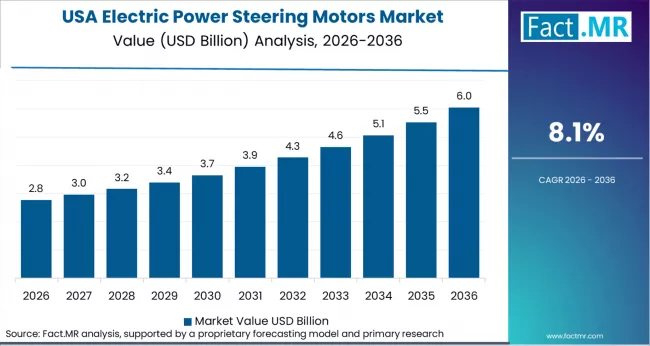
Electric Power Steering Motors Market Country Value Analysis | Source: Fact.MR
North America operates as a platform upgrade driven electric power steering motors market supported by strong light vehicle production and growing electrification. Demand is shaped by fuel economy standards advanced driver assistance integration and OEM platform redesigns. Adoption is centered in the United States where manufacturers expand electric steering penetration across SUVs pickups and passenger cars. Growth reflects replacement of hydraulic systems increased electronic control integration and rising electric vehicle output nationally across automotive clusters.
- United States: Demand for electric power steering motors in the United States is projected to rise at 8.1% CAGR through 2036. Usage reflects high penetration across light vehicles and integration within electric and hybrid platforms, as per Fact.MR.
Fact.MR’s analysis of the Electric Power Steering Motors Market in North America consists of country-wise assessment that includes the United States. Readers can find platform transition trends and electrification demand references.
Latin America Electric Power Steering Motors Market Analysis
Latin America functions as an expanding automotive components market for electric power steering motors driven by gradual technology adoption and domestic vehicle production. Demand is influenced by efficiency improvements and OEM platform updates. Adoption is concentrated in Brazil where manufacturers increase electric steering penetration within locally assembled vehicles. Market activity reflects modernization of steering systems alignment with global production platforms and steady increase in electronically assisted steering installations regionwide.
- Brazil: Demand for electric power steering motors in Brazil is projected to rise at 8.9% CAGR through 2036. Usage reflects increasing integration of electric steering systems in domestically produced passenger vehicles, according to Fact.MR.
Fact.MR’s analysis of the Electric Power Steering Motors Market in Latin America consists of country-wise assessment that includes Brazil. Readers can find production integration trends and technology adoption references.
Japan Electric Power Steering Motors Market Analysis
Japan operates as a mature and technology intensive electric power steering motors market supported by advanced automotive manufacturing and high penetration of compact vehicles. Demand is shaped by integration of electronic control systems and continued hybrid vehicle production. Adoption reflects established supplier networks and ongoing platform refinements rather than large scale capacity expansion.
- Japan: Demand for electric power steering motors in Japan is projected to rise at 6.4% CAGR through 2036. Usage reflects steady integration within hybrid and compact vehicle platforms, as per Fact.MR.
Fact.MR’s analysis of the Electric Power Steering Motors Market in Japan consists of country-wise assessment that includes Japan. Readers can find platform upgrade trends and supplier integration insights.
Competitive Landscape of Electric Power Steering Motors Market
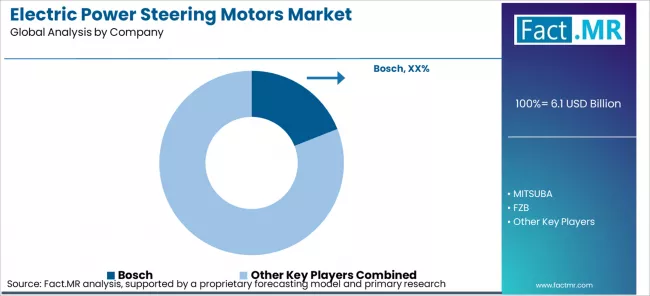
Electric Power Steering Motors Market Analysis By Company | Source: Fact.MR
As per Fact.MR analysis, the 2026 electric power steering (EPS) motors market is defined by validated torque performance, system integration, and OEM alignment, which determine competitive advantage. Bosch and MITSUBA lead with high-efficiency motors and proven reliability under varied load and temperature conditions, which strengthens adoption in premium and mass-market vehicles. FZB and Nidec focus on validated precision and thermal stability, which improves vehicle handling and reduces warranty claims. Johnson Electric and MAHLE Group provide modular motor solutions with documented durability and multi-region compliance, which supports OEM qualification and large-scale adoption. Toshiba and JTEKT emphasize integrated control and torque sensing, which enhances system responsiveness and supports advanced driver-assistance systems. Hitachi and General Ricambi deliver validated performance for high-volume applications, which ensures consistency in assembly and operation. LG Innotek provides compact, efficient motors with verified reliability, which enables integration into electric and hybrid vehicles. Across the market, validated torque performance, system-level integration, and regulatory compliance form enduring competitive moats, reducing reliance on price or isolated component claims.
Recent Industry Developments
- Robert Bosch GmbH (Jan 2026): Showcased its next-gen Steer-by-Wire system at CES, utilizing high-torque redundant motors to eliminate mechanical linkages. This follows a $117M investment in its Hungary plant to scale global EPS motor production. [5]
- ZF Group (Sept 2025): At IAA Mobility, ZF debuted the "Chassis 2.0" concept, integrating AI-driven EPS motors with their cubiX software to coordinate vehicle motion across six degrees of freedom for software-defined vehicles. [6]
Key Players in Electric Power Steering Motors Market
- Bosch
- MITSUBA
- FZB
- Nidec
- Johnson Electric
- MAHLE Group
- Toshiba
- JTEKT
- Hitachi
- General Ricambi
- LG Innotek
References
- [1] National Highway Traffic Safety Administration. (2024). Laws and regulations: Motor vehicle safety standards. U.S. Department of Transportation; United Nations Economic Commission for Europe. (2024). UNECE vehicle regulations and type approval framework. UNECE.
- [2] National Highway Traffic Safety Administration. (2024). Motor vehicle steering systems and safety requirements. U.S. Department of Transportation.
- [3] U.S. Department of Energy. (2024). Vehicle Technologies Office: Electrification and advanced vehicle components. Office of Energy Efficiency and Renewable Energy, U.S. Department of Energy.
- [4] U.S. Environmental Protection Agency. (2024). Greenhouse gas emissions and fuel economy standards for light-duty vehicles. U.S. Environmental Protection Agency.
- [5] Robert Bosch GmbH. (2026). Bosch presents next-generation steer-by-wire system and expands EPS motor production capacity [Press release]. Bosch Media Service.
- [6] ZF Friedrichshafen AG. (2025). ZF unveils “Chassis 2.0” with AI-enabled electric power steering at IAA Mobility [Press release]. ZF Press Office.
This Report Addresses
- Market intelligence to support structured strategic decision making across global electric power steering motor manufacturing and automotive supply ecosystems
- Market size estimation and ten year revenue forecasts from 2026 to 2036, supported by validated vehicle production data, EPS penetration rates, and motor fitment benchmarking
- Growth opportunity assessment across AC and DC motor platforms with focused evaluation of power rating shifts driven by passenger cars, SUVs, light commercial vehicles, and off highway applications
- Segment and regional revenue forecasts covering vehicle type, product type, motor power category, and sales channel across OEM and aftermarket supply chains
- Competitive strategy assessment including OEM platform alignment, motor performance capability, thermal and durability positioning, and cost competitiveness across global suppliers
- Technology evolution tracking covering EPS motor integration with ADAS, higher torque density designs, and readiness for steer by wire and software defined vehicle architectures
- Regulatory impact analysis covering vehicle safety standards, fuel efficiency mandates, and steering system compliance requirements influencing motor specification and qualification
- Market report delivery in PDF, Excel, PowerPoint, and interactive dashboard formats for executive, engineering, and operational decision support
Segmentation
Scope of the Report
| Metric | Value |
|---|---|
| Quantitative Units | USD 6.1 billion (2026) to USD 13.7 billion (2036), CAGR 8.5% |
| Market Definition | The electric power steering (EPS) motors market covers the production and sale of electric motors used in steering systems to provide electronically controlled torque support. EPS motors replace hydraulic assistance, reduce engine load, and integrate with driver assistance systems such as lane keeping and parking support. Safety and integration are regulated under NHTSA and UNECE frameworks. |
| Vehicle Type Segmentation | Passenger Cars, Light Commercial Vehicles, Heavy Commercial Vehicles, Off-Highway Vehicles |
| Product Type Segmentation | AC Motors, DC Motors |
| Motor Power Segmentation | Less Than 300 Watts, 300-600 Watts, More Than 600 Watts |
| Sales Channel Segmentation | Original Equipment Manufacturers (OEM), Aftersales |
| Regions Covered | Asia Pacific, Europe, North America, Latin America, Middle East & Africa |
| Countries Covered | India, China, Japan, South Korea, Indonesia, Australia & New Zealand, ASEAN, Rest of Asia Pacific, Germany, Italy, France, United Kingdom, Spain, Benelux, Nordics, Central & Eastern Europe, Rest of Europe, United States, Canada, Mexico, Brazil, Argentina, Chile, Rest of Latin America, Kingdom of Saudi Arabia, United Arab Emirates, South Africa, Turkey, Rest of Middle East & Africa |
| Key Companies Profiled | Bosch, MITSUBA, FZB, Nidec, Johnson Electric, MAHLE Group, Toshiba, JTEKT, Hitachi, General Ricambi, LG Innotek |
| Forecast Period | 2026 to 2036 |
| Approach | Hybrid top-down and bottom-up modeling validated with primary interviews of EPS motor manufacturers, OEM suppliers, and automotive platform engineers; cross-checked with vehicle production data, EPS penetration rates, and NHTSA/UNECE regulatory frameworks. |
Source: Fact.MR analysis. Updated Feb 27, 2026
Analysis by Segments
-
By Vehicle Type :
- Passenger Cars
- Light Commercial Vehicles (LVC)
- Heavy Commercial Vehicles (HCV)
- Off-Highway Vehicles
-
By Product Type :
- AC Motors
- DC Motors
-
By Sales Channel :
- Original Equipment Manufacturers (OEM)
- Aftersales
-
By Motor Power :
- 300 - 600 Watts
- Less Than 300 Watts
- More Than 600 Watts
-
Region :
- Asia Pacific
- India
- China
- Japan
- South Korea
- Indonesia
- Australia & New Zealand
- ASEAN
- Rest of Asia Pacific
- Europe
- Germany
- Italy
- France
- United Kingdom
- Spain
- Benelux
- Nordics
- Central & Eastern Europe
- Rest of Europe
- North America
- United States
- Canada
- Mexico
- Latin America
- Brazil
- Argentina
- Chile
- Rest of Latin America
- Middle East & Africa
- Kingdom of Saudi Arabia
- United Arab Emirates
- South Africa
- Turkey
- Rest of Middle East & Africa
- Asia Pacific
Frequently Asked Questions
How large is the electric power steering motors market in 2026?
What will the global electric power steering motors market size be by 2036?
What is the expected CAGR of the electric power steering motors market during 2026–2036?
How much absolute value is the market expected to add during the forecast window?
What are the primary factors driving growth in the electric power steering motors market?
Which vehicle type accounts for the largest share of electric power steering motor demand?
Why do passenger cars dominate electric power steering motor consumption?
Which product type leads the electric power steering motors market?
Why are AC motors preferred over DC motors in electric power steering systems?
How significant is passenger car electrification to early market growth?
Which country is expected to see the fastest growth in electric power steering motors demand?
What factors are driving strong growth in China’s electric power steering motors market?
How does India compare in terms of market growth outlook?
What is the growth outlook for Germany in this market?
How fast is the electric power steering motors market expected to grow in Brazil?
What is the projected growth rate for the United States electric power steering motors market?
Why is growth slower in mature markets such as Japan and the UK?
How is EPS motor power demand evolving over the forecast period?
What role will steer-by-wire technologies play in later-stage market growth?
What are the key priorities for suppliers competing in the electric power steering motors market?
Who worked on this report


Preview the report firsthand - request a free sample
Free SampleGet the brochure for pricing and purchase details
Download PDF