- Market Value (2025): USD 425.3 Bn
- Estimated Value (2026): USD 466.6 Bn
- Forecast Value (2036): USD 1178.8 Bn
- CAGR (2026-2036): 9.7%
What is the Automotive Battery Powered Propulsion System Market forecast to be worth by 2036?
USD 466.6 billion in 2026 to USD 1178.8 billion by 2036, at a 9.7% CAGR.
- The automotive battery powered propulsion system market reached USD 425.3 billion in 2025.
- As per Fact.MR analysis, demand will increase from USD 466.6 billion in 2026 to USD 1178.8 billion by 2036.
- The market is expected to grow at a 9.7% CAGR from 2026 to 2036, reflecting purchases of battery packs and related traction equipment.
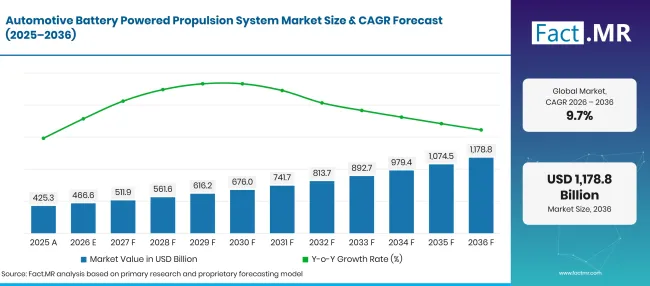
Factmr Automotive Battery Powered Propulsion System Market Forecast Global | Source: Fact.MR
| Year | Basis | Market Value (USD billion) |
|---|---|---|
| 2025 | Actual | 425.3 |
| 2026 | Estimate | 466.6 |
| 2036 | Forecast | 1178.8 |
| CAGR 2026 to 2036 | Forecast period | 9.7% |
Source: Fact.MR analysis. Updated Oct 19, 2026
What are the defining numbers behind Automotive Battery Powered Propulsion System Market growth?
USD 712.3 billion absolute opportunity from 2026 to 2036, with passenger cars and lithium-ion systems forming the main sales base.
- Demand Drivers in the Market
- Passenger-car makers want electric powertrains that offer practical range and respond reliably when drivers accelerate. By using related parts across several models, they can reduce the amount of engineering work required for each vehicle.
- Fleet managers compare electric drivetrains against daily mileage and time available for charging. A battery and motor sized for those routes can simplify maintenance planning and avoid paying for capacity that the fleet rarely uses.
- Battery engineers favor proven lithium-ion packs suited to several vehicle sizes. The European Automobile Manufacturers’ Association reported that battery-electric cars accounted for 17.4% of new EU car registrations in 2025 [6].
- Production teams evaluate thermal control alongside inverter and motor performance. Stable operating temperatures help protect battery life during charging and sustained driving, while dependable software calibration reduces engineering changes after a model enters production.
- Key Segments Analyzed
- By Vehicle Type: Passenger Cars hold 52.2% share in 2026, reflecting the wide range of battery electric passenger models.
- By Battery Type: Lithium-ion represents 81.9% share in 2026 because automotive traction systems need rechargeable packs built for repeated cycling.
- By Application: Electric Vehicles account for 88.0% share in 2026 as dedicated battery powered platforms use traction motors as their primary drive.
- By Power Output: 100-250 kW captures 41.9% share in 2026, serving common passenger-car performance and driving needs.
- Analyst Opinion at Fact.MR
- Shambhu Nath Jha, Principal Consultant at Fact.MR, states, “Battery powered propulsion is increasingly a vehicle-level engineering decision. Manufacturers compare how the battery works with the motor and inverter under real driving conditions, and they also consider the cost of keeping a vehicle on the road.”
- Strategic Implications
- Vehicle manufacturers should test battery packs and motors across realistic driving cycles before approving shared platforms. The same pack needs different cooling arrangements in different vehicles.
- Battery suppliers should fit pack design to a vehicle maker’s cooling system. Clear limits for fast charging and heavy loads make production approvals easier.
- Power electronics providers should explain inverter losses and software controls in practical terms. Useful fault reports shorten diagnostic work during vehicle testing.
Germany is projected to record an 11.3% CAGR through 2036 as manufacturers extend electrified passenger-car ranges. Brazil follows at 10.3%, reflecting a wider selection of electric and hybrid models. The USA carries a 9.3% outlook, while the UK records 8.3%. Japan is forecast to advance at 7.4% as its established vehicle manufacturing base manages the shift between hybrid and battery-only propulsion.
How does the Automotive Battery Powered Propulsion System Market break down by segment?
Passenger Cars 52.2%; Lithium-ion 81.9%; Electric Vehicles 88.0%; 100-250 kW 41.9% in 2026.
Which Vehicle Type holds the greatest share?
Passenger Cars accounts for 52.2% share in 2026.
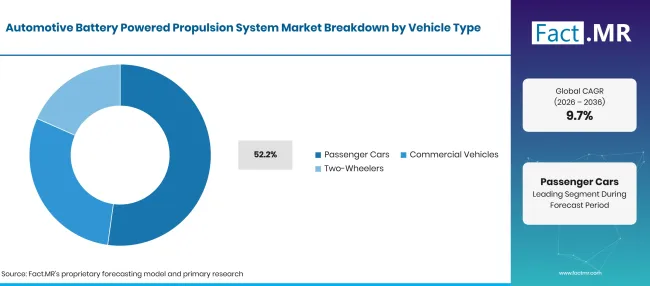
Factmr Automotive Battery Powered Propulsion System Market Breakdown Vehicle Type | Source: Fact.MR
| Vehicle Type | Share (2026) |
|---|---|
| Passenger Cars (Leading segment) | 52.2% |
| Other segments combined | 47.8% |
| Total | 100.0% |
Source: Fact.MR analysis. Updated Oct 19, 2026
Passenger-car powertrains support vehicles with different weight, performance, and driving-range requirements. Carmakers prefer propulsion designs that can share motors, controls, and related components across several passenger-car sizes, helping manufacturers maintain consistent system integration while adapting the powertrain to different vehicle platforms.
Which Battery Type leads purchases?
Lithium-ion accounts for 81.9% share in 2026.
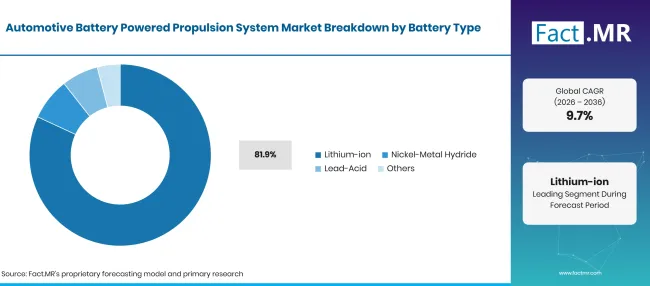
Factmr Automotive Battery Powered Propulsion System Market Breakdown Battery Type | Source: Fact.MR
| Battery Type | Share (2026) |
|---|---|
| Lithium-ion (Leading segment) | 81.9% |
| Other segments combined | 18.1% |
| Total | 100.0% |
Source: Fact.MR analysis. Updated Oct 19, 2026
Lithium-ion batteries have become the usual choice for full battery powered traction because pack makers can select different cell chemistries to fit vehicle cost and range needs. Nickel-Metal Hydride continues to suit selected hybrid vehicle architectures. Lead-Acid batteries are mainly associated with auxiliary or established low-voltage roles, so their place in main propulsion is narrower.
What leads the Application segment?
Electric Vehicles accounts for 88.0% share in 2026.
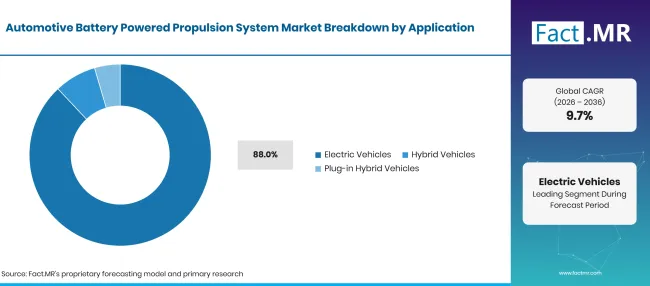
Factmr Automotive Battery Powered Propulsion System Market Breakdown Application | Source: Fact.MR
| Application | Share (2026) |
|---|---|
| Electric Vehicles (Leading segment) | 88.0% |
| Other segments combined | 12.0% |
| Total | 100.0% |
Source: Fact.MR analysis. Updated Oct 19, 2026
Electric vehicles use stored battery energy to operate traction motors, making efficient energy transfer central to propulsion performance. The battery pack and power electronics control how effectively power reaches the wheels, while pack cooling and motor control remain important for reliable battery-only vehicle operation.
How is Power Output distributed?
100-250 kW accounts for 41.9% share in 2026.
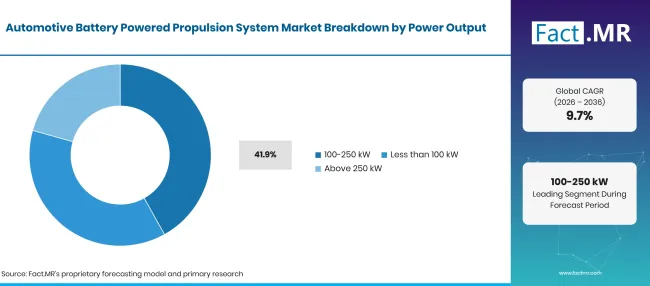
Factmr Automotive Battery Powered Propulsion System Market Breakdown Power Output | Source: Fact.MR
| Power Output | Share (2026) |
|---|---|
| 100-250 kW (Leading segment) | 41.9% |
| Other segments combined | 58.1% |
| Total | 100.0% |
Source: Fact.MR analysis. Updated Oct 19, 2026
The 100-250 kW range offers enough traction output for many passenger-car applications while keeping battery draw and heat management within practical design limits. Less than 100 kW supports smaller vehicles and models planned for everyday urban driving. Above 250 kW systems suit heavier or higher-performance vehicles with greater electrical and thermal requirements.
What is accelerating Automotive Battery Powered Propulsion System Market adoption, and what is holding it back?
Electric car production and shared vehicle platforms support sales, while battery cost and charging access shape purchase decisions.
Drivers Impact Analysis
| DRIVER | (~) % IMPACT ON CAGR | GEOGRAPHIC RELEVANCE | IMPACT TIMELINE |
|---|---|---|---|
| Electric vehicle manufacturing | +1.0% | Global | Medium term (2–4 years) |
| Shared propulsion platforms | +0.8% | Europe, East Asia | Medium term (2–4 years) |
| Battery integration efficiency | +0.7% | Global | Long term (>= 4 years) |
| Fleet electrification | +0.5% | North America, Europe | Medium term (2–4 years) |
| Vehicle efficiency design | +0.4% | Global | Short term (<= 2 years) |
Source: Fact.MR analysis. Updated Oct 19, 2026
Opportunity Impact Analysis
| OPPORTUNITY | (~) % IMPACT ON CAGR | GEOGRAPHIC RELEVANCE | IMPACT TIMELINE |
|---|---|---|---|
| Local battery system assembly | +0.8% | Americas, Europe | Medium term (2–4 years) |
| Commercial fleet specifications | +0.6% | Global | Medium term (2–4 years) |
| Service-ready platform designs | +0.5% | Global | Short term (<= 2 years) |
| Battery and motor co-design | +0.4% | East Asia, Europe | Long term (>= 4 years) |
Source: Fact.MR analysis. Updated Oct 19, 2026
Restraints Impact Analysis
| RESTRAINT | (~) % IMPACT ON CAGR | GEOGRAPHIC RELEVANCE | IMPACT TIMELINE |
|---|---|---|---|
| Battery material and cell cost | -0.8% | Global | Medium term (2–4 years) |
| Uneven charging access | -0.6% | Americas, Europe, Japan | Short term (<= 2 years) |
| High-voltage testing expense | -0.5% | Global | Medium term (2–4 years) |
| Parts and repair readiness | -0.4% | Global | Long term (>= 4 years) |
Source: Fact.MR analysis. Updated Oct 19, 2026
Which countries are scaling Automotive Battery Powered Propulsion System Market through 2036?
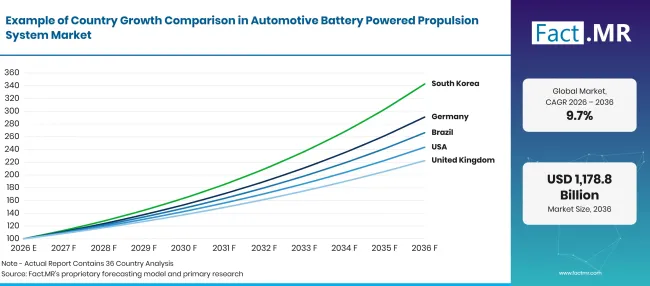
Factmr Automotive Battery Powered Propulsion System Market Growth Index | Source: Fact.MR
| Country | CAGR (2026-2036) |
|---|---|
| Germany | 11.3% |
| Brazil | 10.3% |
| USA | 9.3% |
| UK | 8.3% |
| Japan | 7.4% |
Source: Fact.MR analysis. Updated Oct 19, 2026
Why is Germany expanding battery propulsion system production?
11.3% CAGR, shaped by export-focused vehicle engineering and electric-car registration activity.
Germany’s electric-car production base gives propulsion suppliers a route into both domestic assembly and export models. In July 2025, Statistisches Bundesamt reported exports of 416,000 electric cars during January to May 2025 [2]. Vehicle engineers need battery systems suited to compact cars and higher-output premium models. Shared platforms are anticipated to favor pack layouts that work across several body styles.
How does Brazil support electric propulsion sales?
10.3% CAGR, influenced by electric vehicle availability and local charging considerations.
Brazil’s passenger-car market is opening more room for electric and hybrid propulsion designs. In July 2026, Associação Brasileira do Veículo Elétrico reported 215,023 electrified light-vehicle sales during the first half of 2026 [3]. Compact electric cars can use smaller traction motors suited to frequent city journeys. Carmakers are expected to assess local assembly and service arrangements as sales increase.
What shapes the USA battery propulsion outlook?
9.3% CAGR, linked to passenger electric platforms and fleet operating choices.
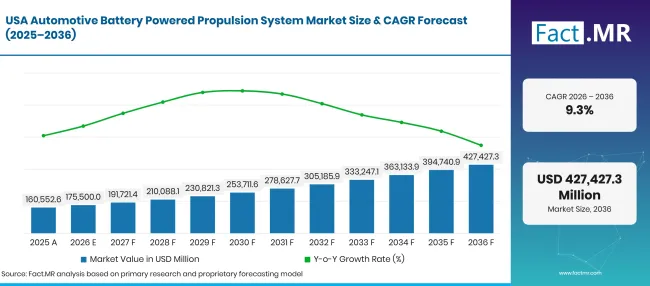
Factmr Automotive Battery Powered Propulsion System Market Forecast Usa | Source: Fact.MR
US vehicle makers are developing battery-powered propulsion for passenger cars and larger utility vehicles. The International Energy Agency reported in May 2026 that electric cars represented just under 10% of US car sales in 2025 [1]. Battery size varies with vehicle weight and expected driving range. Fleet managers compare electric models using regular mileage and dependable depot charging.
What supports the UK electric propulsion outlook?
8.3% CAGR, associated with battery-electric registrations and wider public charging availability.
The UK’s company-car and passenger market brings electric propulsion into a broad range of vehicle classes. In October 2026, the Society of Motor Manufacturers and Traders recorded 454,947 battery-electric car registrations during January to September 2026 [4]. Electric van orders create scope for common drivetrain designs across fleet models. Drivers consider realistic range when selecting battery size and motor output. The Department for Transport recorded 28,887 rapid-or-faster public chargers on 1 July 2026 [5]. Charging access varies by residential property and region. Fleet operators must plan charging around working hours. Vehicle prices remain a factor in private purchase decisions.
How is Japan adapting its battery powered propulsion systems?
7.4% CAGR, linked to hybrid engineering knowledge and battery electric platform development.
Japan’s vehicle manufacturers have developed extensive expertise in hybrid motors and power controls. The Ministry of Economy, Trade and Industry announced a commercial vehicle electrification support programme in April 2026 covering eligible electric trucks and buses [7]. Battery-electric vehicles require different charging and cooling systems from conventional hybrids.
Who leads the Automotive Battery Powered Propulsion System Market?
Tesla, BYD, Volkswagen and Hyundai are among the manufacturers integrating battery powered vehicle propulsion.
Tesla designs complete battery electric vehicle platforms that combine motors and battery controls. BYD manufactures electric and plug-in hybrid vehicles with integrated battery technologies. Nissan and General Motors offer electric models with different vehicle sizes and drive arrangements. Their powertrain decisions depend on how well packs fit production designs and the driving range customers expect.
BMW Group and Mercedes-Benz Group AG operate electric passenger-car lines in premium classes. Volkswagen AG offers several electric car models across its brands. Ford Motor Company participates through electric cars and trucks, while Hyundai Motor Company offers battery electric vehicle platforms. Toyota Motor Corporation remains active across hybrid and battery electric programs. Competition turns on efficiency, product cost, service support and the ability to scale production without frequent component changes.
Which companies are the key providers?
Key companies include Tesla, Inc.; BYD Company Limited; Nissan Motor Co., Ltd.; General Motors Company; BMW Group; Ford Motor Company; Volkswagen AG; Hyundai Motor Company; Toyota Motor Corporation; Mercedes-Benz Group AG.
- Tesla, Inc.
- BYD Company Limited
- Nissan Motor Co., Ltd.
- General Motors Company
- BMW Group
- Ford Motor Company
- Volkswagen AG
- Hyundai Motor Company
- Toyota Motor Corporation
- Mercedes-Benz Group AG
Bibliography
- [1] International Energy Agency. (2026, May 20). Global EV Outlook 2026: Executive summary.
- [2] Statistisches Bundesamt (Destatis). (2025, July 18). Exporte von neuen Pkw in den ersten fünf Monaten 2025 um 1,1 % zum Vorjahreszeitraum gestiegen.
- [3] Associação Brasileira do Veículo Elétrico. (2026, July 6). De cada 100 veículos leves vendidos no Brasil no primeiro semestre, 16 foram eletrificados.
- [4] Society of Motor Manufacturers and Traders. (n.d.). Electric vehicle data.
- [5] Department for Transport. (2026, August 27). Public electric vehicle charging infrastructure statistics: 1 July 2026.
- [6] European Automobile Manufacturers’ Association. (2026, January 27). New car registrations: +1.8% in 2025; battery-electric 17.4% market share.
- [7] Ministry of Economy, Trade and Industry. (2026, April 24). FY2025 supplementary budget: Commercial vehicle electrification promotion project (trucks, taxis and buses)—Call for applications.
This Report Answers
- Battery analysis explains how lithium-ion packs influence powertrain architecture and cooling requirements.
- Application analysis separates full battery electric vehicles from hybrid and plug-in hybrid designs.
- Power output analysis describes why vehicle weight and performance influence motor sizing.
- Country outlook examines Germany, Brazil, USA, UK and Japan using country-specific operating conditions.
What does the Automotive Battery Powered Propulsion System Market cover?
The scope differs from the starter battery replacement business. automotive power electronics provide switching and control functions needed to turn battery energy into motor output.
Battery packs determine range and cooling requirements, connecting propulsion design to electric vehicle battery technologies. Commercial fleets have different driving cycles, particularly electric commercial vehicles that return to a depot for regular charging.
What is included in the scope?
Coverage includes battery energy storage that provides traction power and the electrical components needed to use that energy for vehicle movement. The market definition considers vehicle manufacturers and their traction equipment arrangements.
What is excluded from the scope?
Standalone charging-station sales are outside the propulsion-system boundary. Stationary energy storage equipment is also excluded unless installed as vehicle traction hardware. Conventional starter batteries supplied without a traction application are distinct from battery powered propulsion. The report does not count unrelated vehicle accessories as part of the electric drive system.
How Was the Analysis Built?
The analysis draws on 120+ sources, 35+ company portfolios, 25+ countries, and more than 20 industry interviews.
- Primary Research: Primary research includes discussions with manufacturers, service providers, technology developers, distributors, end users, and subject-matter experts. These conversations examine purchasing priorities, product adoption, operational challenges, approval requirements, competitive positioning, and the factors that influence wider market acceptance.
- Desk Research: Desk research covers government statistics, regulatory publications, company filings, trade data, technical studies, industry associations, standards, public policy, and other authoritative sources. Every source used in the analysis is documented in the bibliography.
- Market Sizing and Forecasting: Market estimates combine historical performance, demand indicators, pricing and volume trends, segment shares, company participation, country-level growth, adoption patterns, investment activity, and barriers to market expansion.
- Data Validation and Update Cycle: Findings are validated by comparing primary interviews with public data, company activity, regulatory changes, trade patterns, and industry developments. Regular updates review new product launches, capacity changes, partnerships, approvals, and shifts in commercial adoption.
Segmentation
What is the report’s scope and coverage?
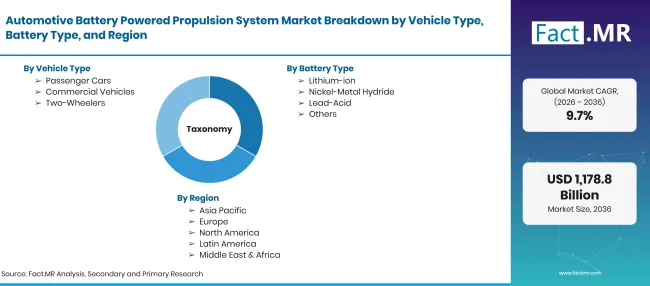
Factmr Automotive Battery Powered Propulsion System Market Taxonomy | Source: Fact.MR
| Attribute | Details |
|---|---|
| Quantitative Units | USD billion in 2026 to USD billion in 2036, at CAGR |
| Market Definition | Battery powered traction systems combining energy storage with electric motor drive and control |
| Vehicle Type | Passenger Cars; Commercial Vehicles; Two-Wheelers |
| Battery Type | Lithium-ion; Nickel-Metal Hydride; Lead-Acid; Others |
| Application | Electric Vehicles; Hybrid Vehicles; Plug-in Hybrid Vehicles |
| Power Output | Less than 100 kW; 100-250 kW; Above 250 kW |
| Countries Covered | Germany; Brazil; USA; UK; Japan |
| Companies Profiled | Tesla, Inc.; BYD Company Limited; Nissan Motor Co., Ltd.; General Motors Company; BMW Group; Ford Motor Company; Volkswagen AG; Hyundai Motor Company; Toyota Motor Corporation; Mercedes-Benz Group AG |
| Forecast Period | 2026 to 2036 |
| Approach | Review of electric vehicle adoption, traction equipment selection and first-party institutional material |
Source: Fact.MR analysis. Updated Oct 19, 2026
How is the market segmented?
-
By Vehicle Type
- Passenger Cars
- Commercial Vehicles
- Two-Wheelers
-
By Battery Type
- Lithium-ion
- Nickel-Metal Hydride
- Lead-Acid
- Others
-
By Application
- Electric Vehicles
- Hybrid Vehicles
- Plug-in Hybrid Vehicles
-
By Power Output
- Less than 100 kW
- 100-250 kW
- Above 250 kW
-
By Region
- North America
- Latin America
- Western Europe
- Eastern Europe
- East Asia
- South Asia & Pacific
- Middle East & Africa
Frequently Asked Questions
How big is the Automotive Battery Powered Propulsion System Market in 2026?
What is the CAGR of the Automotive Battery Powered Propulsion System Market from 2026 to 2036?
Which vehicle type leads the Automotive Battery Powered Propulsion System Market?
Which battery type leads the Automotive Battery Powered Propulsion System Market?
Who are the leading companies in the Automotive Battery Powered Propulsion System Market?
Who worked on this report


Preview the report firsthand - request a free sample
Free SampleGet the brochure for pricing and purchase details
Download PDF