Electric Parking Brake Actuator Components Market Size, Share, Growth and Forecast (2026 - 2036)
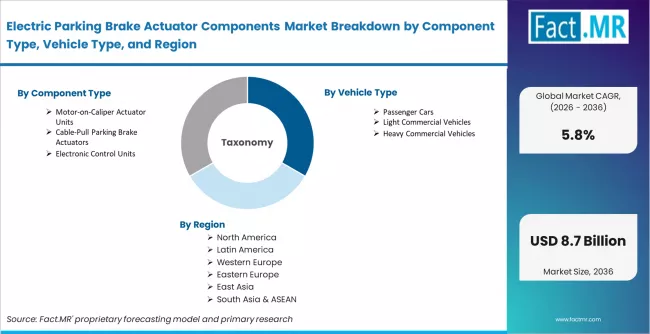
The Electric Parking Brake Actuator Components Market is segmented by Component Type, Vehicle Type, Brake Configuration, and Region. Forecast for 2026 to 2036.
Fact.MR analysis indicates that the electric parking brake actuator components market is experiencing an automation-versus-mechanical transition. Parking brake hardware is moving away from hand levers, foot pedals, and cable-dominant layouts toward electronically controlled actuation built around caliper motors, control electronics, and software-linked convenience functions.
Electric Parking Brake Actuator Components Market Forecast and Outlook by Fact.MR
- The electric parking brake actuator components market was valued at USD 4.4 billion in 2025.
- According to Fact.MR, demand is projected to reach USD 4.7 billion in 2026 and expand to USD 8.3 billion by 2036, reflecting a CAGR of 5.8% during the forecast period.
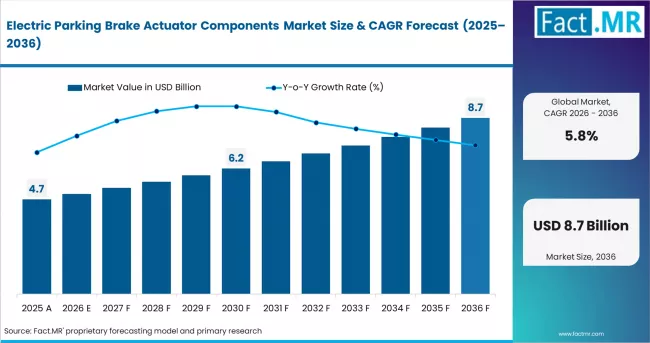
| Metric | Value |
|---|---|
| Estimated Value in 2026 | USD 4.7 billion |
| Forecast Value in 2036 | USD 8.3 billion |
| Forecast CAGR (2026 to 2036) | 5.8% |
Summary of the Electric Parking Brake Actuator Components Market
- Market Definition
- The electric parking brake actuator components market includes the motors, control units, and interface hardware that electronically engage and release the parking brake in modern vehicles.
- Demand Drivers
- OEMs are replacing manual parking brake hardware with electronically controlled actuation to improve packaging and convenience.
- Vehicle platforms need parking brake systems that support additional software-linked features such as remote control and integrated braking logic.
- EV and premium vehicle programs are increasing the commercial case for compact, low-drag, electronically managed parking brake systems.
- Key Segments Analyzed
- By Component Type: Motor-on-Caliper Actuator Units are expected to account for 41.0% share in 2026, supported by their role as the dominant execution format in modern EPB systems.
- By Vehicle Type: Passenger Cars are projected to hold 64.0% share in 2026 because EPB adoption is most widespread in passenger-vehicle platforms.
- By Brake Configuration: Rear Disc Brake EPB Systems are expected to capture 36.0% share in 2026 as motor-on-caliper architectures remain the clearest commercial base.
- By Geography: China leads growth with a 6.5% CAGR through 2036, supported by vehicle scale and faster migration toward electronically actuated parking brakes.
- Analyst Opinion at Fact.MR
- Shambhu Nath Jha, Senior Analyst at Fact.MR, states that the strongest shift in this market is that the EPB actuator is no longer just a convenience part. It is becoming a compact brake-control building block that influences packaging, software functions, and vehicle differentiation. Once parking hold, drag optimization, and remote or automated features enter the picture, the actuator component becomes more strategic than a simple replacement for the handbrake.”
- Strategic Implications
- Suppliers that combine compact actuator packaging with low-drag and software-ready control will be better placed in next-generation vehicle programs.
- OEMs need EPB actuator vendors that support broader brake-system integration rather than isolated hardware supply.
- Aftermarket participants gain more from exact OE-quality replacement and validated repair support than from low-cost generic substitution.
- Methodology
- Market sizing used vehicle production, EPB penetration, and premium-content intensity as baseline anchors.
- Analysis incorporated supplier positioning around EPB calipers, actuator kits, and integrated electronic parking brake functionality.
- Forecasts were checked against recent SOP signals and current aftermarket expansion in EPB actuator repair coverage. [2]
The market is expected to create an absolute opportunity of USD 3.5 billion between 2026 and 2036, supported by the continued shift toward electronically controlled braking systems. Growth remains steady because EPB actuation is no longer evaluated only on parking-hold functionality. Buyers increasingly assess how effectively these systems support packaging flexibility, reduce brake drag, enable convenience features, and integrate with broader vehicle-control architectures. ZF Friedrichshafen states that its EPB systems support both front and rear wheel applications and enable advanced functions such as remote-controlled parking and redundancy support for driver assistance systems. Continental also highlights that integrated electric parking brake systems create more interior design flexibility and can scale across different vehicle classes. [1]
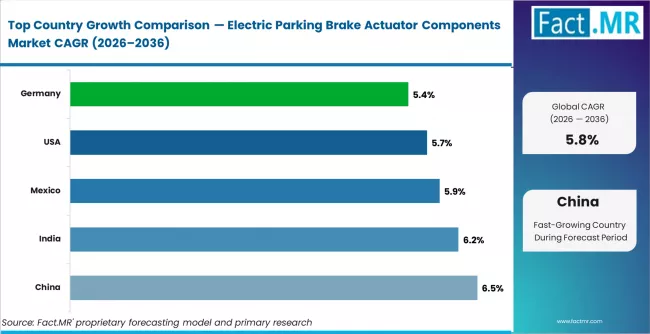
China is projected to remain the fastest-growing country, with a CAGR of 6.5% through 2036, followed by India at 6.2% and Mexico at 5.9%. The United States is expected to expand at 5.7%, Germany at 5.4%. Fact.MR views this spread as a reflection of differences in vehicle electrification, premium braking-content adoption, and the rate at which OEMs replace mechanical parking brake hardware with electronically actuated systems. Recent supplier positioning from ZF, AISIN/ADVICS, and Continental supports that transition path.
Segmental Analysis
Electric Parking Brake Actuator Components Market Analysis by Component Type
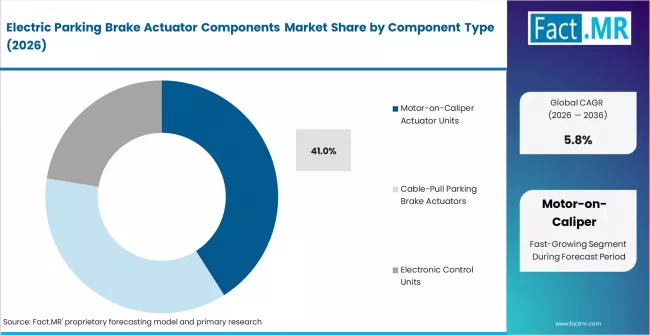
Motor-on-caliper actuator units are expected to hold 41.0% share in 2026, as the clearest modern EPB architecture is a caliper with an added electric motor. ZF explicitly defines EPB this way, describing the EPB caliper as a caliper with an additional motor that operates the parking brake. Continental’s aftermarket business also packages the repair logic around actuator and caliper assemblies, while ADVICS actuator kits reinforce that the motorized caliper-side unit is the central serviceable value point.
- Execution maturity: Motor-on-caliper architecture is the clearest commercial EPB format in current supplier materials.
- Packaging value: It removes traditional cabin-operated parking-brake hardware and supports simpler vehicle packaging.
- Service visibility: The actuator unit is a distinct replacement and repair item in the aftermarket, which reinforces its commercial importance.
Electric Parking Brake Actuator Components Market Analysis by Vehicle Type
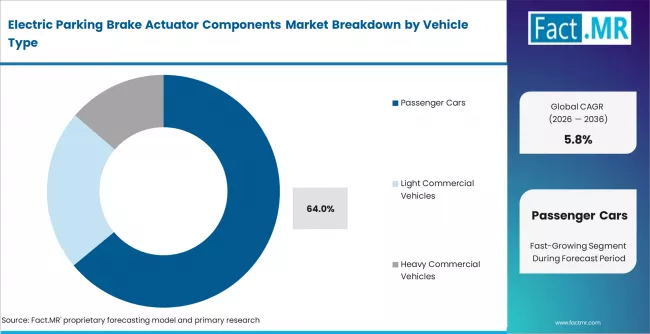
Passenger cars are expected to account for 64.0% share in 2026, driven by strong migration toward electric parking brake systems in mainstream and premium vehicle segments. Electrified passenger platforms are prioritizing compact packaging and digitally controlled braking functions. ZF Friedrichshafen and Aisin both reinforce this trend through their focus on passenger-car braking solutions. EPB systems provide visible benefits such as console-space savings, automatic engagement, and compatibility with driver-assistance features, making them more commercially impactful in passenger vehicles than in many heavy-duty applications. [3]
- Commercial readiness: Passenger cars are where EPB has become a mainstream braking-content choice rather than a niche upgrade.
- Feature pull: Automatic hold, packaging freedom, and software-linked parking functions matter more in passenger platforms.
- Scale pathway: Passenger-vehicle volume offers the strongest route to larger actuator-component demand.
Electric Parking Brake Actuator Components Market Analysis by Brake Configuration
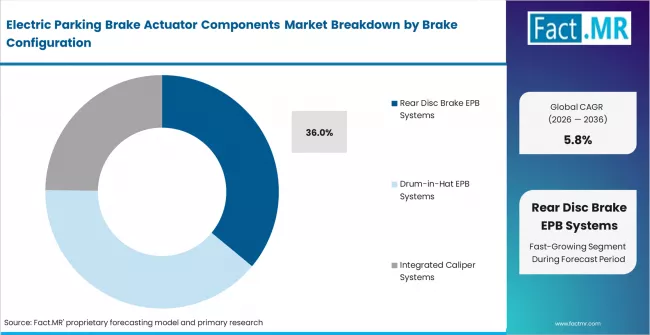
Rear disc brake EPB systems are expected to capture 36.0% share in 2026. Their rise comes from the fact that caliper-integrated EPB logic naturally fits rear disc-brake layouts. ZF’s system description around EPB calipers, Continental’s repair units consisting of a brake caliper and motor, and the general aftermarket language around EPB actuator kits all point to a market anchored in disc-brake rear axle implementation.
- Architecture fit: Rear disc systems work naturally with motor-on-caliper EPB execution.
- Repair clarity: Service logic is easier to define when the EPB actuator is tied directly to the caliper assembly.
Commercial visibility: Supplier and aftermarket references consistently center on caliper-based EPB hardware.
Electric Parking Brake Actuator Components Market Drivers, Restraints, and Opportunities
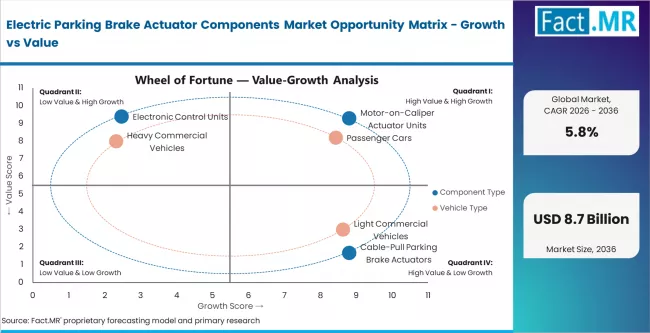
The strongest market driver is the need to replace manual parking-brake hardware with electronically managed systems that support convenience, packaging efficiency, and higher-order vehicle functions. ZF says EPB enables advanced features such as remote controlled parking and AD fallback functionality, while Continental links integrated electric parking brake to more freedom in vehicle interior design. These factors make EPB actuator components more valuable than a simple brake-hold mechanism alone.
The main restraint is validation and service complexity. EPB actuators must deliver reliable holding performance while also integrating correctly with the brake caliper, ECU, and vehicle controls. The strong emphasis on OE-quality replacements from Continental and ADVICS suggests that actuator failure or incorrect servicing can create significant practical issues, which keeps the market quality-sensitive rather than purely price-led. [4]
Opportunities in the Electric Parking Brake Actuator Components Market
- EV platform rollout: New EV platforms create room for compact EPB actuation with drag and packaging advantages. ZF’s 2025 Indian passenger-EV SOP supports this path.
- Aftermarket actuator replacement: Installed-vehicle parc growth creates a larger service base for OE-quality actuator kits and repair parts. Continental and ADVICS both support this opportunity directly.
- Advanced parking functions: Remote parking and software-linked fallback features increase the strategic value of reliable EPB actuator hardware. ZF explicitly connects its EPB to these functions.
Regional Analysis
Based on the regional analysis, the Electric Parking Brake Actuator Components Market is segmented into East Asia, South Asia and Pacific, North America, Europe, Latin America, and Middle East and Africa across 40 plus countries.
.webp)
| Country | CAGR (2026 to 2036) |
|---|---|
| China | 6.5% |
| India | 6.2% |
| Mexico | 5.9% |
| United States | 5.7% |
| Germany | 5.4% |
Source: Fact.MR analysis, based on proprietary forecasting model and primary research
East Asia Electric Parking Brake Actuator Components Market Analysis
East Asia remains the strongest production and adoption base for this market. The region combines large passenger-vehicle output with strong supplier capability in braking and mechatronic actuation. AISIN’s and ADVICS’ EPB positioning, together with ZF’s and Continental’s global product strategies, support the importance of this region in both OE integration and component replacement. [5]
- China: Electric parking brake actuator components demand in China is projected to grow at a CAGR of 6.5% by 2036. The market benefits from large passenger-vehicle output and a faster move toward electronically managed braking content in higher-volume platforms.
Fact.MR’s report also covers ASEAN, Australia and New Zealand, and other South Asia and Pacific markets. These countries matter where passenger-vehicle manufacturing expands and electronically actuated brake systems penetrate newer platforms.
South Asia & Pacific Electric Parking Brake Actuator Components Market Analysis
South Asia & Pacific is an emerging growth region as passenger vehicle production expands and electronically actuated braking systems become more common across mid-range models. Increasing safety awareness and feature migration are key demand drivers.
- India: India is expected to expand at a 6.2% CAGR by 2036, supported by rising passenger vehicle production and increasing penetration of EPB systems in SUVs and premium hatchbacks. Automakers are gradually introducing electronic parking brakes as part of broader feature upgrades, particularly in higher trims. Growth is also supported by localization of braking components and expanding domestic supplier capabilities.
Fact.MR’s report also includes ASEAN and other regional markets where EPB adoption is still developing but gaining traction with newer vehicle platforms.
North America Electric Parking Brake Actuator Components Market Analysis
North America is shaped by high passenger-vehicle content, strong SUV and crossover demand, and a growing installed base requiring brake-service support. EPB actuator components matter in this region because parking-brake automation and integrated caliper-motor layouts are already established in many mainstream and premium models. Continental’s ATE aftermarket expansion explicitly targets more than 5 million vehicles-in-operation in North America, which highlights the region’s replacement-market significance.
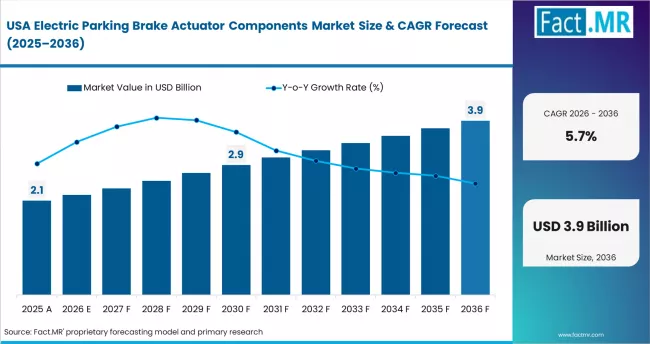
- United States: Electric parking brake actuator components demand in the United States is projected to rise at a CAGR of 5.7% from 2026 to 2036. The market is supported by broad passenger-vehicle EPB adoption and a sizable installed base that feeds service demand.
- Mexico: Mexico is expected to record a CAGR of 5.9% over the study period. Its faster growth comes from assembly-led momentum and integration into North American passenger-vehicle production programs.
Fact.MR’s report also includes Canada and the wider North American passenger-vehicle braking ecosystem. Additional value comes from repair demand, OE replacement quality requirements, and continued spread of electronically actuated parking-brake hardware.
Europe Electric Parking Brake Actuator Components Market Analysis
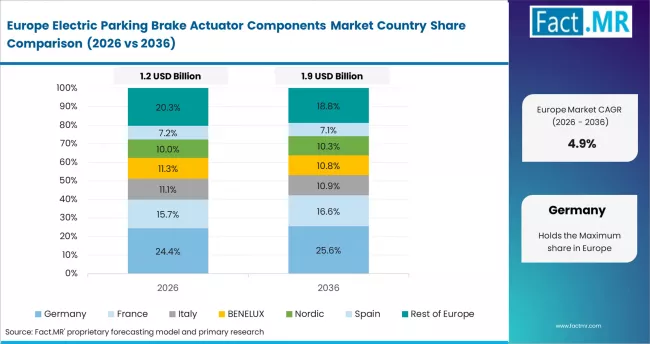
Europe remains a high-discipline market rather than the fastest-growing one. Vehicle makers in the region place strong weight on packaging efficiency, brake-system integration, and higher-value electronic braking functions. Continental and ZF both provide a strong technology and market presence in this direction, and the aftermarket logic around OE-quality EPB replacement also appears especially visible in European-branded vehicle coverage.
- Germany: Germany is projected to expand at a CAGR of 5.4% from 2026 to 2036. Its importance comes from premium passenger-vehicle engineering, supplier depth, and stronger demand for integrated brake mechatronics.
Fact.MR’s report also covers France, Italy, the United Kingdom, Spain, and the rest of Europe. These markets add commercial depth through premium braking content, strong component-replacement quality expectations, and continued evolution toward electronically controlled parking-brake systems.
Competitive Aligners for Market Players
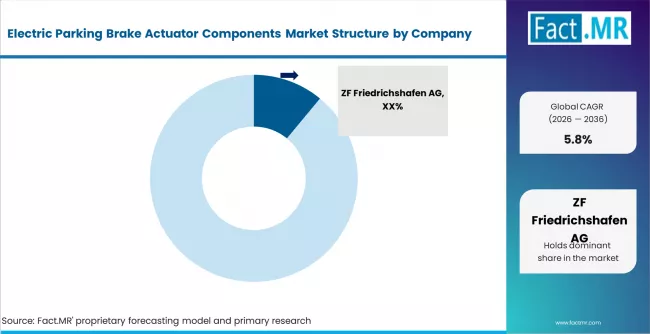
The electric parking brake actuator components market is moderately consolidated. Buyers do not choose suppliers only on parking-hold capability. They choose on actuator packaging, OE integration quality, electronic control compatibility, drag behavior, and support for broader brake functions. ZF, Continental, AISIN/ADVICS, and other established braking suppliers remain visible because they operate at the point where caliper mechanics, electric actuation, and control electronics meet.
Incumbents hold an advantage because EPB actuation is difficult to separate from the full brake-system design and service ecosystem. A challenger may offer a motor or repair part, but replicating OEM confidence is harder when clamping force, electronic control, and service procedure all depend on the complete component-package behavior. The strong emphasis on current OE production parts and OEM quality in ADVICS and Continental aftermarket materials makes this systems logic clear. Buyer power still matters, though it is limited by fitment sensitivity and brake-system validation cost. OEMs want packaging and functional gains, but they also want low risk in a safety-critical actuation system. Through 2036, Fact.MR expects competition to remain rational, with stronger selectivity in motor-on-caliper architectures, EV platforms, and actuator replacement components that preserve OE behavior.
Key Players in Electric Parking Brake Actuator Components Market
- ZF Friedrichshafen AG
- Continental AG
- AISIN Corporation
- ADVICS Co., Ltd.
- Brembo N.V.
- Robert Bosch GmbH
- Hitachi Astemo, Ltd.
- Mando Corporation
- Hyundai Mobis
- ATE / Continental Aftermarket
Bibliography
- [1] ZF. Electric Park Brake (EPB). Official product page describing EPB technology and advanced functions.
- [2] ZF Press. ZF Group to supply its Electric Park Brake System to a leading Pass Car OEM (July 30, 2025). Official SOP announcement for an EV platform.
- [3] Continental. Electric cars require innovative brake systems. Official article referencing integrated electric parking brake and vehicle-packaging freedom.
- [4] Continental Aftermarket. ATE Electronic Parking Brake Actuators Save Time and Money on Caliper Repairs (October 31, 2023). Official aftermarket coverage statement.
- [5] AISIN. Electric Parking Brake. Official product page.
This Report Addresses
- Strategic demand outlook for electric parking brake actuator components across modern vehicle brake architectures.
- Market forecast from USD 4.7 billion in 2026 to USD 8.3 billion by 2036.
- The growing role of motor-on-caliper actuator units, control electronics, and EPB integration in vehicle packaging and braking strategy.
- The effect of EV platform rollout and parking-brake automation on actuator-component demand.
- OEM versus aftermarket demand patterns in a fitment- and validation-sensitive brake-mechatronics category.
- Regional differences in vehicle production, EPB adoption, and supplier depth.
- Competitive positioning of suppliers active in EPB calipers, actuators, and related control components.
- Segment analysis by component type, vehicle type, brake configuration, sales channel, and geography.
Electric Parking Brake Actuator Components Market Definition
The market covers the component-level hardware and control elements that electrically actuate and manage a vehicle’s parking brake. This includes motor-on-caliper actuator units, cable-pull EPB actuators, control electronics, and switch-interface hardware used to engage, release, and supervise the parking brake through electronic commands. The category is distinct because it focuses on the actuation components of EPB systems rather than on full service brake systems or passive brake hardware.
Electric Parking Brake Actuator Components Market Inclusions
The market includes caliper-mounted EPB motors, actuator housings, cable-pull actuator devices, EPB ECUs, switch assemblies, and related actuation hardware used in passenger and other road vehicles.
Electric Parking Brake Actuator Components Market Exclusions
The market excludes manual handbrake levers, passive cables without electric actuation, conventional service brake calipers without EPB hardware value separation, and broader brake-by-wire or ESC systems where parking-brake actuation value cannot be isolated. It also excludes non-vehicle industrial holding-brake systems.
Electric Parking Brake Actuator Components Market Research Methodology
- Primary Research
- Interviews with brake-system engineers, caliper-actuator integration specialists, vehicle brake-control teams, passenger-vehicle platform managers, and aftermarket brake-service distributors.
- Desk Research
- Review of official EPB product pages, OEM and supplier press releases, actuator-repair materials, and public brake-technology positioning from ZF, Continental, AISIN, and ADVICS.
- Market-Sizing and Forecasting
- Fact.MR used a blended model based on vehicle production, EPB penetration, EV and premium-vehicle mix, motor-on-caliper adoption, and replacement demand in the installed vehicle parc.
- Data Validation and Update Cycle
- Forecasts were cross-checked through supplier commercialization signals, aftermarket repair coverage, and public positioning around integrated electric parking brake functionality in newer vehicle platforms.
Scope of the Report

| Attribute | Details |
|---|---|
| Quantitative Units | USD 4.7 billion in 2026 to USD 8.3 billion in 2036, at a CAGR of 5.8% |
| Market Definition | Electric parking brake actuator components that electronically engage, release, and control parking brake function through motors, ECUs, and interface hardware. |
| Component Type Segmentation | Motor-on-Caliper Actuator Units, Cable-Pull Parking Brake Actuators, Electronic Control Units, Switch and Interface Components, Others |
| Vehicle Type Segmentation | Passenger Cars, Light Commercial Vehicles, Heavy Commercial Vehicles, Electric Vehicles |
| Brake Configuration Segmentation | Rear Disc Brake EPB Systems, Drum-in-Hat EPB Systems, Integrated Caliper Systems, Others |
| Regions Covered | East Asia, South Asia and Pacific, North America, Europe, Latin America, Middle East and Africa |
| Countries Covered | China, India, Mexico, United States, Germany, Japan, South Korea, and 40+ countries |
| Key Companies Profiled | ZF, Continental, AISIN, ADVICS, Brembo, Bosch, Hitachi Astemo, Mando, Hyundai Mobis, ATE and others |
| Forecast Period | 2026 to 2036 |
| Approach | Fact.MR combined primary interviews with brake and mechatronics stakeholders, desk research across official EPB materials, and a forecast model anchored in vehicle production, EPB penetration, and actuator replacement demand. |
Electric Parking Brake Actuator Components Market by Segments
-
By Component Type:
- Motor-on-Caliper Actuator Units
- Cable-Pull Parking Brake Actuators
- Electronic Control Units
- Switch and Interface Components
- Others
-
By Vehicle Type:
- Passenger Cars
- Light Commercial Vehicles
- Heavy Commercial Vehicles
- Electric Vehicles
-
By Brake Configuration:
- Rear Disc Brake EPB Systems
- Drum-in-Hat EPB Systems
- Integrated Caliper Systems
- Others
-
By Region:
-
North America
- United States
- Canada
- Mexico
- Latin America
- Brazil
- Argentina
- Rest of Latin America
- Europe
- Germany
- France
- United Kingdom
- Italy
- Spain
- Rest of Europe
- East Asia
- China
- Japan
- South Korea
- South Asia and Pacific
- India
- ASEAN
- Australia and New Zealand
- Rest of South Asia and Pacific
- Middle East and Africa
- GCC Countries
- South Africa
- Turkey
- Rest of Middle East and Africa
-
- Frequently Asked Questions -
What is the estimated size of the electric parking brake actuator components market in 2026?
The market is estimated at USD 4.7 billion in 2026.
How large is the market expected to become by 2036?
Fact.MR estimates the market will reach USD 8.3 billion by 2036.
What is the forecast CAGR for 2026 to 2036?
The market is projected to expand at a CAGR of 5.8% during the forecast period.
Which component type leads the market?
Motor-on-caliper actuator units lead the market with an expected 41.0% share in 2026. ZF’s official EPB system description directly supports this architecture.
Which vehicle type dominates demand?
Passenger cars lead with a projected 64.0% share in 2026.
Why does the OEM channel dominate?
OEM dominates because EPB actuator selection is closely tied to brake-system architecture, control integration, and platform validation.
Why are EPB actuator components important here?
They let the vehicle engage and release the parking brake electronically while supporting packaging, automation, and newer brake-control features.
What is the strongest demand driver?
The strongest driver is the replacement of manual parking-brake mechanisms with electronically managed actuation that supports convenience and broader vehicle-control functions.
What is the key restraint?
The main restraint is the need for exact OE-quality fitment and reliable integration between actuator, caliper, and control electronics.
Which country is growing fastest?
China is the fastest-growing country, with a projected CAGR of 6.5% through 2036.
Why is China ahead?
China combines large vehicle output with faster migration toward electronically actuated parking-brake systems.
How does India compare?
India follows at 6.2% CAGR, supported by new EPB SOP activity and broader passenger-vehicle modernization.
Why does Mexico rank strongly?
Mexico benefits from assembly-led momentum and integration into North American passenger-vehicle braking programs.
How do EVs affect this market?
EVs strengthen the case for compact electronically actuated parking-brake systems because packaging, drag behavior, and software-linked control become more valuable.
Is this a fragmented supplier market?
No. It is moderately consolidated because buyers value integrated brake-mechatronics capability and OE-quality execution.
What do OEM buyers prioritize?
They prioritize actuator packaging, control compatibility, reliability, drag behavior, and fit with broader brake functions.
Why does the aftermarket matter in this segment?
Because actuator failures and caliper-motor repair needs create a clear replacement market tied to OE-quality components. Continental and ADVICS both directly position products around this need.
Which companies are most visible in this market?
ZF, Continental, AISIN, and ADVICS are among the most visible participants in EPB actuator and related component positioning.
What is the broader outlook through 2036?
By 2036, the market is expected to become more mechatronics-led, with greater value placed on compact EPB actuation that supports software-linked braking and vehicle packaging goals.
Table of Content
- Executive Summary
- Global Market Outlook
- Demand to side Trends
- Supply to side Trends
- Technology Roadmap Analysis
- Analysis and Recommendations
- Market Overview
- Market Coverage / Taxonomy
- Market Definition / Scope / Limitations
- Research Methodology
- Chapter Orientation
- Analytical Lens and Working Hypotheses
- Market Structure, Signals, and Trend Drivers
- Benchmarking and Cross-market Comparability
- Market Sizing, Forecasting, and Opportunity Mapping
- Research Design and Evidence Framework
- Desk Research Programme (Secondary Evidence)
- Company Annual and Sustainability Reports
- Peer-reviewed Journals and Academic Literature
- Corporate Websites, Product Literature, and Technical Notes
- Earnings Decks and Investor Briefings
- Statutory Filings and Regulatory Disclosures
- Technical White Papers and Standards Notes
- Trade Journals, Industry Magazines, and Analyst Briefs
- Conference Proceedings, Webinars, and Seminar Materials
- Government Statistics Portals and Public Data Releases
- Press Releases and Reputable Media Coverage
- Specialist Newsletters and Curated Briefings
- Sector Databases and Reference Repositories
- Fact.MR Internal Proprietary Databases and Historical Market Datasets
- Subscription Datasets and Paid Sources
- Social Channels, Communities, and Digital Listening Inputs
- Additional Desk Sources
- Expert Input and Fieldwork (Primary Evidence)
- Primary Modes
- Qualitative Interviews and Expert Elicitation
- Quantitative Surveys and Structured Data Capture
- Blended Approach
- Why Primary Evidence is Used
- Field Techniques
- Interviews
- Surveys
- Focus Groups
- Observational and In-context Research
- Social and Community Interactions
- Stakeholder Universe Engaged
- C-suite Leaders
- Board Members
- Presidents and Vice Presidents
- R&D and Innovation Heads
- Technical Specialists
- Domain Subject-matter Experts
- Scientists
- Physicians and Other Healthcare Professionals
- Governance, Ethics, and Data Stewardship
- Research Ethics
- Data Integrity and Handling
- Primary Modes
- Tooling, Models, and Reference Databases
- Desk Research Programme (Secondary Evidence)
- Data Engineering and Model Build
- Data Acquisition and Ingestion
- Cleaning, Normalisation, and Verification
- Synthesis, Triangulation, and Analysis
- Quality Assurance and Audit Trail
- Market Background
- Market Dynamics
- Drivers
- Restraints
- Opportunity
- Trends
- Scenario Forecast
- Demand in Optimistic Scenario
- Demand in Likely Scenario
- Demand in Conservative Scenario
- Opportunity Map Analysis
- Product Life Cycle Analysis
- Supply Chain Analysis
- Investment Feasibility Matrix
- Value Chain Analysis
- PESTLE and Porter’s Analysis
- Regulatory Landscape
- Regional Parent Market Outlook
- Production and Consumption Statistics
- Import and Export Statistics
- Market Dynamics
- Global Market Analysis 2021 to 2025 and Forecast, 2026 to 2036
- Historical Market Size Value (USD Million) Analysis, 2021 to 2025
- Current and Future Market Size Value (USD Million) Projections, 2026 to 2036
- Y to o to Y Growth Trend Analysis
- Absolute $ Opportunity Analysis
- Global Market Pricing Analysis 2021 to 2025 and Forecast 2026 to 2036
- Global Market Analysis 2021 to 2025 and Forecast 2026 to 2036, By Component Type
- Introduction / Key Findings
- Historical Market Size Value (USD Million) Analysis By Component Type , 2021 to 2025
- Current and Future Market Size Value (USD Million) Analysis and Forecast By Component Type , 2026 to 2036
- Motor-on-Caliper Actuator Value (USD Million)s
- Cable-Pull Parking Brake Actuators
- Electronic Control Value (USD Million)s
- Motor-on-Caliper Actuator Value (USD Million)s
- Y to o to Y Growth Trend Analysis By Component Type , 2021 to 2025
- Absolute $ Opportunity Analysis By Component Type , 2026 to 2036
- Global Market Analysis 2021 to 2025 and Forecast 2026 to 2036, By Vehicle Type
- Introduction / Key Findings
- Historical Market Size Value (USD Million) Analysis By Vehicle Type, 2021 to 2025
- Current and Future Market Size Value (USD Million) Analysis and Forecast By Vehicle Type, 2026 to 2036
- Passenger Cars
- Light Commercial Vehicles
- Heavy Commercial Vehicles
- Passenger Cars
- Y to o to Y Growth Trend Analysis By Vehicle Type, 2021 to 2025
- Absolute $ Opportunity Analysis By Vehicle Type, 2026 to 2036
- Global Market Analysis 2021 to 2025 and Forecast 2026 to 2036, By Brake Configuration
- Introduction / Key Findings
- Historical Market Size Value (USD Million) Analysis By Brake Configuration, 2021 to 2025
- Current and Future Market Size Value (USD Million) Analysis and Forecast By Brake Configuration, 2026 to 2036
- Rear Disc Brake EPB Systems
- Drum-in-Hat EPB Systems
- Integrated Caliper Systems
- Rear Disc Brake EPB Systems
- Y to o to Y Growth Trend Analysis By Brake Configuration, 2021 to 2025
- Absolute $ Opportunity Analysis By Brake Configuration, 2026 to 2036
- Global Market Analysis 2021 to 2025 and Forecast 2026 to 2036, By Region
- Introduction
- Historical Market Size Value (USD Million) Analysis By Region, 2021 to 2025
- Current Market Size Value (USD Million) Analysis and Forecast By Region, 2026 to 2036
- North America
- Latin America
- Western Europe
- Eastern Europe
- East Asia
- South Asia and Pacific
- Middle East & Africa
- Market Attractiveness Analysis By Region
- North America Market Analysis 2021 to 2025 and Forecast 2026 to 2036, By Country
- Historical Market Size Value (USD Million) Trend Analysis By Market Taxonomy, 2021 to 2025
- Market Size Value (USD Million) Forecast By Market Taxonomy, 2026 to 2036
- By Country
- USA
- Canada
- Mexico
- By Component Type
- By Vehicle Type
- By Brake Configuration
- By Country
- Market Attractiveness Analysis
- By Country
- By Component Type
- By Vehicle Type
- By Brake Configuration
- Key Takeaways
- Latin America Market Analysis 2021 to 2025 and Forecast 2026 to 2036, By Country
- Historical Market Size Value (USD Million) Trend Analysis By Market Taxonomy, 2021 to 2025
- Market Size Value (USD Million) Forecast By Market Taxonomy, 2026 to 2036
- By Country
- Brazil
- Chile
- Rest of Latin America
- By Component Type
- By Vehicle Type
- By Brake Configuration
- By Country
- Market Attractiveness Analysis
- By Country
- By Component Type
- By Vehicle Type
- By Brake Configuration
- Key Takeaways
- Western Europe Market Analysis 2021 to 2025 and Forecast 2026 to 2036, By Country
- Historical Market Size Value (USD Million) Trend Analysis By Market Taxonomy, 2021 to 2025
- Market Size Value (USD Million) Forecast By Market Taxonomy, 2026 to 2036
- By Country
- Germany
- UK
- Italy
- Spain
- France
- Nordic
- BENELUX
- Rest of Western Europe
- By Component Type
- By Vehicle Type
- By Brake Configuration
- By Country
- Market Attractiveness Analysis
- By Country
- By Component Type
- By Vehicle Type
- By Brake Configuration
- Key Takeaways
- Eastern Europe Market Analysis 2021 to 2025 and Forecast 2026 to 2036, By Country
- Historical Market Size Value (USD Million) Trend Analysis By Market Taxonomy, 2021 to 2025
- Market Size Value (USD Million) Forecast By Market Taxonomy, 2026 to 2036
- By Country
- Russia
- Poland
- Hungary
- Balkan & Baltic
- Rest of Eastern Europe
- By Component Type
- By Vehicle Type
- By Brake Configuration
- By Country
- Market Attractiveness Analysis
- By Country
- By Component Type
- By Vehicle Type
- By Brake Configuration
- Key Takeaways
- East Asia Market Analysis 2021 to 2025 and Forecast 2026 to 2036, By Country
- Historical Market Size Value (USD Million) Trend Analysis By Market Taxonomy, 2021 to 2025
- Market Size Value (USD Million) Forecast By Market Taxonomy, 2026 to 2036
- By Country
- China
- Japan
- South Korea
- By Component Type
- By Vehicle Type
- By Brake Configuration
- By Country
- Market Attractiveness Analysis
- By Country
- By Component Type
- By Vehicle Type
- By Brake Configuration
- Key Takeaways
- South Asia and Pacific Market Analysis 2021 to 2025 and Forecast 2026 to 2036, By Country
- Historical Market Size Value (USD Million) Trend Analysis By Market Taxonomy, 2021 to 2025
- Market Size Value (USD Million) Forecast By Market Taxonomy, 2026 to 2036
- By Country
- India
- ASEAN
- Australia & New Zealand
- Rest of South Asia and Pacific
- By Component Type
- By Vehicle Type
- By Brake Configuration
- By Country
- Market Attractiveness Analysis
- By Country
- By Component Type
- By Vehicle Type
- By Brake Configuration
- Key Takeaways
- Middle East & Africa Market Analysis 2021 to 2025 and Forecast 2026 to 2036, By Country
- Historical Market Size Value (USD Million) Trend Analysis By Market Taxonomy, 2021 to 2025
- Market Size Value (USD Million) Forecast By Market Taxonomy, 2026 to 2036
- By Country
- Kingdom of Saudi Arabia
- Other GCC Countries
- Turkiye
- South Africa
- Other African Union
- Rest of Middle East & Africa
- By Component Type
- By Vehicle Type
- By Brake Configuration
- By Country
- Market Attractiveness Analysis
- By Country
- By Component Type
- By Vehicle Type
- By Brake Configuration
- Key Takeaways
- Key Countries Market Analysis
- USA
- Pricing Analysis
- Market Share Analysis, 2025
- By Component Type
- By Vehicle Type
- By Brake Configuration
- Canada
- Pricing Analysis
- Market Share Analysis, 2025
- By Component Type
- By Vehicle Type
- By Brake Configuration
- Mexico
- Pricing Analysis
- Market Share Analysis, 2025
- By Component Type
- By Vehicle Type
- By Brake Configuration
- Brazil
- Pricing Analysis
- Market Share Analysis, 2025
- By Component Type
- By Vehicle Type
- By Brake Configuration
- Chile
- Pricing Analysis
- Market Share Analysis, 2025
- By Component Type
- By Vehicle Type
- By Brake Configuration
- Germany
- Pricing Analysis
- Market Share Analysis, 2025
- By Component Type
- By Vehicle Type
- By Brake Configuration
- UK
- Pricing Analysis
- Market Share Analysis, 2025
- By Component Type
- By Vehicle Type
- By Brake Configuration
- Italy
- Pricing Analysis
- Market Share Analysis, 2025
- By Component Type
- By Vehicle Type
- By Brake Configuration
- Spain
- Pricing Analysis
- Market Share Analysis, 2025
- By Component Type
- By Vehicle Type
- By Brake Configuration
- France
- Pricing Analysis
- Market Share Analysis, 2025
- By Component Type
- By Vehicle Type
- By Brake Configuration
- India
- Pricing Analysis
- Market Share Analysis, 2025
- By Component Type
- By Vehicle Type
- By Brake Configuration
- ASEAN
- Pricing Analysis
- Market Share Analysis, 2025
- By Component Type
- By Vehicle Type
- By Brake Configuration
- Australia & New Zealand
- Pricing Analysis
- Market Share Analysis, 2025
- By Component Type
- By Vehicle Type
- By Brake Configuration
- China
- Pricing Analysis
- Market Share Analysis, 2025
- By Component Type
- By Vehicle Type
- By Brake Configuration
- Japan
- Pricing Analysis
- Market Share Analysis, 2025
- By Component Type
- By Vehicle Type
- By Brake Configuration
- South Korea
- Pricing Analysis
- Market Share Analysis, 2025
- By Component Type
- By Vehicle Type
- By Brake Configuration
- Russia
- Pricing Analysis
- Market Share Analysis, 2025
- By Component Type
- By Vehicle Type
- By Brake Configuration
- Poland
- Pricing Analysis
- Market Share Analysis, 2025
- By Component Type
- By Vehicle Type
- By Brake Configuration
- Hungary
- Pricing Analysis
- Market Share Analysis, 2025
- By Component Type
- By Vehicle Type
- By Brake Configuration
- Kingdom of Saudi Arabia
- Pricing Analysis
- Market Share Analysis, 2025
- By Component Type
- By Vehicle Type
- By Brake Configuration
- Turkiye
- Pricing Analysis
- Market Share Analysis, 2025
- By Component Type
- By Vehicle Type
- By Brake Configuration
- South Africa
- Pricing Analysis
- Market Share Analysis, 2025
- By Component Type
- By Vehicle Type
- By Brake Configuration
- USA
- Market Structure Analysis
- Competition Dashboard
- Competition Benchmarking
- Market Share Analysis of Top Players
- By Regional
- By Component Type
- By Vehicle Type
- By Brake Configuration
- Competition Analysis
- Competition Deep Dive
- ZF Friedrichshafen AG
- Overview
- Product Portfolio
- Profitability by Market Segments (Product/Age /Sales Channel/Region)
- Sales Footprint
- Strategy Overview
- Marketing Strategy
- Product Strategy
- Channel Strategy
- Continental AG
- AISIN Corporation
- ADVICS Co., Ltd.
- Brembo N.V.
- Robert Bosch GmbH
- Hitachi Astemo, Ltd.
- ZF Friedrichshafen AG
- Competition Deep Dive
- Assumptions & Acronyms Used
List Of Table
- Table 1: Global Market Value (USD Million) Forecast by Region, 2021 to 2036
- Table 2: Global Market Value (USD Million) Forecast by Component Type , 2021 to 2036
- Table 3: Global Market Value (USD Million) Forecast by Vehicle Type, 2021 to 2036
- Table 4: Global Market Value (USD Million) Forecast by Brake Configuration, 2021 to 2036
- Table 5: North America Market Value (USD Million) Forecast by Country, 2021 to 2036
- Table 6: North America Market Value (USD Million) Forecast by Component Type , 2021 to 2036
- Table 7: North America Market Value (USD Million) Forecast by Vehicle Type, 2021 to 2036
- Table 8: North America Market Value (USD Million) Forecast by Brake Configuration, 2021 to 2036
- Table 9: Latin America Market Value (USD Million) Forecast by Country, 2021 to 2036
- Table 10: Latin America Market Value (USD Million) Forecast by Component Type , 2021 to 2036
- Table 11: Latin America Market Value (USD Million) Forecast by Vehicle Type, 2021 to 2036
- Table 12: Latin America Market Value (USD Million) Forecast by Brake Configuration, 2021 to 2036
- Table 13: Western Europe Market Value (USD Million) Forecast by Country, 2021 to 2036
- Table 14: Western Europe Market Value (USD Million) Forecast by Component Type , 2021 to 2036
- Table 15: Western Europe Market Value (USD Million) Forecast by Vehicle Type, 2021 to 2036
- Table 16: Western Europe Market Value (USD Million) Forecast by Brake Configuration, 2021 to 2036
- Table 17: Eastern Europe Market Value (USD Million) Forecast by Country, 2021 to 2036
- Table 18: Eastern Europe Market Value (USD Million) Forecast by Component Type , 2021 to 2036
- Table 19: Eastern Europe Market Value (USD Million) Forecast by Vehicle Type, 2021 to 2036
- Table 20: Eastern Europe Market Value (USD Million) Forecast by Brake Configuration, 2021 to 2036
- Table 21: East Asia Market Value (USD Million) Forecast by Country, 2021 to 2036
- Table 22: East Asia Market Value (USD Million) Forecast by Component Type , 2021 to 2036
- Table 23: East Asia Market Value (USD Million) Forecast by Vehicle Type, 2021 to 2036
- Table 24: East Asia Market Value (USD Million) Forecast by Brake Configuration, 2021 to 2036
- Table 25: South Asia and Pacific Market Value (USD Million) Forecast by Country, 2021 to 2036
- Table 26: South Asia and Pacific Market Value (USD Million) Forecast by Component Type , 2021 to 2036
- Table 27: South Asia and Pacific Market Value (USD Million) Forecast by Vehicle Type, 2021 to 2036
- Table 28: South Asia and Pacific Market Value (USD Million) Forecast by Brake Configuration, 2021 to 2036
- Table 29: Middle East & Africa Market Value (USD Million) Forecast by Country, 2021 to 2036
- Table 30: Middle East & Africa Market Value (USD Million) Forecast by Component Type , 2021 to 2036
- Table 31: Middle East & Africa Market Value (USD Million) Forecast by Vehicle Type, 2021 to 2036
- Table 32: Middle East & Africa Market Value (USD Million) Forecast by Brake Configuration, 2021 to 2036
List Of Figures
- Figure 1: Global Market Pricing Analysis
- Figure 2: Global Market Value (USD Million) Forecast 2021-2036
- Figure 3: Global Market Value Share and BPS Analysis by Component Type, 2026 and 2036
- Figure 4: Global Market Y-o-Y Growth Comparison by Component Type, 2026 to 2036
- Figure 5: Global Market Attractiveness Analysis by Component Type
- Figure 6: Global Market Value Share and BPS Analysis by Vehicle Type, 2026 and 2036
- Figure 7: Global Market Y-o-Y Growth Comparison by Vehicle Type, 2026 to 2036
- Figure 8: Global Market Attractiveness Analysis by Vehicle Type
- Figure 9: Global Market Value Share and BPS Analysis by Brake Configuration, 2026 and 2036
- Figure 10: Global Market Y-o-Y Growth Comparison by Brake Configuration, 2026 to 2036
- Figure 11: Global Market Attractiveness Analysis by Brake Configuration
- Figure 12: Global Market Value (USD Million) Share and BPS Analysis by Region, 2026 and 2036
- Figure 13: Global Market Y-o-Y Growth Comparison by Region, 2026 to 2036
- Figure 14: Global Market Attractiveness Analysis by Region
- Figure 15: North America Market Incremental Dollar Opportunity, 2026 to 2036
- Figure 16: Latin America Market Incremental Dollar Opportunity, 2026 to 2036
- Figure 17: Western Europe Market Incremental Dollar Opportunity, 2026 to 2036
- Figure 18: Eastern Europe Market Incremental Dollar Opportunity, 2026 to 2036
- Figure 19: East Asia Market Incremental Dollar Opportunity, 2026 to 2036
- Figure 20: South Asia and Pacific Market Incremental Dollar Opportunity, 2026 to 2036
- Figure 21: Middle East & Africa Market Incremental Dollar Opportunity, 2026 to 2036
- Figure 22: North America Market Value Share and BPS Analysis by Country, 2026 and 2036
- Figure 23: North America Market Value Share and BPS Analysis by Component Type, 2026 and 2036
- Figure 24: North America Market Y-o-Y Growth Comparison by Component Type, 2026 to 2036
- Figure 25: North America Market Attractiveness Analysis by Component Type
- Figure 26: North America Market Value Share and BPS Analysis by Vehicle Type, 2026 and 2036
- Figure 27: North America Market Y-o-Y Growth Comparison by Vehicle Type, 2026 to 2036
- Figure 28: North America Market Attractiveness Analysis by Vehicle Type
- Figure 29: North America Market Value Share and BPS Analysis by Brake Configuration, 2026 and 2036
- Figure 30: North America Market Y-o-Y Growth Comparison by Brake Configuration, 2026 to 2036
- Figure 31: North America Market Attractiveness Analysis by Brake Configuration
- Figure 32: Latin America Market Value Share and BPS Analysis by Country, 2026 and 2036
- Figure 33: Latin America Market Value Share and BPS Analysis by Component Type, 2026 and 2036
- Figure 34: Latin America Market Y-o-Y Growth Comparison by Component Type, 2026 to 2036
- Figure 35: Latin America Market Attractiveness Analysis by Component Type
- Figure 36: Latin America Market Value Share and BPS Analysis by Vehicle Type, 2026 and 2036
- Figure 37: Latin America Market Y-o-Y Growth Comparison by Vehicle Type, 2026 to 2036
- Figure 38: Latin America Market Attractiveness Analysis by Vehicle Type
- Figure 39: Latin America Market Value Share and BPS Analysis by Brake Configuration, 2026 and 2036
- Figure 40: Latin America Market Y-o-Y Growth Comparison by Brake Configuration, 2026 to 2036
- Figure 41: Latin America Market Attractiveness Analysis by Brake Configuration
- Figure 42: Western Europe Market Value Share and BPS Analysis by Country, 2026 and 2036
- Figure 43: Western Europe Market Value Share and BPS Analysis by Component Type, 2026 and 2036
- Figure 44: Western Europe Market Y-o-Y Growth Comparison by Component Type, 2026 to 2036
- Figure 45: Western Europe Market Attractiveness Analysis by Component Type
- Figure 46: Western Europe Market Value Share and BPS Analysis by Vehicle Type, 2026 and 2036
- Figure 47: Western Europe Market Y-o-Y Growth Comparison by Vehicle Type, 2026 to 2036
- Figure 48: Western Europe Market Attractiveness Analysis by Vehicle Type
- Figure 49: Western Europe Market Value Share and BPS Analysis by Brake Configuration, 2026 and 2036
- Figure 50: Western Europe Market Y-o-Y Growth Comparison by Brake Configuration, 2026 to 2036
- Figure 51: Western Europe Market Attractiveness Analysis by Brake Configuration
- Figure 52: Eastern Europe Market Value Share and BPS Analysis by Country, 2026 and 2036
- Figure 53: Eastern Europe Market Value Share and BPS Analysis by Component Type, 2026 and 2036
- Figure 54: Eastern Europe Market Y-o-Y Growth Comparison by Component Type, 2026 to 2036
- Figure 55: Eastern Europe Market Attractiveness Analysis by Component Type
- Figure 56: Eastern Europe Market Value Share and BPS Analysis by Vehicle Type, 2026 and 2036
- Figure 57: Eastern Europe Market Y-o-Y Growth Comparison by Vehicle Type, 2026 to 2036
- Figure 58: Eastern Europe Market Attractiveness Analysis by Vehicle Type
- Figure 59: Eastern Europe Market Value Share and BPS Analysis by Brake Configuration, 2026 and 2036
- Figure 60: Eastern Europe Market Y-o-Y Growth Comparison by Brake Configuration, 2026 to 2036
- Figure 61: Eastern Europe Market Attractiveness Analysis by Brake Configuration
- Figure 62: East Asia Market Value Share and BPS Analysis by Country, 2026 and 2036
- Figure 63: East Asia Market Value Share and BPS Analysis by Component Type, 2026 and 2036
- Figure 64: East Asia Market Y-o-Y Growth Comparison by Component Type, 2026 to 2036
- Figure 65: East Asia Market Attractiveness Analysis by Component Type
- Figure 66: East Asia Market Value Share and BPS Analysis by Vehicle Type, 2026 and 2036
- Figure 67: East Asia Market Y-o-Y Growth Comparison by Vehicle Type, 2026 to 2036
- Figure 68: East Asia Market Attractiveness Analysis by Vehicle Type
- Figure 69: East Asia Market Value Share and BPS Analysis by Brake Configuration, 2026 and 2036
- Figure 70: East Asia Market Y-o-Y Growth Comparison by Brake Configuration, 2026 to 2036
- Figure 71: East Asia Market Attractiveness Analysis by Brake Configuration
- Figure 72: South Asia and Pacific Market Value Share and BPS Analysis by Country, 2026 and 2036
- Figure 73: South Asia and Pacific Market Value Share and BPS Analysis by Component Type, 2026 and 2036
- Figure 74: South Asia and Pacific Market Y-o-Y Growth Comparison by Component Type, 2026 to 2036
- Figure 75: South Asia and Pacific Market Attractiveness Analysis by Component Type
- Figure 76: South Asia and Pacific Market Value Share and BPS Analysis by Vehicle Type, 2026 and 2036
- Figure 77: South Asia and Pacific Market Y-o-Y Growth Comparison by Vehicle Type, 2026 to 2036
- Figure 78: South Asia and Pacific Market Attractiveness Analysis by Vehicle Type
- Figure 79: South Asia and Pacific Market Value Share and BPS Analysis by Brake Configuration, 2026 and 2036
- Figure 80: South Asia and Pacific Market Y-o-Y Growth Comparison by Brake Configuration, 2026 to 2036
- Figure 81: South Asia and Pacific Market Attractiveness Analysis by Brake Configuration
- Figure 82: Middle East & Africa Market Value Share and BPS Analysis by Country, 2026 and 2036
- Figure 83: Middle East & Africa Market Value Share and BPS Analysis by Component Type, 2026 and 2036
- Figure 84: Middle East & Africa Market Y-o-Y Growth Comparison by Component Type, 2026 to 2036
- Figure 85: Middle East & Africa Market Attractiveness Analysis by Component Type
- Figure 86: Middle East & Africa Market Value Share and BPS Analysis by Vehicle Type, 2026 and 2036
- Figure 87: Middle East & Africa Market Y-o-Y Growth Comparison by Vehicle Type, 2026 to 2036
- Figure 88: Middle East & Africa Market Attractiveness Analysis by Vehicle Type
- Figure 89: Middle East & Africa Market Value Share and BPS Analysis by Brake Configuration, 2026 and 2036
- Figure 90: Middle East & Africa Market Y-o-Y Growth Comparison by Brake Configuration, 2026 to 2036
- Figure 91: Middle East & Africa Market Attractiveness Analysis by Brake Configuration
- Figure 92: Global Market - Tier Structure Analysis
- Figure 93: Global Market - Company Share Analysis