- Base Value(2025): 237 Mn
- Forecast Value (2035): 436.6 Mn
- CAGR (2035): 7.3%
Electro-Hydraulic Actuators Market Outlook 2025 to 2035
Global electro-hydraulic actuators market is expected to reach USD 436.6 million by 2035, up from USD 237 million in 2025. During the forecast period 2025 to 2035, the industry is projected to expand at a CAGR of 6.3%.
One of the major factors that significantly drives the global electro-hydraulic actuator market is the trend of industrial automation. Besides, the market is being significantly influenced by the uptrend in the demand for energy-efficient systems and the series of technological advancements.
These devices, as they provide precise motion control and a high power-to-weight ratio, are able to perform various applications with less energy consumption and fewer emissions. Further, the use of IoT sensors and smart controllers is making the devices more reliable, hence, enabling real-time monitoring and maintenance which can be predicted in different industrial applications.
Quick Stats for Electro-Hydraulic Actuators Market
- Industry Value (2025): USD 237 Million
- Projected Value (2035): USD 436.6 Million
- Forecast CAGR (2025 to 2035): 6.3%
- Leading Segment (2025): Linear (69.0% Market Share)
- Fastest Growing Country (2025-2035): China (6.9% CAGR)
- Top Key Players: Emerson Electric Co., Rotex Automation Limited, Rotork, Cowan dynamics, Bosch Rexroth AG, and Moog Inc
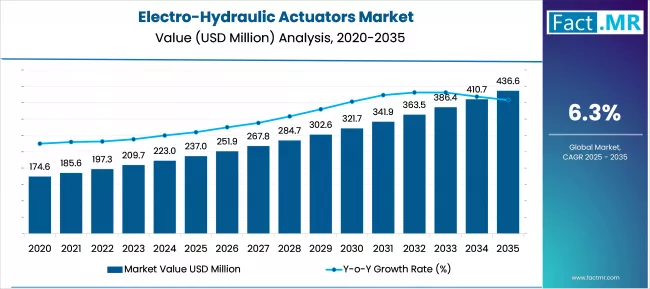
Electro Hydraulic Actuators Market Market Value Analysis | Source: Fact.MR
What are the drivers of the electro-hydraulic actuators market?
The factor which is leading the demand for electro-hydraulic actuators is the trend of industrial automation, which is spreading in various sectors such as manufacturing, oil, and gas, and aerospace. These units offer exact motion control, a high level of force, and energy saving, which makes them perfect for newly automated systems that require stability and can be easily adjusted even in different load conditions.
Another very significant factor, which is also a direct consequence of the rising global energy and climate change crisis, is the increased focus on energy efficiency and environmental sustainability. The electro-hydraulic actuators are more energy-efficient as compared to conventional hydraulic systems as the electric control is used for hydraulic pressure which leads to less energy being wasted and fewer emissions in industrial operations.
Moreover, technological innovations keep on improving actuator performance and reliability, as an example IoT sensors can be integrated with smart control systems. These technologies provide remote monitoring, maintenance on a non-interruptive basis, and better control precision which in turn persuades the industrial sector to use advanced electro-hydraulic actuation systems.
What are the regional trends of the electro-hydraulic actuators market?
The main reasons for the growth of North America is highly advanced industrial automation along with aerospace and defense applications mostly in the United States and Canada. The expansion of the market is being supported by the region's mature infrastructure and a high number of smart technology adoptions.
Strict energy-efficient regulations and a strong automotive and manufacturing sector, mainly in Germany, France, and the UK, are the primary factors that drive the European market. The continuous innovation and sustainability initiatives also significantly contribute to the adoption of these sectors.
Asia-Pacific is leading in the pace of market growth as the first region due to the rapid industrialization, infrastructure development and the trend of increasing automation in China, India, and Southeast Asia. The region's growth is further accelerated by the widening of manufacturing capabilities and the government's push for modernization.
While Latin America, the Middle East, and Africa are moving forward step by step and have the support of increased investments in energy, mining, and infrastructure projects, economic instability and lack of technological infrastructure are factors that limit their fast adoption rate.
What are the challenges and restraining factors of the electro-hydraulic actuators market?
A costly installation and system integration upfront is the primary factor among the significant problems that the electro-hydraulic actuator market faces. These systems require more intricate components and a complicated setup than just electric or pneumatic actuators, so small and medium-sized enterprises may be reluctant to use them even if they are more efficient in the long run.
Additionally, the maintenance difficulties for electro-hydraulic systems are a major factor as these systems combine electrical and hydraulic mechanisms and, therefore, require skilled technicians for servicing. The performance can be affected by fluid leaks, contamination, and pressure loss, so the users endure increased downtime and higher operational costs.
The major limitation of the market is the threat posed by the competition of the alternative actuation technologies which are fully electric actuators, in particular. These alternatives offer cleaner operation, have fewer maintenance requirements, and are more easily integrated with modern automation systems, thereby, becoming the preferred choice of industries that commit to simplicity and sustainability.
Country-Wise Insights
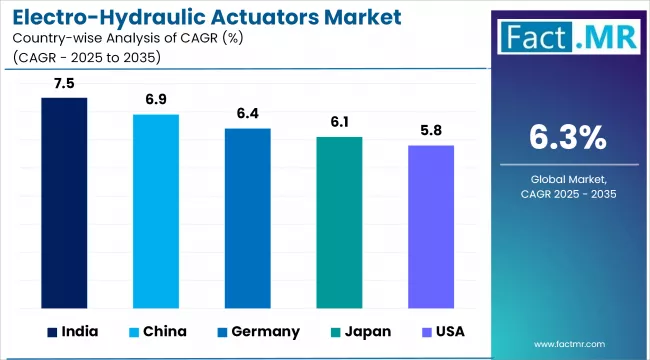
Electro Hydraulic Actuators Market Cagr Analysis By Country | Source: Fact.MR
Technological innovation and industrial automation propel the U.S. electro-hydraulic actuator market
The U.S. market for electro-hydraulic actuators has been expanding continually, the country's advanced manufacturing base being the primary factor. The increased use of automation in the aerospace, defense, and energy sectors, as well as the strong demand for precision motion control systems, are the other reasons that have been contributing to this rise.
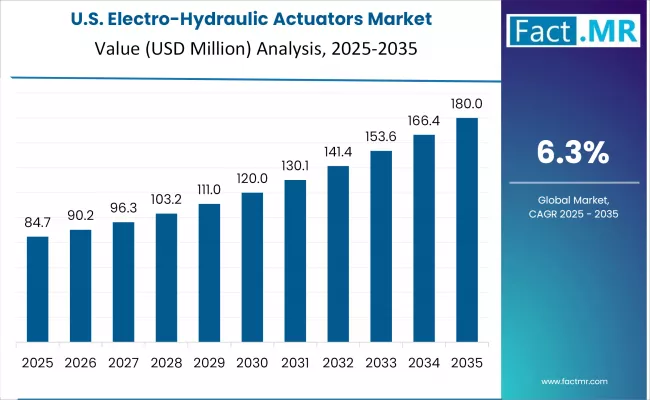
Electro Hydraulic Actuators Market Country Value Analysis | Source: Fact.MR
The heavy investments in infrastructure modernization and smart factories have accelerated the implementation of intelligent electro-hydraulic systems that are more efficient, have less leakage, and are digitally connected. The top American manufacturers are focusing on product development that combines servo control, IoT integration, and predictive maintenance features to increase reliability and performance.
With a strong emphasis on research and development and an increasing number of Industry 4.0 technology users, the U.S. is still the leader in the creation and the earliest adoption of next-gen electro-hydraulic actuators that, among other benefits, increase productivity, safety, and operational efficiency in various industrial sectors.
Rapid industrialization and smart manufacturing initiatives drive China’s electro-hydraulic actuator market
Such factors as massive industrialization, the rise of infrastructure, and the government-supported programs that encourage automation and smart manufacturing are contributing to a notable expansion of China's electro-hydraulic actuator market. High-end actuators that make the systems accurate, reliable, and energy-efficient are the primary demand driving the automotive, construction and heavy machinery sectors of the country.
To keep up with the global Industry 4.0 standards, Chinese manufacturers are progressively turning to sophisticated control technologies, sensor integration, and digital monitoring systems. The continuous infusion of funds into local R&D along with the partnerships between the industrial equipment manufacturers and the tech companies is upgrading the domestic production potential.
Industrial excellence and sustainability goals strengthen Germany’s electro-hydraulic actuator market
Germany's electro-hydraulic actuator market is growing gradually, which is facilitated by the country's robust industrial base, sophisticated engineering capabilities, and a strong emphasis on energy-efficient automation. The requirement for precise, high-performance actuation systems that improve the productivity and reliability of the processes is driven by the presence of the leading manufacturers in automotive, aerospace, and machinery sectors.
German firms are spending a lot of money on R&D to create smart actuators that incorporate sensors, real-time data analytics, and digital control technologies, thus conforming to the country's Industry 4.0 concept. Targets for sustainability as well as strict energy regulations are some of the factors that have led to the usage of electro-hydraulic systems that, while retaining their power, are efficient in terms of energy consumption, thus lowering both emissions and operational costs.
Category-Wise Analysis
Precision control and heavy-load capability boost demand for linear electro-hydraulic actuators
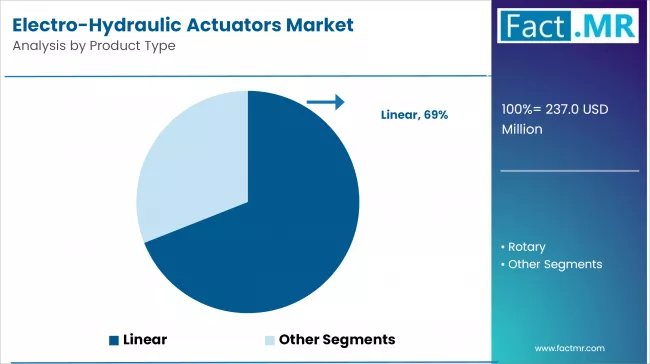
Electro Hydraulic Actuators Market Analysis By Product Type | Source: Fact.MR
The linear electro-hydraulic actuator segment is witnessing an uptrend largely attributed to the segment’s capability of delivering precise one-directional movement along with a high force output in harsh industrial surroundings. Such actuators have been aggressively adopted in the mentioned sectors of the industry, namely aerospace, oil and gas, marine, and heavy machinery, where the utmost reliability and accuracy in control are among the most essential criteria.
The use of hydraulic power combined with electronic precision gives these linear actuators the capability to function efficiently in a high-pressure environment, thereby making them perfect for applications that demand strong positioning yet the requirement for operation to be smooth. Producers are committing resources towards integrating smart sensors, energy-saving hydraulic circuits, and real-time control systems to uplift the performance and cut down on the maintenance costs.
With industries progressively shifting to automation for their operations, electro-hydraulic linear actuators are turning out to be the key enablers of enhanced productivity, precision, and safety, in applications that are of vital importance to the success of the mission
Cost-effectiveness and simplicity drive adoption of open-loop electro-hydraulic actuators
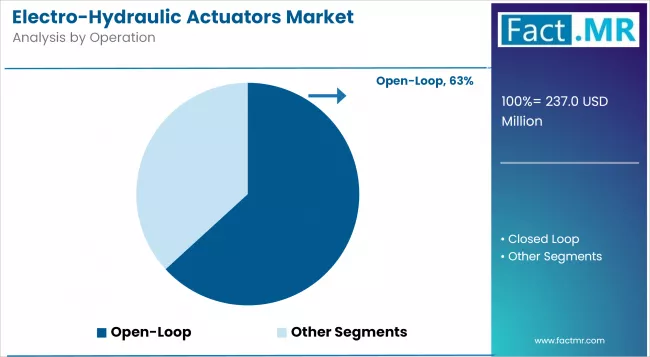
Electro Hydraulic Actuators Market Analysis By Operation | Source: Fact.MR
Open-loop electro-hydraulic actuators are becoming increasingly popular as a result of their simple structure, low price, and the fact that they can easily be incorporated into different industrial systems. Such drives function in the absence of continuous feedback which makes them appropriate for use in situations where exact position control is not necessary but stable performance and reliability are still required.
Inductive processes like building, marine, and heavy equipment production are using open-loop systems more and more because of their ruggedness, less maintenance tasks, and less complicated system features. There is a trend among manufacturers to upgrade these motors to faster operation and lower energy consumption by having better valve designs and more efficient hydraulic circuits.
Operational safety and reliability drive electro-hydraulic actuator adoption in the oil and gas sector
Electro-hydraulic actuators are a top performance choice in harsh and remote areas for the oil and gas industry. These devices are vastly implemented in valve control, drilling, and pipeline management sectors where accurate motion control and fail-safe features are requirements for safety and business continuity. It is their feature to function without external power sources and generate high torque that makes them very attractive for the execution of critical tasks in the field.
Major manufacturers are investing in the development of sophisticated electro-hydraulic actuator units incorporating features such as remote monitoring, predictive maintenance, and explosion-proof enclosures to comply with the safety regulations of the industry.
Consequently, electro-hydraulic actuators are progressively becoming a must in the supply and production sides of the energy sector for the realization of the set goals of automation and downtime reduction thus ensuring efficiency, safety, and reliability.
Competitive Analysis
The market for electro-hydraulic actuators is characterized by intense competition among top manufacturers who are always eager to bring to the market more intelligent, energy-saving, and longer-lasting actuation systems. These companies are improving such features as the system's responsiveness, torque output, and digital control technology integration to be able to meet the requirements of automation and precision engineering that are constantly changing. The incorporation of smart sensors, IoT connectivity, and predictive maintenance functionalities is permitting organizations to set their products apart by performance optimization and lesser downtime.
Such activities as strategic collaborations, mergers, and partnerships between actuator manufacturers, industrial automation firms, and technology providers aimed at broadening product portfolios and consolidating global market standing are becoming more and more frequent. Leading players are thus heavily spending on research and development to come up with the next generation of electro-hydraulic actuators characterized by compact architectures, higher power density, and environmentally friendly hydraulic systems.
Key players in the electro hydraulic actuators market are Emerson Electric Co., Rotex Automation Limited, Rotork, Cowan dynamics, Bosch Rexroth AG, Moog Inc, and others.
Recent Developments
- In June 2025, Power Jacks Launches New POWERAM Linear Actuators for Improved Machine Design. The official launch of POWERAM a new electric linear actuator range designed to enable engineers to quickly and easily automate a manual system, transition to electro-mechanical linear motion from hydraulics and upgrade screw jack systems.
- In May 2025, Rotork supplies actuators for an automated ‘Next Generation’ fully electrified offshore gas platform
Fact.MR has provided detailed information about the price points of key manufacturers of Electro-Hydraulic Actuators Market positioned across regions, sales growth, production capacity, and speculative technological expansion, in the recently published report.
Methodology and Industry Tracking Approach
Global Electro-Hydraulic Actuators Market 2025 report is a long research that taps the insights of over 10210 professionals. These experts come from industrial automation, aerospace, oil and gas, marine, and heavy machinery subsectors. The surveyed sample mainly consists of engineering managers, plant operators, R&D personnel, product designers, system integrators, and regulatory experts who are directly involved in the designing, implementing, and evaluating the advanced actuation systems. The respondents are representatives of the actuator manufacturing companies, industrial automation firms, energy corporations, and research institutions that specialize in motion control and fluid power technologies.
This study will employ a cross-sectional survey design and will also conduct interviews with experts. The work will be done from October 2024 to September 2025. The methodology is centered on the assessment of the adoption, operational efficiency, cost-effectiveness, and performance enhancements of electro-hydraulic actuators in various industrial applications.
With Fact.MR monitoring consumer behavior, product efficacy, industry trends, and market opportunities since 2018, this report is becoming an authoritative source of information that stakeholders can rely on.
Segmentation
Segmentation of Electro-Hydraulic Actuators Market
-
By Product Type :
- Linear
- Rotary
-
By Operation :
- Open-Loop
- Closed Loop
-
By Application :
- Aerospace and Defense
- Oil and Gas
- Construction
- Marine & Offshore
- Others
-
By Region :
- North America
- Latin America
- Western Europe
- Eastern Europe
- East Asia
- South Asia & Pacific
- Middle East & Africa
Frequently Asked Questions
What was the electro-hydraulic actuators market size reported by Fact.MR for 2025?
Who are the major players operating in the electro-hydraulic actuators market?
What is the estimated valuation of the electro-hydraulic actuators market in 2035?
What value CAGR did the electro-hydraulic actuators market exhibit over the last five years?
Who worked on this report


Preview the report firsthand - request a free sample
Free SampleGet the brochure for pricing and purchase details
Download PDF