- Market Value (2025): USD 23.4 Bn
- Estimated Value (2026): USD 25.1Bn
- Forecast Value (2036): USD 49.2 Bn
- CAGR (2026-2036): 7.0%
Electroceutical Devices Market Forecast and Outlook 2026 to 2036
According to the Fact.MR analysis, the electroceutical devices market surpassed a value of USD 23.4 billion in 2025 and is projected to grow from USD 25.1 billion in 2026 to USD 49.2 billion by 2036. Demand for electroceutical devices is likely to grow at a CAGR of 7.0% over the forecast period.
Demand for electroceutical devices is rising as neurostimulation, cardiac rhythm and hearing implants treat chronic conditions without drugs. Suppliers of electroceutical devices are adding closed-loop sensing and rechargeable batteries. For example, in February 2025, the US FDA approved Medtronic's BrainSense adaptive deep brain stimulation for Parkinson's disease. Similar approvals are projected to drive sales of electroceutical devices through 2036.
Key Takeaways from the Electroceutical Devices Market
- Electroceutical Devices Market Value (2025): USD 23.4 billion
- Electroceutical Devices Market Value (2026): USD 25.1 billion
- Electroceutical Devices Market Forecast Value (2036): USD 49.2 billion
- Electroceutical Devices Market Forecast CAGR (2026-2036): 7.0%
- Leading Product Type: Implantable Electroceutical Devices (62.3%)
- Key Market Participants: Medtronic, Boston Scientific Corporation, Abbott Laboratories, LivaNova PLC, Nevro Corp, Biotronik SE & Co. KG
- Key Growth Regions: Germany, Brazil, United States, United Kingdom, Japan
In November 2024, Boston Scientific completed its acquisition of Axonics, adding sacral neuromodulation for bladder and bowel control. Demand for electroceutical devices is growing as large device makers expand neuromodulation portfolios. Suppliers of electroceutical devices are using acquisitions. Similar consolidation is projected to shape sales of electroceutical devices worldwide.
Electroceutical Devices Market
| Metric | Value |
|---|---|
| Estimated Value in (2026) | USD 25.1 billion |
| Forecast Value in (2036) | USD 49.2 billion |
| Forecast CAGR (2026 to 2036) | 7.0% |
Source: Fact.MR analysis. Updated Nov 18, 2026
Source: Fact.MR analysis.
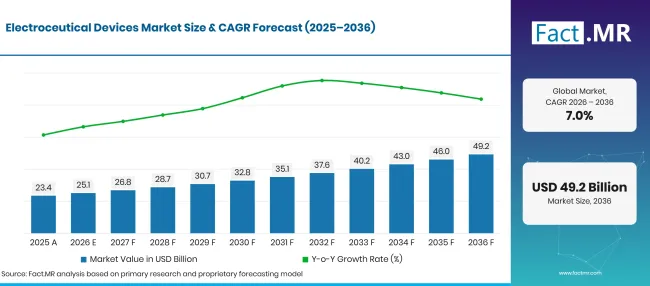
Electroceutical Devices Market Forecast Global | Source: Fact.MR
Category
| Category | Segments |
|---|---|
| Product Type | Implantable Electroceutical Devices, Non-Invasive Electroceutical Devices |
| Application | Cardiovascular Diseases, Neurological Disorders, Pain Management, Others |
| End-User | Hospitals, Ambulatory Surgical Centers, Specialty Clinics, Others |
| Region | Germany; Brazil; United States; United Kingdom; Japan |
Source: Fact.MR analysis. Updated Nov 18, 2026
Source: Fact.MR analysis.
Segmental Analysis
How do implantable devices maintain their lead in product demand?
Electroceutical Devices Market Breakdown Product Type | Source: Fact.MR
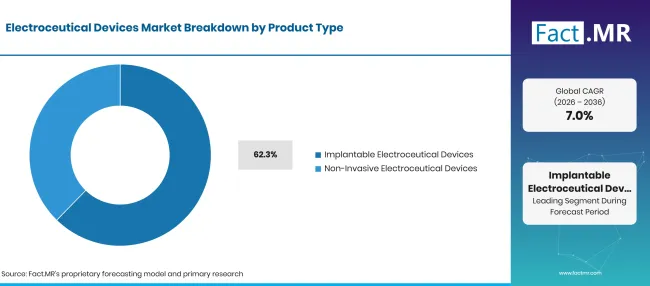
Demand for implantable electroceutical devices represents 62.3% of 2026 revenue, about USD 15.6 billion, as pacemakers, implantable cardioverter defibrillators, spinal cord stimulators and cochlear implants involve higher-value devices and specialized implantation procedures. Hospitals also require associated programming, follow-up and device-management services, supporting sales beyond the initial implant. India's Department of Empowerment of Persons with Disabilities allocated ₹375 crore for the ADIP scheme in FY 2026–27, with a target of providing assistive devices to 2.43 lakh beneficiaries. Its performance framework also tracks access to cochlear implant surgery, demonstrating continued public support for implant-based hearing rehabilitation.
What is sustaining cardiovascular diseases as the leading application?
Electroceutical Devices Market Breakdown Application | Source: Fact.MR
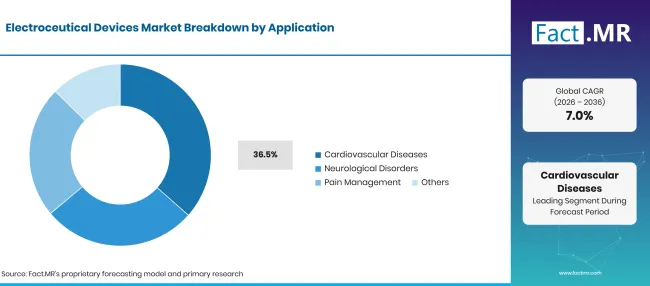
Cardiovascular applications represent 36.5% of 2026 revenue, about USD 9.2 billion, as pacemakers and defibrillators are used to manage rhythm disorders and other cardiac conditions. Demand is supported by the continuing burden of cardiovascular risk factors and the need for long-term rhythm management. India's Ministry of Health and Family Welfare reported that, by February 2026, more than 40.87 crore people had been screened for hypertension, with approximately 7.01 crore diagnosed and 5.57 crore receiving treatment under the national non-communicable disease programme.
Which factors make hospitals the largest end-user segment?
Electroceutical Devices Market Breakdown End User | Source: Fact.MR
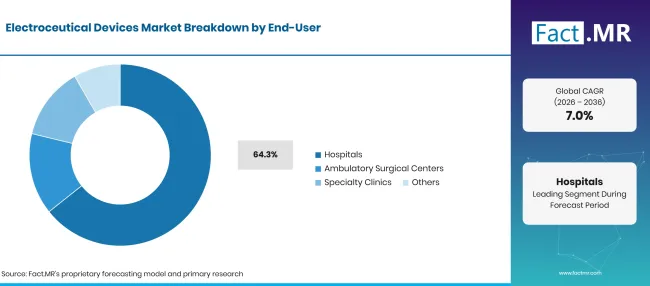
Hospitals account for 64.3% of 2026 revenue, about USD 16.1 billion, because implantable electroceutical procedures require specialist physicians, operating facilities, diagnostic imaging, device programming and post-implant monitoring. Cardiac implants and neuromodulation systems also involve multidisciplinary clinical teams, making hospitals a central purchasing channel. India's Ministry of Health and Family Welfare reported that more than 38,466 public and private hospitals were empanelled under Ayushman Bharat PM-JAY by August 2026, while the scheme had covered 12.69 crore hospitalizations by June 30, 2026. This expanding hospital treatment network provides a broad institutional base for advanced medical-device procurement, including implantable technologies.
Electroceutical Devices Market-Drivers, Restraints & Trends
Drivers: Increasing Adoption of Advanced Neuromodulation
Demand for electroceutical devices is supported by advances in programmable and patient-specific neuromodulation, particularly systems that adjust stimulation parameters to neurological responses. In August 2026, the U.S. FDA cleared Bioventus’ StimTrial Neuromodulation System, a Class II implanted peripheral nerve stimulator for pain relief. The clearance provides a recent example of continued regulatory progress in nerve-stimulation technology. In addition, the Centers for Medicare & Medicaid Services (CMS) reported that approximately 300,000 people in the United States live with spinal cord injury, with around 18,000 new cases annually. This patient population creates a clinical need for technologies that support neurological rehabilitation and pain management.
Restraints: High Treatment Costs and Reimbursement Requirements
High device costs, implantation procedures and reimbursement requirements can limit the adoption of electroceutical devices. CMS's 2026 Medicare coverage manual states that spinal cord stimulation for chronic intractable pain is generally considered only after other treatment options have proved unsatisfactory or unsuitable. It also requires careful patient screening and evaluation by a multidisciplinary team, along with a successful temporary stimulation trial before permanent implantation. These conditions can lengthen the treatment pathway and increase the administrative and clinical burden on providers. Manufacturers therefore need to demonstrate clinical benefit, patient suitability and durable outcomes to support payer coverage.
Opportunity: Expansion of Closed-Loop and Personalized Neuromodulation
Closed-loop neuromodulation offers an opportunity to improve stimulation precision by using sensing and feedback to adjust therapy. The 2026 CMS ICD-10 procedure update considered a new code for transcutaneous spinal cord stimulation using the ExaStim system in patients with incomplete spinal cord injury. CMS describes ExaStim as a portable, non-invasive system with a 16-channel electrode array, independently programmable stimulation electrodes and integrated impedance sensing. Its programming interface allows clinicians to personalize stimulation parameters and monitor therapy use. The document also cites a 128-subject, multicenter randomized controlled trial, with 46 device-related adverse events reported across 1,800 active therapy sessions and no serious device-related adverse events in active subjects. This development illustrates the potential for programmable, sensor-supported and non-invasive neuromodulation to broaden the range of electroceutical applications.
Trend: Portfolio Consolidation and Broader Neuromodulation Platforms
The electroceutical-device industry is seeing strategic portfolio expansion as companies seek to combine complementary neuromodulation technologies, clinical expertise and commercial reach. Boston Scientific's acquisition of Axonics in 2024 and Globus Medical's acquisition of Nevro in 2025 illustrate this consolidation trend. Government evidence also points to continued innovation across the category: the FDA's 2026 Breakthrough Devices Program listings include neuromodulation-related technologies such as Helius Medical's Portable Neuromodulation Stimulator and Wave Neuroscience's MERT System. Together, these developments indicate that companies are competing across a wider range of stimulation technologies and therapeutic applications.
Electroceutical Devices Market by Analysis by Key Country
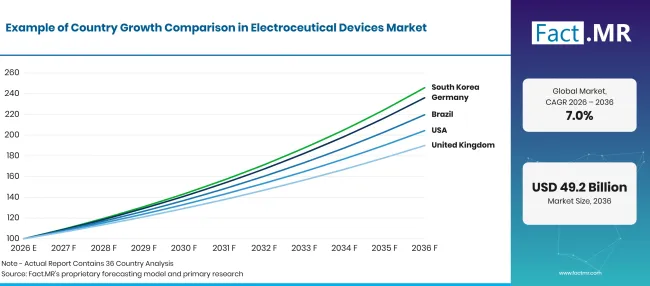
Electroceutical Devices Market Growth Index | Source: Fact.MR
| Country | CAGR (2026-2036) |
|---|---|
| Germany | 9.0% |
| Brazil | 8.2% |
| United States | 7.4% |
| United Kingdom | 6.6% |
| Japan | 5.9% |
Source: Fact.MR analysis. Updated Nov 18, 2026
Source: Fact.MR analysis.
Why is Germany the fastest-growing market for electroceutical devices?
Demand for electroceutical devices in Germany is estimated to rise at a 9.0% CAGR, supported by an aging population and established reimbursement pathways for cardiac implants.
Germany’s Federal Statistical Office reported that 19.3 million people were aged 65 or older in 2025, representing 23% of the population. A 2026 report commissioned by the Federal Joint Committee (G-BA) also identified 353,353 people with at least one pacemaker or defibrillator procedure among statutory health insurance beneficiaries during 2021 through the third quarter of 2024. The concentration of implant procedures among people older than 70 reinforces demand for cardiac rhythm-management devices. Biotronik’s Berlin headquarters adds to Germany’s role as a center for electroceutical-device development and supply.
What is supporting electroceutical device demand in Brazil?
Sales of electroceutical devices in Brazil are projected to represent 8.2% CAGR as a large private healthcare base supports demand for advanced cardiac and neuromodulation services.
Brazil’s National Supplementary Health Agency (ANS) recorded 53.1 million beneficiaries in private medical plans in September 2026, while medical-plan coverage reached 24.9% of the population. The Ministry of Health’s first-quarter 2026 activity report also recorded 758 surgeries at the National Institute of Cardiology between January and March. These figures indicate a substantial insured patient base and continuing cardiac-care activity, supporting opportunities for implantable rhythm-management and stimulation devices.
How are approvals supporting electroceutical device sales in the United States?
Sales of electroceutical devices in the United States are estimated to capture 7.4% CAGR as regulatory clearances expand treatment options across neuromodulation applications.
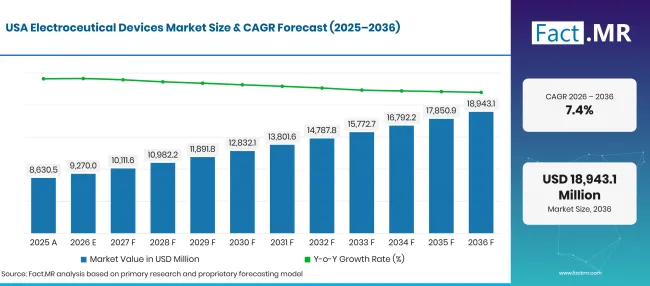
Electroceutical Devices Market Forecast Usa | Source: Fact.MR
In February 2026, the FDA granted 510(k) clearance to the ExaStim stimulation system for improving hand sensation and strength in adults with chronic, non-progressive neurological deficits caused by incomplete spinal cord injury. CMS reported that approximately 300,000 people in the United States live with spinal cord injury, with around 18,000 new cases annually. This patient population and the availability of newly cleared stimulation technologies support demand for devices used in neurological rehabilitation. Medtronic, Boston Scientific and Abbott remain important suppliers across the broader neuromodulation and cardiac-device landscape.
What is shaping electroceutical device demand in the United Kingdom?
Demand for electroceutical devices in the United Kingdom is projected to grow at a 6.6% CAGR, supported by NICE recommendations for spinal cord stimulation in selected patients with persistent neuropathic pain.
NICE recommends the therapy for adults whose pain continues despite at least six months of appropriate conventional treatment and who achieve a successful stimulation trial. However, NHS capacity constraints can delay diagnosis and treatment. The Care Quality Commission’s 2025/26 report recorded an average of 390,000 people waiting more than six weeks for diagnostic tests, while 77.8% received their diagnostic test within six weeks. These pressures can slow patient assessment and access to implant procedures, tempering the pace of device uptake.
Why is electroceutical device growth slower in Japan?
Demand for electroceutical devices in Japan is estimated to record a 5.9% CAGR, as an aging population supports procedure volumes while regulated reimbursement pricing constrains revenue growth.
Japan’s Ministry of Health, Labour and Welfare estimated that people aged 65 or older would account for 30.5% of the population in 2026, equivalent to approximately 36.3 million people. The ministry’s fiscal 2026 medical fee revision also includes updated rules for medical-device reimbursement and designated medical materials, reflecting the government’s continued management of healthcare expenditure. These conditions support the need for pacemakers, neurostimulation systems and other implantable devices, while price controls can limit average selling prices and revenue expansion.
Competitive Landscape for Electroceutical Devices Market
Competition in the electroceutical devices market is shaped by diversified medical technology companies and specialists focused on electrical stimulation and sensory implants. Medtronic, Boston Scientific, Abbott and BIOTRONIK compete across cardiac rhythm management and implantable neuromodulation, while LivaNova focuses on vagus nerve stimulation and other neuromodulation therapies. Cochlear and Sonova (Advanced Bionics) compete in cochlear implant technologies, whereas electroCore differentiates itself through non-invasive vagus nerve stimulation devices. Buyers evaluate manufacturers on clinical evidence, therapeutic effectiveness, device longevity, battery performance, MRI compatibility, programming capabilities and physician support.
From 2025, competition has increasingly centered on closed-loop stimulation, improved sensing capabilities, rechargeable implants and less-invasive treatment options. Medtronic's sensing-enabled neuromodulation platforms and Abbott's programmable stimulation systems reflect the shift toward more personalized therapy delivery. Consolidation has also influenced portfolio competition, with Boston Scientific's acquisition of Axonics strengthening its presence in sacral neuromodulation. Companies combining strong clinical evidence, advanced stimulation technology, broader therapeutic portfolios and long-term patient support are better positioned to strengthen their market presence.
Recent Developments
- In February 2025, the FDA approved Medtronic's BrainSense adaptive deep brain stimulation.
- In November 2024, Boston Scientific completed its acquisition of Axonics.
- In April 2024, the FDA approved Medtronic's Inceptiv closed-loop spinal cord stimulator.
- In 2025, Globus Medical agreed to acquire Nevro.
Key Players in Electroceutical Devices Market
Key companies operating in the market include Medtronic plc, Boston Scientific Corporation, Abbott Laboratories, LivaNova PLC, BIOTRONIK SE & Co. KG, Cochlear Limited, Sonova Holding AG (Advanced Bionics), and ElectroCore Inc.
- Medtronic plc
- Boston Scientific Corporation
- Abbott Laboratories
- LivaNova PLC
- BIOTRONIK SE & Co. KG
- Cochlear Limited
- Sonova Holding AG (Advanced Bionics)
- ElectroCore Inc.
Bibliography
- Boston Scientific Corporation. (2024, November 15). Boston Scientific closes acquisition of Axonics, Inc.
- Centers for Medicare & Medicaid Services. (2026). Fall 2026 ICD-10-PCS update materials.
- Care Quality Commission. (2026). State of care 2025/26: Hospitals.
- Checkpoint Surgical, Inc. (2026, August 20). Checkpoint Surgical expands peripheral nerve portfolio with new flexible nerve conduit.
- Federal Joint Committee (Gemeinsamer Bundesausschuss). (n.d.). Gemeinsamer Bundesausschuss.
- Federal Statistical Office of Germany (Destatis). (n.d.). Population aged 65 and over.
- Medtronic plc. (2024, April 26). Medtronic receives FDA approval for Inceptiv™ closed-loop spinal cord stimulator.
- Ministry of Health, Labour and Welfare, Japan. (n.d.). Health and medical care policy information.
- Ministry of Health, Labour and Welfare, Japan. (n.d.). Medical care and healthcare policy information.
- Ministry of Health, Labour and Welfare, Japan. (n.d.). Healthcare policy-related document [PDF].
- Ministry of Health, Brazil. (2026). 1st quarterly accountability report 2026 [PDF].
- National Agency for Supplementary Health (ANS), Brazil. (n.d.). General data on the supplementary health sector.
- National Agency for Supplementary Health (ANS), Brazil. (n.d.). ANS releases September beneficiary figures.
- National Institute for Health and Care Excellence. (2008). Spinal cord stimulation for chronic pain of neuropathic or ischaemic origin (Technology Appraisal Guidance TA159).
- U.S. Food and Drug Administration. (2025, February 20). Premarket approval supplement: Activa®, Percept™ and SenSight™ deep brain stimulation therapy system (P960009/S478).
- U.S. Food and Drug Administration. (n.d.). 510(k) premarket notification: K252893.
- U.S. Food and Drug Administration. (n.d.). Premarket approval database.
- Department of Empowerment of Persons with Disabilities, Government of India. (n.d.). Assistance to persons with disabilities for purchase/fitting of aids and appliances (ADIP Scheme).
- Press Information Bureau, Government of India. (2026). National programme for prevention and control of non-communicable diseases: Hypertension screening and treatment update.
- Press Information Bureau, Government of India. (2026). Ayushman Bharat Pradhan Mantri Jan Arogya Yojana: Hospitalization and coverage update.
- Central Government Health Scheme. (2026, November 9). Revised guidelines for cochlear implantation and rehabilitation [PDF].
Segmentation
Scope of Report
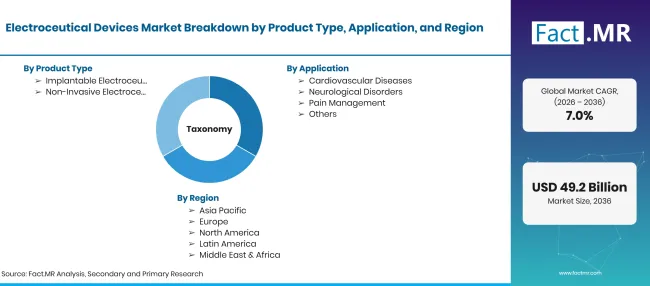
Electroceutical Devices Market Taxonomy | Source: Fact.MR
| Items | Values |
|---|---|
| Quantitative Units (2026) | USD 25.08 Billion |
| Product Type | Implantable Electroceutical Devices, Non-Invasive Electroceutical Devices |
| Application | Cardiovascular Diseases, Neurological Disorders, Pain Management, Others |
| End-User | Hospitals, Ambulatory Surgical Centers, Specialty Clinics, Others |
| Regions Covered | North America, Latin America, Europe, East Asia, South Asia and Pacific, Middle East & Africa |
| Countries Covered | United States, Germany, Japan, United Kingdom, Brazil, and other countries |
| Key Companies Profiled | Medtronic plc; Boston Scientific Corporation; Abbott Laboratories; LivaNova PLC; BIOTRONIK SE & Co. KG; Cochlear Limited; Sonova Holding AG (Advanced Bionics); ElectroCore Inc. |
| Additional Attributes | Dollar revenue in the Electroceutical Devices Market is segmented by product type (implantable electroceutical devices, non-invasive electroceutical devices); application (cardiovascular diseases, neurological disorders, pain management); end-user (hospitals, ambulatory surgical centers, specialty clinics) and region. |
Source: Fact.MR analysis. Updated Nov 18, 2026
Electroceutical Devices Market by Segments
-
Product Type
- Implantable Electroceutical Devices
- Non-Invasive Electroceutical Devices
-
Application
- Cardiovascular Diseases
- Neurological Disorders
- Pain Management
- Others
-
End-User
- Hospitals
- Ambulatory Surgical Centers
- Specialty Clinics
- Others
-
Region:
- North America
- United States
- Canada
- Mexico
- Europe
- Germany
- United Kingdom
- France
- Italy
- Spain
- Rest of Europe
- Asia Pacific
- China
- India
- Japan
- South Korea
- Australia
- Rest of Asia Pacific
- Latin America
- Brazil
- Mexico
- Argentina
- Rest of Latin America
- Middle East & Africa
- GCC Countries
- South Africa
- Rest of Middle East & Africa
- North America
Frequently Asked Questions
How big is the global Electroceutical Devices Market in 2026?
What will be the size of the Electroceutical Devices Market by 2036?
How fast will the Electroceutical Devices Market grow during the forecast period?
Which product type segment holds the largest share of the Electroceutical Devices Market?
Who worked on this report


Preview the report firsthand - request a free sample
Free SampleGet the brochure for pricing and purchase details
Download PDF