- Market Value (2025): USD 176.4 Mn
- Estimated Value (2026): USD 195.1 Mn
- Forecast Value (2036): USD 535.3 Mn
- CAGR (2026-2036): 10.6%
Hair-Health Diagnostic Devices Market Forecast and Outlook 2026 to 2036
As per Fact.MR analysis, the global hair-health diagnostic devices market was valued at USD 176.4 million in 2025 and is estimated to reach USD 195.1 million in 2026. The market is projected to grow to USD 535.3 million by 2036, expanding at a CAGR of 10.6% from 2026 to 2036.
Sales of hair-health diagnostic devices are increasing as consumers, dermatologists and hair-care professionals seek more objective methods to evaluate scalp conditions, hair density, follicular health and hair-loss progression. Demand is supported by the growing adoption of digital trichoscopy, scalp imaging systems and AI-assisted follicle assessment technologies. These devices allow professionals to examine scalp conditions, compare hair density and monitor changes across multiple consultations. Increasing consumer interest in personalized hair-care treatments is also encouraging clinics, diagnostic laboratories and specialist retailers to adopt digital hair-analysis equipment. Manufacturers are focusing on high-resolution imaging, automated analysis and longitudinal monitoring capabilities to improve diagnostic efficiency and strengthen product adoption.
Key Takeaways from the Hair-Health Diagnostic Devices Market
- Hair-Health Diagnostic Devices Market Value (2025): USD 176.4 million
- Hair-Health Diagnostic Devices Market Value (2026): USD 195.1 million
- Hair-Health Diagnostic Devices Market Forecast Value (2036): USD 535.3 million
- Hair-Health Diagnostic Devices Market Forecast CAGR (2026–2036): 10.6%
- Leading Hair Diagnostic Imaging Segment: Trichoscopy (28.3%)
- Leading Sample / Examination Segment: Imaging / optical (23.4%)
- Leading Testing Location: Independent laboratory (31.4%)
- Leading Result Delivery Segment: Longitudinal tracking (33.6%)
- Key Market Participants: TrichoLAB, Canfield Scientific, FotoFinder Systems GmbH, DermoScan GmbH / Tricholog GmbH, Kérastase (L'Oréal Group), Aram Huvis Co., Ltd. and Becon Co., Ltd.
- Key Growth Regions: United States, China, Japan, Germany and South Korea
Demand for advanced hair and scalp assessment technologies is increasing as consumers seek more reliable information before selecting hair-loss treatments and scalp-care products. Trichoscopy accounts for 28.3% of hair diagnostic imaging demand, while longitudinal tracking represents 33.6% of result delivery demand in 2026. These segments reflect the importance of visual scalp assessment and repeated measurements in monitoring hair-health changes. Independent laboratories and specialist diagnostic facilities are also creating opportunities for equipment providers by offering structured hair and scalp examination services. Manufacturers are increasingly incorporating digital imaging, automated follicle measurements and software-based reporting to improve the accessibility of hair-health assessments.
Hair-Health Diagnostic Devices Market
| Metric | Value |
|---|---|
| Estimated Value (2026) | USD 195.1 million |
| Forecast Value (2036) | USD 535.3 million |
| Forecast CAGR (2026–2036) | 10.6% |
Source: Fact.MR analysis. Updated Nov 18, 2026
Source: Fact.MR analysis. Category
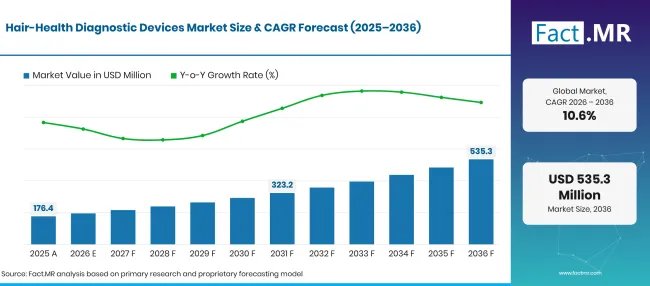
Hair Health Diagnostic Devices Market Forecast Global | Source: Fact.MR
Category
| Category | Segments |
|---|---|
| Hair Diagnostic Imaging | Trichoscopy, Scalp spectral imaging, Follicle density AI, Hair-shaft microscopy, Scalp biochemical analysis |
| Sample / Examination | Imaging / optical, Saliva / buccal, Urine, Blood, Multi-source panel |
| Testing Location | Independent laboratory, Retail diagnostics, At-home self-test, Hospital / clinic, Mobile screening |
| Result Delivery | Longitudinal tracking, Single test report, Clinician interpretation, AI decision support, Integrated wellness plan |
| Region | United States, China, Japan, Germany, South Korea |
Source: Fact.MR analysis. Updated Nov 18, 2026
Source: Fact.MR analysis.
Segmental Analysis
Why does trichoscopy lead demand in the Hair-Health Diagnostic Devices Market?
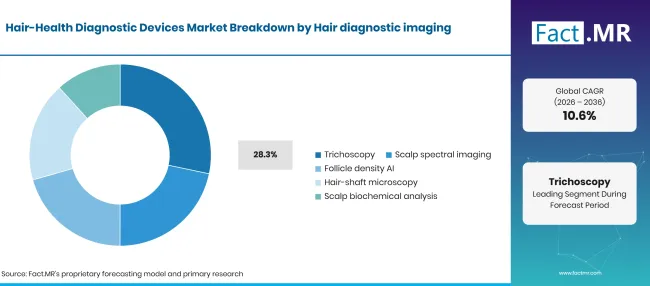
Hair Health Diagnostic Devices Market Breakdown Hair Diagnostic Imaging | Source: Fact.MR
Sales of trichoscopy-based hair diagnostic devices are increasing as dermatologists and hair-care specialists seek detailed visualization of scalp conditions and follicular structures. The trichoscopy segment holds 28.3% of hair diagnostic imaging demand in 2026, about USD 55.21 million. These systems use magnified imaging to examine hair shafts, follicular openings, scalp conditions and variations in hair density. The technology can help professionals distinguish between different patterns of hair loss and evaluate changes during treatment. Digital trichoscopy also supports image documentation and comparisons across consultations, making it relevant for longitudinal patient assessment. India's Ministry of Health and Family Welfare reported 86,360 postgraduate medical seats for academic year 2025–26 and an estimated doctor-population ratio of 1:778 in July 2026, reflecting the expansion of the country's medical workforce. These national workforce figures describe general healthcare capacity. Trichoscopy demand is more directly linked to specialist dermatology consultations and digital scalp-imaging examinations. Manufacturers are focusing on high-resolution imaging, automated measurements and software-supported examination to expand adoption across dermatology clinics and specialist hair-care centers.
How is hair-shaft microscopy supporting demand for hair diagnostic imaging devices?
Demand for hair-shaft microscopy devices is supported by the need to examine structural characteristics of individual hair fibers and identify visible changes associated with hair damage. This segment represents 23.2% of hair diagnostic imaging demand in 2026, about USD 45.26 million. Microscopic examination allows professionals to evaluate hair-shaft structure, surface irregularities and variations in fiber condition. These assessments can support consultations involving hair breakage, dryness and damage-related concerns. Adoption is particularly relevant among specialist hair clinics, cosmetic laboratories and research facilities that require closer examination than conventional scalp photography can provide. India's Pradhan Mantri Ayushman Bharat Health Infrastructure Mission is establishing 744 integrated public health laboratories across districts, reflecting broader investment in diagnostic infrastructure. The public health laboratory program reflects wider diagnostic infrastructure investment, but it does not measure installations or sales of hair-shaft microscopy devices.
What is driving demand for imaging and optical examination technologies?
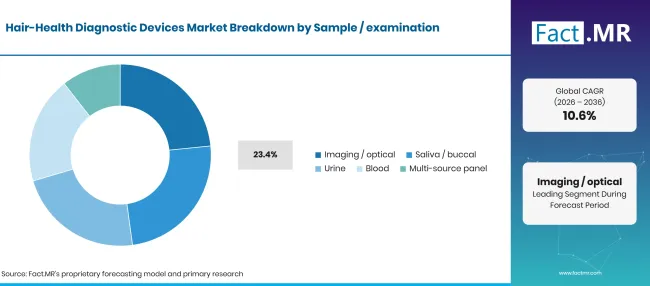
Hair Health Diagnostic Devices Market Breakdown Sample Examination | Source: Fact.MR
Sales of imaging and optical examination systems are gaining momentum as consumers and professionals increasingly prefer visual assessment methods for evaluating hair and scalp conditions. This segment accounts for 23.4% of sample and examination demand in 2026, about USD 45.65 million. Optical examination enables the capture of scalp images and hair characteristics without requiring invasive sampling. Digital imaging can also support the documentation of hair density, scalp appearance and treatment-related changes. According to the Ministry of Health and Family Welfare, more than 110 crore health records had been linked with ABHA by August 12, 2026, while over 5.47 lakh health facilities and 10.50 lakh healthcare professionals were registered under ABDM. This expanding digital health infrastructure supports the wider adoption of technology-enabled healthcare services and creates a favorable environment for software-integrated diagnostic imaging solutions.
Why are independent laboratories gaining importance in hair-health diagnostics?
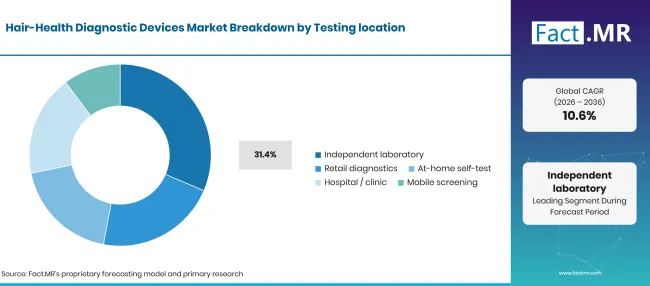
Hair Health Diagnostic Devices Market Breakdown Testing Location | Source: Fact.MR
Demand for independent laboratory-based hair-health diagnostic services represents 31.4% of testing location revenue in 2026, about USD 61.26 million. Adoption is supported by consumer interest in structured hair-health assessments and the availability of specialized testing services outside conventional hospital settings. Independent laboratories can offer dedicated examination facilities, standardized sample handling and organized reporting workflows. Their role is relevant for consumers seeking additional information about hair and scalp conditions before consulting dermatologists or selecting treatment options. India had 2,248 NABL-accredited medical laboratories according to the Department for Promotion of Industry and Internal Trade's 2025–26 annual report, highlighting the established base of accredited laboratory infrastructure. In addition, the Ministry of Health and Family Welfare reported that 4,76,712 healthcare facilities were registered under the Ayushman Bharat Digital Mission as of March 9, 2026. These developments support the broader availability of organized diagnostic services and digital healthcare infrastructure. Diagnostic equipment providers can benefit from this environment by supplying imaging systems, examination instruments and digital reporting solutions. Expansion of specialist testing services is expected to support sales of hair-health diagnostic devices among independent laboratories.
How is longitudinal tracking shaping result delivery demand?
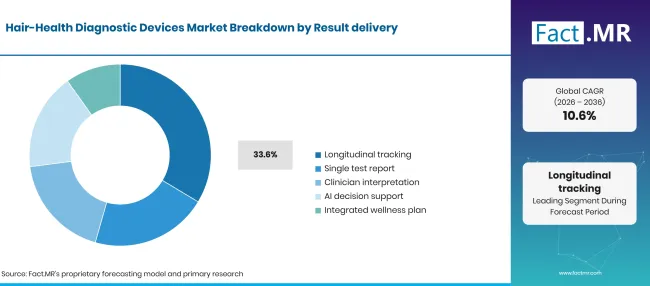
Hair Health Diagnostic Devices Market Breakdown Result Delivery | Source: Fact.MR
Sales of hair-health diagnostic devices with longitudinal tracking capabilities are increasing as professionals and consumers seek to monitor changes in hair density and scalp conditions over extended periods. Longitudinal tracking represents 33.6% of result delivery demand in 2026, equivalent to approximately USD 65.55 million. Repeated image capture and comparison can help identify changes in hair growth patterns and evaluate responses to hair-care interventions. This approach is particularly relevant for individuals experiencing progressive hair thinning or undergoing ongoing treatment. Digital platforms that store examination records and organize previous results can improve continuity between consultations. Manufacturers are incorporating image comparison, historical records and automated reporting to encourage repeat usage and strengthen demand for connected hair-health diagnostic systems.
Hair-Health Diagnostic Devices Market – Drivers, Restraints & Trends
Drivers – Rising demand for objective hair-loss assessment
Demand for hair-health diagnostic devices is increasing as consumers seek more reliable assessments of hair thinning, scalp conditions and follicular health. Dermatologists and trichologists are adopting digital imaging systems to examine scalp characteristics and document hair-density changes. Trichoscopy and follicle-analysis technologies can provide magnified images that support the evaluation of different hair-loss patterns. FotoFinder Systems and Canfield Scientific offer imaging and documentation technologies relevant to dermatological assessment. Wider adoption of digital examination systems is expected to support sales of hair-health diagnostic devices across dermatology clinics and specialist hair-care centers.
Restraints – High equipment costs and diagnostic standardization
Sales of hair-health diagnostic devices can be constrained by the cost of advanced imaging equipment, software licensing, maintenance and professional training. High-resolution imaging systems and AI-assisted analysis platforms require investment in hardware and supporting digital infrastructure. Differences in image capture conditions, magnification, scalp preparation and interpretation can also affect measurement consistency. Smaller clinics and independent hair-care professionals may face difficulties justifying equipment expenditure when consultation volumes are limited. Manufacturers need to improve affordability, simplify operating procedures and establish consistent examination protocols to encourage broader adoption.
Opportunity – AI-assisted follicle assessment and personalized hair-care services
Adoption of AI-supported hair diagnostic systems is creating opportunities for manufacturers to automate hair-density measurements and improve the interpretation of scalp images. Automated follicle identification, image comparison and digital reporting can help professionals assess changes more efficiently across repeat examinations. Increasing consumer interest in personalized hair-care routines is also encouraging specialist retailers and clinics to introduce digital scalp-assessment services. Companies developing integrated imaging and analytics platforms can benefit from demand for more accessible hair-health evaluations. These developments are expected to create additional sales opportunities for AI-enabled diagnostic devices.
Trend – Longitudinal scalp monitoring and connected diagnostic platforms
Demand for longitudinal monitoring is increasing as consumers and clinicians seek to evaluate hair-health changes over multiple consultations rather than relying on a single examination. Digital imaging platforms can maintain historical records, compare scalp photographs and document changes in hair density. Integration with cloud-based software and AI-supported reporting can improve access to examination results and support communication between professionals and consumers. Diagnostic technology providers are increasingly focusing on connected imaging systems and organized patient records to strengthen repeat usage. This trend is expected to support adoption of hair-health diagnostic devices across clinical and consumer-facing applications.
Hair-Health Diagnostic Devices Market Analysis by Key Country
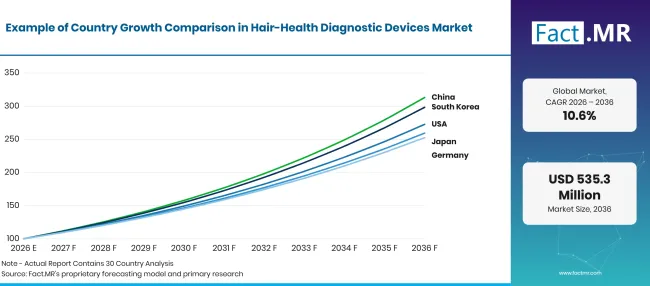
Hair Health Diagnostic Devices Market Growth Index | Source: Fact.MR
| Country | CAGR (2026–2036) |
|---|---|
| China | 12.1% |
| South Korea | 11.6% |
| United States | 10.6% |
| Japan | 10.0% |
| Germany | 9.7% |
Source: Fact.MR analysis. Updated Nov 18, 2026
Source: Fact.MR analysis.
What is accelerating hair-health diagnostic device demand in the United States?
Demand and sales of hair-health diagnostic devices in the United States are estimated to hold CAGR of 10.6% through 2036.
Adoption is supported by the established dermatology sector, growing consumer interest in hair restoration and increasing demand for personalized scalp-care assessments. Dermatology clinics and specialist hair-restoration providers are using digital imaging to document scalp conditions and evaluate changes in hair density. Canfield Scientific offers the FotoFinder and related imaging technology ecosystem for dermatological documentation and analysis, while specialized hair-analysis providers are developing solutions for follicular assessment. Growing interest in evidence-based hair-care consultations is expected to support sales of digital trichoscopy systems, scalp imaging equipment and AI-assisted diagnostic platforms.
How is China's beauty technology sector expanding the hair-health diagnostics market?
Sales of hair-health diagnostic devices in China are estimated to increase at a CAGR of 12.1% through 2036, making it the fastest-growing country among the five key markets.
Adoption is gaining momentum from the country's large beauty and personal-care market, expanding digital retail ecosystem and growing consumer interest in scalp-health management. According to China's National Bureau of Statistics, retail sales of cosmetics reached CNY 349.1 billion during January–September 2026, registering 6.1% year-over-year growth. In addition, online retail sales of goods and services reached CNY 16.98 trillion during January–October 2026, increasing 3.7% year over year, while online service sales grew by 5.0%. Hair-care brands and specialist service providers can use imaging-based diagnostic equipment to offer personalized scalp assessments and product recommendations. Aram Huvis, a South Korean beauty diagnostic technology provider with an established presence in Asian markets, offers scalp and skin analysis systems that demonstrate the commercial relevance of digital beauty diagnostics. Increasing availability of technology-enabled hair-care consultations is expected to support sales through beauty retailers, specialist clinics and online-connected diagnostic services in China.
Why is South Korea becoming an important market for hair-health diagnostic devices?
Adoption of hair-health diagnostic devices in South Korea are forecast to grow at a CAGR of 11.6% through 2036.
Demand is supported by the country's established beauty technology industry and consumer interest in personalized scalp and hair-care solutions. South Korea's Ministry of Finance and Economy reported that K-beauty exports reached USD 3.1 billion in the first quarter of 2026. The Ministry of Food and Drug Safety also reported that hair-care product exports reached approximately USD 590 million in 2025, as part of its May 2026 industry statistics. Beauty clinics, professional hair-care centers and cosmetic retailers are adopting digital assessment technologies to provide more detailed evaluations of scalp conditions. Aram Huvis and Becon are relevant participants in the development of digital skin and scalp analysis technologies. Integration of imaging equipment with software-based assessments can help service providers deliver more consistent consultations and recommend targeted hair-care products. Continued adoption of technology-enabled beauty services is expected to strengthen sales of hair-health diagnostic devices across professional and retail channels.
What is supporting the adoption of hair-health diagnostic devices in Japan?
Demand for hair-health diagnostic devices in Japan is projected to expand at a CAGR of 10.0% through 2036.
Adoption is supported by interest in advanced personal-care technologies, scalp-health assessment and precision-based hair-care services. Consumers are increasingly seeking personalized solutions for hair thinning, scalp conditions and changes in hair quality. Digital imaging systems can help specialist providers examine scalp characteristics and maintain records of treatment-related changes. Kérastase, part of L'Oréal Group, participates in the professional hair-care ecosystem through its diagnostic-led consultation and personalized product recommendation approach. Growing integration of digital scalp assessments with professional hair-care services is expected to create opportunities for imaging and analysis equipment providers in Japan.
How are Germany's dermatology and medical imaging capabilities supporting market demand?
Germany's hair-health diagnostic devices market is projected to register a CAGR of 9.7% through 2036.
Demand is supported by the country's established medical technology industry, dermatology services and professional interest in structured scalp examination. Dermatologists and hair-restoration specialists require imaging equipment that can document scalp conditions and monitor changes in hair density across consultations. FotoFinder Systems GmbH and DermoScan GmbH / Tricholog GmbH are relevant participants in the German dermatological imaging and hair-analysis ecosystem. Their technology focus reflects the importance of digital documentation and specialized examination in professional hair-health assessment. Wider adoption of image-based diagnostic workflows is expected to support sales across dermatology clinics, hair-restoration centers and specialist diagnostic facilities.
Competitive Landscape for Hair-Health Diagnostic Devices Market
Competition in the hair-health diagnostic devices market includes specialized trichoscopy providers, dermatological imaging companies, digital scalp-analysis technology developers and established beauty-care brands. TrichoLAB participates in specialized hair and scalp analysis, while Canfield Scientific and FotoFinder Systems GmbH are associated with professional imaging and dermatological documentation technologies. DermoScan GmbH / Tricholog GmbH represents the specialized hair-analysis segment, with an emphasis on professional examination and digital assessment. Aram Huvis Co., Ltd. and Becon Co., Ltd. contribute through beauty diagnostic and skin or scalp analysis technologies. Kérastase, part of L'Oréal Group, occupies a different position through professional hair-care services and diagnostic-led consumer engagement.
Competition is increasingly shaped by imaging accuracy, automated hair-density assessment, software capabilities and the ability to provide consistent results across repeat examinations. Specialized diagnostic equipment providers are focusing on high-resolution scalp imaging, follicle visualization and digital documentation, while beauty technology companies are expanding the use of diagnostic equipment in retail and professional hair-care environments. Companies that combine reliable imaging, accessible software and practical examination workflows are positioned to capture opportunities across dermatology, hair restoration and personalized beauty services.
Recent Developments
- In April 2026, Becon introduced melanin and keratin analysis features using its 20x optical scanner, expanding AI-powered skin assessments and supporting more detailed evaluation of cosmetic conditions through its digital diagnostic platform.
- In June 2026, L'Oréal unveiled Kérastase K-SPA at VivaTech, integrating its K-SCAN AI-powered scalp diagnostic camera with K-STATION treatment technology to provide personalized scalp assessments and salon-based haircare services worldwide.
Key Players in Hair-Health Diagnostic Devices Market
Key companies profiled include TrichoLAB; Canfield Scientific; FotoFinder Systems GmbH; DermoScan GmbH / Tricholog GmbH; Kérastase (L'Oréal Group); Aram Huvis Co., Ltd.; and Becon Co., Ltd.
- TrichoLAB
- Canfield Scientific
- FotoFinder Systems GmbH
- DermoScan GmbH / Tricholog GmbH
- Kérastase (L'Oréal Group)
- Aram Huvis Co., Ltd.
- Becon Co., Ltd.
Bibliography
- Becon. (2026, April 1). Melanin & keratin analysis launched! Official product update
- Department for Promotion of Industry and Internal Trade. (2026, March 25). Annual report 2025–26. Government of India.
- L'Oréal Groupe. (2026, June 11). L'Oréal unveils the future of beauty at its VivaTech 2026 Beauty Odyssey. Official press release
- Lok Sabha Secretariat. (2026, March 13). Ayushman Bharat Digital Mission statistics (Lok Sabha Unstarred Question No. 308). Parliament of India.
- Ministry of Finance and Economy. (2026, May 28). DPM Koo Yun Cheol holds meeting with K-Beauty tech companies. Government of the Republic of Korea.
- Ministry of Food and Drug Safety. (2026, May 22). 2025 cosmetics production and export/import performance [Press release]. Government of the Republic of Korea.
- Ministry of Health and Family Welfare. (2026, July 24). MBBS seats increase to 1.29 lakh, PG seats nearly triple to 86,360 between AY 2023–24 and AY 2025–26. Press Information Bureau, Government of India.
- National Bureau of Statistics of China. (2026, October 20). Total retail sales of consumer goods from January to September 2026.
- National Bureau of Statistics of China. (2026, November 16). National economy was generally stable with innovation-led and high-quality development in October.
- National Data Agency. (2026, November 2). 2026[September 2026 online shopping trends and third-quarter overseas direct sales and purchases]. Government of the Republic of Korea.
- Press Information Bureau. (2026, July 6). Ayushman Bharat Digital Mission: India’s digital health backbone. Government of India.
- Press Information Bureau. (2026, August 12). Affordable and accessible healthcare for all. Government of India.
- Press Information Bureau. (2026, August 12). Healthcare infrastructure and Ayushman Bharat statistics [Factsheet]. Government of India.
- Press Information Bureau. (2026, October 6). E-Sanjeevani crosses 50 crore teleconsultations, strengthening access to healthcare across the country. Ministry of Health and Family Welfare, Government of India.
Segmentation
Scope of Report
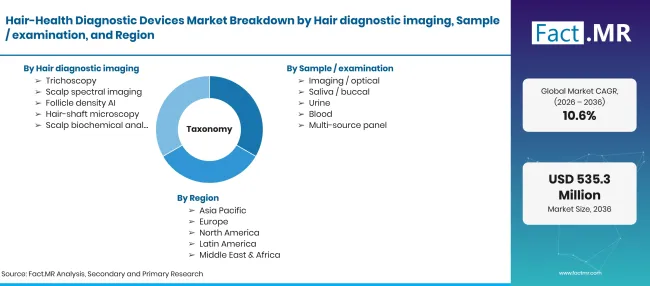
Hair Health Diagnostic Devices Market Taxonomy | Source: Fact.MR
| Items | Values |
|---|---|
| Quantitative Units (2026) | USD 195.1 million |
| Hair Diagnostic Imaging | Trichoscopy, Scalp spectral imaging, Follicle density AI, Hair-shaft microscopy, Scalp biochemical analysis |
| Sample / Examination | Imaging / optical, Saliva / buccal, Urine, Blood, Multi-source panel |
| Testing Location | Independent laboratory, Retail diagnostics, At-home self-test, Hospital / clinic, Mobile screening |
| Result Delivery | Longitudinal tracking, Single test report, Clinician interpretation, AI decision support, Integrated wellness plan |
| Regions Covered | North America, Latin America, Europe, East Asia, South Asia and Pacific, Middle East & Africa |
| Countries Covered | United States, China, Japan, Germany, South Korea and other countries |
| Key Companies Profiled | TrichoLAB, Canfield Scientific, FotoFinder Systems GmbH, DermoScan GmbH / Tricholog GmbH, Kérastase (L'Oréal Group), Aram Huvis Co., Ltd. and Becon Co., Ltd. |
| Additional Attributes | Dollar revenue in the hair-health diagnostic devices market is segmented by hair diagnostic imaging, sample / examination, testing location, result delivery and region. |
Source: Fact.MR analysis. Updated Nov 18, 2026
Hair-Health Diagnostic Devices Market by Segments
-
Hair Diagnostic Imaging
- Trichoscopy
- Scalp Spectral Imaging
- AI-Based Follicle Density Analysis
- Hair-Shaft Microscopy
- Scalp Biochemical Analysis
-
Sample / Examination
- Imaging / Optical Examination
- Saliva / Buccal Testing
- Urine Testing
- Blood Testing
- Multi-Source Diagnostic Panels
-
Testing Location
- Independent Diagnostic Laboratories
- Retail Diagnostic Centers
- At-Home Testing
- Hospitals / Clinics
- Mobile Screening Centers
-
Result Delivery
- Longitudinal Hair-Health Tracking
- Single-Test Reports
- Clinician Interpretation
- AI-Based Decision Support
- Integrated Hair-Wellness Plans
-
Region:
- North America
- United States
- Canada
- Mexico
- Europe
- Germany
- United Kingdom
- France
- Italy
- Spain
- Rest of Europe
- East Asia
- China
- Japan
- South Korea
- Rest of East Asia
- South Asia & Pacific
- India
- Australia
- Rest of South Asia & Pacific
- Latin America
- Brazil
- Mexico
- Argentina
- Rest of Latin America
- Middle East & Africa
- GCC Countries
- South Africa
- Rest of Middle East & Africa
- North America
Frequently Asked Questions
How big is the global Hair-Health Diagnostic Devices Market in 2026?
What will be the size of the Hair-Health Diagnostic Devices Market by 2036?
How fast will the Hair-Health Diagnostic Devices Market grow during the forecast period?
Which hair diagnostic imaging segment holds the largest market share?
Which testing location segment leads the Hair-Health Diagnostic Devices Market?
Which country is expected to experience the fastest growth in the Hair-Health Diagnostic Devices Market?
Who are the key companies operating in the Hair-Health Diagnostic Devices Market?
Who worked on this report


Preview the report firsthand - request a free sample
Free SampleGet the brochure for pricing and purchase details
Download PDF