- Market Value (2025): USD 5.51 Bn
- Estimated Value (2026): USD 30.1 Bn
- Forecast Value (2036): USD 6.43 Bn
- CAGR (2026-2036): 16.7%
What is the Embedded System for Electric Vehicle Market forecast to be worth by 2036?
USD 6.43 billion in 2026 to USD 30.1 billion by 2036, at a 16.7% CAGR.
- As per Fact.MR analysis, the embedded system for electric vehicle market reached USD 5.51 billion in 2025.
- The market is projected to reach USD 30.1 billion by 2036 as battery and powertrain control tasks become more software-intensive.
- The market is forecast to record a 16.7% CAGR from 2026 to 2036, reflecting wider use of processors, sensor connections and control software in electric vehicles.
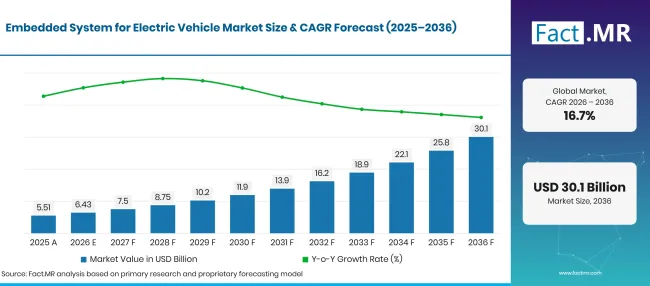
Factmr Embedded System For Electric Vehicle Market Forecast Global | Source: Fact.MR
| Year | Basis | Market Value (USD billion) |
|---|---|---|
| 2026 | Estimate | 6.43 |
| 2036 | Forecast | 30.1 |
| CAGR 2026 to 2036 | Forecast period | 16.7% |
Source: Fact.MR analysis. Updated Oct 16, 2026
What are the defining numbers behind Embedded System for Electric Vehicle Market growth?
USD 23.7 billion absolute opportunity between 2026 and 2036; Hardware 52.3% and Battery Management 29.6% in 2026.
- Demand Drivers in the Market
- Battery engineering teams need precise voltage and temperature readings because pack work depends on steady cell monitoring. The International Energy Agency recorded 21 million electric car sales worldwide in 2025 [1].
- Powertrain developers rely on embedded controllers to coordinate inverter signals and motor response. Automotive teams review software timing and fault behavior before hardware enters production, since errors in switching or sensor readings can affect both performance and safety.
- Vehicle-platform teams increasingly seek controller designs that can be reused across several battery packs or model variants. Standard software links reduce the effort required to adapt a controller to a new vehicle layout while keeping safety checks tied to each use.
- Automotive electronics specialists must manage component sourcing well before production. The choice of microcontrollers and power-management chips affects board design, testing time and long-term service support, so supplier continuity shapes purchasing alongside unit price.
- Key Segments Analyzed
- By Component: Hardware represents 52.3% share in 2026 as each controller depends on physical processing and sensor components.
- By Use: Battery Management accounts for 29.6% share in 2026 because pack monitoring is essential across electric powertrain designs.
- By Vehicle Type: Passenger Cars account for 72.4% share in 2026 alongside their wide production base.
- By Propulsion Type: Battery Electric Vehicles hold 54.8% share in 2026 because they depend entirely on electrical traction.
- Analyst Opinion at Fact.MR
- Shambhu Nath Jha, Principal Consultant at Fact.MR, states, “Embedded-system design around the time needed to qualify a control platform for production. Battery measurements must remain accurate across operating conditions, while engineers also need clear documentation for software changes.”
- Strategic Implications
- Chip designers should connect chip specifications with practical battery and inverter use cases. Reference software and fault-check features help vehicle engineers assess how each device behaves during fault handling.
- Vehicle manufacturers need a clear review path for software updates across model years. Common links can reduce duplicate engineering work, although each vehicle system fit still requires its own safety checks.
- Tier-1 electronics suppliers benefit from tracking long-life component supply and testing capacity. A controller that works well in development still needs a stable production and quality process.
- Software teams should focus on clean fault records and predictable controller response. Fault-check output becomes more useful when service engineers can relate a warning to a specific battery or powertrain condition.
The United States carries a 21.3% CAGR outlook, while Brazil follows at 20.3%. The United Kingdom is set at 16.5%, Japan at 13.3%, and Germany at 12.2%. These rates describe the respective embedded-system markets and should not be read as national electric-vehicle registration growth rates. Each vehicle program requires its own testing and approval of embedded control systems.
How does the Embedded System for Electric Vehicle Market break down by segment?
Hardware 52.3%; Battery Management 29.6%; Passenger Cars 72.4%; Battery Electric Vehicles 54.8% in 2026.
Which Component dominates?
Hardware is forecast to hold a 52.3% share in 2026.
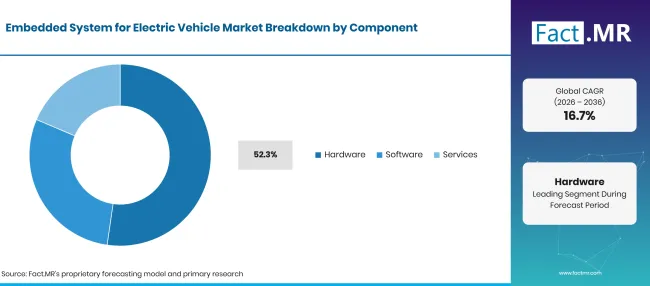
Factmr Embedded System For Electric Vehicle Market Breakdown Component | Source: Fact.MR
| Component | Share (2026) |
|---|---|
| Hardware (Leading segment) | 52.3% |
| Other segments combined | 47.7% |
| Total | 100.0% |
Source: Fact.MR analysis. Updated Oct 16, 2026
Hardware sits on every vehicle control board, linking computing chips to sensors and physical electrical signals. Power electronics applications require dependable interfaces and protection around each circuit.
What leads the Application segment?
Battery Management is forecast to hold a 29.6% share in 2026.
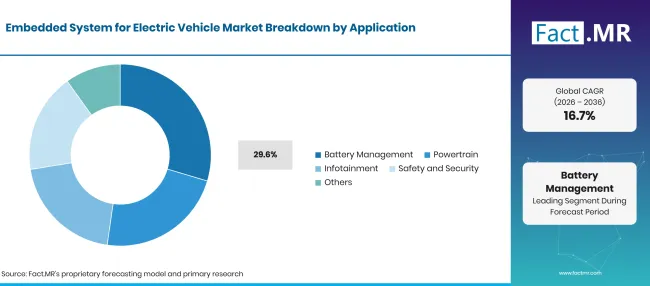
Factmr Embedded System For Electric Vehicle Market Breakdown Application | Source: Fact.MR
| Application | Share (2026) |
|---|---|
| Battery Management (Leading segment) | 29.6% |
| Other segments combined | 70.4% |
| Total | 100.0% |
Source: Fact.MR analysis. Updated Oct 16, 2026
Battery management combines cell data with operating limits for charging and discharge. Engineers select sensor devices according to pack layout and the fault information needed by other controllers. NXP’s October 2025 battery chipset development focused on coordinated cell readings, showing the role of reading accuracy in the battery use [2]. Each vehicle program requires its own testing and approval of embedded control systems.
How does Vehicle Type shape purchases?
Passenger Cars is forecast to hold a 72.4% share in 2026.
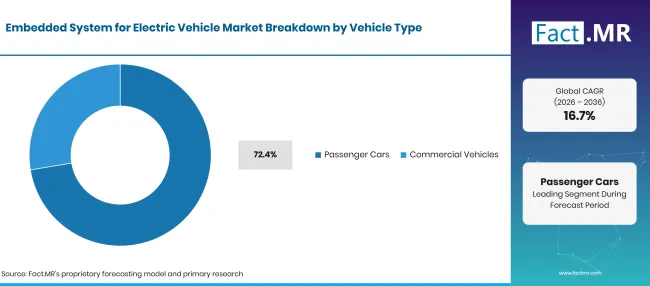
Factmr Embedded System For Electric Vehicle Market Breakdown Vehicle Type | Source: Fact.MR
| Vehicle Type | Share (2026) |
|---|---|
| Passenger Cars (Leading segment) | 72.4% |
| Other segments combined | 27.6% |
| Total | 100.0% |
Source: Fact.MR analysis. Updated Oct 16, 2026
Passenger car programs often share hardware platforms across different trim levels and battery designs. This encourages electronics teams to reuse tested controllers while adjusting software for each model. The International Energy Agency reported that nearly 22 million electric cars were built worldwide in 2025, up more than 25% from 2024 [4]. Each vehicle program requires its own testing and approval of embedded control systems.
Which Propulsion Type has the wider base?
Battery Electric Vehicles is forecast to hold a 54.8% share in 2026.
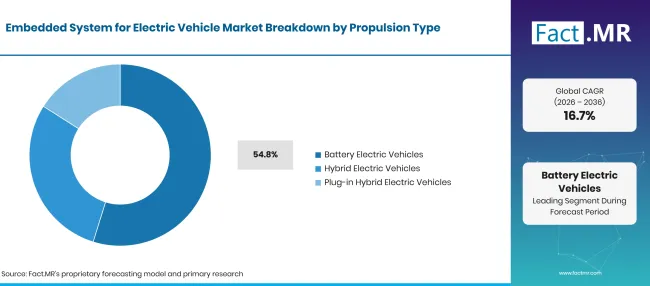
Factmr Embedded System For Electric Vehicle Market Breakdown Propulsion Type | Source: Fact.MR
| Propulsion Type | Share (2026) |
|---|---|
| Battery Electric Vehicles (Leading segment) | 54.8% |
| Other segments combined | 45.2% |
| Total | 100.0% |
Source: Fact.MR analysis. Updated Oct 16, 2026
Battery electric vehicles require embedded controls for battery protection and electric traction as core operating functions. Hybrid electric vehicles coordinate electric propulsion with a combustion engine, creating another layer of powertrain control. Infineon’s November 2025 high-voltage battery device illustrates a product specifically intended for battery-management designs [3].
What is accelerating Embedded System for Electric Vehicle Market adoption, and what is holding it back?
Battery diagnostics and reusable control platforms support adoption; safety testing and component qualification slow approval.
Drivers Impact Analysis
| DRIVER | (~) % IMPACT ON CAGR | GEOGRAPHIC RELEVANCE | IMPACT TIMELINE |
|---|---|---|---|
| Battery condition monitoring | +1.2% | Global | Medium term (2–4 years) |
| Powertrain control integration | +1.0% | Germany, Japan | Medium term (2–4 years) |
| Shared vehicle software platforms | +0.9% | United States, United Kingdom | Long term (>= 4 years) |
| EV passenger-car output | +0.8% | Global | Medium term (2–4 years) |
| Controller diagnostic functions | +0.6% | Global | Short term (<= 2 years) |
Source: Fact.MR analysis. Updated Oct 16, 2026
Opportunity Impact Analysis
| OPPORTUNITY | (~) % IMPACT ON CAGR | GEOGRAPHIC RELEVANCE | IMPACT TIMELINE |
|---|---|---|---|
| Integrated sensing and control | +0.9% | Global | Medium term (2–4 years) |
| Standard software interfaces | +0.8% | Germany, United States | Long term (>= 4 years) |
| Fleet-oriented monitoring | +0.6% | Brazil, United Kingdom | Medium term (2–4 years) |
| Supplier qualification support | +0.5% | Japan, Germany | Short term (<= 2 years) |
Source: Fact.MR analysis. Updated Oct 16, 2026
Restraints Impact Analysis
| RESTRAINT | (~) % IMPACT ON CAGR | GEOGRAPHIC RELEVANCE | IMPACT TIMELINE |
|---|---|---|---|
| Safety-validation workload | -0.9% | Global | Medium term (2–4 years) |
| Semiconductor supply planning | -0.7% | Global | Short term (<= 2 years) |
| Software integration expense | -0.6% | Global | Medium term (2–4 years) |
| Testing across propulsion variants | -0.5% | Global | Long term (>= 4 years) |
Source: Fact.MR analysis. Updated Oct 16, 2026
Which countries are scaling Embedded System for Electric Vehicle Market through 2036?
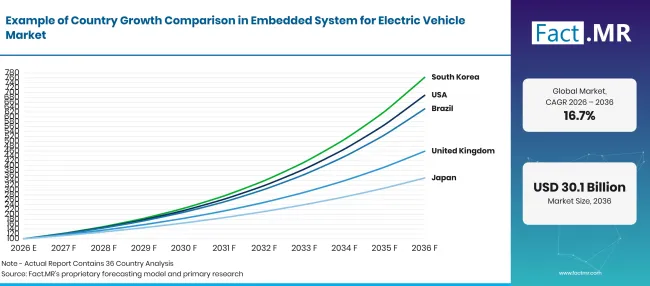
Factmr Embedded System For Electric Vehicle Market Growth Index | Source: Fact.MR
| Country | CAGR (2026–2036) |
|---|---|
| United States | 21.3% |
| Brazil | 20.3% |
| United Kingdom | 16.5% |
| Japan | 13.3% |
| Germany | 12.2% |
Source: Fact.MR analysis. Updated Oct 16, 2026
How are United States vehicle electronics programs expanding?
21.3% CAGR, driven by battery-control engineering, EV registrations, and reusable vehicle software platforms.
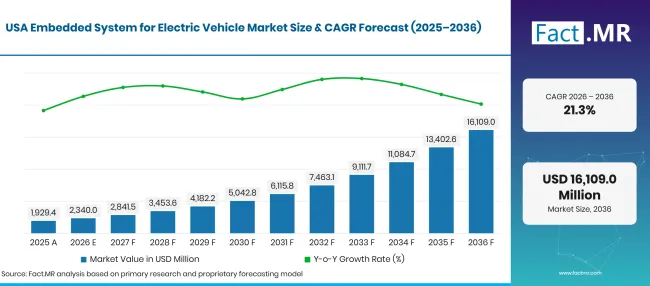
Factmr Embedded System For Electric Vehicle Market Forecast Usa 1 | Source: Fact.MR
U.S. vehicle manufacturers rely on embedded controllers to manage battery systems, powertrain operation and vehicle diagnostics. The U.S. Department of Energy Alternative Fuels Data Center tracks state-level electric vehicle registrations for 2025 [5]. Automakers often use the same controller software across multiple EV models to reduce development time. Each vehicle still goes through its own testing and approval process before reaching the market.
Why is Brazil expanding electric vehicle control adoption?
20.3% CAGR, influenced by rising electrified-vehicle sales and a broader mix of vehicle platforms.
Brazil's growing market for electric and hybrid vehicles is increasing demand for vehicle controllers and software. The Brazilian Electric Vehicle Association recorded 223,912 sales of light electrified vehicles in 2025 [6]. Manufacturers and importers need software that can work across different vehicle designs and charging systems. Suppliers that provide technical support and diagnostic services can help vehicle brands manage a wider range of electronic systems more effectively.
What supports electric vehicle embedded systems in the United Kingdom?
16.5% CAGR, led by zero-emission vehicle registrations and growing vehicle software needs.
The UK's growing number of electric vehicles is increasing demand for battery monitoring, vehicle controls and diagnostic systems. The Department for Transport reported 528,000 first registrations of zero-emission vehicles in 2025 [7]. Engineering teams often use software modules across multiple vehicle platforms to reduce development work. Each controller still needs to meet the testing and safety requirements of the vehicle in which it is used.
How is Japan developing its electric vehicle control capabilities?
13.3% CAGR, shaped by precision electronics, hybrid-system experience, and long-life component support.
Japan's automotive electronics industry combines strong semiconductor capabilities with many years of experience in hybrid vehicle control systems. METI approved a JPY 51 billion charging and refuelling infrastructure funding package in December 2025 [10]. Japanese suppliers place close attention on consistent controller performance and thorough testing before production. Long-term hardware support is also important because many vehicle platforms remain in use for several years.
Why does Germany remain an important embedded-control market?
12.2% CAGR, supported by automotive engineering, electric-car production, and export activity.
Germany's automotive industry creates steady demand for battery management and traction-control electronics across a wide range of vehicle programs. Destatis reported 545,142 new electric car registrations in 2025 [8]. The agency also recorded 416,000 German electric-car exports between January and May 2025 [9]. As manufacturers serve both domestic and export markets, they place strong importance on reliable controller performance, consistent testing and a stable supply of semiconductor components.
Who leads the Embedded System for Electric Vehicle Market?
NXP Chips and Infineon Technologies supply automotive chips used in electric vehicle battery electronics. Renesas Electronics develops microcontrollers and automotive connection devices, while STMicroelectronics and Texas Instruments offer chip portfolios suited to sensor and control tasks. The competitive difference often concerns the complete design package, including records and developer tools, more than the chip alone.
Robert Bosch and Denso take part in automotive control and systems system fit, while Continental has vehicle electronics capabilities. Panasonic and Analog Devices contribute electronics related to battery or vehicle control tasks. Suppliers serve different layers of the design, so their activities should not be treated as identical products or evidence of a single market-share ranking.
Which companies are the key providers?
Key companies include NXP Semiconductors; Robert Bosch GmbH; Denso Corporation; Panasonic Automotive Systems Co., Ltd.; Infineon Technologies AG; Texas Instruments Incorporated; Renesas Electronics Corporation; STMicroelectronics; and Analog Devices Inc.
- NXP Semiconductors
- Robert Bosch GmbH
- Denso Corporation
- Panasonic Automotive Systems Co., Ltd.
- Infineon Technologies AG
- Texas Instruments Incorporated
- Renesas Electronics Corporation
- STMicroelectronics
- Analog Devices Inc.
Bibliography
- [1] International Energy Agency. (2026, May 20). Global EV Outlook 2026: Trends in electric cars.
- [2] NXP Semiconductors. (2025, October 29). NXP improves battery health monitoring with EIS capable battery management chipset.
- [3] Infineon Technologies AG. (2025, November 13). Infineon launches PSOC™ 4 HVPA-SPM 1.0 – bringing intelligence to automotive battery management systems to enable zonal architectures.
- [4] International Energy Agency. (2026, May 20). Global EV Outlook 2026: Manufacturing and trade.
- [5] U.S. Department of Energy, Alternative Fuels Data Center. (n.d.). Vehicle registration counts by state.
- [6] Associação Brasileira do Veículo Elétrico. (2026, January 6). Eletrificados crescem dez vezes mais do que o conjunto do mercado, e vendas chegam a 224 mil veículos em 2025.
- [7] Department for Transport. (2026, April 29). Vehicle licensing statistics, United Kingdom: 2025.
- [8] Statistisches Bundesamt (Destatis). (2026, September 22). 17,3 % der Pkw-Neuzulassungen in der EU im Jahr 2025 waren E-Autos.
- [9] Statistisches Bundesamt (Destatis). (2025, July 18). Exporte von neuen Pkw in den ersten fünf Monaten 2025 um 1,1 % zum Vorjahreszeitraum gestiegen.
- [10] Ministry of Economy, Trade and Industry. (2026, June 12). FY2025 supplementary budget: Subsidies for promoting the introduction of charging and refuelling infrastructure for clean energy vehicles.
This Report Answers
- The analysis examines how hardware and software choices shape battery control and vehicle electronics purchasing.
- Application coverage compares battery management with powertrain control and connected in-vehicle functions.
- Country outlook compares the United States, Brazil, United Kingdom, Japan and Germany under their respective forecasts.
- The competitive review separates semiconductor components from complete vehicle electronic systems.
- Supply-chain discussion considers testing effort and long-life chip availability during vehicle-program approval.
What does the Embedded System for Electric Vehicle Market cover?
The market covers computing chips and related electronic hardware used in electric vehicle control systems. It also includes embedded software and associated engineering services tied to these functions.
What is included in the scope?
Coverage includes embedded components and software used in vehicle control functions.
Battery reading interfaces and traction controllers are included when sold for vehicle uses. Related engineering services count when directly supporting these controls. Component revenue is separate from complete vehicle sales.
What is excluded from the scope?
The scope excludes complete vehicles and battery cell materials.
Consumer uses and external charging equipment belong to separate categories unless sold as part of an onboard vehicle controller. Standalone cloud subscriptions unrelated to embedded controller operation are outside this market.
How Was the Analysis Built?
The analysis draws on 120+ sources, 35+ company portfolios, 25+ countries, and more than 20 industry interviews.
- Primary Research: Primary research includes discussions with manufacturers, service providers, technology developers, distributors, end users, and subject-matter experts. These conversations examine purchasing priorities, product adoption, operational challenges, approval requirements, competitive positioning, and the factors that influence wider market acceptance.
- Desk Research: Desk research covers government statistics, regulatory publications, company filings, trade data, technical studies, industry associations, standards, public policy, and other authoritative sources. Every source used in the analysis is documented in the bibliography.
- Market Sizing and Forecasting: Market estimates combine historical performance, demand indicators, pricing and volume trends, segment shares, company participation, country-level growth, adoption patterns, investment activity, and barriers to market expansion.
- Data Validation and Update Cycle: Findings are validated by comparing primary interviews with public data, company activity, regulatory changes, trade patterns, and industry developments. Regular updates review new product launches, capacity changes, partnerships, approvals, and shifts in commercial adoption.
Segmentation
What is the report’s scope and coverage?
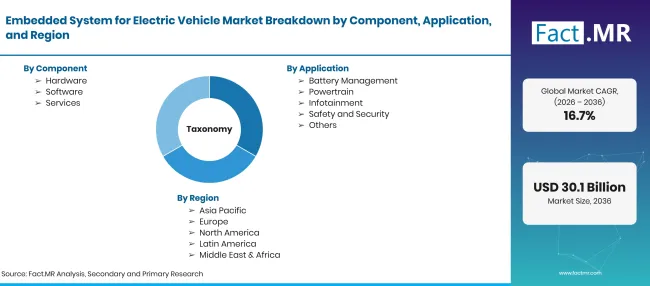
Factmr Embedded System For Electric Vehicle Market Taxonomy | Source: Fact.MR
| Attribute | Details |
|---|---|
| Quantitative Units | USD billion, forecast for 2026 to 2036 |
| Market Definition | Embedded hardware, software and related services directly used to control electric vehicle functions |
| Component | Hardware; Software; Services |
| Application | Battery Management; Powertrain; Infotainment; Safety and Security; Others |
| Vehicle Type | Passenger Cars; Commercial Vehicles |
| Propulsion Type | Battery Electric Vehicles; Hybrid Electric Vehicles; Plug-in Hybrid Electric Vehicles |
| Regions Covered | North America; Latin America; Western Europe; Eastern Europe; East Asia; South Asia & Pacific; Middle East & Africa |
| Countries Covered | United States; Brazil; United Kingdom; Japan; Germany |
| Companies Profiled | NXP Semiconductors; Robert Bosch GmbH; Denso Corporation; Panasonic Automotive Systems Co., Ltd.; Infineon Technologies AG; Texas Instruments Incorporated; Renesas Electronics Corporation; STMicroelectronics; Analog Devices Inc. |
| Forecast Period | 2026 to 2036 |
| Approach | Technology review, vehicle activity, company product evidence and country-level analysis |
Source: Fact.MR analysis. Updated Oct 16, 2026
How is the market segmented?
-
By Component:
- Hardware
- Software
- Services
-
By Application:
- Battery Management
- Powertrain
- Infotainment
- Safety and Security
- Others
-
By Vehicle Type:
- Passenger Cars
- Commercial Vehicles
-
By Propulsion Type:
- Battery Electric Vehicles
- Hybrid Electric Vehicles
- Plug-in Hybrid Electric Vehicles
-
By Region:
- North America
- Latin America
- Western Europe
- Eastern Europe
- East Asia
- South Asia & Pacific
- Middle East & Africa
Frequently Asked Questions
How big is the Embedded System for Electric Vehicle Market in 2026?
What is the CAGR of the Embedded System for Electric Vehicle Market from 2026 to 2036?
Which component leads the Embedded System for Electric Vehicle Market?
Which application leads the Embedded System for Electric Vehicle Market?
Who are the leading companies in the Embedded System for Electric Vehicle Market?
Who worked on this report


Preview the report firsthand - request a free sample
Free SampleGet the brochure for pricing and purchase details
Download PDF