
- Market Value (2025): USD 300.0 Mn
- Estimated Value (2026): USD 316.5 Mn
- Forecast Value (2036): USD 566.8 Mn
- CAGR (2026-2036): 6.0%
Emergency Trolley Market Forecast and Outlook 2026 to 2036
As per the Fact.MR analysis, the emergency trolley market crossed a valuation of USD 300.0 million in 2025 and is projected to grow from USD 316.5 million in 2026 to USD 566.8 million by 2036. Demand for emergency trolleys is likely to grow at a CAGR of 6.0% over the forecast period.
Demand for emergency trolleys is rising as hospitals, clinics and care facilities stock resuscitation drugs and equipment in mobile carts that can be wheeled quickly to a patient. The key players are offering steel, polymer and stainless steel trolleys with drawers, tamper-evident locks and defibrillator shelves in several sizes.
Key Takeaways from the Emergency Trolley Market
- Emergency Trolley Market Value (2025): USD 300.0 million
- Emergency Trolley Market Value (2026): USD 316.5 million
- Emergency Trolley Market Forecast Value (2036): USD 566.8 million
- Emergency Trolley Market Forecast CAGR (2026-2036): 6.0%
- Leading Material: Powder-coated steel (38.0%)
- Key Market Participants: Medline Industries, Capsa Healthcare (incl. Harloff), Armstrong Medical Industries, Waterloo Healthcare
- Key Growth Countries: India, China, South Korea, United Kingdom, United States
Expansion of hospital capacity and investment in emergency care infrastructure are expected to support demand for emergency trolleys through 2036. India's Union Budget 2026–27 announced a 50% increase in emergency and trauma care capacity across district hospitals, while the Ministry of Health and Family Welfare identified 160 district hospitals for the first implementation phase, targeting completion by March 2027. Additionally, as of June 26, 2026, all public healthcare facilities had been assessed through the Indian Public Health Standards digital toolkit, with 64% scoring above 50%. These initiatives are expected to encourage hospitals to strengthen emergency preparedness, improve patient handling and equip facilities with standardized crash carts and replacement emergency trolleys.
Emergency Trolley Market
| Metric | Value |
|---|---|
| Estimated Value in (2026) | USD 316.5 million |
| Forecast Value in (2036) | USD 566.8 million |
| Forecast CAGR (2026 to 2036) | 6.0% |
Source: Fact.MR analysis.
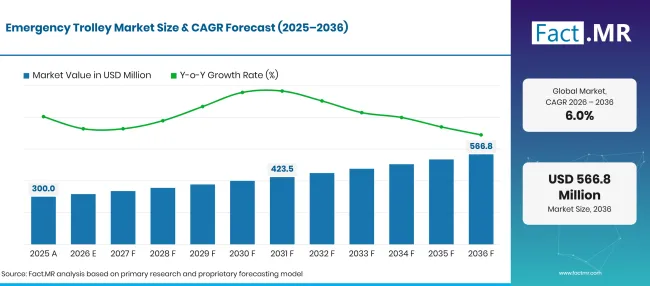
Emergency Trolley Market Forecast Global | Source: Fact.MR
Category
| Category | Segments |
|---|---|
| Material | Powder-coated steel, Polymer and ABS, Stainless steel, Aluminium |
| Size | 5 to 6 drawers, Up to 4 drawers, 7 or more drawers, Open-shelf and transport carts |
| Locking System | Breakaway tamper-evident lock, Key lock, Combination and keypad lock, Electronic and RFID lock |
| End User | Hospitals, Ambulatory surgery centres and clinics, Long-term care facilities, Dental and veterinary clinics, Emergency medical services and others |
| Region | India; China; South Korea; United Kingdom; United States |
Source: Fact.MR analysis.
Emergency Trolley Market-Drivers, Restraints & Trends
Drivers:
Expansion of Hospital Infrastructure and Emergency-Care Capacity
Demand for emergency trolleys is increasing as hospitals expand bed capacity, strengthen emergency departments and improve access to critical-care services. India's Ministry of Health and Family Welfare reported in November 2026 that 18 functional new AIIMS collectively operated 14,860 beds and 404 operation theatres. Additionally, the Union Budget 2026–27 introduced plans to increase emergency and trauma-care capacity in district hospitals by 50%. These investments are strengthening the need for readily accessible emergency equipment, including crash carts, resuscitation trolleys and medication-storage systems, across hospital departments.
Restraints: High Replacement Costs and Long Equipment Lifecycles
Sales is constrained by long trolley life, limited budgets in smaller facilities and the choice of some hospitals to use lower-cost carts or bags instead of complete trolley systems. Demand for emergency trolleys is constrained by long equipment replacement cycles, limited procurement budgets and competition from lower-cost alternatives. Hospitals with established emergency equipment inventories may continue using existing trolleys as long as their structural condition, mobility and storage functions remain adequate. Smaller healthcare facilities may also prioritize essential medicines, monitoring devices and life-support equipment over complete trolley replacements. These purchasing constraints can delay procurement, particularly where hospitals use basic utility carts or emergency bags to meet immediate operational requirements.
Opportunity: Easy-to-Clean and Infection-Control Designs
Opportunities are emerging for manufacturers offering stainless steel and polymer emergency trolleys with smooth surfaces, rounded corners, sealed joints and removable components. India's National Guidelines for Infection Prevention and Control in Healthcare Facilities, issued by the Ministry of Health and Family Welfare, emphasize cleaning and disinfection of patient-care equipment and maintaining standardized hospital cleaning procedures. These requirements create opportunities for trolley designs that simplify routine disinfection, reduce dirt accumulation and support infection-control practices.
Trend: Standardized Layouts and Tracking
Hospitals are increasingly focusing on standardized emergency trolley configurations, organized medication drawers and routine inventory checks to improve equipment readiness. The Ministry of Health and Family Welfare's 2026 initiative to assess public healthcare facilities against Indian Public Health Standards demonstrates the government's emphasis on monitoring facility readiness and identifying infrastructure gaps. This environment supports demand for emergency trolleys with standardized drawer arrangements, tamper-evident seals, identification tags and checklist-based stock monitoring. Digital tracking capabilities can further help hospital staff monitor medicine availability, expiry dates and equipment readiness.
Emergency Trolley Market Analysis by Key Country
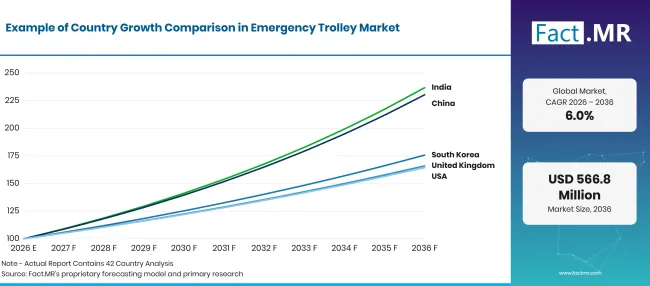
Emergency Trolley Market Growth Index | Source: Fact.MR
| Country | CAGR (2026-2036) |
|---|---|
| India | 9.0% |
| China | 8.7% |
| South Korea | 5.8% |
| United Kingdom | 5.2% |
| United States | 5.1% |
Source: Fact.MR analysis.
Why is India the fastest-growing market for emergency trolleys?
Demand for emergency trolleys in India is estimated to advance at a 9.0% CAGR through 2036, the fastest among the five countries.
Rapid hospital and clinic expansion and growing patient-safety requirements drive strong growth. Growing hospital infrastructure and increasing emergency-care requirements are creating opportunities for medical furniture manufacturers. According to the Press Information Bureau, 38,466 public and private hospitals were empanelled under Ayushman Bharat PM-JAY as of August 2026. The programme had also covered 12.69 crore hospitalizations by June 30, 2026. Rising hospital admissions and expanding treatment capacity are encouraging healthcare providers to procure emergency trolleys, resuscitation carts and mobile patient-care equipment.
How is demand for emergency trolleys developing in China?
Sales of emergency trolleys in China is set to expand at an 8.7% CAGR through 2036, above the global rate of 6.0%.
Large hospital building programs and a strong domestic manufacturing base support demand for hospital furniture and carts. According to China's National Bureau of Statistics, its 2025 Statistical Communiqué, published in February 2026, reported 38,000 hospitals and approximately 10.09 million healthcare beds at the end of 2025. The country also recorded 10.58 billion medical visits during the year. High patient volumes and extensive hospital networks are creating recurring requirements for emergency trolleys, medication carts and mobile resuscitation equipment.
What is driving emergency trolleys demand in South Korea?
Demand for emergency trolleys in South Korea is projected to grow at a 5.8% CAGR through 2036, below the global rate of 6.0%.
A well-developed hospital network and strong resuscitation standards support steady demand for emergency carts. According to South Korea's National Health Insurance Service, the country recorded 105,271 registered healthcare institutions in the second quarter of 2026, including 47 tertiary general hospitals, 337 general hospitals and 1,429 hospitals. This extensive institutional network supports demand for mobile emergency equipment across different care settings. Hospitals are expected to prioritize organized emergency response, equipment accessibility and replacement of ageing trolley fleets, sustaining supplier sales.
What is shaping emergency trolleys demand in United Kingdom?
Sales of emergency trolleys in United Kingdom is forecast to rise at a 5.2% CAGR through 2036, below the global rate of 6.0%.
National resuscitation guidelines and a large hospital system support steady replacement and standardization of carts. Sustained emergency department activity and requirements for organized patient handling support equipment procurement across NHS facilities. NHS England reported 7,268,445 A&E attendances between June and August 2026, the highest summer total on record. The same period recorded 2,455,833 ambulance call-outs, reflecting considerable pressure on emergency services. Such activity reinforces the need for accessible resuscitation equipment, mobile treatment carts and organized emergency-care stations. Hospitals are likely to maintain replacement purchasing while standardizing trolley configurations across emergency departments.
Why is growth slower for emergency trolleys in United States?
Demand for emergency trolleys in United States is likely to increase at a 5.1% CAGR through 2036, the slowest among the five countries.
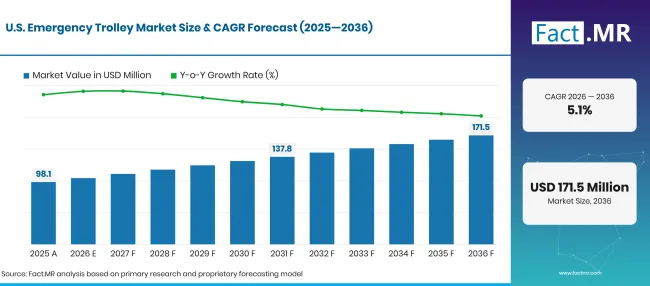
Emergency Trolley Market Forecast Usa | Source: Fact.MR
A large hospital sector and strong standards for emergency equipment support steady demand, with attention to tamper-evident designs. Although hospital infrastructure is extensive, established procurement networks and longer equipment replacement cycles can moderate additional sales. The Centers for Medicare and Medicaid Services reported 5,435 Medicare-registered hospitals in its November 2026 hospital dataset. Separately, the Agency for Healthcare Research and Quality's 2026-updated emergency department database provides national utilization estimates based on more than 135 million annual visits. Hospitals continue to require dependable resuscitation carts, secure medication storage and tamper-evident designs, supporting replacement and specialized equipment purchases.
Competitive Landscape for Emergency Trolley Market
The emergency trolley market is relatively concentrated, with Medline Industries, Capsa Healthcare (incl. Harloff), Armstrong Medical Industries and Waterloo Healthcare together hold about 63% of 2026 revenue, based on Fact.MR estimates. Competition centers on durability, drawer layout, locking systems, infection-control design and distribution through hospital supply contracts. Medical-supply and hospital-cart specialists lead, with regional manufacturers supplying lower-cost steel carts.
Recent Developments
- In June, 2026, Capsa Healthcare acquired The Harloff Company, a manufacturer of healthcare storage and mobility products, including medical storage cabinets, procedure carts and medication storage solutions. The acquisition expands Capsa's clinical storage and mobility portfolio and strengthens its presence across hospitals, clinics, ambulatory surgery centres and long-term care facilities. The combined business can offer a broader range of healthcare cart and storage solutions to institutional buyers.
- In August, 2026, Waterloo Healthcare introduced its Quick Ship programme to provide faster access to essential medical carts, including emergency crash carts, anaesthesia carts and universal procedure carts. The programme offers shipment within 24 hours of an order, subject to a maximum of five carts per order. The initiative addresses urgent requirements arising from new healthcare facility openings, equipment replacement, accreditation reviews and emergency preparedness activities.
- In December, 2025, Medline highlighted several product and operational developments in its 2025 annual review. The company introduced the ComfortTemp Patient Warming System, featuring a retractable lock-in hose and rotating elbow connector to improve positioning and clinical usability. It also expanded supply-chain capabilities through automation and inventory-management initiatives.
Key Players in Emergency Trolley Market
Key companies operating in the market include Medline Industries, Capsa Healthcare, Harloff, Armstrong Medical Industries, and Waterloo Healthcare.
- Medline Industries
- Capsa Healthcare
- Harloff
- Armstrong Medical Industries
- Waterloo Healthcare
Segmental Analysis
What is driving demand for powder-coated steel emergency trolleys?
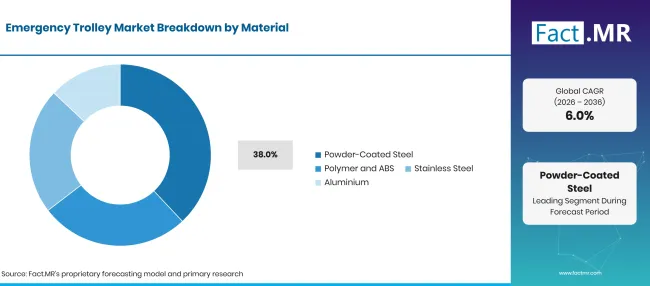
Emergency Trolley Market Breakdown Material | Source: Fact.MR
Demand for the powder-coated steel segment accounts for 38.0% of market revenue in 2026, about USD 120.3 million. Demand is supported by hospital requirements for durable equipment that can withstand frequent handling and repeated cleaning. In August 2026, the Ministry of Health and Family Welfare reported that 100% of public healthcare facilities had undergone assessment through the Indian Public Health Standards digital toolkit, with 64% scoring above 50%. This quality-assessment programme encourages facilities to identify infrastructure and equipment gaps, creating opportunities for replacement and procurement of durable emergency trolleys.
Which hospital requirements are supporting demand for 5 to 6-drawer emergency trolleys?
Emergency Trolley Market Breakdown Size | Source: Fact.MR
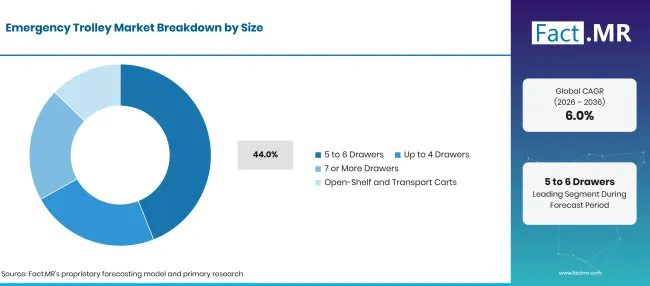
Sales of the 5 to 6-drawer segment represents 44.0% of 2026 revenue, about USD 139.3 million. Demand is supported by the need to organize emergency medicines, airway supplies and resuscitation accessories for rapid access. The National Health Mission's IPHS 2022 guidelines specify emergency department equipment and essential accessories, including defibrillators, laryngoscopes, resuscitation equipment, syringes and airway tubes. In March 2026, the government announced plans to increase emergency and trauma-care capacity in district hospitals by 50%.
How does tamper-evident security influence emergency trolley purchasing?
Emergency Trolley Market Breakdown Locking System | Source: Fact.MR
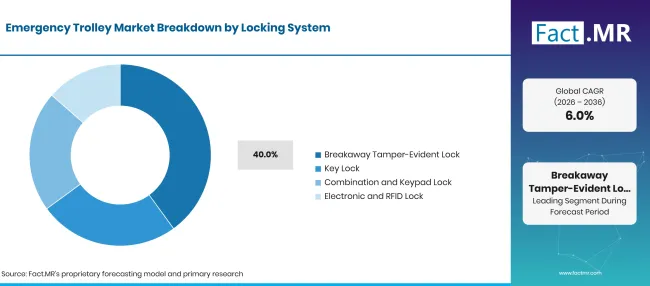
Demand for breakaway tamper-evident lock segment holds 40.0% of market revenue in 2026, about USD 126.6 million. Hospitals require controlled access to emergency medicines and equipment while maintaining accountability for stock usage and replenishment. The Ministry of Health and Family Welfare reported in March 2026 that all public healthcare facilities had been assessed against Indian Public Health Standards, with 64% scoring above 50%. These assessments reinforce the importance of standardized healthcare processes and equipment management. This creates a supportive environment for emergency trolleys with secure locking and inspection features.
How are hospital infrastructure investments strengthening demand for emergency trolleys?
Emergency Trolley Market Breakdown End User | Source: Fact.MR
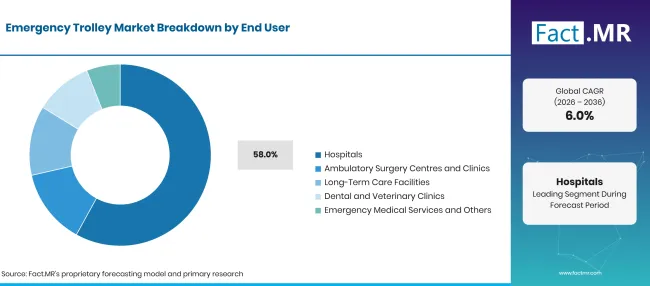
Hospitals account for 58.0% of market revenue in 2026, about USD 183.6 million, reflecting their extensive emergency-care requirements and larger equipment needs. In August 2026, the Ministry of Health and Family Welfare confirmed that 160 district hospitals had been identified for the first phase of emergency and trauma-care strengthening, with implementation targeted by March 2027. The programme aims to increase district-hospital emergency and trauma-care capacity by 50%. Such investments are expected to encourage hospitals to expand emergency facilities, equip treatment areas and replace ageing crash carts, supporting institutional purchasing demand.
Bibliography
- Capsa Healthcare. (2026, June). Capsa Healthcare acquires The Harloff Company.
- Medline Industries. (2025). 2025 year in review.
- Ministry of Health and Family Welfare. (n.d.). National guidelines for infection prevention and control in healthcare facilities.
- National Health Mission. (n.d.). Healthcare infrastructure.
- Press Information Bureau. (2026, March 9). Strengthening emergency and trauma care centres.
- Press Information Bureau. (2026, August 4). Measures to strengthen 24×7 emergency services.
- Press Information Bureau. (2026, August 27). Strengthening emergency and trauma care capacity.
- Press Information Bureau. (n.d.). Status of healthcare infrastructure.
- Waterloo Healthcare. (2026). Quick ship.
Segmentation
Scope of Report
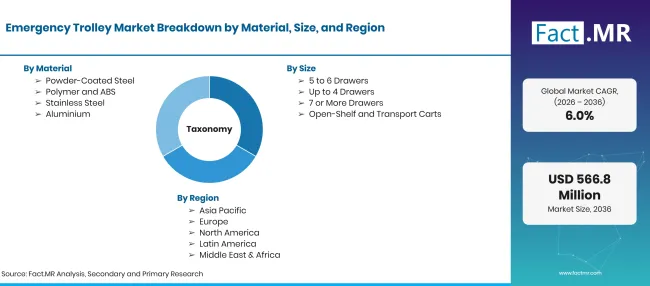
Emergency Trolley Market Taxonomy | Source: Fact.MR
| Items | Values |
|---|---|
| Quantitative Units (2026) | USD 316.5 Million |
| Material | Powder-coated steel, Polymer and ABS, Stainless steel, Aluminium |
| Size | 5 to 6 drawers, Up to 4 drawers, 7 or more drawers, Open-shelf and transport carts |
| Locking System | Breakaway tamper-evident lock, Key lock, Combination and keypad lock, Electronic and RFID lock |
| End User | Hospitals, Ambulatory surgery centres and clinics, Long-term care facilities, Dental and veterinary clinics, Emergency medical services and others |
| Regions Covered | North America, Latin America, Europe, Asia Pacific, Middle East & Africa |
| Countries Covered | India, China, South Korea, United Kingdom, United States, and other countries |
| Key Companies Profiled | Medline Industries, Capsa Healthcare (incl. Harloff), Armstrong Medical Industries, Waterloo Healthcare |
| Additional Attributes | Dollar revenue in the Emergency Trolley Market is segmented by material, size, locking system and end user and region. |
Source: Fact.MR analysis.
Emergency Trolley Market by Segments
-
Material
- Powder-coated steel
- Polymer and ABS
- Stainless steel
- Aluminium
-
Size
- 5 to 6 drawers
- Up to 4 drawers
- 7 or more drawers
- Open-shelf and transport carts
-
Locking System
- Breakaway tamper-evident lock
- Key lock
- Combination and keypad lock
- Electronic and RFID lock
-
End User
- Hospitals
- Ambulatory surgery centres and clinics
- Long-term care facilities
- Dental and veterinary clinics
- Emergency medical services and others
-
Region:
- North America
- United States
- Canada
- Mexico
- Europe
- Germany
- United Kingdom
- France
- Italy
- Spain
- Rest of Europe
- Asia Pacific
- China
- India
- Japan
- South Korea
- Australia and New Zealand
- Rest of Asia Pacific
- Latin America
- Brazil
- Argentina
- Rest of Latin America
- Middle East & Africa
- GCC Countries
- South Africa
- Rest of Middle East & Africa
- North America
Table of Contents
Key Takeaways
- Market Size and CAGR
- Top Growth Driver
- Fastest Growing Segment
- Leading Region
- Key Companies
- Emerging Opportunities

