
- Market Value (2025): USD 93.0 Mn
- Estimated Value (2026): USD 100.0 Mn
- Forecast Value (2036): USD 206.1 Mn
- CAGR (2026-2036): 7.5%
Programmable Alarm Modules Market Forecast and Outlook 2026 to 2036
The global programmable alarm modules market stood at a derived estimate of USD 93.0 million in 2025 and reached USD 100.0 million in 2026. The market is forecast to reach USD 206.1 million by 2036, advancing at a CAGR of 7.5% during the 2026 to 2036 assessment period.
Food processing facilities are installing more sensors to track temperature, pressure, vibration and machine guarding. Programmable alarm modules bring these signals together and alert operators when operating conditions move beyond preset limits. Event recording and adjustable thresholds also help plants manage different production requirements. The EU Machinery Regulation (EU) 2023/1230, which applies from January 20, 2027, introduces provisions covering machinery safety functions and cybersecurity for safety-related control systems. These requirements are adding another reason for manufacturers to review their alarm and control infrastructure.
Key Takeaways from the Programmable Alarm Modules Market
- Programmable alarm modules market value in 2025: USD 93.0 million (derived estimate).
- Programmable Alarm Modules Market Value (2026): USD 100.0 million.
- Programmable Alarm Modules Market Forecast Value (2036): USD 206.1 million.
- Programmable Alarm Modules Market Forecast CAGR (2026-2036): 7.5%.
- Leading Alarm Module Trigger: Machine safety (27.6%).
- Key Market Participants: GEA, JBT Marel, Heat and Control, Bühler, Baker Perkins and tna solutions.
- Key Growth Regions: China, United States, Italy, Germany and Japan.
Food processors are paying closer attention to alarm quality as excessive notifications can distract operators from serious equipment faults. ANSI/ISA-18.2 and IEC 62682 establish frameworks for alarm lifecycle management, including identification, prioritization and rationalization. These practices are encouraging manufacturers to adopt configurable alarm logic that separates routine process variations from conditions requiring immediate attention. Equipment manufacturers are also incorporating monitoring and control functions into broader processing-line automation systems [3].
Programmable Alarm Modules Market
| Metric | Value |
|---|---|
| Market Value (2025) | USD 93.0 million (derived estimate) |
| Market Value (2026) | USD 100.0 million |
| Forecast Value (2036) | USD 206.1 million |
| CAGR (2026 to 2036) | 7.5% |
Source: Fact.MR analysis. Updated Nov 26, 2026
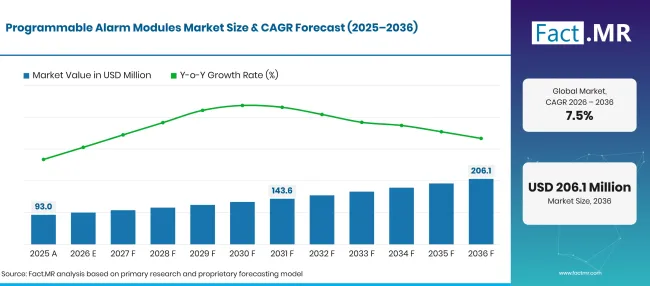
Programmable Alarm Modules Forecast Global | Source: Fact.MR
Category
| Category | Segments |
|---|---|
| Alarm module trigger | Temperature, Pressure / flow, Vibration, Machine safety, Multi-parameter logic |
| Processing scale | Pilot / lab, Small commercial, Mid-scale, High-throughput, Ultra-high-throughput |
| Operating configuration | Batch, Semi-continuous, Continuous, Modular skid, Integrated line |
| Food / process application | Bakery / wafers, Confectionery / cocoa, Snacks / seasoning, Brewing / grains, Other food / industrial |
| Region | China, United States, Italy, Germany and Japan |
Source: Fact.MR analysis. Updated Nov 26, 2026
Segmental Analysis
Why does Machine Safety lead trigger demand in the Programmable Alarm Modules Market?
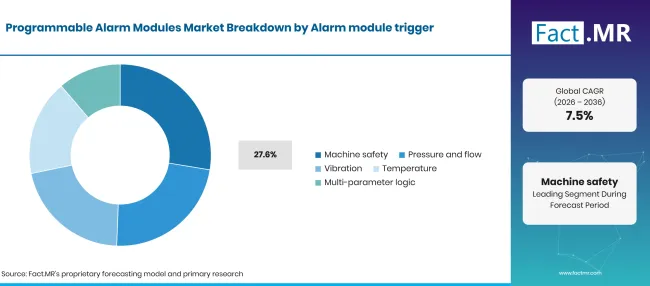
Programmable Alarm Modules Breakdown Alarm Module Trigger | Source: Fact.MR
Machine safety takes a 27.6% share of market revenue in 2026, translating to USD 27.6 million. Alarms can notify operators when a guard switch, light curtain or emergency stop is triggered. Safety-related controls provide the required protective response. Multi-parameter monitoring and vibration alerts are also finding wider use as processors seek earlier fault detection. India’s Ministry of Heavy Industries withdrew the Machinery and Electrical Equipment Safety (Omnibus Technical Regulation) Order, 2024, on January 16, 2026.
Why does the Mid-scale segment lead scale demand in the Programmable Alarm Modules Market?
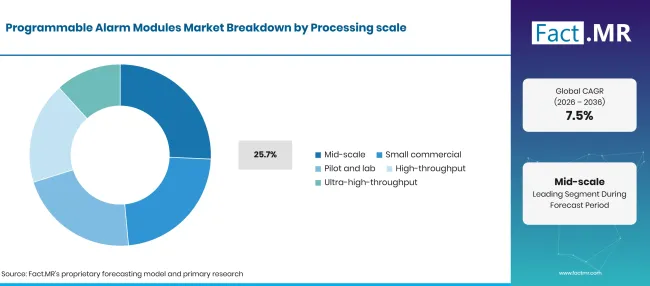
Programmable Alarm Modules Breakdown Processing Scale | Source: Fact.MR
The mid-scale segment captures 25.7% of market revenue in 2026, equivalent to USD 25.7 million. Medium-sized processors often upgrade individual production lines rather than replace complete control infrastructure. Programmable alarm modules offer a practical route to better monitoring without extensive changes to existing machinery. Small commercial plants are adopting compact monitoring arrangements, while ultra-high-throughput facilities are expanding centralized control and equipment supervision.
Why does Semi-continuous operation lead configuration demand in the Programmable Alarm Modules Market?
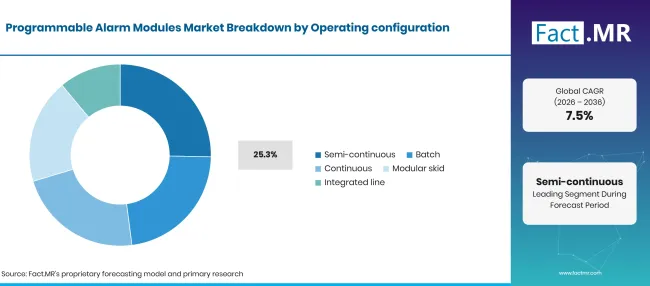
Programmable Alarm Modules Breakdown Operating Configuration | Source: Fact.MR
Frequent production starts, shutdowns and product changeovers make semi-continuous lines particularly reliant on configurable alarm settings. This operating format captures 25.3% of market revenue in 2026, equivalent to USD 25.3 million. Modular skids are gaining traction as processors expand individual production stages, while continuous facilities are incorporating centralized monitoring for uninterrupted operations. India's food processing incentive scheme had generated around 35 lakh metric tonnes per annum of processing and preservation capacity by December 2025, indicating continued expansion of domestic food manufacturing infrastructure.
Why does Bakery / wafers lead application demand in the Programmable Alarm Modules Market?
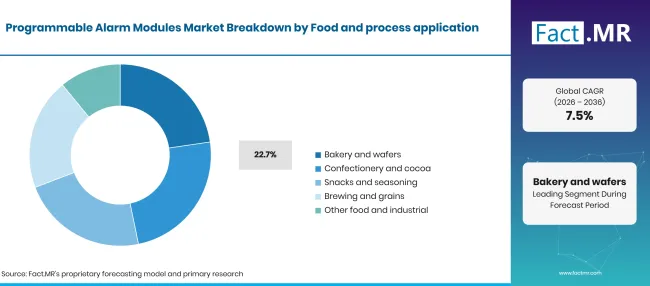
Programmable Alarm Modules Breakdown Food And Process Application | Source: Fact.MR
Ovens, proofing chambers and mixers create several points where temperature changes or equipment faults can affect product consistency. Bakery and wafer production therefore captures the largest application share at 22.7%, equivalent to USD 22.7 million in 2026. Snack manufacturers are also incorporating alarms into frying and seasoning operations, while other food producers are improving monitoring across automated packaging lines. India's food products manufacturing index recorded 5.4% cumulative growth during April to September 2026 compared with the corresponding period in 2025, reflecting continued activity across the sector.
Programmable Alarm Modules Market: Drivers, Restraints and Trends
Drivers: Predictive Maintenance and Early Fault Detection
Food manufacturers are placing greater emphasis on preventing equipment failures rather than dealing with production stoppages after they occur. A temperature spike in an oven, unusual vibration in a mixer or pressure fluctuation in a processing line can signal trouble well before a machine stops working. Programmable alarm modules help operators recognize these changes and respond before minor faults turn into costly interruptions. Their ability to combine multiple sensor inputs with configurable alert logic makes them increasingly relevant to automated food production environments.
Restraints: Legacy System Integration and Alarm Fatigue
Bringing programmable alarm modules into older food processing facilities is not always straightforward. Existing machinery may use outdated controllers, incompatible communication protocols or control architectures that require extensive modification. Installation and programming expenses can discourage smaller processors from upgrading. Alarm fatigue creates another concern. When poorly configured systems repeatedly flag minor operating variations, workers may begin overlooking important warnings. Manufacturers therefore face the challenge of balancing sensitive fault detection with practical alert management.
Trends: Alarm Rationalization and Intelligent Alert Management
Food processors are moving towards more disciplined alarm management as production lines become increasingly automated. A large volume of repetitive notifications can distract operators from conditions that genuinely require intervention. Programmable alarm modules offer scope to organize alerts according to severity, operating conditions and production stages. ANSI/ISA-18.2 and IEC 62682 establish frameworks for alarm lifecycle management, including rationalization and prioritization. These practices are increasing interest in more manageable control-room operations and clearer operator notifications.
Trends: Cybersecure Controls and Industrial Network Protection
Connectivity is changing how food processing facilities monitor equipment, but it also introduces greater exposure to unauthorized access and software manipulation. Alarm modules linked with industrial control networks need stronger protection to preserve reliable operation. In December 2025, the International Society of Automation published ISA-TR62443-2-2-2025, which outlines methods for developing, validating and maintaining security protection schemes for industrial automation and control systems. The publication adds further attention to cybersecurity across connected manufacturing environments.
Programmable Alarm Modules Market Analysis by Key Country
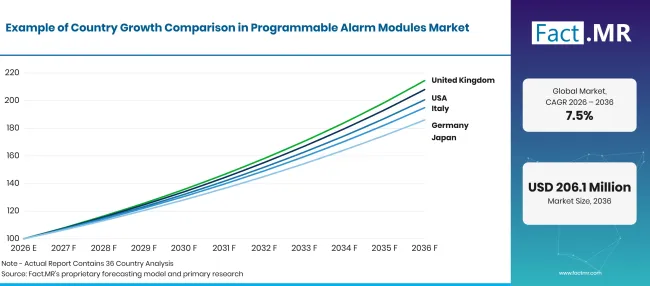
Programmable Alarm Modules Growth Index | Source: Fact.MR
| Country | CAGR (2026-2036) |
|---|---|
| China | 9.1% |
| United States | 7.6% |
| Italy | 7.1% |
| Germany | 6.9% |
| Japan | 6.4% |
Source: Fact.MR analysis. Updated Nov 26, 2026
Why is China the fastest-growing market for programmable alarm modules?
China's rapid manufacturing upgrade is creating favourable conditions for programmable alarm module adoption.
Food processors are investing in automated production equipment where temperature variations, pressure changes and equipment faults require immediate attention. The country's wider industrial transformation is adding momentum to this shift. According to China's State Taxation Administration, manufacturer expenditure on automated equipment increased 11.3% in 2025, while sales revenue from intelligent equipment manufacturing rose 28.1%. These investments are strengthening the industrial base for configurable alarm management systems.
What is shaping programmable alarm module sales in the United States?
Food manufacturing in the United States involves extensive processing, storage and distribution networks, leaving little room for equipment failures that interrupt production schedules.
Programmable alarm modules help plant operators monitor critical operating conditions and respond to irregularities before they affect output. USDA reported that total inflation-adjusted food spending reached USD 2.51 trillion in 2025. Spending on domestically produced food reached USD 2.08 trillion in nominal terms, up 3.1% from 2024. This extensive food production and distribution network creates opportunities for continued investment in processing infrastructure and automation.
What is shaping programmable alarm module demand in Italy?
Italy's food manufacturing industry is gradually embracing digital production practices, creating opportunities for programmable alarm modules across automated processing facilities.
Producers of bakery goods, packaged foods and beverages have reason to improve equipment visibility as production operations become more connected. Istat reported that AI adoption among Italian businesses with at least 10 employees doubled from 8.2% in 2024 to 16.4% in 2025. Although this figure covers businesses across industries, it illustrates the wider shift towards digital operations and creates a favourable environment for more connected factory monitoring.
What is shaping programmable alarm module demand in Germany?
Germany's established food and feed manufacturing base creates opportunities for programmable alarm modules across processing and packaging facilities.
Temperature monitoring, equipment protection and timely fault notifications are important across mixing, cooking, filling and packaging operations. Destatis recorded 4,831 businesses and 729,802 employees in Germany's food and feed manufacturing industry in 2025. This substantial industrial base creates scope for equipment monitoring upgrades, particularly as manufacturers look to improve production visibility and reduce interruptions across multiple processing stages.
Why is programmable alarm module growth slower in Japan?
Japan's food processors are under pressure to maintain production capacity despite persistent labour shortages.
Automated monitoring is becoming particularly useful in facilities where fewer workers supervise several machines and processing stages. Programmable alarm modules help operators identify abnormal conditions without continuously checking every piece of equipment. In June 2025, Japan's Ministry of Agriculture, Forestry and Fisheries launched the Food Business Productivity Improvement Forum and advanced a five-year labour-saving investment plan for food manufacturing through FY2029. This policy focus is encouraging factory modernization and creating opportunities for configurable alarm management systems.
Competitive Landscape for Programmable Alarm Modules Market
The programmable alarm modules market brings together established food equipment manufacturers and specialist processing-line companies. GEA, JBT Marel and Bühler extend their automation portfolios through integrated process controls, digital monitoring and equipment management. Heat and Control, Baker Perkins and tna solutions strengthen their offerings through processing and packaging machinery with configurable operating controls.
Competition increasingly centres on how easily these systems fit existing factory infrastructure and handle changing production conditions. Safety and cybersecurity are also becoming stronger purchasing considerations ahead of the EU Machinery Regulation's January 2027 application. The regulation includes provisions for cyber-safety in compliance-relevant software and safety-related control systems. Companies offering dependable integration, flexible alarm settings and secure control environments are likely to gain greater attention from food processors upgrading their facilities.
Recent Developments
- On August 24, 2026, Changeover Assist was introduced as a digital application for SmartControl-based machines. The software guides operators through product and recipe changeovers to reduce operating errors, product waste and unplanned downtime.
- On May 11, 2026, an exclusive partnership was announced with Aurum Process Technology to expand aseptic food processing and filling solutions for ready meals and premium wet pet food.
- On April 8, 2025, two UK-based businesses specialising in thermal processing and heat exchangers were acquired to expand food processing and heat transfer equipment capabilities.
- On June 11, 2026, an acquisition was announced to strengthen capabilities in plant-based protein processing and food applications through the addition of a German food technology specialist.
- In October 2026, the ServoForm Flexi+ automated starch-free gummy production system was launched. The equipment combines depositing, demoulding and automated mould handling, with production capacity of up to 1,000 kg per hour.
- On April 16, 2026, a vacuum de-oiling technology was announced for presentation at interpack 2026. The system removes oil from batch-fried potato chips while retaining taste and crispiness.
Key Players in Programmable Alarm Modules Market
Key companies operating in the market include GEA, JBT Marel, Heat and Control, Bühler, Baker Perkins, and tna solutions.
- GEA
- JBT Marel
- Heat and Control
- Bühler
- Baker Perkins
- tna solutions
Bibliography
- China State Taxation Administration. (2026, January 28). Tax data shows China’s faster transformation in manufacturing.
- Destatis. (2026). Unternehmen, Beschäftigte, Umsatz und Investitionen im Verarbeitenden Gewerbe und Bergbau: Deutschland, Jahre, Wirtschaftszweige. GENESIS-Online.
- European Commission. (n.d.). Machinery. Internal Market, Industry, Entrepreneurship and SMEs.
- European Parliament and Council of the European Union. (2023). Regulation (EU) 2023/1230 of the European Parliament and of the Council of 14 June 2023 on machinery. Official Journal of the European Union.
- Ministry of Heavy Industries. (2026, January 16). Withdrawal of the Machinery and Electrical Equipment Safety (Omnibus Technical Regulation) Order, 2024.
- International Society of Automation. (n.d.). ISA-18 series of standards.
- International Society of Automation. (2025, December 4). Update to ISA/IEC 62443 series includes guidance on security protection schemes for IACS.
- Istituto Nazionale di Statistica. (2025, December 15). Imprese e ICT: Anno 2025
- Ministry of Agriculture, Forestry and Fisheries, Japan. (2025). [Productivity improvement in food manufacturing and related industries].
- Ministry of Food Processing Industries, Government of India. (2026, January 29). PLI scheme for food processing industries: Progress and achievements. Press Information Bureau.
- Ministry of Statistics and Programme Implementation, Government of India. (2026, October 28). Quick estimates of index of industrial production and use-based index for the month of September 2026.
- U.S. Department of Agriculture, Economic Research Service. (2026, June 11). Total U.S. food spending reached $2.51 trillion in 2025.
Segmentation
Scope of Report
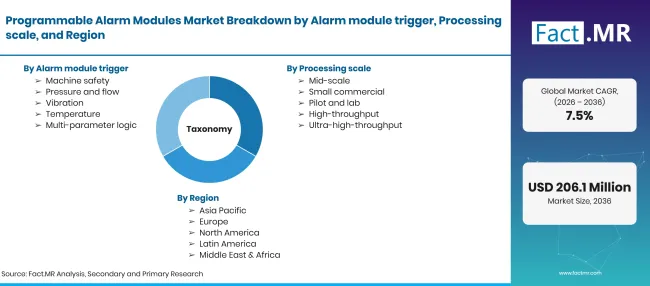
Programmable Alarm Modules Taxonomy | Source: Fact.MR
| Items | Values |
|---|---|
| Quantitative Units (2026) | USD 100.0 million |
| Alarm module trigger | Temperature, Pressure / flow, Vibration, Machine safety, Multi-parameter logic |
| Processing scale | Pilot / lab, Small commercial, Mid-scale, High-throughput, Ultra-high-throughput |
| Operating configuration | Batch, Semi-continuous, Continuous, Modular skid, Integrated line |
| Food / process application | Bakery / wafers, Confectionery / cocoa, Snacks / seasoning, Brewing / grains, Other food / industrial |
| Regions Covered | North America, Latin America, Europe, East Asia, South Asia and Pacific, Middle East and Africa |
| Countries Covered | China, United States, Italy, Germany, Japan and other countries |
| Key Companies Profiled | GEA, JBT Marel, Heat and Control, Bühler, Baker Perkins, tna solutions |
| Additional Attributes | Dollar revenue in the Programmable Alarm Modules Market is segmented by alarm module trigger (temperature, pressure / flow, vibration, machine safety, multi-parameter logic); processing scale (pilot / lab, small commercial, mid-scale, high-throughput, ultra-high-throughput); operating configuration (batch, semi-continuous, continuous, modular skid, integrated line); food / process application (bakery / wafers, confectionery / cocoa, snacks / seasoning, brewing / grains, other food / industrial) and region. |
Source: Fact.MR analysis. Updated Nov 26, 2026
Programmable Alarm Modules Market by Segments
-
Alarm Module Trigger
- Temperature
- Pressure / flow
- Vibration
- Machine safety
- Multi-parameter logic
-
Processing Scale
- Pilot / lab
- Small commercial
- Mid-scale
- High-throughput
- Ultra-high-throughput
-
Operating Configuration
- Batch
- Semi-continuous
- Continuous
- Modular skid
- Integrated line
-
Food / Process Application
- Bakery / wafers
- Confectionery / cocoa
- Snacks / seasoning
- Brewing / grains
- Other food / industrial
-
Region
- North America
- United States
- Canada
- Mexico
- Europe
- Germany
- United Kingdom
- France
- Italy
- Spain
- Rest of Europe
- Asia Pacific
- China
- India
- Japan
- South Korea
- Australia
- Rest of Asia Pacific
- Latin America
- Brazil
- Mexico
- Argentina
- Rest of Latin America
- Middle East and Africa
- GCC Countries
- South Africa
- Rest of Middle East and Africa
- North America
Table of Contents
Key Takeaways
- Market Size and CAGR
- Top Growth Driver
- Fastest Growing Segment
- Leading Region
- Key Companies
- Emerging Opportunities

