
- Market Value (2025): USD 148.8 Mn
- Estimated Value (2026): USD 160.0 Mn
- Forecast Value (2036): USD 329.8 Mn
- CAGR (2026-2036): 7.5%
Defect-Reduction Coating Lines Market Forecast and Outlook 2026 to 2036
The global defect-reduction coating lines market reached a derived estimate of USD 148.8 million in 2025 and stood at USD 160.0 million in 2026. The market is anticipated to reach USD 329.8 million by 2036, expanding at a CAGR of 7.5% during the 2026 to 2036 assessment period.
Food manufacturers are paying closer attention to coating uniformity as minor flaws can affect product appearance, consistency and packaging quality. Uneven batter flow, air bubbles and incomplete coverage also increase rework and material wastage. Automated inspection is becoming increasingly relevant as processors look for ways to identify defects before products reach packaging. A June 2026 report from the UK Food Standards Agency highlighted the growing role of artificial intelligence, computer vision and robotics in food manufacturing, particularly for quality control, production efficiency and waste reduction [3].
Key Takeaways from the Defect-Reduction Coating Lines Market
- Sales of defect-reduction coating lines reached a derived estimate of USD 148.8 million in 2025.
- Defect-Reduction Coating Lines Market Value (2026): USD 160.0 million.
- Defect-Reduction Coating Lines Market Forecast Value (2036): USD 329.8 million.
- Defect-Reduction Coating Lines Market Forecast CAGR (2026-2036): 7.5%.
- Leading Coating Defect Detection: Line-scan vision (25.6%).
- Key Market Participants: GEA, JBT Marel, Heat and Control, Bühler, Baker Perkins and tna solutions.
- Key Growth Regions: United States, China, Italy, Germany and Japan.
Food manufacturers in North America and Europe are looking for ways to maintain consistent production quality without relying entirely on manual inspection. Repetitive visual checks become difficult to sustain across fast-moving production lines, particularly when products have different shapes, textures and coating finishes. Automated inspection helps identify uncovered areas, uneven layers and surface defects while production continues. In June 2026, the UK Food Standards Agency highlighted how computer vision and machine learning could improve quality control and identify production inconsistencies more consistently. These developments are strengthening interest in automated inspection across food-processing facilities .
Defect-Reduction Coating Lines Market
| Metric | Value |
|---|---|
| Market Value (2025) | USD 148.8 million (Derived Estimate) |
| Market Value (2026) | USD 160.0 million |
| Forecast Value (2036) | USD 329.8 million |
| CAGR (2026-2036) | 7.5% |
Source: Fact.MR analysis. Updated Nov 26, 2026
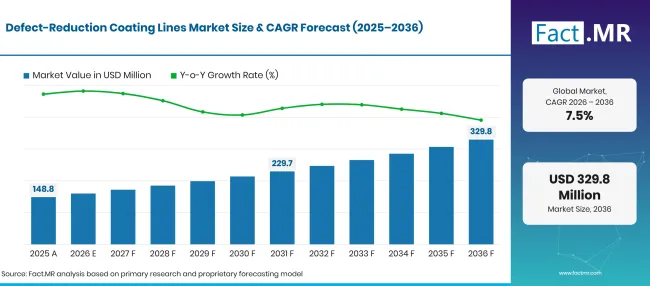
Defect Reduction Coating Lines Forecast Global | Source: Fact.MR
Category
| Category | Segments |
|---|---|
| Coating defect detection | Line-scan vision, Laser thickness, Ultrasonic inspection, Thermal imaging, Multimodal closed-loop |
| Processing scale | Pilot / lab, Small commercial, Mid-scale, High-throughput, Ultra-high-throughput |
| Operating configuration | Batch, Semi-continuous, Continuous, Modular skid, Integrated line |
| Food / process application | Bakery / wafers, Confectionery / cocoa, Snacks / seasoning, Brewing / grains, Other food / industrial |
| Region | United States, China, Italy, Germany, Japan |
Source: Fact.MR analysis. Updated Nov 26, 2026
Segmental Analysis
Why does Line-scan vision lead detection demand in the Defect-Reduction Coating Lines Market?
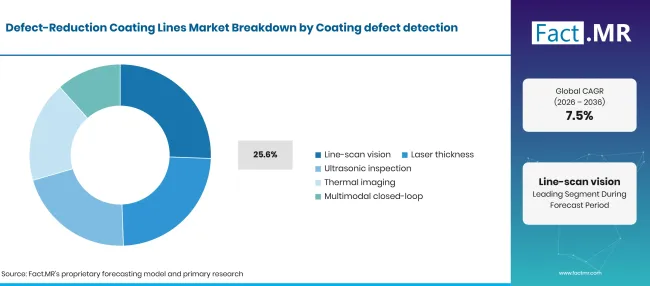
Defect Reduction Coating Lines Breakdown Coating Defect Detection | Source: Fact.MR
At a 25.6% share, line-scan vision generates USD 41.0 million in 2026 as food processors seek faster ways to identify bare patches, colour variations and uneven coating across moving products. These cameras examine product surfaces throughout the production run while reducing reliance on occasional manual checks.Ultrasonic inspection is gaining attention for applications requiring deeper material assessment, while laser thickness measurement appeals to manufacturers seeking precise coating control. In June 2026, the UK Food Standards Agency highlighted computer vision as an emerging tool for improving food inspection and quality assessment.
Why does the Mid-scale segment lead scale demand in the Defect-Reduction Coating Lines Market?
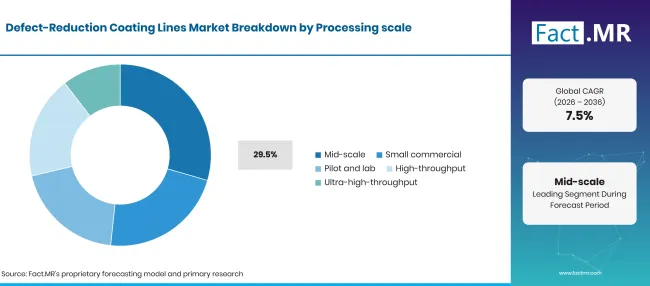
Defect Reduction Coating Lines Breakdown Processing Scale | Source: Fact.MR
Mid-scale installations generate USD 47.2 million in 2026, capturing 29.5% of the market. Many food processors prefer upgrading selected production lines before committing to extensive factory automation. This makes mid-sized inspection installations suitable for businesses seeking better quality checks without major infrastructure changes. Pilot units also attract manufacturers that want to test detection accuracy before wider installation. Large-scale configurations appeal to established facilities running several coating lines. India's Ministry of Food Processing Industries encourages modernization and capacity expansion through its food-processing unit scheme, creating a favourable environment for equipment upgrades .
Why does Continuous operation lead configuration demand in the Defect-Reduction Coating Lines Market?
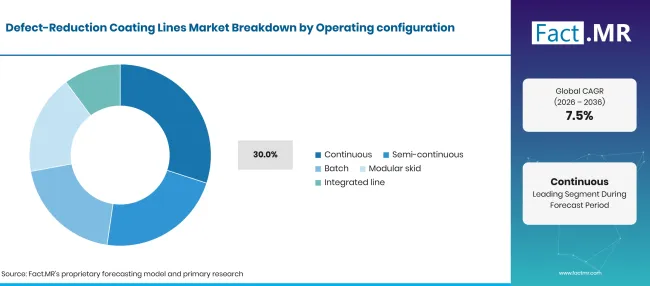
Defect Reduction Coating Lines Breakdown Operating Configuration | Source: Fact.MR
Long production runs make continuous inspection particularly useful, placing this configuration at a 30.0% share worth USD 48.0 million in 2026. Manufacturers can monitor coating consistency while products move through applicators and conveyors, avoiding repeated stoppages for manual checks. Integrated configurations are also gaining attention as processors connect inspection sensors directly with coating controls. Batch systems remain relevant for facilities handling smaller production volumes or frequent recipe changes. India's food-processing modernization scheme also encourages capacity expansion and the introduction of modern technologies to improve processing efficiency and finished-product quality.
Why does Other food / industrial lead application demand in the Defect-Reduction Coating Lines Market?
Defect Reduction Coating Lines Breakdown Food And Process Application | Source: Fact.MR
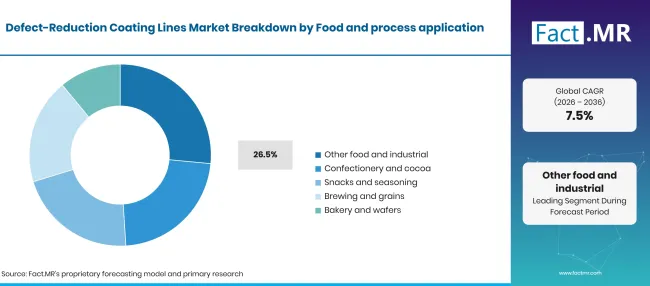
Frozen foods, nutrition bars, pet treats and pharmaceutical coatings give this category a broad application base, generating USD 42.4 million in 2026 at a 26.5% share. Each product type presents different inspection challenges, from uneven batter coverage to inconsistent protective layers. Brewing and grain processing also offer opportunities as manufacturers improve process monitoring, while confectionery producers focus on appearance and coating thickness. APEDA reported India's processed food exports at USD 8.03 billion in FY 2025-26, India's processed food exports reached USD 8.03 billion in FY 2025-26. This scale reinforces the importance of consistent production quality.
Defect-Reduction Coating Lines Market: Drivers, Restraints and Trends
Driver: Growing Pressure to Maintain Consistent Coating Quality:
Food manufacturers have little room for visible defects when supplying products to major retailers and established brands. A patchy chocolate layer, uneven batter coverage or cracked coating can make an otherwise acceptable product unsuitable for sale. Automated defect-reduction coating lines help identify problems before entire batches are affected, saving ingredients and reducing rework. In March 2026, FSSAI emphasized risk-based inspections and stronger surveillance of high-risk food categories, reinforcing the importance of consistent food quality oversight.
Restraint: High Installation and Calibration Expenses:
For smaller food processors, the cost of introducing automated coating inspection goes beyond purchasing the equipment. Cameras, lighting arrangements, sensors, software integration and operator training add to the initial investment. Each product may also require separate calibration because a system trained to recognize defects on a chocolate-coated bar may not perform equally well on frozen snacks or textured confectionery. False alerts during initial operation create another problem, as acceptable products may be rejected and production teams may need time to correct the settings. These expenses make investment harder to justify for plants running shorter production batches or handling frequent product changes.
Trend: AI-Based Inspection Creates Scope for More Adaptable Quality Checks:
Food inspection is moving beyond fixed image thresholds, with machine learning helping systems distinguish genuine defects from natural differences in product colour, shape and texture. This is particularly relevant to coating lines handling several recipes and product formats during the same shift. A June 2026 report from the UK Food Standards Agency examined the growing use of AI across food manufacturing, including computer vision, robotics and machine learning. It highlighted opportunities to improve quality control, identify non-conformances and reduce production waste. These developments create scope for inspection models that adapt to changing ingredients and surface finishes.
Trend: Connecting Inspection Results with Coating Process Adjustments:
A major opportunity lies in making inspection systems more useful after a defect has been identified. Instead of simply flagging uneven coverage, future installations could use inspection data to guide changes in applicator settings, coating flow, conveyor speed and material delivery. This would help processors correct recurring problems before they affect larger batches. The opportunity extends across frozen foods, confectionery, bakery products and nutrition bars, where coating consistency affects both appearance and material usage. The UK Food Standards Agency's 2026 assessment of AI in food manufacturing also highlights the scope for more connected and responsive production systems.
Defect-Reduction Coating Lines Market Analysis by Key Country
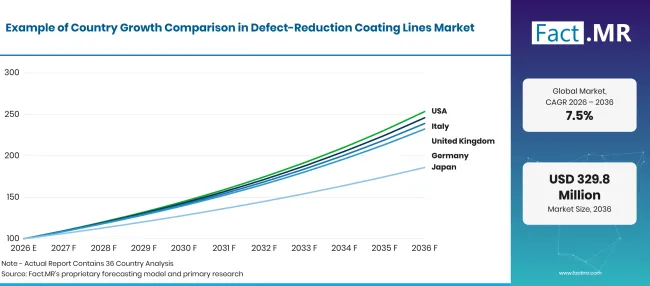
Defect Reduction Coating Lines Growth Index | Source: Fact.MR
| Country | CAGR (2026-2036) |
|---|---|
| United States | 11.3% |
| China | 9.1% |
| Italy | 9.0% |
| Germany | 8.8% |
| Japan | 6.4% |
Source: Fact.MR analysis. Updated Nov 26, 2026
Why is the United States the fastest-growing market for defect-reduction coating lines?
The United States offers considerable growth opportunities for automated coating inspection because of its large food and beverage manufacturing base.
Snack, bakery, confectionery and frozen food producers require consistent product finishes across high-volume production runs. Manual inspection becomes less practical as output increases, encouraging investment in automated quality checks. According to the U.S. Bureau of Labor Statistics, food and beverage manufacturing employed around 2.1 million people in 2024, with employment expected to exceed 2.2 million by 2034. This expanding manufacturing base creates further opportunities for inspection and process-control equipment.
What is driving defect-reduction coating line demand in China?
China's food manufacturing industry is moving towards digitally monitored production, creating favourable conditions for automated coating inspection.
Manufacturers are looking for ways to track product quality and identify processing inconsistencies with greater accuracy. A major policy development came in June 2025, when seven government departments introduced the Food Industry Digital Transformation Implementation Plan. The initiative targets digital management coverage of 80% at key enterprises and a 75% rate of numerical control in key production processes at major food enterprises by 2027. This policy is encouraging investment in machine vision, sensors and connected production equipment.
What is shaping defect-reduction coating line demand in Italy?
Italy's established food industry is creating opportunities for equipment that improves product appearance and reduces processing losses.
This is particularly relevant to confectionery, bakery and specialty food producers, where coating quality influences the finished product. Official Istat figures show that Italy's agri-food sector generated EUR 89 billion in value added in 2025, compared with EUR 83.4 billion in 2024. Food, beverage and tobacco manufacturing recorded 1.4% growth in volume during the year. This expansion strengthens the case for equipment that maintains consistent production quality across food-processing facilities.
What is shaping defect-reduction coating line demand in Germany?
Germany's established food manufacturing industry creates a strong base for advanced coating inspection systems.
Manufacturers are looking for equipment that maintains uniform coverage during long production cycles and reduces avoidable material waste. According to Germany's Federal Statistical Office, domestic production of ready meals reached 1.7 million tonnes in 2024, with production value reaching EUR 5.9 billion. The value of ready-meal production also increased by 2.8% during the first three quarters of 2025 compared with the same period in 2024. This activity across prepared food manufacturing creates opportunities for automated inspection and coating-control installations.
What is supporting steady growth in Japan's defect-reduction coating lines market?
Japan's food factories are increasingly looking for ways to maintain production output while reducing repetitive manual work.
Visual inspection can become difficult to sustain when experienced production staff are in short supply, making automated defect detection a practical alternative. In June 2025, Japan's Ministry of Agriculture, Forestry and Fisheries launched its Food Industry Productivity Improvement Forum to help manufacturers adopt advanced technologies and connect with technical specialists. The initiative promotes robotics, AI and IoT adoption across food manufacturing. These efforts are encouraging processors to consider automated inspection and coating systems.
Competitive Landscape for Defect-Reduction Coating Lines Market
The market features companies offering complete food-processing lines alongside specialists concentrating on individual coating operations. GEA and JBT Marel cater to processors seeking broader equipment integration, while Heat and Control, Baker Perkins and tna solutions focus on specialized processing machinery. Bühler also participates through its food-processing and confectionery equipment portfolio.
Recent developments show greater attention to product quality and production consistency. In September 2025, JBT Marel introduced its IRIS FP vision inspection system to identify product defects during processing. GEA followed with its ProCoater wet coating system in October 2026, featuring adjustable scrapers and smart air knives to improve coating consistency. Buyers are placing greater weight on inspection accuracy, easier cleaning, lower product rejection and operating costs. Manufacturers that connect defect detection with automatic coating adjustments are gaining an important competitive advantage.
Recent Developments
- On October 19, 2026, GEA introduced its ProCoater wet coating system, featuring adjustable scrapers and smart air knives to improve coating consistency and reduce foam formation by up to 80%.
- On September 30, 2025, JBT Marel introduced its IRIS FP visual inspection system, which scans products across the conveyor belt to identify defects and alert processors to quality deviations before rejects occur.
- On June 2, 2025, Heat and Control acquired Fabcon Food Systems Ltd, a UK-based manufacturer of food-processing and handling equipment, strengthening its capabilities in snack, French fry and protein processing.
- On May 7, 2026, Bühler introduced several food-processing innovations at Interpack 2026, including its Lucent cocoa roaster, Nutrex 7 Series extruder and upgraded chocolate-processing equipment to improve production efficiency and hygiene.
- On September 23, 2026, tna solutions partnered with Mohammed Riaz & Partner LLC to establish a new potato chip production line in Oman with a capacity of 300 kg per hour and packaging speeds of 120 packs per minute.
Key Players in Defect-Reduction Coating Lines Market
Key companies operating in the market include GEA, JBT Marel, Heat and Control, Bühler, Baker Perkins, and tna solutions.
- GEA
- JBT Marel
- Heat and Control
- Bühler
- Baker Perkins
- tna solutions
Bibliography
- Agricultural and Processed Food Products Export Development Authority. (2026). Processed foods.
- Destatis. (2026, January 14). Production of ready meals increased by 25.6% in five years. Federal Statistical Office of Germany.
- Food Standards Agency. (2026, June 25). Science Council report of project: Artificial intelligence applications in food safety and authenticity. GOV.UK.
- Food Safety and Standards Authority of India. (2026, March 2). FSSAI CEO calls for nationwide crackdown on high-risk food commodities at 49th CAC meeting.
- Istat. (2026). Economic accounts for agriculture: Year 2025. Italian National Institute of Statistics
- Ministry of Agriculture, Forestry and Fisheries. (2025, June 10). Productivity improvement in food manufacturing and related industries. Government of Japan.
- Ministry of Food Processing Industries. (n.d.). Creation/expansion of food processing and preservation capacities (Unit Scheme). Government of India.
- Ministry of Industry and Information Technology, Ministry of Education, Ministry of Human Resources and Social Security, People's Bank of China, State Administration for Market Regulation, National Food and Strategic Reserves Administration, & National Data Administration. (2025, June 10). Notice on issuing the Food Industry Digital Transformation Implementation Plan. Government of China.
- U.S. Bureau of Labor Statistics. (2026, July 1). A recipe for growth: Food and beverage manufacturing projected to expand through 2034.
Segmentation
Scope of Report
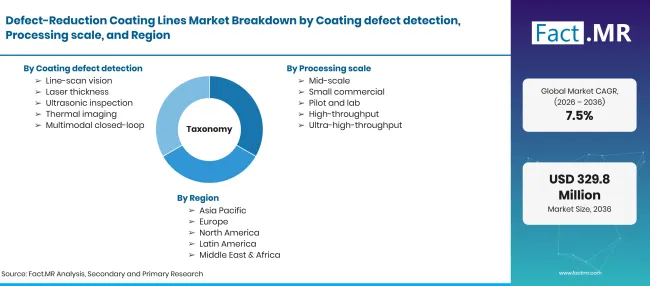
Defect Reduction Coating Lines Taxonomy | Source: Fact.MR
| Items | Values |
|---|---|
| Quantitative Units (2026) | USD 160.0 million |
| Coating defect detection | Line-scan vision, Laser thickness, Ultrasonic inspection, Thermal imaging, Multimodal closed-loop |
| Processing scale | Pilot / lab, Small commercial, Mid-scale, High-throughput, Ultra-high-throughput |
| Operating configuration | Batch, Semi-continuous, Continuous, Modular skid, Integrated line |
| Food / process application | Bakery / wafers, Confectionery / cocoa, Snacks / seasoning, Brewing / grains, Other food / industrial |
| Regions Covered | North America, Latin America, Europe, East Asia, South Asia and Pacific, Middle East and Africa |
| Countries Covered | United States, China, Italy, Germany, Japan and other countries |
| Key Companies Profiled | GEA, JBT Marel, Heat and Control, Bühler, Baker Perkins, tna solutions |
| Additional Attributes | Dollar revenue in the Defect-Reduction Coating Lines Market is segmented by coating defect detection (line-scan vision, laser thickness, ultrasonic inspection, thermal imaging, multimodal closed-loop); processing scale (pilot / lab, small commercial, mid-scale, high-throughput, ultra-high-throughput); operating configuration (batch, semi-continuous, continuous, modular skid, integrated line); food / process application (bakery / wafers, confectionery / cocoa, snacks / seasoning, brewing / grains, other food / industrial) and region. |
Source: Fact.MR analysis. Updated Nov 26, 2026
Defect-Reduction Coating Lines Market by Segments
-
Coating defect detection
- Line-scan vision
- Laser thickness
- Ultrasonic inspection
- Thermal imaging
- Multimodal closed-loop
-
Processing scale
- Pilot / lab
- Small commercial
- Mid-scale
- High-throughput
- Ultra-high-throughput
-
Operating configuration
- Batch
- Semi-continuous
- Continuous
- Modular skid
- Integrated line
-
Food / process application
- Bakery / wafers
- Confectionery / cocoa
- Snacks / seasoning
- Brewing / grains
- Other food / industrial
-
Region
- North America
- United States
- Canada
- Mexico
- Europe
- Germany
- United Kingdom
- France
- Italy
- Spain
- Rest of Europe
- Asia Pacific
- China
- India
- Japan
- South Korea
- Australia
- Rest of Asia Pacific
- Latin America
- Brazil
- Mexico
- Argentina
- Rest of Latin America
- Middle East and Africa
- GCC Countries
- South Africa
- Rest of Middle East and Africa
- North America
Table of Contents
Key Takeaways
- Market Size and CAGR
- Top Growth Driver
- Fastest Growing Segment
- Leading Region
- Key Companies
- Emerging Opportunities

