
- Market Value (2025): USD 68.2 Mn
- Estimated Value (2026): USD 73.0 Mn
- Forecast Value (2036): USD Mn
- CAGR (2026-2036): 7.0%
Inline Quality Control Units Market Forecast and Outlook 2026 to 2036
The inline quality control units market stands at USD 73.0 million in 2026, with revenue anticipated to reach USD 143.6 million by 2036. This represents a 7.0% CAGR over the ten-year period, as manufacturers invest in inspection systems that monitor product quality during production.
Inline quality control systems can combine optical inspection, metal detection, checkweighing, and spectroscopy according to the process. On May 15, 2025, Bühler introduced its SORTEX AI700 optical sorter, which applies deep learning to impurity detection, initially for oat processing.
Key Takeaways from Inline Quality Control Units Market
- Sales of inline quality control units stood at USD 68.2 million in 2025
- Inline Quality Control Units Market Value (2026): USD 73.0 million
- Inline Quality Control Units Market Forecast Value (2036): USD 143.6 million
- Inline Quality Control Units Market Forecast CAGR (2026-2036): 7.0%
- Leading Inline QC principle: Machine vision (31.2%)
- Key Market Participants: GEA, JBT Marel, Heat and Control, Bühler, tna solutions
- Key Growth Countries: China, United States, Switzerland, Germany, Japan
Food manufacturers use checkweighing, metal detection, and optical inspection for quality checks selected according to product risks and line configuration. Mettler-Toledo supplies integrated inspection systems, including checkweighing, metal detection, and machine vision.
Inline Quality Control Units Market
| Metric | Value |
|---|---|
| Estimated Value in (2026) | USD 73.0 million |
| Forecast Value in (2036) | USD 143.6 million |
| Forecast CAGR (2026 to 2036) | 7.0% |
Source: Fact.MR analysis.
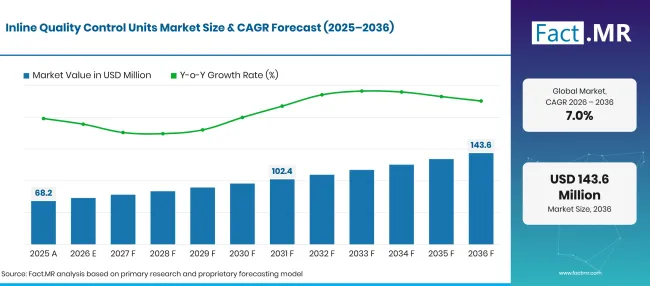
Inline Quality Control Units Forecast Global | Source: Fact.MR
Category
| Category | Segments |
|---|---|
| Inline QC principle | Machine vision, Near-infrared, Metal detection, Checkweighing, Multi-sensor |
| Processing scale | Pilot / lab, Small commercial, Mid-scale, High-throughput, Ultra-high-throughput |
| Operating configuration | Batch, Semi-continuous, Continuous, Modular skid, Integrated line |
| Food / process application | Bakery / wafers, Confectionery / cocoa, Snacks / seasoning, Brewing / grains, Other food / industrial |
| Country | China; United States; Switzerland; Germany; Japan |
Source: Fact.MR analysis.
Segmental Analysis
Why does machine vision lead QC principle demand in the Inline Quality Control Units Market?
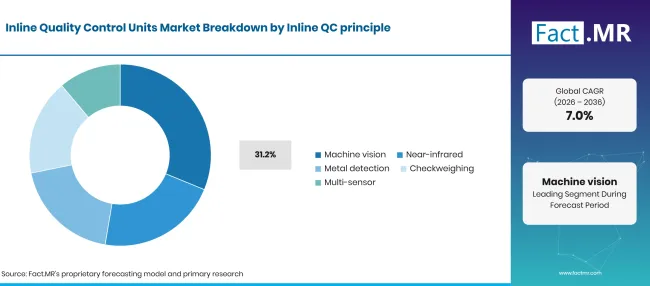
Inline Quality Control Units Breakdown Inline Qc Principle | Source: Fact.MR
Machine vision accounts for 31.2% of revenue in 2026, approximately USD 22.8 million, as automated cameras identify differences in product color, shape and surface appearance. TOMRA's optical sorting technologies demonstrate how imaging supports defect detection and foreign material removal. Manufacturers are introducing AI-assisted inspection to improve sorting accuracy while maintaining production speed.
Why does the high-throughput segment lead scale demand in the Inline Quality Control Units Market?
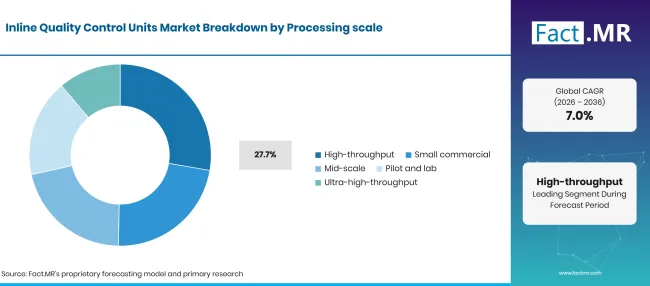
Inline Quality Control Units Breakdown Processing Scale | Source: Fact.MR
High-throughput facilities represent 27.7% of revenue in 2026, valued at approximately USD 20.2 million, reflecting the need to inspect large production volumes without relying entirely on manual checks. Automated inspection systems examine products at line speed and identify quality deviations. Equipment selection centers on detection accuracy and integration with existing manufacturing controls.
Why does semi-continuous operation lead configuration demand in the Inline Quality Control Units Market?
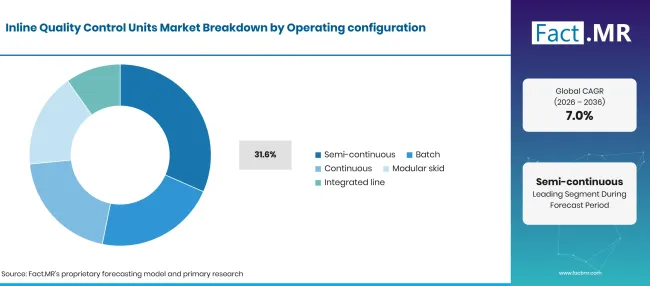
Inline Quality Control Units Breakdown Operating Configuration | Source: Fact.MR
Semi-continuous operation holds 31.6% of revenue in 2026, equivalent to approximately USD 23.1 million, as manufacturers position inspection equipment between separate processing stages. These arrangements accommodate scheduled production interruptions, product changes and intermediate quality checks. Modular inspection units can be incorporated into existing conveying lines. Processors prioritize installation flexibility and convenient access for cleaning and maintenance.
Why does brewing / grains lead application demand in the Inline Quality Control Units Market?
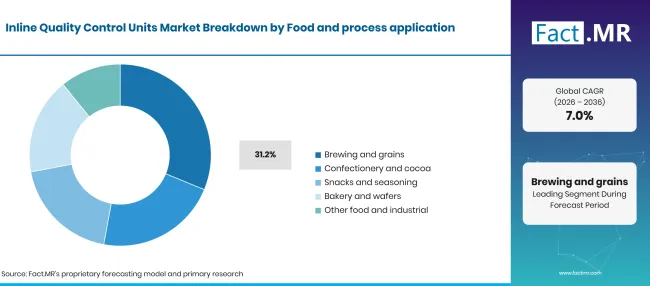
Inline Quality Control Units Breakdown Food And Process Application | Source: Fact.MR
Brewing and grains contribute 31.2% of revenue in 2026, approximately USD 22.8 million, supported by quality inspection requirements across grain handling and malt processing. Bühler's SORTEX optical systems identify defective kernels and foreign materials, with selected configurations supporting mycotoxin risk reduction. Grain processors also use spectroscopic instruments for compositional analysis. Inspection methods must match the specific quality parameter.
Inline Quality Control Units Market: Drivers, Restraints and Trends
Drivers
Food processors are strengthening quality assurance through optical sorting, metal detection and near-infrared inspection. These technologies help identify foreign materials, product defects and composition differences. Equipment selection depends on product characteristics, detection requirements and integration with existing production lines.
Restraints
False rejects increase material waste, while frequent calibration and equipment maintenance create additional operating costs. Smaller processors may face difficulties managing complex inspection settings. Manufacturers are improving detection accuracy, calibration support and operator interfaces to simplify routine quality control.
Trend: AI-Driven Optical Sorting
Deep-learning technologies are improving automated defect recognition in food processing. TOMRA's LUCAi platform uses trained AI models to distinguish product defects during sorting. Equipment developers are refining classification accuracy and rejection controls to reduce unnecessary product losses.
Trend: Inline NIR for Grain Quality:
Grain processors are introducing inline near-infrared analyzers to monitor moisture and protein content during handling and milling. FOSS offers ProFoss 2 for continuous whole-grain measurements. These instruments support process adjustments, quality consistency and reduced dependence on manual sampling.
Inline Quality Control Units Market by key country
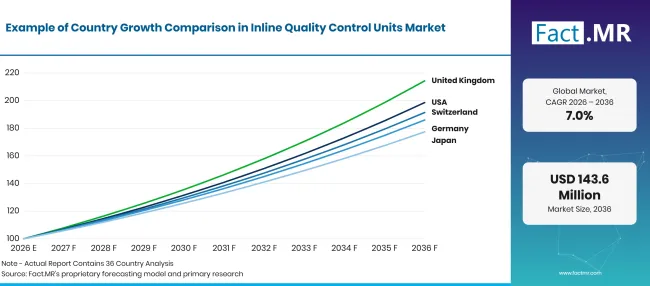
Inline Quality Control Units Growth Index | Source: Fact.MR
| Country | CAGR (2026-2036) |
|---|---|
| China | 8.6% |
| United States | 7.1% |
| Switzerland | 6.6% |
| Germany | 6.4% |
| Japan | 5.9% |
Source: Fact.MR analysis.
Why is China the fastest-growing market for inline quality control units?
Demand for inline quality control units in China carries an 8.6% CAGR through 2036, the fastest among the five countries.
Large grain processors are investing in automated inspection to improve sorting accuracy and reduce foreign material contamination. China's Food Safety Law was amended on 12 September 2025, effective 1 December 2025, mainly for bulk liquid food transport and liquid infant formula, and the market regulator released a draft comprehensive revision for public comment on 10 October 2026. Optical inspection and automated rejection systems provide practical options for high-volume production.
What is shaping inline quality control unit sales in the United States?
Sales of inline quality control units in the United States are gaining momentum as food manufacturers strengthen automated inspection and production monitoring.
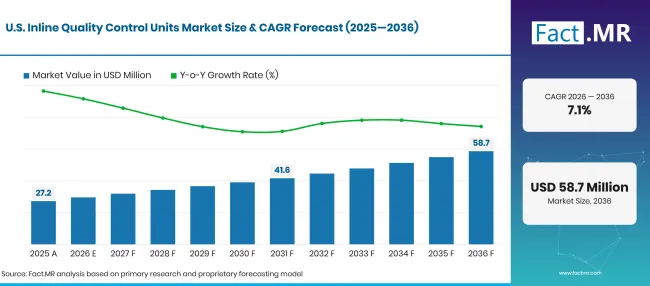
Inline Quality Control Units Forecast Usa | Source: Fact.MR
The FDA's Food Traceability Rule is encouraging affected processors to improve recordkeeping and product tracking. Machine vision, metal detection and checkweighing systems help manufacturers identify defects and maintain consistent product quality.
What is shaping inline quality control unit demand in Switzerland?
Demand for inline quality control units in Switzerland is set to increase at a 6.6% CAGR through 2036, supported by precision engineering and specialized food inspection technologies.
Uzwil-based Bühler develops SORTEX optical sorters for detecting defective grains and foreign materials. Mettler-Toledo, headquartered in Greifensee, supplies metal detection, X-ray inspection and checkweighing equipment. Swiss food manufacturers can integrate these technologies into automated production environments.
What is shaping inline quality control unit demand in Germany?
Demand for inline quality control units in Germany is likely to expand at a 6.4% CAGR through 2036 as bakeries and ingredient processors modernize inspection practices.
Sesotec, based in Schönberg, develops metal detection, X-ray inspection and sorting technologies, while Hamburg-based Minebea Intec supplies weighing and foreign material detection systems. German food manufacturers are examining automated inspection to strengthen consistency across production batches.
Why is inline quality control unit growth slower in Japan?
Demand for inline quality control units in Japan is forecast to rise at a 5.9% CAGR through 2036, the slowest among the five countries.
Established inspection equipment and domestic manufacturing expertise create a replacement-oriented market. Ishida supplies X-ray systems designed to identify foreign materials in packaged foods, while Anritsu provides checkweighers, metal detectors and X-ray inspection equipment. Japanese processors may prioritize upgrading detection software and improving equipment reliability rather than replacing complete production lines.
Competitive Landscape for Inline Quality Control Units Market
Inspection accuracy and product recovery are important areas of competition in the inline quality control units market. Bühler addresses grain and food processors through SORTEX optical sorting systems, including AI-assisted defect identification. JBT Marel specializes in X-ray inspection and machine vision for meat and prepared foods. Heat and Control provides metal detectors, checkweighers and X-ray equipment through partnerships with Ishida and CEIA. tna solutions supplies integrated metal detection for high-speed snack packaging lines. GEA competes through broader processing automation.
Recent development has emphasized improved inspection capacity without sacrificing detection performance. In July 2026, JBT Marel introduced SensorX Xpress software for X-ray bone detection in poultry, which raises inspection capacity by up to 20% through upgraded image processing. Bühler's SORTEX AI700 also illustrates the growing use of AI-based defect recognition. Suppliers offering reliable detection, efficient rejection and accessible inspection records can strengthen relationships with food manufacturers.
Recent Developments
- In August 2025, GEA acquired Flocmix to expand its real-time centrate monitoring and process-control capabilities for water and wastewater treatment. The deal illustrates sensor integration in an adjacent application.
- In January 2025, JBT completed its acquisition of Marel, combining food processing equipment portfolios. The transaction brought Marel's established inspection technologies into the combined business alongside automation, processing, and integrated production solutions.
Key Players in Inline Quality Control Units Market
Key companies operating in the Inline Quality Control Units Market include GEA, JBT Marel, Heat and Control, Bühler, and tna solutions.GEA
- JBT Marel
- Heat and Control
- Bühler
- tna solutions
Bibliography
- Bühler Group. (2025, May 15). Deep learning powers Bühler’s new SORTEX AI700. Uzwil: Bühler Group.
- Bühler Group. (2025). Annual Report 2024.
- Bühler Group. (2026, September). Seeing the difference: AI redefines optical sorting.
- GEA Group Aktiengesellschaft. (2025, August 19). GEA expands portfolio for water and wastewater treatment.
- JBT Marel Corporation. (2025, February 28). Annual report for the fiscal year ended December 31, 2024 [Form 10-K].
- JBT Marel. (2026, July 14). 20% capacity boost with SensorX Xpress.
- Mettler-Toledo International Inc. (2025). 2024 Annual Report.
- U.S. Food and Drug Administration. (2026, November 6). FDA public meeting: Challenges and solutions in lot-level food traceability.
- U.S. Food and Drug Administration. (2026, February 19). FDA takes several actions related to the Food Traceability Rule.
- U.S. Food and Drug Administration. (2026, October). Guidance for industry: Requirements for additional traceability records for certain foods—Enforcement policy for certain retail food establishments and restaurants [Draft guidance].
- U.S. Food and Drug Administration. (2025, March 20). FDA intends to extend compliance date for Food Traceability Rule.
Segmentation
Scope of Report
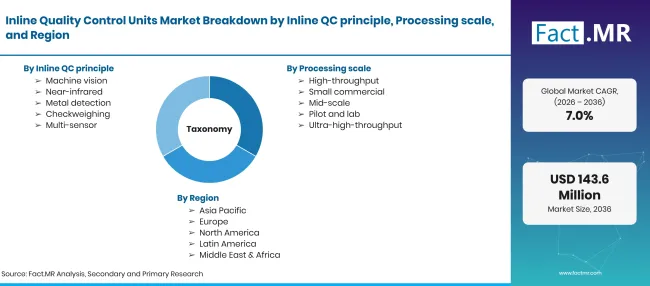
Inline Quality Control Units Taxonomy | Source: Fact.MR
| Items | Values |
|---|---|
| Quantitative Units (2026) | USD Million |
| Inline QC principle | Machine vision, Near-infrared, Metal detection, Checkweighing, Multi-sensor |
| Processing scale | Pilot / lab, Small commercial, Mid-scale, High-throughput, Ultra-high-throughput |
| Operating configuration | Batch, Semi-continuous, Continuous, Modular skid, Integrated line |
| Food / process application | Bakery / wafers, Confectionery / cocoa, Snacks / seasoning, Brewing / grains, Other food / industrial |
| Regions Covered | North America, Latin America, Europe, East Asia, South Asia and Pacific, Middle East & Africa |
| Countries Covered | China, United States, Switzerland, Germany, Japan, and other countries |
| Key Companies Profiled | GEA, JBT Marel, Heat and Control, Bühler, tna solutions |
| Additional Attributes | Dollar revenue in the Inline Quality Control Units Market is segmented by inline QC principle (machine vision, near-infrared, metal detection, checkweighing, multi-sensor); processing scale (pilot / lab, small commercial, mid-scale, high-throughput, ultra-high-throughput); operating configuration (batch, semi-continuous, continuous, modular skid, integrated line); food / process application (bakery / wafers, confectionery / cocoa, snacks / seasoning, brewing / grains, other food / industrial) and region. |
Source: Fact.MR analysis.
Inline Quality Control Units Market by Segments
-
Inline QC principle
- Machine vision
- Near-infrared
- Metal detection
- Checkweighing
- Multi-sensor
-
Processing scale
- Pilot / lab
- Small commercial
- Mid-scale
- High-throughput
- Ultra-high-throughput
-
Operating configuration
- Batch
- Semi-continuous
- Continuous
- Modular skid
- Integrated line
-
Food / process application
- Bakery / wafers
- Confectionery / cocoa
- Snacks / seasoning
- Brewing / grains
- Other food / industrial
-
Region:
- North America
- United States
- Canada
- Mexico
- Europe
- Germany
- United Kingdom
- France
- Italy
- Spain
- Rest of Europe
- Asia Pacific
- China
- India
- Japan
- South Korea
- Australia
- Rest of Asia Pacific
- Latin America
- Brazil
- Argentina
- Rest of Latin America
- Middle East & Africa
- GCC Countries
- South Africa
- Rest of Middle East & Africa
- North America
Table of Contents
Key Takeaways
- Market Size and CAGR
- Top Growth Driver
- Fastest Growing Segment
- Leading Region
- Key Companies
- Emerging Opportunities

