- Market Value (2025): USD 1.4 Bn
- Estimated Value (2026): USD 1.6 Bn
- Forecast Value (2036): USD 5.8 Bn
- CAGR (2026-2036): 13.5%
What is the Encapsulated Salicylic Acid Serums Market forecast to be worth by 2036?
USD 1.6 Billion in 2026 to USD 5.8 Billion by 2036, at 13.5% CAGR.
- The Encapsulated Salicylic Acid Serums Market reached USD 1.4 Billion in 2025.
- Demand is projected to increase from USD 1.6 Billion in 2026 to USD 5.8 Billion by 2036.
- The market is forecast to record 13.5% CAGR from 2026 to 2036 as acne-care brands and contract formulators use encapsulation to balance efficacy with skin comfort.
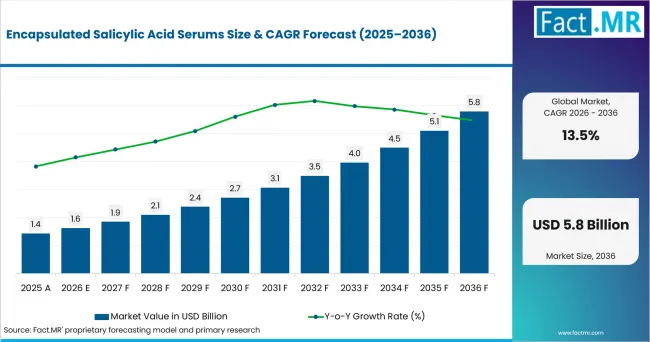
Encapsulated Salicylic Acid Serums Value Analysis | Source: Fact.MR
What are the defining numbers behind Encapsulated Salicylic Acid Serums Market growth?
USD 4.2 Billion absolute opportunity by 2036, led by lipid encapsulation, <0.5% SA and acne care.
- Demand Drivers in the Market
- Acne-care brands need controlled BHA delivery because leave-on serums must feel tolerable during daily or alternate-day routines.
- Dermatologist-led labels need clearer active positioning supported by concentration discipline, especially where sensitive-skin users avoid harsh exfoliation.
- Mass beauty retailers need stable low-strength products that fit repeat purchase. FDA reported 1,298,361 unique, active cosmetic product listings under MoCRA as of June 30, 2026.
- Contract manufacturers need carrier systems that keep salicylic acid evenly dispersed during filling, storage and e-commerce shipment.
- Key Segments Analyzed
- By Encapsulation: Lipid encapsulation is expected to hold 34.0% share in 2026 due to its fit with oil-soluble actives and lighter skin feel.
- By Serum Strength: <0.5% SA is projected to account for 37.0% share in 2026 because entry-level strengths support wider daily-use positioning.
- By Application: Acne care is anticipated to capture 33.0% share in 2026, supported by familiar salicylic acid use in blemish-prone routines.
- By Release Profile: Immediate release is estimated to represent 36.0% share in 2026 owing to simpler formulation routes and clear user feedback.
- Analyst Opinion at Fact.MR
- Shambhu Nath Jha, Principal Consultant at Fact.MR, states, "Encapsulation is changing how brands discuss salicylic acid. The market is expected to reward systems that make BHA serums easier to tolerate while keeping acne-care positioning clear. Suppliers should combine carrier science, irritation testing and regulatory documentation so formulators move faster from lab batch to shelf."
- Strategic Implications
- Ingredient suppliers should document active loading, release behavior and compatibility with water-light serum bases.
- Beauty brands should pair low-strength salicylic acid claims with skin-comfort language that avoids drug-style promises.
- Retail teams should plan pricing around routine replenishment. BLS recorded USD 978 average annual spending on personal care products and services per consumer unit in 2024.
- Regulatory teams should align salicylic acid concentration, label language and product-listing records before launch.
Japan is estimated to post 13.8% CAGR through 2036, supported by drugstore skin-care routines and online replenishment. China is forecast to record 13.5% CAGR as cosmetics filings keep local launches active. France is anticipated to advance at 13.4% CAGR due to beauty retail depth and export capability. The USA is projected to hold 13.0% CAGR, reinforced by MoCRA listing discipline and personal-care spending. Germany is expected to reach 12.8% CAGR as EU safety review shapes ingredient documentation and supplier selection.
How does the Encapsulated Salicylic Acid Serums Market break down by segment?
Lipid encapsulation leads Encapsulation at 34.0%; <0.5% SA leads Serum Strength at 37.0%.
Which Encapsulation dominates?
Lipid encapsulation is expected to hold 34.0% share in 2026.
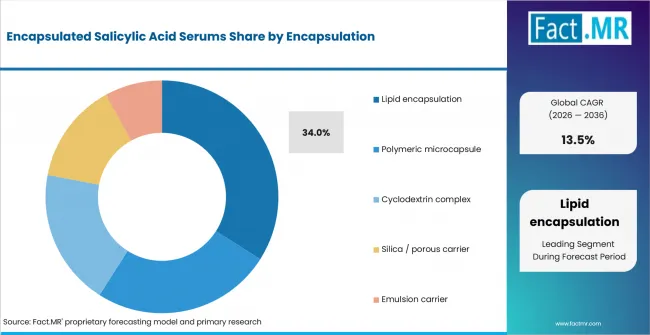
Encapsulated Salicylic Acid Serums Analysis By Encapsulation | Source: Fact.MR
Lipid encapsulation is expected to hold 34.0% share in 2026 because it fits oil-soluble actives and skin-barrier language. Polymeric microcapsules serve brands that need firmer release control in longer-use products. Cyclodextrin complexes and porous carriers support odor, stability and texture targets.
What leads the Serum Strength segment?
<0.5% SA is projected to account for 37.0% share in 2026.
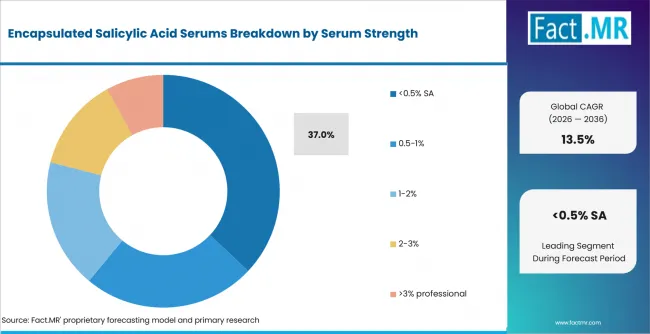
Encapsulated Salicylic Acid Serums Analysis By Serum Strength | Source: Fact.MR
<0.5% SA is projected to account for 37.0% share in 2026, supported by users who want blemish care with a softer exfoliation step. In its final opinion published on May 2, 2025, the SCCS reported that an applicant proposed reducing salicylic acid in leave-on products to 0.15% for children aged 3-10 years; the SCCS concluded that the proposed concentrations would be safe for that age group.
How does Application shape demand?
Acne care is anticipated to capture 33.0% share in 2026.
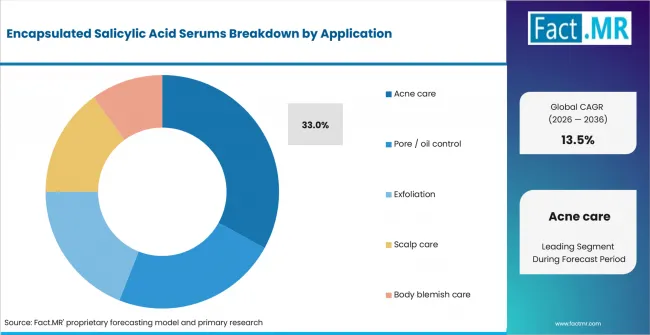
Encapsulated Salicylic Acid Serums Analysis By Application | Source: Fact.MR
Acne care is anticipated to capture 33.0% share in 2026, led by the familiar role of salicylic acid in blemish-prone routines. Pore and oil-control serums align with astringent skin care products where sebum language guides shopper comparison. Exfoliation remains a secondary route because acids need clear use directions and tolerability claims.
What supports Immediate within Release Profile?
Immediate release is estimated to represent 36.0% share in 2026.
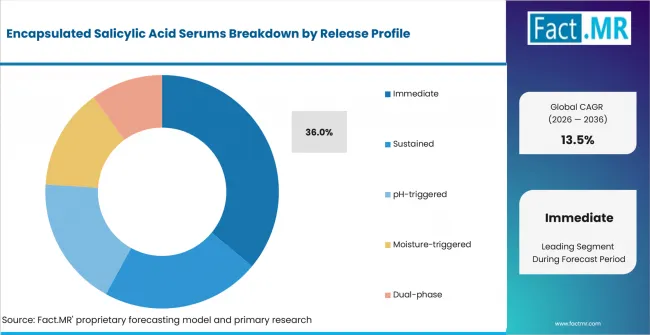
Encapsulated Salicylic Acid Serums Analysis By Release Profile | Source: Fact.MR
Immediate release is estimated to represent 36.0% share in 2026 owing to lower formulation complexity and faster consumer feedback. Sustained release suits premium serums where brands need longer comfort messaging. pH-triggered and moisture-triggered profiles remain more technical, so they need stronger explanation at shelf.
What is accelerating Encapsulated Salicylic Acid Serums Market adoption, and what is holding it back?
Active-stability needs drive it; irritation risk restrains it.
Drivers Impact Analysis
| DRIVER | (~) % IMPACT ON CAGR | GEOGRAPHIC RELEVANCE | IMPACT TIMELINE |
|---|---|---|---|
| Gentler BHA delivery for acne care | +1.9% | Global | Short term (<= 2 years) |
| Active stability in water-light serum bases | +1.5% | North America, Europe, East Asia | Medium term (2-4 years) |
| Pharmacy and dermocosmetic channel expansion | +1.2% | USA, France, Japan | Medium term (2-4 years) |
| Platform-led product discovery and refill purchasing | +0.9% | China, Japan, USA | Short term (<= 2 years) |
| Supplier documentation for release performance | +0.8% | Europe, North America | Long term (>= 4 years) |
Opportunity Impact Analysis
| OPPORTUNITY | (~) % IMPACT ON CAGR | GEOGRAPHIC RELEVANCE | IMPACT TIMELINE |
|---|---|---|---|
| Low-strength daily acne serums | +1.3% | Global | Short term (<= 2 years) |
| Scalp and body blemish extensions | +1.0% | Japan, USA, Europe | Medium term (2-4 years) |
| Controlled-release active blends | +0.8% | North America, Western Europe | Long term (>= 4 years) |
| China-localized compliant formulations | +0.7% | China | Medium term (2-4 years) |
Restraints Impact Analysis
| RESTRAINT | (~) % IMPACT ON CAGR | GEOGRAPHIC RELEVANCE | IMPACT TIMELINE |
|---|---|---|---|
| Irritation and over-exfoliation concerns | -0.8% | Global | Short term (<= 2 years) |
| Salicylic acid concentration limits and claim controls | -0.6% | Europe, China, USA | Medium term (2-4 years) |
| Higher cost of encapsulated carrier systems | -0.5% | Global | Medium term (2-4 years) |
| Release-proof requirements for premium claims | -0.4% | Europe, North America | Long term (>= 4 years) |
Which countries are scaling the Encapsulated Salicylic Acid Serums Market through 2036?
- The country comparison spans 1.0 percentage point and forms a tight growth band across the forecast period.
- Japan remains 0.3 percentage point above China through drugstore skin-care routines and online replenishment.
- China remains 0.1 percentage point above France as cosmetics filings support frequent local launches.
- France remains 0.4 percentage point above the USA through dermocosmetic credibility and beauty export capability.
- The USA remains 0.2 percentage point above Germany as MoCRA listing discipline strengthens launch documentation.
- Germany closes the displayed range through EU safety review and local personal-care ingredient capability.
Comparable CAGRs create different entry conditions due to regulation, pharmacy retail depth, online discovery and supplier documentation. Full report coverage includes North America, Latin America, Western Europe, Eastern Europe, East Asia, South Asia & Pacific, Middle East & Africa.
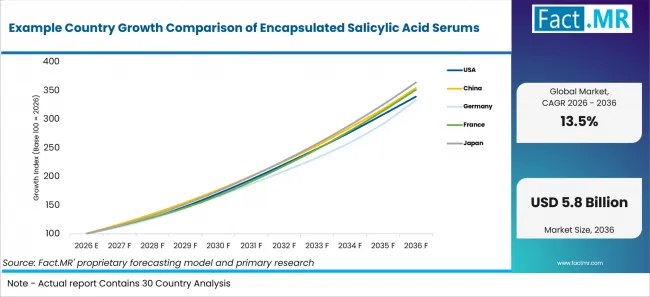
Example Country Growth Comparison Of Encapsulated Salicylic Acid Serums | Source: Fact.MR
| Country | CAGR |
|---|---|
| Japan | 13.8% |
| China | 13.5% |
| France | 13.4% |
| United States | 13.0% |
| Germany | 12.8% |
How does Japan perform?
13.8% CAGR through 2036, supported by drugstore skin-care routines and online replenishment.
Japan's skin-care shoppers often buy acne and pore serums through drugstores and online channels. METI reported in August 2025 that Japan's cosmetics and pharmaceuticals B-to-C e-commerce category reached JPY 1.015 trillion in 2024. Encapsulated salicylic acid serums are expected to benefit when brands explain controlled delivery through simple texture, strength and replenishment cues.
How is China scaling demand?
13.5% CAGR through 2036, driven by domestic cosmetics filings and platform-led launches.
China's beauty market rewards frequent product refreshes and ingredient-led stories. NIFDC reported in April 2026 that China recorded 511,974 ordinary cosmetics filings nationwide in 2025. Local acne-care brands are forecast to use lipid and polymeric carriers to separate salicylic acid serums across platform storefronts.
What supports France growth?
13.4% CAGR through 2036, backed by dermocosmetic credibility and export capability.
France brings pharmacy beauty credibility to active serums aimed at acne, pore and exfoliation routines. The French Treasury reported in October 2025 that perfumes and toiletry exports to the United States reached EUR 1.5 billion during the first seven months of 2025. The export base supports premium positioning for documented carrier systems and tolerable acid formats.
What supports USA adoption?
13.0% CAGR through 2036, supported by product-listing discipline and personal-care spending.
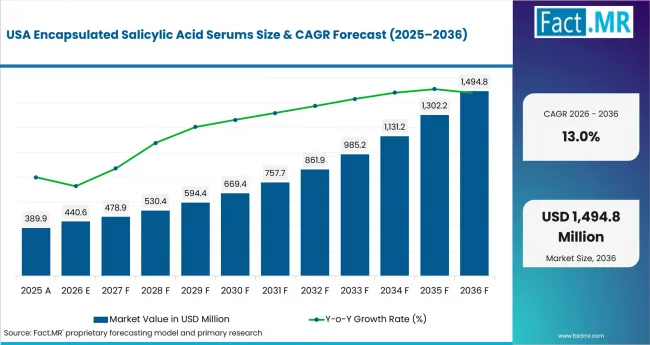
Encapsulated Salicylic Acid Serums Country Value Analysis | Source: Fact.MR
U.S. brands are expected to prioritize MoCRA-ready records when launching active serum lines. BLS reported in September 2026 that CPI for cosmetics, perfume, bath, nail preparations and implements rose 2.8% year over year in August 2026. Price visibility makes clear strength tiers and comfort claims more useful for repeat purchase.
What underpins Germany adoption?
12.8% CAGR through 2036, shaped by EU safety review and local ingredient capability.
Germany combines ingredient-supplier depth with a retail base shaped by pharmacy and personal-care channels. Destatis estimated in January 2026 that German retail sales rose 2.4% in real terms in 2025. Encapsulated salicylic acid serums are projected to gain from concentration control and documentation that fits EU safety expectations.
Who leads the Encapsulated Salicylic Acid Serums Market?
BASF is a prominent participant through its personal-care active-delivery and encapsulation capabilities. Its relevance lies in helping formulators combine carrier science with skin-feel, stability and compatibility requirements as brands move from conventional salicylic acid dosing toward delivery-controlled serum systems.
Salvona Technologies and TAGRA Biotechnologies are also included among the key providers assessed for active-delivery and formulation support. Their positioning is relevant where beauty brands require encapsulation systems that can improve ingredient handling, release control and formulation stability across acne-care and exfoliation products.
Umang Encapsulation, Flychem and Naulakha Essentials complete the profiled supplier set. These companies participate in the broader encapsulation and ingredient-support landscape serving formulators that need controlled delivery, consistent dispersion and compatibility with lightweight serum bases.
Competition therefore centers on carrier performance, release control, formulation stability, skin tolerability, active loading, compatibility with serum bases and regulatory documentation. Suppliers that can combine encapsulation expertise with irritation testing and practical formulation support are better positioned for acne-care, pore-control and exfoliation serum programs.
Which companies are the key providers?
The company set includes BASF; Salvona Technologies; TAGRA Biotechnologies; Umang Encapsulation; Flychem; and Naulakha Essentials.
- BASF
- Salvona Technologies
- TAGRA Biotechnologies
- Umang Encapsulation
- Flychem
- Naulakha Essentials
Bibliography
- BASF. (2025, January 17). BASF’s Personal Care business launches VitaGuard® A, an innovative encapsulation technology for retinol.
- Ministry of Economy, Trade and Industry. (2025, August 26). Results of FY2024 E-Commerce Market Survey compiled.
- Nkoa Zoa, M. (2025, October 17). Flash conjoncture France - Les exportations cosmétiques françaises face aux droits de douanes américains. Direction générale du Trésor.
- Scientific Committee on Consumer Safety. (2025, May 2). SCCS opinion on salicylic acid (CAS No. 69-72-7, EC No. 200-712-3) - Children’s exposure. European Commission.
- Statistisches Bundesamt. (2026, January 7). Einzelhandelsumsatz im Jahr 2025 real voraussichtlich um 2,4 % höher als im Vorjahr.
- U.S. Bureau of Labor Statistics. (2025, December 19). Consumer expenditures – 2024 [News release].
- U.S. Bureau of Labor Statistics. (2026, September 11). Consumer Price Index – August 2026 [News release].
This Report Answers
- The report explains how encapsulated salicylic acid serums are used across encapsulation type and serum strength.
- Segment analysis identifies lipid encapsulation and <0.5% SA as the leading subsegments in 2026.
- Country analysis examines Japan, China, France, the United States and Germany with reference-style Q&A blocks.
- Competitive analysis reviews BASF, Salvona Technologies, TAGRA Biotechnologies, Umang Encapsulation, Flychem and Naulakha Essentials across active delivery and formulation support.
- Application analysis assesses acne care, pore and oil control, exfoliation, scalp care and body blemish care.
- Regulatory analysis considers MoCRA listing, EU salicylic acid review and China filing requirements.
What does the Encapsulated Salicylic Acid Serums Market cover?
Lipid, polymeric, cyclodextrin and porous-carrier serums used for salicylic acid delivery.
The Encapsulated Salicylic Acid Serums Market covers topical serum formats where salicylic acid is delivered through lipid carriers, polymeric microcapsules, cyclodextrin complexes or porous systems. These products target acne care, pore appearance, oil control, exfoliation and related skin-care routines.
The market differs from plain salicylic acid liquids because the carrier system is part of the product value. General toners, cleansers and unencapsulated spot treatments remain outside scope. A product belongs inside the scope when salicylic acid delivery is a defined part of the serum formula.
What is included in the scope?
Encapsulated salicylic acid serum systems used in acne, pore, exfoliation, scalp and body care.
The scope includes lipid, polymeric, cyclodextrin and porous-carrier systems used in serum formats. It covers <0.5% SA, 0.5-1%, 1-2%, 2-3% and >3% professional strengths. Related coverage of mass beauty and personal care products places these formulas inside broader everyday skin-care access. Adjacent analysis of cosmetic chemicals supports the ingredient-side view of serum formulation systems.
What is excluded from the scope?
Plain salicylic acid solutions and non-serum acne medicines are outside the scope.
The scope excludes unencapsulated salicylic acid toners, basic cleansers, acne medicines and prescription dermatology products. Related coverage of skin microbiome formats and anti-dandruff shampoos is useful only where the product links back to active-delivery serum or scalp-care positioning.
How Was the Analysis Built?
The analysis draws on 120+ sources, 35+ company portfolios, 25+ countries, and more than 20 industry interviews.
- Primary Research: Primary research includes discussions with ingredient suppliers, formulators, brand managers and dermatology retailers.
- Desk Research: Desk research covers government statistics, cosmetic rules, product-listing guidance, company portfolios and launches.
- Market Sizing and Forecasting: Market estimates combine values, concentration tiers, application shares, release profiles, country growth and suppliers.
- Data Validation and Update Cycle: Findings are validated through company activity, statistics, regulatory changes, portfolio mapping and interviews.
What is the report's scope and coverage?
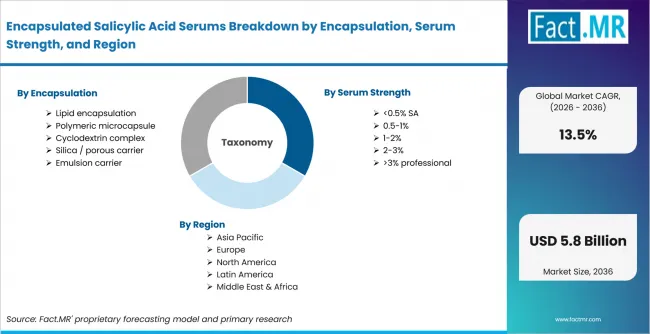
Encapsulated Salicylic Acid Serums Breakdown By Encapsulation, Serum Strength, And Region | Source: Fact.MR
| Attribute | Details |
|---|---|
| Quantitative Units | USD Billion |
| Market Definition | Leave-on serum formulations that use encapsulated salicylic acid or salicylic acid carrier systems for acne care, pore and oil control, exfoliation, scalp care and body blemish care. |
| Encapsulation | Lipid encapsulation; Polymeric microcapsule; Cyclodextrin complex; Silica / porous carrier; Emulsion carrier |
| Serum Strength | <0.5% SA; 0.5-1%; 1-2%; 2-3%; >3% professional |
| Application | Acne care; Pore / oil control; Exfoliation; Scalp care; Body blemish care |
| Release Profile | Immediate; Sustained; pH-triggered; Moisture-triggered; Dual-phase |
| Regions Covered | North America; Latin America; Western Europe; Eastern Europe; East Asia; South Asia & Pacific; Middle East & Africa |
| Countries Covered | United States; China; Germany; France; Japan |
| Key Companies Profiled | BASF; Salvona Technologies; TAGRA Biotechnologies; Umang Encapsulation; Flychem; Naulakha Essentials |
| Forecast Period | 2026 to 2036 |
| Approach | Hybrid top-down and bottom-up approach using active-serum usage; encapsulation routes; serum strength tiers; application mix; release profile; country adoption; and provider portfolio review. |
How is the market segmented?
-
By Encapsulation
- Lipid encapsulation
- Polymeric microcapsule
- Cyclodextrin complex
- Silica / porous carrier
- Emulsion carrier
-
By Serum Strength
- <0.5% SA
- 0.5-1%
- 1-2%
- 2-3%
- >3% professional
-
By Application
- Acne care
- Pore / oil control
- Exfoliation
- Scalp care
- Body blemish care
-
By Release Profile
- Immediate
- Sustained
- pH-triggered
- Moisture-triggered
- Dual-phase
-
By Region
- North America
- Latin America
- Western Europe
- Eastern Europe
- East Asia
- South Asia & Pacific
- Middle East & Africa