- Base Value(2026): 1.5 Bn
- Estimated Value(2026): 1.5 Bn
- Forecast Value (2036): 6.9 Bn
- CAGR (2026 - 2036): 16.5%
Bio Foam Serums Market Forecast and Outlook 2026 to 2036
The bio foam serums market is projected to expand from USD 1.5 billion in 2026 to USD 6.9 billion by 2036, reflecting a compound annual growth rate of 16.5% over the forecast period.
Key Takeaways from Bio Foam Serums Market
- Bio Foam Serums Market Value (2026): USD 1.5 billion
- Bio Foam Serums Market Forecast Value (2036): USD 6.9 billion
- Bio Foam Serums Market Forecast CAGR: 16.5%
- Leading Product Type in Bio Foam Serums Market: Hydrating Bio Foam Serums (38.4%)
- Key Growth Countries in Bio Foam Serums Market: China, India, Germany, Brazil, USA, UK, Japan
- Key Players in Bio Foam Serums Market: Dr Barbara Sturm, Bioeffect, Allies Of Skin, Augustinus Bader, Tatcha, Eighth Day Skin, True Botanicals, Symbiome, OneSkin, BeautyStat
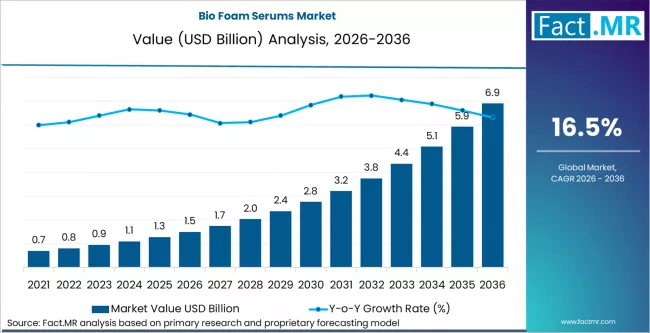
Bio Foam Serums Market Market Value Analysis | Source: Fact.MR
Market growth is driven by increasing adoption of advanced foam-based serum formulations in China, India, Germany, Brazil, the United States, the United Kingdom, and Japan, where skincare innovation and premium product penetration continue to rise.
Product type segmentation identifies hydrating bio foam serums as the leading category, supported by anti-aging bio foam serums, brightening bio foam serums, and barrier repair bio foam serums, each catering to specific skin concerns. Bioactive source analysis shows plant-derived enzymes as the dominant ingredient class, supplemented by marine bioactives, fermented microbial actives, and peptide and growth factor complexes, reflecting diverse functional approaches in formulation.
Bio Foam Serums Market
| Metric | Value |
|---|---|
| Market Value 2026 | USD 1.5 Billion |
| Market Forecast Value 2036 | USD 6.9 Billion |
| Forecast CAGR 2026 to 2036 | 16.5% |
Source: Fact.MR analysis. Updated Jan 29, 2026
Category
| Category | Segments |
|---|---|
| Product Type | Hydrating Bio Foam Serums; Anti-Aging Bio Foam Serums; Brightening Bio Foam Serums; Barrier Repair Bio Foam Serums; Other |
| Bio Active Source | Plant Derived Enzymes; Marine Bioactives; Fermented Microbial Actives; Peptide and Growth Factor Complexes; Other |
| Application | Hydration; Anti-Aging; Brightening; Barrier Repair; Other |
| End User | Individual Consumers; Professional Skincare Clinics; Dermatology Clinics; Medical Aesthetic Centers; Other |
| Region | North America; Europe; Asia Pacific; Latin America; Middle East & Africa |
Source: Fact.MR analysis. Updated Jan 29, 2026
Segmental Analysis
Which Product Type Holds the Largest Share in the Bio Foam Serums Market?
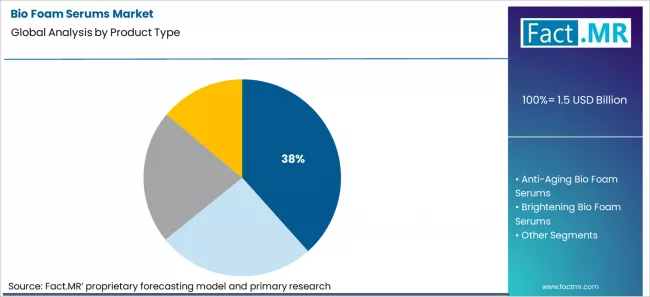
Bio Foam Serums Market Analysis By Product Type | Source: Fact.MR
Hydrating bio foam serums lead the Bio Foam Serums market with a 38.4% share. These serums are formulated to deliver lightweight, rapid-absorbing moisture while supporting skin barrier function and overall hydration. The combination of functional hydration and gentle texture makes them a preferred choice for daily skincare routines across professional and consumer use.
- Manufacturers are emphasizing formulations that combine bioactive delivery with a foaming, fast-absorbing texture for improved user experience.
- Growing consumer demand for multifunctional hydration solutions ensures hydrating serums remain the dominant product type.
Which Bioactive Source Drives the Highest Adoption in the Bio Foam Serums Market?
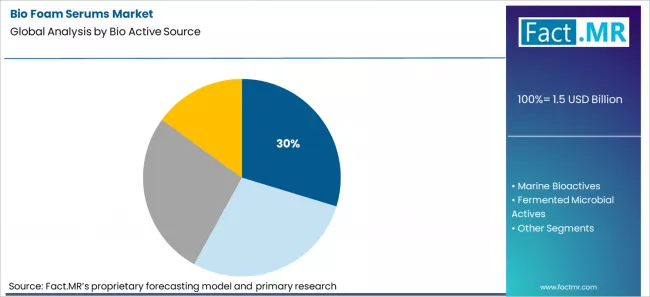
Bio Foam Serums Market Analysis By Bio Active Source | Source: Fact.MR
Plant derived enzymes lead the ingredient segment with a 29.7% share. These enzymes are valued for their ability to enhance skin renewal, gently exfoliate, and support natural repair mechanisms. Formulations incorporating plant-derived enzymes are increasingly preferred for their perceived safety and compatibility with sensitive skin.
- Brands continue to expand plant enzyme-based formulations to strengthen differentiation and meet consumer expectations for natural, effective actives
- The popularity of plant-derived bioactives reinforces their position as the primary source driving adoption in the Bio Foam Serums market.
What are the Drivers, Restraints, and Key Trends in Bio Foam Serums Market?
- Drivers: Growth in demand for lightweight, high performance skincare formulations that combine hydration, anti aging, brightening, and barrier repair effects is driving uptake of bio foam serums containing plant derived enzymes, marine bioactives, fermented microbial actives, peptides, and growth factor complexes. Expansion of biotech and foam based cosmetic product categories supports consumer and professional interest in novel serum textures that enhance absorption and sensory experience, prompting skincare brands to launch targeted bio foam serum ranges. Increased research and adoption of foam delivery systems in beauty products further underpins category expansion across mature and emerging markets.
- Restraints: High formulation complexity and production costs associated with integrating sensitive bioactive sources into stable foam serum matrices limit broader manufacturer participation and slow mainstream adoption. Regulatory scrutiny of advanced bioactives, combined with the technical challenge of maintaining functional integrity of enzyme and peptide components throughout shelf life, restricts rapid new product approvals and deters smaller skincare brands from scaling foam serum offerings.
- Trend 1: Development of multifunctional bio foam serums that integrate hydrating, anti aging, brightening, and barrier support properties within single formulations to better align with holistic skincare regimens and consumer preference for consolidated benefits.
- Trend 2: Increasing penetration of direct to consumer digital platforms and specialty e commerce retailers that improve accessibility and support targeted marketing for advanced foam serum technologies among diverse consumer segments.
Analysis of the Bio Foam Serums Market by Key Country
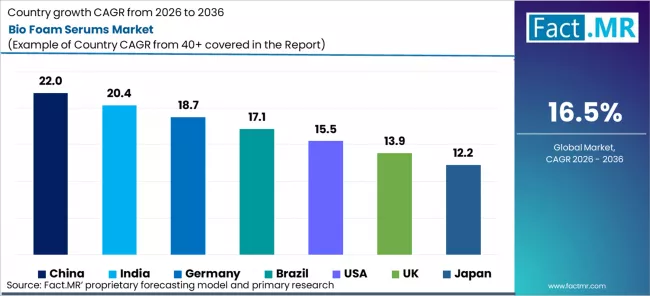
Bio Foam Serums Market Cagr Analysis By Country | Source: Fact.MR
| Country | CAGR |
|---|---|
| China | 22.0% |
| India | 20.4% |
| Germany | 18.7% |
| Brazil | 17.1% |
| USA | 15.5% |
| UK | 13.9% |
| Japan | 12.2% |
Source: Fact.MR analysis. Updated Jan 29, 2026
How Is Innovation Driving Bio Foam Serums Adoption in China?
The Bio Foam Serums market in China is projected to grow at a CAGR of 22.0% from 2026 to 2036. Urban consumers increasingly prefer multifunctional formulations that combine hydration, anti-aging, and skin repair benefits. Plant-derived and marine bioactive ingredients are gaining traction in premium skincare routines. Specialty stores and e-commerce platforms enhance product accessibility, while rising awareness of clinical-grade serums drives adoption of bio foam formats in metropolitan areas.
Why Is India Emerging as a High-Growth Market for Bio Foam Serums?
Bio Foam Serums adoption in India is projected to expand at a CAGR of 20.4% from 2026 to 2036. Hydrating formulations incorporating plant-derived enzymes are driving uptake, particularly among urban consumers focused on skin wellness and anti-aging. Online retail dominates distribution, while rising disposable income and exposure to international skincare trends encourage trial of premium bio foam products. Multi-benefit serums are increasingly used in daily routines for hydration, brightening, and anti-aging outcomes.
What Factors Are Influencing Bio Foam Serums Demand in Germany?
Germany’s Bio Foam Serums market is expected to grow at a CAGR of 18.7% from 2026 to 2036. Consumers are prioritizing anti-aging and high-performance marine bioactive formulations. Professional skincare clinics and specialty retailers play a key role in product access, while urban adoption is influenced by evidence-backed claims and premium positioning. The combination of functional benefits, efficacy, and trust in scientific formulations continues to drive uptake of bio foam serums across the German market.
How Are Advanced Formulations Supporting Bio Foam Serums Growth in Brazil?
Revenue from Bio Foam Serums in Brazil is projected to expand at a CAGR of 17.1% from 2026 to 2036. Brightening serums with fermented microbial actives are increasingly adopted among urban consumers seeking multifunctional skincare solutions. Specialty beauty stores and e-commerce platforms facilitate access to premium formulations. Awareness of ingredient efficacy and clinical performance encourages broader adoption, while consumer interest in anti-aging and skin-brightening benefits supports sustained market growth.
Why Does the USA Remain a Key Market for Bio Foam Serums?
The USA Bio Foam Serums market is projected to grow at a CAGR of 15.5% from 2026 to 2036. Barrier repair-focused formulations with peptide and growth factor complexes are driving adoption, particularly in professional and premium skincare channels. Consumers increasingly integrate multifunctional serums into daily routines, while retail and online platforms expand access to advanced bio foam products. Urban awareness of ingredient performance and efficacy supports consistent growth in this high-demand market.
What Is Supporting Bio Foam Serums Adoption in the UK?
Bio Foam Serums adoption in the UK is projected to expand at a CAGR of 13.9% from 2026 to 2036. Urban consumers are increasingly focused on multifunctional anti-aging and hydrating serums, favoring premium and clinically validated formulations. Specialty beauty retailers and online channels enhance accessibility, while rising consumer preference for high-performance bio foam textures drives steady uptake. Product innovation and functional benefits encourage adoption across metropolitan skincare routines.
How Is Market Maturity Affecting Bio Foam Serums Demand in Japan?
Japan’s Bio Foam Serums market is projected to grow at a CAGR of 12.2% from 2026 to 2036. Consumers prioritize high-quality, multifunctional serums with clinical-grade marine and microbial bioactives. Urban adoption is concentrated among premium skincare users seeking hydration, brightening, and anti-aging benefits. Market maturity has led to strong competition, with domestic and international brands focusing on efficacy, texture, and ingredient innovation to maintain share and drive adoption in metropolitan areas.
How is Competition Structured in the Bio Foam Serums Market?
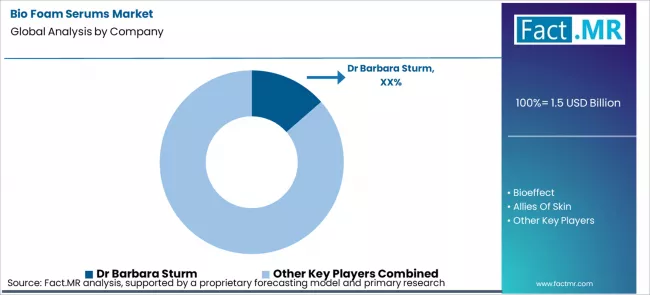
Bio Foam Serums Market Analysis By Company | Source: Fact.MR
Competition in the Bio Foam Serums Market is centered on bioactive innovation, formulation performance, and multifunctional efficacy. Dr. Barbara Sturm and Bioeffect lead with hydrating and anti-aging serums formulated with plant-derived enzymes and marine bioactives, targeting hydration, wrinkle reduction, and skin resilience. Allies Of Skin and Augustinus Bader focus on brightening and barrier repair serums developed with fermented microbial actives and peptide-growth factor complexes, providing targeted solutions for skin repair and radiance enhancement.
Tatcha, Eighth Day Skin, True Botanicals, Symbiome, OneSkin, and BeautyStat differentiate through proprietary delivery mechanisms, multi-functional biofoam formulations, and efficacy across diverse skin types. Competitive advantage arises from ingredient quality, visible performance, and formulation stability. Buyers evaluate companies based on clinical validation, bioactive potency, and compatibility with professional or consumer routines. From 2026 onward, strategies are expected to emphasize precision-targeted delivery, integration of bioactive technologies, and personalized treatment protocols supported by digital diagnostics and connected skincare solutions.
Key Players in the Bio Foam Serums Market
- Dr. Barbara Sturm
- Bioeffect
- Allies Of Skin
- Augustinus Bader
- Tatcha
- Eighth Day Skin
- True Botanicals
- Symbiome
- OneSkin
- BeautyStat
Bibliography
- World Health Organization. (2023). WHO global report on the public health value of biotechnology. World Health Organization.
- Organisation for Economic Co-operation and Development. (2023). Biotechnology statistics 2023. OECD.
- National Institutes of Health. (2024). Cosmeceuticals and biologically active ingredients in skin care. National Library of Medicine.
- U.S. Food and Drug Administration. (2023). Cosmetic ingredients and product safety. U.S. Food and Drug Administration.
- European Commission. (2024). Scientific Committee on Consumer Safety: guidance on safety evaluation of cosmetic ingredients. European Commission.
Segmentation
Scope of the Report
| Items | Values |
|---|---|
| Quantitative Units (2026) | USD 1.5 Billion |
| Product Type | Hydrating Bio Foam Serums, Anti-Aging Bio Foam Serums, Brightening Bio Foam Serums, Barrier Repair Bio Foam Serums, Other |
| Bio Active Source | Plant Derived Enzymes, Marine Bioactives, Fermented Microbial Actives, Peptide and Growth Factor Complexes, Other |
| Regions Covered | Asia Pacific, North America, Europe, Latin America, and Middle East & Africa |
| Countries Covered | China, India, Germany, Brazil, USA, UK, Japan, and other countries |
| Key Companies Profiled | Dr Barbara Sturm, Bioeffect, Allies Of Skin, Augustinus Bader, Tatcha, Eighth Day Skin, True Botanicals, Symbiome, OneSkin, BeautyStat, and other leading skincare companies |
| Additional Attributes | Dollar revenue by product type, bio active source, and region; regional demand trends, competitive landscape, innovations in foam serum delivery and bioactive encapsulation, anti-aging and skin repair efficacy, premiumization strategies, and brand positioning analysis |
Source: Fact.MR analysis. Updated Jan 29, 2026
Bio Foam Serums Market by Segments
-
Product Type :
- Hydrating Bio Foam Serums
- Anti-Aging Bio Foam Serums
- Brightening Bio Foam Serums
- Barrier Repair Bio Foam Serums
-
Bio Active Source :
- Plant Derived Enzymes
- Marine Bioactives
- Fermented Microbial Actives
- Peptide And Growth Factor Complexes
-
Region :
- North America
- U.S.
- Canada
- Mexico
- Europe
- Germany
- Italy
- UK
- France
- Spain
- Netherlands
- Switzerland
- Rest of Europe
- Asia Pacific
- Japan
- Australia
- South Korea
- China
- India
- Rest of Asia Pacific
- Latin America
- Brazil
- Argentina
- Rest of Latin America
- Middle East and Africa
- United Arab Emirates
- South Africa
- Rest of Middle East and Africa
- North America
Frequently Asked Questions
How big is the bio foam serums market in 2026?
What will be the size of bio foam serums market in 2036?
How much will be the bio foam serums market growth between 2026 and 2036?
What are the key product types in the bio foam serums market?
Which bio active source segment to contribute significant share in the bio foam serums market in 2026?
Who worked on this report


Preview the report firsthand - request a free sample
Free SampleGet the brochure for pricing and purchase details
Download PDF