- Base Value(2025): 0.4 Bn
- Estimated Value(2026): 0.5 Bn
- Forecast Value (2036): 1.1 Bn
- CAGR (2026 - 2036): 8.0%
Capsule Endoscopy Localization Systems Market Forecast and Outlook By Fact.MR
In 2025, the capsule endoscopy localization systems market was valued at USD 0.4 billion. Based on Fact.MR analysis, demand for capsule endoscopy localization systems is estimated to grow to USD 0.5 billion in 2026 and USD 1.1 billion by 2036. FACT.MR projects a CAGR of 8.0% during the forecast period.
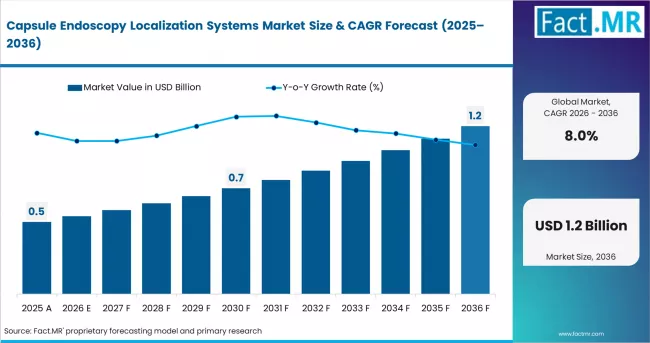
Capsule Endoscopy Localization Systems Market Market Value Analysis | Source: Fact.MR
| Metric | Value |
|---|---|
| Estimated Value in 2026 | USD 0.5 billion |
| Forecast Value in 2036 | USD 1.1 billion |
| Forecast CAGR (2026 to 2036) | 8.0% |
Source: Fact.MR analysis. Updated Apr 22, 2026
Summary of the Capsule Endoscopy Localization Systems Market
- Market Definition
- The market covers electromagnetic, RF-based, sensor-based, and AI-assisted systems used to determine real-time capsule position during GI tract transit across hospital and ambulatory endoscopy settings globally.
- Demand Drivers
- U.S. GI centers are adopting AI-assisted localization software to reduce re-intervention rates and improve lesion re-identification accuracy following small bowel capsule endoscopy procedures.
- India's hospital infrastructure expansion is accelerating capsule endoscopy deployment in tier-2 and tier-3 cities, creating new demand for integrated localization systems at newly built GI diagnostic centers.
- European GI society guidelines updated in 2024 are recommending localization-capable systems for small bowel capsule endoscopy to support precise lesion reporting for surgical and interventional follow-up.
- Key Segments Analyzed
- By Technology: Electromagnetic localization leads with 42% share in 2026. Most clinically validated technology for real-time capsule tracking and widely integrated with existing capsule systems.
- By Component: Hardware leads with 47% share in 2026. Sensor arrays and receivers represent the core procurement requirement and highest upfront system cost share.
- By Application: Small bowel diagnostics leads with 55% share in 2026, reflecting global dominance of small intestine as the primary capsule endoscopy indication.
- By Geography: India leads at 9.8% CAGR through 2036, driven by diagnostic infrastructure expansion and rising GI disease burden in urban and peri-urban centers.
- Analyst Opinion at FACT.MR
- Shambhu Nath Jha, Principal Consultant at Fact.MR, opines, 'CXOs will find that localization accuracy is the decisive procurement variable in capsule endoscopy, and vendors who can demonstrate sub-centimeter positional precision with AI-assisted lesion mapping will capture disproportionate share of high-value hospital GI center contracts through 2036.'
- Strategic Implications
- Invest in electromagnetic localization with AI integration to meet high-spec hospital procurement in United States, Japan, and Germany.
- Build reimbursement evidence and clinical outcome data to expand coverage beyond small bowel applications.
- Develop entry strategies for India and China through regulatory approvals and distributor partnerships.
- Methodology
- Market sizing based on procedure volumes, localization attach rates, and pricing by technology type. Validated with 2024–2025 data.
- Uses FDA 510(k), PMDA registrations, NICE guidelines, and CE marking records for demand analysis.
- Forecasts consider GI disease trends, endoscopy expansion, reimbursement changes, and AI platform commercialization timelines.
The market is projected to generate USD 0.6 billion in absolute opportunity between 2026 and 2036. Growth is structurally driven by expanding capsule endoscopy adoption globally. Demand is rising as small bowel diagnostics shift from hospital-only to ambulatory settings. Growth is moderated by high system integration costs, limited reimbursement in emerging markets, and lengthy clinical validation cycles for new localization platforms.
Hospitals and endoscopy centers are standardising on integrated localization platforms. Standalone capsule systems without real-time positional feedback are losing ground in clinical preference. AI-assisted localization software is emerging as a key differentiator for lesion re-identification and reporting accuracy. Procurement decisions at leading GI centers now include localization accuracy as a core evaluation criterion alongside image resolution and battery life.
India leads with a projected CAGR of 9.8% through 2036, driven by rapid expansion of diagnostic access and hospital infrastructure investment. China follows at 9.5%, supported by a large patient base and strong domestic capsule manufacturing. Japan records 8.8%, anchored in early clinical adoption and premium GI diagnostics investment. Germany grows at 8.5%, driven by strong clinical infrastructure and diagnostic precision culture. The United States records 8.2%, supported by advanced GI diagnostics programmes and early AI-enabled system adoption. Mature Western markets face reimbursement coverage constraints and long procurement approval cycles as structural limits.
Segmental Analysis
Capsule Endoscopy Localization Systems Market Analysis by Technology
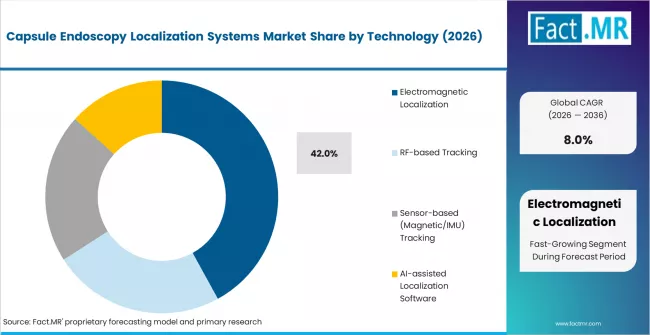
Capsule Endoscopy Localization Systems Market Analysis By Technology | Source: Fact.MR
Based on FACT.MR, electromagnetic localization holds 42% share in 2026. It leads due to strong clinical validation. It provides real-time 3D position tracking. Accuracy supports lesion mapping and intervention planning.
- Medtronic Platform Expansion: Expanded PillCam in 2024. Added electromagnetic localization and AI lesion detection. Cleared under FDA and CE frameworks. [1]
- AnX Robotica Development: Launched NaviCam in 2024. Integrated magnetic localization and capsule steering. Approved in China and pursuing U.S. clearance. [2]
- Electromagnetic Adoption Trend: ESGE updated guidelines in 2024. Recommended localization systems for cases needing intervention. This increased hospital procurement across Europe. [4]
Capsule Endoscopy Localization Systems Market Analysis by Component
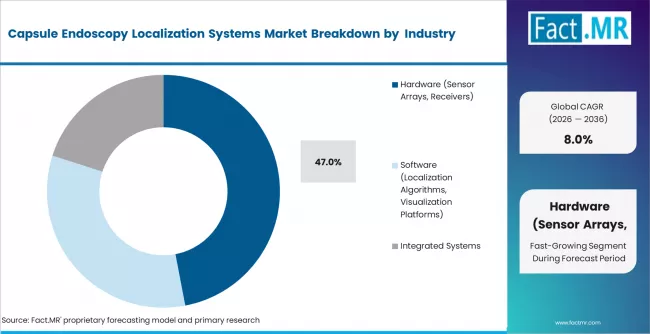
Capsule Endoscopy Localization Systems Market Analysis By Component | Source: Fact.MR
Based on FACT.MR, hardware holds 47% share in 2026. Sensor arrays and receivers are core system components. High upfront costs and replacement cycles drive revenue share.
- Olympus Corporation Investment: Expanded R&D in 2024. Focus on sensor miniaturisation and ambulatory systems. [1]
- Check-Cap Development: Advanced C-Scan system in 2025. Integrated positioning sensors with low-dose imaging. Targets colon diagnostics. [6]
- Hardware Procurement Trend: 58% of U.S. GI units cited interoperability as a barrier in 2024. Hospitals prefer integrated systems over standalone hardware. This is accelerating bundled procurement. [5]
Drivers, Restraints, and Opportunities
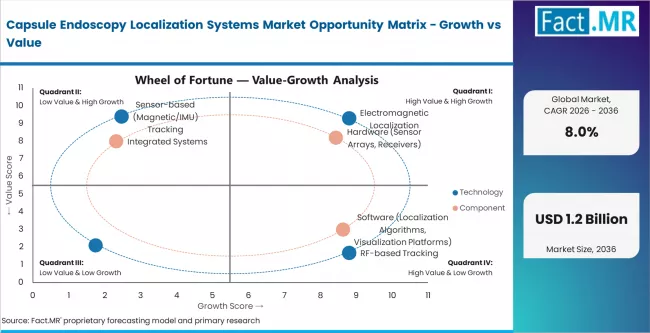
Capsule Endoscopy Localization Systems Market Opportunity Matrix Growth Vs Value | Source: Fact.MR
FACT.MR analysts observe that growth is driven by the expansion of capsule endoscopy as a primary diagnostic tool. It is widely used for obscure GI bleeding and small bowel disorders. Procedure volumes are increasing as clinical guidelines expand. Reimbursement coverage is improving across North America, Europe, and Japan. Localization systems act as an enabling layer. Demand rises in line with capsule endoscopy adoption.
Procurement trends are reshaping competition. Legacy systems without localization are losing preference. Hospitals are shifting to electromagnetic and AI-integrated platforms. Bundled systems command 25 to 40% price premiums. Devices without regulatory clearance or clinical validation are excluded from procurement lists.
- AI Localization Regulatory Clearance: The FDA cleared two AI-assisted localization platforms in 2024 under the De Novo pathway. This established a regulatory framework for AI-based tracking. It expanded the U.S. market for localization modules. EU MDR approvals are progressing in parallel.
- India Diagnostic Access Expansion: National Programme for Non-Communicable Diseases funded GI diagnostic equipment in 2024. Capsule systems with localization were included. Rajasthan and Karnataka issued tenders in Q3 2024 under Ayushman Bharat.
- Japan Reimbursement Coverage Update: Japan expanded reimbursement in 2024. Coverage now includes small bowel tumours and polyposis syndromes. This increased procedure volume. Olympus Corporation and IntroMedic are approved vendors. [3]
Regional Analysis
The capsule endoscopy localization systems market is assessed across Asia Pacific, North America, Europe, Latin America, and Middle East and Africa, covering 40+ countries with distinct demand profiles shaped by GI disease burden, reimbursement frameworks, clinical guideline adoption, and domestic device manufacturing capability. The full report provides market attractiveness analysis by region and country.
.webp "Top Country Growth Comparison Capsule Endoscopy Localization Systems Market Cagr (2026 2036)")
Top Country Growth Comparison Capsule Endoscopy Localization Systems Market Cagr (2026 2036) | Source: Fact.MR
| Country | CAGR (2026 to 2036) |
|---|---|
| India | 9.8% |
| China | 9.5% |
| Japan | 8.8% |
| Germany | 8.5% |
| United States | 8.2% |
Source: Fact.MR analysis. Updated Apr 22, 2026
Source: Fact.MR (FACT.MR) analysis, based on proprietary forecasting model and primary research
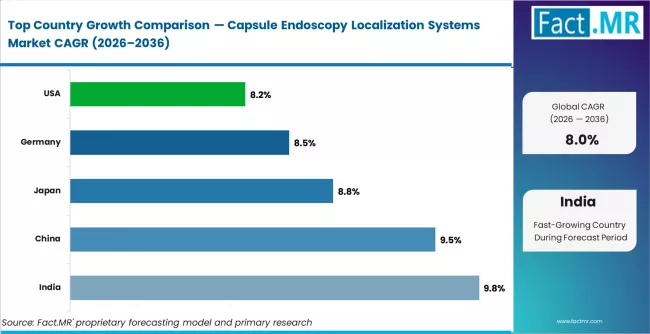
Capsule Endoscopy Localization Systems Market Cagr Analysis By Country | Source: Fact.MR
Asia Pacific Capsule Endoscopy Localization Systems Market Analysis
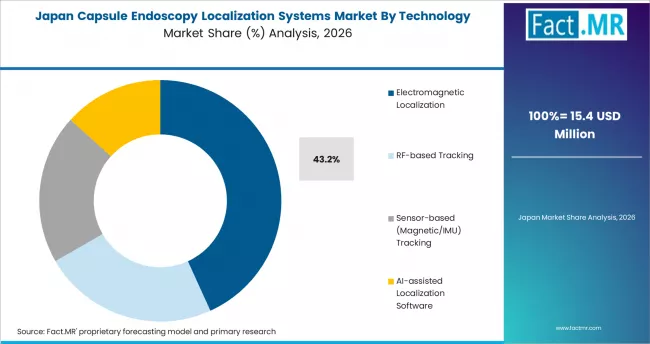
Capsule Endoscopy Localization Systems Market Japan Market Share Analysis By Technology | Source: Fact.MR
Asia Pacific is the highest-growth region and an emerging production epicenter. India and China drive procedure volume expansion. Japan leads in technology quality and clinical adoption depth. Jinshan Science & Technology and IntroMedic are strengthening regional supply through domestic manufacturing and regulatory registrations.
- India: Diagnostic infrastructure expansion supports 9.8% CAGR through 2036. It is the fastest among tracked markets. National Programme for Non-Communicable Diseases released GI procurement guidelines in 2024. Capsule endoscopy systems are listed for district hospital upgrades. Maharashtra and Gujarat issued tenders in Q2 2024 under Ayushman Bharat. Private hospital chains are expanding GI units in tier-2 cities. PLI scheme is supporting local assembly of hardware components. Growth is volume-led and policy-driven across public and private hospitals.
- China: Large patient volume supports 9.5% CAGR through 2036. National Health Commission updated GI diagnosis guidelines in 2024. Capsule endoscopy is included as a first-line investigation. Jinshan Science & Technology expanded production and received NMPA approval in 2024. AnX Robotica received NMPA clearance for NaviCam in 2024. Provincial procurement favours domestic devices. This limits imports. Growth is driven by guidelines, domestic innovation, and system scale.
- Japan: Premium diagnostics investment supports 8.8% CAGR through 2036. Ministry of Health updated reimbursement in 2024. Coverage expanded for tumours and polyposis syndromes. Olympus Corporation expanded localization R&D in FY2024. IntroMedic strengthened distribution in 2024. Growth is driven by reimbursement and early clinical adoption.
Fact.MR's analysis covers India, China, Japan, South Korea, ASEAN, and ANZ. It includes GI disease trends, reimbursement updates, and manufacturing impacts.
North America Capsule Endoscopy Localization Systems Market Analysis
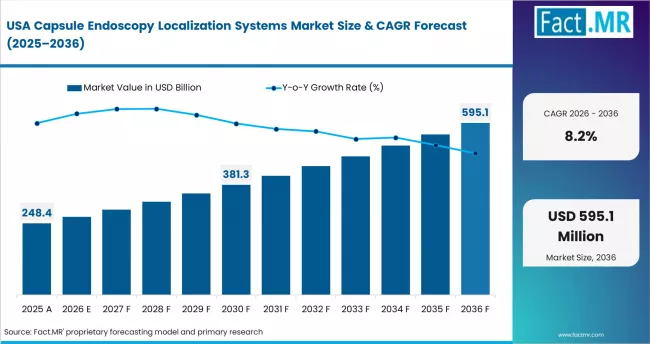
Capsule Endoscopy Localization Systems Market Country Value Analysis | Source: Fact.MR
North America is the leading market by value. It is the regulatory standard-setter. FDA clearance and AI pathways define access. Medtronic and CapsoVision lead institutional supply.
- United States: AI-enabled adoption supports 8.2% CAGR through 2036. It is the largest GI diagnostics market. FDA cleared two AI localization platforms in 2024. This established regulatory precedent. ASGE updated guidelines in 2024. Indications expanded for colon capsule use. CMS updated reimbursement in Q1 2025. Localization systems are now separate billing items. Medtronic expanded PillCam sales in 2024. Growth is driven by regulation and guideline adoption.
Fact.MR's analysis covers the United States, Canada, and Mexico. It includes FDA timelines, guideline updates, and procurement trends.
Europe Capsule Endoscopy Localization Systems Market Analysis
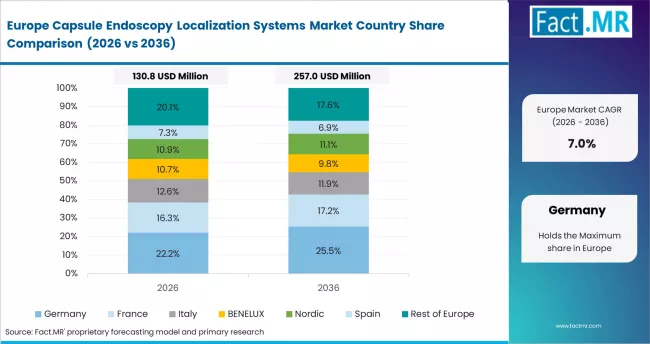
Capsule Endoscopy Localization Systems Market Europe Country Market Share Analysis, 2026 & 2036 | Source: Fact.MR
Europe is a guideline-driven market. EU MDR certification shapes access. GI society recommendations influence procurement. Medtronic and Olympus Corporation lead supply through CE-marked systems.
- Germany: Clinical precision drives 8.5% CAGR through 2036. German GI society updated guidelines in 2024. Localization systems are recommended for small bowel cases. EU MDR deadlines accelerated device replacement. Siemens Healthineers expanded GI partnerships in Q3 2024. Bundeswehr added GI equipment procurement in 2024. Growth is driven by compliance and quality standards.
- United Kingdom: NHS frameworks support 8.0% CAGR through 2036. NICE updated guidance in 2024. Localization systems are recommended for small bowel diagnostics. NHS Supply Chain added approved systems in Q2 2024. Olympus UK expanded NHS sales in 2024. Scotland piloted AI localization systems in Q3 2024. Growth is driven by national procurement and guideline implementation.
Fact.MR's analysis covers Germany, France, the United Kingdom, Italy, Spain, and Rest of Europe. It includes EU MDR timelines, GI guidelines, and NHS procurement trends.
Competitive Aligners for Market Players
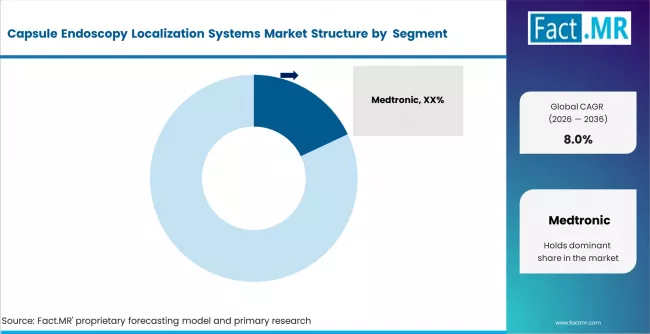
Capsule Endoscopy Localization Systems Market Analysis By Company | Source: Fact.MR
The capsule endoscopy localization systems market exhibits a moderately concentrated competitive structure, with a limited number of regulatory-cleared manufacturers securing the majority of high-value hospital procurement contracts. Market entry is tightly governed by regulatory approvals, including FDA 510(k) or De Novo pathways in the United States, CE marking under EU MDR in Europe, and equivalent national frameworks across Asia. As a result, competitive positioning is driven more by regulatory depth, clinical validation, and endorsement from gastroenterology societies than by pricing strategies.
Medtronic maintains a leading global position through its PillCam platform, supported by extensive regulatory coverage and long-standing integration into clinical workflows. Its strength lies in a robust body of clinical evidence across multiple gastrointestinal indications, reinforcing trust among clinicians. Olympus Corporation competes by leveraging its dominant installed base in conventional endoscopy, enabling seamless cross-selling of capsule localization systems without requiring new vendor onboarding.
Specialist players such as CapsoVision and IntroMedic differentiate through innovative capsule designs and AI-enabled localization capabilities. CapsoVision focuses on premium GI centers with advanced imaging and positional reporting, while IntroMedic strengthens its presence in Asia through competitive pricing and regional regulatory approvals. Meanwhile, AnX Robotica and Jinshan Science & Technology are expanding within China, benefiting from domestic regulatory alignment and state-led procurement preferences. Hospital purchasing behavior further consolidates market leadership. Healthcare providers prioritize integrated, single-vendor platforms that combine localization, imaging, and reporting functionalities. Long-term service agreements and workflow integration create high switching costs, reinforcing the dominance of established players while limiting smaller vendors to niche or price-sensitive segments.
Key Players
- Medtronic
- Olympus Corporation
- CapsoVision
- IntroMedic
- AnX Robotica
- Check-Cap
- Jinshan Science & Technology
Bibliography
- Medtronic plc. (2024). Product Update: PillCam Platform Updated Electromagnetic Localization and AI-Assisted Lesion Flagging Integration for Small Bowel and Colon Capsule Endoscopy at U.S. and European Hospital GI Endoscopy Centers Under FDA 510(k) and CE Marking Regulatory Clearances. 2024. medtronic.com/newsroom
- AnX Robotica Corp. (2024). Regulatory Clearance Announcement: NaviCam Magnetically Guided Colon Capsule System with Integrated Real-Time Magnetic Localization Receives NMPA Approval in China for Clinical Deployment at Hospital GI Departments. 2024. anxrobotica.com/news
- Japan Ministry of Health, Labour and Welfare. (2024). Medical Device Reimbursement Update: Expanded Capsule Endoscopy Coverage Including Localization-Capable Systems for Small Bowel Tumour and Hereditary Polyposis Syndrome Indications at PMDA-Registered Hospital GI Facilities. 2024. mhlw.go.jp
- European Society of Gastrointestinal Endoscopy. (2024). Consensus Statement Update: Small Bowel Capsule Endoscopy Clinical Guidelines Recommending Localization-Capable Systems for Patients with Findings Requiring Surgical or Interventional Follow-up at Accredited European GI Endoscopy Units. 2024. esge.com
- U.S. Food and Drug Administration. (2024). De Novo Authorization: AI-Assisted Capsule Endoscopy Localization Software Platforms for Real-Time and Retrospective Positional Tracking in Gastrointestinal Diagnostic Applications Under FDA Medical Device AI/ML Action Plan Framework. 2024. fda.gov/medicaldevices
- Check-Cap Ltd. (2025). Technology Development Update: C-Scan Colon Capsule System Updated Positional Tracking Sensor Integration for Colon Anatomy Mapping Without Bowel Preparation for Patients Ineligible for Conventional Colonoscopy. January 2025. check-cap.com/investors
This Report Addresses
- Strategic intelligence on capsule endoscopy localization system demand across electromagnetic, RF-based, sensor-based, and AI-assisted technology platforms for GI diagnostic applications globally.
- Market forecast from USD 0.5 billion in 2026 to USD 1.1 billion by 2036 at a CAGR of 8.0%.
- Growth opportunity mapping across India diagnostic infrastructure expansion, China domestic manufacturing scale, Japan reimbursement broadening, Germany GI guideline mandates, and U.S. AI regulatory clearance pathways.
- Segment analysis by technology (electromagnetic, RF, sensor-based, AI-assisted), component (hardware, software, integrated systems), and application (small bowel, colon, esophageal).
- Regional outlook covering Asia Pacific procedure volume growth, North America AI-enabled adoption, and Europe EU MDR compliance and GI society guideline-driven procurement cycles.
- Competitive analysis of Medtronic, Olympus Corporation, CapsoVision, IntroMedic, AnX Robotica, Check-Cap, and Jinshan Science & Technology. Focus on regulatory clearance depth, clinical validation breadth, and GI workflow integration.
- Regulatory impact analysis covering FDA 510(k) and De Novo pathways for AI localization, EU MDR CE marking requirements, PMDA Japan registration updates, NMPA China device approvals, and national GI society guideline adoption.
- Report delivered in PDF, Excel datasets, and presentation formats. Supported by primary interviews, hospital procurement records, FDA and EU MDR clearance filings, GI society guideline documents, and manufacturer revenue disclosures.
Capsule Endoscopy Localization Systems Market Definition
The market covers hardware, software, and integrated systems used to determine the real-time and post-procedure position of a swallowed capsule endoscope as it transits the gastrointestinal tract.
Capsule Endoscopy Localization Systems Market Inclusions
Covers global and regional forecasts from 2026 to 2036. Includes technology, component, and application segments. Covers electromagnetic, RF, sensor-based, and AI-assisted localization platforms. Includes hardware sensor arrays, localization software, and integrated systems across hospital and ambulatory GI diagnostic settings.
Capsule Endoscopy Localization Systems Market Exclusions
Excludes capsule endoscope imaging devices not equipped with localization functionality. Omits standalone capsule reading and AI image analysis software unless integrated with positional tracking. Excludes colonoscopy and gastroscopy equipment. Focus remains on active localization components and systems for capsule position determination.
Capsule Endoscopy Localization Systems Market Research Methodology
- Primary Research: Interviews with gastroenterologists, GI endoscopy unit directors, hospital procurement managers, and device engineers at key companies across the United States, Japan, Germany, China, and India.
- Desk Research: Uses FDA 510(k) clearance data, PMDA device registration records, CE marking databases, NICE clinical guidance, and company disclosures from Medtronic, Olympus Corporation, and CapsoVision from 2024 to 2025.
- Market-Sizing and Forecasting: Hybrid model using capsule endoscopy procedure volumes by application, localization system attach rates, and average selling prices by technology type across all covered geographies and end-user segments.
- Data Validation and Update Cycle: Validated using hospital procurement records, regulatory approvals, and company revenues. Cross-checked with clinical expert interviews. Updated annually.
Segmentation
Scope of Report
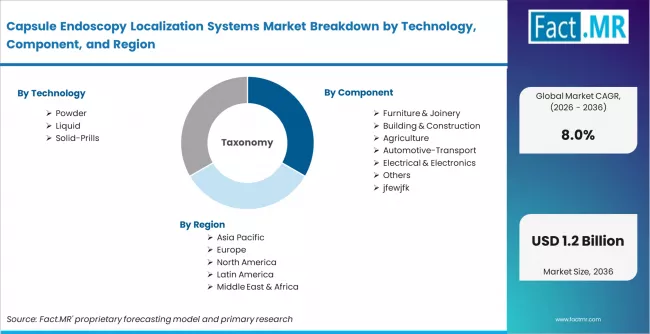
Capsule Endoscopy Localization Systems Market Breakdown By Technology, Component, And Region | Source: Fact.MR
| Attribute | Details |
|---|---|
| Quantitative Units | USD 0.5 billion (2026) to USD 1.1 billion (2036), at a CAGR of 8.0% |
| Market Definition | Electromagnetic, RF-based, sensor-based, and AI-assisted systems for real-time and retrospective capsule position determination during GI tract transit, including hardware sensor arrays, localization software, and integrated capsule systems procured by hospitals and ambulatory GI diagnostic centers globally. |
| Technology Segmentation | Electromagnetic Localization, RF-based Tracking, Sensor-based (Magnetic/IMU) Tracking, AI-assisted Localization Software |
| Component Segmentation | Hardware (Sensor Arrays, Receivers), Software (Localization Algorithms, Visualization Platforms), Integrated Systems |
| Application Segmentation | Small Bowel Diagnostics, Colon Capsule Endoscopy, Esophageal Capsule Endoscopy |
| Application Coverage | Small bowel lesion mapping for GI bleeding and Crohn's disease, colon surveillance for patients with incomplete colonoscopy, esophageal capsule evaluation, and AI-assisted lesion re-identification for interventional follow-up planning. |
| Regions Covered | North America, Europe, Asia Pacific, Latin America, Middle East and Africa |
| Countries Covered | USA, Canada, Mexico, Germany, UK, France, Italy, Spain, Nordic, BENELUX, China, Japan, South Korea, India, ASEAN, Australia and New Zealand, Brazil, Argentina, Chile, Saudi Arabia, GCC, Turkey, South Africa, Rest of MEA |
| Key Companies Profiled | Medtronic, Olympus Corporation, CapsoVision, IntroMedic, AnX Robotica, Check-Cap, Jinshan Science & Technology |
| Forecast Period | 2026 to 2036 |
| Approach | Hybrid top-down and bottom-up model using capsule endoscopy procedure volumes by application, localization system attach rates by technology type, average selling prices by component, regulatory clearance timelines, and primary interviews with gastroenterologists and GI center procurement directors. |
Source: Fact.MR analysis. Updated Apr 22, 2026
Capsule Endoscopy Localization Systems Market by Segments
-
By Technology:
- Electromagnetic Localization
- RF-based Tracking
- Sensor-based (Magnetic/IMU) Tracking
- AI-assisted Localization Software
-
By Component:
- Hardware (Sensor Arrays, Receivers)
- Software (Localization Algorithms, Visualization Platforms)
- Integrated Systems
-
By Application:
- Small Bowel Diagnostics
- Colon Capsule Endoscopy
- Esophageal Capsule Endoscopy
-
By Region:
-
North America
- United States
- Canada
- Mexico
-
Latin America
- Brazil
- Mexico
- Argentina
- Chile
- Rest of Latin America
-
Western Europe
- Germany
- United Kingdom
- France
- Italy
- Spain
- Nordic Countries
- BENELUX
- Rest of Western Europe
-
Eastern Europe
- Russia
- Poland
- Hungary
- Balkan and Baltic
- Rest of Eastern Europe
-
East Asia
- China
- Japan
- South Korea
-
South Asia and Pacific
- India
- ASEAN
- Australia and New Zealand
- Rest of South Asia and Pacific
-
Middle East and Africa
- Kingdom of Saudi Arabia
- Other GCC Countries
- Turkey
- South Africa
- Rest of Middle East and Africa
-
Frequently Asked Questions
How large is the global capsule endoscopy localization systems market in 2025?
What will the market size be in 2026?
What is the projected market size by 2036?
What is the expected CAGR from 2026 to 2036?
Which technology segment is poised to lead the market?
Which component segment holds the largest share?
Which application dominates the market?
Which country shows the fastest growth?
What is driving demand for capsule endoscopy localization systems?
What are the major restraints?
Who worked on this report


Preview the report firsthand - request a free sample
Free SampleGet the brochure for pricing and purchase details
Download PDF