- Market Value (2025): USD 26.3 Bn
- Estimated Value (2026): USD 27.8 Bn
- Forecast Value (2036): USD 48.3 Bn
- CAGR (2026-2036): 5.7%
What is the Energy Efficient Lamps Market forecast to be worth by 2036?
USD 27.8 billion in 2026 to USD 48.3 billion by 2036 at a 5.7% CAGR.
- Fact.MR estimates the energy efficient lamps market at USD 26.3 billion for 2025, a base built mainly on LED replacement bulbs bought for homes and small businesses.
- Revenue will advance from USD 27.8 billion in 2026 to USD 48.3 billion by 2036 as the remaining halogen, CFL and fluorescent sockets switch to LED.
- A 5.7% CAGR reflects steady replacement demand, tempered by the long service life of LED products that slows repeat purchases.
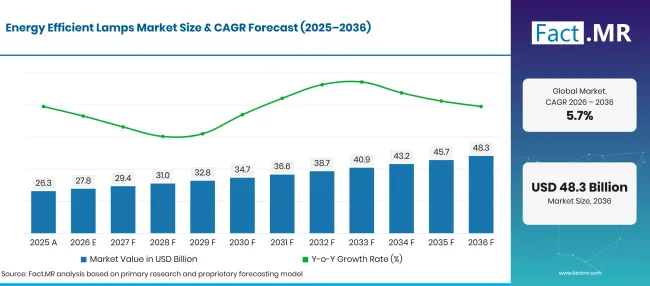
Energy Efficient Lamps Market Forecast Global | Source: Fact.MR
| Year | Basis | Market Value (USD billion) |
|---|---|---|
| 2025 | Actual | 26.3 |
| 2026 | Estimate | 27.8 |
| 2036 | Forecast | 48.3 |
| CAGR 2026 to 2036 | Forecast period | 5.7% |
Source: Fact.MR analysis. Updated Nov 6, 2026
What are the defining numbers behind Energy Efficient Lamps Market growth?
The 2026 to 2036 period adds USD 20.5 billion in new value, concentrated in LED retrofits for homes and supermarket-led retail sales.
- Demand Drivers in the Market
- Lighting is still a sizeable electricity load worldwide. The IEA puts lighting in buildings and outdoor applications at about 8% of global electricity demand in 2024, or roughly 2,200 TWh, which keeps efficient lamps high on energy-saving checklists [1].
- A large pool of sockets has yet to convert. About 30% of residential lamps globally are still not LEDs, and nearly 15% are early-generation LEDs reaching end of life, according to the same IEA analysis [1].
- Fluorescent phase-outs are turning upgrades into obligations. Once tubes and compact fluorescent bulbs leave store shelves, buyers must shift to LED replacements that fit existing fittings.
- Commercial property owners are retrofitting offices, shops and public buildings to lower running costs. Lamp swaps need little disruption, so they are often the first measure in a wider renovation plan.
- Key Segments Analyzed
- By Product Type: LED Lamps will hold 62.5% share in 2026, since they use a fraction of the power of halogen bulbs and run for many years between changes.
- By Application: Residential will account for 38.7% of 2026 value, as homes contain the greatest number of sockets and replace bulbs on a routine basis.
- By Distribution Channel: Supermarkets/Hypermarkets will capture 40.8% of 2026 sales, helped by wide shelf ranges and the habit of buying bulbs during weekly grocery trips.
- Analyst Opinion at Fact.MR
- Shambhu Nath Jha, Principal Consultant at Fact.MR, states, “The next ten years in this market will be shaped less by first-time LED adoption and more by the final conversion of fluorescent and halogen sockets, plus the replacement of early LED bulbs that are now wearing out. Brands that pair high efficacy with low shelf prices will win the household buyer, while commercial demand will reward lamps that drop into existing fittings and work with dimmers and controls. Long product life will cap repeat volumes, so suppliers will need to add value through smart features, better light quality and dependable retail availability.”
- Strategic Implications
- Manufacturers should widen LED tube and bulb ranges that fit legacy fluorescent and halogen fittings, so phase-out buyers can switch without rewiring.
- Retailers should group LED products by lumen output, colour temperature and socket type, which shortens the decision for shoppers replacing a failed bulb.
- Facility managers should audit fluorescent stock ahead of national bans and plan staged LED replacement to avoid sudden supply gaps.
- Investors should favour suppliers with strong supermarket and online reach in price-sensitive regions, where conversion still has room to run.
Germany will lead the five-country set at 6.7%, with high household power prices and EU building renovation rules giving owners a clear payback case. Brazil follows at 6.1%, where rising residential electricity use and national efficiency planning widen the LED customer base. The United States, at 5.5%, already has deep LED use at home, so growth there leans on commercial retrofits and the replacement of older LED bulbs. The United Kingdom at 4.9% relies on public building upgrades and steady retail replacement. Japan closes the range at 4.4%: its 2027 fluorescent cut-off lifts near-term volumes, yet a mature, slow-growing housing stock limits new installations.
How does the Energy Efficient Lamps Market break down by segment?
LED Lamps will lead Product Type at 62.5%; Residential will head Application at 38.7%; Supermarkets/Hypermarkets will top Distribution Channel at 40.8% in 2026.
Which Product Type leads?
LED Lamps hold 62.5% of 2026 sales.
| Product Type | Share (2026) |
|---|---|
| LED Lamps (Leading segment) | 62.5% |
| Other segments combined | 37.5%* |
| Total | 100.0% |
Source: Fact.MR analysis. Updated Nov 6, 2026
Efficacy is the main reason buyers move to LEDs. The IEA reports that halogen lamps deliver about 20 lumens per watt and compact fluorescent lamps about 50, while LEDs sold today average close to 100 lumens per watt, with some professional models above 200 [1]. That gap means a typical LED bulb cuts lighting power use by well over half compared with older technology, and the saving shows up directly on a monthly bill. CFL, fluorescent and halogen lamps still serve installed fittings in offices, warehouses and older homes, but their share will keep shrinking as bans take effect. Upstream, progress in the LED chip industry keeps lifting light output per watt. Flat formats such as the LED panel range compete with tube replacements in ceiling grids.
What supports Residential within Application?
Residential takes 38.7% of 2026 revenue.
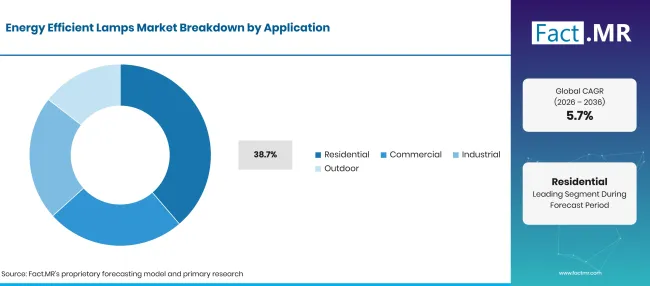
Energy Efficient Lamps Market Breakdown Application | Source: Fact.MR
| Application | Share (2026) |
|---|---|
| Residential (Leading segment) | 38.7% |
| Other segments combined | 61.3%* |
| Total | 100.0% |
Source: Fact.MR analysis. Updated Nov 6, 2026
Homes hold more sockets than any other setting, and each failed bulb is a buying moment. The U.S. Energy Information Administration found that the share of households using mostly LED bulbs for indoor lighting rose from 4% in 2015 to 63% in 2024 [2]. Similar conversion patterns in other countries keep residential demand broad, from basic A-shape bulbs to filament and smart lamps. Commercial, industrial and outdoor applications favour higher-output tubes, high-bay lamps and lamps paired with controls. Building managers often combine lamp upgrades with an LED lighting controller to add dimming and occupancy sensing.
How does Distribution Channel shape demand?
Supermarkets/Hypermarkets account for 32.6% of 2026 value.
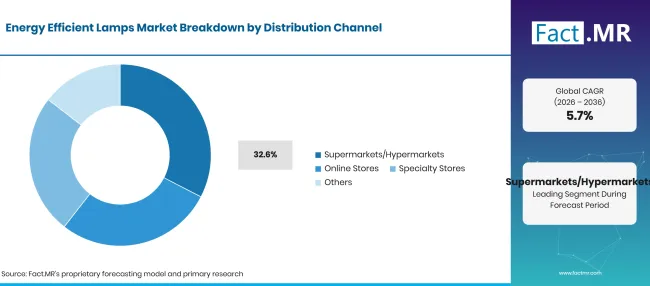
Energy Efficient Lamps Market Breakdown Distribution Channel | Source: Fact.MR
| Distribution Channel | Share (2026) |
|---|---|
| Supermarkets/Hypermarkets (Leading segment) | 32.6% |
| Other segments combined | 59.2%* |
| Total | 100.0% |
Source: Fact.MR analysis. Updated Nov 6, 2026
Shoppers usually replace a bulb on short notice, so they buy where they already shop for food and household goods. Supermarkets and hypermarkets offer multipacks at sharp prices, and promotions often push buyers to replace several bulbs at once. Online stores are gaining share for specialist shapes, smart bulbs and bulk orders. The U.S. Census Bureau reported that e-commerce accounted for 17.1% of total retail sales in the second quarter of 2026, on a seasonally adjusted basis [3]. Specialty lighting stores and electrical wholesalers remain important for contractors and commercial buyers.
What is accelerating Energy Efficient Lamps Market adoption, and what is holding it back?
Fluorescent phase-outs, higher power prices and building renovation rules are steadily pushing buyers toward LED lamps. Growth is limited by the long life of LED products, which delays repeat purchases, and by cheap imports that squeeze prices. Dimmer and fitting compatibility problems in older buildings can also slow upgrades.
Drivers Impact Analysis
| DRIVER | (~) % IMPACT ON CAGR | GEOGRAPHIC RELEVANCE | IMPACT TIMELINE |
|---|---|---|---|
| Fluorescent lamp phase-outs accelerating LED replacement demand | +1.5% | Global | Short term (<=2 years) |
| Rising electricity costs encouraging energy-saving lighting upgrades | +1.2% | Western Europe, East Asia | Short term (<=2 years) |
| Residential construction and household lighting replacement | +0.9% | Global | Medium term (2-4 years) |
| Commercial and institutional lighting modernization | +0.7% | North America, Western Europe | Medium term (2-4 years) |
Source: Fact.MR analysis. Updated Nov 6, 2026
Opportunity Impact Analysis
| OPPORTUNITY | (~) % IMPACT ON CAGR | GEOGRAPHIC RELEVANCE | IMPACT TIMELINE |
|---|---|---|---|
| Affordable LED lamps for price-sensitive residential buyers | +0.8% | South Asia & Pacific, Latin America | Medium term (2-4 years) |
| Replacement of early-generation LED bulbs reaching end of life | +0.6% | Global | Medium term (2-4 years) |
| Smart LED bulbs with dimming and connected features | +0.5% | North America, Western Europe, East Asia | Long term (>=4 years) |
| Wider online retail of efficient lighting products | +0.4% | Global | Short term (<=2 years) |
Source: Fact.MR analysis. Updated Nov 6, 2026
Restraints Impact Analysis
| RESTRAINT | (~) % IMPACT ON CAGR | GEOGRAPHIC RELEVANCE | IMPACT TIMELINE |
|---|---|---|---|
| Low-cost lamps and price-led purchasing decisions | -0.8% | Latin America, South Asia & Pacific | Short term (<=2 years) |
| Long LED operating life slowing replacement frequency | -0.6% | Global | Long term (>=4 years) |
| Compatibility issues with existing fixtures and dimmers | -0.4% | North America, Western Europe | Medium term (2-4 years) |
| Price competition from low-cost imports | -0.3% | Global | Short term (<=2 years) |
Source: Fact.MR analysis. Updated Nov 6, 2026
Which countries are scaling the Energy Efficient Lamps Market through 2036?
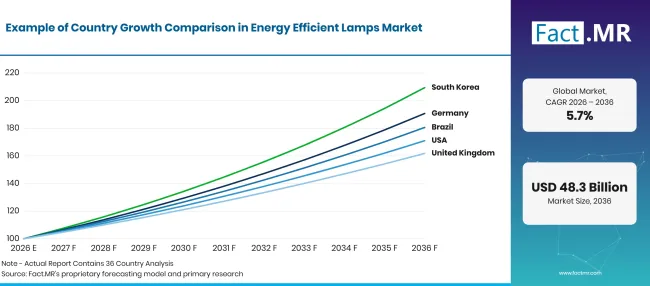
Energy Efficient Lamps Market Growth Index | Source: Fact.MR
| Country | CAGR (2026 to 2036) |
|---|---|
| Germany | 6.7% |
| Brazil | 6.1% |
| United States | 5.5% |
| United Kingdom | 4.9% |
| Japan | 4.4% |
Source: Fact.MR analysis. Updated Nov 6, 2026
What supports energy efficient lamp adoption in Germany?
6.7% CAGR, supported by high household power prices and EU renovation rules.
German households pay some of the steepest electricity rates in Europe, which shortens the payback on every LED swap. Destatis reported an average household electricity price of 37.97 cents per kWh in the first half of 2026, down 6.4% from the second half of 2025 but still 16.4% above the first half of 2021 [4]. At EU level, the European Commission notes that buildings account for 40% of energy consumption and that 75% of EU buildings have poor energy performance [5]. Renovation programmes built on these rules give lamp upgrades a steady pipeline across homes and offices.
How is Brazil developing demand?
6.1% CAGR, as residential power use grows and efficiency planning gains weight.
Brazilian homes are using more electricity, and lighting is one of the simplest loads to trim. The Energy Research Office (EPE) reported that residential consumption rose 7.7% year on year in September 2026, the sixth straight month of national growth [6]. The PDE 2036 efficiency study points to 53 TWh of avoided electricity demand in 2036 and a 7% efficiency gain in the residential sector between 2026 and 2036, supported by equipment standards, labelling and the Selo Procel programme [7]. Those instruments favour efficient lamps on retail shelves.
What is supporting United States adoption?
5.5% CAGR, backed by commercial retrofits and the renewal of older LED bulbs.
American homes already use LEDs widely. The U.S. Energy Information Administration reported that 90% of households used LED bulbs in 2024, and 37% used them for all indoor lighting [2]. The rest of the installed base, including halogen bulbs and fluorescent tubes in commercial space, will keep supporting replacement sales. Smart bulbs that work with voice assistants and phone apps add value to each purchase.
How is the United Kingdom developing demand?
4.9% CAGR, helped by public building upgrades and steady retail replacement.
Public sector buildings are a clear target for energy savings. In May 2025, the UK government awarded over £630 million for energy upgrades to public buildings, with savings averaging about £650 million a year to 2037 [8]. Lighting is not named in that funding round, but such projects often run alongside lamp and control upgrades. In homes, supermarkets remain the main outlet for replacement bulbs, and LED multipacks are the standard offer.
What supports Japan’s adoption?
4.4% CAGR, owing to the 2027 fluorescent cut-off and ongoing LED conversion.
Japan has set a firm end date for fluorescent lighting. The Shikoku Bureau of Economy, Trade and Industry reported an LED conversion rate of 66.4% at the end of 2025 and confirmed that the manufacture, import and export of fluorescent lamps will end by the close of 2027 [9]. Homeowners and businesses with older fixtures will need to switch over the next two years, which brings forward LED demand, though the aging housing stock limits growth after that point.
Who leads the Energy Efficient Lamps Market?
Competition falls into three groups. Global lamp specialists such as Signify, LEDVANCE and GE Lighting cover the full range from basic bulbs to smart lamps and compete on brand trust, efficacy and shelf presence. LEDVANCE used its light + building 2026 preview, announced in September 2025, to present advanced LED lamps alongside traditional lamps and luminaires sold under the OSRAM and SYLVANIA trademarks [10].
GE Lighting refreshed its reveal series in December 2025 with bulbs rated for up to 15 years that give the light of a traditional 60W bulb [11]. Signify published research in October 2026 showing that 74% of 50 circular lighting projects studied reported business benefits [12]. A second group, led by Panasonic, Havells and Bajaj Electricals, relies on strong home-market networks in Japan and India. Acuity Brands serves commercial retrofit buyers through lighting and controls. Price, light quality and retail reach will separate winners as fluorescent stock runs out.
Which companies are the key providers?
Key companies in the Energy Efficient Lamps Market include Signify, LEDVANCE, GE Lighting, Panasonic, Havells, Bajaj Electricals and Acuity Brands.
- Signify
- LEDVANCE
- GE Lighting
- Panasonic
- Havells
- Bajaj Electricals
- Acuity Brands
Bibliography
- [1] International Energy Agency. (2026, March 6). The next wave of LED lighting: Smarter, circular and more efficient.
- [2] U.S. Energy Information Administration. (2026, March 23). More U.S. homes used LEDs over other bulb types for indoor lighting in 2024.
- [3] U.S. Census Bureau. (2026, August 18). Quarterly Retail E-Commerce Sales: 2nd Quarter 2026.
- [4] Statistisches Bundesamt (Destatis). (2026, September 30). Strom- und Gaspreise für Haushalte im 1. Halbjahr 2026 gesunken.
- [5] European Commission. (2026, May 29). Improving energy efficiency of buildings to reduce bills and save energy.
- [6] Empresa de Pesquisa Energética. (2026, October 30). Resenha Mensal: consumo nacional de eletricidade cresce pelo sexto mês consecutivo.
- [7] Empresa de Pesquisa Energética. (2026, November 4). PDE 2036 projeta contribuição de 276 TWh da eficiência e dos recursos energéticos distribuídos em 2036.
- [8] Department for Energy Security and Net Zero. (2025, May 15). New energy upgrades for public buildings to save taxpayers money.
- [9] Shikoku Bureau of Economy, Trade and Industry. (2026, March 26). .
- [10] LEDVANCE. (2025, September 15). LEDVANCE at light + building 2026: Celebrating 10 years of transformation from lamps manufacturer to lighting projects house.
- [11] GE Lighting. (2025, December 9). Refreshed reveal Series and Design-Forward Light + Form Bulbs.
- [12] Signify. (2026, October 26). Oxford analysis links circular approaches to business benefits in 74% of real-world lighting projects studied.
This Report Answers
- How is lamp revenue split between LED, CFL, fluorescent and halogen products, and how fast is the older stock shrinking?
- Why do LED lamps lead product demand, and which efficacy gains keep them ahead?
- What keeps residential buyers and supermarket shelves central to lamp sales?
- How do online stores and specialty retailers change the way commercial and smart lamps reach buyers?
- Which of the five profiled countries will grow quickest, and which rules and power prices explain the gaps?
- Which suppliers compete across household and commercial lamp ranges, and on what terms?
What does the Energy Efficient Lamps Market cover?
This study tracks lamps used for general illumination, measured at manufacturer selling value. LED bulbs and tubes form the core category, while CFL, fluorescent and halogen lamps are counted until they leave the market.
Revenue is split by product type, application, distribution channel and end-user. Households, offices, retail sites and hospitality venues are tracked as separate buyer groups, with no shares assigned outside the leading segments.
What is included in the scope?
LED replacement bulbs in standard and decorative shapes, including filament and smart LED lamps.
LED tubes and retrofit lamps designed for existing fluorescent and high-intensity fittings.Compact fluorescent, linear fluorescent and energy-saving halogen lamps still sold for general lighting.Lamps sold through supermarkets, hypermarkets, online stores, specialty lighting shops and wholesalers.
What is excluded from the scope?
Complete luminaires with integrated light sources, which are covered in the lighting fixture study.
Vehicle lamps, assessed separately in the automotive exterior LED lighting report.Display backlighting, cinema and stage lighting, and horticultural grow lights.Installation labour, electricity charges and standalone software, as well as project services covered under LED lighting solutions.
How Was the Analysis Built?
The analysis draws on 120+ sources, 35+ company portfolios, 25+ countries, and more than 20 industry interviews.
- Primary Research: Primary research includes discussions with manufacturers, service providers, technology developers, distributors, end users, and subject-matter experts. These conversations examine purchasing priorities, product adoption, operational challenges, approval requirements, competitive positioning, and the factors that influence wider market acceptance.
- Desk Research: Desk research covers government statistics, regulatory publications, company filings, trade data, technical studies, industry associations, standards, public policy, and other authoritative sources. Every source used in the analysis is documented in the bibliography.
- Market Sizing and Forecasting: Market estimates combine historical performance, demand indicators, pricing and volume trends, segment shares, company participation, country-level growth, adoption patterns, investment activity, and barriers to market expansion.
- Data Validation and Update Cycle: Findings are validated by comparing primary interviews with public data, company activity, regulatory changes, trade patterns, and industry developments. Regular updates review new product launches, capacity changes, partnerships, approvals, and shifts in commercial adoption.
Segmentation
What is the report’s scope and coverage?
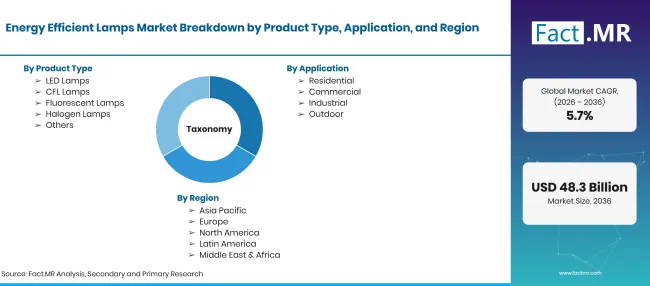
Energy Efficient Lamps Market Taxonomy | Source: Fact.MR
| Attribute | Details |
|---|---|
| Quantitative Units | USD billion in 2026 to USD billion by 2036 at CAGR |
| Market Definition | Energy efficient lamps used for general illumination in residential, commercial, industrial and outdoor settings, covering LED, CFL, fluorescent, halogen and other qualifying lamp types. |
| Product Type | LED Lamps; CFL Lamps; Fluorescent Lamps; Halogen Lamps; Others |
| Application | Residential; Commercial; Industrial; Outdoor; Others |
| Distribution Channel | Supermarkets/Hypermarkets; Online Stores; Specialty Stores; Others |
| End-User | Households; Offices; Retail; Hospitality; Others |
| Regions Covered | North America; Latin America; Western Europe; Eastern Europe; East Asia; South Asia & Pacific; Middle East & Africa |
| Countries Covered | Germany; Brazil; United States; United Kingdom; Japan |
| Companies Profiled | Signify; LEDVANCE; GE Lighting; Panasonic; Havells; Bajaj Electricals; Acuity Brands |
| Forecast Period | 2026 to 2036 |
| Approach | Replacement-cycle model built on installed socket stock, lamp technology shares, phase-out timelines and retail channel mix by country. |
Source: Fact.MR analysis. Updated Nov 6, 2026
How is the market segmented?
-
By Product Type
- LED Lamps
- CFL Lamps
- Fluorescent Lamps
- Halogen Lamps
- Others
-
By Application
- Residential
- Commercial
- Industrial
- Outdoor
- Others
-
By Distribution Channel
- Supermarkets/Hypermarkets
- Online Stores
- Specialty Stores
- Others
-
By End-User
- Households
- Offices
- Retail
- Hospitality
- Others
-
By Region
- North America
- Latin America
- Western Europe
- Eastern Europe
- East Asia
- South Asia & Pacific
- Middle East & Africa
Frequently Asked Questions
How large is the energy efficient lamps market in 2026?
What growth rate will the energy efficient lamps market record?
Which product type leads?
Which application leads?
Which distribution channel leads?
Which country will grow quickest?
Who are the main companies?
What holds the market back?
Who worked on this report


Preview the report firsthand - request a free sample
Free SampleGet the brochure for pricing and purchase details
Download PDF