- Market Value (2025): USD 113.8 Bn
- Estimated Value (2026): USD 120.3 Bn
- Forecast Value (2036): USD 209.4 Bn
- CAGR (2026-2036): 5.7%
What is the Energy Efficient Lighting Market forecast to be worth by 2036?
USD 120.3 billion in 2026 to USD 209.4 billion by 2036 at a 5.7% CAGR.
- Fact.MR estimates that the energy efficient lighting market reached USD 113.8 billion in 2025, as LED products replaced legacy lamps in homes and workplaces.
- Revenue is set to climb from USD 120.3 billion in 2026 to USD 209.4 billion by 2036 as owners retrofit offices, schools and streets.
- Fluorescent phase-outs and commercial LED retrofits will carry growth at a 5.7% CAGR between 2026 and 2036.
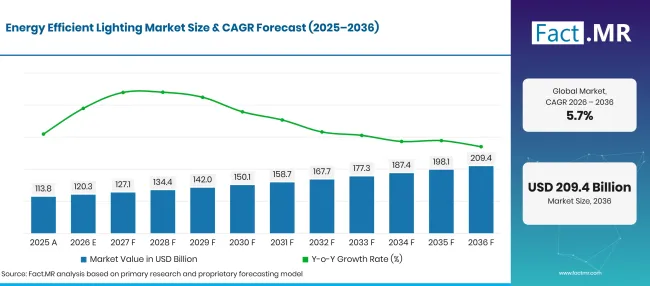
Factmr Energy Efficient Lighting Market Forecast Global | Source: Fact.MR
| Year | Basis | Market Value (USD billion) |
|---|---|---|
| 2025 | Actual | 113.81 |
| 2026 | Estimate | 120.3 |
| 2036 | Forecast | 209.4 |
| CAGR 2026 to 2036 | Forecast period | 5.7% |
Source: Fact.MR analysis. Updated Oct 16, 2026
What are the defining numbers behind Energy Efficient Lighting Market growth?
The 2026 to 2036 period adds USD 89.1 billion in new value, concentrated in LED fixtures and building retrofits.
- Demand Drivers in the Market
- Lighting still draws a large share of power in buildings and streets. The International Energy Agency reported in March 2026 that lighting in buildings and outdoor applications accounted for around 8% of global electricity demand in 2024, or about 2,200 TWh [1].
- Mercury rules are closing the market for fluorescent lamps. Parties to the Minamata Convention agreed in November 2025 to end the manufacture, import and export of compact fluorescent lamps above 30 watts after 2026 [2]. Triband linear fluorescent tubes follow after 2027 [2].
- Efficiency standards trail product gains, which leaves room for tighter rules. In its Energy Efficiency 2025 report, the IEA stated that the efficiency of best-in-class lightbulbs doubled over the last 15 years, while minimum performance standards rose by only 30% [3].
- Connected controls raise the value of each LED project. Occupancy sensors and daylight dimming cut energy use beyond the lamp swap, and operators use the same network to collect space data.
- Key Segments Analyzed
- By Product Type: LED will command 62.4% share in 2026 since it gives more light per watt and a longer service life than other general lighting sources.
- By Application: Residential will take 35.2% share in 2026, as households buy replacement lamps through hardware stores and online.
- By Distribution Channel: Offline will capture 73.4% share in 2026, with trade counters and home centers letting buyers check fittings and color before purchase.
- By End-User: Offices will represent 22.3% share in 2026, reflecting landlord efforts to lower service charges and lift energy ratings.
- Analyst Opinion at Fact.MR
- Shambhu Nath Jha, Principal Consultant at Fact.MR, states, “Fluorescent bans are turning the next few years into a replacement wave for offices, schools and warehouses. Owners now look past the lamp to the full LED fixture and its controls, chasing lower power bills and data on space use. Retrofit contracts will go to suppliers able to deliver certified fixtures, drivers and commissioning support as one package.”
- Strategic Implications
- Lighting manufacturers should prepare LED tube and fixture ranges for the 2026 and 2027 fluorescent phase-out dates, since stocked lamps will run out faster than many owners expect.
- Electrical wholesalers should bundle LED fixtures with sensors and installation guidance for contractors, given that retrofit buyers compare full project cost.
- Facility managers in offices and public buildings should plan fixture replacement before legacy tubes fail, where group retrofits lower labor cost per point.
At 6.4% CAGR, Germany heads the group, backed by high electricity prices that speed up LED retrofits. Brazil will follow at 5.9% as national efficiency programs fund LED street and building lighting. The United States will record 5.3% with household LED use spreading across new and older homes. Public building upgrades will lift the United Kingdom to 4.8%, and Japan rounds out the list at 4.2% as fluorescent lamp production ends.
How does the Energy Efficient Lighting Market break down by segment?
LED at 62.4%, Residential at 35.2%, Offline at 73.4% and Offices at 22.3% head their segments in 2026.
Which Product Type dominates?
LED takes 62.4% of 2026 sales.
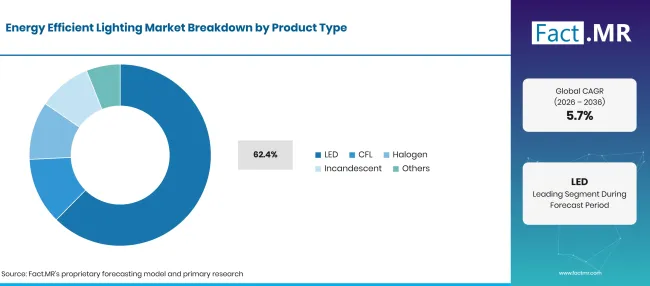
Factmr Energy Efficient Lighting Market Breakdown Product Type | Source: Fact.MR
| Product Type | Share (2026) |
|---|---|
| LED (Leading segment) | 62.4% |
| Other segments combined | 37.6%* |
| Total | 100.0% |
Source: Fact.MR analysis. Updated Oct 16, 2026
Fixture makers now design new luminaires around LED light sources, and retrofit LED lamps fit the sockets owners already have. Buyers can also pick LED tubes or integrated fixtures with dimming built in, and many fixtures use high-output chip-on-board LEDs as the light source. CFLs remain in use in older fittings, but mercury rules are ending their production. Halogen and incandescent lamps are legacy products in decline, and regulation has removed most general service versions from sale in the EU and the United States. The IEA put halogen efficacy at about 20 lm/W, against close to 100 lm/W for an average LED sold today [1].
What leads the Application segment?
Residential accounts for 35.2% of 2026 demand.
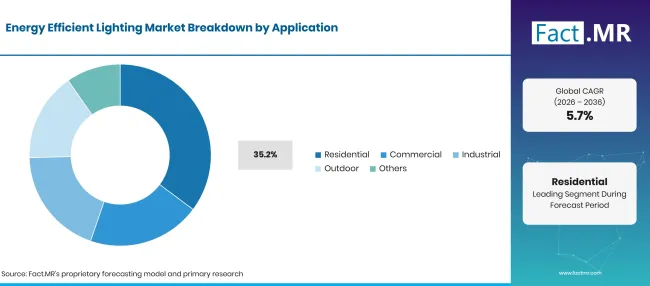
Factmr Energy Efficient Lighting Market Breakdown Application | Source: Fact.MR
| Application | Share (2026) |
|---|---|
| Residential (Leading segment) | 35.2% |
| Other segments combined | 64.8%* |
| Total | 100.0% |
Source: Fact.MR analysis. Updated Oct 16, 2026
Every home holds many sockets, and bulbs fail on a regular cycle. Eurostat reported that electricity used for lighting and most electrical appliances made up 14.8% of EU household final energy consumption in 2024 [4]. Homeowners also replace a ceiling lighting fixture during renovation, which lifts spend per room. The IEA estimated that 30% of residential lamps worldwide have yet to be upgraded to LED [1]. Cities upgrading roads and public spaces are adding smart street lighting systems that dim as needed and report faults.
How does Distribution Channel shape demand?
Offline commands 73.4% of 2026 sales.
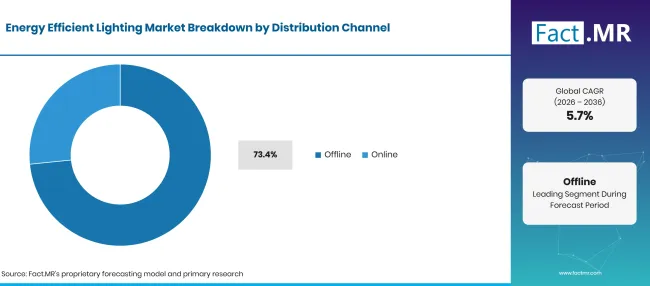
Factmr Energy Efficient Lighting Market Breakdown Distribution Channel | Source: Fact.MR
| Distribution Channel | Share (2026) |
|---|---|
| Offline (Leading segment) | 73.4% |
| Other segments combined | 26.6%* |
| Total | 100.0% |
Source: Fact.MR analysis. Updated Oct 16, 2026
Contractors buy most fixtures, tubes and controls through electrical wholesalers and lighting distributors, which hold stock for project schedules. Online sales are growing for replacement lamps and smart bulbs, where buyers know the base type and wattage. The U.S. Census Bureau reported that e-commerce accounted for 17.1% of total retail sales in the second quarter of 2026 [5].
What supports Offices within End-User?
Offices hold a 22.3% share in 2026.
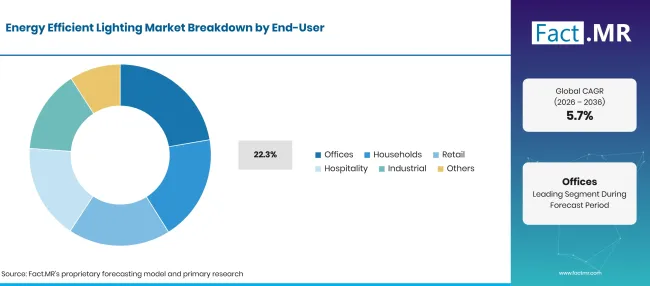
Factmr Energy Efficient Lighting Market Breakdown End User | Source: Fact.MR
| End-User | Share (2026) |
|---|---|
| Offices (Leading segment) | 22.3% |
| Other segments combined | 77.7%* |
| Total | 100.0% |
Source: Fact.MR analysis. Updated Oct 16, 2026
Office lights run for long hours each workday, so building managers replace fixtures floor by floor. Group retrofits also cut labor cost per lighting point. An LED lighting controller lets each zone dim by occupancy and daylight. Retail and hospitality buyers focus on color quality and dimming, while industrial sites need high-bay fixtures.
What is accelerating Energy Efficient Lighting Market adoption, and what is holding it back?
Adoption will rise through fluorescent phase-outs, high power prices and retrofits of commercial buildings. Growth is held back by long LED lifetimes that slow repeat purchases and by price pressure from low-cost imports.
Drivers Impact Analysis
| DRIVER | (~) % IMPACT ON CAGR | GEOGRAPHIC RELEVANCE | IMPACT TIMELINE |
|---|---|---|---|
| Mercury lamp phase-outs that force fluorescent to LED conversion | +1.2% | Global | Short term (<= 2 years) |
| High electricity prices that shorten retrofit payback | +1.0% | Western Europe, East Asia | Short term (<= 2 years) |
| Tighter minimum efficacy standards for lamps and luminaires | +0.8% | North America, Western Europe, South Asia & Pacific | Medium term (2-4 years) |
| Public funding for LED street and building lighting | +0.7% | Latin America, Western Europe | Medium term (2-4 years) |
| Connected controls that add value per lighting point | +0.6% | North America, Western Europe | Long term (>= 4 years) |
Source: Fact.MR analysis. Updated Oct 16, 2026
Opportunity Impact Analysis
| OPPORTUNITY | (~) % IMPACT ON CAGR | GEOGRAPHIC RELEVANCE | IMPACT TIMELINE |
|---|---|---|---|
| Replacement of early-generation LED lamps reaching end of life | +0.8% | Global | Medium term (2-4 years) |
| Smart street lighting with remote monitoring | +0.6% | Latin America, Middle East & Africa | Medium term (2-4 years) |
| Lighting as a service contracts for offices and public buildings | +0.5% | Western Europe, North America | Long term (>= 4 years) |
Source: Fact.MR analysis. Updated Oct 16, 2026
Restraints Impact Analysis
| RESTRAINT | (~) % IMPACT ON CAGR | GEOGRAPHIC RELEVANCE | IMPACT TIMELINE |
|---|---|---|---|
| Long LED lifetimes that slow repeat lamp purchases | -0.7% | Global | Long term (>= 4 years) |
| Price pressure from low-cost imported lamps | -0.5% | Global | Short term (<= 2 years) |
| Weak construction activity in some markets | -0.4% | Western Europe, East Asia | Short term (<= 2 years) |
Source: Fact.MR analysis. Updated Oct 16, 2026
Which countries are scaling the Energy Efficient Lighting Market through 2036?
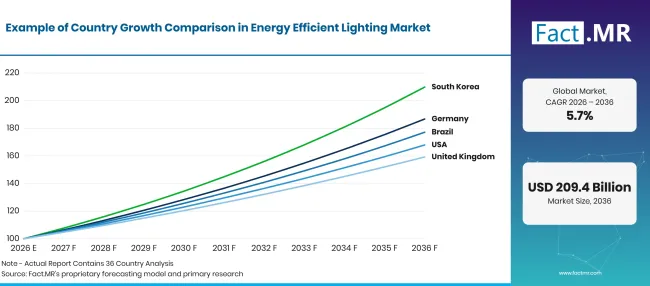
Factmr Energy Efficient Lighting Market Growth Index | Source: Fact.MR
| Country | CAGR (2026–2036) |
|---|---|
| Germany | 6.4% |
| Brazil | 5.9% |
| United States | 5.3% |
| United Kingdom | 4.8% |
| Japan | 4.2% |
Source: Fact.MR analysis. Updated Oct 16, 2026
What supports Germany adoption?
6.4% CAGR, on the back of high electricity prices that shorten LED retrofit payback.
Destatis reported that households paid an average of 37.97 cents per kWh for electricity in the first half of 2026 [6]. Non-household users paid a provisional 17.64 cents per kWh in the same period [6].
How is Brazil scaling demand?
5.9% CAGR, driven by rising power demand and public efficiency programs.
Brazil’s Energy Research Office (EPE) projected in October 2026 that national electricity consumption would grow by 3.4% a year to 979 TWh in 2036 [7]. The same plan counts 53 TWh of consumption avoided through efficiency gains over the horizon [7]. Under the federal Procel program, efficient products carry a certification seal and Reluz calls fund LED street lighting.
What supports United States growth?
5.3% CAGR, helped by spreading LED use in homes and federal lamp rules.
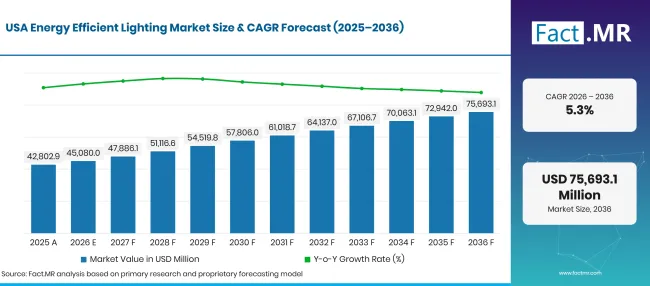
Factmr Energy Efficient Lighting Market Forecast Usa | Source: Fact.MR
U.S. households have moved quickly to LED bulbs since federal general service lamp rules took effect. The Energy Information Administration reported that 90% of households used LED bulbs in 2024 [8]. Homes using mostly LEDs rose from 4% in 2015 to 63% in 2024 [8]. Remaining sales come from outdoor fixtures, older homes and commercial retrofits.
How is the United Kingdom developing demand?
4.8% CAGR, backed by public building upgrades and lower household lighting loads.
The Department for Energy Security and Net Zero reported that domestic energy use for lighting and appliances fell by 0.3 mtoe, or 4.5%, between 2000 and 2025 [9]. Projects in the fourth phase of the Public Sector Decarbonisation Scheme list LED lighting at NHS trusts and councils alongside heating upgrades [10].
How does Japan perform?
4.2% CAGR, reflecting the end of fluorescent lamp production.
Japan’s Ministry of the Environment confirmed in April 2026 that general lighting fluorescent lamps will be banned from manufacture, import and export by the end of 2027 [11]. Straight tube and circular lamps face the final cut-off on January 1, 2028 [11]. Panasonic launched a dedicated site in May 2026 announcing the end of its fluorescent lamp production by September 2027 [12].
Who leads the Energy Efficient Lighting Market?
Competition runs across three groups. Full-line lighting makers such as Signify, Acuity and Zumtobel Group sell luminaires, lamps and controls for building projects.
Panasonic holds a similar role in Japan and other Asian markets. These firms compete on specification wins and connected systems. Zumtobel Group stated in September 2026 that rules on energy efficiency and building refurbishment create medium and long term opportunities [13]. Lamp brands such as GE Lighting and LEDVANCE compete for shelf space in home centers and online stores. GE Lighting introduced reformulated GE reveal LED bulbs with better color rendering and efficacy in January 2025 [14]. Component suppliers such as ams OSRAM and Cree LED sell LED chips and packages to fixture makers. Fixture efficacy, control integration and readiness for the fluorescent phase-out will separate winners from the rest.
Which companies are the key providers?
Key companies include Signify N.V.; Acuity Inc.; Zumtobel Group AG; Panasonic Electric Works Co., Ltd.; GE Lighting; LEDVANCE GmbH; ams OSRAM AG; and Cree LED.
- Signify N.V.
- Acuity Inc.
- Zumtobel Group AG
- Panasonic Electric Works Co., Ltd.
- GE Lighting
- LEDVANCE GmbH
- ams OSRAM AG
- Cree LED
Bibliography
- [1] International Energy Agency. (2026, March 6). The next wave of LED lighting: Smarter, circular and more efficient.
- [2] Minamata Convention on Mercury. (2025, November 24). Decision MC-6/3: Amendments to annex A (UNEP/MC/COP.6/Dec.3).
- [3] International Energy Agency. (2025, November 20). Energy Efficiency 2025: Executive summary.
- [4] Eurostat. (2026, June). Energy consumption in households.
- [5] U.S. Census Bureau. (2026, August 18). Quarterly Retail E-Commerce Sales Report.
- [6] Statistisches Bundesamt (Destatis). (2026, September 30). Strom- und Gaspreise für Haushalte im 1. Halbjahr 2026 gesunken [Electricity and gas prices for households fell in the first half of 2026].
- [7] Empresa de Pesquisa Energética (EPE). (2026, October 8). Mais elétrico, mais renovável, mais flexível: PDE 2036 projeta a energia do Brasil nos próximos dez anos e abre Consulta Pública [More electric, more renewable, more flexible: PDE 2036 projects Brazil’s energy over the next ten years].
- [8] U.S. Energy Information Administration. (2026, March 23). More U.S. homes used LEDs over other bulb types for indoor lighting in 2024.
- [9] Department for Energy Security and Net Zero. (2026, September 24). Energy Consumption in the UK (ECUK) 2026.
- [10] Department for Energy Security and Net Zero. (2025, December 4). Phase 4 Public Sector Decarbonisation Scheme: project summaries.
- [11] Ministry of the Environment, Japan. (2026, April 15). 蛍光ランプの製造・輸出入禁止 [Ban on the manufacture and import/export of fluorescent lamps].
- [12] Panasonic Electric Works Co., Ltd. (2026, May 22). 蛍光灯生産終了特設サイト「ありが灯。」 [Special site on the end of fluorescent lamp production].
- [13] Zumtobel Group AG. (2026, September 3). Zumtobel Group starts the new 2026/27 financial year with improved profitability.
- [14] GE Lighting. (2025, January 6). Savant at CES 2025.
This Report Answers
- Readers see how energy efficient lighting sales split by product type, application, channel and end-user.
- Each segment’s top subsegment is linked to the operating factors behind its 2026 share.
- Power prices, public funding and fluorescent phase-out timing frame the comparison of the five listed countries.
- Active lighting manufacturers, lamp brands and LED component suppliers are profiled by the products they sell.
- Mercury bans and efficacy standards are tracked for how they steer adoption away from legacy lamps toward LED products.
What does the Energy Efficient Lighting Market cover?
Lamps and luminaires used for general lighting in homes, workplaces, industrial sites and outdoor spaces form this market. Coverage spans LED lamps, LED tubes and integrated LED fixtures.
What is included in the scope?
Replacement lamps, LED retrofit tubes and new LED fixtures sold for indoor and outdoor general lighting are counted in full. Garden and path fittings used in landscape lighting are included when they use efficient light sources.
Fixtures with built-in sensors or drivers are counted at full fixture value, and street lights are included under the outdoor application.
What is excluded from the scope?
The scope excludes vehicle lamps such as an automotive LED light and lighting built into consumer electronics. Display backlights and specialty lamps for cinema, stage and industrial processes are also excluded.
Stand-alone control software, installation labor and energy service fees fall outside the revenue boundary.
How Was the Analysis Built?
The analysis draws on 120+ sources, 35+ company portfolios, 25+ countries, and more than 20 industry interviews.
- Primary Research: Primary research includes discussions with manufacturers, service providers, technology developers, distributors, end users, and subject-matter experts. These conversations examine purchasing priorities, product adoption, operational challenges, approval requirements, competitive positioning, and the factors that influence wider market acceptance.
- Desk Research: Desk research covers government statistics, regulatory publications, company filings, trade data, technical studies, industry associations, standards, public policy, and other authoritative sources. Every source used in the analysis is documented in the bibliography.
- Market Sizing and Forecasting: Market estimates combine historical performance, demand indicators, pricing and volume trends, segment shares, company participation, country-level growth, adoption patterns, investment activity, and barriers to market expansion.
- Data Validation and Update Cycle: Findings are validated by comparing primary interviews with public data, company activity, regulatory changes, trade patterns, and industry developments. Regular updates review new product launches, capacity changes, partnerships, approvals, and shifts in commercial adoption.
Segmentation
What is the report’s scope and coverage?
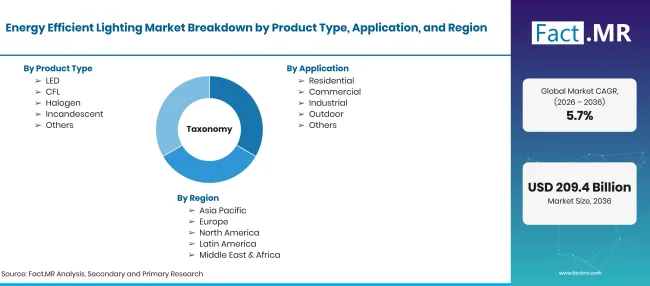
Factmr Energy Efficient Lighting Market Taxonomy | Source: Fact.MR
| Attribute | Details |
|---|---|
| Quantitative Units | USD billion in 2026 to USD billion by 2036 at CAGR |
| Market Definition | Lamps and luminaires for general lighting, led by LED products, together with CFL, halogen and incandescent lamps that remain on sale during their regulatory phase-out. Products sold to residential, commercial, industrial and outdoor users are counted. |
| Product Type | LED; CFL; Halogen; Incandescent; Others |
| Application | Residential; Commercial; Industrial; Outdoor; Others |
| Distribution Channel | Offline; Online |
| End-User | Offices; Households; Retail; Hospitality; Industrial; Others |
| Regions Covered | North America; Latin America; Western Europe; Eastern Europe; East Asia; South Asia & Pacific; Middle East & Africa |
| Countries Covered | Germany; Brazil; United States; United Kingdom; Japan |
| Companies Profiled | Signify N.V.; Acuity Inc.; Zumtobel Group AG; Panasonic Electric Works Co., Ltd.; GE Lighting; LEDVANCE GmbH; ams OSRAM AG; Cree LED |
| Forecast Period | 2026 to 2036 |
| Approach | Hybrid top-down and bottom-up approach using lamp and luminaire shipments; installed lighting stock; phase-out schedules for mercury and halogen lamps; channel split; country growth; and supplier portfolio review. |
Source: Fact.MR analysis. Updated Oct 16, 2026
How is the market segmented?
-
By Product Type
- LED
- CFL
- Halogen
- Incandescent
- Others
-
By Application
- Residential
- Commercial
- Industrial
- Outdoor
- Others
-
By Distribution Channel
- Offline
- Online
-
By End-User
- Offices
- Households
- Retail
- Hospitality
- Industrial
- Others
-
By Region
- North America
- Latin America
- Western Europe
- Eastern Europe
- East Asia
- South Asia & Pacific
- Middle East & Africa
Frequently Asked Questions
How big is the energy efficient lighting market in 2026?
What is the CAGR of the energy efficient lighting market from 2026 to 2036?
Which product type leads the energy efficient lighting market?
Which application leads the energy efficient lighting market?
Which distribution channel leads the energy efficient lighting market?
Which end-user leads the energy efficient lighting market?
Which country will grow the most in the energy efficient lighting market?
Who are the main companies in the energy efficient lighting market?
Who worked on this report


Preview the report firsthand - request a free sample
Free SampleGet the brochure for pricing and purchase details
Download PDF