- Market Value (2025): USD 2.8 Bn
- Estimated Value (2026): USD 3.0 Bn
- Forecast Value (2036): USD 5.92 Bn
- CAGR (2026-2036): 7.0%
What is the Energy Curing Market forecast to be worth by 2036?
USD 3.0 Billion in 2026 to USD 5.9 Billion by 2036 at a 7.0% CAGR.
- At USD 2.8 Billion in 2025, the energy curing market established strong momentum across flexible packaging printing, industrial wood clearcoats, and automotive electronic component encapsulation.
- Sales will surge from USD 3.0 Billion in 2026 to USD 5.92 Billion by 2036 as manufacturing plants convert conventional thermal coating lines to compact, narrow-spectrum UV-LED and high-throughput electron beam curing systems.
- Compounding at a robust 7.0% CAGR over the 2026 to 2036 forecast period, market value expansion is driven by environmental regulations curbing VOC emissions, lower utility electricity bills, and superior coating scratch resistance.
The commercial trajectory of the market reflects intense technological modernization across industrial finishing ecosystems. Traditional solvent-borne and water-borne coating systems require extensive physical drying tunnels, thermal oxidizers, and significant floor space to evaporate liquid carriers. In contrast, 100% solids energy-curable formulations require zero drying footprint, curing instantly under focused photon or electron bombardment at ambient factory temperatures. This instantaneous physical cure allows finished goods to be stacked, packaged, or mechanically processed immediately downstream without risk of blocking or surface marring, thereby dramatically reducing work-in-progress inventory across high-speed packaging and manufacturing lines.
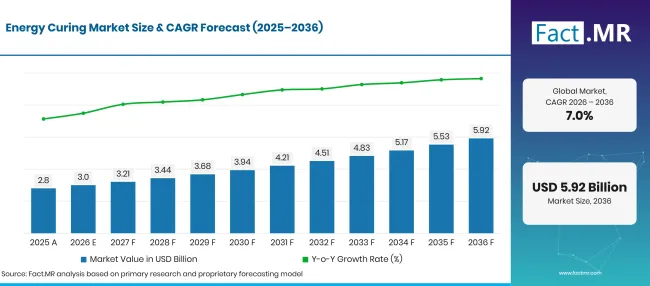
Energy Curing Market Forecast Global 1 | Source: Fact.MR
| Year | Basis | Market Value (USD Billion) |
|---|---|---|
| 2025 | Actual | 2.8 |
| 2026 | Estimate | 3.0 |
| 2036 | Forecast | 5.92 |
| CAGR 2026 to 2036 | Forecast period | 7.0% |
Source: Fact.MR analysis. Updated Oct 27, 2026
What are the defining numbers behind Energy Curing Market growth?
Between 2026 and 2036, the energy curing industry will generate an absolute dollar opportunity of USD 2.9 Billion, driven by regulatory bans on hazardous air pollutants, rapid industrial adoption of UV-LED curing heads, and surging demand for sustainable consumer goods packaging.
- Demand Drivers in the Market
- Lower-emission formulation is becoming a practical compliance route. EPA’s 2025 aerosol-coatings amendments revised product-weighted reactivity limits, compound reactivity factors, reporting requirements, and test methods [1]. The changes strengthen the case for controlled curing and coatings with lower solvent-related emissions.
- Clean-air rules are widening the operating case for 100%-solids chemistry. The 2025 U.S. aerosol-coatings rule was adopted under the Clean Air Act to reduce VOC contributions to ozone formation [2]. UV and electron-beam systems benefit because they can cure rapidly without conventional thermal drying.
- Material selection is becoming as important as curing speed. EPA’s current TSCA process reviews new chemicals before manufacture and may impose restrictions when risks are identified [3]. Suppliers with well-characterized photoinitiators, oligomers, additives, and low-migration formulations gain an adoption advantage.
- Factory modernization is linking faster throughput with lower process-energy intensity. NIST’s 2025 review describes a large, capital-intensive U.S. manufacturing base in which productivity, energy performance, and modernization remain central competitiveness measures [4]. Efficient curing and finishing systems align with all three priorities.
- Corporate carbon accounting is exposing the energy cost of every curing step. Germany’s Environment Agency has supplied quality-assured organizational emission factors since 2025 for fuel, electricity, and process-emissions measurement [5]. More consistent accounting makes UV-LED retrofits easier to assess within capital-planning decisions.
- Key Segments Analyzed
- By Technology: UV Curing commands 52.3% of 2026 market value, serving as the industry's primary technology platform across commercial graphic arts, industrial coatings, and assembly adhesives.
- By Application: Printing represents the leading application with a 29.3% share in 2026, driven by rapid uptake of UV and EB inks across food carton printing, label converting, and flexible plastic pouches.
- By End-User Industry: Packaging forms the largest end-user sector with a 28.2% share in 2026, where brand owners demand instant-cure, food-contact safe, and high-gloss packaging finishes.
- Analyst Opinion at Fact.MR
- Shambhu Nath Jha, Principal Consultant at Fact.MR, states, "Energy curing is no longer a niche finishing alternative; it has become the central operational pillar of modern sustainable industrial manufacturing. Escalating electricity costs and aggressive municipal VOC emission limits are rendering traditional gas-fired thermal drying ovens financially unviable. Converters are rapidly embracing UV-LED curing platforms because they eliminate warm-up times, produce zero hazardous ozone, and reduce operating power consumption by 50% to 75% relative to medium-pressure mercury arc lamps. Simultaneously, the chemical formulation landscape is advancing rapidly. Chemical synthesizers are commercializing highly reactive multi-functional acrylate oligomers and polymeric photoinitiators with ultra-low migration profiles, fully resolving historical food packaging odor and contamination concerns. We project that over the next ten years, industrial coaters who fail to convert their conventional thermal lines to radiation-curable platforms will face severe regulatory penalties and unsustainable operating cost disadvantages."
- Strategic Implications
- Chemical formulators should accelerate the synthesis of bio-derived epoxy acrylates and polyester acrylates to meet brand owner targets for renewably sourced consumer packaging resins.
- Industrial coating applicators must invest in automated radiometric monitoring and UV-LED retrofits to ensure uniform cure depth and avoid unreacted monomer residuals.
- Printing press manufacturers should standardize on dual-cure UV/EB drying stations to enable converters to switch seamlessly between paperboard carton inks and ultra-thin flexible barrier films.
- Oligomer producers must establish dedicated cleanroom synthesis lines to certify low-migration, low-odor raw materials for food-contact, medical packaging, and electronic display laminations.
German energy curing consumption will expand at an 8.5% CAGR through 2036, leading European markets as automotive Tier-1 suppliers and precision engineering plants convert finishing operations to zero-VOC radiation curing.
How does the Energy Curing Market break down by segment?
UV Curing leads Technology at 52.3%, Printing leads Application at 29.3%, and Packaging dominates End-User Industry at 28.2% in 2026.
Which Technology dominates?
UV Curing captures 52.3% of 2026 technology value.
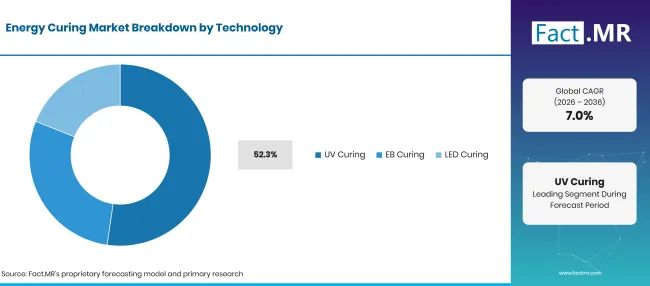
Energy Curing Market Breakdown Technology 1 | Source: Fact.MR
Ultraviolet curing technology represents the foundation of the energy curing industry, commanding more than half of total global revenues. UV curing systems deploy either traditional medium-pressure mercury vapor lamps or solid-state UV-LED arrays emitting photons in the UVA, UVB, and UVC spectral bands. When exposed to this radiant energy, photoinitiator molecules dissolved within the formulated liquid coating dissociate into reactive free radicals or cationic species. These reactive intermediates initiate rapid chain-growth polymerization among acrylate or epoxy monomers, converting the liquid film into a crosslinked, insoluble polymer network in fractions of a second. UV curing is universally deployed across graphic arts printing presses, compact disc manufacturing, optical fiber cladding, and furniture finishing lines. The rapid adoption of 365 nm, 385 nm, and 395 nm UV-LED modules has further solidified this dominance by eliminating heavy metal mercury disposal concerns, delivering instant on/off cycling without mechanical shutters, and preventing thermal substrate distortion. Manufacturers routinely consult industrial wood finishing formulations and automotive exterior surface coatings technical data to optimize photoinitiator absorption spectra for high-pigment-load coating formulations.
| Technology | Share (2026) |
|---|---|
| UV Curing (Leading segment) | 52.3% |
| Other segments combined | 47.7%* |
| Total | 100.0% |
Source: Fact.MR analysis. Updated Oct 27, 2026
Which Application leads the market?
Printing accounts for 29.3% of 2026 application revenue.
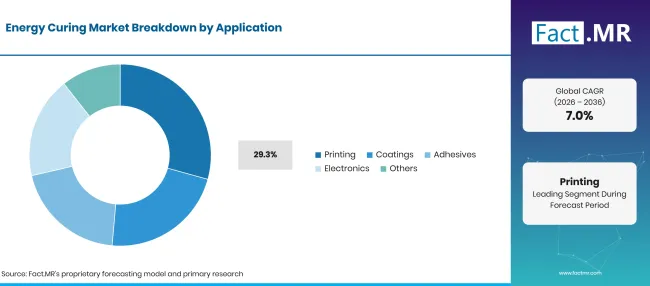
Energy Curing Market Breakdown Application 1 | Source: Fact.MR
The commercial printing and graphic arts sector represents the primary commercial application of energy curing chemistry. Printing operations require rapid drying of inks and varnishes on fast-moving web presses running at speeds exceeding 300 to 500 meters per minute. Traditional heat-set inks require large gas ovens that dry the ink by evaporating mineral oil solvents, releasing substantial VOC emissions and requiring massive capital expenditures for thermal incinerators. In contrast, UV and EB curable inks consist of 100% active solids that cure instantaneously at the print nip. This immediate drying enables printers to print multiple ink layers consecutively without inter-station smearing, while delivering superior color density, razor-sharp dot reproduction, and exceptional rub resistance. Energy curable inks dominate luxury folding carton packaging, self-adhesive labels, beverage shrink sleeves, and metal decorating for beverage cans. Print converters also utilize specialized original equipment automotive finishes and sustainable dry powder finishes to benchmark curing speed and surface scratch resistance on high-speed industrial presses.
| Application | Share (2026) |
|---|---|
| Printing (Leading segment) | 29.3% |
| Other segments combined | 70.7%* |
| Total | 100.0% |
Source: Fact.MR analysis. Updated Oct 27, 2026
Which End-User Industry captures the largest share?
Packaging commands 28.2% of 2026 end-user demand.
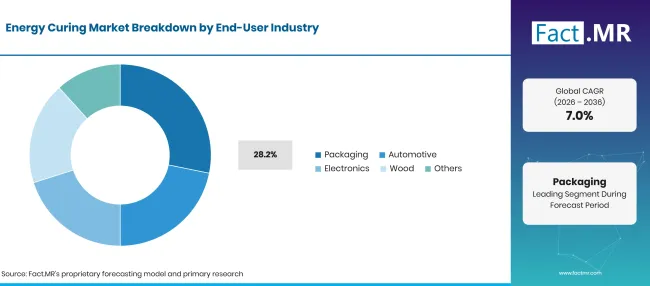
Energy Curing Market Breakdown End User Industry 1 | Source: Fact.MR
Packaging conversion represents the single largest consuming industry for energy curable materials. Brand owners across food and beverage, pharmaceuticals, personal care, and luxury consumer goods mandate packaging that combines eye-catching visual aesthetics with robust physical barrier protection. Energy-cured overprint varnishes (OPVs) deliver high-gloss, matte, soft-touch, and tactile textured finishes that elevate shelf appeal while shielding the underlying printed graphics from scuffing, moisture, and chemical exposure during shipping and handling. Moreover, the packaging sector's urgent push toward circular economy compliance and lightweighting has made energy curing indispensable. Because energy curing generates minimal heat, converters can print and coat ultra-thin, heat-sensitive mono-material polyethylene and polypropylene films that would melt inside conventional thermal drying tunnels. Converters maintain strict quality assurance by implementing surface preparation and stripping agents protocols and utilizing formulated fillers and coating additives to optimize ink rheology and film barrier integrity.
| End-User Industry | Share (2026) |
|---|---|
| Packaging (Leading segment) | 28.2% |
| Other segments combined | 71.8%* |
| Total | 100.0% |
Source: Fact.MR analysis. Updated Oct 27, 2026
What is accelerating Energy Curing Market adoption, and what is holding it back?
Adoption is propelled by aggressive government VOC emission curbs, rapid energy savings from UV-LED retrofits, and high packaging line speeds, while growth is restrained by raw material cost premiums, oxygen inhibition challenges in thin films, and photoinitiator migration safety concerns in food packaging.
Drivers Impact Analysis
| DRIVER | (~) % IMPACT ON CAGR | GEOGRAPHIC RELEVANCE | IMPACT TIMELINE |
|---|---|---|---|
| International environmental regulations imposing strict industrial VOC and carbon caps | +1.6% | Western Europe, North America, East Asia | Short term (<= 2 years) |
| Conversion of mercury vapor lamp systems to energy-saving, solid-state UV-LED arrays | +1.4% | Global | Short term (<= 2 years) |
| Surging demand for high-speed, instant-cure flexible packaging and folding carton printing | +1.1% | North America, East Asia | Short term (<= 2 years) |
| Ability to coat temperature-sensitive substrates like thin polymer films and wood veneers | +0.9% | Western Europe, North America | Medium term (2-4 years) |
| Superior scratch, chemical, and solvent resistance delivered by high crosslink densities | +0.7% | Global | Medium term (2-4 years) |
| Miniaturization of electron beam curing units enabling compact web press installations | +0.6% | North America, Western Europe | Long term (>= 4 years) |
Source: Fact.MR analysis. Updated Oct 27, 2026
Opportunity Impact Analysis
| OPPORTUNITY | (~) % IMPACT ON CAGR | GEOGRAPHIC RELEVANCE | IMPACT TIMELINE |
|---|---|---|---|
| Development of bio-based acrylate oligomers derived from renewable plant oils and lignin | +0.8% | Western Europe, North America | Medium term (2-4 years) |
| Expansion of dual-cure and water-borne UV formulations for complex 3D industrial shapes | +0.7% | North America, Western Europe | Medium term (2-4 years) |
| Commercialization of polymeric non-migrating photoinitiators for direct food contact | +0.6% | Western Europe, East Asia | Long term (>= 4 years) |
| Application of UV-curable dielectric coatings in electric vehicle battery cells and circuit boards | +0.5% | East Asia, North America | Short term (<= 2 years) |
Source: Fact.MR analysis. Updated Oct 27, 2026
Restraints Impact Analysis
| RESTRAINT | (~) % IMPACT ON CAGR | GEOGRAPHIC RELEVANCE | IMPACT TIMELINE |
|---|---|---|---|
| Higher raw material cost per kilogram for formulated acrylates compared to solvent resins | -0.6% | Global | Short term (<= 2 years) |
| Surface tackiness and curing defects caused by atmospheric oxygen inhibition in thin films | -0.5% | Global | Medium term (2-4 years) |
| Substantial capital investment required to retrofit existing thermal drying press lines | -0.4% | Latin America, South Asia & Pacific | Short term (<= 2 years) |
| Stringent regulatory scrutiny regarding potential skin sensitization from monomer handling | -0.4% | Western Europe, North America | Long term (>= 4 years) |
Source: Fact.MR analysis. Updated Oct 27, 2026
Which countries are scaling the Energy Curing Market through 2036?
Sustained investments across modern industrial coating facilities, advanced packaging converting operations, and electronics manufacturing hubs drive country-level energy curing consumption through 2036.
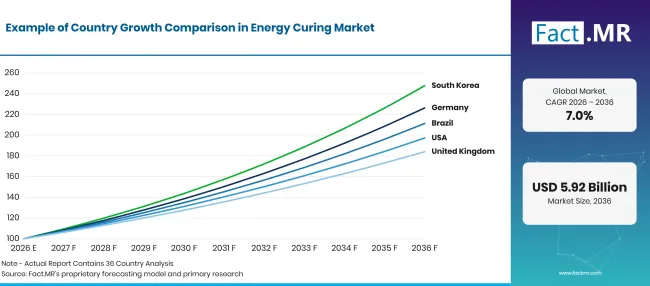
Energy Curing Market Growth Index | Source: Fact.MR
| Country | CAGR (2026 to 2036) |
|---|---|
| Germany | 8.5% |
| Brazil | 7.8% |
| United States | 7.0% |
| United Kingdom | 6.3% |
| Japan | 5.6% |
Source: Fact.MR analysis. Updated Oct 27, 2026
What supports Germany's adoption?
8.5% CAGR, driven by industrial decarbonization laws, automotive Tier-1 component coating, and high-efficiency UV-LED press conversions.
Germany’s opportunity is tied to industrial decarbonization rather than simple line expansion. In 2025, 1,789 stationary installations covered by the EU ETS emitted about 265 million tonnes of CO2 equivalent, 3.1% less than in 2024, while industrial installations cut emissions by around 5% [6]. The reduction imperative favors curing systems that lower heat demand without compromising finish quality.
How does Brazil perform?
7.8% CAGR, powered by booming flexible packaging conversion, agricultural label printing, and expanding furniture manufacturing hubs.
Brazil’s demand pool is spread across flexible, rigid, and decorated packaging formats. Formal packaging-industry employment increased 1.35% in 2025 to 277,667 jobs, while plastic packaging represented 37.6% of production value and metal packaging 18.9% [7]. That mix creates several entry points for fast-curing inks, varnishes, and functional coatings.
What is supporting United States adoption?
7.0% CAGR, anchored by massive consumer packaging production, digital UV inkjet printing growth, and industrial electronics assembly.
The U.S. market is shaped by retrofit economics and equipment integration. NIST’s 2025 manufacturing review identifies productivity, energy use, and supply-chain resilience as continuing competitiveness measures across a large capital-intensive production base [8]. UV-LED and electron-beam systems address these pressures by shortening cure time, reducing line footprint, and limiting work-in-process.
How is the United Kingdom developing demand?
6.3% CAGR, centered on luxury packaging finishing, sustainable food label printing, and industrial wood coating conversions.
UK growth depends on replacement demand within an established printing network. The Office for National Statistics issued a dedicated 2025 dataset covering VAT- and PAYE-registered printing enterprises and employment [9]. That operating base supports recurring UV and LED curing demand across labels, packaging, and commercial print.
How is Japan scaling demand?
5.6% CAGR, underpinned by advanced semiconductor packaging, precision electronics coating, and high-performance optical film fabrication.
Japan’s strongest opportunity lies in precision substrates where cure control outweighs raw line speed. METI data reported through JEITA show January 2025 production of electronic components and devices rising 3.0% year over year, with electronic boards up 9.2% and mounted circuit boards up 13.8% [10]. The production mix supports specialized UV-curable coatings, inks, adhesives, and encapsulants.
Who leads the Energy Curing Market?
The competitive landscape of the global energy curing market is characterized by specialized multinational chemical conglomerates, dedicated radiation-curing oligomer innovators, and advanced photoinitiator manufacturers. Leading chemical producers protect their market share through vertically integrated acrylic acid feedstocks, proprietary multi-functional acrylate syntheses, and global technical service centers that assist converters in optimizing cure speeds and adhesion profiles. Top-tier suppliers are focusing extensive research capital on synthesizing low-viscosity, 100% solids oligomers that eliminate the need for reactive diluent monomers, thereby reducing skin irritation risks and improving workplace safety.
Industry participants are actively partnering with printing press original equipment manufacturers (OEMs), UV-LED curing lamp developers, and packaging brand owners to develop integrated turnkey curing ecosystems. Leaders in the graphic arts sector focus on low-migration, low-odor ink vehicles certified for food packaging compliance under European food contact regulations. In industrial coatings, manufacturers develop dual-cure systems combining UV initiation with secondary moisture or thermal cure mechanisms to ensure full crosslinking in shadowed undercuts of complex 3D parts. Chemical suppliers also furnish advanced thin-film separator treatments for electric vehicle batteries and formulate radiation curable pressure sensitive adhesives and high-performance industrial adhesive tapes used in precision aerospace assembly.
Which companies are the key providers?
Key companies include BASF SE; Akzo Nobel N.V.; PPG Industries Inc.; Dymax Corporation; dsm-firmenich AG; Allnex Group; Alberdingk Boley GmbH; Arkema Group; Resonac Holdings Corporation; IGM Resins B.V.
- BASF SE
- Akzo Nobel N.V.
- PPG Industries Inc.
- Dymax Corporation
- dsm-firmenich AG
- Allnex Group
- Alberdingk Boley GmbH
- Arkema Group
- Resonac Holdings Corporation
- IGM Resins B.V.
Bibliography
- [1] U.S. Environmental Protection Agency. (2025, January 17). National volatile organic compound emission standards for aerosol coatings: Amendments (90 FR 5697).
- [2] U.S. Environmental Protection Agency. (2026, July 6). Aerosol coatings: National volatile organic compound emission standards.
- [3] U.S. Environmental Protection Agency. (2025). Reviewing new chemicals under the Toxic Substances Control Act (TSCA).
- [4] Thomas, D. (2026). Annual report on the U.S. manufacturing economy: 2025 (NIST AMS 100-76). National Institute of Standards and Technology.
- [5] Umweltbundesamt. (2026, March 25). Emissionsfaktoren zur Treibhausgasbilanzierung von Organisationen.
- [6] German Emissions Trading Authority. (2026, October 4). Significantly slower decline in emissions in 2025.
- [7] Associação Brasileira de Embalagem. (2026). Estudo ABRE macroeconômico da embalagem e cadeia de consumo: 2025.
- [8] Thomas, D. (2026). Annual report on the U.S. manufacturing economy: 2025 (NIST AMS 100-76). National Institute of Standards and Technology.
- [9] Office for National Statistics. (2025, September 30). Enterprises in the printing industry for 2025.
- [10] Japan Electronics and Information Technology Industries Association. (2025). January 2025 production by the Japanese electronics industry [Data from the Ministry of Economy, Trade and Industry].
This Report Answers
- The study analyzes how ultraviolet arc, solid-state UV-LED, and electron beam curing technologies differ across capital expenditure, energy efficiency, substrate thermal limits, and cure depth.
- Application analysis details market expansion across graphic arts printing inks, industrial surface coatings, assembly structural adhesives, and semiconductor encapsulation materials.
- End-user industry mapping quantifies commercial demand across consumer packaging converters, automotive manufacturers, consumer electronics assemblers, and commercial wood finishing plants.
- Chemical composition benchmarking evaluates performance dynamics between epoxy acrylates, polyurethane acrylates, polyester acrylates, and specialized non-migrating polymeric photoinitiators.
- Country market assessments deliver granular ten-year growth forecasts across Germany, Brazil, the United States, the United Kingdom, and Japan, linking material sales to environmental legislation and manufacturing output.
- Competitive profiling examines the chemical synthesis capacities, patent portfolios, sustainability roadmaps, and M&A strategies of the ten leading global energy curing chemical suppliers.
What does the Energy Curing Market cover?
The energy curing market covers all formulated chemical systems, prepolymers, and reactive raw materials engineered to undergo instantaneous, radiation-induced free radical or cationic polymerization upon exposure to ultraviolet photons or accelerated electron beams. By completely bypassing conventional thermal evaporation drying mechanisms, energy curable products achieve 100% reactive solids conversion without discharging volatile organic solvents, hazardous air pollutants, or greenhouse gases. Market scope tracks chemical consumption across high-speed commercial printing, protective industrial wood and plastic coatings, automotive surface finishing, structural adhesive bonding, and microelectronics component packaging. Chemical formulators synthesize photopolymerizable specialty resins with specialized functional backbone architectures to deliver balanced tensile strength, flexibility, and chemical resistance.
Financial valuations evaluate manufacturer-level wholesale revenues generated through the commercial sale of formulated radiation-curable coatings, inks, adhesives, and overprint varnishes, as well as intermediate oligomers and specialized photoinitiator packages sold directly to industrial converters. The analytical perimeter encompasses 100% active liquid formulations, specialized water-borne radiation-curable polyurethane dispersions (UV-PUDs), cationic cycloaliphatic epoxy resins, and dual-cure hybrid formulations. Capital equipment sales for standalone UV lamp fixtures, LED light arrays, and electron beam accelerators are accounted for in technology market breakdowns.
What is included in the scope?
Included in the report's coverage are radiation-curable formulations utilizing free radical mechanisms (based on acrylate monomers and oligomers) and cationic mechanisms (based on cycloaliphatic epoxies and vinyl ethers). Product types encompass flexographic inks, gravure inks, screen printing inks, digital UV inkjet inks, overprint varnishes, industrial wood clearcoats, automotive basecoats and topcoats, plastic surface hardcoats, optical disc coatings, and structural assembly adhesives. The analytical scope captures formulations engineered for mercury arc lamps, gallium-doped lamps, solid-state UV-LED heads (365 nm, 385 nm, 395 nm, 405 nm), and low-to-medium voltage electron beam systems.
Geographic coverage is comprehensive, tracking market demand across North America, Latin America, Western Europe, Eastern Europe, East Asia, South Asia & Pacific, and the Middle East & Africa. Channel mapping covers commercial transactions flowing through primary chemical formulators, toll compounders, authorized industrial chemical distributors, and direct supply contracts with multinational packaging converters and automotive OEMs.
What is excluded from the scope?
Excluded from market scope are conventional solvent-borne and standard water-borne coatings, inks, and adhesives that cure strictly through thermal solvent evaporation or ambient air oxidation without radiation initiation. Similarly, standard thermosetting powder coatings that require high-temperature thermal baking ovens are excluded from primary energy curing chemical totals, except where specialized low-temperature UV-curable powder formulations are explicitly identified.
Furthermore, medical dental composite filling restoratives applied chairside by dentists, consumer retail UV-curable gel nail polishes, and consumer craft hobbyist UV curing kits are excluded from the industrial and commercial manufacturing scope of this report. Standalone industrial heating ducts, natural gas burners, and thermal exhaust incinerators associated with conventional thermal drying ovens fall outside the analytical boundary.
How Was the Analysis Built?
The analysis draws on 120+ sources, 35+ company portfolios, 25+ countries, and more than 20 industry interviews.
- Primary Research: Primary research includes discussions with manufacturers, service providers, technology developers, distributors, end users, and subject-matter experts. These conversations examine purchasing priorities, product adoption, operational challenges, approval requirements, competitive positioning, and the factors that influence wider market acceptance.
- Desk Research: Desk research covers government statistics, regulatory publications, company filings, trade data, technical studies, industry associations, standards, public policy, and other authoritative sources. Every source used in the analysis is documented in the bibliography.
- Market Sizing and Forecasting: Market estimates combine historical performance, demand indicators, pricing and volume trends, segment shares, company participation, country-level growth, adoption patterns, investment activity, and barriers to market expansion.
- Data Validation and Update Cycle: Findings are validated by comparing primary interviews with public data, company activity, regulatory changes, trade patterns, and industry developments. Regular updates review new product launches, capacity changes, partnerships, approvals, and shifts in commercial adoption.
Segmentation
What is the report’s scope and coverage?
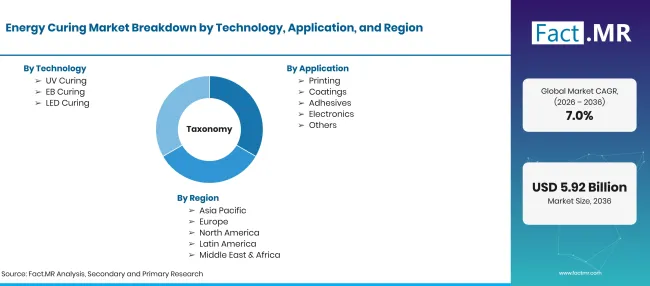
Energy Curing Market Taxonomy | Source: Fact.MR
| Attribute | Details |
|---|---|
| Quantitative Units | USD Billion in 2026 to USD Billion by 2036 at a 7.0% CAGR |
| Market Definition | Energy curing encompasses radiation-curable coatings, inks, adhesives, and electronics encapsulants formulated with photoinitiators, oligomers, and monomers that polymerize instantaneously upon exposure to ultraviolet light (UV), light-emitting diodes (UV-LED), or electron beam (EB) radiation. Market value is tracked at the formulated chemical manufacturer realization tier. |
| Technology | UV Curing; EB Curing; LED Curing |
| Application | Printing; Coatings; Adhesives; Electronics; Others |
| End-User Industry | Packaging; Automotive; Electronics; Wood; Others |
| Regional Coverage | North America; Latin America; Western Europe; Eastern Europe; East Asia; South Asia & Pacific; Middle East & Africa |
| Key Countries Analyzed | Germany; Brazil; United States; United Kingdom; Japan |
| Key Players Profiled | BASF SE; Akzo Nobel N.V.; PPG Industries Inc.; Dymax Corporation; dsm-firmenich AG; Allnex Group; Alberdingk Boley GmbH; Arkema Group; Resonac Holdings Corporation; IGM Resins B.V. |
| Historical Base Year | 2025 (USD 2.8 Billion) |
| Forecast Timeframe | 2026 (USD 3.0 Billion) to 2036 (USD 5.9 Billion) |
Source: Fact.MR analysis. Updated Oct 27, 2026
How is the market segmented?
-
By Technology
- UV Curing
- EB Curing
- LED Curing
-
By Application
- Printing
- Coatings
- Adhesives
- Electronics
- Others
-
By End-User Industry
- Packaging
- Automotive
- Electronics
- Wood
- Others
-
By Region
- North America
- Latin America
- Western Europe
- Eastern Europe
- East Asia
- South Asia & Pacific
- Middle East & Africa
Frequently Asked Questions
How big is the energy curing market in 2026?
What is the CAGR of the energy curing market from 2026 to 2036?
Which technology leads the energy curing market?
Which application accounts for the highest market share?
Which end-user industry dominates energy curing consumption?
Which country will grow at the fastest rate through 2036?
Who are the leading manufacturers in the energy curing market?
Who worked on this report


Preview the report firsthand - request a free sample
Free SampleGet the brochure for pricing and purchase details
Download PDF