Environmentally Safe Hydraulic Fluids for Offshore Wind Market

Environmentally Safe Hydraulic Fluids for Offshore Wind Market Size and Share Forecast Outlook 2026 to 2036

Environmentally safe hydraulic fluids for offshore wind market is projected to grow from USD 106.0 million in 2026 to USD 265.1 million by 2036, at a CAGR of 9.6%. Biodegradable synthetic esters (PAE DEE families) will dominate with a 34.0% market share, while pitch & blade actuation hydraulics will lead the turbine system segment with a 36.0% share.

Environmentally Safe Hydraulic Fluids for Offshore Wind Market Forecast and Outlook 2026 to 2036

The global environmentally safe hydraulic fluids for offshore wind market is projected to reach USD 265.10 million by 2036. The market is valued at USD 106.00 million in 2026 and is set to rise at a CAGR of 9.6% during the assessment period.

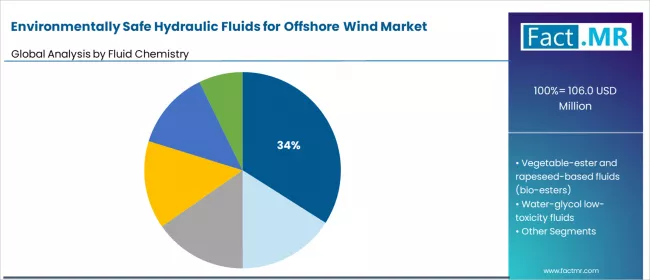
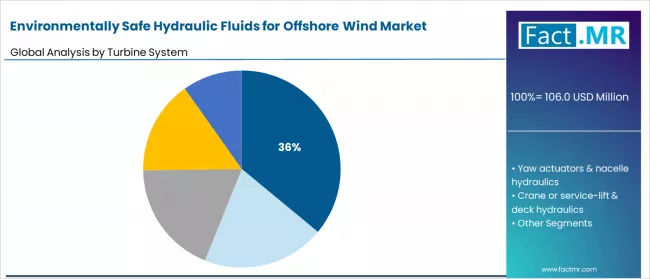
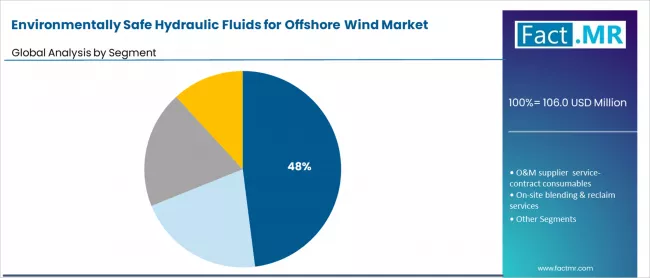
By fluid chemistry, biodegradable synthetic esters (PAE & DEE families) hold a leading 34% share. Pitch & blade actuation hydraulics represent the dominant turbine system at 36%, while the OEM & turbine-spec fluids (bundled with equipment) segment is the primary segment, accounting for 48.00% market share.

Key Takeaways from the Environmentally Safe Hydraulic Fluids for Offshore Wind Market

  • Market Value for 2026: USD 106.00 Million
  • Market Value for 2036: USD 265.10 Million
  • Forecast CAGR (2026-2036): 9.6%
  • Leading Fluid Chemistry Share (2026): Biodegradable Synthetic Esters (PAE & DEE families) (34%)
  • Leading Turbine System Share (2026): Pitch & Blade Actuation Hydraulics (36%)
  • Leading Segment Share (2026): OEM & Turbine-Spec Fluids (48.00%)
  • Key Players in the Market: FUCHS, Shell Plc., Klüber Lubrication, Cargill bio-ester base suppliers, TotalEnergies, PLANTO EAL lines, Castrol (EAL product lines)
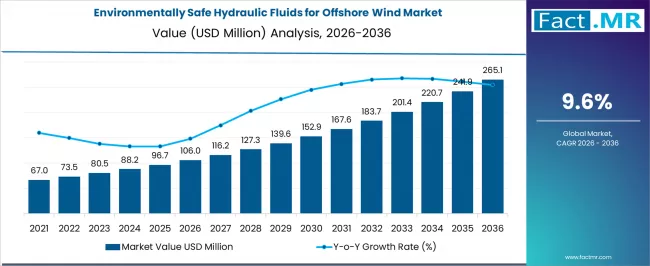
Environmentally Safe Hydraulic Fluids For Offshore Wind Market Market Value Analysis

Defining trends involve the mandatory shift from conventional mineral oils to Environmentally Acceptable Lubricants (EALs) that meet stringent biodegradability and toxicity standards for marine environments. Innovation is focused on enhancing the hydrolytic stability, corrosion protection, and long-term performance of bio-esters and synthetic blends in harsh, saline conditions. Integration of these specialized fluids with predictive maintenance systems to monitor fluid health and prevent leaks is becoming critical for operational reliability and environmental compliance.

Regulatory frameworks, most notably the U.S. Vessel General Permit (VGP) and similar international maritime regulations, are the unequivocal primary driver, mandating the use of EALs in all oil-to-sea interfaces. The exponential global growth of offshore wind, coupled with zero-tolerance policies for pollution in marine protected areas, acts as a powerful market catalyst, making these fluids a non-negotiable requirement for project permitting and operation.

Environmentally Safe Hydraulic Fluids for Offshore Wind Market

Metric Value
Market Value (2026) USD 106.00 Million
Market Forecast Value (2036) USD 265.10 Million
Forecast CAGR (2026-2036) 9.6%

Category

Category Segments
Fluid Chemistry Biodegradable synthetic esters (PAE & DEE families), Vegetable-ester and rapeseed-based fluids (bio-esters), Water-glycol low-toxicity fluids, High-performance synthetic (EAL-grade PAO blends), Reclaimed & re-refined EAL blends (reclaim service), Specialty ionic & novel green base fluids
Turbine System Pitch & blade actuation hydraulics, Yaw actuators & nacelle hydraulics, Crane or service-lift & deck hydraulics, Substructure & monopile & marine-interface hydraulics, Auxiliary systems (oil reservoirs, control valves)
Segment OEM & turbine-spec fluids (bundled with equipment), O&M supplier & service-contract consumables, On-site blending & reclaim services, Direct asset-owner procurement (bulk buys)
Region North America, Latin America, Western Europe, Eastern Europe, East Asia, South Asia & Pacific, MEA

Segmental Analysis

By Fluid Chemistry, Which Technology Offers the Best Balance of Environmental Compliance and High-Performance Engineering?
Environmentally Safe Hydraulic Fluids For Offshore Wind Market Analysis By Fluid Chemistry

Biodegradable synthetic esters (PAE & DEE families) lead the segment with a 34% share. This dominance is due to their superior technical performance, excellent lubricity, high viscosity index, and thermal stability, combined with rapid biodegradability and low aquatic toxicity. They are specifically engineered to withstand the demanding conditions of offshore hydraulic systems while providing an order-of-magnitude improvement in environmental safety over mineral oils, making them the preferred choice for critical systems like pitch control.

By Turbine System, Which Application is Most Critical for Safety and Performance, with Direct Environmental Interface Risk?
Environmentally Safe Hydraulic Fluids For Offshore Wind Market Analysis By Turbine System

Pitch & blade actuation hydraulics command the largest turbine system share at 36%. This system is essential for power regulation and turbine safety, operating under high pressure and stress. It is also one of the systems most vulnerable to leaks, with fluid potentially released directly into the marine environment from the nacelle. The mandatory use of high-integrity, environmentally safe fluids here is a top priority to prevent operational failure and minimize ecological impact from any leakage.

By Segment, Which Channel Controls the Initial Specification and a Significant Portion of Lifetime Supply?
Environmentally Safe Hydraulic Fluids For Offshore Wind Market Analysis By Segment

The OEM & turbine-spec fluids (bundled with equipment) segment is the dominant model at 48.00%. Turbine original equipment manufacturers (OEMs) specify and often pre-fill the hydraulic systems at the factory with a certified EAL as part of their type certification and warranty conditions. This practice locks in the initial fill volume and establishes a qualified product standard, creating a powerful, specification-driven channel that influences subsequent top-up and service fluid purchases throughout the turbine's operational life.

What are the Drivers, Restraints, and Key Trends of the Environmentally Safe Hydraulic Fluids for Offshore Wind Market?

Market growth is driven by the explosive global deployment of offshore wind farms, particularly in ecologically sensitive areas. Stringent and globally harmonizing maritime environmental regulations (VGP, EU regulations) legally mandate EAL use. Insurers and financiers require demonstrably lower environmental risk profiles for projects. The industry's strong ESG commitment and public reputation further accelerate the adoption of certified green hydraulic fluids.

A significant restraint is the higher initial cost of advanced biodegradable esters compared to conventional fluids, though total cost-of-ownership analysis often favors them. Performance concerns regarding hydrolytic stability (water resistance) and long-term seal compatibility in some early bio-fluids have created skepticism. The complexity of fluid management and monitoring in remote offshore settings adds operational challenges. Furthermore, the need for crew training on handling and disposing of these different fluids is an additional hurdle.

Key trends include the development of next-generation synthetic esters with enhanced hydrolytic stability and longer service life. There is a growing focus on creating closed-loop fluid management systems, including on-site reconditioning and re-refining of used EALs. Digital monitoring of fluid quality (e.g., water content, acidity) via sensors is being integrated into SCADA systems. Additionally, there is a push for standardized, global certifications for EALs beyond regional regulations to simplify procurement for global operators.

Analysis of the Environmentally Safe Hydraulic Fluids for Offshore Wind Market by Key Countries
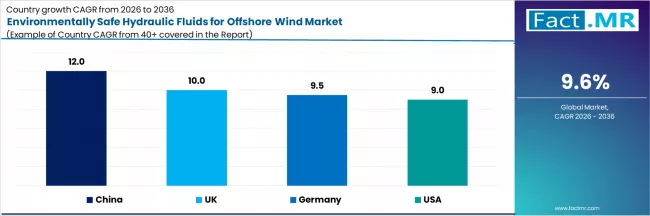
Environmentally Safe Hydraulic Fluids For Offshore Wind Market Cagr Analysis By Country

Country CAGR (2026-2036)
China 12.00%
UK 10.00%
Germany 9.50%
USA 9.00%
Netherlands 8.50%

How does China's Rapid Offshore Wind Expansion and Domestic Supply Chain Push Drive Market Leadership?

China leads with a 12.00% CAGR, driven by its staggering pace of offshore wind installation, particularly in the South China Sea and East China Sea. National policies emphasize ecological protection alongside development, driving EAL adoption. Domestic lubricant and chemical companies are aggressively developing and localizing high-performance biodegradable ester technologies to supply this vast market, reducing reliance on imports and supporting the full domestic supply chain.

Why is the UK's Mature Offshore Sector and Strict Regulatory Enforcement a Key Driver?

The UK's 10.00% growth is fueled by its large, mature fleet of offshore wind farms in the North Sea, subject to some of the world's strictest maritime environmental regulations. The UK's rigorous enforcement of EAL standards creates a compliance-driven market where performance and certification are paramount. The extensive operational experience here serves as a global benchmark for best practices in fluid selection, handling, and monitoring.

What Role does Germany's Engineering Leadership and OEM Presence Play?

Germany's 9.50% growth reflects its leadership in wind turbine manufacturing and precision engineering. German OEMs set global technical standards, and their factory fill specifications for EALs influence the entire industry. The focus is on fluid reliability and longevity to match the engineering quality of the turbines. German chemical companies are also at the forefront of developing advanced, high-stability ester base stocks.

How does the USA's Emerging Offshore Market and VGP Regulation Influence Adoption?
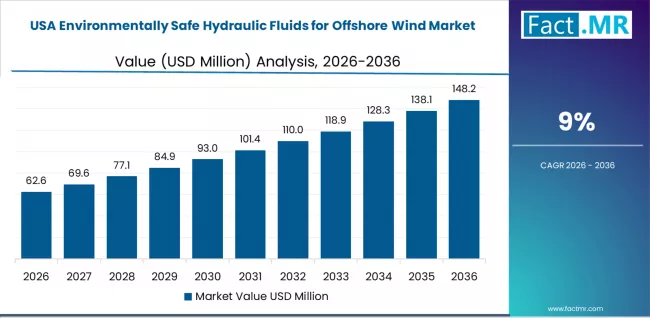
Environmentally Safe Hydraulic Fluids For Offshore Wind Market Country Value Analysis

The USA's 9.00% growth is underpinned by its nascent but rapidly scaling offshore wind industry on the East and West Coasts. The U.S. Vessel General Permit (VGP) regulation mandates EAL use from the outset, creating a greenfield market where all new projects adopt compliant fluids immediately. This, combined with strong state-level environmental policies, ensures that the U.S. market is built on the latest EAL standards without legacy system conversion challenges.

What Factors Underpin the Netherlands' Role as a Logistics and Innovation Hub?

The Netherlands' 8.50% growth is anchored in its central role as a European offshore wind logistics and service hub. Its ports host major O&M fleets and blending facilities. A high concentration of service companies and a strong focus on circular economy principles, driving innovation in fluid reclamation, on-site blending services, and the testing of novel, high-performance green base fluids, characterize the Dutch market.

Competitive Landscape of the Environmentally Safe Hydraulic Fluids for Offshore Wind Market
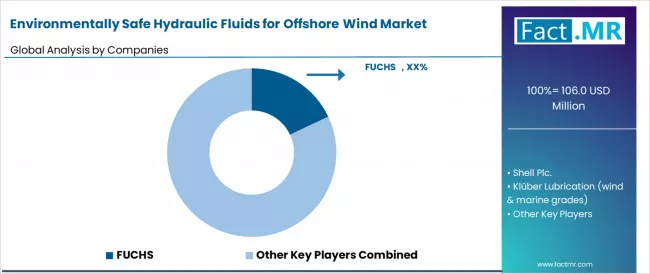
Environmentally Safe Hydraulic Fluids For Offshore Wind Market Analysis By Company

The competitive landscape is characterized by rivalry between specialized wind-turbine lubricant suppliers and global energy & lubrication majors. Specialized players like Klüber Lubrication and PLANTO EAL lines compete with deep application expertise, offering fluids specifically formulated and tested for the unique demands of offshore wind hydraulic systems.

Global integrated energy and chemical companies like Shell Plc., TotalEnergies, FUCHS, and Castrol compete by leveraging their vast resources, global supply chains, and strong relationships with turbine OEMs to secure factory-fill approvals. Base stock suppliers like Cargill play a key role in the bio-ester value chain. Competition intensifies around securing long-term OEM approval, providing comprehensive technical and fluid analysis services, and establishing closed-loop fluid management partnerships with large wind farm operators.

Key Players in the Environmentally Safe Hydraulic Fluids for Offshore Wind Market

  • FUCHS
  • Shell Plc.
  • Klüber Lubrication (wind & marine grades)
  • Cargill bio-ester base suppliers (industrial biofluids)
  • TotalEnergies
  • PLANTO EAL lines
  • Castrol (EAL product lines)

Scope of Report

Items Values
Quantitative Units USD Million
Fluid Chemistry Biodegradable synthetic esters, Vegetable-ester & rapeseed-based fluids, Water-glycol fluids, High-performance synthetic EAL blends, Reclaimed & re-refined EAL blends, Specialty ionic & novel fluids
Turbine System Pitch & blade actuation, Yaw & nacelle, Crane & deck, Substructure & marine-interface, Auxiliary systems
Segment OEM & turbine-spec fluids, O&M supplier consumables, On-site blending & reclaim, Direct asset-owner procurement
Key Countries China, UK, Germany, USA, Netherlands
Key Companies FUCHS, Shell Plc., Klüber Lubrication, Cargill, TotalEnergies, PLANTO, Castrol
Additional Analysis Analysis of biodegradation rates (OECD 301), aquatic toxicity testing, hydrolytic stability performance, seal compatibility data, filterability, and total cost-of-ownership models including potential spill liability reduction.

Environmentally Safe Hydraulic Fluids for Offshore Wind Market by Segments

  • Fluid Chemistry :

    • Biodegradable synthetic esters (PAE & DEE families)
    • Vegetable-ester and rapeseed-based fluids (bio-esters)
    • Water-glycol low-toxicity fluids
    • High-performance synthetic (EAL-grade PAO blends)
    • Reclaimed & re-refined EAL blends (reclaim service)
    • Specialty ionic & novel green base fluids
  • Turbine System :

    • Pitch & blade actuation hydraulics
    • Yaw actuators & nacelle hydraulics
    • Crane or service-lift & deck hydraulics
    • Substructure & monopile & marine-interface hydraulics
    • Auxiliary systems (oil reservoirs, control valves)
  • Segment :

    • OEM & turbine-spec fluids (bundled with equipment)
    • O&M supplier & service-contract consumables
    • On-site blending & reclaim services
    • Direct asset-owner procurement (bulk buys)
  • Region :

    • North America

      • USA
      • Canada
    • Latin America

      • Brazil
      • Mexico
      • Argentina
      • Chile
      • Rest of Latin America
    • Western Europe

      • UK
      • Germany
      • Netherlands
      • Denmark
      • France
      • Italy
      • Spain
      • BENELUX
      • Rest of Western Europe
    • Eastern Europe

      • Poland
      • Russia
      • Czech Republic
      • Rest of Eastern Europe
    • East Asia

      • China
      • South Korea
      • Japan
      • Rest of East Asia
    • South Asia & Pacific

      • India
      • Indonesia
      • Australia
      • Rest of South Asia & Pacific
    • MEA

      • Saudi Arabia
      • UAE
      • Rest of MEA

Table of Content

  1. Executive Summary
    • Global Market Outlook
    • Demand to side Trends
    • Supply to side Trends
    • Technology Roadmap Analysis
    • Analysis and Recommendations
  2. Market Overview
    • Market Coverage / Taxonomy
    • Market Definition / Scope / Limitations
  3. Market Background
    • Market Dynamics
      • Drivers
      • Restraints
      • Opportunity
      • Trends
    • Scenario Forecast
      • Demand in Optimistic Scenario
      • Demand in Likely Scenario
      • Demand in Conservative Scenario
    • Opportunity Map Analysis
    • Product Life Cycle Analysis
    • Supply Chain Analysis
    • Investment Feasibility Matrix
    • Value Chain Analysis
    • PESTLE and Porter’s Analysis
    • Regulatory Landscape
    • Regional Parent Market Outlook
    • Production and Consumption Statistics
    • Import and Export Statistics
  4. Global Market Analysis 2021 to 2025 and Forecast, 2026 to 2036
    • Historical Market Size Value (USD Million) Analysis, 2021 to 2025
    • Current and Future Market Size Value (USD Million) Projections, 2026 to 2036
      • Y to o to Y Growth Trend Analysis
      • Absolute $ Opportunity Analysis
  5. Global Market Pricing Analysis 2021 to 2025 and Forecast 2026 to 2036
  6. Global Market Analysis 2021 to 2025 and Forecast 2026 to 2036, By Fluid Chemistry
    • Introduction / Key Findings
    • Historical Market Size Value (USD Million) Analysis By Fluid Chemistry, 2021 to 2025
    • Current and Future Market Size Value (USD Million) Analysis and Forecast By Fluid Chemistry, 2026 to 2036
      • Biodegradable synthetic esters (PAE DEE families)
      • Vegetable-ester and rapeseed-based fluids (bio-esters)
      • Water-glycol low-toxicity fluids
      • High-performance synthetic (EAL-grade PAO blends)
      • Reclaimed re-refined EAL blends (reclaim service)
      • Specialty ionic novel green base fluids
    • Y to o to Y Growth Trend Analysis By Fluid Chemistry, 2021 to 2025
    • Absolute $ Opportunity Analysis By Fluid Chemistry, 2026 to 2036
  7. Global Market Analysis 2021 to 2025 and Forecast 2026 to 2036, By Turbine System
    • Introduction / Key Findings
    • Historical Market Size Value (USD Million) Analysis By Turbine System, 2021 to 2025
    • Current and Future Market Size Value (USD Million) Analysis and Forecast By Turbine System, 2026 to 2036
      • Pitch & blade actuation hydraulics
      • Yaw actuators & nacelle hydraulics
      • Crane or service-lift & deck hydraulics
      • Substructure monopile marine-interface hydraulics
      • Auxiliary systems (oil reservoirs, control valves)
    • Y to o to Y Growth Trend Analysis By Turbine System, 2021 to 2025
    • Absolute $ Opportunity Analysis By Turbine System, 2026 to 2036
  8. Global Market Analysis 2021 to 2025 and Forecast 2026 to 2036, By Segment
    • Introduction / Key Findings
    • Historical Market Size Value (USD Million) Analysis By Segment, 2021 to 2025
    • Current and Future Market Size Value (USD Million) Analysis and Forecast By Segment, 2026 to 2036
      • OEM turbine-spec fluids (bundled with equipment)
      • O&M supplier service-contract consumables
      • On-site blending & reclaim services
      • Direct asset-owner procurement (bulk buys)
    • Y to o to Y Growth Trend Analysis By Segment, 2021 to 2025
    • Absolute $ Opportunity Analysis By Segment, 2026 to 2036
  9. Global Market Analysis 2021 to 2025 and Forecast 2026 to 2036, By Region
    • Introduction
    • Historical Market Size Value (USD Million) Analysis By Region, 2021 to 2025
    • Current Market Size Value (USD Million) Analysis and Forecast By Region, 2026 to 2036
      • North America
      • Latin America
      • Western Europe
      • Eastern Europe
      • East Asia
      • South Asia and Pacific
      • Middle East & Africa
    • Market Attractiveness Analysis By Region
  10. North America Market Analysis 2021 to 2025 and Forecast 2026 to 2036, By Country
    • Historical Market Size Value (USD Million) Trend Analysis By Market Taxonomy, 2021 to 2025
    • Market Size Value (USD Million) Forecast By Market Taxonomy, 2026 to 2036
      • By Country
        • USA
        • Canada
        • Mexico
      • By Fluid Chemistry
      • By Turbine System
      • By Segment
    • Market Attractiveness Analysis
      • By Country
      • By Fluid Chemistry
      • By Turbine System
      • By Segment
    • Key Takeaways
  11. Latin America Market Analysis 2021 to 2025 and Forecast 2026 to 2036, By Country
    • Historical Market Size Value (USD Million) Trend Analysis By Market Taxonomy, 2021 to 2025
    • Market Size Value (USD Million) Forecast By Market Taxonomy, 2026 to 2036
      • By Country
        • Brazil
        • Chile
        • Rest of Latin America
      • By Fluid Chemistry
      • By Turbine System
      • By Segment
    • Market Attractiveness Analysis
      • By Country
      • By Fluid Chemistry
      • By Turbine System
      • By Segment
    • Key Takeaways
  12. Western Europe Market Analysis 2021 to 2025 and Forecast 2026 to 2036, By Country
    • Historical Market Size Value (USD Million) Trend Analysis By Market Taxonomy, 2021 to 2025
    • Market Size Value (USD Million) Forecast By Market Taxonomy, 2026 to 2036
      • By Country
        • Germany
        • UK
        • Italy
        • Spain
        • France
        • Nordic
        • BENELUX
        • Rest of Western Europe
      • By Fluid Chemistry
      • By Turbine System
      • By Segment
    • Market Attractiveness Analysis
      • By Country
      • By Fluid Chemistry
      • By Turbine System
      • By Segment
    • Key Takeaways
  13. Eastern Europe Market Analysis 2021 to 2025 and Forecast 2026 to 2036, By Country
    • Historical Market Size Value (USD Million) Trend Analysis By Market Taxonomy, 2021 to 2025
    • Market Size Value (USD Million) Forecast By Market Taxonomy, 2026 to 2036
      • By Country
        • Russia
        • Poland
        • Hungary
        • Balkan & Baltic
        • Rest of Eastern Europe
      • By Fluid Chemistry
      • By Turbine System
      • By Segment
    • Market Attractiveness Analysis
      • By Country
      • By Fluid Chemistry
      • By Turbine System
      • By Segment
    • Key Takeaways
  14. East Asia Market Analysis 2021 to 2025 and Forecast 2026 to 2036, By Country
    • Historical Market Size Value (USD Million) Trend Analysis By Market Taxonomy, 2021 to 2025
    • Market Size Value (USD Million) Forecast By Market Taxonomy, 2026 to 2036
      • By Country
        • China
        • Japan
        • South Korea
      • By Fluid Chemistry
      • By Turbine System
      • By Segment
    • Market Attractiveness Analysis
      • By Country
      • By Fluid Chemistry
      • By Turbine System
      • By Segment
    • Key Takeaways
  15. South Asia and Pacific Market Analysis 2021 to 2025 and Forecast 2026 to 2036, By Country
    • Historical Market Size Value (USD Million) Trend Analysis By Market Taxonomy, 2021 to 2025
    • Market Size Value (USD Million) Forecast By Market Taxonomy, 2026 to 2036
      • By Country
        • India
        • ASEAN
        • Australia & New Zealand
        • Rest of South Asia and Pacific
      • By Fluid Chemistry
      • By Turbine System
      • By Segment
    • Market Attractiveness Analysis
      • By Country
      • By Fluid Chemistry
      • By Turbine System
      • By Segment
    • Key Takeaways
  16. Middle East & Africa Market Analysis 2021 to 2025 and Forecast 2026 to 2036, By Country
    • Historical Market Size Value (USD Million) Trend Analysis By Market Taxonomy, 2021 to 2025
    • Market Size Value (USD Million) Forecast By Market Taxonomy, 2026 to 2036
      • By Country
        • Kingdom of Saudi Arabia
        • Other GCC Countries
        • Turkiye
        • South Africa
        • Other African Union
        • Rest of Middle East & Africa
      • By Fluid Chemistry
      • By Turbine System
      • By Segment
    • Market Attractiveness Analysis
      • By Country
      • By Fluid Chemistry
      • By Turbine System
      • By Segment
    • Key Takeaways
  17. Key Countries Market Analysis
    • USA
      • Pricing Analysis
      • Market Share Analysis, 2025
        • By Fluid Chemistry
        • By Turbine System
        • By Segment
    • Canada
      • Pricing Analysis
      • Market Share Analysis, 2025
        • By Fluid Chemistry
        • By Turbine System
        • By Segment
    • Mexico
      • Pricing Analysis
      • Market Share Analysis, 2025
        • By Fluid Chemistry
        • By Turbine System
        • By Segment
    • Brazil
      • Pricing Analysis
      • Market Share Analysis, 2025
        • By Fluid Chemistry
        • By Turbine System
        • By Segment
    • Chile
      • Pricing Analysis
      • Market Share Analysis, 2025
        • By Fluid Chemistry
        • By Turbine System
        • By Segment
    • Germany
      • Pricing Analysis
      • Market Share Analysis, 2025
        • By Fluid Chemistry
        • By Turbine System
        • By Segment
    • UK
      • Pricing Analysis
      • Market Share Analysis, 2025
        • By Fluid Chemistry
        • By Turbine System
        • By Segment
    • Italy
      • Pricing Analysis
      • Market Share Analysis, 2025
        • By Fluid Chemistry
        • By Turbine System
        • By Segment
    • Spain
      • Pricing Analysis
      • Market Share Analysis, 2025
        • By Fluid Chemistry
        • By Turbine System
        • By Segment
    • France
      • Pricing Analysis
      • Market Share Analysis, 2025
        • By Fluid Chemistry
        • By Turbine System
        • By Segment
    • India
      • Pricing Analysis
      • Market Share Analysis, 2025
        • By Fluid Chemistry
        • By Turbine System
        • By Segment
    • ASEAN
      • Pricing Analysis
      • Market Share Analysis, 2025
        • By Fluid Chemistry
        • By Turbine System
        • By Segment
    • Australia & New Zealand
      • Pricing Analysis
      • Market Share Analysis, 2025
        • By Fluid Chemistry
        • By Turbine System
        • By Segment
    • China
      • Pricing Analysis
      • Market Share Analysis, 2025
        • By Fluid Chemistry
        • By Turbine System
        • By Segment
    • Japan
      • Pricing Analysis
      • Market Share Analysis, 2025
        • By Fluid Chemistry
        • By Turbine System
        • By Segment
    • South Korea
      • Pricing Analysis
      • Market Share Analysis, 2025
        • By Fluid Chemistry
        • By Turbine System
        • By Segment
    • Russia
      • Pricing Analysis
      • Market Share Analysis, 2025
        • By Fluid Chemistry
        • By Turbine System
        • By Segment
    • Poland
      • Pricing Analysis
      • Market Share Analysis, 2025
        • By Fluid Chemistry
        • By Turbine System
        • By Segment
    • Hungary
      • Pricing Analysis
      • Market Share Analysis, 2025
        • By Fluid Chemistry
        • By Turbine System
        • By Segment
    • Kingdom of Saudi Arabia
      • Pricing Analysis
      • Market Share Analysis, 2025
        • By Fluid Chemistry
        • By Turbine System
        • By Segment
    • Turkiye
      • Pricing Analysis
      • Market Share Analysis, 2025
        • By Fluid Chemistry
        • By Turbine System
        • By Segment
    • South Africa
      • Pricing Analysis
      • Market Share Analysis, 2025
        • By Fluid Chemistry
        • By Turbine System
        • By Segment
  18. Market Structure Analysis
    • Competition Dashboard
    • Competition Benchmarking
    • Market Share Analysis of Top Players
      • By Regional
      • By Fluid Chemistry
      • By Turbine System
      • By Segment
  19. Competition Analysis
    • Competition Deep Dive
      • FUCHS
        • Overview
        • Product Portfolio
        • Profitability by Market Segments (Product/Age /Sales Channel/Region)
        • Sales Footprint
        • Strategy Overview
          • Marketing Strategy
          • Product Strategy
          • Channel Strategy
      • Shell Plc.
      • Klüber Lubrication (wind & marine grades)
      • Cargill bio-ester base suppliers (industrial biofluids)
      • TotalEnergies
      • PLANTO
      • EAL lines
      • Castrol (EAL product lines)
  20. Assumptions & Acronyms Used
  21. Research Methodology

List Of Table

  • Table 1: Global Market Value (USD Million) Forecast by Region, 2021 to 2036
  • Table 2: Global Market Value (USD Million) Forecast by Fluid Chemistry, 2021 to 2036
  • Table 3: Global Market Value (USD Million) Forecast by Turbine System, 2021 to 2036
  • Table 4: Global Market Value (USD Million) Forecast by Segment, 2021 to 2036
  • Table 5: North America Market Value (USD Million) Forecast by Country, 2021 to 2036
  • Table 6: North America Market Value (USD Million) Forecast by Fluid Chemistry, 2021 to 2036
  • Table 7: North America Market Value (USD Million) Forecast by Turbine System, 2021 to 2036
  • Table 8: North America Market Value (USD Million) Forecast by Segment, 2021 to 2036
  • Table 9: Latin America Market Value (USD Million) Forecast by Country, 2021 to 2036
  • Table 10: Latin America Market Value (USD Million) Forecast by Fluid Chemistry, 2021 to 2036
  • Table 11: Latin America Market Value (USD Million) Forecast by Turbine System, 2021 to 2036
  • Table 12: Latin America Market Value (USD Million) Forecast by Segment, 2021 to 2036
  • Table 13: Western Europe Market Value (USD Million) Forecast by Country, 2021 to 2036
  • Table 14: Western Europe Market Value (USD Million) Forecast by Fluid Chemistry, 2021 to 2036
  • Table 15: Western Europe Market Value (USD Million) Forecast by Turbine System, 2021 to 2036
  • Table 16: Western Europe Market Value (USD Million) Forecast by Segment, 2021 to 2036
  • Table 17: Eastern Europe Market Value (USD Million) Forecast by Country, 2021 to 2036
  • Table 18: Eastern Europe Market Value (USD Million) Forecast by Fluid Chemistry, 2021 to 2036
  • Table 19: Eastern Europe Market Value (USD Million) Forecast by Turbine System, 2021 to 2036
  • Table 20: Eastern Europe Market Value (USD Million) Forecast by Segment, 2021 to 2036
  • Table 21: East Asia Market Value (USD Million) Forecast by Country, 2021 to 2036
  • Table 22: East Asia Market Value (USD Million) Forecast by Fluid Chemistry, 2021 to 2036
  • Table 23: East Asia Market Value (USD Million) Forecast by Turbine System, 2021 to 2036
  • Table 24: East Asia Market Value (USD Million) Forecast by Segment, 2021 to 2036
  • Table 25: South Asia and Pacific Market Value (USD Million) Forecast by Country, 2021 to 2036
  • Table 26: South Asia and Pacific Market Value (USD Million) Forecast by Fluid Chemistry, 2021 to 2036
  • Table 27: South Asia and Pacific Market Value (USD Million) Forecast by Turbine System, 2021 to 2036
  • Table 28: South Asia and Pacific Market Value (USD Million) Forecast by Segment, 2021 to 2036
  • Table 29: Middle East & Africa Market Value (USD Million) Forecast by Country, 2021 to 2036
  • Table 30: Middle East & Africa Market Value (USD Million) Forecast by Fluid Chemistry, 2021 to 2036
  • Table 31: Middle East & Africa Market Value (USD Million) Forecast by Turbine System, 2021 to 2036
  • Table 32: Middle East & Africa Market Value (USD Million) Forecast by Segment, 2021 to 2036

List Of Figures

  • Figure 1: Global Market Pricing Analysis
  • Figure 2: Global Market Value (USD Million) Forecast 2021 to 2036
  • Figure 3: Global Market Value Share and BPS Analysis by Fluid Chemistry, 2026 and 2036
  • Figure 4: Global Market Y to o to Y Growth Comparison by Fluid Chemistry, 2026 to 2036
  • Figure 5: Global Market Attractiveness Analysis by Fluid Chemistry
  • Figure 6: Global Market Value Share and BPS Analysis by Turbine System, 2026 and 2036
  • Figure 7: Global Market Y to o to Y Growth Comparison by Turbine System, 2026 to 2036
  • Figure 8: Global Market Attractiveness Analysis by Turbine System
  • Figure 9: Global Market Value Share and BPS Analysis by Segment, 2026 and 2036
  • Figure 10: Global Market Y to o to Y Growth Comparison by Segment, 2026 to 2036
  • Figure 11: Global Market Attractiveness Analysis by Segment
  • Figure 12: Global Market Value (USD Million) Share and BPS Analysis by Region, 2026 and 2036
  • Figure 13: Global Market Y to o to Y Growth Comparison by Region, 2026 to 2036
  • Figure 14: Global Market Attractiveness Analysis by Region
  • Figure 15: North America Market Incremental Dollar Opportunity, 2026 to 2036
  • Figure 16: Latin America Market Incremental Dollar Opportunity, 2026 to 2036
  • Figure 17: Western Europe Market Incremental Dollar Opportunity, 2026 to 2036
  • Figure 18: Eastern Europe Market Incremental Dollar Opportunity, 2026 to 2036
  • Figure 19: East Asia Market Incremental Dollar Opportunity, 2026 to 2036
  • Figure 20: South Asia and Pacific Market Incremental Dollar Opportunity, 2026 to 2036
  • Figure 21: Middle East & Africa Market Incremental Dollar Opportunity, 2026 to 2036
  • Figure 22: North America Market Value Share and BPS Analysis by Country, 2026 and 2036
  • Figure 23: North America Market Value Share and BPS Analysis by Fluid Chemistry, 2026 and 2036
  • Figure 24: North America Market Y to o to Y Growth Comparison by Fluid Chemistry, 2026 to 2036
  • Figure 25: North America Market Attractiveness Analysis by Fluid Chemistry
  • Figure 26: North America Market Value Share and BPS Analysis by Turbine System, 2026 and 2036
  • Figure 27: North America Market Y to o to Y Growth Comparison by Turbine System, 2026 to 2036
  • Figure 28: North America Market Attractiveness Analysis by Turbine System
  • Figure 29: North America Market Value Share and BPS Analysis by Segment, 2026 and 2036
  • Figure 30: North America Market Y to o to Y Growth Comparison by Segment, 2026 to 2036
  • Figure 31: North America Market Attractiveness Analysis by Segment
  • Figure 32: Latin America Market Value Share and BPS Analysis by Country, 2026 and 2036
  • Figure 33: Latin America Market Value Share and BPS Analysis by Fluid Chemistry, 2026 and 2036
  • Figure 34: Latin America Market Y to o to Y Growth Comparison by Fluid Chemistry, 2026 to 2036
  • Figure 35: Latin America Market Attractiveness Analysis by Fluid Chemistry
  • Figure 36: Latin America Market Value Share and BPS Analysis by Turbine System, 2026 and 2036
  • Figure 37: Latin America Market Y to o to Y Growth Comparison by Turbine System, 2026 to 2036
  • Figure 38: Latin America Market Attractiveness Analysis by Turbine System
  • Figure 39: Latin America Market Value Share and BPS Analysis by Segment, 2026 and 2036
  • Figure 40: Latin America Market Y to o to Y Growth Comparison by Segment, 2026 to 2036
  • Figure 41: Latin America Market Attractiveness Analysis by Segment
  • Figure 42: Western Europe Market Value Share and BPS Analysis by Country, 2026 and 2036
  • Figure 43: Western Europe Market Value Share and BPS Analysis by Fluid Chemistry, 2026 and 2036
  • Figure 44: Western Europe Market Y to o to Y Growth Comparison by Fluid Chemistry, 2026 to 2036
  • Figure 45: Western Europe Market Attractiveness Analysis by Fluid Chemistry
  • Figure 46: Western Europe Market Value Share and BPS Analysis by Turbine System, 2026 and 2036
  • Figure 47: Western Europe Market Y to o to Y Growth Comparison by Turbine System, 2026 to 2036
  • Figure 48: Western Europe Market Attractiveness Analysis by Turbine System
  • Figure 49: Western Europe Market Value Share and BPS Analysis by Segment, 2026 and 2036
  • Figure 50: Western Europe Market Y to o to Y Growth Comparison by Segment, 2026 to 2036
  • Figure 51: Western Europe Market Attractiveness Analysis by Segment
  • Figure 52: Eastern Europe Market Value Share and BPS Analysis by Country, 2026 and 2036
  • Figure 53: Eastern Europe Market Value Share and BPS Analysis by Fluid Chemistry, 2026 and 2036
  • Figure 54: Eastern Europe Market Y to o to Y Growth Comparison by Fluid Chemistry, 2026 to 2036
  • Figure 55: Eastern Europe Market Attractiveness Analysis by Fluid Chemistry
  • Figure 56: Eastern Europe Market Value Share and BPS Analysis by Turbine System, 2026 and 2036
  • Figure 57: Eastern Europe Market Y to o to Y Growth Comparison by Turbine System, 2026 to 2036
  • Figure 58: Eastern Europe Market Attractiveness Analysis by Turbine System
  • Figure 59: Eastern Europe Market Value Share and BPS Analysis by Segment, 2026 and 2036
  • Figure 60: Eastern Europe Market Y to o to Y Growth Comparison by Segment, 2026 to 2036
  • Figure 61: Eastern Europe Market Attractiveness Analysis by Segment
  • Figure 62: East Asia Market Value Share and BPS Analysis by Country, 2026 and 2036
  • Figure 63: East Asia Market Value Share and BPS Analysis by Fluid Chemistry, 2026 and 2036
  • Figure 64: East Asia Market Y to o to Y Growth Comparison by Fluid Chemistry, 2026 to 2036
  • Figure 65: East Asia Market Attractiveness Analysis by Fluid Chemistry
  • Figure 66: East Asia Market Value Share and BPS Analysis by Turbine System, 2026 and 2036
  • Figure 67: East Asia Market Y to o to Y Growth Comparison by Turbine System, 2026 to 2036
  • Figure 68: East Asia Market Attractiveness Analysis by Turbine System
  • Figure 69: East Asia Market Value Share and BPS Analysis by Segment, 2026 and 2036
  • Figure 70: East Asia Market Y to o to Y Growth Comparison by Segment, 2026 to 2036
  • Figure 71: East Asia Market Attractiveness Analysis by Segment
  • Figure 72: South Asia and Pacific Market Value Share and BPS Analysis by Country, 2026 and 2036
  • Figure 73: South Asia and Pacific Market Value Share and BPS Analysis by Fluid Chemistry, 2026 and 2036
  • Figure 74: South Asia and Pacific Market Y to o to Y Growth Comparison by Fluid Chemistry, 2026 to 2036
  • Figure 75: South Asia and Pacific Market Attractiveness Analysis by Fluid Chemistry
  • Figure 76: South Asia and Pacific Market Value Share and BPS Analysis by Turbine System, 2026 and 2036
  • Figure 77: South Asia and Pacific Market Y to o to Y Growth Comparison by Turbine System, 2026 to 2036
  • Figure 78: South Asia and Pacific Market Attractiveness Analysis by Turbine System
  • Figure 79: South Asia and Pacific Market Value Share and BPS Analysis by Segment, 2026 and 2036
  • Figure 80: South Asia and Pacific Market Y to o to Y Growth Comparison by Segment, 2026 to 2036
  • Figure 81: South Asia and Pacific Market Attractiveness Analysis by Segment
  • Figure 82: Middle East & Africa Market Value Share and BPS Analysis by Country, 2026 and 2036
  • Figure 83: Middle East & Africa Market Value Share and BPS Analysis by Fluid Chemistry, 2026 and 2036
  • Figure 84: Middle East & Africa Market Y to o to Y Growth Comparison by Fluid Chemistry, 2026 to 2036
  • Figure 85: Middle East & Africa Market Attractiveness Analysis by Fluid Chemistry
  • Figure 86: Middle East & Africa Market Value Share and BPS Analysis by Turbine System, 2026 and 2036
  • Figure 87: Middle East & Africa Market Y to o to Y Growth Comparison by Turbine System, 2026 to 2036
  • Figure 88: Middle East & Africa Market Attractiveness Analysis by Turbine System
  • Figure 89: Middle East & Africa Market Value Share and BPS Analysis by Segment, 2026 and 2036
  • Figure 90: Middle East & Africa Market Y to o to Y Growth Comparison by Segment, 2026 to 2036
  • Figure 91: Middle East & Africa Market Attractiveness Analysis by Segment
  • Figure 92: Global Market - Tier Structure Analysis
  • Figure 93: Global Market - Company Share Analysis

- FAQs -

How big is the environmentally safe hydraulic fluids for offshore wind market in 2026?

The global environmentally safe hydraulic fluids for offshore wind market is estimated to be valued at USD 106.0 million in 2026.

What will be the size of environmentally safe hydraulic fluids for offshore wind market in 2036?

The market size for the environmentally safe hydraulic fluids for offshore wind market is projected to reach USD 265.1 million by 2036.

How much will be the environmentally safe hydraulic fluids for offshore wind market growth between 2026 and 2036?

The environmentally safe hydraulic fluids for offshore wind market is expected to grow at a 9.6% CAGR between 2026 and 2036.

What are the key product types in the environmentally safe hydraulic fluids for offshore wind market?

The key product types in environmentally safe hydraulic fluids for offshore wind market are biodegradable synthetic esters (pae dee families), vegetable-ester and rapeseed-based fluids (bio-esters), water-glycol low-toxicity fluids, high-performance synthetic (eal-grade pao blends), reclaimed re-refined eal blends (reclaim service) and specialty ionic novel green base fluids.

Which turbine system segment to contribute significant share in the environmentally safe hydraulic fluids for offshore wind market in 2026?

In terms of turbine system, pitch & blade actuation hydraulics segment to command 36.0% share in the environmentally safe hydraulic fluids for offshore wind market in 2026.

Environmentally Safe Hydraulic Fluids for Offshore Wind Market