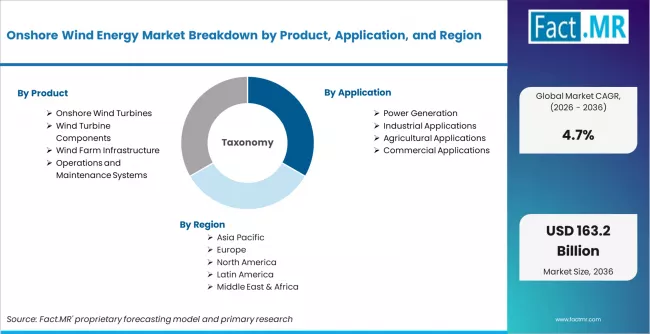
Onshore Wind Energy Market Size, Share, Growth and Forecast (2026 - 2036)

Onshore Wind Energy Market is segmented by Product (Onshore Wind Turbines, Wind Turbine Components, Wind Farm Infrastructure, Operations and Maintenance Systems), Application (Power Generation, Industrial Applications, Agricultural Applications, Commercial Applications), End Use (Independent Power Producers, Utilities, Industrial Consumers, Government Bodies), and Region, with forecasts covering the period from 2026 to 2036.

According to Fact.MR estimates, the global onshore wind energy market was valued at USD 98.5 billion in 2025. The market is projected to reach USD 103.1 billion in 2026 and is expected to grow to USD 163.2 billion by 2036, expanding at a CAGR of 4.7%. Onshore Wind Turbines is anticipated to account for 54.0% of the product segment in 2026, while Power Generation is expected to remain the leading application with around 59.0% share.

Onshore Wind Energy Market Analysis and Forecast by Fact.MR

  • The global market for onshore wind energy is estimated at US$ 103.13 billion in 2026 and is forecast to expand at a CAGR of 4.7% to reach US$ 163.25 billion by 2036.
  • The onshore wind energy market covers wind turbines, turbine components, wind farm infrastructure, and operations and maintenance systems used in power generation, industrial, agricultural, and commercial applications.
  • Wind turbine technology leads the technology segment, supported by larger rotor diameters, higher hub heights, and advanced power conversion efficiency.
  • Growth is shaped by renewable energy mandates, declining levelized cost of energy, corporate power purchase agreements, grid decarbonization targets, and repowering of aging wind farm installations with higher capacity turbines.
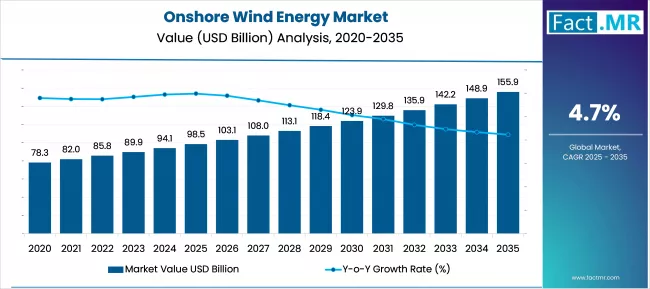
Onshore Wind Energy Market Market Value Analysis

Summary of Onshore Wind Energy Market

  • Market Snapshot
    • In 2025, the global Onshore Wind Energy Market was valued at approximately USD 98.5 billion.
    • The market is estimated to reach USD 103.13 billion in 2026 and is projected to attain USD 163.25 billion by 2036.
    • The onshore wind energy market is likely to expand at a CAGR of 4.7% during the forecast period.
    • The market is anticipated to create an absolute dollar opportunity of USD 60.12 billion between 2026 and 2036.
    • Onshore Wind Turbines accounts for 54% of product share in 2026.
    • South Korea (6.2%) and Germany (5.4%) are the key growth markets during the forecast period.
  • Demand and Growth Drivers
    • National renewable energy mandates and carbon reduction targets are sustaining policy driven demand for new onshore wind capacity additions across developed and emerging markets.
    • Declining levelized cost of energy for onshore wind makes it cost competitive with fossil fuel generation in most geographies, supporting procurement even without subsidy support.
    • Repowering of aging wind farm installations with larger, more efficient turbines is creating a sustained replacement demand cycle in markets with mature installed bases.
    • Expansion of distribution channels and direct to customer platforms is improving market access and product penetration across geographies.
    • Growing investment in research and product development is supporting the introduction of higher specification and differentiated products.
  • Product and Segment View
    • Onshore wind turbines hold 54% of the product type segment in 2026, supported by their core role as the primary revenue generating component in wind farm installations.
    • Power generation represents 59% of the application segment in 2026, with utility scale electricity production under long term power purchase agreements and feed in tariff structures acting as the primary demand channel.
    • Operations and maintenance systems are growing faster in percentage terms, with their share projected to rise as the installed base of wind turbines ages and requires increasing levels of service, component replacement, and performance optimization.
    • Key segmentation includes:
      • Product: Onshore Wind Turbines, Wind Turbine Components, Wind Farm Infrastructure, Operations and Maintenance Systems
      • Application: Power Generation, Industrial Applications, Agricultural Applications, Commercial Applications
      • End Use: Independent Power Producers, Utilities, Industrial Consumers, Government Bodies
      • Technology: Wind Turbine Technology, Power Conversion Technology, Control Systems, Structural Technology
      • Formulation: Wind Energy Systems, Energy Conversion Systems, Control Systems, Infrastructure Systems
      • Distribution Channel: Direct Sales, Distributors, E Commerce, Aftermarket Services
  • Geography and Competitive Outlook
    • South Korea leads growth at 6.2%, supported by expanding domestic demand, industry investment, and favorable policy conditions.
    • North America shows mixed growth patterns, with the United States representing a mature market and other countries showing stronger growth driven by emerging applications.
    • Europe demonstrates steady demand, with Germany and other key markets supported by regulatory frameworks and established industrial infrastructure.
    • Key players in this market include Vestas Wind Systems, Siemens Gamesa, General Electric, Goldwind, Enercon.
  • Analyst Opinion
    • Shambhu Nath Jha, Principal Consultant at Fact.MR, says 'Onshore wind energy is entering a phase where growth is driven as much by repowering existing wind farms with larger, more efficient turbines as by new greenfield installations. Developed markets in Europe and North America have substantial installed bases approaching end of design life, creating a repowering cycle that sustains turbine demand even as new site availability tightens. In parallel, corporate power purchase agreements and national renewable energy targets continue to drive new capacity additions across Asia Pacific and emerging markets. The competitive advantage increasingly depends on turbine platform efficiency at low wind speeds, service contract economics, and the ability to offer integrated energy solutions including storage and grid services rather than standalone turbine sales.'

Key Growth Drivers, Constraints, and Opportunities
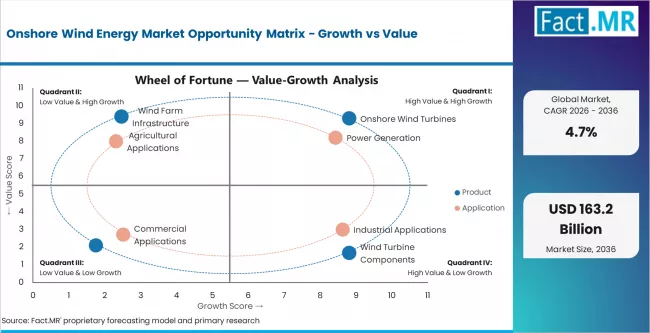
Onshore Wind Energy Market Opportunity Matrix Growth Vs Value

Key Factors Driving Growth

  • National renewable energy mandates and carbon reduction targets are sustaining policy driven demand for new onshore wind capacity additions across developed and emerging markets.
  • Declining levelized cost of energy for onshore wind makes it cost competitive with fossil fuel generation in most geographies, supporting procurement even without subsidy support.
  • Repowering of aging wind farm installations with larger, more efficient turbines is creating a sustained replacement demand cycle in markets with mature installed bases.

Key Market Constraints

  • Land availability and permitting challenges in densely populated or environmentally sensitive regions constrain new site development and extend project timelines.
  • Grid interconnection bottlenecks and curtailment risk reduce the economic viability of new wind installations in regions with insufficient transmission capacity.
  • Community opposition to visual and noise impacts of wind turbines creates permitting delays and project cancellations in certain markets.

Key Opportunity Areas

  • Repowering of aging European and North American wind farms with higher capacity turbines represents a multi decade replacement cycle with substantial annual volume.
  • Corporate PPA driven procurement by large technology, industrial, and consumer companies creates demand independent of government subsidy cycles.
  • Hybrid wind plus storage projects that combine onshore wind with battery or thermal storage improve grid dispatchability and create new project configurations with higher total value.

Segment-wise Analysis of the Onshore Wind Energy Market

  • Onshore wind turbines hold 54% of the product type segment in 2026, supported by their core role as the primary revenue generating component in wind farm installations.
  • Power generation represents 59% of the application segment in 2026, with utility scale electricity production under long term power purchase agreements and feed in tariff structures acting as the primary demand channel.
  • Operations and maintenance systems are growing faster in percentage terms, with their share projected to rise as the installed base of wind turbines ages and requires increasing levels of service, component replacement, and performance optimization.

The onshore wind energy market is segmented by product type, application, end use, technology, formulation, and distribution channel. By product type, the market covers wind turbines, turbine components, wind farm infrastructure, and operations and maintenance systems. By application, coverage includes power generation, industrial, agricultural, and commercial applications. Wind turbines lead by value as the highest cost component.

Which Product Type Segment Dominates the Onshore Wind Energy Market?
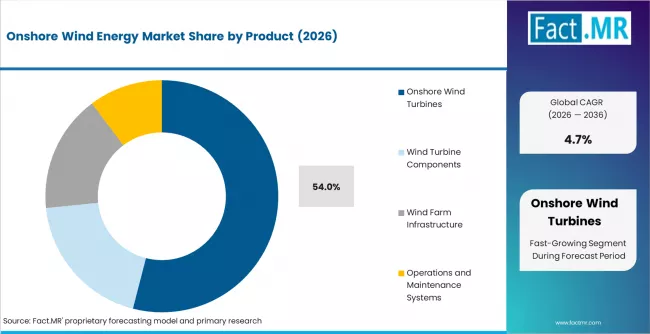
Onshore Wind Energy Market Analysis By Product

Onshore wind turbines account for approximately 54% of the total market value in 2026. Their leadership is supported by the high unit cost of turbine nacelles, rotors, and towers relative to other wind farm components, making turbines the dominant revenue driver in new installations and repowering projects.

Wind turbines retain dominance because they represent the core technology investment in every wind project. As turbine sizes increase with larger rotor diameters and higher hub heights, the per unit cost continues to rise even as the levelized cost of energy declines, concentrating an increasing share of project value in the turbine itself.

Which Application Segment Dominates the Onshore Wind Energy Market?
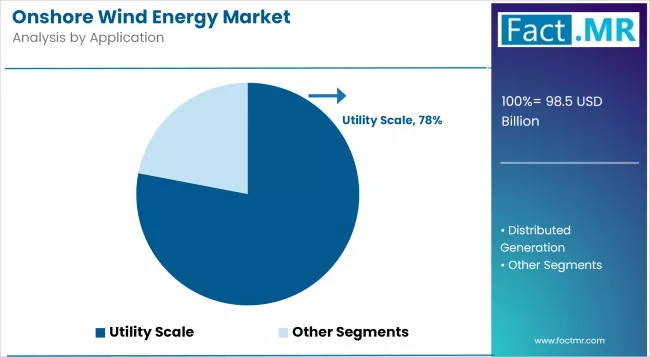
Onshore Wind Energy Market Analysis By Application

Power generation is expected to lead the application segment with 59% of global market value in 2026. Demand is shaped by national renewable energy targets, corporate power procurement strategies, and the cost competitiveness of onshore wind electricity in most major markets.

Industrial and commercial self generation applications are growing, but utility scale power generation retains overwhelming dominance because wind farm economics favor large installations with optimized turbine placement, shared grid connection infrastructure, and long term offtake agreements that provide revenue certainty.

Which Product Trend is Shaping the Next Phase of Growth in the Onshore Wind Energy Market?

Larger turbine platforms with rotor diameters exceeding 170 meters and hub heights above 140 meters are reshaping the competitive landscape by delivering higher energy capture per turbine, reducing the number of units needed per project, and improving the economics of lower wind speed sites that were previously unviable.

The shift toward larger platforms reflects the industry drive to maximize energy output per land area and reduce balance of plant costs on a per megawatt basis. This trend favors turbine manufacturers with the engineering capability to design, transport, and install increasingly large components, while creating challenges for logistics providers and grid operators that must accommodate higher per turbine power output. Companies leading the platform size increase are capturing a disproportionate share of new orders as developers prioritize energy yield optimization.

Regional Outlook Across Key Markets

Top Country Growth Comparison Onshore Wind Energy Market Cagr (2026 2036)

  • South Korea leads growth at 6.2%, supported by expanding domestic demand and favorable industry conditions.
  • North America shows varied growth, with the U.S. at 5.1% and Germany at 5.4%.
  • European demand remains steady, supported by established industrial infrastructure and regulatory frameworks.

CAGR Table

Country CAGR (%)
South Korea 6.2%
Germany 5.4%
USA 5.1%
France 4.9%
Spain 4.6%
UK 4.2%
Japan 3.8%

Source: Fact MR (FMR) analysis, based on proprietary forecasting model and primary research.
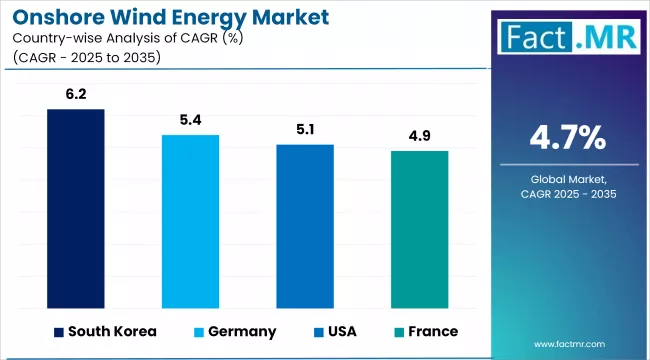
Onshore Wind Energy Market Cagr Analysis By Country

Market Outlook for Onshore Wind Energy in South Korea
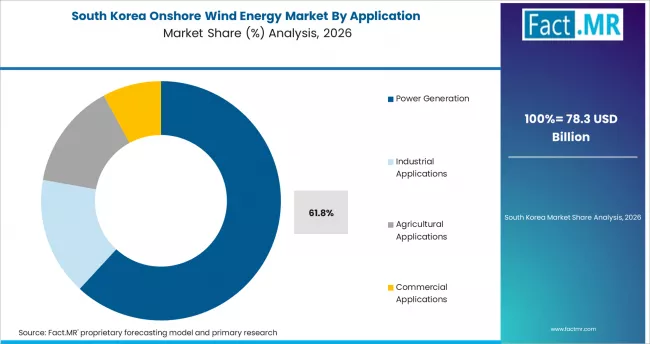
Onshore Wind Energy Market South Korea Market Share Analysis By Application

The South Korea onshore wind energy market is projected to grow at a CAGR of 6.2% through 2036. Demand is supported by renewable energy targets under the Renewable Portfolio Standard, growing corporate PPA procurement, and government investment in energy transition infrastructure.

  • Renewable Portfolio Standard drives capacity addition targets.
  • Corporate PPA procurement creates private sector demand.
  • Energy transition investment supports project development.

Demand Trends for Onshore Wind Energy in Germany

The Germany onshore wind energy market is projected to grow at a CAGR of 5.4% through 2036. Demand is supported by Energiewende targets, large repowering potential from aging turbine installations, and growing corporate renewable procurement.

  • Energiewende targets sustain policy driven demand.
  • Repowering of aging turbines creates replacement cycles.
  • Corporate procurement adds private sector demand.

Growth Assessment for Onshore Wind Energy in the United States
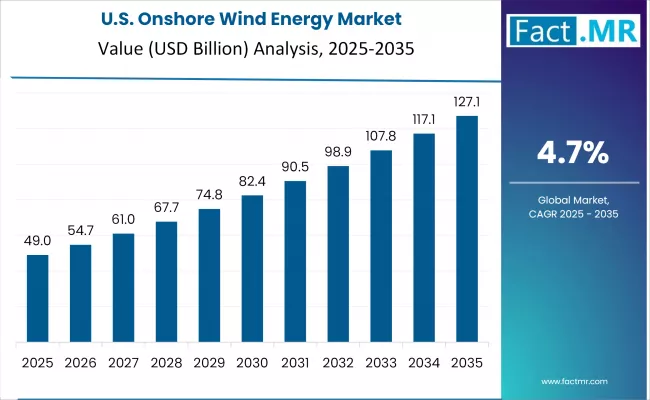
Onshore Wind Energy Market Country Value Analysis

The U.S. onshore wind energy market is projected to grow at a CAGR of 5.1% through 2036. Demand is supported by federal tax incentives, state level renewable mandates, corporate PPA growth, and a large repowering pipeline from early installations reaching end of design life.

  • Federal tax incentives support project economics.
  • State renewable mandates drive capacity additions.
  • Repowering pipeline creates sustained turbine demand.

Market Demand Analysis for Onshore Wind Energy in France

The France onshore wind energy market is projected to grow at a CAGR of 4.9% through 2036. Demand is shaped by national energy transition targets, auction based capacity procurement, and growing repowering activity in early wind farm installations.

  • Energy transition targets drive capacity additions.
  • Auction mechanisms provide procurement visibility.
  • Repowering activity sustains turbine demand.

Growth Outlook for Onshore Wind Energy in Spain

The Spain onshore wind energy market is projected to grow at a CAGR of 4.6% through 2036. Demand is supported by favorable wind resources, competitive auction pricing, and growing corporate PPA procurement driven by industrial energy cost management.

  • Favorable wind resources support project economics.
  • Competitive auctions drive capacity additions.
  • Corporate PPAs create private sector demand.

Market Opportunity Outlook for Onshore Wind Energy in the United Kingdom

The UK onshore wind energy market is projected to grow at a CAGR of 4.2% through 2036. Demand is shaped by net zero targets, planning policy reforms improving onshore wind project viability, and repowering potential from aging turbine installations.

  • Net zero targets sustain policy driven demand.
  • Planning reforms improve project development pipeline.
  • Repowering creates turbine replacement demand.

Demand Patterns for Onshore Wind Energy in Japan
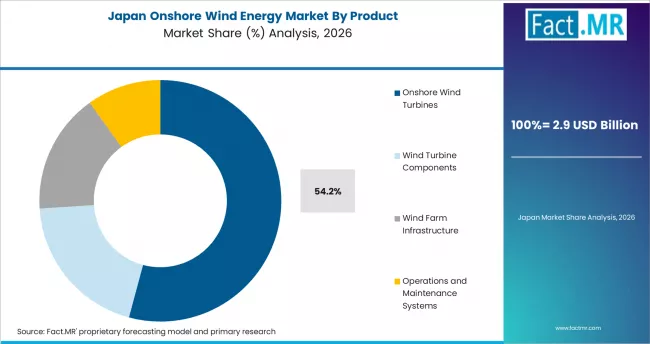
Onshore Wind Energy Market Japan Market Share Analysis By Product

The Japan onshore wind energy market is projected to grow at a CAGR of 3.8% through 2036. Demand is supported by energy diversification policy following Fukushima, feed in tariff structures, and growing corporate interest in renewable power procurement.

  • Energy diversification policy supports wind capacity.
  • Feed in tariff structures provide revenue certainty.
  • Corporate renewable procurement adds demand.

Competitive Benchmarking and Company Positioning
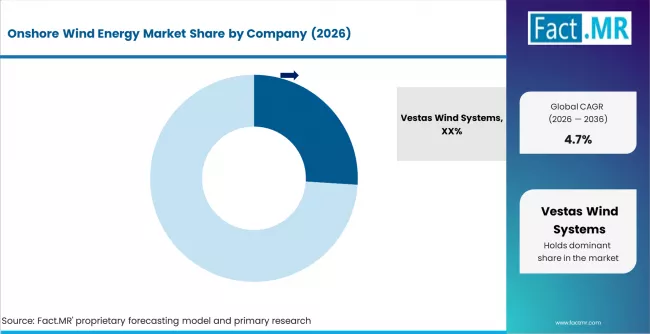
Onshore Wind Energy Market Analysis By Company

Onshore Wind Energy Market Analysis By Company

  • Vestas Wind Systems, Siemens Gamesa, General Electric, Goldwind hold strong positions in the global onshore wind energy market through broad product portfolios, established customer relationships, and growing capabilities in their respective technology areas.
  • Enercon, Nordex, Suzlon Energy, Ming Yang participate meaningfully across specific price tiers, user segments, and regional channels.
  • Technology integration and service capabilities create important differentiation factors, especially in segments where product specification and after sales support influence buyer decisions.

The competitive landscape is moderately fragmented, with a mix of established industry leaders, specialized technology providers, and regional players. Vestas Wind Systems, Siemens Gamesa, General Electric compete through product breadth, technology capabilities, and customer service infrastructure.

Competition is shaped by differences in product specification, geographic coverage, and service capability. Companies with integrated product and service offerings, strong distribution networks, and established customer relationships are positioned to retain market share and improve margins over time.

Key Companies in the Onshore Wind Energy Market

  • Vestas Wind Systems, Siemens Gamesa, General Electric, Goldwind are among the leading players in the onshore wind energy market globally.
  • Enercon, Nordex, Suzlon Energy, Ming Yang hold established positions across specific customer groups and application areas.
  • Senvion, Envision Energy continue to compete through focused product offerings and niche strength in specific applications.

Recent Industry Developments

  • Vestas Wind Systems Product Launch / Large Rotor Platform (2025)
    • Vestas launched its EnVentus platform with rotor diameters exceeding 170 meters for onshore applications, targeting low to medium wind speed sites where larger swept area improves energy capture and project economics.
  • Siemens Gamesa Technology Update / Onshore Platform Enhancement (2026)
    • Siemens Gamesa announced performance upgrades to its onshore turbine portfolio, including higher tip speed operation and improved control algorithms that increase annual energy production from existing platform designs.
  • Goldwind Market Expansion / International Onshore Projects (2025)
    • Goldwind expanded its international onshore wind project portfolio with new installations across Latin America and Southeast Asia, leveraging competitive turbine pricing and growing local service and maintenance capabilities.

Leading Companies Shaping the Onshore Wind Energy Market

  • Vestas Wind Systems
  • Siemens Gamesa
  • General Electric
  • Goldwind
  • Enercon
  • Nordex
  • Suzlon Energy
  • Ming Yang
  • Senvion
  • Envision Energy

Onshore Wind Energy Market Segmentation

  • Onshore Wind Energy market Segmented by Product:

    • Onshore Wind Turbines
      • Horizontal Axis Wind Turbines
        • Utility Scale Turbines
        • Distributed Wind Turbines
      • Vertical Axis Wind Turbines
        • Small Scale VAWT Systems
        • Hybrid Design Turbines
    • Wind Turbine Components
      • Rotor Systems
        • Blades and Hub Assemblies
        • Pitch Control Systems
      • Nacelle Systems
        • Gearbox and Generator Units
        • Cooling and Brake Systems
    • Wind Farm Infrastructure
      • Towers and Foundations
        • Steel Tower Structures
        • Concrete Foundation Systems
      • Electrical Infrastructure
        • Substation Systems
        • Grid Connection Systems
    • Operations and Maintenance Systems
      • Monitoring Systems
        • SCADA Wind Monitoring
        • Condition Monitoring Systems
      • Maintenance Equipment
        • Blade Inspection Tools
        • Service Lifting Equipment
  • Onshore Wind Energy market Segmented by Application:

    • Power Generation
      • Utility Scale Generation
        • Grid Connected Power Plants
        • Large Wind Farms
      • Distributed Power Generation
        • Community Wind Projects
        • Industrial Captive Power
    • Industrial Applications
      • Manufacturing Facilities
        • Factory Power Supply Systems
        • Industrial Energy Offset Systems
      • Mining Operations
        • Remote Mining Power Systems
        • Off Grid Energy Solutions
    • Agricultural Applications
      • Rural Electrification
        • Farm Power Systems
        • Irrigation Energy Systems
      • Agro Processing Units
        • Food Processing Plants
        • Cold Storage Facilities
    • Commercial Applications
      • Commercial Buildings
        • Business Complex Power Systems
        • Retail Energy Solutions
      • Infrastructure Projects
        • Smart City Energy Systems
        • Transport Energy Systems
  • Onshore Wind Energy market Segmented by End Use:

    • Independent Power Producers
      • Wind Farm Developers
        • Large Scale Developers
        • Mid Scale Developers
      • Energy Investment Firms
        • Renewable Energy Investors
        • Infrastructure Funds
    • Utilities
      • Public Utilities
        • State Electricity Boards
        • National Power Utilities
      • Private Utilities
        • Independent Power Utilities
        • Regional Energy Providers
    • Industrial Consumers
      • Heavy Industries
        • Steel and Cement Plants
        • Mining Companies
      • Manufacturing Industries
        • Automotive Plants
        • Electronics Factories
    • Government Bodies
      • Energy Authorities
        • Renewable Energy Agencies
        • Grid Management Authorities
      • Municipal Bodies
        • Rural Electrification Programs
        • Urban Energy Planning Units
  • Onshore Wind Energy market Segmented by Technology:

    • Wind Turbine Technology
      • Horizontal Axis Technology
        • Three Blade Rotor Systems
        • Variable Speed Systems
      • Vertical Axis Technology
        • Drag Based Systems
        • Lift Based Systems
    • Power Conversion Technology
      • Generator Systems
        • Direct Drive Generators
        • Gearbox Based Generators
      • Power Electronics
        • Converters and Inverters
        • Grid Synchronization Systems
    • Control Systems
      • SCADA Systems
        • Remote Monitoring Systems
        • Real Time Control Platforms
      • Smart Control Systems
        • AI Based Wind Optimization
        • Predictive Maintenance Systems
    • Structural Technology
      • Blade Technology
        • Composite Blade Systems
        • Aerodynamic Blade Design
      • Tower Technology
        • Modular Tower Structures
        • Hybrid Material Towers
  • Onshore Wind Energy market Segmented by Formulation:

    • Wind Energy Systems
      • Wind Turbine Assemblies
        • Complete Turbine Systems
        • Modular Turbine Units
      • Wind Farm Systems
        • Multi Turbine Farm Layouts
        • Distributed Wind Arrays
    • Energy Conversion Systems
      • Power Generation Units
        • Generator Based Systems
        • Direct Drive Systems
      • Power Conditioning Systems
        • Inverter Based Systems
        • Grid Integration Units
    • Control Systems
      • SCADA Control Systems
        • Remote Monitoring Platforms
        • Central Control Systems
      • Smart Automation Systems
        • AI Optimization Systems
        • Predictive Control Systems
    • Infrastructure Systems
      • Foundation Systems
        • Concrete Base Structures
        • Hybrid Tower Foundations
      • Electrical Infrastructure
        • Substation Integration Units
        • Transmission Systems
  • Onshore Wind Energy market Segmented by Distribution Channel:

    • Direct Sales
      • OEM Supply
        • Wind Turbine OEMs
        • Energy Equipment OEMs
      • Project Sales
        • Wind Farm Developers
        • Utility Scale Projects
    • Distributors
      • Energy Equipment Distributors
        • Renewable Energy Dealers
        • Industrial Equipment Suppliers
      • Regional Partners
        • Local Energy Contractors
        • Installation Contractors
    • E Commerce
      • B2B Energy Platforms
        • Renewable Energy Marketplaces
        • Industrial Procurement Portals
      • Direct Online Sales
        • Manufacturer Websites
    • Aftermarket Services
      • Maintenance Services
        • Turbine Repair Services
        • Blade Maintenance Services
      • Spare Parts Supply
        • Rotor Components
        • Generator Parts
  • Onshore Wind Energy market by Region:

    • North America
      • USA
      • Canada
      • Mexico
    • Latin America
      • Brazil
      • Chile
      • Rest of Latin America
    • Western Europe
      • Germany
      • UK
      • Italy
      • Spain
      • France
      • Nordic
      • BENELUX
      • Rest of Western Europe
    • Eastern Europe
      • Russia
      • Poland
      • Hungary
      • Balkan & Baltic
      • Rest of Eastern Europe
    • East Asia
      • China
      • Japan
      • South Korea
    • South Asia and Pacific
      • India
      • ASEAN
      • Australia & New Zealand
      • Rest of South Asia and Pacific
    • Middle East & Africa
      • Kingdom of Saudi Arabia
      • Other GCC Countries
      • Turkiye
      • South Africa
      • Other African Union
      • Rest of Middle East & Africa

Sources and Research References

  • Vestas Wind Systems. Product portfolio, corporate announcements, and market disclosures.
  • Siemens Gamesa. Product portfolio, corporate announcements, and market disclosures.
  • General Electric. Product portfolio, corporate announcements, and market disclosures.
  • Industry association statistics, government agency publications, trade data, customs databases, and company product catalogs.
  • Primary interviews with manufacturers, distributors, end users, and industry specialists.

This bibliography is provided for reader reference and is not exhaustive. The full report contains the complete reference list and detailed citations.

Key Questions This Report Addresses

  • What is the current and future size of the Onshore Wind Energy Market?
  • How fast is the Onshore Wind Energy Market expected to grow between 2026 and 2036?
  • Which product type is likely to lead the market by 2026?
  • Which application segment is expected to account for the highest demand by 2026?
  • What factors are driving demand for onshore wind energy globally?
  • Which countries are projected to show the fastest growth through 2036?
  • What is driving market expansion in South Korea and Germany?
  • Who are the key companies active in the Onshore Wind Energy Market?
  • How does Fact.MR estimate and validate the market forecast?
  • What are the key constraints and opportunity areas in this market?

Onshore Wind Energy Market Definition

The onshore wind energy market covers wind turbines, turbine components, wind farm infrastructure, and operations and maintenance systems installed on land based sites for electricity generation, including utility scale and distributed wind installations used by independent power producers, utilities, industrial consumers, and government entities under power purchase agreements and renewable energy mandates across global markets.

Onshore Wind Energy Market Inclusions

  • The scope covers global and regional market size and forecasts for 2026 to 2036 across product type, application, end use, technology, formulation, and distribution channel.
  • It includes regional demand analysis across major geographies, based on factors such as renewable energy targets, wind resource availability, grid infrastructure capacity, and policy incentive structures.
  • The report includes pricing and cost analysis covering turbine costs, balance of plant, installation, and levelized cost of energy benchmarks across turbine classes and site conditions.
  • It covers technology trends, market drivers and constraints, and the competitive landscape, including turbine portfolios, service contract strategies, market share positions, and geographic reach of leading OEMs.

Onshore Wind Energy Market Exclusions

  • The scope excludes offshore wind installations, floating wind platforms, and marine based wind energy systems.
  • It excludes small scale residential micro wind turbines below 100 kW capacity and vertical axis wind turbines not used in utility scale applications.
  • The report excludes standalone energy storage systems, grid infrastructure equipment, and power transmission assets not sold as part of wind farm projects.
  • It also excludes wind resource assessment services, environmental impact consultancy, and permitting services sold independently of turbine or project procurement.

Onshore Wind Energy Market Research Methodology

  • The methodology combines secondary research, primary interviews, and forecast modelling.
  • It draws on 100+ secondary sources and benchmarks 50+ company product portfolios.
  • Market sizing covers 30+ countries through a demand side model, supported by top down validation.
  • Key inputs include industry production data, trade statistics, pricing benchmarks, regulatory frameworks, and end use demand patterns.
  • The model cross checks demand with shipments, pricing trends, channel mix, and product launches.
  • Primary validation includes 20+ interviews across manufacturers, distributors, end users, and industry specialists.
  • Final estimates go through trade flow checks, sales pattern review, and sensitivity testing.

Scope of Analysis

Onshore Wind Energy Market Breakdown By Product, Application, And Region

Parameter Details
Quantitative Units USD 103.13 billion to USD 163.25 billion, at a CAGR of 4.7%
Market Definition The onshore wind energy market covers wind turbines, turbine components, wind farm infrastructure, and operations and maintenance systems installed on land based sites for electricity generation, including utility scale and distributed wind installations used by independent power producers, utilities, industrial consumers, and government entities under power purchase agreements and renewable energy mandates across global markets.
Regions Covered North America, Latin America, Europe, East Asia, South Asia and Pacific, Middle East and Africa
Countries Covered South Korea, Germany, USA, France, Spain, UK, Japan, 30 plus countries
Key Companies Vestas Wind Systems, Siemens Gamesa, General Electric, Goldwind, Enercon, Nordex, Suzlon Energy, Ming Yang, Senvion, Envision Energy
Forecast Period 2026 to 2036
Approach Hybrid demand side and top down methodology built on country level demand analysis, product benchmarking, pricing analysis, shipment validation, and primary interviews across manufacturers, distributors, and end users

- Frequently Asked Questions -

How big is the onshore wind energy market in 2025?

The global onshore wind energy market is estimated to be valued at USD 98.5 billion in 2025.

What will be the size of the onshore wind energy market in 2036?

The market size for the onshore wind energy market is projected to reach USD 163.25 billion by 2036.

How much will the onshore wind energy market grow between 2026 and 2036?

The onshore wind energy market is expected to grow at a 4.7% CAGR between 2026 and 2036.

What are the key product types in the onshore wind energy market?

The key product types are onshore wind turbines, wind turbine components, wind farm infrastructure, operations and maintenance systems.

Which segment will contribute significant share in the onshore wind energy market in 2026?

In terms of product, onshore wind turbines is expected to account for 54% share in the onshore wind energy market in 2026.

Which are the fastest growing countries in the onshore wind energy market?

South Korea (6.2%) and Germany (5.4%) are the key growth markets during the forecast period.

Table of Content

  1. Executive Summary
    • Global Market Outlook
    • Demand to side Trends
    • Supply to side Trends
    • Technology Roadmap Analysis
    • Analysis and Recommendations
  2. Market Overview
    • Market Coverage / Taxonomy
    • Market Definition / Scope / Limitations
  3. Research Methodology
    • Chapter Orientation
    • Analytical Lens and Working Hypotheses
      • Market Structure, Signals, and Trend Drivers
      • Benchmarking and Cross-market Comparability
      • Market Sizing, Forecasting, and Opportunity Mapping
    • Research Design and Evidence Framework
      • Desk Research Programme (Secondary Evidence)
        • Company Annual and Sustainability Reports
        • Peer-reviewed Journals and Academic Literature
        • Corporate Websites, Product Literature, and Technical Notes
        • Earnings Decks and Investor Briefings
        • Statutory Filings and Regulatory Disclosures
        • Technical White Papers and Standards Notes
        • Trade Journals, Industry Magazines, and Analyst Briefs
        • Conference Proceedings, Webinars, and Seminar Materials
        • Government Statistics Portals and Public Data Releases
        • Press Releases and Reputable Media Coverage
        • Specialist Newsletters and Curated Briefings
        • Sector Databases and Reference Repositories
        • Fact.MR Internal Proprietary Databases and Historical Market Datasets
        • Subscription Datasets and Paid Sources
        • Social Channels, Communities, and Digital Listening Inputs
        • Additional Desk Sources
      • Expert Input and Fieldwork (Primary Evidence)
        • Primary Modes
          • Qualitative Interviews and Expert Elicitation
          • Quantitative Surveys and Structured Data Capture
          • Blended Approach
        • Why Primary Evidence is Used
        • Field Techniques
          • Interviews
          • Surveys
          • Focus Groups
          • Observational and In-context Research
          • Social and Community Interactions
        • Stakeholder Universe Engaged
          • C-suite Leaders
          • Board Members
          • Presidents and Vice Presidents
          • R&D and Innovation Heads
          • Technical Specialists
          • Domain Subject-matter Experts
          • Scientists
          • Physicians and Other Healthcare Professionals
        • Governance, Ethics, and Data Stewardship
          • Research Ethics
          • Data Integrity and Handling
      • Tooling, Models, and Reference Databases
    • Data Engineering and Model Build
      • Data Acquisition and Ingestion
      • Cleaning, Normalisation, and Verification
      • Synthesis, Triangulation, and Analysis
    • Quality Assurance and Audit Trail
  4. Market Background
    • Market Dynamics
      • Drivers
      • Restraints
      • Opportunity
      • Trends
    • Scenario Forecast
      • Demand in Optimistic Scenario
      • Demand in Likely Scenario
      • Demand in Conservative Scenario
    • Opportunity Map Analysis
    • Product Life Cycle Analysis
    • Supply Chain Analysis
    • Investment Feasibility Matrix
    • Value Chain Analysis
    • PESTLE and Porter’s Analysis
    • Regulatory Landscape
    • Regional Parent Market Outlook
    • Production and Consumption Statistics
    • Import and Export Statistics
  5. Global Market Analysis 2021 to 2025 and Forecast, 2026 to 2036
    • Historical Market Size Value (USD Million) Analysis, 2021 to 2025
    • Current and Future Market Size Value (USD Million) Projections, 2026 to 2036
      • Y to o to Y Growth Trend Analysis
      • Absolute $ Opportunity Analysis
  6. Global Market Pricing Analysis 2021 to 2025 and Forecast 2026 to 2036
  7. Global Market Analysis 2021 to 2025 and Forecast 2026 to 2036, By Product
    • Introduction / Key Findings
    • Historical Market Size Value (USD Million) Analysis By Product, 2021 to 2025
    • Current and Future Market Size Value (USD Million) Analysis and Forecast By Product, 2026 to 2036
      • Onshore Wind Turbines
        • Horizontal Axis Wind Turbines
        • Utility Scale Turbines
        • Distributed Wind Turbines
        • Vertical Axis Wind Turbines
        • Small Scale VAWT Systems
        • Hybrid Design Turbines
      • Wind Turbine Components
        • Rotor Systems
        • Blades and Hub Assemblies
        • Pitch Control Systems
        • Nacelle Systems
        • Gearbox and Generator Value (USD Million)s
      • Wind Farm Infrastructure
        • Towers and Foundations
        • Steel Tower Structures
        • Concrete Foundation Systems
        • Electrical Infrastructure
        • Substation Systems
      • Operations and Maintenance Systems
        • Monitoring Systems
        • SCADA Wind Monitoring
        • Condition Monitoring Systems
        • Maintenance Equipment
        • Blade Inspection Tools
    • Y to o to Y Growth Trend Analysis By Product, 2021 to 2025
    • Absolute $ Opportunity Analysis By Product, 2026 to 2036
  8. Global Market Analysis 2021 to 2025 and Forecast 2026 to 2036, By Application
    • Introduction / Key Findings
    • Historical Market Size Value (USD Million) Analysis By Application, 2021 to 2025
    • Current and Future Market Size Value (USD Million) Analysis and Forecast By Application, 2026 to 2036
      • Power Generation
        • Utility Scale Generation
        • Grid Connected Power Plants
        • Large Wind Farms
        • Distributed Power Generation
        • Community Wind Projects
        • Industrial Captive Power
      • Industrial Applications
        • Manufacturing Facilities
        • Factory Power Supply Systems
        • Industrial Energy Offset Systems
        • Mining Operations
        • Remote Mining Power Systems
      • Agricultural Applications
        • Rural Electrification
        • Farm Power Systems
        • Irrigation Energy Systems
        • Agro Processing Value (USD Million)s
        • Food Processing Plants
      • Commercial Applications
        • Commercial Buildings
        • Business Complex Power Systems
        • Retail Energy Solutions
        • Infrastructure Projects
        • Smart City Energy Systems
    • Y to o to Y Growth Trend Analysis By Application, 2021 to 2025
    • Absolute $ Opportunity Analysis By Application, 2026 to 2036
  9. Global Market Analysis 2021 to 2025 and Forecast 2026 to 2036, By End Use
    • Introduction / Key Findings
    • Historical Market Size Value (USD Million) Analysis By End Use, 2021 to 2025
    • Current and Future Market Size Value (USD Million) Analysis and Forecast By End Use, 2026 to 2036
      • Independent Power Producers
        • Wind Farm Developers
        • Large Scale Developers
        • Mid Scale Developers
        • Energy Investment Firms
        • Renewable Energy Investors
        • Infrastructure Funds
      • Utilities
        • Public Utilities
        • State Electricity Boards
        • National Power Utilities
        • Private Utilities
        • Independent Power Utilities
      • Industrial Consumers
        • Heavy Industries
        • Steel and Cement Plants
        • Mining Companies
        • Manufacturing Industries
        • Automotive Plants
      • Government Bodies
        • Energy Authorities
        • Renewable Energy Agencies
        • Grid Management Authorities
        • Municipal Bodies
        • Rural Electrification Programs
    • Y to o to Y Growth Trend Analysis By End Use, 2021 to 2025
    • Absolute $ Opportunity Analysis By End Use, 2026 to 2036
  10. Global Market Analysis 2021 to 2025 and Forecast 2026 to 2036, By Technology
    • Introduction / Key Findings
    • Historical Market Size Value (USD Million) Analysis By Technology, 2021 to 2025
    • Current and Future Market Size Value (USD Million) Analysis and Forecast By Technology, 2026 to 2036
      • Wind Turbine Technology
        • Horizontal Axis Technology
        • Three Blade Rotor Systems
        • Variable Speed Systems
        • Vertical Axis Technology
        • Drag Based Systems
        • Lift Based Systems
      • Power Conversion Technology
        • Generator Systems
        • Direct Drive Generators
        • Gearbox Based Generators
        • Power Electronics
        • Converters and Inverters
      • Control Systems
        • SCADA Systems
        • Remote Monitoring Systems
        • Real Time Control Platforms
        • Smart Control Systems
        • AI Based Wind Optimization
      • Structural Technology
        • Blade Technology
        • Composite Blade Systems
        • Aerodynamic Blade Design
        • Tower Technology
        • Modular Tower Structures
    • Y to o to Y Growth Trend Analysis By Technology, 2021 to 2025
    • Absolute $ Opportunity Analysis By Technology, 2026 to 2036
  11. Global Market Analysis 2021 to 2025 and Forecast 2026 to 2036, By Formulation
    • Introduction / Key Findings
    • Historical Market Size Value (USD Million) Analysis By Formulation, 2021 to 2025
    • Current and Future Market Size Value (USD Million) Analysis and Forecast By Formulation, 2026 to 2036
      • Wind Energy Systems
        • Wind Turbine Assemblies
        • Complete Turbine Systems
        • Modular Turbine Value (USD Million)s
        • Wind Farm Systems
        • Multi Turbine Farm Layouts
        • Distributed Wind Arrays
      • Energy Conversion Systems
        • Power Generation Value (USD Million)s
        • Generator Based Systems
        • Direct Drive Systems
        • Power Conditioning Systems
        • Inverter Based Systems
      • Control Systems
        • SCADA Control Systems
        • Remote Monitoring Platforms
        • Central Control Systems
        • Smart Automation Systems
        • AI Optimization Systems
      • Infrastructure Systems
        • Foundation Systems
        • Concrete Base Structures
        • Hybrid Tower Foundations
        • Electrical Infrastructure
        • Substation Integration Value (USD Million)s
    • Y to o to Y Growth Trend Analysis By Formulation, 2021 to 2025
    • Absolute $ Opportunity Analysis By Formulation, 2026 to 2036
  12. Global Market Analysis 2021 to 2025 and Forecast 2026 to 2036, By Distribution Channel
    • Introduction / Key Findings
    • Historical Market Size Value (USD Million) Analysis By Distribution Channel, 2021 to 2025
    • Current and Future Market Size Value (USD Million) Analysis and Forecast By Distribution Channel, 2026 to 2036
      • Direct Sales
        • OEM Supply
        • Wind Turbine OEMs
        • Energy Equipment OEMs
        • Project Sales
        • Wind Farm Developers
        • Utility Scale Projects
      • Distributors
        • Energy Equipment Distributors
        • Renewable Energy Dealers
        • Industrial Equipment Suppliers
        • Regional Partners
        • Local Energy Contractors
      • E Commerce
        • B2B Energy Platforms
        • Renewable Energy Marketplaces
        • Industrial Procurement Portals
        • Direct Online Sales
        • Manufacturer Websites
      • Aftermarket Services
        • Maintenance Services
        • Turbine Repair Services
        • Blade Maintenance Services
        • Spare Parts Supply
        • Rotor Components
    • Y to o to Y Growth Trend Analysis By Distribution Channel, 2021 to 2025
    • Absolute $ Opportunity Analysis By Distribution Channel, 2026 to 2036
  13. Global Market Analysis 2021 to 2025 and Forecast 2026 to 2036, By Region
    • Introduction
    • Historical Market Size Value (USD Million) Analysis By Region, 2021 to 2025
    • Current Market Size Value (USD Million) Analysis and Forecast By Region, 2026 to 2036
      • North America
      • Latin America
      • Western Europe
      • Eastern Europe
      • East Asia
      • South Asia and Pacific
      • Middle East & Africa
    • Market Attractiveness Analysis By Region
  14. North America Market Analysis 2021 to 2025 and Forecast 2026 to 2036, By Country
    • Historical Market Size Value (USD Million) Trend Analysis By Market Taxonomy, 2021 to 2025
    • Market Size Value (USD Million) Forecast By Market Taxonomy, 2026 to 2036
      • By Country
        • USA
        • Canada
        • Mexico
      • By Product
      • By Application
      • By End Use
      • By Technology
      • By Formulation
      • By Distribution Channel
    • Market Attractiveness Analysis
      • By Country
      • By Product
      • By Application
      • By End Use
      • By Technology
      • By Formulation
      • By Distribution Channel
    • Key Takeaways
  15. Latin America Market Analysis 2021 to 2025 and Forecast 2026 to 2036, By Country
    • Historical Market Size Value (USD Million) Trend Analysis By Market Taxonomy, 2021 to 2025
    • Market Size Value (USD Million) Forecast By Market Taxonomy, 2026 to 2036
      • By Country
        • Brazil
        • Chile
        • Rest of Latin America
      • By Product
      • By Application
      • By End Use
      • By Technology
      • By Formulation
      • By Distribution Channel
    • Market Attractiveness Analysis
      • By Country
      • By Product
      • By Application
      • By End Use
      • By Technology
      • By Formulation
      • By Distribution Channel
    • Key Takeaways
  16. Western Europe Market Analysis 2021 to 2025 and Forecast 2026 to 2036, By Country
    • Historical Market Size Value (USD Million) Trend Analysis By Market Taxonomy, 2021 to 2025
    • Market Size Value (USD Million) Forecast By Market Taxonomy, 2026 to 2036
      • By Country
        • Germany
        • UK
        • Italy
        • Spain
        • France
        • Nordic
        • BENELUX
        • Rest of Western Europe
      • By Product
      • By Application
      • By End Use
      • By Technology
      • By Formulation
      • By Distribution Channel
    • Market Attractiveness Analysis
      • By Country
      • By Product
      • By Application
      • By End Use
      • By Technology
      • By Formulation
      • By Distribution Channel
    • Key Takeaways
  17. Eastern Europe Market Analysis 2021 to 2025 and Forecast 2026 to 2036, By Country
    • Historical Market Size Value (USD Million) Trend Analysis By Market Taxonomy, 2021 to 2025
    • Market Size Value (USD Million) Forecast By Market Taxonomy, 2026 to 2036
      • By Country
        • Russia
        • Poland
        • Hungary
        • Balkan & Baltic
        • Rest of Eastern Europe
      • By Product
      • By Application
      • By End Use
      • By Technology
      • By Formulation
      • By Distribution Channel
    • Market Attractiveness Analysis
      • By Country
      • By Product
      • By Application
      • By End Use
      • By Technology
      • By Formulation
      • By Distribution Channel
    • Key Takeaways
  18. East Asia Market Analysis 2021 to 2025 and Forecast 2026 to 2036, By Country
    • Historical Market Size Value (USD Million) Trend Analysis By Market Taxonomy, 2021 to 2025
    • Market Size Value (USD Million) Forecast By Market Taxonomy, 2026 to 2036
      • By Country
        • China
        • Japan
        • South Korea
      • By Product
      • By Application
      • By End Use
      • By Technology
      • By Formulation
      • By Distribution Channel
    • Market Attractiveness Analysis
      • By Country
      • By Product
      • By Application
      • By End Use
      • By Technology
      • By Formulation
      • By Distribution Channel
    • Key Takeaways
  19. South Asia and Pacific Market Analysis 2021 to 2025 and Forecast 2026 to 2036, By Country
    • Historical Market Size Value (USD Million) Trend Analysis By Market Taxonomy, 2021 to 2025
    • Market Size Value (USD Million) Forecast By Market Taxonomy, 2026 to 2036
      • By Country
        • India
        • ASEAN
        • Australia & New Zealand
        • Rest of South Asia and Pacific
      • By Product
      • By Application
      • By End Use
      • By Technology
      • By Formulation
      • By Distribution Channel
    • Market Attractiveness Analysis
      • By Country
      • By Product
      • By Application
      • By End Use
      • By Technology
      • By Formulation
      • By Distribution Channel
    • Key Takeaways
  20. Middle East & Africa Market Analysis 2021 to 2025 and Forecast 2026 to 2036, By Country
    • Historical Market Size Value (USD Million) Trend Analysis By Market Taxonomy, 2021 to 2025
    • Market Size Value (USD Million) Forecast By Market Taxonomy, 2026 to 2036
      • By Country
        • Kingdom of Saudi Arabia
        • Other GCC Countries
        • Turkiye
        • South Africa
        • Other African Union
        • Rest of Middle East & Africa
      • By Product
      • By Application
      • By End Use
      • By Technology
      • By Formulation
      • By Distribution Channel
    • Market Attractiveness Analysis
      • By Country
      • By Product
      • By Application
      • By End Use
      • By Technology
      • By Formulation
      • By Distribution Channel
    • Key Takeaways
  21. Key Countries Market Analysis
    • USA
      • Pricing Analysis
      • Market Share Analysis, 2025
        • By Product
        • By Application
        • By End Use
        • By Technology
        • By Formulation
        • By Distribution Channel
    • Canada
      • Pricing Analysis
      • Market Share Analysis, 2025
        • By Product
        • By Application
        • By End Use
        • By Technology
        • By Formulation
        • By Distribution Channel
    • Mexico
      • Pricing Analysis
      • Market Share Analysis, 2025
        • By Product
        • By Application
        • By End Use
        • By Technology
        • By Formulation
        • By Distribution Channel
    • Brazil
      • Pricing Analysis
      • Market Share Analysis, 2025
        • By Product
        • By Application
        • By End Use
        • By Technology
        • By Formulation
        • By Distribution Channel
    • Chile
      • Pricing Analysis
      • Market Share Analysis, 2025
        • By Product
        • By Application
        • By End Use
        • By Technology
        • By Formulation
        • By Distribution Channel
    • Germany
      • Pricing Analysis
      • Market Share Analysis, 2025
        • By Product
        • By Application
        • By End Use
        • By Technology
        • By Formulation
        • By Distribution Channel
    • UK
      • Pricing Analysis
      • Market Share Analysis, 2025
        • By Product
        • By Application
        • By End Use
        • By Technology
        • By Formulation
        • By Distribution Channel
    • Italy
      • Pricing Analysis
      • Market Share Analysis, 2025
        • By Product
        • By Application
        • By End Use
        • By Technology
        • By Formulation
        • By Distribution Channel
    • Spain
      • Pricing Analysis
      • Market Share Analysis, 2025
        • By Product
        • By Application
        • By End Use
        • By Technology
        • By Formulation
        • By Distribution Channel
    • France
      • Pricing Analysis
      • Market Share Analysis, 2025
        • By Product
        • By Application
        • By End Use
        • By Technology
        • By Formulation
        • By Distribution Channel
    • India
      • Pricing Analysis
      • Market Share Analysis, 2025
        • By Product
        • By Application
        • By End Use
        • By Technology
        • By Formulation
        • By Distribution Channel
    • ASEAN
      • Pricing Analysis
      • Market Share Analysis, 2025
        • By Product
        • By Application
        • By End Use
        • By Technology
        • By Formulation
        • By Distribution Channel
    • Australia & New Zealand
      • Pricing Analysis
      • Market Share Analysis, 2025
        • By Product
        • By Application
        • By End Use
        • By Technology
        • By Formulation
        • By Distribution Channel
    • China
      • Pricing Analysis
      • Market Share Analysis, 2025
        • By Product
        • By Application
        • By End Use
        • By Technology
        • By Formulation
        • By Distribution Channel
    • Japan
      • Pricing Analysis
      • Market Share Analysis, 2025
        • By Product
        • By Application
        • By End Use
        • By Technology
        • By Formulation
        • By Distribution Channel
    • South Korea
      • Pricing Analysis
      • Market Share Analysis, 2025
        • By Product
        • By Application
        • By End Use
        • By Technology
        • By Formulation
        • By Distribution Channel
    • Russia
      • Pricing Analysis
      • Market Share Analysis, 2025
        • By Product
        • By Application
        • By End Use
        • By Technology
        • By Formulation
        • By Distribution Channel
    • Poland
      • Pricing Analysis
      • Market Share Analysis, 2025
        • By Product
        • By Application
        • By End Use
        • By Technology
        • By Formulation
        • By Distribution Channel
    • Hungary
      • Pricing Analysis
      • Market Share Analysis, 2025
        • By Product
        • By Application
        • By End Use
        • By Technology
        • By Formulation
        • By Distribution Channel
    • Kingdom of Saudi Arabia
      • Pricing Analysis
      • Market Share Analysis, 2025
        • By Product
        • By Application
        • By End Use
        • By Technology
        • By Formulation
        • By Distribution Channel
    • Turkiye
      • Pricing Analysis
      • Market Share Analysis, 2025
        • By Product
        • By Application
        • By End Use
        • By Technology
        • By Formulation
        • By Distribution Channel
    • South Africa
      • Pricing Analysis
      • Market Share Analysis, 2025
        • By Product
        • By Application
        • By End Use
        • By Technology
        • By Formulation
        • By Distribution Channel
  22. Market Structure Analysis
    • Competition Dashboard
    • Competition Benchmarking
    • Market Share Analysis of Top Players
      • By Regional
      • By Product
      • By Application
      • By End Use
      • By Technology
      • By Formulation
      • By Distribution Channel
  23. Competition Analysis
    • Competition Deep Dive
      • Vestas Wind Systems
        • Overview
        • Product Portfolio
        • Profitability by Market Segments (Product/Age /Sales Channel/Region)
        • Sales Footprint
        • Strategy Overview
          • Marketing Strategy
          • Product Strategy
          • Channel Strategy
      • Siemens Gamesa
      • General Electric
      • Goldwind
      • Enercon
      • Nordex
      • Suzlon Energy
      • Ming Yang
      • Senvion
      • Envision Energy
  24. Assumptions & Acronyms Used

List Of Table

  • Table 1: Global Market Value (USD Million) Forecast by Region, 2021 to 2036
  • Table 2: Global Market Value (USD Million) Forecast by Product, 2021 to 2036
  • Table 3: Global Market Value (USD Million) Forecast by Application, 2021 to 2036
  • Table 4: Global Market Value (USD Million) Forecast by End Use, 2021 to 2036
  • Table 5: Global Market Value (USD Million) Forecast by Technology, 2021 to 2036
  • Table 6: Global Market Value (USD Million) Forecast by Formulation, 2021 to 2036
  • Table 7: Global Market Value (USD Million) Forecast by Distribution Channel, 2021 to 2036
  • Table 8: North America Market Value (USD Million) Forecast by Country, 2021 to 2036
  • Table 9: North America Market Value (USD Million) Forecast by Product, 2021 to 2036
  • Table 10: North America Market Value (USD Million) Forecast by Application, 2021 to 2036
  • Table 11: North America Market Value (USD Million) Forecast by End Use, 2021 to 2036
  • Table 12: North America Market Value (USD Million) Forecast by Technology, 2021 to 2036
  • Table 13: North America Market Value (USD Million) Forecast by Formulation, 2021 to 2036
  • Table 14: North America Market Value (USD Million) Forecast by Distribution Channel, 2021 to 2036
  • Table 15: Latin America Market Value (USD Million) Forecast by Country, 2021 to 2036
  • Table 16: Latin America Market Value (USD Million) Forecast by Product, 2021 to 2036
  • Table 17: Latin America Market Value (USD Million) Forecast by Application, 2021 to 2036
  • Table 18: Latin America Market Value (USD Million) Forecast by End Use, 2021 to 2036
  • Table 19: Latin America Market Value (USD Million) Forecast by Technology, 2021 to 2036
  • Table 20: Latin America Market Value (USD Million) Forecast by Formulation, 2021 to 2036
  • Table 21: Latin America Market Value (USD Million) Forecast by Distribution Channel, 2021 to 2036
  • Table 22: Western Europe Market Value (USD Million) Forecast by Country, 2021 to 2036
  • Table 23: Western Europe Market Value (USD Million) Forecast by Product, 2021 to 2036
  • Table 24: Western Europe Market Value (USD Million) Forecast by Application, 2021 to 2036
  • Table 25: Western Europe Market Value (USD Million) Forecast by End Use, 2021 to 2036
  • Table 26: Western Europe Market Value (USD Million) Forecast by Technology, 2021 to 2036
  • Table 27: Western Europe Market Value (USD Million) Forecast by Formulation, 2021 to 2036
  • Table 28: Western Europe Market Value (USD Million) Forecast by Distribution Channel, 2021 to 2036
  • Table 29: Eastern Europe Market Value (USD Million) Forecast by Country, 2021 to 2036
  • Table 30: Eastern Europe Market Value (USD Million) Forecast by Product, 2021 to 2036
  • Table 31: Eastern Europe Market Value (USD Million) Forecast by Application, 2021 to 2036
  • Table 32: Eastern Europe Market Value (USD Million) Forecast by End Use, 2021 to 2036
  • Table 33: Eastern Europe Market Value (USD Million) Forecast by Technology, 2021 to 2036
  • Table 34: Eastern Europe Market Value (USD Million) Forecast by Formulation, 2021 to 2036
  • Table 35: Eastern Europe Market Value (USD Million) Forecast by Distribution Channel, 2021 to 2036
  • Table 36: East Asia Market Value (USD Million) Forecast by Country, 2021 to 2036
  • Table 37: East Asia Market Value (USD Million) Forecast by Product, 2021 to 2036
  • Table 38: East Asia Market Value (USD Million) Forecast by Application, 2021 to 2036
  • Table 39: East Asia Market Value (USD Million) Forecast by End Use, 2021 to 2036
  • Table 40: East Asia Market Value (USD Million) Forecast by Technology, 2021 to 2036
  • Table 41: East Asia Market Value (USD Million) Forecast by Formulation, 2021 to 2036
  • Table 42: East Asia Market Value (USD Million) Forecast by Distribution Channel, 2021 to 2036
  • Table 43: South Asia and Pacific Market Value (USD Million) Forecast by Country, 2021 to 2036
  • Table 44: South Asia and Pacific Market Value (USD Million) Forecast by Product, 2021 to 2036
  • Table 45: South Asia and Pacific Market Value (USD Million) Forecast by Application, 2021 to 2036
  • Table 46: South Asia and Pacific Market Value (USD Million) Forecast by End Use, 2021 to 2036
  • Table 47: South Asia and Pacific Market Value (USD Million) Forecast by Technology, 2021 to 2036
  • Table 48: South Asia and Pacific Market Value (USD Million) Forecast by Formulation, 2021 to 2036
  • Table 49: South Asia and Pacific Market Value (USD Million) Forecast by Distribution Channel, 2021 to 2036
  • Table 50: Middle East & Africa Market Value (USD Million) Forecast by Country, 2021 to 2036
  • Table 51: Middle East & Africa Market Value (USD Million) Forecast by Product, 2021 to 2036
  • Table 52: Middle East & Africa Market Value (USD Million) Forecast by Application, 2021 to 2036
  • Table 53: Middle East & Africa Market Value (USD Million) Forecast by End Use, 2021 to 2036
  • Table 54: Middle East & Africa Market Value (USD Million) Forecast by Technology, 2021 to 2036
  • Table 55: Middle East & Africa Market Value (USD Million) Forecast by Formulation, 2021 to 2036
  • Table 56: Middle East & Africa Market Value (USD Million) Forecast by Distribution Channel, 2021 to 2036

List Of Figures

  • Figure 1: Global Market Pricing Analysis
  • Figure 2: Global Market Value (USD Million) Forecast 2021 to 2036
  • Figure 3: Global Market Value Share and BPS Analysis by Product, 2026 and 2036
  • Figure 4: Global Market Y-o-Y Growth Comparison by Product, 2026 to 2036
  • Figure 5: Global Market Attractiveness Analysis by Product
  • Figure 6: Global Market Value Share and BPS Analysis by Application, 2026 and 2036
  • Figure 7: Global Market Y-o-Y Growth Comparison by Application, 2026 to 2036
  • Figure 8: Global Market Attractiveness Analysis by Application
  • Figure 9: Global Market Value Share and BPS Analysis by End Use, 2026 and 2036
  • Figure 10: Global Market Y-o-Y Growth Comparison by End Use, 2026 to 2036
  • Figure 11: Global Market Attractiveness Analysis by End Use
  • Figure 12: Global Market Value Share and BPS Analysis by Technology, 2026 and 2036
  • Figure 13: Global Market Y-o-Y Growth Comparison by Technology, 2026 to 2036
  • Figure 14: Global Market Attractiveness Analysis by Technology
  • Figure 15: Global Market Value Share and BPS Analysis by Formulation, 2026 and 2036
  • Figure 16: Global Market Y-o-Y Growth Comparison by Formulation, 2026 to 2036
  • Figure 17: Global Market Attractiveness Analysis by Formulation
  • Figure 18: Global Market Value Share and BPS Analysis by Distribution Channel, 2026 and 2036
  • Figure 19: Global Market Y-o-Y Growth Comparison by Distribution Channel, 2026 to 2036
  • Figure 20: Global Market Attractiveness Analysis by Distribution Channel
  • Figure 21: Global Market Value (USD Million) Share and BPS Analysis by Region, 2026 and 2036
  • Figure 22: Global Market Y-o-Y Growth Comparison by Region, 2026 to 2036
  • Figure 23: Global Market Attractiveness Analysis by Region
  • Figure 24: North America Market Incremental Dollar Opportunity, 2026 to 2036
  • Figure 25: Latin America Market Incremental Dollar Opportunity, 2026 to 2036
  • Figure 26: Western Europe Market Incremental Dollar Opportunity, 2026 to 2036
  • Figure 27: Eastern Europe Market Incremental Dollar Opportunity, 2026 to 2036
  • Figure 28: East Asia Market Incremental Dollar Opportunity, 2026 to 2036
  • Figure 29: South Asia and Pacific Market Incremental Dollar Opportunity, 2026 to 2036
  • Figure 30: Middle East & Africa Market Incremental Dollar Opportunity, 2026 to 2036
  • Figure 31: North America Market Value Share and BPS Analysis by Country, 2026 and 2036
  • Figure 32: North America Market Value Share and BPS Analysis by Product, 2026 and 2036
  • Figure 33: North America Market Y-o-Y Growth Comparison by Product, 2026 to 2036
  • Figure 34: North America Market Attractiveness Analysis by Product
  • Figure 35: North America Market Value Share and BPS Analysis by Application, 2026 and 2036
  • Figure 36: North America Market Y-o-Y Growth Comparison by Application, 2026 to 2036
  • Figure 37: North America Market Attractiveness Analysis by Application
  • Figure 38: North America Market Value Share and BPS Analysis by End Use, 2026 and 2036
  • Figure 39: North America Market Y-o-Y Growth Comparison by End Use, 2026 to 2036
  • Figure 40: North America Market Attractiveness Analysis by End Use
  • Figure 41: North America Market Value Share and BPS Analysis by Technology, 2026 and 2036
  • Figure 42: North America Market Y-o-Y Growth Comparison by Technology, 2026 to 2036
  • Figure 43: North America Market Attractiveness Analysis by Technology
  • Figure 44: North America Market Value Share and BPS Analysis by Formulation, 2026 and 2036
  • Figure 45: North America Market Y-o-Y Growth Comparison by Formulation, 2026 to 2036
  • Figure 46: North America Market Attractiveness Analysis by Formulation
  • Figure 47: North America Market Value Share and BPS Analysis by Distribution Channel, 2026 and 2036
  • Figure 48: North America Market Y-o-Y Growth Comparison by Distribution Channel, 2026 to 2036
  • Figure 49: North America Market Attractiveness Analysis by Distribution Channel
  • Figure 50: Latin America Market Value Share and BPS Analysis by Country, 2026 and 2036
  • Figure 51: Latin America Market Value Share and BPS Analysis by Product, 2026 and 2036
  • Figure 52: Latin America Market Y-o-Y Growth Comparison by Product, 2026 to 2036
  • Figure 53: Latin America Market Attractiveness Analysis by Product
  • Figure 54: Latin America Market Value Share and BPS Analysis by Application, 2026 and 2036
  • Figure 55: Latin America Market Y-o-Y Growth Comparison by Application, 2026 to 2036
  • Figure 56: Latin America Market Attractiveness Analysis by Application
  • Figure 57: Latin America Market Value Share and BPS Analysis by End Use, 2026 and 2036
  • Figure 58: Latin America Market Y-o-Y Growth Comparison by End Use, 2026 to 2036
  • Figure 59: Latin America Market Attractiveness Analysis by End Use
  • Figure 60: Latin America Market Value Share and BPS Analysis by Technology, 2026 and 2036
  • Figure 61: Latin America Market Y-o-Y Growth Comparison by Technology, 2026 to 2036
  • Figure 62: Latin America Market Attractiveness Analysis by Technology
  • Figure 63: Latin America Market Value Share and BPS Analysis by Formulation, 2026 and 2036
  • Figure 64: Latin America Market Y-o-Y Growth Comparison by Formulation, 2026 to 2036
  • Figure 65: Latin America Market Attractiveness Analysis by Formulation
  • Figure 66: Latin America Market Value Share and BPS Analysis by Distribution Channel, 2026 and 2036
  • Figure 67: Latin America Market Y-o-Y Growth Comparison by Distribution Channel, 2026 to 2036
  • Figure 68: Latin America Market Attractiveness Analysis by Distribution Channel
  • Figure 69: Western Europe Market Value Share and BPS Analysis by Country, 2026 and 2036
  • Figure 70: Western Europe Market Value Share and BPS Analysis by Product, 2026 and 2036
  • Figure 71: Western Europe Market Y-o-Y Growth Comparison by Product, 2026 to 2036
  • Figure 72: Western Europe Market Attractiveness Analysis by Product
  • Figure 73: Western Europe Market Value Share and BPS Analysis by Application, 2026 and 2036
  • Figure 74: Western Europe Market Y-o-Y Growth Comparison by Application, 2026 to 2036
  • Figure 75: Western Europe Market Attractiveness Analysis by Application
  • Figure 76: Western Europe Market Value Share and BPS Analysis by End Use, 2026 and 2036
  • Figure 77: Western Europe Market Y-o-Y Growth Comparison by End Use, 2026 to 2036
  • Figure 78: Western Europe Market Attractiveness Analysis by End Use
  • Figure 79: Western Europe Market Value Share and BPS Analysis by Technology, 2026 and 2036
  • Figure 80: Western Europe Market Y-o-Y Growth Comparison by Technology, 2026 to 2036
  • Figure 81: Western Europe Market Attractiveness Analysis by Technology
  • Figure 82: Western Europe Market Value Share and BPS Analysis by Formulation, 2026 and 2036
  • Figure 83: Western Europe Market Y-o-Y Growth Comparison by Formulation, 2026 to 2036
  • Figure 84: Western Europe Market Attractiveness Analysis by Formulation
  • Figure 85: Western Europe Market Value Share and BPS Analysis by Distribution Channel, 2026 and 2036
  • Figure 86: Western Europe Market Y-o-Y Growth Comparison by Distribution Channel, 2026 to 2036
  • Figure 87: Western Europe Market Attractiveness Analysis by Distribution Channel
  • Figure 88: Eastern Europe Market Value Share and BPS Analysis by Country, 2026 and 2036
  • Figure 89: Eastern Europe Market Value Share and BPS Analysis by Product, 2026 and 2036
  • Figure 90: Eastern Europe Market Y-o-Y Growth Comparison by Product, 2026 to 2036
  • Figure 91: Eastern Europe Market Attractiveness Analysis by Product
  • Figure 92: Eastern Europe Market Value Share and BPS Analysis by Application, 2026 and 2036
  • Figure 93: Eastern Europe Market Y-o-Y Growth Comparison by Application, 2026 to 2036
  • Figure 94: Eastern Europe Market Attractiveness Analysis by Application
  • Figure 95: Eastern Europe Market Value Share and BPS Analysis by End Use, 2026 and 2036
  • Figure 96: Eastern Europe Market Y-o-Y Growth Comparison by End Use, 2026 to 2036
  • Figure 97: Eastern Europe Market Attractiveness Analysis by End Use
  • Figure 98: Eastern Europe Market Value Share and BPS Analysis by Technology, 2026 and 2036
  • Figure 99: Eastern Europe Market Y-o-Y Growth Comparison by Technology, 2026 to 2036
  • Figure 100: Eastern Europe Market Attractiveness Analysis by Technology
  • Figure 101: Eastern Europe Market Value Share and BPS Analysis by Formulation, 2026 and 2036
  • Figure 102: Eastern Europe Market Y-o-Y Growth Comparison by Formulation, 2026 to 2036
  • Figure 103: Eastern Europe Market Attractiveness Analysis by Formulation
  • Figure 104: Eastern Europe Market Value Share and BPS Analysis by Distribution Channel, 2026 and 2036
  • Figure 105: Eastern Europe Market Y-o-Y Growth Comparison by Distribution Channel, 2026 to 2036
  • Figure 106: Eastern Europe Market Attractiveness Analysis by Distribution Channel
  • Figure 107: East Asia Market Value Share and BPS Analysis by Country, 2026 and 2036
  • Figure 108: East Asia Market Value Share and BPS Analysis by Product, 2026 and 2036
  • Figure 109: East Asia Market Y-o-Y Growth Comparison by Product, 2026 to 2036
  • Figure 110: East Asia Market Attractiveness Analysis by Product
  • Figure 111: East Asia Market Value Share and BPS Analysis by Application, 2026 and 2036
  • Figure 112: East Asia Market Y-o-Y Growth Comparison by Application, 2026 to 2036
  • Figure 113: East Asia Market Attractiveness Analysis by Application
  • Figure 114: East Asia Market Value Share and BPS Analysis by End Use, 2026 and 2036
  • Figure 115: East Asia Market Y-o-Y Growth Comparison by End Use, 2026 to 2036
  • Figure 116: East Asia Market Attractiveness Analysis by End Use
  • Figure 117: East Asia Market Value Share and BPS Analysis by Technology, 2026 and 2036
  • Figure 118: East Asia Market Y-o-Y Growth Comparison by Technology, 2026 to 2036
  • Figure 119: East Asia Market Attractiveness Analysis by Technology
  • Figure 120: East Asia Market Value Share and BPS Analysis by Formulation, 2026 and 2036
  • Figure 121: East Asia Market Y-o-Y Growth Comparison by Formulation, 2026 to 2036
  • Figure 122: East Asia Market Attractiveness Analysis by Formulation
  • Figure 123: East Asia Market Value Share and BPS Analysis by Distribution Channel, 2026 and 2036
  • Figure 124: East Asia Market Y-o-Y Growth Comparison by Distribution Channel, 2026 to 2036
  • Figure 125: East Asia Market Attractiveness Analysis by Distribution Channel
  • Figure 126: South Asia and Pacific Market Value Share and BPS Analysis by Country, 2026 and 2036
  • Figure 127: South Asia and Pacific Market Value Share and BPS Analysis by Product, 2026 and 2036
  • Figure 128: South Asia and Pacific Market Y-o-Y Growth Comparison by Product, 2026 to 2036
  • Figure 129: South Asia and Pacific Market Attractiveness Analysis by Product
  • Figure 130: South Asia and Pacific Market Value Share and BPS Analysis by Application, 2026 and 2036
  • Figure 131: South Asia and Pacific Market Y-o-Y Growth Comparison by Application, 2026 to 2036
  • Figure 132: South Asia and Pacific Market Attractiveness Analysis by Application
  • Figure 133: South Asia and Pacific Market Value Share and BPS Analysis by End Use, 2026 and 2036
  • Figure 134: South Asia and Pacific Market Y-o-Y Growth Comparison by End Use, 2026 to 2036
  • Figure 135: South Asia and Pacific Market Attractiveness Analysis by End Use
  • Figure 136: South Asia and Pacific Market Value Share and BPS Analysis by Technology, 2026 and 2036
  • Figure 137: South Asia and Pacific Market Y-o-Y Growth Comparison by Technology, 2026 to 2036
  • Figure 138: South Asia and Pacific Market Attractiveness Analysis by Technology
  • Figure 139: South Asia and Pacific Market Value Share and BPS Analysis by Formulation, 2026 and 2036
  • Figure 140: South Asia and Pacific Market Y-o-Y Growth Comparison by Formulation, 2026 to 2036
  • Figure 141: South Asia and Pacific Market Attractiveness Analysis by Formulation
  • Figure 142: South Asia and Pacific Market Value Share and BPS Analysis by Distribution Channel, 2026 and 2036
  • Figure 143: South Asia and Pacific Market Y-o-Y Growth Comparison by Distribution Channel, 2026 to 2036
  • Figure 144: South Asia and Pacific Market Attractiveness Analysis by Distribution Channel
  • Figure 145: Middle East & Africa Market Value Share and BPS Analysis by Country, 2026 and 2036
  • Figure 146: Middle East & Africa Market Value Share and BPS Analysis by Product, 2026 and 2036
  • Figure 147: Middle East & Africa Market Y-o-Y Growth Comparison by Product, 2026 to 2036
  • Figure 148: Middle East & Africa Market Attractiveness Analysis by Product
  • Figure 149: Middle East & Africa Market Value Share and BPS Analysis by Application, 2026 and 2036
  • Figure 150: Middle East & Africa Market Y-o-Y Growth Comparison by Application, 2026 to 2036
  • Figure 151: Middle East & Africa Market Attractiveness Analysis by Application
  • Figure 152: Middle East & Africa Market Value Share and BPS Analysis by End Use, 2026 and 2036
  • Figure 153: Middle East & Africa Market Y-o-Y Growth Comparison by End Use, 2026 to 2036
  • Figure 154: Middle East & Africa Market Attractiveness Analysis by End Use
  • Figure 155: Middle East & Africa Market Value Share and BPS Analysis by Technology, 2026 and 2036
  • Figure 156: Middle East & Africa Market Y-o-Y Growth Comparison by Technology, 2026 to 2036
  • Figure 157: Middle East & Africa Market Attractiveness Analysis by Technology
  • Figure 158: Middle East & Africa Market Value Share and BPS Analysis by Formulation, 2026 and 2036
  • Figure 159: Middle East & Africa Market Y-o-Y Growth Comparison by Formulation, 2026 to 2036
  • Figure 160: Middle East & Africa Market Attractiveness Analysis by Formulation
  • Figure 161: Middle East & Africa Market Value Share and BPS Analysis by Distribution Channel, 2026 and 2036
  • Figure 162: Middle East & Africa Market Y-o-Y Growth Comparison by Distribution Channel, 2026 to 2036
  • Figure 163: Middle East & Africa Market Attractiveness Analysis by Distribution Channel
  • Figure 164: Global Market - Tier Structure Analysis
  • Figure 165: Global Market - Company Share Analysis

Onshore Wind Energy Market