Safety Cans Market
Safety Cans Market Size and Share Forecast Outlook 2026 to 2036
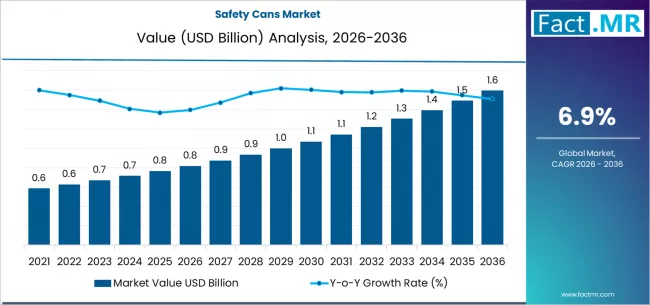
Safety cans market is projected to grow from USD 0.8 billion in 2026 to USD 1.6 billion by 2036, at a CAGR of 6.9%. Industrial & lab safety will dominate with a 42.8% market share, while flame-arrestor safety cans will lead the can type segment with a 47.5% share.
Safety Cans Market Forecast and Outlook 2026 to 2036
The global market for safety cans is projected to total USD 0.82 billion in 2026, reaching USD 1.60 billion by 2036, advancing at a 6.9% CAGR. This steady growth trajectory is anchored in persistent industrial safety mandates and a broadening scope of applications beyond traditional sectors. Heightened global enforcement of occupational safety standards governing flammable liquid storage and handling creates a consistent replacement and upgrade cycle for industrial equipment.
Key Takeaways from the Safety Cans Market
- Market Value for 2026: USD 0.82 Billion
- Market Value for 2036: USD 1.60 Billion
- Forecast CAGR 2026 to 2036: 6.9%
- Leading End-Use Segment (2026): Industrial & Lab Safety (42.8%)
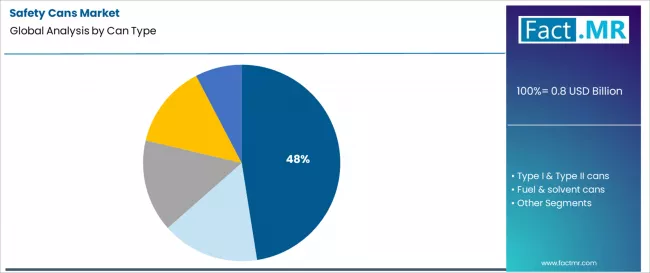
- Leading Can Type Segment (2026): Flame-Arrestor Safety Cans (47.5%)
- Leading Material Segment (2026): Stainless Steel (52.3%)
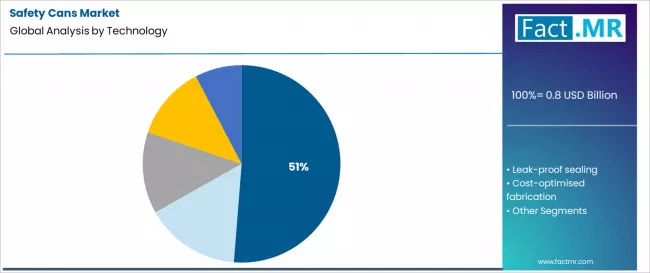
- Leading Technology Segment (2026): Self-Closing Lid & Pressure Relief (51.3%)
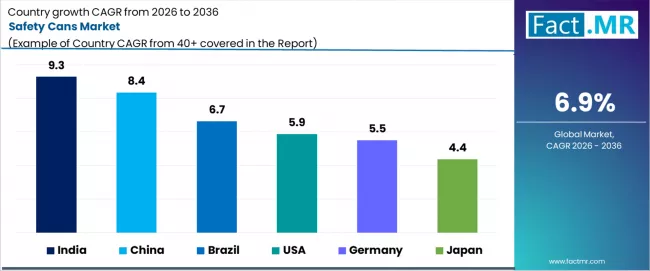
- Key Growth Countries: India (9.3% CAGR), China (8.4% CAGR), Brazil (6.7% CAGR), USA (5.9% CAGR), Germany (5.5% CAGR), Japan (4.4% CAGR)
- Key Players: Justrite Manufacturing Company, L.L.C., Eagle Manufacturing Company, Denios AG, Jiangsu Safety Tech, Nilkamal Limited, TRUSCO Nakayama Co., Ltd.

Expanding chemical manufacturing, coupled with stringent hazardous material protocols in emerging economies, directly fuels demand for certified containment solutions. The evolution of safety cans from basic storage vessels to integrated risk management components supports this growth.
Modern units increasingly incorporate features for spill prevention, pressure management, and compatibility with automated material transfer systems, aligning with broader industrial digitization and safety culture investments.
Progress is linked to regulatory compliance and the economic imperative to mitigate workplace hazards. The financial and reputational costs associated with spills, fires, and regulatory penalties make robust safety infrastructure a non-negotiable capital expenditure for responsible operators across the value chain.
Safety Cans Market
| Metric | Value |
|---|---|
| Market Value (2026) | USD 0.82 Billion |
| Market Forecast Value (2036) | USD 1.60 Billion |
| Forecast CAGR 2026 to 2036 | 6.9% |
Category
| Category | Segments |
|---|---|
| End-Use | Industrial & Lab Safety, Chemical Handling, Manufacturing Plants, Workshops & Labs, Industrial Users, Precision Industries |
| Can Type | Flame-Arrestor Safety Cans, Type I & Type II Cans, Fuel & Solvent Cans, Small Safety Cans, Others |
| Material | Stainless Steel, Steel, HDPE, Others |
| Technology | Self-Closing Lid & Pressure Relief, Leak-Proof Sealing, Cost-Optimised Fabrication, Manual Safety Features, Others |
| Region | North America, Latin America, Western Europe, Eastern Europe, East Asia, South Asia & Pacific, Middle East & Africa |
Industrial Convergence and Material Innovation
Demand patterns are increasingly influenced by cross-industry trends in automation and material science. The integration of Industrial Internet of Things sensors into safety systems prompts development of smart cans with usage monitoring and compliance logging capabilities.
Advancements in polymer science and metal alloy coatings are enhancing chemical resistance and durability, allowing product differentiation for handling aggressive or high-purity substances. These innovations expand the value proposition of safety cans from passive containers to active components in plant safety and operational efficiency protocols.
Segmental Analysis
By Technology, Which Feature Set is Paramount for Hazard Mitigation?

Self-closing lids coupled with pressure relief mechanisms dominate with a 51.3% share. This configuration addresses the two primary risks in flammable liquid storage: vapor ignition and dangerous pressure build-up from temperature fluctuations.
The self-closing lid automatically seals to contain vapors and prevent spillage, while the pressure relief valve safely vents excess pressure to prevent container rupture. This dual-function technology represents the baseline expectation for critical applications, making it indispensable for compliance with major safety standards like OSHA 29 CFR 1910.106 and NFPA 30.
By End-Use, Which Sector Drives Baseline Demand?

The industrial and lab safety segment commands a leading 42.8% share. This broad category encompasses chemical plants, pharmaceutical R&D laboratories, educational institutions, and general manufacturing facilities.
These environments represent the foundational application for safety cans due to the omnipresent need for safe handling of solvents, fuels, and reagents. Continuous operations, strict audit requirements, and a high frequency of use establish a steady demand for both initial outfitting and regular replacement cycles within this segment.
By Can Type, Which Design Addresses the Most Critical Ignition Risk?

Flame-arrestor safety cans hold a predominant 47.5% share. These cans integrate a mesh or perforated metal cylinder within the fill and/or pour spout. This component acts as a heat sink, preventing an external flame from traveling back into the can's vapor space and causing an explosion.
Given that static discharge or nearby ignition sources pose a constant threat, the flame arrestor is a non-negotiable safety feature for storing and dispensing most flammable liquids, solidifying this can type as the industry standard for high-risk duties.
Which are the Principal Drivers, Restraints, Opportunities, and Trends in the Safety Cans Market?
| Attribute | Impact |
|---|---|
| Driver | Stringent Global Occupational Safety Regulations |
| Worldwide enforcement of standards like NFPA, OSHA, and Seveso III directives mandates certified equipment for flammable liquid handling, creating compliance-driven demand. | |
| Restraint | Proliferation of Low-Cost, Non-Compliant Alternatives |
| The availability of uncertified containers in price-sensitive markets undermines safety standards and hinders adoption of legitimate, tested safety cans. | |
| Opportunity | Integration with Smart Industrial Ecosystems |
| Developing IIoT-enabled safety cans with fill-level sensors, tilt alarms, and usage data logging creates value-added products for modern, data-driven facility management. | |
| Trend | Material Innovation for Specialized Applications |
| Advancements in coated steels and high-performance polymers are enabling safer handling of corrosive, ultrapure, or bio-based fluids, opening new application verticals. |
Analysis of the Safety Cans Market by Key Countries

| Country | CAGR 2026 to 2036 |
|---|---|
| USA | 5.9% |
| Germany | 5.5% |
| China | 8.4% |
| India | 9.3% |
| Brazil | 6.7% |
| Japan | 4.4% |
How do Evolving OSHA Guidelines and Industrial Output Influence Demand in the USA?
A 5.9% CAGR reflects steady demand driven by consistent OSHA enforcement and robust activity in chemical and aerospace sectors. Renewed emphasis on Process Safety Management and hazard communication standards necessitates reliable equipment.
Replacement cycles in established manufacturing and energy facilities, alongside growth in smaller-scale specialty chemical operations, sustain volume. Demand centers on durable, fully compliant flame-arrestor cans and specialized designs for new biofuel and solvent blends.
What defines Germany's Focus on Engineering and Certification Standards?
Germany's 5.5% CAGR is characterized by an unwavering focus on precision engineering and adherence to demanding DIN/EN certifications. Demand originates from high-value chemical and automotive manufacturing where process integrity is critical.
German operators prioritize safety cans with superior materials of construction, often featuring embedded gauges or compatibility with closed-system transfers. The emphasis is on product longevity, full traceability, and integration into broader plant safety systems.
What fuels Expansion within China's Rapid Industrial and Infrastructure Development?
An 8.4% CAGR is propelled by massive-scale industrial expansion and national workplace safety campaigns. The Safe Production initiative prioritizes modernization of safety infrastructure across chemical parks, manufacturing zones, and new energy facilities.
This creates volume demand for standardized, cost-effective safety cans. Simultaneously, growing technical capabilities of domestic producers allow for increased localization of supply, catering to both basic and increasingly sophisticated end-user requirements.
How is India's Formalizing Industrial Sector Catalyzing Growth?
India leads with a 9.3% CAGR, driven by the formalization and scaling of its chemical, pharmaceutical, and automotive industries. New industrial clusters enforce stricter safety protocols, moving away from informal handling practices.
Public sector undertakings and large private firms are standardizing safety equipment procurement. This environment fosters demand for a wide range of products, from entry-level compliant cans for workshops to advanced stainless-steel units for API manufacturing, with a strong sensitivity to lifecycle cost.
Why is Brazil's Growth Linked to Natural Resource and Agricultural Sectors?
A 6.7% CAGR is closely tied to the safe handling needs of the mining, oil & gas, and agribusiness sectors. Enforcement of NR-20 and NR-23 standards for flammable liquids in these high-hazard industries is strengthening.
Modernization efforts at fuel depots, mining sites, and biofuel plants are key demand drivers. Requirements often focus on robust, corrosion-resistant designs suitable for tropical and industrial outdoor environments, with an emphasis on fuel transportation and onsite storage.
What Characterizes Japan's Mature Market for Precision and Longevity?
Japan's 4.4% CAGR represents a replacement market focused on ultra-reliability and precision. Demand stems from electronics, automotive, and high-precision chemical industries where contamination or minute failures are unacceptable.
Japanese manufacturers prioritize safety cans with exceptional build quality, advanced sealing technologies, and features enabling cleanroom compatibility or handling of high-purity solvents. The focus is on premium materials, meticulous manufacturing, and integration into lean, automated workflows.
Competitive Landscape of the Safety Cans Market
The competitive environment features established global safety equipment leaders competing with strong regional manufacturers and low-cost producers. Incumbents like Justrite and Eagle leverage decades of brand trust, extensive certification portfolios, and deep understanding of international safety codes. Their strategy involves offering comprehensive product lines and emphasizing durability and guaranteed compliance.
Regional players such as Denios in Europe and Nilkamal in Asia compete through strong local distribution, responsiveness to regional standards, and cost-optimized manufacturing. Competition increasingly hinges on value-added services like onsite safety audits, training, and the ability to provide customized solutions for unusual chemicals or specific process integrations. The competitive frontier is extending into digital offerings, such as equipment management software and smart sensor integrations, transforming providers into holistic safety partners.
Key Players in the Safety Cans Market
- Justrite Manufacturing Company, L.L.C.
- Eagle Manufacturing Company
- Denios AG
- Jiangsu Safety Tech
- Nilkamal Limited
- TRUSCO Nakayama Co., Ltd.
Scope of Report
| Items | Metrics |
|---|---|
| Quantitative Units | USD Billion |
| Technology | Self-Closing Lid & Pressure Relief, Leak-Proof Sealing, Cost-Optimised Fabrication, Manual Safety Features, Others |
| Can Type | Flame-Arrestor Safety Cans, Type I & Type II Cans, Fuel & Solvent Cans, Small Safety Cans, Others |
| End-Use | Industrial & Lab Safety, Chemical Handling, Manufacturing Plants, Workshops & Labs, Industrial Users, Precision Industries |
| Material | Stainless Steel, Steel, HDPE, Others |
| Key Countries | India, China, USA, Brazil, Germany, Japan |
| Key Companies | Justrite, Eagle, Denios, Jiangsu Safety Tech, Nilkamal, TRUSCO Nakayama, Others |
| Additional Analysis | Comparative analysis of total cost of ownership (standard vs. premium cans); impact of material choice on chemical compatibility and lifespan; study of procurement patterns in formal vs. informal sectors; analysis of insurance and liability influences on product specification; review of recycling and end-of-life considerations for metal and plastic safety containers. |
Market by Segments
-
End-Use :
- Industrial & Lab Safety
- Chemical Handling
- Manufacturing Plants
- Workshops & Labs
- Industrial Users
- Precision Industries
-
Can Type :
- Flame-Arrestor Safety Cans
- Type I & Type II Cans
- Fuel & Solvent Cans
- Small Safety Cans
- Others
-
Material :
- Stainless Steel
- Steel
- HDPE
- Others
-
Region :
- North America
- USA
- Canada
- Latin America
- Brazil
- Mexico
- Argentina
- Rest of Latin America
- Western Europe
- Germany
- France
- Italy
- Spain
- UK
- BENELUX
- Rest of Western Europe
- Eastern Europe
- Russia
- Poland
- Czech Republic
- Rest of Eastern Europe
- East Asia
- China
- Japan
- South Korea
- Rest of East Asia
- South Asia & Pacific
- India
- ASEAN
- Australia
- Rest of South Asia & Pacific
- MEA
- GCC Countries
- South Africa
- Turkiye
- Rest of MEA
- North America
References
- International Labour Organization. (2024). Safety and health in the use of chemicals at work. ILO Code of Practice.
- National Fire Protection Association. (2025). NFPA 30: Flammable and Combustible Liquids Code. NFPA.
- Occupational Safety and Health Administration. (2024). 29 CFR 1910.106: Flammable liquids. U.S. Department of Labor.
- Schmidt, M., & Mayer, F. (2023). Advanced Materials for Hazardous Substance Containment. In Handbook of Industrial Safety Engineering (2nd ed.). Springer.
- United Nations Industrial Development Organization. (2024). Industrial Safety and Risk Management in Emerging Economies: Trends and Case Studies. UNIDO Research Paper.
- Zhang, L., & Volkov, A. (2025). "Trends in Smart Containment and IIoT for Industrial Safety." Journal of Loss Prevention in the Process Industries, 78, 104-112.
Table of Content
- Executive Summary
- Global Market Outlook
- Demand to side Trends
- Supply to side Trends
- Technology Roadmap Analysis
- Analysis and Recommendations
- Market Overview
- Market Coverage / Taxonomy
- Market Definition / Scope / Limitations
- Market Background
- Market Dynamics
- Drivers
- Restraints
- Opportunity
- Trends
- Scenario Forecast
- Demand in Optimistic Scenario
- Demand in Likely Scenario
- Demand in Conservative Scenario
- Opportunity Map Analysis
- Product Life Cycle Analysis
- Supply Chain Analysis
- Investment Feasibility Matrix
- Value Chain Analysis
- PESTLE and Porter’s Analysis
- Regulatory Landscape
- Regional Parent Market Outlook
- Production and Consumption Statistics
- Import and Export Statistics
- Market Dynamics
- Global Market Analysis 2021 to 2025 and Forecast, 2026 to 2036
- Historical Market Size Value (USD Million) Analysis, 2021 to 2025
- Current and Future Market Size Value (USD Million) Projections, 2026 to 2036
- Y to o to Y Growth Trend Analysis
- Absolute $ Opportunity Analysis
- Global Market Pricing Analysis 2021 to 2025 and Forecast 2026 to 2036
- Global Market Analysis 2021 to 2025 and Forecast 2026 to 2036, By End-use
- Introduction / Key Findings
- Historical Market Size Value (USD Million) Analysis By End-use, 2021 to 2025
- Current and Future Market Size Value (USD Million) Analysis and Forecast By End-use, 2026 to 2036
- Industrial & lab safety
- Chemical handling
- Manufacturing plants
- Workshops & labs
- Industrial users
- Precision industries
- Industrial & lab safety
- Y to o to Y Growth Trend Analysis By End-use, 2021 to 2025
- Absolute $ Opportunity Analysis By End-use, 2026 to 2036
- Global Market Analysis 2021 to 2025 and Forecast 2026 to 2036, By Can Type
- Introduction / Key Findings
- Historical Market Size Value (USD Million) Analysis By Can Type, 2021 to 2025
- Current and Future Market Size Value (USD Million) Analysis and Forecast By Can Type, 2026 to 2036
- Flame-arrestor safety cans
- Type I & Type II cans
- Fuel & solvent cans
- Small safety cans
- Others
- Flame-arrestor safety cans
- Y to o to Y Growth Trend Analysis By Can Type, 2021 to 2025
- Absolute $ Opportunity Analysis By Can Type, 2026 to 2036
- Global Market Analysis 2021 to 2025 and Forecast 2026 to 2036, By Material
- Introduction / Key Findings
- Historical Market Size Value (USD Million) Analysis By Material, 2021 to 2025
- Current and Future Market Size Value (USD Million) Analysis and Forecast By Material, 2026 to 2036
- Stainless Steel
- Steel
- HDPE
- Others
- Stainless Steel
- Y to o to Y Growth Trend Analysis By Material, 2021 to 2025
- Absolute $ Opportunity Analysis By Material, 2026 to 2036
- Global Market Analysis 2021 to 2025 and Forecast 2026 to 2036, By Technology
- Introduction / Key Findings
- Historical Market Size Value (USD Million) Analysis By Technology, 2021 to 2025
- Current and Future Market Size Value (USD Million) Analysis and Forecast By Technology, 2026 to 2036
- Self-closing lid & pressure relief
- Leak-proof sealing
- Cost-optimised fabrication
- Manual safety features
- Others
- Self-closing lid & pressure relief
- Y to o to Y Growth Trend Analysis By Technology, 2021 to 2025
- Absolute $ Opportunity Analysis By Technology, 2026 to 2036
- Global Market Analysis 2021 to 2025 and Forecast 2026 to 2036, By Region
- Introduction
- Historical Market Size Value (USD Million) Analysis By Region, 2021 to 2025
- Current Market Size Value (USD Million) Analysis and Forecast By Region, 2026 to 2036
- North America
- Latin America
- Western Europe
- Eastern Europe
- East Asia
- South Asia and Pacific
- Middle East & Africa
- Market Attractiveness Analysis By Region
- North America Market Analysis 2021 to 2025 and Forecast 2026 to 2036, By Country
- Historical Market Size Value (USD Million) Trend Analysis By Market Taxonomy, 2021 to 2025
- Market Size Value (USD Million) Forecast By Market Taxonomy, 2026 to 2036
- By Country
- USA
- Canada
- Mexico
- By End-use
- By Can Type
- By Material
- By Technology
- By Country
- Market Attractiveness Analysis
- By Country
- By End-use
- By Can Type
- By Material
- By Technology
- Key Takeaways
- Latin America Market Analysis 2021 to 2025 and Forecast 2026 to 2036, By Country
- Historical Market Size Value (USD Million) Trend Analysis By Market Taxonomy, 2021 to 2025
- Market Size Value (USD Million) Forecast By Market Taxonomy, 2026 to 2036
- By Country
- Brazil
- Chile
- Rest of Latin America
- By End-use
- By Can Type
- By Material
- By Technology
- By Country
- Market Attractiveness Analysis
- By Country
- By End-use
- By Can Type
- By Material
- By Technology
- Key Takeaways
- Western Europe Market Analysis 2021 to 2025 and Forecast 2026 to 2036, By Country
- Historical Market Size Value (USD Million) Trend Analysis By Market Taxonomy, 2021 to 2025
- Market Size Value (USD Million) Forecast By Market Taxonomy, 2026 to 2036
- By Country
- Germany
- UK
- Italy
- Spain
- France
- Nordic
- BENELUX
- Rest of Western Europe
- By End-use
- By Can Type
- By Material
- By Technology
- By Country
- Market Attractiveness Analysis
- By Country
- By End-use
- By Can Type
- By Material
- By Technology
- Key Takeaways
- Eastern Europe Market Analysis 2021 to 2025 and Forecast 2026 to 2036, By Country
- Historical Market Size Value (USD Million) Trend Analysis By Market Taxonomy, 2021 to 2025
- Market Size Value (USD Million) Forecast By Market Taxonomy, 2026 to 2036
- By Country
- Russia
- Poland
- Hungary
- Balkan & Baltic
- Rest of Eastern Europe
- By End-use
- By Can Type
- By Material
- By Technology
- By Country
- Market Attractiveness Analysis
- By Country
- By End-use
- By Can Type
- By Material
- By Technology
- Key Takeaways
- East Asia Market Analysis 2021 to 2025 and Forecast 2026 to 2036, By Country
- Historical Market Size Value (USD Million) Trend Analysis By Market Taxonomy, 2021 to 2025
- Market Size Value (USD Million) Forecast By Market Taxonomy, 2026 to 2036
- By Country
- China
- Japan
- South Korea
- By End-use
- By Can Type
- By Material
- By Technology
- By Country
- Market Attractiveness Analysis
- By Country
- By End-use
- By Can Type
- By Material
- By Technology
- Key Takeaways
- South Asia and Pacific Market Analysis 2021 to 2025 and Forecast 2026 to 2036, By Country
- Historical Market Size Value (USD Million) Trend Analysis By Market Taxonomy, 2021 to 2025
- Market Size Value (USD Million) Forecast By Market Taxonomy, 2026 to 2036
- By Country
- India
- ASEAN
- Australia & New Zealand
- Rest of South Asia and Pacific
- By End-use
- By Can Type
- By Material
- By Technology
- By Country
- Market Attractiveness Analysis
- By Country
- By End-use
- By Can Type
- By Material
- By Technology
- Key Takeaways
- Middle East & Africa Market Analysis 2021 to 2025 and Forecast 2026 to 2036, By Country
- Historical Market Size Value (USD Million) Trend Analysis By Market Taxonomy, 2021 to 2025
- Market Size Value (USD Million) Forecast By Market Taxonomy, 2026 to 2036
- By Country
- Kingdom of Saudi Arabia
- Other GCC Countries
- Turkiye
- South Africa
- Other African Union
- Rest of Middle East & Africa
- By End-use
- By Can Type
- By Material
- By Technology
- By Country
- Market Attractiveness Analysis
- By Country
- By End-use
- By Can Type
- By Material
- By Technology
- Key Takeaways
- Key Countries Market Analysis
- USA
- Pricing Analysis
- Market Share Analysis, 2025
- By End-use
- By Can Type
- By Material
- By Technology
- Canada
- Pricing Analysis
- Market Share Analysis, 2025
- By End-use
- By Can Type
- By Material
- By Technology
- Mexico
- Pricing Analysis
- Market Share Analysis, 2025
- By End-use
- By Can Type
- By Material
- By Technology
- Brazil
- Pricing Analysis
- Market Share Analysis, 2025
- By End-use
- By Can Type
- By Material
- By Technology
- Chile
- Pricing Analysis
- Market Share Analysis, 2025
- By End-use
- By Can Type
- By Material
- By Technology
- Germany
- Pricing Analysis
- Market Share Analysis, 2025
- By End-use
- By Can Type
- By Material
- By Technology
- UK
- Pricing Analysis
- Market Share Analysis, 2025
- By End-use
- By Can Type
- By Material
- By Technology
- Italy
- Pricing Analysis
- Market Share Analysis, 2025
- By End-use
- By Can Type
- By Material
- By Technology
- Spain
- Pricing Analysis
- Market Share Analysis, 2025
- By End-use
- By Can Type
- By Material
- By Technology
- France
- Pricing Analysis
- Market Share Analysis, 2025
- By End-use
- By Can Type
- By Material
- By Technology
- India
- Pricing Analysis
- Market Share Analysis, 2025
- By End-use
- By Can Type
- By Material
- By Technology
- ASEAN
- Pricing Analysis
- Market Share Analysis, 2025
- By End-use
- By Can Type
- By Material
- By Technology
- Australia & New Zealand
- Pricing Analysis
- Market Share Analysis, 2025
- By End-use
- By Can Type
- By Material
- By Technology
- China
- Pricing Analysis
- Market Share Analysis, 2025
- By End-use
- By Can Type
- By Material
- By Technology
- Japan
- Pricing Analysis
- Market Share Analysis, 2025
- By End-use
- By Can Type
- By Material
- By Technology
- South Korea
- Pricing Analysis
- Market Share Analysis, 2025
- By End-use
- By Can Type
- By Material
- By Technology
- Russia
- Pricing Analysis
- Market Share Analysis, 2025
- By End-use
- By Can Type
- By Material
- By Technology
- Poland
- Pricing Analysis
- Market Share Analysis, 2025
- By End-use
- By Can Type
- By Material
- By Technology
- Hungary
- Pricing Analysis
- Market Share Analysis, 2025
- By End-use
- By Can Type
- By Material
- By Technology
- Kingdom of Saudi Arabia
- Pricing Analysis
- Market Share Analysis, 2025
- By End-use
- By Can Type
- By Material
- By Technology
- Turkiye
- Pricing Analysis
- Market Share Analysis, 2025
- By End-use
- By Can Type
- By Material
- By Technology
- South Africa
- Pricing Analysis
- Market Share Analysis, 2025
- By End-use
- By Can Type
- By Material
- By Technology
- USA
- Market Structure Analysis
- Competition Dashboard
- Competition Benchmarking
- Market Share Analysis of Top Players
- By Regional
- By End-use
- By Can Type
- By Material
- By Technology
- Competition Analysis
- Competition Deep Dive
- Justrite Manufacturing Company, L.L.C.
- Overview
- Product Portfolio
- Profitability by Market Segments (Product/Age /Sales Channel/Region)
- Sales Footprint
- Strategy Overview
- Marketing Strategy
- Product Strategy
- Channel Strategy
- Eagle Manufacturing Company
- Denios AG
- Jiangsu Safety Tech
- Nilkamal Limited
- TRUSCO Nakayama Co., Ltd.
- Justrite Manufacturing Company, L.L.C.
- Competition Deep Dive
- Assumptions & Acronyms Used
- Research Methodology
List Of Table
- Table 1: Global Market Value (USD Million) Forecast by Region, 2021 to 2036
- Table 2: Global Market Value (USD Million) Forecast by End-use, 2021 to 2036
- Table 3: Global Market Value (USD Million) Forecast by Can Type, 2021 to 2036
- Table 4: Global Market Value (USD Million) Forecast by Material, 2021 to 2036
- Table 5: Global Market Value (USD Million) Forecast by Technology, 2021 to 2036
- Table 6: North America Market Value (USD Million) Forecast by Country, 2021 to 2036
- Table 7: North America Market Value (USD Million) Forecast by End-use, 2021 to 2036
- Table 8: North America Market Value (USD Million) Forecast by Can Type, 2021 to 2036
- Table 9: North America Market Value (USD Million) Forecast by Material, 2021 to 2036
- Table 10: North America Market Value (USD Million) Forecast by Technology, 2021 to 2036
- Table 11: Latin America Market Value (USD Million) Forecast by Country, 2021 to 2036
- Table 12: Latin America Market Value (USD Million) Forecast by End-use, 2021 to 2036
- Table 13: Latin America Market Value (USD Million) Forecast by Can Type, 2021 to 2036
- Table 14: Latin America Market Value (USD Million) Forecast by Material, 2021 to 2036
- Table 15: Latin America Market Value (USD Million) Forecast by Technology, 2021 to 2036
- Table 16: Western Europe Market Value (USD Million) Forecast by Country, 2021 to 2036
- Table 17: Western Europe Market Value (USD Million) Forecast by End-use, 2021 to 2036
- Table 18: Western Europe Market Value (USD Million) Forecast by Can Type, 2021 to 2036
- Table 19: Western Europe Market Value (USD Million) Forecast by Material, 2021 to 2036
- Table 20: Western Europe Market Value (USD Million) Forecast by Technology, 2021 to 2036
- Table 21: Eastern Europe Market Value (USD Million) Forecast by Country, 2021 to 2036
- Table 22: Eastern Europe Market Value (USD Million) Forecast by End-use, 2021 to 2036
- Table 23: Eastern Europe Market Value (USD Million) Forecast by Can Type, 2021 to 2036
- Table 24: Eastern Europe Market Value (USD Million) Forecast by Material, 2021 to 2036
- Table 25: Eastern Europe Market Value (USD Million) Forecast by Technology, 2021 to 2036
- Table 26: East Asia Market Value (USD Million) Forecast by Country, 2021 to 2036
- Table 27: East Asia Market Value (USD Million) Forecast by End-use, 2021 to 2036
- Table 28: East Asia Market Value (USD Million) Forecast by Can Type, 2021 to 2036
- Table 29: East Asia Market Value (USD Million) Forecast by Material, 2021 to 2036
- Table 30: East Asia Market Value (USD Million) Forecast by Technology, 2021 to 2036
- Table 31: South Asia and Pacific Market Value (USD Million) Forecast by Country, 2021 to 2036
- Table 32: South Asia and Pacific Market Value (USD Million) Forecast by End-use, 2021 to 2036
- Table 33: South Asia and Pacific Market Value (USD Million) Forecast by Can Type, 2021 to 2036
- Table 34: South Asia and Pacific Market Value (USD Million) Forecast by Material, 2021 to 2036
- Table 35: South Asia and Pacific Market Value (USD Million) Forecast by Technology, 2021 to 2036
- Table 36: Middle East & Africa Market Value (USD Million) Forecast by Country, 2021 to 2036
- Table 37: Middle East & Africa Market Value (USD Million) Forecast by End-use, 2021 to 2036
- Table 38: Middle East & Africa Market Value (USD Million) Forecast by Can Type, 2021 to 2036
- Table 39: Middle East & Africa Market Value (USD Million) Forecast by Material, 2021 to 2036
- Table 40: Middle East & Africa Market Value (USD Million) Forecast by Technology, 2021 to 2036
List Of Figures
- Figure 1: Global Market Pricing Analysis
- Figure 2: Global Market Value (USD Million) Forecast 2021 to 2036
- Figure 3: Global Market Value Share and BPS Analysis by End-use, 2026 and 2036
- Figure 4: Global Market Y to o to Y Growth Comparison by End-use, 2026 to 2036
- Figure 5: Global Market Attractiveness Analysis by End-use
- Figure 6: Global Market Value Share and BPS Analysis by Can Type, 2026 and 2036
- Figure 7: Global Market Y to o to Y Growth Comparison by Can Type, 2026 to 2036
- Figure 8: Global Market Attractiveness Analysis by Can Type
- Figure 9: Global Market Value Share and BPS Analysis by Material, 2026 and 2036
- Figure 10: Global Market Y to o to Y Growth Comparison by Material, 2026 to 2036
- Figure 11: Global Market Attractiveness Analysis by Material
- Figure 12: Global Market Value Share and BPS Analysis by Technology, 2026 and 2036
- Figure 13: Global Market Y to o to Y Growth Comparison by Technology, 2026 to 2036
- Figure 14: Global Market Attractiveness Analysis by Technology
- Figure 15: Global Market Value (USD Million) Share and BPS Analysis by Region, 2026 and 2036
- Figure 16: Global Market Y to o to Y Growth Comparison by Region, 2026 to 2036
- Figure 17: Global Market Attractiveness Analysis by Region
- Figure 18: North America Market Incremental Dollar Opportunity, 2026 to 2036
- Figure 19: Latin America Market Incremental Dollar Opportunity, 2026 to 2036
- Figure 20: Western Europe Market Incremental Dollar Opportunity, 2026 to 2036
- Figure 21: Eastern Europe Market Incremental Dollar Opportunity, 2026 to 2036
- Figure 22: East Asia Market Incremental Dollar Opportunity, 2026 to 2036
- Figure 23: South Asia and Pacific Market Incremental Dollar Opportunity, 2026 to 2036
- Figure 24: Middle East & Africa Market Incremental Dollar Opportunity, 2026 to 2036
- Figure 25: North America Market Value Share and BPS Analysis by Country, 2026 and 2036
- Figure 26: North America Market Value Share and BPS Analysis by End-use, 2026 and 2036
- Figure 27: North America Market Y to o to Y Growth Comparison by End-use, 2026 to 2036
- Figure 28: North America Market Attractiveness Analysis by End-use
- Figure 29: North America Market Value Share and BPS Analysis by Can Type, 2026 and 2036
- Figure 30: North America Market Y to o to Y Growth Comparison by Can Type, 2026 to 2036
- Figure 31: North America Market Attractiveness Analysis by Can Type
- Figure 32: North America Market Value Share and BPS Analysis by Material, 2026 and 2036
- Figure 33: North America Market Y to o to Y Growth Comparison by Material, 2026 to 2036
- Figure 34: North America Market Attractiveness Analysis by Material
- Figure 35: North America Market Value Share and BPS Analysis by Technology, 2026 and 2036
- Figure 36: North America Market Y to o to Y Growth Comparison by Technology, 2026 to 2036
- Figure 37: North America Market Attractiveness Analysis by Technology
- Figure 38: Latin America Market Value Share and BPS Analysis by Country, 2026 and 2036
- Figure 39: Latin America Market Value Share and BPS Analysis by End-use, 2026 and 2036
- Figure 40: Latin America Market Y to o to Y Growth Comparison by End-use, 2026 to 2036
- Figure 41: Latin America Market Attractiveness Analysis by End-use
- Figure 42: Latin America Market Value Share and BPS Analysis by Can Type, 2026 and 2036
- Figure 43: Latin America Market Y to o to Y Growth Comparison by Can Type, 2026 to 2036
- Figure 44: Latin America Market Attractiveness Analysis by Can Type
- Figure 45: Latin America Market Value Share and BPS Analysis by Material, 2026 and 2036
- Figure 46: Latin America Market Y to o to Y Growth Comparison by Material, 2026 to 2036
- Figure 47: Latin America Market Attractiveness Analysis by Material
- Figure 48: Latin America Market Value Share and BPS Analysis by Technology, 2026 and 2036
- Figure 49: Latin America Market Y to o to Y Growth Comparison by Technology, 2026 to 2036
- Figure 50: Latin America Market Attractiveness Analysis by Technology
- Figure 51: Western Europe Market Value Share and BPS Analysis by Country, 2026 and 2036
- Figure 52: Western Europe Market Value Share and BPS Analysis by End-use, 2026 and 2036
- Figure 53: Western Europe Market Y to o to Y Growth Comparison by End-use, 2026 to 2036
- Figure 54: Western Europe Market Attractiveness Analysis by End-use
- Figure 55: Western Europe Market Value Share and BPS Analysis by Can Type, 2026 and 2036
- Figure 56: Western Europe Market Y to o to Y Growth Comparison by Can Type, 2026 to 2036
- Figure 57: Western Europe Market Attractiveness Analysis by Can Type
- Figure 58: Western Europe Market Value Share and BPS Analysis by Material, 2026 and 2036
- Figure 59: Western Europe Market Y to o to Y Growth Comparison by Material, 2026 to 2036
- Figure 60: Western Europe Market Attractiveness Analysis by Material
- Figure 61: Western Europe Market Value Share and BPS Analysis by Technology, 2026 and 2036
- Figure 62: Western Europe Market Y to o to Y Growth Comparison by Technology, 2026 to 2036
- Figure 63: Western Europe Market Attractiveness Analysis by Technology
- Figure 64: Eastern Europe Market Value Share and BPS Analysis by Country, 2026 and 2036
- Figure 65: Eastern Europe Market Value Share and BPS Analysis by End-use, 2026 and 2036
- Figure 66: Eastern Europe Market Y to o to Y Growth Comparison by End-use, 2026 to 2036
- Figure 67: Eastern Europe Market Attractiveness Analysis by End-use
- Figure 68: Eastern Europe Market Value Share and BPS Analysis by Can Type, 2026 and 2036
- Figure 69: Eastern Europe Market Y to o to Y Growth Comparison by Can Type, 2026 to 2036
- Figure 70: Eastern Europe Market Attractiveness Analysis by Can Type
- Figure 71: Eastern Europe Market Value Share and BPS Analysis by Material, 2026 and 2036
- Figure 72: Eastern Europe Market Y to o to Y Growth Comparison by Material, 2026 to 2036
- Figure 73: Eastern Europe Market Attractiveness Analysis by Material
- Figure 74: Eastern Europe Market Value Share and BPS Analysis by Technology, 2026 and 2036
- Figure 75: Eastern Europe Market Y to o to Y Growth Comparison by Technology, 2026 to 2036
- Figure 76: Eastern Europe Market Attractiveness Analysis by Technology
- Figure 77: East Asia Market Value Share and BPS Analysis by Country, 2026 and 2036
- Figure 78: East Asia Market Value Share and BPS Analysis by End-use, 2026 and 2036
- Figure 79: East Asia Market Y to o to Y Growth Comparison by End-use, 2026 to 2036
- Figure 80: East Asia Market Attractiveness Analysis by End-use
- Figure 81: East Asia Market Value Share and BPS Analysis by Can Type, 2026 and 2036
- Figure 82: East Asia Market Y to o to Y Growth Comparison by Can Type, 2026 to 2036
- Figure 83: East Asia Market Attractiveness Analysis by Can Type
- Figure 84: East Asia Market Value Share and BPS Analysis by Material, 2026 and 2036
- Figure 85: East Asia Market Y to o to Y Growth Comparison by Material, 2026 to 2036
- Figure 86: East Asia Market Attractiveness Analysis by Material
- Figure 87: East Asia Market Value Share and BPS Analysis by Technology, 2026 and 2036
- Figure 88: East Asia Market Y to o to Y Growth Comparison by Technology, 2026 to 2036
- Figure 89: East Asia Market Attractiveness Analysis by Technology
- Figure 90: South Asia and Pacific Market Value Share and BPS Analysis by Country, 2026 and 2036
- Figure 91: South Asia and Pacific Market Value Share and BPS Analysis by End-use, 2026 and 2036
- Figure 92: South Asia and Pacific Market Y to o to Y Growth Comparison by End-use, 2026 to 2036
- Figure 93: South Asia and Pacific Market Attractiveness Analysis by End-use
- Figure 94: South Asia and Pacific Market Value Share and BPS Analysis by Can Type, 2026 and 2036
- Figure 95: South Asia and Pacific Market Y to o to Y Growth Comparison by Can Type, 2026 to 2036
- Figure 96: South Asia and Pacific Market Attractiveness Analysis by Can Type
- Figure 97: South Asia and Pacific Market Value Share and BPS Analysis by Material, 2026 and 2036
- Figure 98: South Asia and Pacific Market Y to o to Y Growth Comparison by Material, 2026 to 2036
- Figure 99: South Asia and Pacific Market Attractiveness Analysis by Material
- Figure 100: South Asia and Pacific Market Value Share and BPS Analysis by Technology, 2026 and 2036
- Figure 101: South Asia and Pacific Market Y to o to Y Growth Comparison by Technology, 2026 to 2036
- Figure 102: South Asia and Pacific Market Attractiveness Analysis by Technology
- Figure 103: Middle East & Africa Market Value Share and BPS Analysis by Country, 2026 and 2036
- Figure 104: Middle East & Africa Market Value Share and BPS Analysis by End-use, 2026 and 2036
- Figure 105: Middle East & Africa Market Y to o to Y Growth Comparison by End-use, 2026 to 2036
- Figure 106: Middle East & Africa Market Attractiveness Analysis by End-use
- Figure 107: Middle East & Africa Market Value Share and BPS Analysis by Can Type, 2026 and 2036
- Figure 108: Middle East & Africa Market Y to o to Y Growth Comparison by Can Type, 2026 to 2036
- Figure 109: Middle East & Africa Market Attractiveness Analysis by Can Type
- Figure 110: Middle East & Africa Market Value Share and BPS Analysis by Material, 2026 and 2036
- Figure 111: Middle East & Africa Market Y to o to Y Growth Comparison by Material, 2026 to 2036
- Figure 112: Middle East & Africa Market Attractiveness Analysis by Material
- Figure 113: Middle East & Africa Market Value Share and BPS Analysis by Technology, 2026 and 2036
- Figure 114: Middle East & Africa Market Y to o to Y Growth Comparison by Technology, 2026 to 2036
- Figure 115: Middle East & Africa Market Attractiveness Analysis by Technology
- Figure 116: Global Market - Tier Structure Analysis
- Figure 117: Global Market - Company Share Analysis
- FAQs -
How big is the safety cans market in 2026?
The global safety cans market is estimated to be valued at USD 0.8 billion in 2026.
What will be the size of safety cans market in 2036?
The market size for the safety cans market is projected to reach USD 1.6 billion by 2036.
How much will be the safety cans market growth between 2026 and 2036?
The safety cans market is expected to grow at a 6.9% CAGR between 2026 and 2036.
What are the key product types in the safety cans market?
The key product types in safety cans market are industrial & lab safety, chemical handling, manufacturing plants, workshops & labs, industrial users and precision industries.
Which can type segment to contribute significant share in the safety cans market in 2026?
In terms of can type, flame-arrestor safety cans segment to command 47.5% share in the safety cans market in 2026.