Environmentally Safe Release Agents for Molding and Casting Market
Environmentally Safe Release Agents for Molding and Casting Market Size and Share Forecast Outlook 2026 to 2036
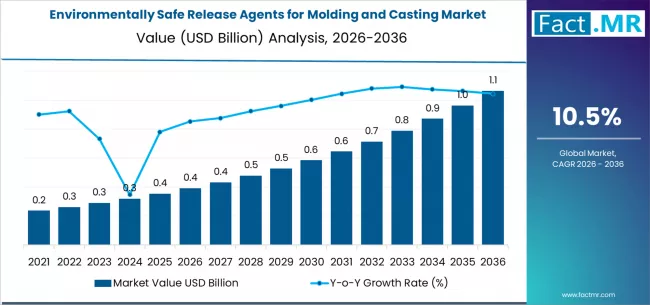
Environmentally safe release agents for molding and casting market is projected to grow from USD 0.4 billion in 2026 to USD 1.1 billion by 2036, at a CAGR of 10.5%. Vegetable-oil & ester-based biodegradable release agents will dominate with a 34.0% market share, while plastic injection molding (automotive & electronics) will lead the end-use segment with a 36.0% share.
Environmentally Safe Release Agents for Molding and Casting Market Forecast and Outlook 2026 to 2036
The global environmentally safe release agents for molding and casting market is projected to reach USD 1.06 billion by 2036. The market is valued at USD 0.39 billion in 2026 and is set to rise at a CAGR of 10.5% during the assessment period.
By formulation, vegetable-oil & ester-based biodegradable release agents hold a leading 34% share. Plastic injection molding (automotive & electronics) represents the dominant end-use at 36%, while release (general purpose) is the primary functional role at 46.0%.
Key Takeaways from the Environmentally Safe Release Agents for Molding and Casting Market
- Market Value for 2026: USD 0.39 Billion
- Market Value for 2036: USD 1.06 Billion
- Forecast CAGR (2026-2036): 10.5%
- Leading Formulation Share (2026): Vegetable-oil & ester-based biodegradable release agents (34%)
- Leading End-Use Application Share (2026): Plastic injection molding (automotive & electronics) (36%)
- Leading Functional Role Share (2026): Release (general purpose) (46.0%)
- Key Players in the Market: Chem-Trend, Henkel AG & Co. KGaA, Dow Inc., Croda International plc., Wacker Chemie AG, Clariant AG, Arkema S.A., The Freudenberg Group
Defining trends involve the development of proprietary multi-component eco-blend packs that combine release, lubricity, and tool protection. Innovation is focused on creating high-performance, silicone-free and fluorochemical-free systems that maintain excellent part surface quality. Integration of these advanced formulations into automated, precision-application systems is becoming a key competitive strategy.
Stringent global regulations on VOC emissions, worker safety, and waste disposal in manufacturing drive market growth. The demand for cleaner production processes, reduced mold maintenance, and the ability to recycle or compost production waste without contaminant release act as significant catalysts, creating sustained demand for high-performance, sustainable release solutions.
Environmentally Safe Release Agents for Molding and Casting Market
| Metric | Value |
|---|---|
| Market Value (2026) | USD 0.39 Billion |
| Market Forecast Value (2036) | USD 1.06 Billion |
| Forecast CAGR (2026-2036) | 10.5% |
Category
| Category | Segments |
|---|---|
| Formulation | Vegetable-oil & ester-based biodegradable release agents, Water-based (emulsion) eco-grades, Silicone-free polymeric release systems, Low-VOC solvent-reduced chemistries, Specialty fluorinated & PTFE-free low-impact systems, Proprietary vendor eco-blend packs (additives + carriers) |
| End-Use | Plastic injection molding (automotive & electronics), Die casting (aluminum & magnesium), Rubber & elastomer molding (seals, tyres), Composite moulding (SMC&BMC, RTM), Thermoforming & sheet processes, Other specialty casting & tooling |
| Functional Role | Release (general purpose), De-moulding & part finish enhancers (high-finish), Anti-sticking & lubricant-compatible grades, Corrosion & die protection additives (eco variants), Food-contact & NSF-approved grades (biodegradable) |
| Region | North America, Latin America, Western Europe, Eastern Europe, East Asia, South Asia & Pacific, MEA |
Segmental Analysis
By Formulation, Which Chemistry Provides a Balance of Performance and Sustainability?
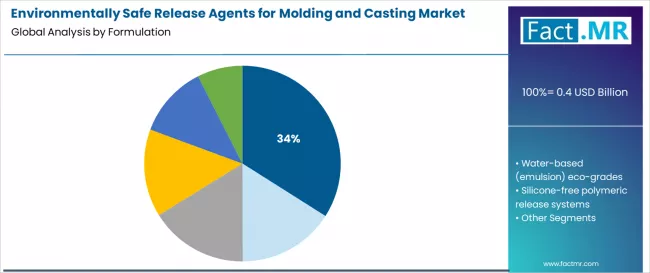
Vegetable-oil & ester-based biodegradable release agents lead the segment with a 34% share. This dominance is due to their excellent release performance, inherent lubricity, and compliance with stringent biodegradability and low-VOC criteria. They serve as effective, drop-in replacements for petroleum-based oils and solvents, directly addressing environmental regulations and end-user sustainability targets without sacrificing core functionality.
By End-Use, Which Application Demands the Highest Volume for High-Volume Production?
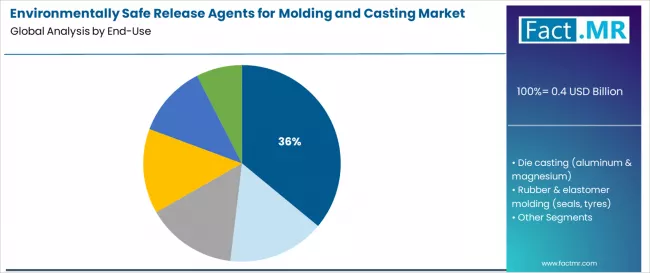
Plastic injection molding (automotive & electronics) commands the largest end-use share at 36%. This sector's high-cycle-time production, extreme pressure to eliminate defects, and stringent requirements for pristine part surfaces drive significant demand. The shift towards engineering bioplastics and the need for release agents that do not interfere with subsequent painting or bonding processes make this a critical market for advanced, compatible eco-formulations.
By Functional Role, Which Attribute is the Universal Baseline Requirement?
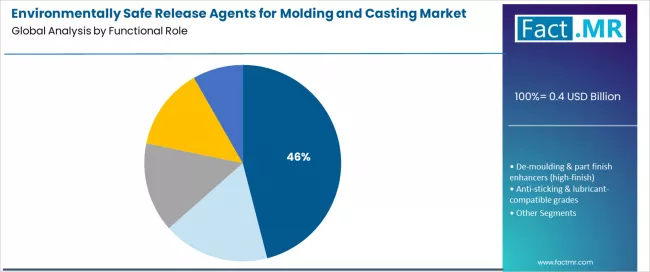
Release (general purpose) represents the leading functional role at 46.0%. This is the fundamental, non-negotiable performance requirement for any release agent—ensuring clean and consistent separation of the molded part from the tool. Eco-friendly formulations must first achieve parity in this core function with traditional agents before additional benefits like enhanced finish or tool protection drive adoption, making it the primary performance benchmark.
What are the Drivers, Restraints, and Key Trends of the Environmentally Safe Release Agents for Molding and Casting Market?
Globally harmonizing regulations on VOC emissions in manufacturing facilities drive market growth. The expansion of lightweight composite and aluminum die-casting in automotive and aerospace increases demand for compatible, non-contaminating release systems. Growing consumer brand pressure for sustainable manufacturing and the rise of bioplastics necessitate compatible, eco-friendly mold release chemistries.
A significant restraint is the higher per-unit cost of advanced biodegradable or synthetic base stocks compared to conventional mineral oil and solvent systems. Performance validation in niche, high-temperature, or highly detailed molding applications can be slower. Concerns about the shelf stability and in-tank longevity of some water-based or bio-based emulsions require robust formulation technology.
Key trends include the development of multi-functional agents that combine release, internal lubricity, and mold corrosion inhibition. There is a strong focus on creating "dry" or low-transfer release systems that minimize residue for downstream processes like bonding and painting. The market is seeing a shift towards concentrate formats and automated dispensing systems to reduce waste and ensure precise, repeatable application.
Analysis of the Environmentally Safe Release Agents for Molding and Casting Market by Key Countries
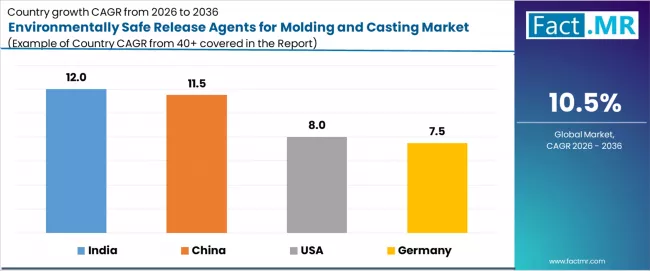
| Country | CAGR (2026-2036) |
|---|---|
| India | 12.00% |
| China | 11.50% |
| Germany | 7.50% |
| USA | 8.00% |
How does India's Manufacturing Boom and Regulatory Shift Drive Exceptional Growth?
India leads with a 12.00% CAGR, driven by the explosive growth of its automotive, consumer electronics, and general plastics manufacturing sectors. New environmental compliance requirements, coupled with the rapid adoption of modern, automated production lines, are accelerating the replacement of traditional oils and solvents with high-performance, water-based or bio-based release agents to improve working conditions and product quality.
Why is China's Massive Manufacturing Base and Green Industrial Policy a Key Driver?
China’s 11.50% growth is fueled by its position as the world's primary manufacturing hub and state-level policies mandating greener production processes. The scale of its plastic injection molding and die-casting industries, under pressure to reduce VOC emissions and industrial waste, creates immense volume demand for cost-effective, reliable, and environmentally compliant release agent solutions.
What Role does Germany's Advanced Engineering and Regulatory Leadership Play?
Germany’s 7.50% growth reflects its leadership in high-precision automotive and engineering sectors, governed by the strictest EU VOC and chemical safety (REACH) regulations. The demand is for premium, technically advanced release systems that ensure flawless part quality in complex molds for lightweight composites and metals, while fully complying with the highest environmental and worker safety standards.
How does the USA's Mature Manufacturing and Regulatory Environment Influence the Market?
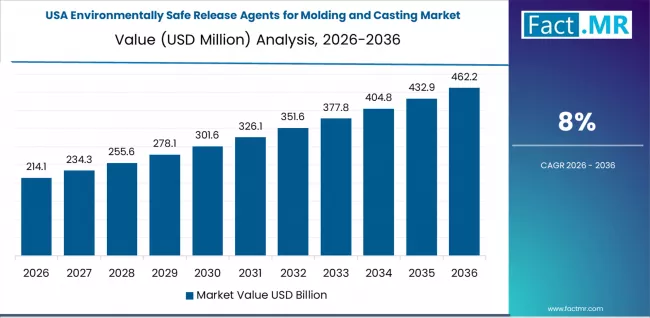
The USA's 8.00% growth is underpinned by stringent EPA and OSHA regulations, a strong automotive sector, and a growing advanced composites industry. Demand is driven by retrofit applications in existing facilities to meet air quality standards and by new, high-value manufacturing lines in aerospace and medical devices that specify clean, contaminant-free release processes from the outset.
Competitive Landscape of the Environmentally Safe Release Agents for Molding and Casting Market
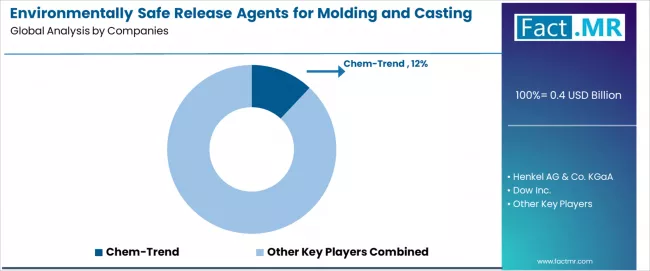
The competitive landscape features global specialty chemical companies and material science leaders. Dedicated release agent and process chemical specialists like Chem-Trend and The Freudenberg Group compete on deep application knowledge, direct technical service for specific molding processes, and tailored formulation capabilities for large OEMs.
Broad-based chemical giants like Henkel, Dow Inc., Clariant AG, and Arkema S.A. leverage their vast polymer and additive portfolios, strong R&D resources, and global supply chains. Specialists in bio-based ingredients like Croda International plc. and silicone/polymer experts like Wacker Chemie AG compete through unique material science. Competition revolves around application expertise, the ability to provide complete technical data packages for compliance, and partnerships in developing new materials and processes.
Key Players in the Environmentally Safe Release Agents for Molding and Casting Market
- Chem-Trend
- Henkel AG & Co. KGaA
- Dow Inc.
- Croda International plc.
- Wacker Chemie AG
- Clariant AG
- Arkema S.A.
- The Freudenberg Group
Scope of Report
| Items | Values |
|---|---|
| Quantitative Units | USD Billion |
| Formulation | Vegetable-oil & ester-based biodegradable release agents, Water-based (emulsion) eco-grades, Silicone-free polymeric release systems, Low-VOC solvent-reduced chemistries, Specialty fluorinated & PTFE-free low-impact systems, Proprietary vendor eco-blend packs (additives + carriers) |
| End-Use | Plastic injection molding (automotive & electronics), Die casting (aluminum & magnesium), Rubber & elastomer molding (seals, tyres), Composite moulding (SMC&BMC, RTM), Thermoforming & sheet processes, Other specialty casting & tooling |
| Functional Role | Release (general purpose), De-moulding & part finish enhancers (high-finish), Anti-sticking & lubricant-compatible grades, Corrosion & die protection additives (eco variants), Food-contact & NSF-approved grades (biodegradable) |
| Key Countries | India, China, Germany, USA |
| Key Companies | Chem-Trend, Henkel AG & Co. KGaA, Dow Inc., Croda International plc., Wacker Chemie AG, Clariant AG, Arkema S.A., The Freudenberg Group |
| Additional Analysis | Analysis of application efficiency and transfer rates, compatibility testing with new polymer & composite matrices, total cost-in-use models including waste & cleaning reduction, competitive assessment versus solvent-based & silicone systems, and analysis of automated dispensing system integration. |
Environmentally Safe Release Agents for Molding and Casting Market by Segments
-
Formulation :
- Vegetable-oil & ester-based biodegradable release agents
- Water-based (emulsion) eco-grades
- Silicone-free polymeric release systems
- Low-VOC solvent-reduced chemistries
- Specialty fluorinated & PTFE-free low-impact systems
- Proprietary vendor eco-blend packs (additives + carriers)
-
End-Use :
- Plastic injection molding (automotive & electronics)
- Die casting (aluminum & magnesium)
- Rubber & elastomer molding (seals, tyres)
- Composite moulding (SMC&BMC, RTM)
- Thermoforming & sheet processes
- Other specialty casting & tooling
-
Functional Role :
- Release (general purpose)
- De-moulding & part finish enhancers (high-finish)
- Anti-sticking & lubricant-compatible grades
- Corrosion & die protection additives (eco variants)
- Food-contact & NSF-approved grades (biodegradable)
-
Region :
-
North America
- USA
- Canada
-
Latin America
- Brazil
- Mexico
- Argentina
- Rest of Latin America
-
Western Europe
- Germany
- UK
- France
- Spain
- Italy
- BENELUX
- Rest of Western Europe
-
Eastern Europe
- Russia
- Poland
- Czech Republic
- Rest of Eastern Europe
-
East Asia
- China
- Japan
- South Korea
- Rest of East Asia
-
South Asia & Pacific
- India
- ASEAN
- Australia
- Rest of South Asia & Pacific
-
MEA
- Saudi Arabia
- UAE
- Turkiye
- Rest of MEA
-
Table of Content
- Executive Summary
- Global Market Outlook
- Demand to side Trends
- Supply to side Trends
- Technology Roadmap Analysis
- Analysis and Recommendations
- Market Overview
- Market Coverage / Taxonomy
- Market Definition / Scope / Limitations
- Market Background
- Market Dynamics
- Drivers
- Restraints
- Opportunity
- Trends
- Scenario Forecast
- Demand in Optimistic Scenario
- Demand in Likely Scenario
- Demand in Conservative Scenario
- Opportunity Map Analysis
- Product Life Cycle Analysis
- Supply Chain Analysis
- Investment Feasibility Matrix
- Value Chain Analysis
- PESTLE and Porter’s Analysis
- Regulatory Landscape
- Regional Parent Market Outlook
- Production and Consumption Statistics
- Import and Export Statistics
- Market Dynamics
- Global Market Analysis 2021 to 2025 and Forecast, 2026 to 2036
- Historical Market Size Value (USD Million) Analysis, 2021 to 2025
- Current and Future Market Size Value (USD Million) Projections, 2026 to 2036
- Y to o to Y Growth Trend Analysis
- Absolute $ Opportunity Analysis
- Global Market Pricing Analysis 2021 to 2025 and Forecast 2026 to 2036
- Global Market Analysis 2021 to 2025 and Forecast 2026 to 2036, By Formulation
- Introduction / Key Findings
- Historical Market Size Value (USD Million) Analysis By Formulation, 2021 to 2025
- Current and Future Market Size Value (USD Million) Analysis and Forecast By Formulation, 2026 to 2036
- Vegetable-oil & ester-based biodegradable release agents
- Water-based (emulsion) eco-grades
- Silicone-free polymeric release systems
- Low-VOC solvent-reduced chemistries
- Specialty fluorinated & PTFE-free low-impact systems
- Proprietary vendor eco-blend packs (additives + carriers)
- Vegetable-oil & ester-based biodegradable release agents
- Y to o to Y Growth Trend Analysis By Formulation, 2021 to 2025
- Absolute $ Opportunity Analysis By Formulation, 2026 to 2036
- Global Market Analysis 2021 to 2025 and Forecast 2026 to 2036, By End-Use
- Introduction / Key Findings
- Historical Market Size Value (USD Million) Analysis By End-Use, 2021 to 2025
- Current and Future Market Size Value (USD Million) Analysis and Forecast By End-Use, 2026 to 2036
- Plastic injection molding (automotive & electronics)
- Die casting (aluminum & magnesium)
- Rubber & elastomer molding (seals, tyres)
- Composite moulding (SMC&BMC, RTM)
- Thermoforming & sheet processes
- Other specialty casting & tooling
- Plastic injection molding (automotive & electronics)
- Y to o to Y Growth Trend Analysis By End-Use, 2021 to 2025
- Absolute $ Opportunity Analysis By End-Use, 2026 to 2036
- Global Market Analysis 2021 to 2025 and Forecast 2026 to 2036, By Functional Role
- Introduction / Key Findings
- Historical Market Size Value (USD Million) Analysis By Functional Role, 2021 to 2025
- Current and Future Market Size Value (USD Million) Analysis and Forecast By Functional Role, 2026 to 2036
- Release (general purpose)
- De-moulding & part finish enhancers (high-finish)
- Anti-sticking & lubricant-compatible grades
- Corrosion & die protection additives (eco variants)
- Food-contact & NSF-approved grades (biodegradable)
- Release (general purpose)
- Y to o to Y Growth Trend Analysis By Functional Role, 2021 to 2025
- Absolute $ Opportunity Analysis By Functional Role, 2026 to 2036
- Global Market Analysis 2021 to 2025 and Forecast 2026 to 2036, By Region
- Introduction
- Historical Market Size Value (USD Million) Analysis By Region, 2021 to 2025
- Current Market Size Value (USD Million) Analysis and Forecast By Region, 2026 to 2036
- North America
- Latin America
- Western Europe
- Eastern Europe
- East Asia
- South Asia and Pacific
- Middle East & Africa
- Market Attractiveness Analysis By Region
- North America Market Analysis 2021 to 2025 and Forecast 2026 to 2036, By Country
- Historical Market Size Value (USD Million) Trend Analysis By Market Taxonomy, 2021 to 2025
- Market Size Value (USD Million) Forecast By Market Taxonomy, 2026 to 2036
- By Country
- USA
- Canada
- Mexico
- By Formulation
- By End-Use
- By Functional Role
- By Country
- Market Attractiveness Analysis
- By Country
- By Formulation
- By End-Use
- By Functional Role
- Key Takeaways
- Latin America Market Analysis 2021 to 2025 and Forecast 2026 to 2036, By Country
- Historical Market Size Value (USD Million) Trend Analysis By Market Taxonomy, 2021 to 2025
- Market Size Value (USD Million) Forecast By Market Taxonomy, 2026 to 2036
- By Country
- Brazil
- Chile
- Rest of Latin America
- By Formulation
- By End-Use
- By Functional Role
- By Country
- Market Attractiveness Analysis
- By Country
- By Formulation
- By End-Use
- By Functional Role
- Key Takeaways
- Western Europe Market Analysis 2021 to 2025 and Forecast 2026 to 2036, By Country
- Historical Market Size Value (USD Million) Trend Analysis By Market Taxonomy, 2021 to 2025
- Market Size Value (USD Million) Forecast By Market Taxonomy, 2026 to 2036
- By Country
- Germany
- UK
- Italy
- Spain
- France
- Nordic
- BENELUX
- Rest of Western Europe
- By Formulation
- By End-Use
- By Functional Role
- By Country
- Market Attractiveness Analysis
- By Country
- By Formulation
- By End-Use
- By Functional Role
- Key Takeaways
- Eastern Europe Market Analysis 2021 to 2025 and Forecast 2026 to 2036, By Country
- Historical Market Size Value (USD Million) Trend Analysis By Market Taxonomy, 2021 to 2025
- Market Size Value (USD Million) Forecast By Market Taxonomy, 2026 to 2036
- By Country
- Russia
- Poland
- Hungary
- Balkan & Baltic
- Rest of Eastern Europe
- By Formulation
- By End-Use
- By Functional Role
- By Country
- Market Attractiveness Analysis
- By Country
- By Formulation
- By End-Use
- By Functional Role
- Key Takeaways
- East Asia Market Analysis 2021 to 2025 and Forecast 2026 to 2036, By Country
- Historical Market Size Value (USD Million) Trend Analysis By Market Taxonomy, 2021 to 2025
- Market Size Value (USD Million) Forecast By Market Taxonomy, 2026 to 2036
- By Country
- China
- Japan
- South Korea
- By Formulation
- By End-Use
- By Functional Role
- By Country
- Market Attractiveness Analysis
- By Country
- By Formulation
- By End-Use
- By Functional Role
- Key Takeaways
- South Asia and Pacific Market Analysis 2021 to 2025 and Forecast 2026 to 2036, By Country
- Historical Market Size Value (USD Million) Trend Analysis By Market Taxonomy, 2021 to 2025
- Market Size Value (USD Million) Forecast By Market Taxonomy, 2026 to 2036
- By Country
- India
- ASEAN
- Australia & New Zealand
- Rest of South Asia and Pacific
- By Formulation
- By End-Use
- By Functional Role
- By Country
- Market Attractiveness Analysis
- By Country
- By Formulation
- By End-Use
- By Functional Role
- Key Takeaways
- Middle East & Africa Market Analysis 2021 to 2025 and Forecast 2026 to 2036, By Country
- Historical Market Size Value (USD Million) Trend Analysis By Market Taxonomy, 2021 to 2025
- Market Size Value (USD Million) Forecast By Market Taxonomy, 2026 to 2036
- By Country
- Kingdom of Saudi Arabia
- Other GCC Countries
- Turkiye
- South Africa
- Other African Union
- Rest of Middle East & Africa
- By Formulation
- By End-Use
- By Functional Role
- By Country
- Market Attractiveness Analysis
- By Country
- By Formulation
- By End-Use
- By Functional Role
- Key Takeaways
- Key Countries Market Analysis
- USA
- Pricing Analysis
- Market Share Analysis, 2025
- By Formulation
- By End-Use
- By Functional Role
- Canada
- Pricing Analysis
- Market Share Analysis, 2025
- By Formulation
- By End-Use
- By Functional Role
- Mexico
- Pricing Analysis
- Market Share Analysis, 2025
- By Formulation
- By End-Use
- By Functional Role
- Brazil
- Pricing Analysis
- Market Share Analysis, 2025
- By Formulation
- By End-Use
- By Functional Role
- Chile
- Pricing Analysis
- Market Share Analysis, 2025
- By Formulation
- By End-Use
- By Functional Role
- Germany
- Pricing Analysis
- Market Share Analysis, 2025
- By Formulation
- By End-Use
- By Functional Role
- UK
- Pricing Analysis
- Market Share Analysis, 2025
- By Formulation
- By End-Use
- By Functional Role
- Italy
- Pricing Analysis
- Market Share Analysis, 2025
- By Formulation
- By End-Use
- By Functional Role
- Spain
- Pricing Analysis
- Market Share Analysis, 2025
- By Formulation
- By End-Use
- By Functional Role
- France
- Pricing Analysis
- Market Share Analysis, 2025
- By Formulation
- By End-Use
- By Functional Role
- India
- Pricing Analysis
- Market Share Analysis, 2025
- By Formulation
- By End-Use
- By Functional Role
- ASEAN
- Pricing Analysis
- Market Share Analysis, 2025
- By Formulation
- By End-Use
- By Functional Role
- Australia & New Zealand
- Pricing Analysis
- Market Share Analysis, 2025
- By Formulation
- By End-Use
- By Functional Role
- China
- Pricing Analysis
- Market Share Analysis, 2025
- By Formulation
- By End-Use
- By Functional Role
- Japan
- Pricing Analysis
- Market Share Analysis, 2025
- By Formulation
- By End-Use
- By Functional Role
- South Korea
- Pricing Analysis
- Market Share Analysis, 2025
- By Formulation
- By End-Use
- By Functional Role
- Russia
- Pricing Analysis
- Market Share Analysis, 2025
- By Formulation
- By End-Use
- By Functional Role
- Poland
- Pricing Analysis
- Market Share Analysis, 2025
- By Formulation
- By End-Use
- By Functional Role
- Hungary
- Pricing Analysis
- Market Share Analysis, 2025
- By Formulation
- By End-Use
- By Functional Role
- Kingdom of Saudi Arabia
- Pricing Analysis
- Market Share Analysis, 2025
- By Formulation
- By End-Use
- By Functional Role
- Turkiye
- Pricing Analysis
- Market Share Analysis, 2025
- By Formulation
- By End-Use
- By Functional Role
- South Africa
- Pricing Analysis
- Market Share Analysis, 2025
- By Formulation
- By End-Use
- By Functional Role
- USA
- Market Structure Analysis
- Competition Dashboard
- Competition Benchmarking
- Market Share Analysis of Top Players
- By Regional
- By Formulation
- By End-Use
- By Functional Role
- Competition Analysis
- Competition Deep Dive
- Chem-Trend
- Overview
- Product Portfolio
- Profitability by Market Segments (Product/Age /Sales Channel/Region)
- Sales Footprint
- Strategy Overview
- Marketing Strategy
- Product Strategy
- Channel Strategy
- Henkel AG & Co. KGaA
- Dow Inc.
- Croda Internationa plc.
- Wacker Chemie AG
- Clariant AG
- Arkema S.A.
- The Freudenberg Group
- Chem-Trend
- Competition Deep Dive
- Assumptions & Acronyms Used
- Research Methodology
List Of Table
- Table 1: Global Market Value (USD Million) Forecast by Region, 2021 to 2036
- Table 2: Global Market Value (USD Million) Forecast by Formulation, 2021 to 2036
- Table 3: Global Market Value (USD Million) Forecast by End-Use, 2021 to 2036
- Table 4: Global Market Value (USD Million) Forecast by Functional Role, 2021 to 2036
- Table 5: North America Market Value (USD Million) Forecast by Country, 2021 to 2036
- Table 6: North America Market Value (USD Million) Forecast by Formulation, 2021 to 2036
- Table 7: North America Market Value (USD Million) Forecast by End-Use, 2021 to 2036
- Table 8: North America Market Value (USD Million) Forecast by Functional Role, 2021 to 2036
- Table 9: Latin America Market Value (USD Million) Forecast by Country, 2021 to 2036
- Table 10: Latin America Market Value (USD Million) Forecast by Formulation, 2021 to 2036
- Table 11: Latin America Market Value (USD Million) Forecast by End-Use, 2021 to 2036
- Table 12: Latin America Market Value (USD Million) Forecast by Functional Role, 2021 to 2036
- Table 13: Western Europe Market Value (USD Million) Forecast by Country, 2021 to 2036
- Table 14: Western Europe Market Value (USD Million) Forecast by Formulation, 2021 to 2036
- Table 15: Western Europe Market Value (USD Million) Forecast by End-Use, 2021 to 2036
- Table 16: Western Europe Market Value (USD Million) Forecast by Functional Role, 2021 to 2036
- Table 17: Eastern Europe Market Value (USD Million) Forecast by Country, 2021 to 2036
- Table 18: Eastern Europe Market Value (USD Million) Forecast by Formulation, 2021 to 2036
- Table 19: Eastern Europe Market Value (USD Million) Forecast by End-Use, 2021 to 2036
- Table 20: Eastern Europe Market Value (USD Million) Forecast by Functional Role, 2021 to 2036
- Table 21: East Asia Market Value (USD Million) Forecast by Country, 2021 to 2036
- Table 22: East Asia Market Value (USD Million) Forecast by Formulation, 2021 to 2036
- Table 23: East Asia Market Value (USD Million) Forecast by End-Use, 2021 to 2036
- Table 24: East Asia Market Value (USD Million) Forecast by Functional Role, 2021 to 2036
- Table 25: South Asia and Pacific Market Value (USD Million) Forecast by Country, 2021 to 2036
- Table 26: South Asia and Pacific Market Value (USD Million) Forecast by Formulation, 2021 to 2036
- Table 27: South Asia and Pacific Market Value (USD Million) Forecast by End-Use, 2021 to 2036
- Table 28: South Asia and Pacific Market Value (USD Million) Forecast by Functional Role, 2021 to 2036
- Table 29: Middle East & Africa Market Value (USD Million) Forecast by Country, 2021 to 2036
- Table 30: Middle East & Africa Market Value (USD Million) Forecast by Formulation, 2021 to 2036
- Table 31: Middle East & Africa Market Value (USD Million) Forecast by End-Use, 2021 to 2036
- Table 32: Middle East & Africa Market Value (USD Million) Forecast by Functional Role, 2021 to 2036
List Of Figures
- Figure 1: Global Market Pricing Analysis
- Figure 2: Global Market Value (USD Million) Forecast 2021 to 2036
- Figure 3: Global Market Value Share and BPS Analysis by Formulation, 2026 and 2036
- Figure 4: Global Market Y to o to Y Growth Comparison by Formulation, 2026 to 2036
- Figure 5: Global Market Attractiveness Analysis by Formulation
- Figure 6: Global Market Value Share and BPS Analysis by End-Use, 2026 and 2036
- Figure 7: Global Market Y to o to Y Growth Comparison by End-Use, 2026 to 2036
- Figure 8: Global Market Attractiveness Analysis by End-Use
- Figure 9: Global Market Value Share and BPS Analysis by Functional Role, 2026 and 2036
- Figure 10: Global Market Y to o to Y Growth Comparison by Functional Role, 2026 to 2036
- Figure 11: Global Market Attractiveness Analysis by Functional Role
- Figure 12: Global Market Value (USD Million) Share and BPS Analysis by Region, 2026 and 2036
- Figure 13: Global Market Y to o to Y Growth Comparison by Region, 2026 to 2036
- Figure 14: Global Market Attractiveness Analysis by Region
- Figure 15: North America Market Incremental Dollar Opportunity, 2026 to 2036
- Figure 16: Latin America Market Incremental Dollar Opportunity, 2026 to 2036
- Figure 17: Western Europe Market Incremental Dollar Opportunity, 2026 to 2036
- Figure 18: Eastern Europe Market Incremental Dollar Opportunity, 2026 to 2036
- Figure 19: East Asia Market Incremental Dollar Opportunity, 2026 to 2036
- Figure 20: South Asia and Pacific Market Incremental Dollar Opportunity, 2026 to 2036
- Figure 21: Middle East & Africa Market Incremental Dollar Opportunity, 2026 to 2036
- Figure 22: North America Market Value Share and BPS Analysis by Country, 2026 and 2036
- Figure 23: North America Market Value Share and BPS Analysis by Formulation, 2026 and 2036
- Figure 24: North America Market Y to o to Y Growth Comparison by Formulation, 2026 to 2036
- Figure 25: North America Market Attractiveness Analysis by Formulation
- Figure 26: North America Market Value Share and BPS Analysis by End-Use, 2026 and 2036
- Figure 27: North America Market Y to o to Y Growth Comparison by End-Use, 2026 to 2036
- Figure 28: North America Market Attractiveness Analysis by End-Use
- Figure 29: North America Market Value Share and BPS Analysis by Functional Role, 2026 and 2036
- Figure 30: North America Market Y to o to Y Growth Comparison by Functional Role, 2026 to 2036
- Figure 31: North America Market Attractiveness Analysis by Functional Role
- Figure 32: Latin America Market Value Share and BPS Analysis by Country, 2026 and 2036
- Figure 33: Latin America Market Value Share and BPS Analysis by Formulation, 2026 and 2036
- Figure 34: Latin America Market Y to o to Y Growth Comparison by Formulation, 2026 to 2036
- Figure 35: Latin America Market Attractiveness Analysis by Formulation
- Figure 36: Latin America Market Value Share and BPS Analysis by End-Use, 2026 and 2036
- Figure 37: Latin America Market Y to o to Y Growth Comparison by End-Use, 2026 to 2036
- Figure 38: Latin America Market Attractiveness Analysis by End-Use
- Figure 39: Latin America Market Value Share and BPS Analysis by Functional Role, 2026 and 2036
- Figure 40: Latin America Market Y to o to Y Growth Comparison by Functional Role, 2026 to 2036
- Figure 41: Latin America Market Attractiveness Analysis by Functional Role
- Figure 42: Western Europe Market Value Share and BPS Analysis by Country, 2026 and 2036
- Figure 43: Western Europe Market Value Share and BPS Analysis by Formulation, 2026 and 2036
- Figure 44: Western Europe Market Y to o to Y Growth Comparison by Formulation, 2026 to 2036
- Figure 45: Western Europe Market Attractiveness Analysis by Formulation
- Figure 46: Western Europe Market Value Share and BPS Analysis by End-Use, 2026 and 2036
- Figure 47: Western Europe Market Y to o to Y Growth Comparison by End-Use, 2026 to 2036
- Figure 48: Western Europe Market Attractiveness Analysis by End-Use
- Figure 49: Western Europe Market Value Share and BPS Analysis by Functional Role, 2026 and 2036
- Figure 50: Western Europe Market Y to o to Y Growth Comparison by Functional Role, 2026 to 2036
- Figure 51: Western Europe Market Attractiveness Analysis by Functional Role
- Figure 52: Eastern Europe Market Value Share and BPS Analysis by Country, 2026 and 2036
- Figure 53: Eastern Europe Market Value Share and BPS Analysis by Formulation, 2026 and 2036
- Figure 54: Eastern Europe Market Y to o to Y Growth Comparison by Formulation, 2026 to 2036
- Figure 55: Eastern Europe Market Attractiveness Analysis by Formulation
- Figure 56: Eastern Europe Market Value Share and BPS Analysis by End-Use, 2026 and 2036
- Figure 57: Eastern Europe Market Y to o to Y Growth Comparison by End-Use, 2026 to 2036
- Figure 58: Eastern Europe Market Attractiveness Analysis by End-Use
- Figure 59: Eastern Europe Market Value Share and BPS Analysis by Functional Role, 2026 and 2036
- Figure 60: Eastern Europe Market Y to o to Y Growth Comparison by Functional Role, 2026 to 2036
- Figure 61: Eastern Europe Market Attractiveness Analysis by Functional Role
- Figure 62: East Asia Market Value Share and BPS Analysis by Country, 2026 and 2036
- Figure 63: East Asia Market Value Share and BPS Analysis by Formulation, 2026 and 2036
- Figure 64: East Asia Market Y to o to Y Growth Comparison by Formulation, 2026 to 2036
- Figure 65: East Asia Market Attractiveness Analysis by Formulation
- Figure 66: East Asia Market Value Share and BPS Analysis by End-Use, 2026 and 2036
- Figure 67: East Asia Market Y to o to Y Growth Comparison by End-Use, 2026 to 2036
- Figure 68: East Asia Market Attractiveness Analysis by End-Use
- Figure 69: East Asia Market Value Share and BPS Analysis by Functional Role, 2026 and 2036
- Figure 70: East Asia Market Y to o to Y Growth Comparison by Functional Role, 2026 to 2036
- Figure 71: East Asia Market Attractiveness Analysis by Functional Role
- Figure 72: South Asia and Pacific Market Value Share and BPS Analysis by Country, 2026 and 2036
- Figure 73: South Asia and Pacific Market Value Share and BPS Analysis by Formulation, 2026 and 2036
- Figure 74: South Asia and Pacific Market Y to o to Y Growth Comparison by Formulation, 2026 to 2036
- Figure 75: South Asia and Pacific Market Attractiveness Analysis by Formulation
- Figure 76: South Asia and Pacific Market Value Share and BPS Analysis by End-Use, 2026 and 2036
- Figure 77: South Asia and Pacific Market Y to o to Y Growth Comparison by End-Use, 2026 to 2036
- Figure 78: South Asia and Pacific Market Attractiveness Analysis by End-Use
- Figure 79: South Asia and Pacific Market Value Share and BPS Analysis by Functional Role, 2026 and 2036
- Figure 80: South Asia and Pacific Market Y to o to Y Growth Comparison by Functional Role, 2026 to 2036
- Figure 81: South Asia and Pacific Market Attractiveness Analysis by Functional Role
- Figure 82: Middle East & Africa Market Value Share and BPS Analysis by Country, 2026 and 2036
- Figure 83: Middle East & Africa Market Value Share and BPS Analysis by Formulation, 2026 and 2036
- Figure 84: Middle East & Africa Market Y to o to Y Growth Comparison by Formulation, 2026 to 2036
- Figure 85: Middle East & Africa Market Attractiveness Analysis by Formulation
- Figure 86: Middle East & Africa Market Value Share and BPS Analysis by End-Use, 2026 and 2036
- Figure 87: Middle East & Africa Market Y to o to Y Growth Comparison by End-Use, 2026 to 2036
- Figure 88: Middle East & Africa Market Attractiveness Analysis by End-Use
- Figure 89: Middle East & Africa Market Value Share and BPS Analysis by Functional Role, 2026 and 2036
- Figure 90: Middle East & Africa Market Y to o to Y Growth Comparison by Functional Role, 2026 to 2036
- Figure 91: Middle East & Africa Market Attractiveness Analysis by Functional Role
- Figure 92: Global Market - Tier Structure Analysis
- Figure 93: Global Market - Company Share Analysis
- FAQs -
How big is the environmentally safe release agents for molding and casting market in 2026?
The market size for the field test kits chemicals for soil contamination screening market is projected to reach USD 896.6 million by 2036.
What will be the size of environmentally safe release agents for molding and casting market in 2036?
The field test kits chemicals for soil contamination screening market is expected to grow at a 7.6% CAGR between 2026 and 2036.
How much will be the environmentally safe release agents for molding and casting market growth between 2026 and 2036?
The key product types in field test kits chemicals for soil contamination screening market are heavy metals (pb, hg, cd, as) reagents, hydrocarbons & petrochemical residues, pesticides & agrochemical screening reagents, volatile organic compounds (voc) indicators, nutrient overload & salinity indicators, pathogen & microbial atp & rapid tests and specialty analytes (pfas, flame retardants, dyes).
What are the key product types in the environmentally safe release agents for molding and casting market?
In terms of application, environmental site assessments (phase i&ii esa) segment to command 26.0% share in the field test kits chemicals for soil contamination screening market in 2026.
Which end-use segment to contribute significant share in the environmentally safe release agents for molding and casting market in 2026?
The global passive sampler sorbents for emerging pollutants market is estimated to be valued at USD 198.0 million in 2026.