- Base Value(2025): 215.0 Mn
- Estimated Value(2025): 215.0 Mn
- Forecast Value (2035): 308.0 Mn
- CAGR (2025 - 2035): 3.7%
Sales of Agglomeration Machine Industry in Europe 2025-2035
Demand for agglomeration machines in Europe is projected to grow from USD 215.0 million in 2025 to approximately USD 308.0 million by 2035, recording an absolute increase of USD 93.0 million over the forecast period. This translates into total growth of 43.3%, with demand forecast to expand at a compound annual growth rate (CAGR) of 3.7% between 2025 and 2035.
Quick Stats for Agglomeration Machine Industry in Europe
- Agglomeration Machine Industry in Europe Sales Value (2025): USD 215.0 million
- Agglomeration Machine Industry in Europe Forecast Value (2035): USD 308.0 million
- Agglomeration Machine Industry in Europe Forecast CAGR: 3.7%
- Leading Material Type in Agglomeration Machine Industry in Europe Demand: Polymer Films (46.0%)
- Key Growth Countries in Agglomeration Machine Industry in Europe Demand: France, Germany, and UK
- Europe Country Leadership: France holds highest CAGR at 4.3%
- Top Key Players in Agglomeration Machine Industry in Europe Demand: Pallmann, Herbold, MHG, Vecoplan, Lindner
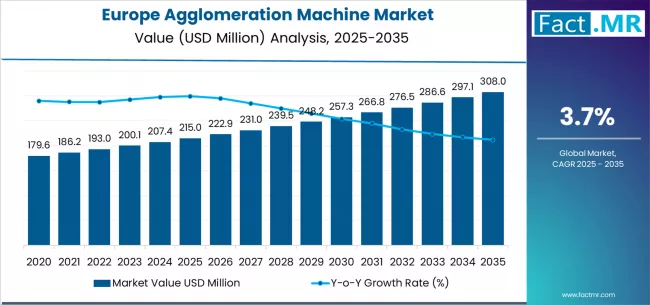
Europe Agglomeration Machine Market Market Value Analysis | Source: Fact.MR
Overall sales are expected to grow by nearly 1.43X during the same period, supported by rising Europe polymer waste recycling initiatives, increasing regulatory requirements for plastic waste reduction, and growing demand for densified recycled materials across recycling plants, industrial re-use, and manufacturing applications. Europe, characterized by stringent environmental regulations and advanced circular economy infrastructure, continues to demonstrate steady growth potential driven by sustainability commitments and waste valorization requirements.
Between 2025 and 2030, sales of agglomeration machines in Europe are projected to expand from USD 215.0 million to USD 265.0 million, resulting in a value increase of USD 50.0 million, which represents 53.8% of the total forecast growth for the decade. This phase of growth will be shaped by rising polymer film recycling operations globally, particularly across Europe where extended producer responsibility schemes and packaging waste directives are accelerating agglomeration equipment adoption. Increasing sophistication of textile waste processing and rubber recycling integration and growing adoption of automated densification solutions continue to drive demand. Equipment manufacturers are expanding their production capabilities to address the growing complexity of modern Europe waste processing operations and material quality requirements, with European recycling operations leading investments in advanced agglomeration and pelletizing technologies.
From 2030 to 2035, demand is forecast to grow from USD 265.0 million to USD 308.0 million, adding another USD 43.0 million, which constitutes 46.2% of the overall ten-year expansion. This period is expected to be characterized by expansion of low-energy agglomeration systems and cold compaction technologies, integration of advanced pelletizer designs and compactor innovations, and development of standardized material processing protocols across different waste streams. The growing adoption of circular economy practices and recycled content mandates, particularly in Europe and global packaging sectors, will drive demand for more sophisticated densification equipment and specialized technical capabilities.
Between 2020 and 2025, Europe agglomeration machine demand experienced steady expansion, driven by increasing Europe polymer film waste generation from packaging and manufacturing operations and growing awareness of landfill diversion benefits and material recovery economics.
The sector developed as recycling operations, especially in Europe, recognized the need for specialized densification equipment and advanced processing technologies to improve material handling efficiency while meeting stringent quality and contamination standards. Equipment providers and recycling facility operators began emphasizing proper equipment selection and process optimization to maximize throughput and output quality.
Agglomeration Machine Industry in Europe Key Takeaways
| Metric | Value |
|---|---|
| Agglomeration Machine Industry in Europe Sales Value (2025) | USD 215.0 million |
| Agglomeration Machine Industry in Europe Forecast Value (2035) | USD 308.0 million |
| Agglomeration Machine Industry in Europe Forecast CAGR (2025-2035) | 3.7% |
Source: Fact.MR analysis. Updated Nov 7, 2025
Why is the Demand for Agglomeration Machines in Europe Growing?
Demand expansion is being supported by the rapid increase in Europe polymer film waste generation worldwide, with Europe maintaining its position as a circular economy and waste management leadership region, and the corresponding need for specialized densification equipment for material volume reduction, transportation efficiency, and recycled content processing activities. Modern polymer recycling operations rely on advanced agglomeration technologies to ensure efficient material handling, moisture removal, and optimal bulk density. Europe agglomeration requires comprehensive equipment solutions including pelletizers, compactors, and pressing systems to maintain material specifications and processing efficiency.
The growing complexity of Europe polymer waste recycling operations and increasing packaging waste regulations, particularly stringent requirements in Europe, are driving demand for advanced agglomeration equipment from certified manufacturers with appropriate engineering expertise and automation capabilities. Recycling facility operators are increasingly investing in high-capacity and energy-efficient densification technologies to improve material quality, meet cleanliness specifications, and enhance operational efficiency in demanding Europe waste processing environments. Environmental requirements and circular economy policies are establishing standardized processing procedures that require specialized capabilities and quality management systems, with European operations often setting benchmark standards for global polymer recycling practices.
Segmental Analysis
Demand is segmented by material, machine type, end use, and country. By material, sales are divided into polymer films, textile waste, and rubber and synthetic materials. Based on machine type, demand is categorized into pelletizers, compactors, and presses. In terms of end use, sales are segmented into recycling plants, industrial re-use, and others. By country, demand is divided into UK, Germany, France, Italy, Spain, and other countries, with France representing a key growth and circular economy hub for Europe agglomeration equipment.
By Material, Polymer Films Segment Accounts for 46.0% Share
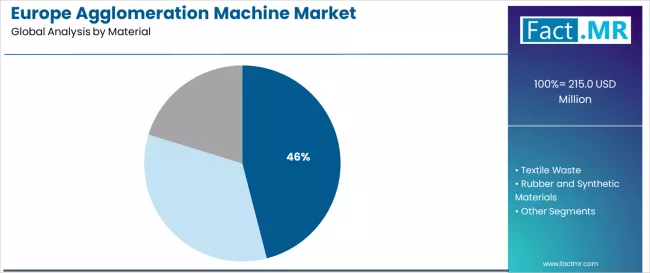
Europe Agglomeration Machine Market Analysis By Material | Source: Fact.MR
Polymer films are projected to account for 46.0% of Europe agglomeration machine demand in 2025, making them the leading material type across the sector. This dominance reflects the substantial waste generation from packaging operations and the essential densification role that agglomeration equipment provides for lightweight film materials where volume reduction and transportation efficiency are critical for economical recycling operations. In Europe, recycling facility operators favor film agglomeration for excellent bulk density improvement, contamination reduction capabilities, and ability to process diverse film types throughout facility operations and material flow.
Continuous innovations are improving the friction heating systems, cooling technologies, and feed designs of agglomeration equipment, enabling recycling operators to maximize processing efficiency while addressing material quality requirements through improved moisture removal and reduced contamination. Additionally, advancements in wear-resistant components and automated control systems are enhancing equipment performance by improving consistency and reducing maintenance intervals. The segment's strong position is reinforced by the rising adoption of post-consumer film recycling solutions and the need for equipment capable of handling multilayer films, which require sophisticated agglomeration technologies.
- Volume reduction and transportation cost savings make polymer film agglomeration indispensable in Europe polymer recycling operations.
- Technological innovation in heating systems is improving efficiency, material quality, and performance across demanding waste processing applications.
By Machine Type, Pelletizers Segment Accounts for 51.0% Share
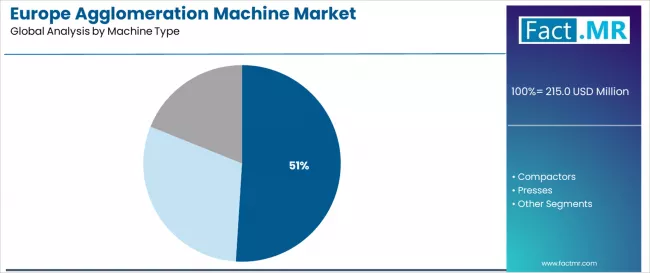
Europe Agglomeration Machine Market Analysis By Machine Type | Source: Fact.MR
Pelletizers are expected to represent 51.0% of Europe agglomeration machine demand in 2025, highlighting their critical role as the dominant equipment category. Pelletizers provide comprehensive densification and material transformation for polymer films and foams where friction heating and mechanical compression are essential for achieving optimal bulk density and material handling characteristics.
Recycling operators, particularly in Europe and global operations, prefer pelletizing systems to maximize material value, improve downstream processing, and meet customer specifications throughout recycling operations and material sales. The machine type allows operators to optimize processing for specific material requirements, whether post-consumer films, industrial scrap, or textile waste.
The segment is also fueled by increasing adoption of advanced pelletizer technologies incorporating variable speed drives, automated feeding systems, and integrated cooling mechanisms. In Europe, leading recycling facilities are investing in high-capacity pelletizers for diverse polymer types and demanding applications to meet packaging industry demands while maintaining processing efficiency. Such strategies not only enhance material quality but also ensure compliance with evolving recycled content specifications and contamination standards.
- Friction heating capability and material transformation make pelletizers the most versatile equipment for comprehensive polymer waste densification.
- European recycling operators are technology leaders, driving specification of advanced pelletizing equipment and automated control systems.
By End Use, Recycling Plants Segment Accounts for 54.0% Share
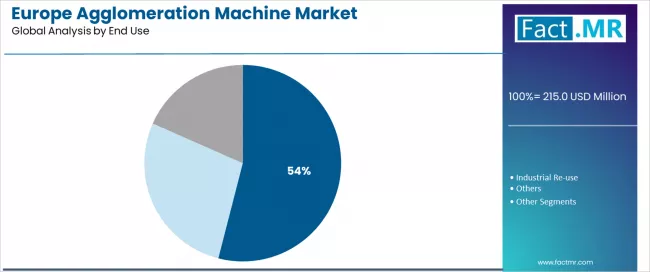
Europe Agglomeration Machine Market Analysis By End Use | Source: Fact.MR
Recycling plants are projected to contribute 54.0% of demand in 2025, making them the single largest end use segment for agglomeration equipment. The recycling plant sector requires sophisticated densification systems with appropriate throughput capacity, material versatility, and quality control to sustain efficient and consistent polymer processing operations. In Europe and global operations, recycling plants remain the primary component of agglomeration equipment utilization, sustaining steady demand even amid growing competition from alternative waste management methods and chemical recycling technologies.
Advanced recycling plant operations rely heavily on integrated agglomeration lines, automated material handling, and quality monitoring capabilities to maintain output specifications. The segment also benefits from circular economy leadership in Europe and ongoing demand from recycling companies requiring high-capacity equipment with proven reliability. In Europe, comprehensive waste management infrastructure and packaging waste directives drive sustained processing volumes and equipment investment in established recycling operations.
- Recycling plants' processing requirements and material diversity make them the largest end use segment for agglomeration equipment.
- Ongoing polymer waste generation and densification needs drive sustained demand despite technological alternatives and processing innovations.
What are the Drivers, Restraints, and Key Trends in the sales of the Agglomeration Machine Industry in Europe?
Europe agglomeration machine demand is advancing steadily due to increasing Europe polymer film waste generation and growing recognition of material densification and transportation efficiency benefits, with Europe serving as a key driver of circular economy innovation and waste valorization standards. However, the sector faces challenges including competition from chemical recycling technologies, energy consumption concerns from friction heating processes, and varying material characteristics across different polymer types and contamination levels. Sustainability initiatives and energy efficiency programs, particularly advanced in European operations, continue to influence equipment specifications and technology selection patterns.
Expansion of Low-Energy Agglomeration Systems and Automation Integration
The growing adoption of energy-efficient drive systems, optimized friction heating, and intelligent control technologies, gaining particular traction in Europe and advanced recycling sectors, is enabling recycling operators to reduce electricity consumption, optimize processing parameters, and improve equipment utilization without increasing labor requirements, offering enhanced cost efficiency and improved environmental performance. Equipment manufacturers equipped with automation expertise offer integrated solutions combining mechanical densification with digital monitoring and predictive maintenance while allowing recycling operators to maximize throughput with minimal energy consumption. These technologies are particularly valuable for high-volume processing facilities and multi-shift operations that require consistent performance without traditional manual intervention or excessive energy cost dependence.
Integration of Cold Compaction Technologies and Alternative Densification Methods
Modern equipment manufacturers, led by European and international innovators, are incorporating mechanical compaction, hydraulic pressing, and cold agglomeration systems that eliminate friction heating, reduce energy requirements, and expand material processing capabilities. Integration of baling technologies, briquetting systems, and extrusion compaction enables more effective material densification and comprehensive processing flexibility achievement. Advanced technologies also support next-generation recycling including contaminated material processing and mixed polymer handling that minimize material rejection, with European waste management and recycling operations increasingly adopting these technologies to meet cost efficiency targets and material quality objectives.
Analysis of Agglomeration Machine Industry in Europe by Key Country
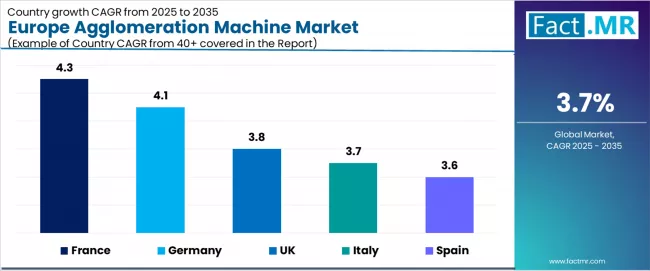
Europe Agglomeration Machine Market Cagr Analysis By Country | Source: Fact.MR
| Country | CAGR (2025-2035) |
|---|---|
| France | 4.3% |
| Germany | 4.1% |
| UK | 3.8% |
| Italy | 3.7% |
| Spain | 3.6% |
Source: Fact.MR analysis. Updated Nov 7, 2025
The Europe agglomeration machine sector is witnessing steady growth, supported by expanding polymer waste generation, regulatory compliance requirements, and the integration of advanced densification technologies across operations. France leads with a 4.3% CAGR, reflecting strong packaging sector concentration, circular economy policy leadership, and adoption of innovative processing solutions. Germany follows with a 4.1% CAGR, driven by established waste management systems and ongoing recycling infrastructure development that enhances equipment utilization. UK and Italy both grow at 3.8%, as recycling operators and waste management companies increasingly adopt advanced densification technologies to improve material handling and operational efficiency.
France Leads Growth with Circular Economy Policy Leadership and Packaging Sector Integration
Demand for agglomeration machines in France is projected to exhibit strong growth with a CAGR of 4.3% through 2035, driven by ongoing Europe waste management operations, expanding circular economy programs and packaging waste regulations, and increasing adoption of advanced polymer recycling technologies. The nation's concentration of packaging manufacturers, recycling facility operators, and regulatory frameworks is creating significant demand for sophisticated densification equipment with enhanced energy efficiency and automation features. Major recycling facility operators and equipment manufacturers are establishing comprehensive processing strategies to support environmental compliance and material recovery excellence across European operations.
- Circular economy policy leadership and packaging waste directives are mandating comprehensive polymer recycling solutions and material densification requirements, driving demand for certified agglomeration equipment with high-capacity processing and energy-efficient systems throughout Europe waste management operations across France.
- Recycling infrastructure modernization programs are supporting adoption of specialized agglomeration equipment and integrated processing lines that accommodate diverse polymer types, enhance material quality, and meet stringent contamination requirements across Europe recycling activities, positioning France as a European polymer recycling leader.
Germany Demonstrates Strong Potential with Environmental Technology Excellence and Manufacturing Integration
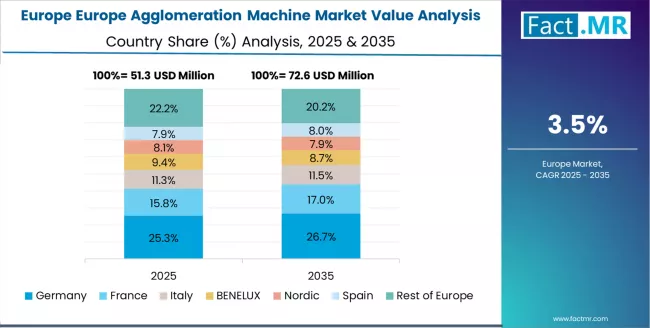
Europe Agglomeration Machine Market Europe Country Market Share Analysis, 2025 & 2035 | Source: Fact.MR
Demand for agglomeration machines in Germany is expanding at a CAGR of 4.1%, supported by extensive Europe waste management operations, established polymer manufacturing presence, and comprehensive environmental compliance infrastructure across regional territories. The country's recycling sector, representing a crucial component of European environmental activities, is increasingly adopting advanced densification technologies including automation systems, energy monitoring equipment, and material quality solutions. Equipment suppliers and facility operators are gradually implementing efficiency enhancement programs to serve expanding Europe polymer recycling activities throughout Germany and broader Europe.
- Environmental technology excellence and manufacturing sector presence are creating opportunities for specialized equipment providers that can support diverse processing requirements and quality expectations including film recycling, industrial polymer waste, and flexible packaging recovery across German and European territories.
- Professional expertise and infrastructure maturity programs are enhancing capabilities among recycling facility operators and waste management companies, enabling comprehensive polymer densification solutions that meet environmental standards and material quality expectations, strengthening Germany's position within European waste management excellence.
UK Maintains Balanced Growth with Recycling Sector Development and Waste Management Infrastructure
Demand for agglomeration machines in UK is growing at a CAGR of 3.8%, driven by established Europe waste management operations, expanding recycling sector capabilities, and regional packaging waste requirements. The country's polymer recycling sector, an integral part of European waste processing operations, is gradually integrating advanced densification technologies to improve material handling and operational efficiency. Recycling facility operators and waste management companies are investing in equipment upgrades and automation systems to address growing processing volumes and align with environmental standards.
- Waste management infrastructure and recycling capabilities are facilitating adoption of versatile agglomeration solutions that support comprehensive Europe polymer waste processing and material densification across processing facilities and established recycling operations, strengthening UK's integration within European circular economy networks.
- Professional training programs are enhancing technical capabilities among facility operators, enabling specialized polymer processing that meets evolving environmental requirements and quality expectations in competitive European recycling operations.
Italy Demonstrates Balanced Growth with Regional Manufacturing and Packaging Sector Integration
Demand for agglomeration machines in Italy is advancing at a CAGR of 3.7%, supported by established Europe manufacturing operations, regional packaging sector presence, and waste management infrastructure development across regional territories. The country's processing requirements reflect manufacturing sector diversity, polymer waste generation patterns, and environmental compliance obligations for domestic operations. Equipment suppliers are establishing technical support and processing capabilities to maintain consistent material quality.
- Regional manufacturing diversity and packaging sector presence are creating demand for agglomeration solutions that can accommodate diverse processing requirements, material specifications, and quality standards across Italian and European territories.
- Regional waste management systems and environmental awareness are supporting agglomeration equipment adoption standards that meet both domestic Italian requirements and European material quality specifications for regional and continental recycling operations.
Spain Shows Steady Growth with Packaging Sector Development and Regional Recycling Infrastructure
Demand for agglomeration machines in Spain is growing at a CAGR of 3.6%, driven by established Europe packaging operations, regional polymer waste generation, and waste management infrastructure development. The country's densification requirements reflect manufacturing presence, packaging consumption patterns, and environmental compliance advancement. Equipment manufacturers are maintaining supply relationships and technical support to ensure consistent processing performance.
- Packaging sector development and regional manufacturing are creating demand for polymer densification equipment that supports material recovery, recycling infrastructure, and processing capabilities throughout Spanish territories.
- Regional environmental regulations and circular economy awareness are supporting agglomeration equipment adoption patterns that meet both domestic Spanish waste management needs and European material quality specifications for regional polymer recycling operations.
Competitive Landscape of Agglomeration Machine Industry in Europe
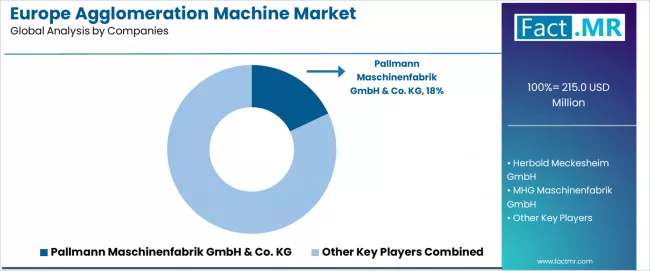
Europe Agglomeration Machine Market Analysis By Company | Source: Fact.MR
Europe agglomeration machine demand is defined by competition among specialized equipment manufacturers, engineering companies, and integrated recycling solution providers, with European and international manufacturers maintaining significant regional and global influence. Manufacturers are investing in advanced pelletizing technologies, energy-efficient systems, processing innovations, and comprehensive technical support networks to deliver reliable, efficient, and high-performance agglomeration solutions across Europe and global operations. Strategic partnerships, processing expertise, and application engineering are central to strengthening product portfolios and presence across Europe and international recycling sectors.
Pallmann, operating globally with European manufacturing presence, offers comprehensive Europe agglomeration solutions including pelletizing equipment, compaction systems, and processing lines with focus on efficiency, innovation, and material quality across European and international operations. The company upgraded agglomeration lines with automation in 2025, demonstrating commitment to operational efficiency and technology advancement. Herbold, serving global customers with European headquarters, provides advanced Europe recycling equipment, densification systems, and technical solutions with emphasis on performance and reliability. The company introduced low-energy twin-screw agglomerators for polymer waste in 2024, strengthening energy-efficient processing capabilities.
MHG delivers specialized agglomeration technologies, processing systems, and material handling solutions serving Europe and global recycling operations. Vecoplan offers comprehensive shredding equipment, agglomeration systems, and processing solutions for Europe polymer recycling and waste management across international territories. Lindner provides advanced size reduction technologies, densification equipment, and automation systems for Europe polymer waste processing operations across European and global recycling sectors.
Agglomeration Machine Industry in Europe Sector – Stakeholder Contribution Framework
Agglomeration machines represent critical recycling infrastructure for material densification, efficient transportation across polymer films, textile waste, rubber materials, and synthetic waste applications. With the sector projected to reach USD 308.0 million by 2035, driven by waste generation growth, circular economy mandates, and sustainability imperatives, the sector stands at the intersection of environmental protection, resource conservation, and economic efficiency. The agglomeration equipment ecosystem spanning pelletizing systems, compaction technologies, pressing equipment, and friction heating solutions requires coordinated action across equipment manufacturers, recycling facility operators, packaging companies, regulatory bodies, waste management organizations, and environmental agencies to unlock its full value potential while addressing the technical complexities of energy-efficient densification and material quality optimization.
How Governments Could Accelerate Circular Economy Development and Waste Reduction
- Extended Producer Responsibility Programs: Establish and enforce comprehensive packaging waste collection requirements mandating producer take-back systems, recycling fees, and material recovery targets that ensure proper waste management while driving adoption of processing infrastructure like agglomeration equipment.
- Recycled Content Mandates: Implement minimum recycled content requirements, progressive targets, and verification systems for packaging products that create consistent demand for recycled materials while supporting recycling facility economics and densification equipment investment.
- Waste Processing Infrastructure Support: Fund facility development, provide capital grants, or incentivize equipment investments through financing programs, tax benefits, or modernization support that improve processing capacity while maintaining environmental standards and operational efficiency.
- Energy Efficiency Incentives: Offer electricity cost support, renewable energy integration subsidies, or technology upgrade incentives for recycling facilities adopting energy-efficient agglomeration systems that reduce operational costs while minimizing environmental impact.
- Packaging Design Requirements: Establish design-for-recycling guidelines, material restriction standards, and recyclability labeling that simplify material processing while improving agglomeration efficiency and recycled material quality.
- Research and Technology Funding: Invest in densification technology research, cold compaction development, and energy optimization systems through innovation grants, university partnerships, or demonstration projects that advance recycling capabilities while improving processing efficiency.
How Industry Bodies Could Strengthen Sector Development
- Processing Standards Development: Define standardized equipment specifications and performance criteria for agglomeration machines across throughput capacity, bulk density achievement, energy consumption, and material quality, enabling objective equipment comparison and driving continuous improvement.
- Material Quality Specifications: Publish comprehensive grade definitions, testing protocols, and application guidelines tailored to specific recycled polymer applications that help end users optimize recycled material utilization.
- Best Practice Guidelines: Establish comprehensive operational guides, maintenance protocols, and safety procedures for agglomeration operations covering equipment operation, material handling, and quality verification that optimize processing efficiency and worker safety.
- Technology Assessment Programs: Organize equipment demonstrations, processing trials, and performance evaluations where manufacturers can showcase innovations and facility operators can evaluate technologies, accelerating adoption of advanced densification solutions.
- Regulatory Intelligence Services: Provide consolidated tracking of evolving packaging regulations, recycled content mandates, and environmental requirements across jurisdictions that inform facility planning decisions and reduce compliance uncertainty for recycling operators.
- Training and Certification Programs: Develop industry-recognized training curricula for equipment operators, facility managers, and maintenance personnel covering safe operation, quality control, and troubleshooting that build technical capabilities and improve processing consistency.
How Equipment Manufacturers Could Capture Value and Drive Innovation
- Energy Efficiency Leadership: Pioneer low-power agglomeration systems, optimized friction heating, and heat recovery technologies that reduce operating costs while maintaining processing capacity, creating differentiated offerings for cost-conscious recycling operators.
- Automation Technology Development: Develop advanced control systems, automated feeding mechanisms, and remote monitoring platforms that reduce labor requirements while improving processing consistency, addressing workforce challenges for efficiency-focused facility operators.
- Material Versatility Solutions: Engineer agglomeration equipment capable of processing diverse polymer types, contamination levels, and material forms with adjustable parameters and flexible configurations that maximize facility utilization.
- Integrated Processing Lines: Offer complete recycling systems combining size reduction, washing, agglomeration, and quality control equipment that simplify facility development while ensuring processing efficiency and material quality for turnkey operations.
- Cold Agglomeration Technologies: Develop mechanical compaction alternatives, hydraulic pressing systems, and extrusion densification that eliminate energy-intensive friction heating while achieving comparable bulk density improvements.
- Technical Support Excellence: Provide comprehensive commissioning services, operator training programs, preventive maintenance planning, and rapid parts availability that minimize downtime while ensuring optimal equipment performance throughout facility lifecycles.
How Recycling Facility Operators Could Optimize Processing Performance
- Comprehensive Material Management: Implement systematic waste collection, sorting protocols, and contamination control that ensure consistent feedstock quality while optimizing agglomeration efficiency and reducing processing issues.
- Equipment Maintenance Programs: Establish preventive maintenance schedules, wear part monitoring, and replacement planning that maximize equipment uptime while controlling maintenance costs and preventing unexpected failures during critical processing periods.
- Quality Control Systems: Deploy systematic sampling protocols, bulk density testing, and contamination monitoring that verify output specifications while identifying processing issues before material shipment to end users.
- Energy Management Strategies: Optimize processing schedules, implement demand management, and utilize variable frequency drives that reduce electricity costs while maintaining production targets in energy-intensive agglomeration operations.
- Output Optimization Planning: Develop processing parameters for different material types, optimize bulk density targets, and establish quality specifications that maximize material value while meeting customer requirements.
- Safety Management Excellence: Implement comprehensive safety protocols, regular training programs, and hazard monitoring systems that protect worker health while maintaining regulatory compliance and reducing liability exposure in processing operations.
How Packaging Companies Could Support Sustainable Material Sourcing
- Recycled Content Commitments: Establish specific targets, implementation timelines, and procurement policies for recycled polymer utilization that create predictable demand while supporting recycling facility viability and circular economy development.
- Material Specification Collaboration: Work with recycling operators to define appropriate quality requirements, contamination tolerances, and acceptance protocols that enable recycled material integration while maintaining product performance.
- Long-Term Supply Agreements: Engage recycling facilities through multi-year contracts, volume commitments, and collaborative quality improvement that ensure consistent material supply while supporting facility investment in processing capabilities.
- Design for Recycling: Simplify packaging structures, eliminate problematic additives, and use mono-material designs that improve recyclability while enhancing agglomeration efficiency and recycled material quality.
- Transparency and Communication: Promote recycled content utilization through product labeling, sustainability reporting, and public communication that builds consumer awareness while demonstrating corporate environmental commitment.
- Pricing Rationality: Recognize appropriate value for recycled materials balancing quality, consistency, and environmental benefits while avoiding excessive discounts that undermine recycling facility economics and discourage infrastructure investment.
How Waste Management Organizations Could Enhance Collection Efficiency
- Integrated Collection Systems: Develop coordinated polymer waste collection programs spanning retail points, manufacturing facilities, and municipal systems that consolidate material flows while reducing collection costs and ensuring consistent supply to recycling facilities.
- Contamination Prevention: Enforce material acceptance standards, provide collection guidance, and implement inspection protocols that maintain feedstock quality while reducing processing costs and improving agglomerated material specifications.
- Storage Infrastructure Development: Establish appropriate waste storage facilities, fire prevention systems, and inventory management that ensure safe material accumulation while enabling efficient processing facility supply.
- Transportation Optimization: Implement route planning, load consolidation, and logistics coordination that minimize transportation costs while maintaining collection frequency and supporting efficient material delivery to recycling facilities.
- Data and Tracking Systems: Deploy waste identification, collection monitoring, and material flow tracking that improve supply chain visibility while supporting regulatory reporting and enabling processing facility planning.
- Stakeholder Coordination: Facilitate communication among waste generators, collection services, recycling facilities, and regulators that optimize collection logistics while reducing system costs and supporting circular economy objectives.
How Technology Providers Could Advance Processing Capabilities
- Sensor and Monitoring Systems: Develop real-time equipment monitoring, energy consumption tracking, and process optimization technologies that improve facility efficiency while reducing operational costs and enabling data-driven decisions.
- Material Handling Automation: Create automated feeding systems, conveying technologies, and intelligent material routing that reduce labor requirements while improving processing consistency and enabling operation in challenging workforce environments.
- Heat Recovery Systems: Engineer waste heat capture, energy recycling technologies, and thermal optimization that reduce net energy consumption while improving overall facility efficiency in friction heating operations.
- Quality Monitoring Technologies: Provide inline bulk density measurement, contamination detection, and automated testing systems that ensure consistent output quality while reducing manual inspection requirements.
- Control System Innovation: Develop intelligent process control, adaptive parameter adjustment, and predictive optimization that maximize throughput while minimizing energy consumption and maintaining material quality.
- Digital Integration Platforms: Create comprehensive facility management software, production tracking systems, and quality monitoring platforms that optimize operations while improving business efficiency and supporting data-driven decision making.
How Investors and Financial Enablers Could Unlock Growth
- Facility Development Financing: Provide project finance, equipment leasing, or capital investment for recycling facility construction, expansion projects, or equipment procurement that improves processing capacity while managing capital requirements for facility operators.
- Technology Development Capital: Back equipment manufacturers developing breakthrough agglomeration systems, energy-efficient technologies, and automation platforms through growth equity or venture investment accepting longer development timelines and commercialization requirements.
- Consolidation and Scale Capital: Finance strategic acquisitions of regional recycling facilities, equipment manufacturers, and collection operators that create operational scale, geographic coverage, and vertical integration attractive to end users and packaging companies.
- Sustainable Infrastructure Investment: Support circular economy facility development, environmental infrastructure projects, and green technology adoption through green bonds or impact investment accepting patient capital for environmental benefits and social returns.
- Working Capital Solutions: Offer inventory financing, equipment financing, and cash flow management specifically structured for recycling facilities managing working capital requirements of waste collection costs and customer payment terms.
- Research Commercialization Support: Finance transition of university research and startup innovations in densification technology, energy-efficient systems, and material processing into commercial operations through seed funding and demonstration project financing.
Key Players in Agglomeration Machine Industry in Europe
- Pallmann Maschinenfabrik GmbH & Co. KG
- Herbold Meckesheim GmbH
- MHG Maschinenfabrik GmbH
- Vecoplan AG
- Lindner-Recyclingtech GmbH
- UNTHA shredding technology GmbH
- CM Shredders
- Andritz AG
- BHS-Sonthofen GmbH
- Granutech-Saturn Systems
Segmentation
Scope of the Report
| Item | Value |
|---|---|
| Quantitative Units | USD 308.0 Million |
| Material | Polymer Films, Textile Waste, Rubber and Synthetic Materials |
| Machine Type | Pelletizers, Compactors, Presses |
| End Use | Recycling Plants, Industrial Re-use, Others |
| Countries Covered | UK, Germany, France, Italy, Spain, Other Countries |
| Key Companies Profiled | Pallmann, Herbold, MHG, Vecoplan, Lindner, Untha, CM Shredders, Andritz, BHS-Sonthofen, Granutech |
| Additional Attributes | Dollar sales by material type, machine type, and end use segment, regional demand trends across key countries, competitive landscape with established European and international manufacturers and processing technology innovators, customer preferences for different throughput capacities and energy efficiency levels, integration with circular economy programs and extended producer responsibility initiatives particularly advancing in Europe, innovations in low-energy processing and automated control systems, and adoption of cold compaction technologies, digital monitoring platforms, and sustainable material densification solutions for enhanced environmental performance and operational efficiency across European and global polymer recycling operations |
Source: Fact.MR analysis. Updated Nov 7, 2025
Agglomeration Machine Industry in Europe by Segments
-
Material :
- Polymer Films
- Textile Waste
- Rubber and Synthetic Materials
-
Machine Type :
- Pelletizers
- Compactors
- Presses
-
End Use :
- Recycling Plants
- Industrial Re-use
- Others
-
Country :
- UK
- Germany
- France
- Italy
- Spain
- Other Countries
Frequently Asked Questions
How big is the europe agglomeration machine market in 2025?
What will be the size of europe agglomeration machine market in 2035?
How much will be the europe agglomeration machine market growth between 2025 and 2035?
What are the key product types in the europe agglomeration machine market?
Which machine type segment to contribute significant share in the europe agglomeration machine market in 2025?
Who worked on this report


Preview the report firsthand - request a free sample
Free SampleGet the brochure for pricing and purchase details
Download PDF