- Base Value(2025): 2361 Mn
- Forecast Value (2035): 4349 Mn
- CAGR (2035): 5.5%
Europe Vacuum Pumps Market Outlook (2025 to 2035)
The Europe vacuum pumps market expected to reach USD 4,349 million by 2035, up from USD 2,222 million in 2024. During the forecast period (2025 to 2035), the industry is projected to expand at a CAGR of 6.3%, driven by rising demand in the semiconductor and clean energy sectors, alongside growing adoption of oil-free. These smart-enabled systems enhance process reliability, energy efficiency, and regulatory compliance.
| Report Attributes | Details |
|---|---|
| Estimated Market Value (2025E) | USD 2,361 Million |
| Forecasted Market Value (2035F) | USD 4,349 million |
| Market Growth Rate (2025 to 2035) | 6.3% |
Source: Fact.MR analysis. Updated Jul 8, 2025
What are the drivers of the Europe Vacuum Pumps Market?
The vacuum pump market in Europe is advancing rapidly due to rising demand across precision-intensive and contamination-sensitive manufacturing environments. A primary driver is the accelerated growth of the semiconductor and electronics industries, where vacuum systems are vital for maintaining cleanroom standards during lithography, etching, and deposition processes. Their role in improving process reliability and yield performance is central to sustaining technological competitiveness.
In the pharmaceutical and biotechnology sectors, vacuum pumps play a critical role in operations such as freeze-drying, sterile filtration, and aseptic packaging. These processes require high levels of vacuum consistency to meet regulatory compliance and ensure product integrity in the formulation of drugs and biologics.
The ongoing shift toward clean energy technologies further reinforces demand for these technologies. Vacuum systems are widely used in the production of lithium-ion batteries, the development of hydrogen fuel cells, and the manufacture of solar modules. Applications such as electrode drying, electrolyte filling, and vacuum encapsulation directly benefit from high-performance vacuum control.
Additionally, increased focus on energy efficiency and process optimization is encouraging the adoption of oil-free, dry-running, and smart-enabled vacuum systems. The integration of IoT-based diagnostics and remote monitoring enables predictive maintenance and minimizes downtime, making vacuum pumps an increasingly strategic component in digitally connected industrial infrastructures.
What are the regional trends of the Europe Vacuum Pumps Market?
Diverse industrial specializations and regulatory frameworks shape the regional landscape of the vacuum pump market in Europe. Germany continues to lead in adoption, supported by a strong base in automotive, electronics, and chemicals manufacturing. Vacuum systems are embedded in multiple production lines, including component drying, wafer processing, and vacuum distillation.
France is experiencing significant uptake in pharmaceutical, biotech, and cosmetics manufacturing. The demand for particle-free, sterile environments is encouraging the deployment of oil-free vacuum technologies. National investment programs aimed at reshoring production and advancing sustainability are further catalyzing market growth.
In the United Kingdom, food processing, packaging, and renewable energy sectors drive demand. Vacuum technology plays a vital role in vacuum cooling, freeze-drying, and energy research applications, particularly in hydrogen and offshore wind projects that require vacuum-enabled fabrication and testing.
Southern Europe, including Italy and Spain, is witnessing an increase in adoption in the HVAC, food technology, and smart manufacturing segments. Compliance with EU energy performance directives is prompting industries to replace outdated systems with more efficient vacuum solutions.
Nordic countries continue to push the envelope in sustainable technologies and digital integration. A strong focus on green innovation in both the public and private sectors has accelerated the adoption of low-emission, smart vacuum systems in laboratories and advanced manufacturing environments.
What are the challenges and restraining factors of the Europe Vacuum Pumps Market?
The vacuum pumps market in Europe, while on a strong upward trajectory, faces notable constraints. One of the key challenges is supply chain vulnerability, particularly for specialized components such as rotor assemblies, bearings, and high-grade seals. Geopolitical tensions, transportation bottlenecks, and limited sourcing flexibility are contributing to delivery delays and cost pressures.
Regulatory complexity also presents operational hurdles. Although EU-wide standards exist, country-specific variations in environmental, safety, and emissions regulations require tailored compliance strategies. This raises the burden on manufacturers operating across multiple jurisdictions, especially those without localized support infrastructure.
The market is also highly fragmented, with a large number of small and medium enterprises competing against established multinational players. This intense competition creates downward pricing pressure and limits margin expansion, particularly in commodity-grade product categories. Customization demands in niche industrial applications further stretch production resources and complicate standardization efforts.
The adoption of modern vacuum technologies is restrained in sectors reliant on legacy equipment. Upgrading to digital or oil-free systems requires not only capital investment but also operational restructuring and training for the workforce. In industries with conservative investment behavior, these factors can delay or dilute the adoption of new technologies.
Despite these challenges, the market outlook remains positive, supported by long-term trends in sustainability, digitalization, and the transformation of advanced manufacturing across Europe.
Country-Wise Insights
| Countries | CAGR (2025 to 2035) |
|---|---|
| Germany | 6.7% |
| Italy | 5.9% |
| France | 6.1% |
Source: Fact.MR analysis. Updated Jul 8, 2025
Eco-Conscious Engineering and Industrial Precision Drive Germany’s Growth
Germany’s vacuum pumps market is undergoing strong growth, supported by the country’s engineering excellence and aggressive sustainability goals. Industries such as chemicals, pharmaceuticals, and semiconductors are core drivers, relying heavily on precision vacuum systems for contamination-free environments. The rise of Industry 4.0 is driving demand for smart, automated vacuum technologies with capabilities such as remote monitoring and predictive maintenance.
Regulatory support through EU policies, such as the Ecodesign Directive and Germany’s Renewable Energy Sources Act, is prompting the widespread adoption of energy-efficient and oil-free vacuum systems. Consumers and industrial users alike are favoring quieter, low-maintenance designs that align with Germany’s commitment to performance and environmentally conscious operations.
Local manufacturers are leveraging R&D partnerships to develop high-efficiency vacuum technologies that utilize advanced materials and digital integration. As industrial automation grows, Germany’s vacuum pump sector is well-positioned to lead in precision manufacturing and sustainability-driven solutions, with strong export potential across Europe and beyond.
Research-Led Innovation and Green Tech Priorities Bolster Italy’s Momentum
Italy’s vacuum pump market is expanding steadily, driven by rising demand in the pharmaceutical, chemical, and food processing industries. These sectors increasingly require high-performance vacuum systems for applications such as freeze-drying, sterile filtration, and vacuum packaging. The government's push toward decarbonization and energy efficiency has encouraged industries to upgrade to eco-friendly, oil-free vacuum technologies.
Innovation plays a central role, with academic and industrial collaborations yielding compact, quiet, and multipurpose vacuum solutions tailored for both laboratory and production line applications. Italy’s emphasis on sustainable manufacturing and its engineering expertise are translating into products that are efficient, durable, and export-ready.
Additionally, EU-backed incentives and green financing are helping local firms adopt advanced vacuum technologies, creating opportunities in emerging clean-tech applications. With a focus on quality and sustainability, Italy’s market is set for continued long-term growth.
Low-Emission Manufacturing and Pharma Investment Accelerate France’s Expansion
France’s vacuum pumps market is gaining traction as the country intensifies its shift toward sustainable industrial practices and expands its life sciences sector. Vacuum systems are critical to pharmaceutical manufacturing, laboratory testing, and clean energy applications - segments experiencing solid investment and regulatory attention. The government’s carbon neutrality targets and industrial modernization programs are stimulating demand for high-efficiency, oil-free vacuum pumps.
French manufacturers are actively investing in modular, energy-saving vacuum solutions optimized for lab-scale and industrial use. Innovation clusters in biotech, materials science, and green chemistry are driving rapid advancements in vacuum technology, often supported by public research and development grants.
Urbanization and the rise of compact laboratories have led to a preference for quiet, portable vacuum units, particularly in densely populated research zones such as Paris and Lyon. Sustainability-conscious consumers and producers are also adopting vacuum solutions that minimize environmental impact across the product lifecycle. These shifts position France as a rising hub for next-gen vacuum technology.
Category-Wise Analysis
Oil-Free Precision Drives Dry Screw Pump Adoption in Critical Applications
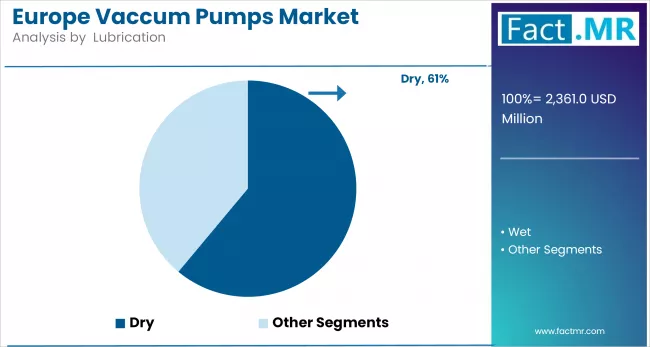
Europe Vaccum Pumps Market Analysis By Lubrication | Source: Fact.MR
Increasingly favored for their contamination-free operation, dry screw pumps have emerged as a key solution for industries with stringent cleanliness requirements. Their oil-free design is particularly well-suited for pharmaceutical, electronics, and specialty chemical applications, where even trace impurities can compromise product integrity.
Key drivers of this segment include the tightening of process purity standards, the shift away from oil-sealed systems, and the rising need for low-maintenance, energy-efficient vacuum solutions. Dry screw pumps eliminate the need for internal lubrication, reducing emissions and disposal costs while maintaining consistent performance, even with condensable or corrosive gases.
Technological advancements in rotor design and temperature control have further enhanced their thermal stability and operational reliability, solidifying their position in modern vacuum architecture.
As manufacturers prioritize sustainable and low-maintenance systems, the demand for dry screw pumps is expected to grow steadily, particularly in sectors that emphasize process integrity, environmental compliance, and long-term cost efficiency.
Gas Displacement Mechanisms Ensure Stable Vacuum Performance
The gas displacement segment is currently experiencing notable growth, largely driven by its versatility and reliability in generating stable vacuum conditions across a broad spectrum of industrial processes. This mechanism, which operates by mechanically displacing gas volumes using pistons, vanes, or diaphragms, is particularly effective in systems that require consistent throughput and pressure control.
Its growing popularity stems from its ability to handle a variety of gas compositions, including moisture-laden or mildly corrosive vapors, without compromising on performance. Gas displacement pumps play a crucial role in various applications, including packaging, freeze-drying, material transfer, and laboratory vacuum systems. The trend toward precision-controlled processes and reduced maintenance cycles further supports adoption.
Advancements in dry-running and hermetically sealed configurations have expanded their utility in sensitive environments, enhancing safety and extending service life. As industries continue to modernize their vacuum infrastructure with robust and low-emission systems, gas displacement mechanisms are expected to remain a mainstay in reliable, medium- to low-vacuum applications.
High Vacuum Segment Supports Advanced Process Integrity
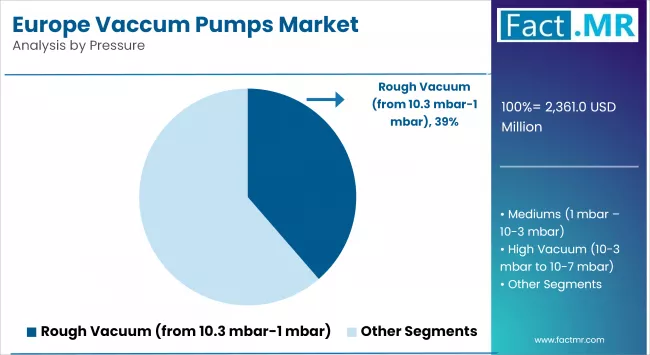
Europe Vaccum Pumps Market Analysis By Pressure | Source: Fact.MR
Applications that require molecular-level cleanliness, such as semiconductor etching, thin-film deposition, and advanced analytics, are increasingly reliant on high-vacuum systems for process assurance. These systems operate within a pressure band that significantly reduces molecular collisions, enabling high-precision manufacturing and scientific experimentation.
High-vacuum systems offer a balance between performance and complexity, enabling stable operations without the cost and sensitivity associated with ultra-high-vacuum technologies. The segment benefits from growing investment in microelectronics, optical coatings, and surface engineering, where vacuum consistency directly impacts product quality and throughput.
Technological advancements in turbo-molecular and hybrid pumping systems have improved the reliability, cleanliness, and efficiency of high-vacuum setups. With an increasing emphasis on defect-free manufacturing and high-yield operations, high-vacuum technologies are becoming indispensable for delivering repeatable, contamination-free conditions across critical sectors.
Competitive Analysis
Key players in the Europe vacuum pumps industry include Atlas Copco, Edwards Vacuum, Leybold GmbH, Gebr. Becker GmbH, Pfeiffer Vacuum GmbH, SIHI Group B.V., VAKUO GmbH, and ELIVAC.
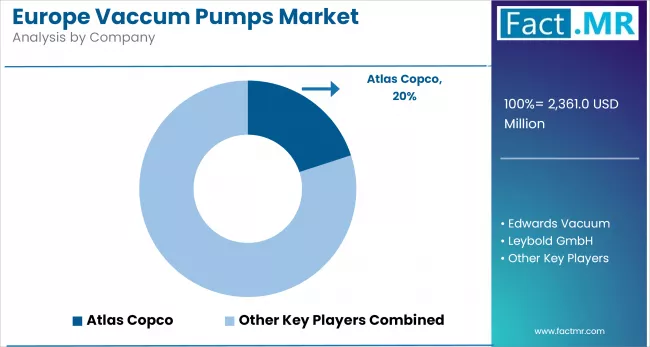
Europe Vaccum Pumps Market Analysis By Company | Source: Fact.MR
The market is expanding due to growing demand for clean, energy-efficient vacuum systems in various applications, including semiconductors, pharmaceuticals, and industrial manufacturing. Increasing automation and stricter environmental regulations are pushing companies to adopt oil-free and dry vacuum technologies.
Technological innovation is central, with manufacturers integrating smart sensors, remote monitoring, and predictive maintenance to improve performance and reduce downtime. There is also a rising focus on sustainability, with companies developing quieter, low-emission systems made from recyclable materials. Compact design, energy optimization, and lifecycle efficiency are key areas of competition across the region.
Recent Development
- In November 2024, ULVAC introduced the Gv135 oil rotary vacuum pump, engineered for analytical environments requiring ultra-quiet operation. Its magnetic coupling eliminates oil leaks, while dual-block valves prevent backflow, enhancing equipment protection and reducing maintenance. Operating at just 46 dB, it ensures a quieter, cleaner workspace.
- In March 2024, Pfeiffer Vacuum introduced the HiPace 30 Neo, the smallest hybrid-bearing high-power turbopump on the market. Designed for compact analytical systems and portable applications, it offers high gas throughput and exceptional compression for light gases. The pump features patented Laser Balancing™ technology, ensuring minimal vibration levels, making it ideal for vibration-sensitive applications.
Fact.MR has provided detailed information about the price points of key manufacturers in the European Vacuum Pumps Market, positioned across regions, including sales growth, production capacity, and speculative technological expansion, in the recently published report.
Methodology and Industry Tracking Approach
Fact.MR’s 2025 Europe vacuum pumps market study draws insights from a survey of over 9,000 participants across 27 European nations, with each country contributing at least 250 respondents. 65% were end users and manufacturers (including semiconductor firms, industrial processors, and healthcare system operators), while the remaining third included professionals such as distributors, procurement heads, and compliance advisors. Data gathered between June 2024 and May 2025 explored market behavior, investment drivers, regulatory hurdles, and emerging needs.
Findings were normalized to reflect regional economic weight and user demographics. The study references more than 280 reliable materials, including scientific journals, patents, financial disclosures, and technical regulations.
Advanced tools such as regression-based modeling ensured analytical accuracy. With continuous tracking of industrial technology markets since 2018, Fact.MR offers a trusted lens into Europe’s vacuum pump sector.
Segmentation
Segmentation of Europe Vacuum Pumps Market
-
By Pump Type :
- Positive Displacement
- Liquid Ring
- Rotary Screw Pumps
- Rotary Root Pumps
- Dry
- Dry Screw
- Dry Scroll
- Dry Diaphragm Pump
- Dry Clan & Hook Pump
- Others
- Centrifugal Pumps
- Momentum Transfer
- Rotary Vane
- Turbo Molecular
- Regenerative
- Positive Displacement
-
By Mechanism :
- Gas Transfer
- Gas Displacement
- Kinetic
- Gas Binding
- Gas Transfer
-
By Pressure :
- Rough Vacuum (from 10.3 mbar-1 mbar)
- Mediums (1 mbar - 10-3 mbar)
- High Vacuum (10-3 mbar to 10-7 mbar)
- Ultra-high Vacuum (10-7 mbar to 10-12 mbar)
- Extreme High Vacuum (less than 10-12 mbar)
-
By Lubrication :
- Dry
- Wet
-
By Flow :
- Up to 85 ACFM
- Up to 150 ACFM
- Up to 550 ACFM
- Up to 1,500 ACFM
- Up to 4,500 ACFM
- Up to 8,500 ACFM
- Up to 15,000 ACFM
- Up to 17,000 ACFM
-
By Application :
- Assembly
- Conveying
- Dehydration/Drying
- Engine Testing
- Evaporation & Distillation
- Filling
- Holding/Chucking
- Manufacturing
- Material Handling
- Thermoforming
- Others
-
By End-Use Vertical :
- Aerospace & Defense
- Automotive
- Chemical & Petrochemical
- Electronics & Semiconductor
- Food & Beverage
- Healthcare & Pharmaceuticals
- Industrial Manufacturing
- Mining & Construction
- Oil & Gas
- Packaging
- Power Generation
- Semiconductor and Electronics
- Others
-
By Country :
- Germany
- Italy
- France
- Spain
- UK
- NORDICS
- BENELUX
- Rest of Europe
Frequently Asked Questions
What was the Europe Vacuum Pumps Market Size Reported by Fact.MR for 2025?
Who are the Major Players Operating in the Europe Vacuum Pumps Market?
What is the Estimated Valuation of the Europe Vacuum Pumps Market in 2035?
What Value CAGR did the Europe Vacuum Pumps Market Exhibit Over the Last Five Years?
Who worked on this report


Preview the report firsthand - request a free sample
Free SampleGet the brochure for pricing and purchase details
Download PDF