- Base Value(2025): 326 Mn
- Estimated Value(2026): 342 Mn
- Forecast Value (2036): 557 Mn
- CAGR (2026 - 2036): 5.0%
Europe Portable Compactor Market Forecast and Outlook By Fact.MR
- The Europe portable compactor market reached USD 326 million in 2025.
- Fact.MR estimates the market will rise to USD 342 million in 2026 and reach nearly USD 557 million by 2036.
- The market is expected to expand at 5.0% CAGR during the forecast period.
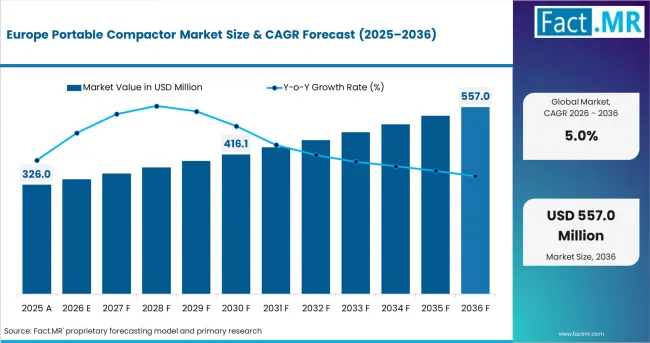
Europe Portable Compactor Market Value Analysis | Source: Fact.MR
| Metric | Value |
|---|---|
| Estimated Value in 2026 | USD 342 million |
| Forecast Value in 2036 | USD 557 million |
| Forecast CAGR (2026 to 2036) | 5.0% |
Source: Fact.MR analysis. Updated May 30, 2026
Summary of Europe Portable Compactor Market
- Demand Drivers
- Municipal waste operators are investing in portable compactor investment. Urban waste volumes continue rising across European cities.
- Retail parks and logistics facilities are adopting mobile and self-cleaning compactors. E-commerce activity is adding more cardboard and packaging waste at retail and logistics sites.
- Industrial waste handlers are upgrading hook-lift and skid-mounted fleets. EU landfill diversion targets are increasing waste transport activity.
- Key Segments Analyzed
- By Compactor Type: Standard compactors hold 48% share in 2026. Strong adoption continues across municipal and commercial waste operations.
- By Container Volume: Up to 16 Cubic Meter containers account for 40% share in 2026. They fit standard municipal collection systems across Europe.
- By Mobility Type: Towable portable compactors hold 50% share in 2026. Operators prefer flexible deployment across multiple collection sites.
- By End User: Municipal waste management holds 35% share in 2026. European cities continue expanding waste collection infrastructure.
- By Loading Mechanism: Rear loading holds 45% share in 2026. Most municipal waste fleets still use rear-loading vehicle systems.
- By Geography: Germany is projected to grow at 5.4% CAGR by 2036. Waste infrastructure upgrades are increasing fleet replacement activity.
- Analyst Opinion at Fact.MR
- Shambhu Nath Jha, Principal Consultant at Fact.MR, opines, CXOs will see rising replacement demand across aging rear-loading and standard compactor fleets. EU waste collection standards are becoming stricter across municipal and commercial waste systems. Manufacturers focusing on self-cleaning and hook-lift compactors are likely to benefit from fleet upgrade activity across Germany, France, and the United Kingdom.
- Strategic Implications
- Portable compactor manufacturers should strengthen expansion plans across Germany and France. Waste regulation reforms are accelerating fleet replacement activity at municipal and private waste facilities.
- Self-cleaning and screw compactors need more product development focus. Commercial operators prefer low-maintenance mobile systems that reduce operational downtime across collection networks.
- Mid-capacity container volumes between 16 and 24 cubic meters are seeing strong upgrade demand. Industrial and commercial operators are shifting from fixed compaction systems toward mobile lifting hook equipment.
The industry is projected to generate USD 215 million in new revenue opportunity by 2036. The growth is driven by increasing urban waste volumes, which are putting pressure on municipal collection systems and commercial waste facilities. Many operators are upgrading outdated compactor fleets with mobile and self-cleaning systems to improve efficiency. Budget limitations among smaller municipalities continue to slow replacement cycles in some regional markets.
Germany is expected to remain the leading market, growing at a 5.4% CAGR. Older waste collection fleets are being replaced with newer compaction equipment. France is likely to witness 5.1% CAGR. Rising waste sorting and recycling requirements are increasing portable compactor demand across municipal and commercial collection networks. The United Kingdom is anticipated to expand at 4.9% CAGR through 2036. Growth in recyclable waste volumes is increasing demand for higher-capacity mobile compaction systems across local authority waste sites. Spain is projected to record 4.7% CAGR. Urban waste collection upgrades and rising recycling targets are supporting demand for portable compactors across municipal facilities. Italy is expected to grow at 4.5% CAGR. Packaging recovery programs and waste sorting expansion are increasing compaction equipment demand across collection and recycling centers.
Segmental Analysis
Europe Portable Compactor Market Analysis by Compactor Type
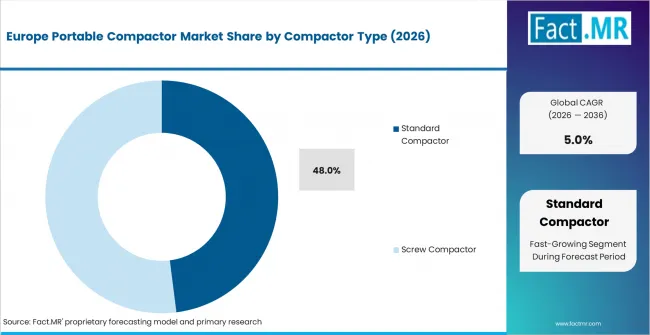
Europe Portable Compactor Market Analysis By Compactor Type | Source: Fact.MR
Standard compactors hold 48% share in 2026 because large installed base across municipal and commercial waste collection systems. Many operators are replacing aging standard compactors because they are still practical for basic waste volume reduction.
- Screw Compactor Expansion: Screw compactors are seeing stronger demand across retail, hospitality, and food service sites handling wet and mixed packaging waste streams.
- Self-cleaning System Growth: Self-cleaning compactors are expanding across municipal and logistics facilities where operators want lower cleaning downtime and higher operational productivity.
- JCB Unveils World-First DEF-Free Soil Compactor: JCB has launched the VM118D, the world’s first EU Stage V single-drum soil compactor above 10 tonnes that operates without Diesel Exhaust Fluid (DEF), reducing operating complexity and maintenance costs. [1]
Europe Portable Compactor Market Analysis by Container Volume
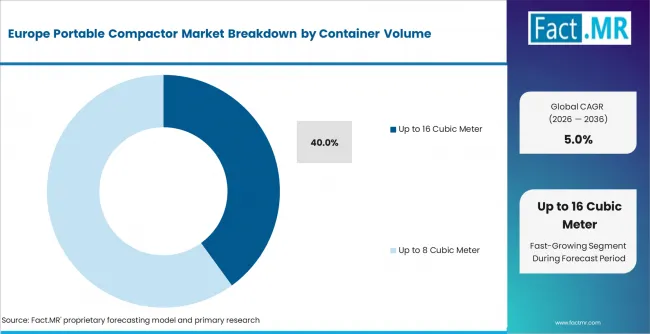
Europe Portable Compactor Market Analysis By Container Volume | Source: Fact.MR
Up to 16 cubic meter containers register for 40% share in 2026 because they fit standard municipal collection vehicles widely used across European waste management networks. Compatibility with existing collection systems helps operator’s lower installation cost and simplify fleet integration.
- Compact Volume Demand: Smaller container volumes are gaining adoption at retail and hospitality sites with limited outdoor installation space.
- Mid-capacity Expansion: Up to 24 cubic meter systems are expanding across industrial and logistics facilities handling larger packaging and production waste volumes.
- Ammann Launches First Electric Reversible Plate Compactor: Ammann has introduced the eAPR 20/40, its first electric-drive reversible plate compactor, expanding its zero-emission equipment portfolio for European construction and infrastructure projects. The machine delivers 20 kN compaction force with low vibration and indoor-operating capability. [2]
Europe Portable Compactor Market Analysis by Mobility Type
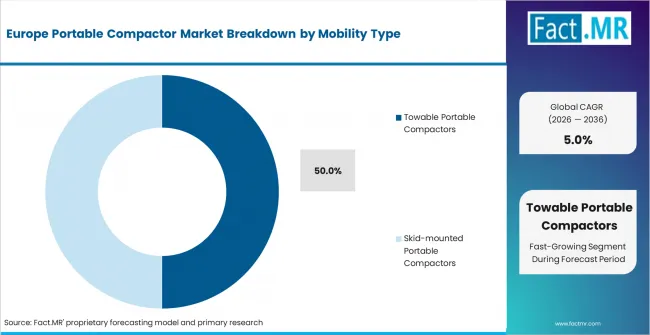
Europe Portable Compactor Market Analysis By Mobility Type | Source: Fact.MR
Towable portable compactors accounts for 50% share in 2026 as lower operating cost and easier deployment across multiple waste collection points. Municipal operators often prefer towable systems because they can improve flexibility without requiring large fleet investment.
- Skid-mounted Demand: Skid-mounted compactors are increasing across semi-permanent commercial waste collection locations where fixed installation is not preferred.
- Hook-lift Growth: Hook-lift compactors are gaining stronger adoption across municipal and industrial waste operations requiring faster waste transport cycles.
- Wacker Neuson Launches 4th-Generation RTD-SC4 Trench Roller: Wacker Neuson has introduced the redesigned RTD-SC4 trench roller featuring an asymmetric design that reduces parts, hoses, and connections by over 30%, improving durability, serviceability, and lowering total ownership costs. [3]
Europe Portable Compactor Market Analysis by End User
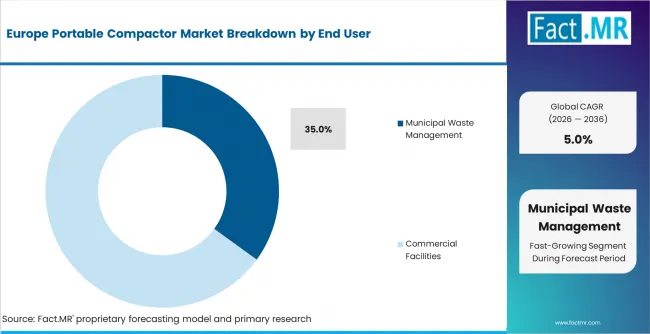
Europe Portable Compactor Market Analysis By End User | Source: Fact.MR
Municipal waste management holds 35% share in 2026 because European cities continue operating large portable compactor fleets across urban waste infrastructure systems. Replacement demand stays steady as older compactors are changed and waste collection rules become stricter.
- Commercial Facility Adoption: Retail parks, hospitality sites, and logistics centers are increasing portable compactor investment as packaging waste volumes continue rising.
- Industrial Facility Demand: Manufacturing and food processing facilities are adopting portable compactors to reduce waste transport cost and improve site waste handling efficiency.
- Municipal Contract Growth: Municipal authorities across Northern and Western Europe continue increasing activity for fleet replacement and infrastructure upgrades.
Europe Portable Compactor Market Analysis by Loading Mechanism
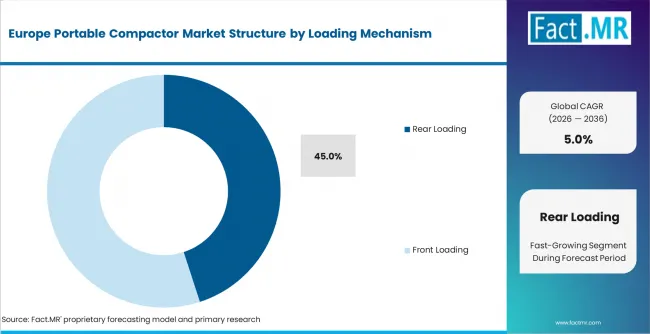
Europe Portable Compactor Market Analysis By Loading Mechanism | Source: Fact.MR
Rear loading contribute 45% share in 2026 because most European municipal waste fleets still operate rear-loading collection vehicles. Operators prefer rear-loading systems because they work well with existing waste transport and need less staff training.
- Front-loading Expansion: Front-loading compactors are gaining adoption at logistics and commercial sites where elevated loading access improves waste handling efficiency.
- Side-loading Growth: Side-loading compactors are increasing across dense urban commercial areas where street access conditions limit rear-loading operations.
- Bobcat Unveils New-Generation Mini Excavators: Bobcat introduced its new 1–2 tonne mini excavator lineup including the E16, E17z, E19, and E20z at Bauma 2025, featuring over 500 new components, advanced load-sensing hydraulics, and improved operator comfort for European construction markets. [4]
Drivers, Restraints, and Opportunities
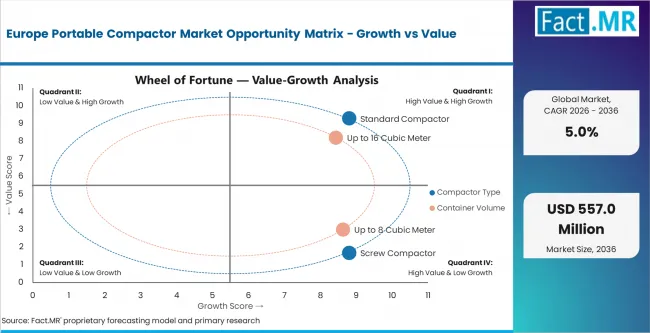
Europe Portable Compactor Market Opportunity Matrix Growth Vs Value | Source: Fact.MR
Fact.MR analysis shows that the Europe portable compactor market is moving through a strong replacement cycle. Municipal and commercial waste operators are upgrading aging equipment fleets as urban waste volumes continue increasing across major European cities. Stricter landfill diversion rules and higher waste collection frequency are also supporting portable compactor demand across regional waste infrastructure networks.
Mobile hook-lift and self-cleaning compactors are replacing older rear-loading systems in large waste collection operations. Operators want equipment that needs less maintenance requirements and works better across multiple collection sites. Screw compactors are also gaining use at commercial sites that handle wet waste and mixed packaging waste.
- EU Waste Infrastructure Upgrades: Municipal waste operators across Europe are increasing portable compactor investment to improve landfill diversion performance and collection efficiency across urban waste systems.
- Commercial Packaging Waste Growth: Logistics parks and fulfillment centers are increasing adoption of mobile compactors as e-commerce packaging waste volumes continue rising across commercial distribution networks.
- Dynapac Delivers Europe’s First Fully Electric Highway Asphalt Pavers: Dynapac has delivered Europe’s first factory-built fully electric highway asphalt pavers, the SD25 80C e, to Dutch infrastructure firms Heijmans, Mourik, and Van Gelder, marking a major step toward zero-emission road construction in Europe. [5]
Regional Analysis
The Europe portable compactor market is assessed across Western Europe covering Germany, France, the United Kingdom, Spain, and Italy, along with BENELUX, Nordic Countries, and Rest of Europe, segmented by waste collection infrastructure capacity, municipal fleet replacement activity, regulatory compliance timelines, and commercial waste volume growth. The full report offers market attractiveness analysis by country and sub-region.
.webp "Top Country Growth Comparison Europe Portable Compactor Market Cagr (2026 2036)")
Top Country Growth Comparison Europe Portable Compactor Market Cagr (2026 2036) | Source: Fact.MR
| Country | CAGR (2026 to 2036) |
|---|---|
| Germany | 5.4% |
| France | 5.1% |
| United Kingdom | 4.9% |
| Spain | 4.7% |
| Italy | 4.5% |
Source: Fact.MR analysis. Updated May 30, 2026
Source: Fact.MR analysis, based on proprietary forecasting model and primary research
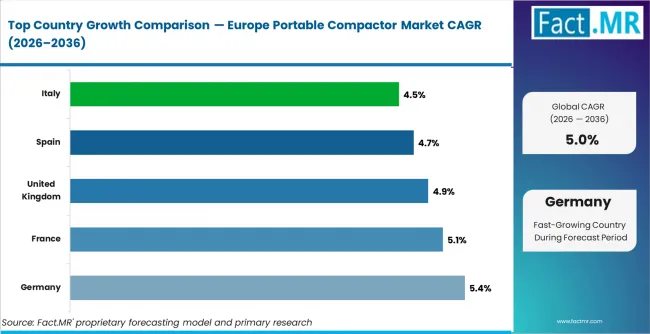
Europe Portable Compactor Market Cagr Analysis By Country | Source: Fact.MR
Europe Portable Compactor Market Analysis
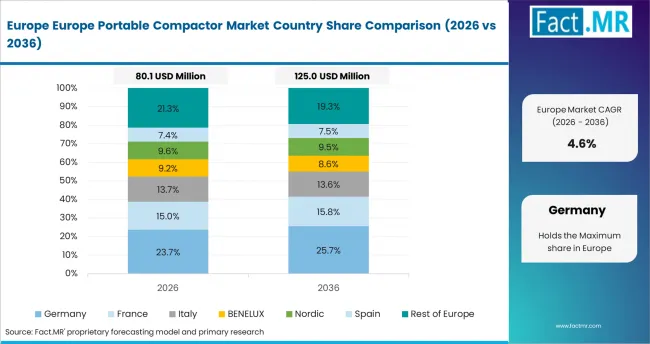
Europe Portable Compactor Market Europe Country Market Share Analysis, 2026 & 2036 | Source: Fact.MR
Europe remains the leading regional market for portable compactors. Municipal waste departments are replacing older equipment as urban waste volumes rise. Packaging waste growth and landfill diversion targets are increasing demand for mobile and self-cleaning compaction. Commercial waste operators are also investing in flexible waste handling equipment to improve collection efficiency across urban areas.
- Germany: Germany continues to lead regional demand with 5.4% CAGR. Municipal waste are replacing older compactor fleets to improve waste transport efficiency. Self-cleaning systems are gaining use in urban waste depots because enclosed handling helps control odor and site cleanliness.
- France: France is expected to expand at 5.1% CAGR by 2036. Commercial waste collection operators are investing in screw and self-cleaning compactors to handle more packaging and food waste. Municipal upgrade programs are supporting fleet replacement across major cities.
- United Kingdom: The United Kingdom is projected to grow at 4.9% CAGR. Local authorities are using higher-capacity mobile compactors to manage rising recyclable waste volumes without major site expansion. Hook-lift systems are becoming more common in municipal and commercial waste operations.
- Spain: Spain is anticipated to record 4.7% CAGR. Municipal waste departments are using portable compactors as urban collection sites handle more packaging and household waste. Mid-sized transfer stations are expanding compaction capacity in growing city districts.
- Italy: Italy is forecast to expand at 4.5% CAGR by 2036. Packaging recovery activity is increasing portable compactor demand across sorting facilities and municipal collection centers. Industrial areas in Northern Italy are investing in waste handling upgrades.
Fact.MR's Europe portable compactor market analysis covers Germany, France, the United Kingdom, Spain, Italy, BENELUX, Nordic Countries, and the Rest of Europe. Readers can find country-level fleet replacement trends, waste infrastructure investment analysis, and segment share benchmarks across compactor type, container volume, and end-user categories.
Competitive Aligners for Market Players
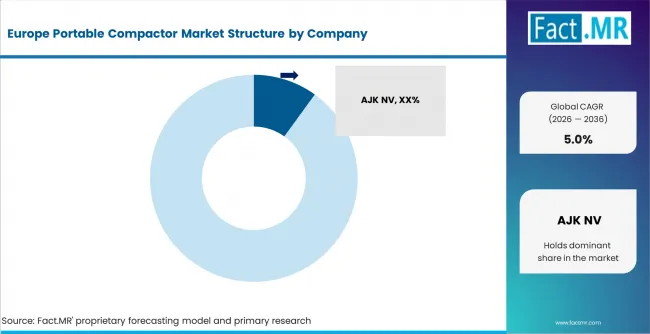
Europe Portable Compactor Market Analysis By Company | Source: Fact.MR
Competition in the Europe portable compactor market is moving toward fleet replacement and easier daily operation. Municipal waste departments are replacing older compactors with mobile and self-cleaning systems. These machines help reduce handling time across urban collection sites. Manufacturers with reliable service support and faster delivery are better placed in public sector contracts.
Demand for hook-lift and towable compactors is rising across municipal and commercial waste work. Operators prefer equipment that can reduce collection trips and limit downtime. Self-cleaning systems are gaining attention at food waste and mixed packaging sites because hygiene control is important.
Commercial facilities and logistics operators are also becoming important demand sources. E-commerce activity is adding more cardboard and packaging waste at retail distribution centers and fulfillment sites. Manufacturers offering compact designs and easy mobility are seeing better adoption. Germany, France, and the United Kingdom are the most competitive markets because municipal waste systems are being upgraded. Companies with better service networks and refurbishment support can protect repeat demand during replacement cycles.
Key Players
- AJK NV
- Avermann Umwelttechnik GmbH & Co. KG
- Bramidan A/S
- Europress Group Oy
- Bergmann Maschinenbau GmbH & Co. KG
- HUSMANN Umwelt-Technik GmbH
Bibliography
- JCB. (2025). New JCB single drum soil compactor is a world-first.
- Supply Post. (2025, September). Ammann unveils electric-drive reversible plate compactor.
- Equipment Journal. (2025). Wacker Neuson rolls out game-changing 4th-gen trench roller.
- Bobcat Company. (2025). Bobcat revolutionizes construction with new 1–2 t mini excavators at Bauma 2025.
- Dynapac. (2026). European market premiere for Dutch infrastructure sector.
This Report Addresses
- Strategic intelligence on Europe portable compactor demand across compactor type, container volume, mobility type, end user, and loading mechanism segments.
- Market forecast from USD 342 million in 2026 to USD 557 million by 2036 at 5.0% CAGR. The market creates USD 215 million in absolute dollar opportunity during the forecast period.
- Growth opportunity analysis across Germany, France, the United Kingdom, Spain, and Italy linked to waste collection compliance and portable compactor fleet replacement cycles.
- Segment analysis with country-level CAGR forecasts and leading segment share benchmarks for 2026.
- Regional outlook covering municipal fleet modernization investment cycles, EU landfill diversion compliance timelines, and mobile compactor adoption across European commercial and industrial waste markets.
- Competitive analysis of AJK NV, Avermann Umwelttechnik GmbH & Co. KG, Bramidan A/S, Orkel, and Dynapac.
- Regulatory analysis covering EU Landfill Directive 2035 targets, German Kreislaufwirtschaftsgesetz landfill diversion requirements, French filière REP commercial waste reform, and UK Simpler Recycling implementation timelines.
- Report delivery in PDF and Excel formats supported by waste facility fleet benchmarks, compactor installation data, and interviews with municipal waste managers and commercial facility operators.
Europe Portable Compactor Market Definition
The Europe portable compactor market covers mobile and relocatable waste management equipment deployed at municipal collection depots, commercial facilities, and industrial waste generation sites to reduce waste volume before transport or disposal. These systems use mechanical, screw, and self-cleaning compaction mechanisms to process general municipal solid waste, commercial dry recyclables, and industrial packaging waste.
Europe Portable Compactor Market Inclusions
The study covers European market forecasts from 2026 to 2036 across compactor type, container volume, mobility type, end user, and loading mechanism segments. It includes standard compactors, screw compactors, and self-cleaning compactors across towable, skid-mounted, and mobile hook-lift configurations used at municipal waste depots, commercial facilities, and industrial waste sites.
Europe Portable Compactor Market Exclusions
The study excludes stationary balers and fixed-installation industrial compaction systems not designed for relocation. It omits shredders, waste sorting equipment, and landfill compactors as separate equipment classes. Compaction units embedded within refuse collection vehicles fall outside scope unless sold as standalone portable units.
Europe Portable Compactor Market Research Methodology
- Primary Research
- Primary research includes interviews with fleet managers and waste operations directors at municipal waste management organizations and private collection firms across Germany and France. Equipment maintenance engineers at commercial waste facilities and industrial site operators in Spain and Italy are covered separately.
- Desk Research
- Desk research uses public disclosures from Bramidan A/S. It includes Eurostat municipal waste data, EU Packaging and Packaging Waste Regulation filings, and national waste infrastructure investment program disclosures covering 2024 and 2025.
- Market-Sizing and Forecasting
- Market sizing applies a hybrid top-down and bottom-up model. Portable compactor unit sales benchmarks and municipal waste facility capacity data by country form the base inputs. Segment forecasts are built separately for compactor type and mobility type categories across end-user and container volume segments.
- Data Validation and Update Cycle
- Data validation uses waste facility capital expenditure disclosures and compactor unit installation benchmarks cross-checked against 2024 and 2025 Eurostat municipal waste infrastructure statistics. Findings are validated through interviews with waste facility operations managers and portable compactor maintenance specialists.
Segmentation
Scope of the Report
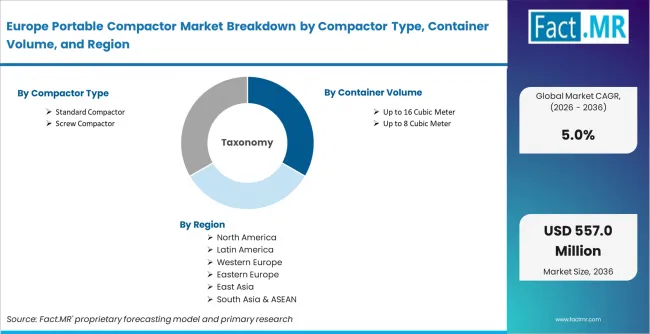
Europe Portable Compactor Market Breakdown By Compactor Type, Container Volume, And Region | Source: Fact.MR
| Attribute | Details |
|---|---|
| Quantitative Units | USD 342 million (2026) to USD 557 million (2036), at a CAGR of 5.0% |
| Market Definition | Mobile and relocatable waste compaction equipment deployed at municipal collection depots, commercial facilities, and industrial waste sites to reduce waste volume using mechanical, screw, and self-cleaning compaction mechanisms across European waste collection operations. |
| Compactor Type Segmentation | Standard Compactor, Screw Compactor, Self-Cleaning Compactor |
| Container Volume Segmentation | Up to 8 Cubic Meter, Up to 16 Cubic Meter, Up to 24 Cubic Meter, More than 24 Cubic Meter |
| Mobility Type Segmentation | Towable Portable Compactors, Skid-mounted Portable Compactors, Mobile Hook-lift Compactors |
| End User Segmentation | Municipal Waste Management, Commercial Facilities, Industrial Facilities |
| Loading Mechanism Segmentation | Rear Loading, Front Loading, Side Loading |
| Application Coverage | Municipal solid waste compaction at collection depots, commercial packaging waste reduction at retail and logistics sites, industrial production waste compaction at manufacturing facilities, and multi-site mobile compaction across municipal collection route networks. |
| Regions Covered | Western Europe, Eastern Europe |
| Countries Covered | Germany, France, United Kingdom, Spain, Italy, BENELUX, Nordic Countries, Portugal, and Rest of Europe |
| Key Companies Profiled | AJK NV, Avermann Umwelttechnik GmbH & Co. KG, Bramidan A/S, Orkel, Dynapac |
| Forecast Period | 2026 to 2036 |
| Approach | Hybrid top-down and bottom-up model using Eurostat municipal waste capacity data, portable compactor unit sales benchmarks, waste facility investment program disclosures, and primary interviews with municipal fleet managers and commercial waste operators. |
Source: Fact.MR analysis. Updated May 30, 2026
Europe Portable Compactor Market by Segments
-
By Compactor Type
- Standard Compactor
- Screw Compactor
- Self-Cleaning Compactor
-
By Container Volume
- Up to 8 Cubic Meter
- Up to 16 Cubic Meter
- Up to 24 Cubic Meter
- More than 24 Cubic Meter
-
By Mobility Type
- Towable Portable Compactors
- Skid-mounted Portable Compactors
- Mobile Hook-lift Compactors
-
By End User
- Municipal Waste Management
- Commercial Facilities
- Industrial Facilities
-
By Loading Mechanism
- Rear Loading
- Front Loading
- Side Loading
-
By Region
- Western Europe
- Germany
- France
- United Kingdom
- Spain
- Italy
- BENELUX
- Nordic Countries
- Portugal
- Rest of Western Europe
- Eastern Europe
- Poland
- Hungary
- Romania
- Balkan and Baltic
- Rest of Eastern Europe
- Western Europe
Frequently Asked Questions
How large is the Europe portable compactor market in 2025?
What will the Europe portable compactor market size be in 2026?
What is the projected Europe portable compactor market size by 2036?
What is the expected CAGR for the Europe portable compactor market from 2026 to 2036?
Which compactor type segment leads the Europe portable compactor market?
Which mobility type holds the leading share in the Europe portable compactor market?
Which country shows the fastest growth in the Europe portable compactor market?
Who worked on this report


Preview the report firsthand - request a free sample
Free SampleGet the brochure for pricing and purchase details
Download PDF