- Market Value (2025): USD 98.8 Mn
- Estimated Value (2026): USD 112 Mn
- Forecast Value (2036): USD 395 Mn
- CAGR (2026-2036): 13.4%
What is the EUV Mask Pod Cleaners Market forecast to be worth by 2036?
USD 112 million in 2026 to USD 395 million by 2036, at 13.4% CAGR.
- The EUV Mask Pod Cleaners Market crossed a valuation of USD 98.8 million in 2025.
- Demand is projected to increase from USD 112 million in 2026 to USD 395 million by 2036.
- The market is forecast to record 13.4% CAGR from 2026 to 2036 as fabs tighten release evidence for EUV reticle handling and pod reuse.
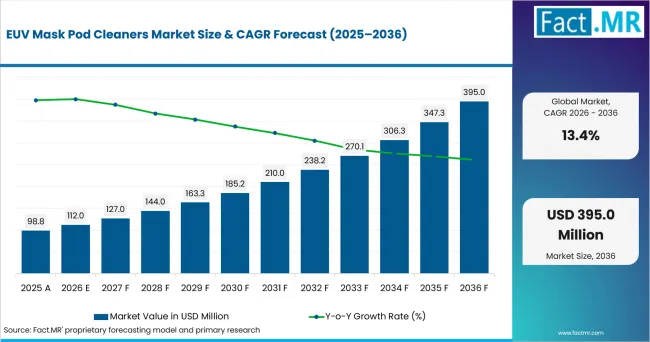
Euv Mask Pod Cleaners Market Value Analysis | Source: Fact.MR
What are the defining numbers behind EUV Mask Pod Cleaners Market growth?
USD 283 million absolute opportunity by 2036, led by Dry cryogenic/CO2 cleaners and EUV dual pod cleaning alongside fully automated clusters.
- Demand Drivers in the Market
- Foundry process teams need dry cryogenic and CO2 cleaning to clear pod particles without adding wet-chemistry residue near EUV reticles.
- Mask-shop engineers require separate inner and outer pod cleaning because EUV dual pods create two contamination surfaces before reticle transfer.
- Automation teams need cluster-ready cleaners since pod opening, cleaning, drying and inspection steps must run with limited human contact.
- SEMI reported on April 7, 2026 that worldwide semiconductor manufacturing equipment sales increased 15.0% to USD 135.1 billion in 2025.
- Key Segments Analyzed
- By Cleaning Technology: Dry cryogenic/CO2 is expected to hold 41.0% share in 2026 due to residue-sensitive EUV pod cleaning requirements.
- By Pod Configuration: EUV dual pod is projected to account for 46.0% share in 2026 because both EIP and EOP surfaces must pass release checks.
- By Automation: Fully automated cluster is anticipated to capture 58.0% share in 2026 as fabs reduce manual handling inside reticle flows.
- By End User: Leading-edge foundries are estimated to represent 52.0% share in 2026 owing to dense EUV layer counts and strict reticle availability targets.
- Analyst Opinion at Fact.MR
- Shambhu Nath Jha, Principal Consultant at Fact.MR, states, “EUV pod cleaning differs from standard carrier washing because the cleaned part returns to a lithography loop where one particle event can stop a reticle. Production buyers are expected to judge cleaners by repeatable drying and proof that inner and outer pods remain qualified. Suppliers should combine low-particle cleaning with inspection hooks and fab automation interfaces.”
- Strategic Implications
- Fab engineering teams should define pod-release limits before cleaner quotations are compared across dry, supercritical and wet ultra-clean systems.
- Mask-shop operators should link cleaner selection with barcode tracking so reticle history remains visible after every cleaning cycle.
- Equipment providers should prove drying performance and particle-count stability on the same pod designs used in customer EUV lines.
- Lithography supply planners should include EUV material capacity in cleaner planning. The U.S. Department of Commerce finalized an award of up to USD 32 million in direct funding to Corning in January 2025 to expand production of HPFS and ULE glass used in semiconductor lithography applications.
Taiwan is projected to record 15.44% CAGR through 2036. South Korea is forecast at 15.08%, Japan is anticipated at 14.98%, and the USA is expected at 14.95%. Germany is estimated at 14.72%, while the Netherlands is projected at 14.63% through EUV equipment depth.
How does the EUV Mask Pod Cleaners Market break down by segment?
Dry cryogenic/CO2 leads at 41.0%; Fully automated cluster leads at 58.0%.
Which cleaning technology dominates?
Dry cryogenic/CO2 is projected to account for 41.0% share in 2026.
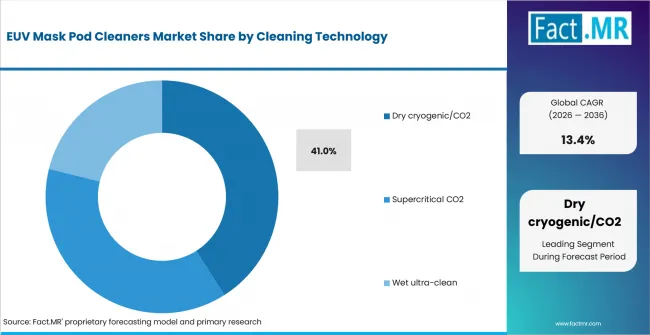
Euv Mask Pod Cleaners Market Analysis By Cleaning Technology | Source: Fact.MR
Dry cryogenic/CO2 cleaners are expected to lead Cleaning Technology with 41.0% share in 2026 because they address residue risks around EUV reticle carriers while supporting contamination-sensitive cleaning. Their dry-cleaning approach is suited to advanced lithography environments where particle control and careful pod handling influence qualification.
What leads the Pod Configuration segment?
EUV dual pod is expected to hold 46.0% share in 2026.
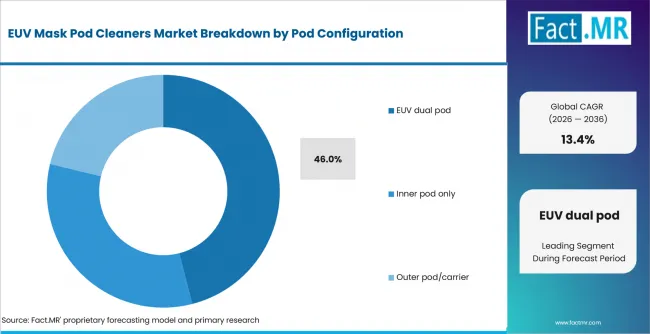
Euv Mask Pod Cleaners Market Analysis By Pod Configuration | Source: Fact.MR
EUV dual pod cleaning is projected to lead Pod Configuration with 46.0% share in 2026 because both inner and outer pod surfaces influence reticle storage, transfer, and contamination control. Cleaning both pod layers helps fabs maintain consistent handling conditions, reduce residue risks, and support reliable reticle movement across lithography workflows.
How does Automation shape demand?
Fully automated cluster is anticipated to lead with 58.0% share in 2026.
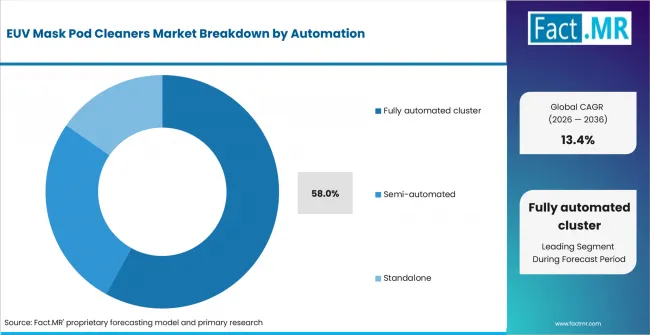
Euv Mask Pod Cleaners Market Analysis By Automation | Source: Fact.MR
Fully automated clusters are forecast to lead Automation with 58.0% share in 2026 because EUV pod cleaning must integrate with low-touch reticle logistics, repeatable handling, and contamination-control routines. Automated systems help fabs reduce manual intervention, standardize cleaning cycles, improve pod consistency, and support reliable reticle movement across advanced lithography environments.
What supports Leading-edge foundries within End User?
Leading-edge foundries are estimated to represent 52.0% share in 2026.
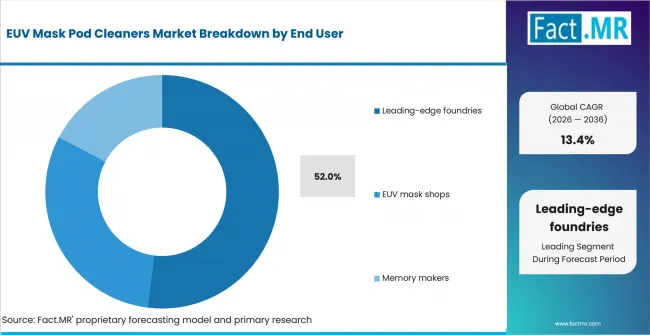
Euv Mask Pod Cleaners Market Analysis By End User | Source: Fact.MR
Leading-edge foundries are expected to lead End User with 52.0% share in 2026 because EUV exposure layers require tightly controlled pod return and contamination-management loops. DGBAS reported in May 2026 that Taiwan’s manufacturing sector grew 26.18% year over year in Q1 2026, mainly due to output expansion in semiconductors, computers, electronics and optical products.
What is accelerating EUV Mask Pod Cleaners Market adoption, and what is holding it back?
Pod contamination control drives it; qualification time restrains it.
Drivers Impact Analysis
| DRIVER | (~) % IMPACT ON CAGR | GEOGRAPHIC RELEVANCE | IMPACT TIMELINE |
|---|---|---|---|
| EUV reticle contamination control | +3.3% | Taiwan, South Korea, USA | Short term (<= 2 years) |
| Dual-pod qualification | +2.7% | Taiwan, Japan, Netherlands | Short term (<= 2 years) |
| Automated reticle logistics | +2.2% | Leading-edge fabs | Medium term (2-4 years) |
| Dry and CO2 process preference | +1.7% | Mask shops and foundries | Medium term (2-4 years) |
| Inspection-linked release evidence | +1.1% | USA, Japan, Germany | Long term (>= 4 years) |
Source: Fact.MR analysis. Updated Aug 20, 2026
- EUV reticle contamination control: A cleaned pod must protect the reticle after exposure, inspection and storage steps. Particle evidence is therefore expected to carry more weight than cleaner throughput alone.
- Dual-pod qualification: EIP and EOP surfaces face different contact and outgassing risks. Cleaner selection is projected to depend on proof that both surfaces remain safe after repeated cycles.
- Automated reticle logistics: Low-touch pod movement is anticipated to raise demand for cleaners that integrate with load ports and fab host systems. Manual rework is expected to remain limited in leading-edge lines.
Opportunity Impact Analysis
| OPPORTUNITY | (~) % IMPACT ON CAGR | GEOGRAPHIC RELEVANCE | IMPACT TIMELINE |
|---|---|---|---|
| Inline pod inspection | +1.4% | Taiwan, South Korea, Japan | Medium term (2-4 years) |
| High-NA EUV readiness | +1.1% | USA, Netherlands, Taiwan | Medium term (2-4 years) |
| Cluster-tool service contracts | +0.9% | Foundry and memory clusters | Long term (>= 4 years) |
| Mask-shop outsourcing | +0.6% | Europe and East Asia | Long term (>= 4 years) |
Source: Fact.MR analysis. Updated Aug 20, 2026
- Inline pod inspection: Cleaner makers are expected to attach inspection steps to the cleaning flow so fabs see surface status before release. That route reduces separate handling events.
- High-NA EUV readiness: Tighter reticle and pellicle handling is anticipated to lift demand for cleaner evidence before high-value masks enter regular circulation.
- Cluster-tool service contracts: Service models are projected to expand where cleaners need vacuum, drying and automation calibration. Local support becomes a purchase factor when reticle loops run daily.
Restraints Impact Analysis
| RESTRAINT | (~) % IMPACT ON CAGR | GEOGRAPHIC RELEVANCE | IMPACT TIMELINE |
|---|---|---|---|
| Long qualification cycles | -1.5% | Global EUV fabs | Short term (<= 2 years) |
| Pod-surface damage risk | -1.1% | Mask shops | Short term (<= 2 years) |
| Export-control exposure | -0.8% | USA, Netherlands, East Asia | Medium term (2-4 years) |
| Limited installed EUV base | -0.5% | Germany and smaller clusters | Long term (>= 4 years) |
Source: Fact.MR analysis. Updated Aug 20, 2026
- Long qualification cycles: Cleaner approval is constrained by repeated particle, humidity and surface-contact checks. Fabs are expected to delay volume purchases until evidence covers the actual pod fleet.
- Pod-surface damage risk: Cleaning force must remove particles without changing contact points or sealing behavior. This limits aggressive processes in EUV dual pod applications.
- Export-control exposure: EUV-related service access remains sensitive in several trade lanes. Cross-border support is anticipated to add lead time for spare parts and field engineering.
Which countries are scaling EUV Mask Pod Cleaners Market fastest?
- The country comparison spans 0.81 percentage point and forms a narrow growth band across EUV lithography clusters.
- Taiwan remains 0.36 percentage point above South Korea as local foundry scale keeps EUV pod cleaning close to volume reticle flows.
- South Korea remains 0.10 percentage point above Japan because memory production raises the need for pod release evidence before EUV layers scale.
- Japan remains 0.03 percentage point above the USA due to equipment depth and local mask-handling expertise.
- The USA remains 0.23 percentage point above Germany as domestic fab awards expand contamination-control planning for EUV materials and photomasks.
- Germany remains 0.09 percentage point above the Netherlands through Dresden fab expansion and European semiconductor support.
- The Netherlands closes the displayed range through EUV equipment depth and national semiconductor coordination.
Comparable CAGRs create different entry conditions because foundry scale, mask-shop density and EUV tool concentration vary by country. Full report coverage includes North America, Latin America, Europe, East Asia, South Asia and Pacific, Middle East and Africa.
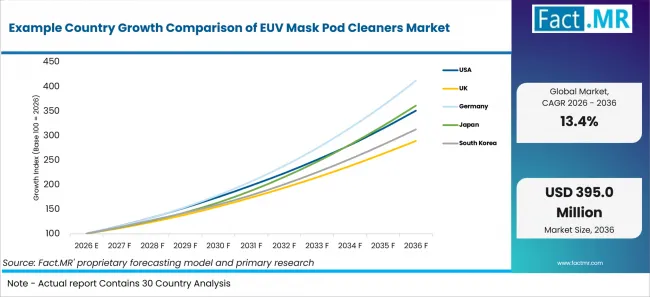
Example Country Growth Comparison Of Euv Mask Pod Cleaners Market | Source: Fact.MR
| Country | CAGR (2026-2036) |
|---|---|
| Taiwan | 15.44% |
| South Korea | 15.08% |
| Japan | 14.98% |
| USA | 14.95% |
| Germany | 14.72% |
| Netherlands | 14.63% |
Source: Fact.MR analysis. Updated Aug 20, 2026
What supports Taiwan adoption?
15.44% CAGR through 2036, supported by foundry scale and EUV pod qualification.
Taiwan foundries evaluate pod cleanliness before reticles return to EUV scanners. The market is projected to record 15.44% CAGR through 2036. DGBAS reported in May 2026 that Taiwan’s manufacturing sector expanded 26.18% year over year in 2026Q1, with semiconductors, computers, electronics and optical products among the principal contributors.
How is South Korea scaling EUV pod-cleaning demand?
15.08% CAGR through 2036, driven by memory production and mask-loop control.
Memory fabs in South Korea need pod cleaning proof before EUV reticles move into high-volume layers. MOTIR reported in January 2026 that 2025 semiconductor exports reached USD 173.4 billion, up 22.2% year over year. Cleaner suppliers are expected to win demand by proving stable drying and particle removal near memory lines.
What supports Japan’s outlook?
14.98% CAGR through 2036, backed by equipment know-how and EUV research.
Japan’s equipment base gives mask shops and process teams a strong testing route for reticle-pod handling. SEAJ’s July 2026 forecast projects Japanese-made semiconductor manufacturing equipment sales of JPY 6.55 trillion in fiscal 2026, up 26.0% year over year. Japan is anticipated to advance at 14.98% CAGR through 2036, while the SEAJ figure is used only as broad equipment-market context.
How is the USA developing demand?
14.95% CAGR through 2036, supported by leading-edge fab funding and EUV materials activity.
U.S. fabs are expected to add pod-cleaning requirements after lithography flows and reticle logistics are fixed for new capacity. GAO reported that Commerce had awarded USD 30.9 billion across 40 semiconductor projects as of July 2025. Demand is expected to concentrate where EUV materials, photomasks and leading-edge wafer starts converge.
What underpins Germany’s growth?
14.72% CAGR through 2036, led by Dresden fab expansion and European chip-policy support.
Germany’s outlook is tied to Dresden’s ability to add semiconductor capacity inside Europe. Infineon said in July 2026 that its Smart Power Fab in Dresden represents EUR 5 billion of investment and creates 1,000 jobs. Support-tool procurement is expected to follow fab schedules and reticle-control needs.
What supports the Netherlands position?
14.63% CAGR through 2036, supported by EUV equipment depth and semiconductor coordination.
The Netherlands benefits from EUV equipment depth and a policy focus on semiconductor capability. The Dutch government published National Semiconductor Vision 2035 on April 1, 2026. Cleaner demand is expected to remain concentrated around qualification, support flows and lithography-adjacent engineering.
Who leads the EUV Mask Pod Cleaners Market?
Hugle Electronics and STI Co., Ltd. show the clearest direct product relevance, while Brooks Automation strengthens the wider reticle-handling and automation landscape.
Hugle Electronics supports EUV pod cleaning through its documented SR-EUV/200/150 fully automatic EUV reticle-pod cleaning system. STI adds direct relevance through its Reflow & EUV POD Cleaner offering. Brooks Automation broadens the competitive field around automated semiconductor-material handling, while GSEC German Semiconductor Equipment Company GmbH completes the profiled provider set.
Which companies are the key providers?
Key companies include Brooks Automation; Hugle Electronics Inc.; STI Co., Ltd.; and GSEC German Semiconductor Equipment Company GmbH.
- Brooks Automation
- Hugle Electronics Inc.
- STI Co., Ltd.
- GSEC German Semiconductor Equipment Company GmbH
Bibliography
- Directorate-General of Budget, Accounting and Statistics. (2026, May 29). GDP: Preliminary estimate for 2026Q1, and outlook for 2026.
- Government of the Netherlands. (2026, April 1). National Semiconductor Vision 2035 – Ambitions for the Dutch semiconductor industry.
- Infineon Technologies AG. (2026, July 2). An impulse for Germany, Europe and the world: Infineon opens the world's largest fab for power semiconductors and analog/mixed-signal technologies in Dresden.
- Ministry of Trade, Industry and Resources. (2026, January 2). Korea's Annual Exports Reach New Highs in 2025.
- Semiconductor Equipment Association of Japan. (2026, July 2). Market Forecast Report: Semiconductor and FPD Manufacturing Equipment Released in July 2026 (Fiscal years 2026 to 2028).
- SEMI. (2026, April 7). SEMI Reports Global Semiconductor Equipment Billings Reached $135 Billion in 2025, Up 15% Year-on-Year.
- U.S. Department of Commerce. (2025, January 17). U.S. Department of Commerce Announces CHIPS Incentives Awards with Corning, Edwards Vacuum, and Infinera to Increase Domestic Production Capacity of Chips and Equipment Critical for U.S. Technological Leadership.
- U.S. Government Accountability Office. (2025, December 11). Semiconductors: Information on Projects Funded to Strengthen U.S. Supply Chain (GAO-26-107882).
This Report Answers
- The report provides strategic intelligence on the EUV Mask Pod Cleaners Market across Cleaning Technology and Pod Configuration choices that shape reticle contamination-control programs.
- Segment analysis covers Dry cryogenic/CO2 and EUV dual pod as the share leaders within the 2026 market, while Fully automated cluster leads Automation.
- Country outlook evaluates Taiwan and South Korea alongside Japan and the USA. Germany and the Netherlands complete the growth comparison across the profiled markets.
- Competitive analysis profiles Brooks Automation, Hugle Electronics Inc., STI Co., Ltd., and GSEC German Semiconductor Equipment Company GmbH.
- Automation and end-user assessment covers Fully automated cluster systems and Leading-edge foundries, with EUV mask shops and memory makers completing the end-user view.
What does the EUV Mask Pod Cleaners Market cover?
EUV mask pod cleaners cover reticle pod cleaning systems used to remove particles and moisture risk from inner and outer reticle carriers before EUV masks return to fab movement. The market includes dry cryogenic, CO2 and wet ultra-clean routes. It excludes general wafer box washing unless the system is qualified for EUV reticle pods.
Coverage connects to EUV photolithography because reticle protection is tied to high-value exposure steps. It also overlaps with wet process equipment where validated drying and ultra-clean chemistry support pod release.
What is included in the scope?
The scope includes cleaners used across EUV dual pods, inner pod cleaning and outer pod or carrier cleaning. Fully automated cluster systems are included where semiconductor robots or load-port integration support low-touch reticle movement.
The analysis includes inspection-linked release where particle checks connect to semiconductor defect inspection equipment. It also includes cleaning process inputs that relate to semiconductor process chemicals when wet ultra-clean systems are used.
What is excluded from the scope?
General FOUP washing and ultrapure water treatment systems remain outside the scope unless the equipment directly supports EUV pod release. Standard carrier cleaning is excluded when it has no reticle, pod or EUV qualification connection.
The scope excludes plasma cleaning machine activity and semiconductor dry etch systems unless they are directly connected to mask pod cleaning evidence. Standalone pellicle membranes are excluded unless the handling step affects pod-cleaner qualification.
How Was the Analysis Built?
The analysis draws on 120+ sources, 35+ company portfolios, 25+ countries, and more than 20 industry interviews.
- Primary Research: Primary research includes discussions with equipment suppliers, mask-shop operators, fab engineers, procurement teams and contamination-control specialists. These interviews examine cleaner qualification, pod handling, approval requirements and wider market acceptance.
- Desk Research: Desk research covers government statistics, company filings, technical studies, standards and public policy. Every source used in the analysis is documented in the bibliography.
- Market Sizing and Forecasting: Market estimates combine historical performance, demand indicators, segment shares, company participation, country-level growth, investment activity and barriers to market expansion.
- Data Validation and Update Cycle: Findings are validated against public data, company activity, policy changes and trade patterns. Updates review product launches, capacity changes, approvals and procurement trends.
Segmentation
What is the report’s scope and coverage?
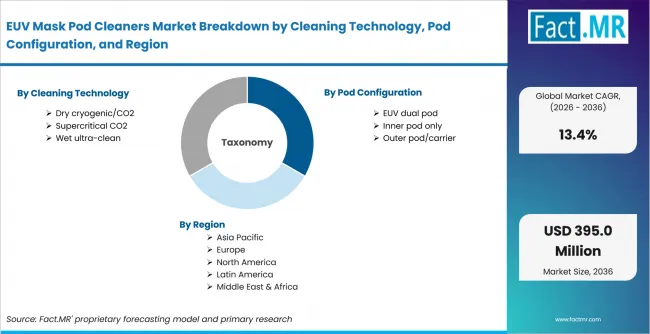
Euv Mask Pod Cleaners Market Breakdown By Cleaning Technology, Pod Configuration, And Region | Source: Fact.MR
| Attribute | Details |
|---|---|
| Quantitative Units | USD million in 2026 to USD million by 2036 at CAGR |
| Market Definition | Systems used to clean EUV reticle pods and mask carriers where particle removal, humidity control, drying proof and reticle-safe handling determine release for EUV lithography loops |
| Cleaning Technology | Dry cryogenic/CO2; Supercritical CO2; Wet ultra-clean |
| Pod Configuration | EUV dual pod; Inner pod only; Outer pod/carrier |
| Automation | Fully automated cluster; Semi-automated; Standalone |
| End User | Leading-edge foundries; EUV mask shops; Memory makers |
| Regions Covered | North America; Latin America; Europe; East Asia; South Asia and Pacific; Middle East and Africa |
| Countries Covered | Taiwan; South Korea; Japan; USA; Germany; Netherlands |
| Key Companies Profiled | Brooks Automation; Hugle Electronics Inc.; STI Co., Ltd.; GSEC German Semiconductor Equipment Company GmbH |
| Forecast Period | 2026 to 2036 |
| Approach | Hybrid top-down and bottom-up approach using EUV lithography demand; mask-shop qualification activity; reticle-pod handling; dry and wet cleaning evidence; cleaner automation; foundry and memory capacity; country adoption patterns and company portfolio review |
Source: Fact.MR analysis. Updated Aug 20, 2026
How is the market segmented?
-
By Cleaning Technology:
- Dry cryogenic/CO2
- Supercritical CO2
- Wet ultra-clean
-
By Pod Configuration:
- EUV dual pod
- Inner pod only
- Outer pod/carrier
-
By Automation:
- Fully automated cluster
- Semi-automated
- Standalone
-
By End User:
- Leading-edge foundries
- EUV mask shops
- Memory makers
-
By Region:
- North America
- Latin America
- Europe
- East Asia
- South Asia and Oceania
- Middle East and Africa
Frequently Asked Questions
How big is the EUV mask pod cleaners market in 2026?
What is the CAGR of the EUV mask pod cleaners market from 2026 to 2036?
Which cleaning technology leads the EUV mask pod cleaners market?
Dry cryogenic/CO2 accounts for 41.0% of the EUV mask pod cleaners market by cleaning technology in 2026, supported by residue-sensitive EUV pod cleaning requirements and contamination-control needs.
Dry cryogenic/CO2 accounts for 41.0% of the EUV mask pod cleaners market by cleaning technology in 2026, supported by residue-sensitive EUV pod cleaning requirements and contamination-control needs.
Who worked on this report


Preview the report firsthand - request a free sample
Free SampleGet the brochure for pricing and purchase details
Download PDF