- Base Value(2025): 3.6 Bn
- Estimated Value(2026): 3.9 Bn
- Forecast Value (2036): 7.6 Bn
- CAGR (2026 - 2036): 7.1%
Eye Testing Equipment Market Forecast 2026 to 2036
In 2025, the eye testing equipment market was valued at USD 3.6 billion. Based on Fact MR analysis, demand for eye testing equipment is estimated to grow to USD 3.9 billion in 2026 and USD 7.6 billion by 2036. FMR projects a CAGR of 7.1% during the forecast period.
The absolute dollar growth from 2026 to 2036 is USD 3.7 billion. This growth is driven by the increasing global prevalence of vision-related disorders, a rising aging population, and the growing demand for advanced diagnostic tools in optometry and ophthalmology. The increasing adoption of innovative eye testing technologies and the expanding healthcare infrastructure in emerging markets are further contributing to market expansion. However, challenges such as the high cost of advanced equipment and regulatory hurdles could impact growth in some regions.
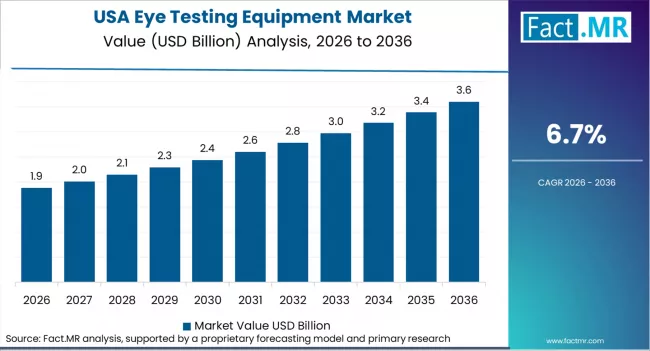
China leads with a CAGR of 9.5%, supported by a large population, increasing healthcare investments, and rising awareness of eye health. India follows with 8.8%, driven by rapid healthcare infrastructure development and growing demand for eye care services. Germany grows at 8.1%, benefiting from strong demand for diagnostic equipment in European healthcare systems. Brazil shows growth at 7.4%, fueled by improving access to healthcare and rising awareness of eye health. The USA grows at 6.7%, reflecting steady demand for advanced eye testing equipment in its well-established healthcare sector.
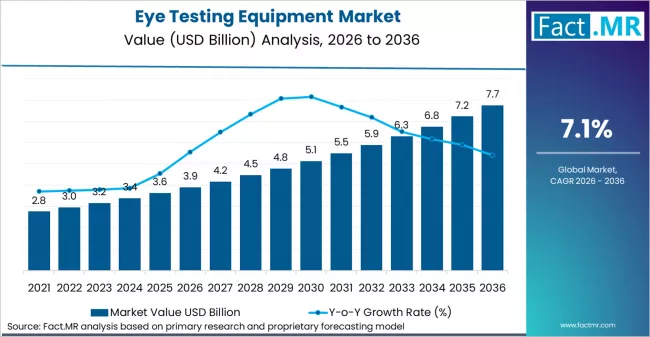
Eye Testing Equipment Market Market Value Analysis | Source: Fact.MR
Eye Testing Equipment Market
| Metric | Value |
|---|---|
| Estimated Value in (2026E) | USD 3.9 billion |
| Forecast Value in (2036F) | USD 7.6 billion |
| Forecast CAGR (2026 to 2036) | 7.1% |
Source: Fact.MR analysis. Updated Mar 5, 2026
Eye Testing Equipment Market Definition
The Eye Testing Equipment Market involves the manufacture and sale of diagnostic instruments used by eye care professionals to assess vision, screen for ocular conditions, and measure eye health parameters such as refractive error, intraocular pressure, and retinal structure.
Market Inclusions
This report covers global and regional market sizes for eye testing equipment over a defined forecast period, including device types (autorefractors, slit lamps, optical coherence tomography, tonometers), care settings (hospitals, clinics, optical retail), and distribution channels (direct, distributor, online).
Market Exclusions
The scope excludes general medical imaging equipment not specific to ophthalmic diagnosis, eyewear products (glasses, contact lenses), and vision screening tools not classified as diagnostic testing instruments.
Research Methodology
- Primary Research: Interviews were conducted with ophthalmologists, optometrists, equipment manufacturers, and procurement specialists.
- Desk Research: Data was sourced from industry reports, clinical publications, and trade association statistics.
- Market‑Sizing and Forecasting: A hybrid model combining top‑down healthcare demand forecasts with bottom‑up shipment and revenue data was used.
- Data Validation and Update Cycle: Findings were validated through expert review and aligned with recent production, adoption, and trade figures.
Summary of the Eye Testing Equipment Market
- Market Definition
- The Eye Testing Equipment Market involves the manufacture and sale of diagnostic instruments used by eye care professionals to assess vision, screen for ocular conditions, and measure eye health parameters such as refractive error, intraocular pressure, and retinal structure.
- Demand Drivers
- Rising Prevalence of Vision Disorders: An increasing global incidence of conditions like cataracts, glaucoma, and refractive errors is driving demand for advanced eye testing equipment.
- Aging Population: As populations age, the need for vision care and diagnostic testing becomes more critical, fueling market growth.
- Technological Advancements: Innovations in eye testing technologies, such as Optical Coherence Tomography (OCT) and retinal imaging, are enhancing diagnostic accuracy and contributing to the demand for modern equipment.
- Key Segments Analyzed
- End-Use: Hospitals are expected to capture 55% of the market share by 2026 due to their comprehensive services, including diagnostic and treatment capabilities for various eye conditions.
- Application Type: General examination is projected to hold 45% of the market share by 2026, as it remains a critical function for routine eye care and early detection of visual impairments.
- Geography: China leads with a CAGR of 9.5%, driven by its growing healthcare infrastructure and increasing awareness about eye health.
- Strategic Implications/Executive Takeaways
- Focus on Technological Integration: Companies should prioritize the development and integration of advanced diagnostic technologies, such as OCT and digital autorefractors, which are gaining popularity in the healthcare sector.
- Target Emerging Markets: With rising healthcare investments in countries like China and India, there are significant opportunities for expansion, particularly in emerging markets with growing demand for eye care services.
- Emphasize Preventive Care: As awareness of the importance of eye health increases, preventive care and early detection are driving demand for eye testing equipment.
- Methodology
- Primary Research: Interviews with ophthalmologists, optometrists, equipment manufacturers, and procurement specialists.
- Desk Research: Sourcing from industry reports, clinical publications, and trade association statistics.
- Market Sizing & Forecasting: A hybrid model combining top-down healthcare demand forecasts with bottom-up shipment and revenue data.
Segmental Analysis
Eye Testing Equipment Market Analysis by End Use
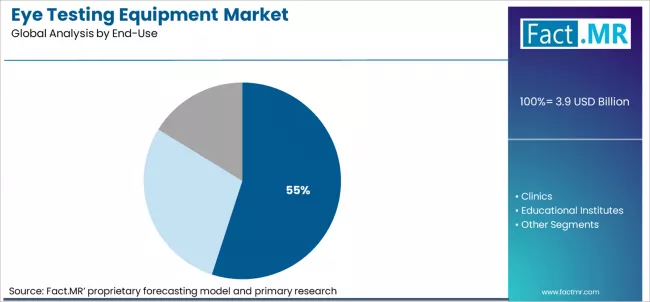
Eye Testing Equipment Market Analysis By End Use | Source: Fact.MR
-
Market Overview: Hospitals are expected to capture 55% of the market share by 2026. Hospitals dominate the eye testing equipment market due to their comprehensive healthcare services, including advanced diagnostic and treatment capabilities for eye diseases. These facilities are equipped with the necessary infrastructure for specialized testing and surgery, making them a primary end-user of eye testing equipment.
- Demand Drivers:
- Wide Range of Eye Care Services: Hospitals provide a broad spectrum of eye care services, including routine exams, surgeries, and specialized treatments, driving the demand for advanced eye testing equipment.
- Increased Prevalence of Eye Diseases: As the incidence of eye diseases like cataracts, glaucoma, and macular degeneration rises, hospitals are seeing a greater need for diagnostic equipment to detect and treat these conditions effectively.
- Technological Advancements: Hospitals are increasingly adopting the latest eye testing technologies, such as OCT (Optical Coherence Tomography) and retinal imaging, to improve diagnostic accuracy and patient outcomes.
Eye Testing Equipment Market Analysis by Application Type
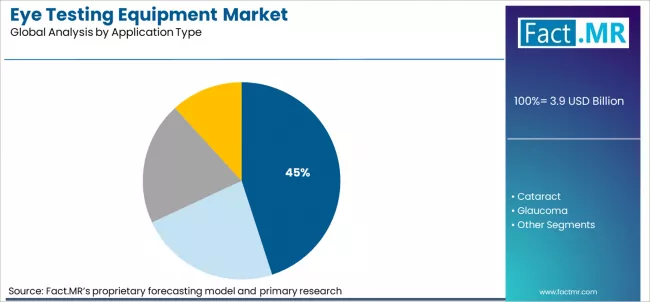
Eye Testing Equipment Market Analysis By Application Type | Source: Fact.MR
- Market Overview: General examination is projected to hold 45% of the market share by 2026. Eye testing for general examination remains a critical application in routine eye care, allowing healthcare providers to screen for various visual impairments and underlying conditions.
- Demand Drivers:
- Routine Eye Exams for Early Detection: General eye examinations are essential for detecting a wide range of visual impairments and eye diseases in their early stages, encouraging regular checkups and widespread use of eye testing equipment.
- Growing Awareness of Eye Health: Increasing public awareness about the importance of eye health and early detection of eye conditions is driving demand for general eye examination equipment.
- Preventive Care Focus: The shift towards preventive healthcare and routine screenings has led to an increase in demand for general eye examination equipment, particularly in hospitals and clinics.
Eye Testing Equipment Market Drivers, Restraints, and Opportunities
FMR analysts observe that the eye testing equipment market is a growth‑aligned healthcare diagnostics segment driven by rising prevalence of visual impairments, aging populations, and expanding access to eye care services. Historically, basic visual acuity charts and manual refraction tools dominated screenings; as the burden of refractive errors, glaucoma, diabetic retinopathy, and other vision disorders increased, structural demand emerged for advanced diagnostic devices that provide precise, early detection and monitoring. The 2026 valuation reflects this shift, with adoption tied to routine health checkups, preventive care programs, and broader integration of optometry services in primary healthcare.
While traditional instruments remain widely used in cost‑sensitive settings, advanced technologies such as optical coherence tomography (OCT), digital autorefractors, and automated perimetry are gaining share because they deliver higher diagnostic accuracy and efficiency. These higher‑value devices command premium pricing, contributing to net market value growth even as unit volumes grow moderately with healthcare infrastructure expansion. The market exists because effective eye testing underpins early intervention and better outcomes across a wide range of ocular conditions.
- Clinical Diagnosis Demand: Rising incidence of vision disorders and preventive screening programs drive uptake of advanced eye testing equipment over basic tools.
- Regulatory & Quality Standards: Healthcare standards and certification criteria push adoption of certified diagnostic devices that meet defined performance benchmarks.
- Regional Healthcare Trends: In North America and Europe, strong access to eye care and insurance coverage support advanced equipment uptake, while Asia‑Pacific shows rapid growth as services expand.
Regional Analysis
The market analysis covers key global regions, including East Asia, South Asia, Western Europe, North America, and Latin America. It is segmented geographically, with specific market dynamics for each region. The full report provides a detailed market attractiveness analysis.
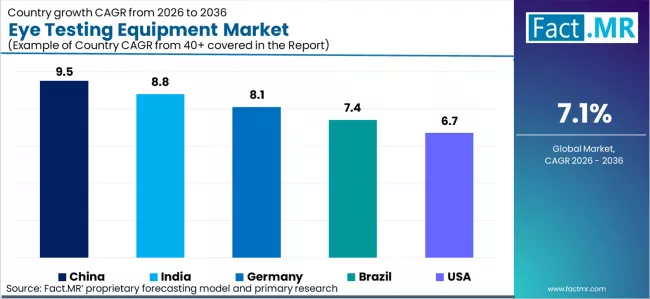
Eye Testing Equipment Market Cagr Analysis By Country | Source: Fact.MR
| Country | CAGR (2026-2036) |
|---|---|
| China | 9.5% |
| India | 8.8% |
| Germany | 8.1% |
| Brazil | 7.4% |
| USA | 6.7% |
Source: Fact.MR analysis. Updated Mar 5, 2026
Source: Fact MR (FMR) analysis, based on proprietary forecasting model and primary research.
East Asia:
In East Asia, China is the leading market for eye testing equipment, driven by the country’s rapidly expanding healthcare sector, increasing focus on vision care, and rising demand for advanced eye testing solutions.
- China: Demand for eye testing equipment in China is projected to rise at 9.5% CAGR through 2036. China’s growing healthcare infrastructure, rising prevalence of vision-related disorders, and increasing investments in eye care technologies continue to drive market growth.
South Asia:
In South Asia, India is a significant market for eye testing equipment, supported by the country’s large population, increasing healthcare investments, and rising demand for eye care solutions in both urban and rural areas.
- India: Demand for eye testing equipment in India is projected to rise at 8.8% CAGR through 2036. India’s expanding healthcare system, rising awareness of eye care, and growing demand for advanced vision testing technologies contribute to steady market growth.
Western Europe:
In Western Europe, Germany is a key market for eye testing equipment, driven by the country’s advanced healthcare system, rising demand for eye care services, and growing adoption of advanced diagnostic technologies.
- Germany: Demand for eye testing equipment in Germany is projected to rise at 8.1% CAGR through 2036. Germany’s strong healthcare infrastructure, growing focus on eye care and diagnostics, and increasing demand for high-quality eye testing devices continue to support market growth.
- France: Demand for eye testing equipment in France is projected to rise at 7.4% CAGR through 2036. France’s increasing focus on eye care technologies and growing adoption of advanced eye testing devices contribute to steady market growth.
North America:
Eye Testing Equipment Market Country Value Analysis | Source: Fact.MR
In North America, the USA remains a significant market for eye testing equipment, supported by the country’s advanced healthcare system, rising demand for vision care, and growing adoption of innovative eye testing technologies.
- USA: Demand for eye testing equipment in the U.S. is projected to rise at 6.7% CAGR through 2036. The USA’s strong healthcare system, rising awareness of eye health, and growing adoption of advanced diagnostic technologies continue to drive market growth.
Latin America:
In Latin America, Brazil is the largest market for eye testing equipment, driven by increasing healthcare investments, rising awareness of vision care, and growing adoption of advanced eye testing technologies in medical institutions.
- Brazil: Demand for eye testing equipment in Brazil is projected to rise at 7.4% CAGR through 2036. Brazil’s expanding healthcare system, growing focus on vision health, and increased demand for advanced eye testing equipment continue to fuel market growth.
Fact MR's analysis of the Eye Testing Equipment Market in East Asia, South Asia, Western Europe, North America, and Latin America consists of country-wise assessments that include China, India, Germany, Brazil, and the USA. Readers can find detailed trends, regulatory updates, and company-specific investments shaping the market’s growth in these countries.
What is the Competitive Structure and Buyer Behavior in the Eye Testing Equipment Market?
Eye Testing Equipment Market Analysis By Company | Source: Fact.MR
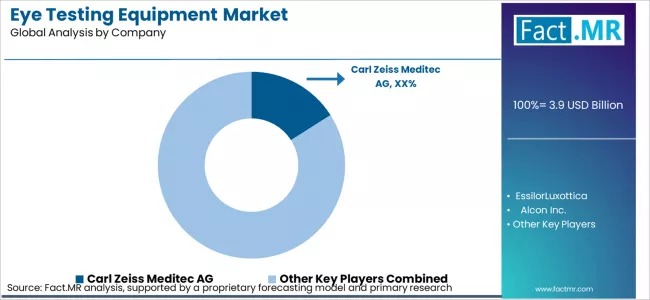
The eye testing equipment market is moderately concentrated, with major optical and medical device manufacturers such as Carl Zeiss Meditec AG, EssilorLuxottica, Alcon Inc., Topcon Corporation, NIDEK Co., Ltd., Canon Inc., Bausch + Lomb, and HEINE Optotechnik GmbH & Co. KG capturing a substantial share alongside smaller specialist providers. The primary competitive variables are measurement precision, ease of use, integration with digital imaging systems, and service reliability, all of which influence procurement by clinics, hospitals, and optical retailers. Companies with extensive R&D capabilities, broad product portfolios, and established global sales and service networks hold structural advantages because they can supply comprehensive diagnostic suites, maintain regulatory compliance, and support long‑term maintenance. Large ophthalmology practices and healthcare networks exert significant buyer leverage by qualifying multiple suppliers, negotiating pricing and service agreements, and standardizing equipment across practices. To manage supplier dependency, these buyers diversify vendor relationships and require consistent calibration and support terms, which limits individual suppliers’ pricing power. As a result, competition focuses on delivering reliable performance, integration with practice workflows, and strong after‑sales service rather than on price alone.
Recent Industry Developments
- "Lens-Free" Refraction Launch: On January 26, 2026, NIDEK launched the PHANTOM™ Open-field Refraction System, which eliminates physical lenses in front of the patient's eyes in favor of virtual lenses, reducing instrument-induced myopia and completing a full binocular exam in under five minutes.
- AI-Integrated "Healthcare from the Eye": Topcon Healthcare debuted its OMNIA 4-in-1 pre-testing platform in early 2026, which integrates with their AI-assisted Harmony® system to screen not only for diabetic retinopathy but also for early markers of cardiovascular and Alzheimer's disease.
- Digitalization of Existing Hardware: In February 2026, ZEISS Medical Technology invested in Custom Surgical to scale the MicroREC Connect system, a hardware-agnostic digital layer that retrofits existing analog slit lamps to capture and sync clinical images directly into cloud-based AI diagnostic workflows.
Key Players of the Eye Testing Equipment Market
- Carl Zeiss Meditec AG
- EssilorLuxottica
- Alcon Inc.
- Topcon Corporation
- NIDEK Co., Ltd.
- Canon Inc.
- Bausch + Lomb (Bausch Health Companies Inc.)
- HEINE Optotechnik GmbH & Co. KG
Report Scope
| Metric | Value |
|---|---|
| Quantitative Units | USD 3.9 billion (2026) to USD 7.6 billion (2036), at a CAGR of 7.1% |
| Market Definition | The Eye Testing Equipment Market includes instruments used for eye and vision testing, diagnosis, and treatment of conditions like cataracts, glaucoma, and general eye diseases across various end uses. |
| By Equipment Type | Slit Lamp, Perimeter, Bio Meter, Tonometer, Fundus Camera, Optical Coherence Tomography Scanner, Auto Refractor, Keratometer, Ophthalmoscope, Corneal Topography |
| By Application Type | General Examination, Cataract, Glaucoma, Other Eye Diseases |
| By End-Use | Hospitals, Clinics, Educational Institutes |
| Regions Covered | North America, Latin America, Europe, East Asia, South Asia, Oceania, Middle East and Africa |
| Countries Covered | United States, Canada, Mexico, Brazil, Argentina, Germany, France, United Kingdom, Italy, Spain, China, India, Japan, South Korea, Indonesia, Australia, and 40+ countries |
| Key Companies Profiled | Carl Zeiss Meditec AG, EssilorLuxottica, Alcon Inc., Topcon Corporation, NIDEK Co., Ltd., Canon Inc., Bausch + Lomb (Bausch Health Companies Inc.), HEINE Optotechnik GmbH & Co. KG |
| Forecast Period | 2026 to 2036 |
| Approach | Hybrid top-down and bottom-up market modeling validated through primary interviews with manufacturers and supported by trade data benchmarking and market research. |
Source: Fact.MR analysis. Updated Mar 5, 2026
Bibliographies
- Carl Zeiss Meditec AG. (2023). Innovations in eye testing equipment: Enhancing precision in vision diagnostics.
- Alcon Inc. (2023). Advanced technologies in ophthalmology: The role of eye testing equipment.
- Topcon Corporation. (2023). Leading advancements in eye care technology: The future of eye testing equipment.
- NIDEK Co., Ltd. (2023). Eye testing solutions for better diagnostics and treatment outcomes.
- NIDEK. (2026). NIDEK launches the PHANTOM™ Open-field Refraction System. NIDEK.
- Topcon Healthcare. (2026). What to expect from Topcon Healthcare at Vision Expo 2026. Topcon Healthcare.
- ZEISS. (2026). ZEISS invests in Custom Surgical to accelerate digitalization of eye health diagnostics. ZEISS.
This report addresses:
- Market intelligence enabling comprehensive assessment of leading countries and product segments across the Eye Testing Equipment Market globally.
- Market volume (sales units) estimates and 10-year revenue forecasts from 2026 to 2036, validated through manufacturer shipment data, channel partner surveys, and country-level demand modeling.
- Growth opportunity mapping across equipment types (Slit Lamp, Perimeter, Bio Meter, Tonometer, Fundus Camera, Optical Coherence Tomography Scanner, Auto Refractor, Keratometer, Ophthalmoscope, Corneal Topography), application types (General Examination, Cataract, Glaucoma, Other Eye Diseases), and end-use industries (Hospitals, Clinics, Educational Institutes).
- Segment and regional revenue forecasts by equipment type, application type, end-use industry, and geography across 40+ countries.
- Competition strategy analysis covering dealer network structure, recent developments, product portfolio, USPs, and market share analysis.
- Product and regulatory compliance tracking aligned with material safety standards, consumer product regulations, and healthcare compliance guidelines.
- Regulatory impact analysis addressing healthcare regulations, medical device certifications, and product safety standards across key markets.
- Report delivery in PDF, Excel, PowerPoint, and interactive dashboard formats for executive, procurement, and operational planning use.
Segmentation
Eye Testing Equipment Market Key Segments
-
Equipment Type :
- Slit Lamp
- Perimeter
- Bio Meter
- Tonometer
- Fundus Camera
- Optical Coherence Tomography Scanner
- Auto Refractor
- Keratometer
- Ophthalmoscope
- Corneal Topography
-
Application Type :
- General Examination
- Cataract
- Glaucoma
- Other Eye Diseases
-
End-Use Industry :
- Hospitals
- Clinics
- Educational Institutes
-
Region :
- North America
- USA
- Canada
- Mexico
- Europe
- Germany
- UK
- France
- Italy
- Spain
- Nordic Countries
- BENELUX
- Rest of Europe
- Asia Pacific
- China
- Japan
- South Korea
- India
- Australia
- Rest of Asia Pacific
- Latin America
- Brazil
- Argentina
- Rest of Latin America
- Middle East and Africa
- Kingdom of Saudi Arabia
- United Arab Emirates
- South Africa
- Rest of Middle East and Africa
- Other Regions
- Oceania
- Central Asia
- Other Markets
- North America
Frequently Asked Questions
How large is the demand for Eye Testing Equipment in the global market in 2026?
What will be the market size of Eye Testing Equipment in the global market by 2036?
What is the expected demand growth for Eye Testing Equipment in the global market between 2026 and 2036?
Which end-use sector is expected to dominate the market?
Which region is expected to show the highest growth rate for Eye Testing Equipment?
How significant is the growth outlook for India in this market?
What is the growth outlook for Germany in the Eye Testing Equipment market?
What is the growth forecast for Brazil in the Eye Testing Equipment market?
What is the growth forecast for the United States in the Eye Testing Equipment market?
Which company is identified as a leading player in the Eye Testing Equipment market?
What are Eye Testing Equipment used for?
What does the Eye Testing Equipment market include in this report?
How is the market forecast developed in this report?
What is meant by the Eye Testing Equipment market in this report?
Who worked on this report


Preview the report firsthand - request a free sample
Free SampleGet the brochure for pricing and purchase details
Download PDF