- Base Value(2025): 640.0 Mn
- Estimated Value(2026): 679.7 Mn
- Forecast Value (2036): 1240.4 Mn
- CAGR (2026 - 2036): 6.2%
HSV Testing Market Analysis and Forecast by Fact.MR
- The global HSV testing market is estimated at US$ 640.0 million in 2025 and has been forecast to expand at a CAGR of 6.2% to reach US$ 1.2 billion by 2036.
- HSV testing encompasses molecular diagnostic, serological, and rapid test products used to detect herpes simplex virus type 1 (HSV-1) and type 2 (HSV-2) infections.
- Molecular diagnostic test kits, primarily PCR-based, account for the largest product share due to superior sensitivity for active infection detection.
- Clinical diagnosis is the primary application. Blood-based serological testing and swab-based molecular testing serve complementary clinical roles. Hospitals and diagnostic laboratories form the core testing infrastructure.
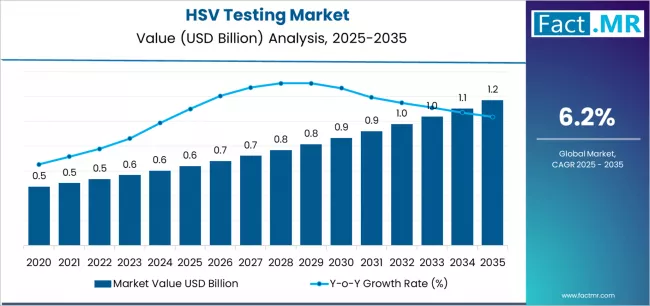
Hsv Testing Market Market Value Analysis | Source: Fact.MR
Summary of HSV Testing Market
- Market Snapshot
- In 2025, the global HSV Testing Market was valued at approximately USD 640.0 million.
- The market is estimated to reach USD 679.7 million in 2026 and is projected to attain USD 1.2 billion by 2036.
- The hsv testing market is likely to expand at a CAGR of 6.2% during the forecast period.
- The market is anticipated to create an absolute dollar opportunity of USD 560.7 million between 2026 and 2036.
- Molecular Diagnostic Test Kits accounts for 38.9% of product share in 2026.
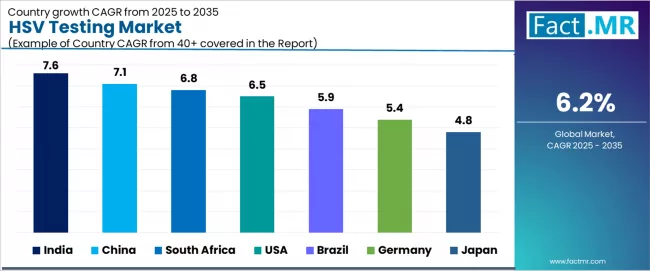
- India (7.6%) and China (7.1%) are the key growth markets during the forecast period.
- Demand and Growth Drivers
- Global HSV-2 seroprevalence affecting an estimated 491 million people aged 15 to 49 creates a large population with undiagnosed infection that could benefit from testing.
- Neonatal herpes prevention efforts through antenatal HSV screening are expanding testing volumes in prenatal care programs across multiple countries.
- Molecular HSV testing adoption in sexual health clinics is replacing less sensitive viral culture methods, improving diagnostic accuracy for active genital herpes lesions.
- HSV-HIV co-infection management, where HSV-2 seropositivity increases HIV acquisition risk, is driving testing integration into HIV prevention and treatment programs.
- Point-of-care rapid HSV testing development is enabling same-visit diagnosis and treatment initiation in sexual health and primary care settings.
- Product and Segment View
- Molecular Diagnostic Test Kits accounts for 38.9% of the product segment in 2026, supported by strong installed base and continued procurement across primary end use channels.
- Polymerase Chain Reaction Technology accounts for 41.6% of the technology segment in 2026, reflecting concentrated demand across established application areas.
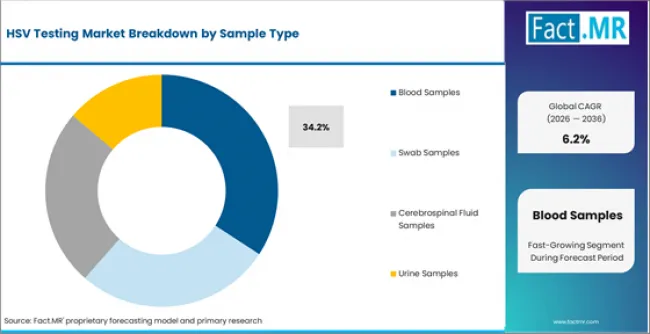
- Blood Samples accounts for 34.2% of the sample type segment in 2026, with adoption rising across both developed and emerging markets.
- Key segmentation includes:
- Product: Molecular Diagnostic Test Kits, Serology Test Kits, Rapid Diagnostic Test Kits
- Technology: Polymerase Chain Reaction Technology, Isothermal Amplification Technology, Immunoassay Technology
- Sample Type: Blood Samples, Swab Samples, Cerebrospinal Fluid Samples
- Application: Clinical Diagnosis, Screening, Prognosis and Monitoring
- These systems enable:
- Targeted procurement and specification alignment across buyer segments
- Performance benchmarking across product and application categories
- Regional demand mapping across 30 plus countries
- Geography and Competitive Outlook
- North America accounts for a large share of global demand, supported by established procurement channels and a mature buyer base.
- Europe shows stable demand, with Germany (5.4%) contributing through regulatory compliance and institutional procurement for hsv testing products.
- Asia Pacific demand is led by India (7.6%) and China (7.1%).
- India (7.6%) and China (7.1%) are the fastest growing country markets during the forecast period.
- Leading companies include F. Hoffmann-La Roche Ltd, Abbott, Thermo Fisher Scientific Inc., BD, Bio-Rad Laboratories Inc..
- Analyst Opinion
- Shambhu Nath Jha, Principal Consultant at Fact.MR, says 'The HSV testing market is a specialized segment within infectious disease diagnostics where growth is driven by molecular testing adoption, multiplex panel inclusion, and sexual health clinic infrastructure development. Roche leads through its molecular diagnostics platform and broad infectious disease test menu. The market is constrained by guideline recommendations against universal asymptomatic screening, but multiplex STI panel inclusion and neonatal screening programs are expanding testing volumes through alternative clinical pathways. HSV vaccine development success would be a transformative market expansion event.'
Key Growth Drivers, Constraints, and Opportunities
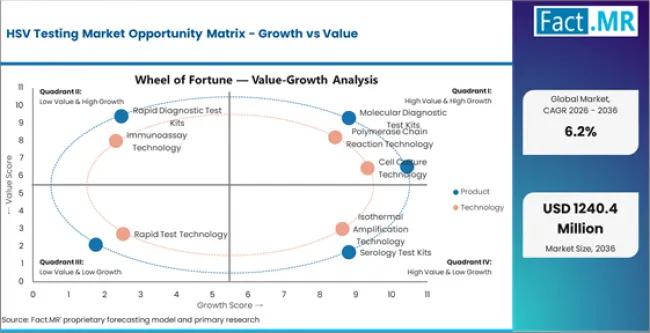
Hsv Testing Market Opportunity Matrix Growth Vs Value | Source: Fact.MR
Key Factors Driving Growth
- Global HSV-2 seroprevalence affecting an estimated 491 million people aged 15 to 49 creates a large population with undiagnosed infection that could benefit from testing.
- Neonatal herpes prevention efforts through antenatal HSV screening are expanding testing volumes in prenatal care programs across multiple countries.
- Molecular HSV testing adoption in sexual health clinics is replacing less sensitive viral culture methods, improving diagnostic accuracy for active genital herpes lesions.
Key Market Constraints
- Asymptomatic HSV infection in the majority of seropositive individuals creates limited clinical motivation for population-level serological screening.
- CDC and USPSTF guidelines currently do not recommend universal HSV-2 serological screening in asymptomatic individuals, limiting systematic screening adoption.
- Serological test performance limitations, particularly false-positive results at low index values, create clinical interpretation challenges and patient anxiety.
Key Opportunity Areas
- HSV vaccine development programs, if successful, would create a large-scale pre-vaccination testing market to identify seronegative individuals eligible for immunization.
- Multiplex STI testing panels that include HSV alongside chlamydia, gonorrhea, syphilis, and HIV are increasing HSV testing as a component of comprehensive sexual health assessment.
- Emerging market sexual health clinic infrastructure development is creating first-time testing access in populations with high HSV-2 seroprevalence.
Segment-wise Analysis of the HSV Testing Market
- Molecular Diagnostic Test Kits holds 38.9% of the product segment in 2026, supported by established demand channels and continued procurement across primary end use applications.
- Polymerase Chain Reaction Technology holds 41.6% of the technology segment in 2026, supported by established demand channels and continued procurement across primary end use applications.
- Blood Samples holds 34.2% of the sample type segment in 2026, supported by established demand channels and continued procurement across primary end use applications.
The hsv testing market is segmented by product, technology, sample type, application, and region.
By product, the market covers Molecular Diagnostic Test Kits, Serology Test Kits, Rapid Diagnostic Test Kits.
By technology, coverage includes Polymerase Chain Reaction Technology, Isothermal Amplification Technology, Immunoassay Technology.
Which Product Segment Dominates the HSV Testing Market?
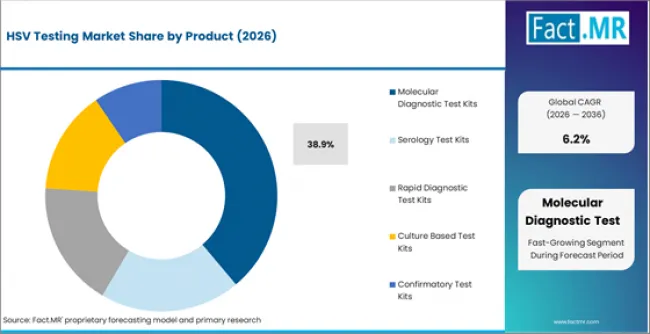
Hsv Testing Market Analysis By Product | Source: Fact.MR
Molecular Diagnostic Test Kits is expected to account for 38.9% of the product segment in 2026. Within this category, PCR Based HSV 1 Test Kits, PCR Based HSV 2 Test Kits, Multiplex HSV Detection Kits represent the primary sub-segments generating procurement activity. The depth of the molecular diagnostic test kits installed base across product applications sustains replacement demand and limits share erosion from newer alternatives in the hsv testing market.
Serology Test Kits is the second largest category in the product segment, with demand concentrated in IgG Antibody Test Kits and IgM Antibody Test Kits. Growth in serology test kits reflects shifting buyer requirements within the hsv testing market toward this category.
Which Technology Segment Dominates the HSV Testing Market?
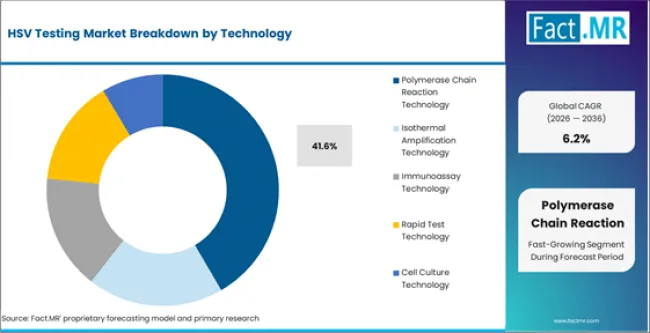
Hsv Testing Market Analysis By Technology | Source: Fact.MR
Polymerase Chain Reaction Technology is expected to account for 41.6% of the technology segment in 2026. Within this category, Real Time PCR, Conventional PCR represent the primary sub-segments generating procurement activity. The depth of the polymerase chain reaction technology installed base across technology applications sustains replacement demand and limits share erosion from newer alternatives in the hsv testing market.
Isothermal Amplification Technology is the second largest category in the technology segment, with demand concentrated in LAMP Based HSV Detection and NAAT Based Platforms. Growth in isothermal amplification technology reflects shifting buyer requirements within the hsv testing market toward this category.
Which Sample Type Segment Dominates the HSV Testing Market?
Hsv Testing Market Analysis By Sample Type | Source: Fact.MR
Blood Samples is expected to account for 34.2% of the sample type segment in 2026. Within this category, Serum Samples, Plasma Samples represent the primary sub-segments generating procurement activity. The depth of the blood samples installed base across sample type applications sustains replacement demand and limits share erosion from newer alternatives in the hsv testing market.
Swab Samples is the second largest category in the sample type segment, with demand concentrated in Genital Swabs and Oral Swabs. Growth in swab samples reflects shifting buyer requirements within the hsv testing market toward this category.
Which Product Trend is Shaping the Next Phase of Growth in the HSV Testing Market?
Multiplex STI molecular testing panels represent the product trend with the highest impact on HSV testing market expansion. Platforms that combine HSV-1, HSV-2, syphilis, chlamydia, gonorrhea, and trichomonas detection from a single swab or blood specimen are transforming sexual health testing from targeted single-pathogen assessment to comprehensive STI profiling. This approach increases the number of clinical encounters where HSV testing is performed.
Roche, Abbott, Hologic, and BD are developing and marketing multiplex STI panels with HSV components. The clinical and laboratory efficiency of multiplex testing justifies per-panel pricing that is higher than individual assays, creating a premium revenue tier. For the HSV testing market, inclusion in multiplex panels expands testing volume beyond dedicated HSV diagnostic ordering to become a routine component of standard sexual health workups.
Regional Outlook Across Key Markets
.webp "Top Country Growth Comparison Hsv Testing Market Cagr (2026 2036)")
Top Country Growth Comparison Hsv Testing Market Cagr (2026 2036) | Source: Fact.MR
- India is growing at 7.6%, supported by NACO STI program expansion, private laboratory molecular testing, and sexual health awareness.
- China is growing at 7.1%, supported by hospital STI diagnostic expansion, domestic multiplex panel development, and reporting requirements.
- South Africa is growing at 6.8%, supported by high HSV-2 seroprevalence, HIV co-infection research, and primary care STI protocols.
- USA is growing at 6.5%, supported by molecular diagnostic adoption, reference laboratory infrastructure, and sexual health clinic access.
CAGR Table
| Country | CAGR (%) |
|---|---|
| India | 7.6% |
| China | 7.1% |
| South Africa | 6.8% |
| USA | 6.5% |
| Brazil | 5.9% |
| Germany | 5.4% |
| Japan | 4.8% |
Source: Fact.MR analysis. Updated May 27, 2026
Source: Fact MR (FMR) analysis, based on proprietary forecasting model and primary research.
Hsv Testing Market Cagr Analysis By Country | Source: Fact.MR
Market Outlook for HSV Testing in India
The India HSV Testing market is projected to grow at a CAGR of 7.6% through 2036. India is the fastest-growing HSV testing market, driven by sexual health clinic development and STI screening program expansion.
- National AIDS Control Organisation (NACO) STI management programs include HSV testing as part of syndromic management protocols.
- Private diagnostic laboratory chains are expanding molecular STI testing panels that include HSV-1 and HSV-2 detection.
- Growing sexual health awareness among urban populations is increasing voluntary testing demand at private clinics.
HSV Testing Demand Trends in China
The China HSV Testing market is projected to grow at a CAGR of 7.1% through 2036. Hospital STI diagnostic capability expansion and growing sexual health awareness support HSV testing growth in China.
- Hospital dermatology and STI departments provide the primary testing infrastructure for HSV diagnosis in urban centers.
- Domestic molecular diagnostic companies are developing multiplex STI panels including HSV for the Chinese clinical market.
- National STI reporting requirements support institutional testing for symptomatic patients presenting at clinical facilities.
South Africa HSV Testing Market Growth Outlook
The South Africa HSV Testing market is projected to grow at a CAGR of 6.8% through 2036. High HSV-2 seroprevalence and HIV co-infection management drive testing demand in South Africa.
- HSV-2 seroprevalence exceeding 50% among adults in southern Africa creates a large testing-eligible population.
- HSV-HIV co-infection research programs at university medical centers generate testing demand for clinical studies.
- Primary healthcare clinic STI management protocols include HSV assessment as part of genital ulcer disease workup.
USA HSV Testing Market Demand Analysis
Hsv Testing Market Country Value Analysis | Source: Fact.MR
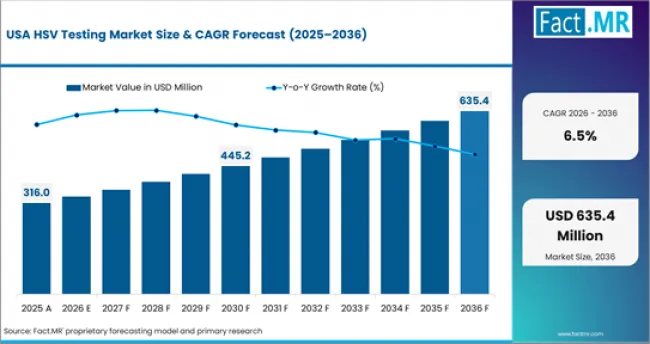
The USA HSV Testing market is projected to grow at a CAGR of 6.5% through 2036. The U.S. is a major HSV testing market, driven by molecular diagnostic adoption and sexual health clinic infrastructure.
- CDC STI treatment guidelines recommend type-specific HSV testing for patients presenting with genital lesions.
- Reference laboratory molecular HSV testing through Quest, Labcorp, and hospital laboratories serves the majority of diagnostic volume.
- Planned Parenthood and community sexual health clinics provide accessible testing for at-risk populations.
HSV Testing Market Growth Assessment in Brazil
The Brazil HSV Testing market is projected to grow at a CAGR of 5.9% through 2036. Growing STI screening programs and sexual health clinic infrastructure support HSV testing in Brazil.
- SUS STI management programs provide clinical framework for HSV testing in public health facilities.
- Diagnostic laboratory chain expansion in major cities improves access to molecular and serological HSV testing.
- Sexual health awareness campaigns during Carnival and public health events promote STI testing including HSV.
HSV Testing Market Opportunity Outlook in Germany
The Germany HSV Testing market is projected to grow at a CAGR of 5.4% through 2036. Established STI diagnostic infrastructure and clinical laboratory capability sustain HSV testing demand in Germany.
- Robert Koch Institut STI surveillance data informs clinical testing recommendations for HSV and other sexually transmitted infections.
- Dermatology and STI specialty clinics provide the primary clinical settings for symptomatic HSV diagnostic testing.
- Statutory health insurance covers indicated HSV diagnostic testing through established laboratory ordering pathways.
Demand Landscape for HSV Testing in Japan
Hsv Testing Market Japan Market Share Analysis By Product | Source: Fact.MR
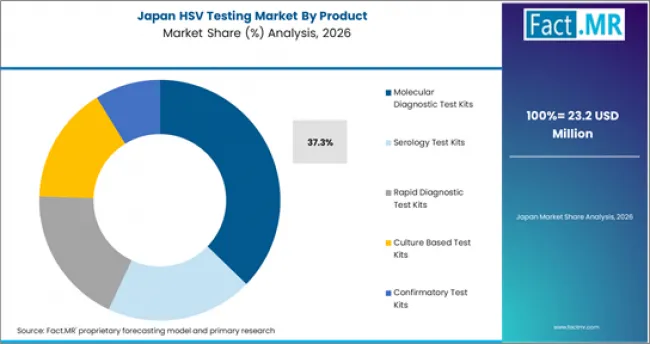
The Japan HSV Testing market is projected to grow at a CAGR of 4.8% through 2036. Conservative sexual health policy and clinical diagnostic standards shape HSV testing demand in Japan.
- Hospital dermatology and urology departments provide the primary HSV diagnostic testing infrastructure.
- JAAD (Japanese Association for the Study of Sexually Transmitted Diseases) guidelines inform clinical testing practices.
- Molecular diagnostic adoption for HSV is growing in hospital laboratories replacing less sensitive viral culture methods.
Competitive Benchmarking and Company Positioning
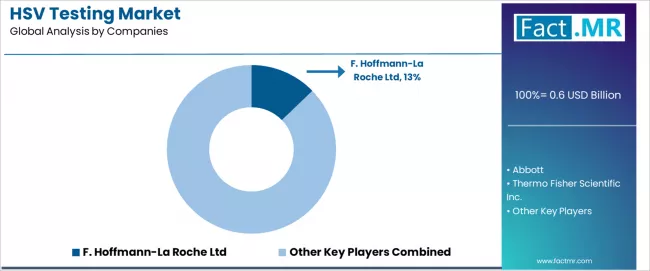
Hsv Testing Market Analysis By Company | Source: Fact.MR
HSV Testing Market Analysis By Company
- F. Hoffmann-La Roche Ltd, Abbott, Thermo Fisher Scientific Inc., BD hold established positions in the global hsv testing market through broad product portfolios, geographic reach, and growing capabilities in higher specification categories.
- Bio-Rad Laboratories Inc., bioMérieux SA, DiaSorin S.p.A., Hologic Inc. participate across specific price tiers, end use segments, and regional channels, with competition shaped by product quality, service support, and distribution access.
- Molecular diagnostic platform sensitivity, multiplex STI panel menu breadth, and sexual health clinic customer relationships are the primary competitive differentiators.
F. Hoffmann-La Roche Ltd leads the HSV testing market through its cobas molecular diagnostics platform and broad infectious disease menu. Abbott competes through its Alinity and m2000 molecular platforms. Thermo Fisher Scientific serves through its Applied Biosystems PCR reagent ecosystem. BD participates through its MAX molecular diagnostic system. Bio-Rad Laboratories serves serological HSV testing through its immunoassay product line.
Competition is shaped by molecular platform installed base in hospital and reference laboratory settings, with multiplex STI panel capability creating a competitive advantage over single-analyte HSV tests. Serological testing competes on immunoassay platform consolidation in large laboratories. Rapid point-of-care HSV testing is an emerging competitive segment where device accuracy, ease of use, and CLIA-waived status drive adoption in sexual health clinic settings.
Key Companies in the HSV Testing Market
- F. Hoffmann-La Roche Ltd, Abbott, Thermo Fisher Scientific Inc., BD are among the leading players in the hsv testing market globally, supported by strong brand visibility and broad product portfolios.
- Bio-Rad Laboratories Inc., bioMérieux SA, DiaSorin S.p.A., Hologic Inc. hold established positions across specific categories, supported by durable products and regional distribution.
Recent Industry Developments
- F. Hoffmann-La Roche Ltd - Multiplex STI Panel (January 2026)
- F. Hoffmann-La Roche Ltd launched an expanded multiplex STI molecular panel detecting HSV-1, HSV-2, syphilis, chlamydia, gonorrhea, and trichomonas from a single genital swab specimen.
- Abbott - Rapid POC HSV Test (2025)
- Abbott introduced a CLIA-waived rapid point-of-care HSV-1/HSV-2 serological test delivering type-specific results in under 15 minutes for sexual health clinic use.
- Thermo Fisher Scientific Inc. - Neonatal HSV Panel (2025)
- Thermo Fisher Scientific Inc. expanded its neonatal testing menu with a dedicated HSV PCR panel for rapid detection of neonatal herpes from CSF and surface swab specimens.
- BD - Digital STI Platform (February 2026)
- BD announced a digital STI testing platform integrating home specimen collection with laboratory molecular HSV testing and telehealth result counseling.
Leading Companies Shaping the HSV Testing Market
- F. Hoffmann-La Roche Ltd
- Abbott
- Thermo Fisher Scientific Inc.
- BD
- Bio-Rad Laboratories Inc.
- bioMérieux SA
- DiaSorin S.p.A.
- Hologic Inc.
- Cepheid
- QuidelOrtho Corporation
Sources and Research References
- F. Hoffmann-La Roche Ltd. Product portfolio and corporate announcements.
- Abbott. Product portfolio and corporate announcements.
- Thermo Fisher Scientific Inc.. Product portfolio and corporate announcements.
- Industry association statistics, regulatory publications, trade databases, and company product catalogs.
- Primary interviews with manufacturers, distributors, buyers, and institutional users.
This bibliography is provided for reader reference and is not exhaustive. The full report contains the complete reference list and detailed citations.
Key Questions This Report Addresses
- What is the current and future size of the HSV Testing Market?
- How fast is the HSV Testing Market expected to grow between 2026 and 2036?
- Which product is likely to lead the market by 2026?
- Which technology segment is expected to account for the highest demand by 2026?
- What factors are driving demand in this market globally?
- How is technology adoption influencing the market structure?
- Which countries are projected to show the fastest growth through 2036?
- What is driving market expansion in India and China?
- Who are the key companies active in the HSV Testing Market?
- How does Fact.MR estimate and validate the market forecast?
HSV Testing Market Definition
The hsv testing market covers products, technologies, and services associated with product, technology, sample type categories. The scope includes global and regional market size and forecasts for 2026 to 2036 across product, technology, sample type, application, and region.
HSV Testing Market Inclusions
- The scope covers global and regional market size and forecasts for 2026 to 2036 across product, technology, sample type, application, and region.
- It includes regional demand analysis across major geographies, based on factors such as technology adoption, regulatory requirements, institutional spending, and commercial demand patterns.
- The report includes pricing and cost analysis across entry-level, mid-range, and premium categories, including hardware, software, and service components where applicable.
- It covers technology trends, market drivers and constraints, and the competitive landscape, including product portfolios, pricing strategy, geographic reach, and distribution expansion of leading players.
HSV Testing Market Exclusions
- The scope excludes adjacent categories, general-purpose alternatives, and products not specifically classified under the hsv testing market taxonomy.
- It excludes custom-built in-house solutions, informal unbranded products with low market visibility, and rental or leasing services without direct product sales.
- The report excludes military or defense-grade variants, industrial systems outside the defined scope, and non-commercial applications without market transaction data.
- It also excludes software-only platforms sold independently from hardware, unless they are part of the defined product or service taxonomy.
HSV Testing Market Research Methodology
- The methodology combines secondary research, primary interviews, and forecast modelling.
- It draws on 120 plus secondary sources and benchmarks 65 plus company product portfolios.
- Market sizing covers 30 plus countries through a demand-side model, supported by top-down validation.
- Key inputs include end use adoption rates, technology penetration, pricing benchmarks, and regional procurement patterns.
- The model cross-checks demand with shipments, pricing trends, channel mix, and product launches.
- Primary validation includes 25 plus interviews across manufacturers, distributors, buyers, and institutional users.
- Final estimates go through trade-flow checks, sales-pattern review, and sensitivity testing.
Segmentation
Scope of Analysis
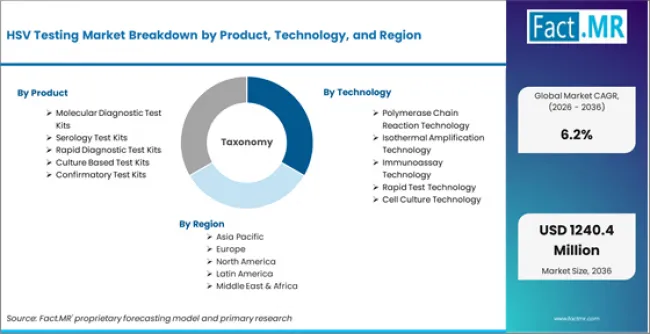
Hsv Testing Market Breakdown By Product, Technology, And Region | Source: Fact.MR
| Parameter | Details |
|---|---|
| Quantitative Units | USD 679.7 million to USD 1.2 billion, at a CAGR of 6.2% |
| Market Definition | The HSV Testing Market covers products, technologies, and services across product, technology, sample type categories for commercial, institutional, and consumer applications. |
| Regions Covered | North America, Latin America, Europe, East Asia, South Asia and Pacific, Middle East and Africa |
| Countries Covered | USA, Canada, UK, Germany, China, India, 30 plus countries |
| Key Companies | F. Hoffmann-La Roche Ltd, Abbott, Thermo Fisher Scientific Inc., BD, Bio-Rad Laboratories Inc., bioMérieux SA, DiaSorin S.p.A., Hologic Inc., Cepheid, QuidelOrtho Corporation |
| Forecast Period | 2026 to 2036 |
| Approach | Hybrid demand-side and top-down methodology built on country-level application demand, product benchmarking, pricing analysis, shipment validation, and primary interviews across manufacturers, distributors, and end users |
Source: Fact.MR analysis. Updated May 27, 2026
HSV Testing Market Segmentation
-
HSV Testing Market Segmented by Product:
- Molecular Diagnostic Test Kits
- PCR Based HSV 1 Test Kits
- PCR Based HSV 2 Test Kits
- Multiplex HSV Detection Kits
- Serology Test Kits
- IgG Antibody Test Kits
- IgM Antibody Test Kits
- Combined IgG and IgM Test Kits
- Rapid Diagnostic Test Kits
- Lateral Flow Immunoassay Kits
- Point of Care HSV Test Kits
- Culture Based Test Kits
- Viral Cell Culture Kits
- Shell Vial Culture Kits
- Confirmatory Test Kits
- Laboratory Confirmation Panels
- Reference Standard Testing Kits
- Molecular Diagnostic Test Kits
-
HSV Testing Market Segmented by Technology:
- Polymerase Chain Reaction Technology
- Real Time PCR
- Conventional PCR
- Isothermal Amplification Technology
- LAMP Based HSV Detection
- NAAT Based Platforms
- Immunoassay Technology
- ELISA Based Testing
- Chemiluminescence Immunoassay
- Rapid Test Technology
- Lateral Flow Assay
- Immunochromatographic Assay
- Cell Culture Technology
- Viral Culture Methods
- Fluorescent Antibody Testing
- Polymerase Chain Reaction Technology
-
HSV Testing Market Segmented by Sample Type:
- Blood Samples
- Serum Samples
- Plasma Samples
- Swab Samples
- Genital Swabs
- Oral Swabs
- Lesion Swabs
- Cerebrospinal Fluid Samples
- Urine Samples
- Blood Samples
-
HSV Testing Market Segmented by Application:
- Clinical Diagnosis
- Primary HSV Infection Diagnosis
- Recurrent Infection Detection
- Screening
- Antenatal HSV Screening
- Sexual Health Screening
- Prognosis and Monitoring
- Viral Load Monitoring
- Treatment Response Monitoring
- Research Applications
- Epidemiological Studies
- Vaccine Development Research
- Clinical Diagnosis
-
HSV Testing Market Segmented by End Use:
- Hospitals
- Public Hospitals
- Private Hospitals
- Diagnostic Laboratories
- Central Laboratories
- Independent Diagnostic Centers
- Specialty Clinics
- Sexual Health Clinics
- Dermatology Clinics
- Research Institutes
- Academic Research Centers
- Biomedical Research Organizations
- Home Care Settings
- Self Testing Users
- Telehealth Supported Testing
- Hospitals
-
HSV Testing Market by Region:
- North America
- USA
- Canada
- Mexico
- Latin America
- Brazil
- Chile
- Rest of Latin America
- Western Europe
- Germany
- UK
- Italy
- Spain
- France
- Nordic
- BENELUX
- Rest of Western Europe
- Eastern Europe
- Russia
- Poland
- Hungary
- Balkan & Baltic
- Rest of Eastern Europe
- East Asia
- China
- Japan
- South Korea
- South Asia and Pacific
- India
- ASEAN
- Australia & New Zealand
- Rest of South Asia and Pacific
- Middle East & Africa
- Kingdom of Saudi Arabia
- Other GCC Countries
- Turkiye
- South Africa
- Other African Union
- Rest of Middle East & Africa
- North America
Frequently Asked Questions
How big is the hsv testing market in 2026?
What will be the size of hsv testing market in 2036?
How much will be the hsv testing market growth between 2026 and 2036?
What are the key product types in the hsv testing market?
Which technology segment is expected to contribute significant share in the hsv testing market in 2026?
Who worked on this report


Preview the report firsthand - request a free sample
Free SampleGet the brochure for pricing and purchase details
Download PDF