- Market Value (2025): USD 2.7 Bn
- Estimated Value (2026): USD 3.0 Bn
- Forecast Value (2036): USD 6.5 Bn
- CAGR (2026-2036): 8.2%
What is the Fast-Ignition Propulsion Modules Market forecast to be worth by 2036?
USD 3.0 billion in 2026 to USD 6.5 billion by 2036 at an 8.2% CAGR.
- As per Fact.MR analysis, the Fast-Ignition Propulsion Modules Market reached USD 2.7 billion in 2025.
- Demand is projected to increase from USD 3.0 billion in 2026 to USD 6.5 billion by 2036.
- The market is forecast to record an 8.2% CAGR from 2026 to 2036.
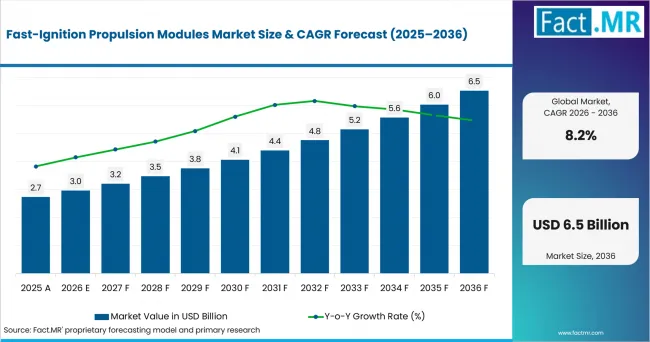
Fast Ignition Propulsion Modules Market Value Analysis | Source: Fact.MR
What are the defining numbers behind Fast-Ignition Propulsion Modules Market growth?
An absolute opportunity of USD 3.5593 billion is expected between 2026 and 2036.
- Demand Drivers in the Market
- Satellite operators need propulsion units that respond quickly when mission plans change. In December 2025, the UK Space Agency committed £17 million to space projects that included work on refuellable electric propulsion [1].
- Defence satellites need propulsion systems for fast orbit changes and repeated starts. Compact systems reduce extra weight and leave more space for other equipment while keeping the satellite ready to change its orbit.
- Small satellites need compact propulsion units because space and weight are limited. Simple connections between the tank, valves, and control unit make installation easier and help builders plan power use and available space.
- Mission planners need reliable ignition to control satellites and avoid collisions. A system that starts within a known time also helps with orbit changes and planned deorbiting, making each move easier to time and control.
- Key Segments Analyzed
- By Module Propulsion: Green monopropellant is expected to hold a 35.0% share in 2026 because its lower toxicity makes handling and installation easier while still providing fast chemical thrust.
- By Ignition: Catalytic ignition is projected to account 31.0% share in 2026 because proven catalyst systems allow monopropellant thrusters to start reliably many times.
- By Response: Less than 25 ms is anticipated to capture 37.0% share in 2026 because a fast response helps satellites quickly change position and avoid collisions.
- By Mission: Collision avoidance is estimated to represent 33.0% share in 2026 as more satellites operate in orbit and need to move safely when a possible collision is detected.
- Analyst Opinion at Fact.MR
- Shambhu Nath Jha, Principal Consultant at Fact.MR, states, “Fast ignition helps satellites respond quickly when they need to change position or orbit. Satellite operators check how quickly the propulsion system starts and how reliably it restarts. Suppliers need reliable ignition, compact systems, and clear test results to support missions that require quick action.”
- Strategic Implications
- Thruster suppliers should have enough testing space before increasing production. In July 2025, SITAEL opened a Smart Space Factory in Pisa with five thermal-vacuum chambers for building and testing electric thrusters.
- Satellite makers should choose the thrust level and fuel type based on how quickly the satellite needs to move. The system must also meet the satellite’s power and weight limits. Early checks can reduce design changes later.
- Defence programs need propulsion systems that can make fast orbit changes and work after long periods without use. The system must also be safe to store and handle during launch.
- Small-satellite makers should keep the propulsion system simple to connect and control. This makes installation easier and reduces design changes when the same satellite design is used for different missions.
The UK is expected to grow at 10.2% CAGR through 2036 as funding supports propulsion testing and space technology. France follows at 9.2% as defence satellite programs need better orbit control. Japan records 7.8% with support from space funding. The USA reaches 7.5% as small-satellite propulsion testing grows, while Germany records 7.2% as compact satellite and rapid space programs expand.
How does the Fast-Ignition Propulsion Modules Market break down by segment?
Green monopropellant leads Module Propulsion at 35.0% share in 2026; while <25 ms leads Response at 37.0% share.
Which Module Propulsion segment leads?
Green monopropellant is expected to hold 35.0% share in 2026.
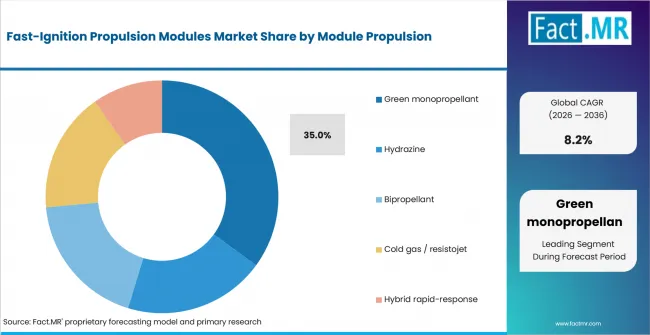
Fast Ignition Propulsion Modules Market Analysis By Module Propulsion | Source: Fact.MR
Green monopropellant leads because it gives fast thrust and is easier to handle than older toxic fuels. Hydrazine is still widely used in space missions. Bipropellant systems are used for missions that need higher thrust or longer use. Cold-gas and resistojet systems are used for smaller moves, while hybrid systems combine fast response with different operating options.
In September 2026, NASA reported that the ASCENT Propulsion Dual Mode spacecraft completed environmental and physical testing [2]. The system uses one fuel tank for chemical and electrospray propulsion, helping satellites make fast moves and stay in the right orbit.
What leads the Ignition segment?
Catalytic is projected to account for 31.0% share in 2026.
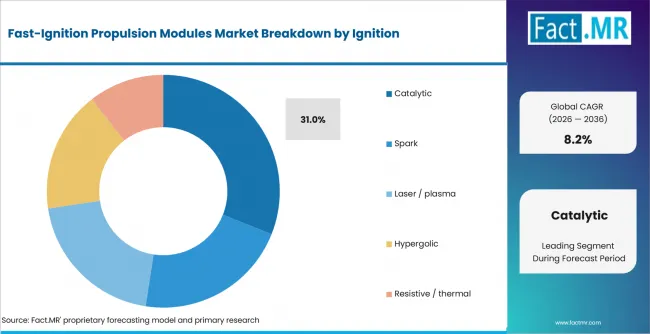
Fast Ignition Propulsion Modules Market Analysis By Ignition | Source: Fact.MR
Catalytic ignition leads because it starts a monopropellant system without a separate spark. Spark ignition uses an electrical signal, while laser and plasma ignition are used for special systems. Hypergolic fuels start when they come into contact, while resistive and thermal systems use heat.
The propulsion system needs to start quickly and reliably every time. Engineers check ignition time, valve timing, heat, and restart performance during repeated use. These tests help compare systems for different satellite missions.
How does Response shape demand?
<25 ms is anticipated to lead with 37.0% share in 2026.
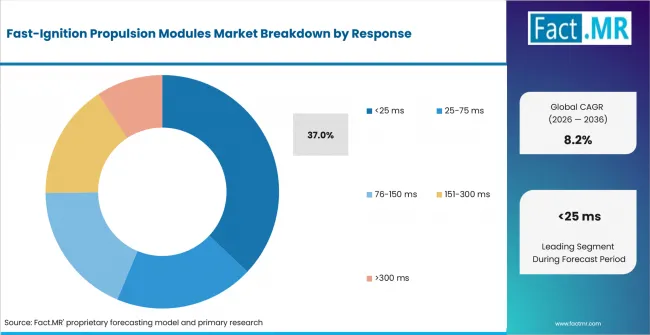
Fast Ignition Propulsion Modules Market Analysis By Response | Source: Fact.MR
The less than 25 ms range leads because some satellite moves need thrust right after a command. The 25–75 ms range also works for fast satellite control. Longer response times are used when missions have more time to make a move. Systems above 300 ms suit missions where fuel use and simple design matter more than speed.
Autonomous satellites need a steady response time for every move. Onboard software plans each move and needs the propulsion system to start on time. Reliable restarts help satellites make safe moves without waiting for ground control.
What supports Collision avoidance within Mission?
Collision avoidance is estimated to represent 33.0% share in 2026.
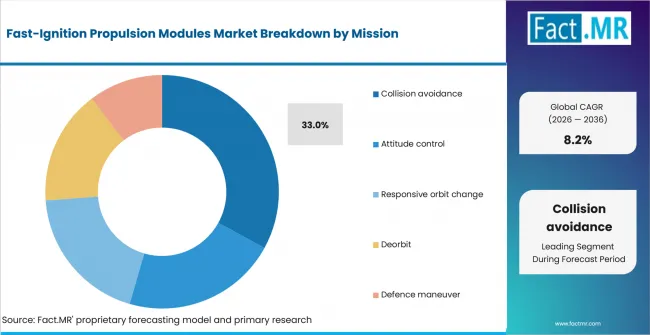
Fast Ignition Propulsion Modules Market Analysis By Mission | Source: Fact.MR
Collision avoidance leads because satellites may need to change orbit quickly after a warning. Position control needs smaller moves, while orbit changes need larger moves. Deorbit systems move satellites out of orbit after a mission ends. Defence satellites also need fast propulsion when their planned path changes.
For collision avoidance, the propulsion system needs to respond quickly and restart reliably. This helps operators plan safe moves and control the satellite.
What is accelerating Fast-Ignition Propulsion Modules Market adoption, and what is holding it back?
Fast orbit changes increase demand, while flight testing and fuel system limits can slow wider use.
Drivers Impact Analysis
| DRIVER | (~) % IMPACT ON CAGR | GEOGRAPHIC RELEVANCE | IMPACT TIMELINE |
|---|---|---|---|
| Short-notice collision-avoidance requirements | +1.5% | Global | Short term (<= 2 years) |
| Defence demand for dynamic space operations | +1.2% | USA, Europe, Japan | Medium term (2-4 years) |
| Green-propellant integration and handling gains | +0.9% | North America, Europe | Medium term (2-4 years) |
| Small-satellite need for compact propulsion modules | +0.7% | Global | Long term (>= 4 years) |
Source: Fact.MR analysis. Updated Oct 6, 2026
Opportunity Impact Analysis
| OPPORTUNITY | (~) % IMPACT ON CAGR | GEOGRAPHIC RELEVANCE | IMPACT TIMELINE |
|---|---|---|---|
| Dual-mode chemical-electric propulsion | +1.0% | USA, Europe | Medium term (2-4 years) |
| Sub-25 ms ignition modules for autonomous spacecraft | +0.8% | Global | Short term (<= 2 years) |
| Refuellable and serviceable propulsion architectures | +0.6% | Europe, USA | Long term (>= 4 years) |
Source: Fact.MR analysis. Updated Oct 6, 2026
Restraints Impact Analysis
| RESTRAINT | (~) % IMPACT ON CAGR | GEOGRAPHIC RELEVANCE | IMPACT TIMELINE |
|---|---|---|---|
| Long propulsion qualification cycles | -0.6% | Global | Short term (<= 2 years) |
| Material and catalyst compatibility limits | -0.5% | Global | Medium term (2-4 years) |
| Limited high-altitude qualification capacity | -0.4% | North America, Europe | Medium term (2-4 years) |
Source: Fact.MR analysis. Updated Oct 6, 2026
Which countries are scaling the Fast-Ignition Propulsion Modules Market through 2036?
- The country comparison spans 3.0 percentage points across the forecast period.
- The UK remains 1.0 percentage point above France as propulsion testing and satellite funding support faster market expansion.
- France remains 1.4 percentage points above Japan through defence-space activity and demand for precise orbital control.
- Japan remains 0.3 percentage point above the USA as space-domain funding supports satellite capability development.
- The USA remains 0.3 percentage point above Germany through small-spacecraft thrust testing and dynamic-space programs.
- Germany closes the displayed range through rapid-space research and compact-satellite development.
Full report coverage includes North America, Latin America, Western Europe, Eastern Europe, East Asia, South Asia & Pacific, Middle East & Africa.
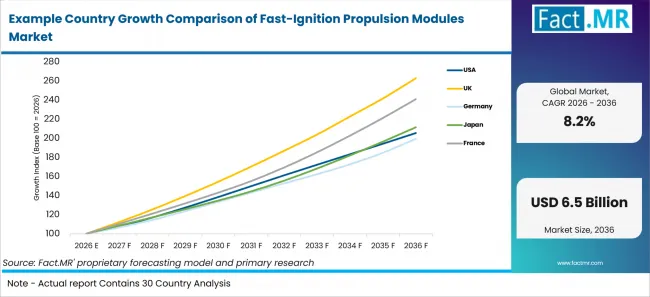
Example Country Growth Comparison Of Fast Ignition Propulsion Modules Market | Source: Fact.MR
| Country | CAGR (2026-2036) |
|---|---|
| United Kingdom | 10.2% |
| France | 9.2% |
| Japan | 7.8% |
| United States | 7.5% |
| Germany | 7.2% |
Source: Fact.MR analysis. Updated Oct 6, 2026
What supports United Kingdom adoption?
10.2% CAGR, supported by propulsion-qualification capacity and satellite technology investment.
The UK is increasing testing facilities for satellite propulsion systems. In February 2026, the UK Space Agency reported that the DEEP Lab was a £3.8 million facility for electric propulsion testing and development [3]. Companies can test propulsion systems under space-like conditions before using them in satellites. This helps find problems early and reduces design changes later.
How is France scaling demand?
9.2% CAGR, backed by defence satellites and precise orbital-control requirements.
France has a strong satellite industry and military Earth observation programs that need reliable orbit control. In March 2025, CNES reported that CSO-3 entered a sun-synchronous orbit at about 800 kilometres [4]. These missions need propulsion systems that start quickly and work reliably. This supports demand for tested systems that keep satellites in orbit and make planned orbit changes.
What supports Japan’s outlook?
7.8% CAGR, shaped by space-domain investment and satellite capability expansion.
Japan is increasing spending on space systems that need reliable satellite control. In April 2025, the Ministry of Defense reported that about JPY 540.3 billion was allocated to the space domain in its FY2025 plan [5]. This funding supports satellites that need good orbit control and long service life. Fast-start propulsion helps satellites change position quickly during regular and defence missions.
What is supporting USA adoption?
7.5% CAGR, supported by small-spacecraft propulsion testing and dynamic orbital operations.
The United States is testing small propulsion systems for satellites that need to change orbit. In December 2025, NASA reported that the DUPLEX CubeSat carried two microthrusters for testing in space [6]. These tests show how the thrusters start and work after launch. The results can help improve propulsion systems for small satellite control and orbit changes.
How does Germany perform?
7.2% CAGR, supported by responsive-space research and compact satellite programs.
Germany is using small satellites to test space systems with limited size and weight. In December 2025, DLR reported that the OTTER satellite weighed six kilograms and used electric propulsion to speed up re-entry [7]. Small satellites have limited space for fuel tanks and control parts. Compact propulsion systems help them change orbit and leave orbit after the mission.
Who leads the Fast-Ignition Propulsion Modules Market?
Safran, ArianeGroup, Busek, SITAEL, Moog, and L3Harris provide propulsion systems for moving satellites in orbit.
ArianeGroup offers chemical and electric propulsion, while Safran focuses on Hall-effect electric propulsion. Busek and SITAEL supply electric thrusters. Moog and L3Harris provide propulsion systems and other spacecraft hardware.
In September 2025, Moog completed two high-velocity propulsion modules for its Meteor satellite buses. The modules combine Moog engines, fuel systems, and valves for large orbit changes. ArianeGroup, Safran, Busek, SITAEL, and L3Harris also provide propulsion systems for moving spacecraft in orbit.
Which companies are the key providers?
Safran and ArianeGroup are key providers, and Busek, SITAEL, Moog, and L3Harris are also profiled.
- Safran
- ArianeGroup
- Busek
- SITAEL
- Moog
- L3Harris
Bibliography
- [1] UK Space Agency. (2025, December 3). UK Space Agency invests £17 million to drive next wave of space innovation. GOV.UK
- [2] National Aeronautics and Space Administration. (2026, September 25). NASA tests dual mode propulsion CubeSat ahead of launch. NASA
- [3] UK Space Agency. (2026, February 6). UK Space Agency investment helps launch cutting-edge electric propulsion lab. GOV.UK
- [4] Centre National d’Études Spatiales. (2025, March 6). Ariane 6 successfully orbits CSO-3 military satellite on first commercial mission. CNES
- [5] Ministry of Defense, Japan. (2025). Progress and Budget in Fundamental Reinforcement of Defense Capabilities: Overview of FY2025 Budget. Ministry of Defense Japan
- [6] National Aeronautics and Space Administration. (2025, December 17). NASA’s two-in-one satellite propulsion demo begins in-space test. NASA
- [7] German Aerospace Center (DLR). (2025, December 1). Small satellite for observing activities at sea. DLR
- [8] Moog Inc. (2025, September 29). Moog completes high-velocity propulsion systems, begins next phase of spacecraft integration.
This Report Answers
- The report explains where fast-ignition thrust units are used across module type, ignition method, response class, and mission, and It also covers regional demand.
- Segment analysis identifies the leading subsegments and the operating reasons satellite teams prioritize them.
- Country analysis reviews government programs, satellite activity, and test infrastructure that influence propulsion demand.
- Competitive analysis reviews the listed companies across chemical, electric, and integrated spacecraft propulsion.
- Application analysis considers how mission type affects propulsion-module selection.
What does the Fast-Ignition Propulsion Modules Market cover?
The Fast-Ignition Propulsion Modules Market covers integrated spacecraft propulsion hardware designed for short command-to-thrust response, and Related in-space propulsion components include thrusters and feed hardware used after launch, and high-thrust electric propulsion forms an adjacent category for spacecraft that need larger electric maneuvers.
The assessment includes propulsion for collision avoidance and responsive orbit change, and It also covers attitude control and controlled deorbit functions, and VLEO satellite platforms create a related low-orbit use case, while air-breathing electric propulsion represents a separate electric-propulsion approach.
What is included in the scope?
The scope includes green monopropellant and hydrazine systems, and Bipropellant, cold-gas, resistojet, and hybrid propellants architectures are included where they form an integrated spacecraft module, and Qualification can involve electric propulsion thruster test equipment and small satellite environmental test systems.
What is excluded from the scope?
The scope excludes launch-vehicle main propulsion sold only for ascent and unrelated spacecraft hardware, and 3D-printed satellite hardware remains outside the boundary unless it forms part of an integrated propulsion module, and space situational awareness sensor test systems and all-electric satellites are adjacent categories used only as context.
How Was the Analysis Built?
The analysis draws on 120+ sources, 35+ company portfolios, 25+ countries, and more than 20 industry interviews.
- Primary Research: Primary research includes discussions with manufacturers, service providers, technology developers, distributors, end users, and subject-matter experts. These conversations examine purchasing priorities, product adoption, operational challenges, approval requirements, competitive positioning, and the factors that influence wider market acceptance.
- Desk Research: Desk research covers government statistics, regulatory publications, company filings, trade data, technical studies, industry associations, standards, public policy, and other authoritative sources. Every source used in the analysis is documented in the bibliography.
- Market Sizing and Forecasting: Market estimates combine historical performance, demand indicators, pricing and volume trends, segment shares, company participation, country-level growth, adoption patterns, investment activity, and barriers to market expansion.
- Data Validation and Update Cycle: Findings are validated by comparing primary interviews with public data, company activity, regulatory changes, trade patterns, and industry developments. Regular updates review new product launches, capacity changes, partnerships, approvals, and shifts in commercial adoption.
Segmentation
What is the report’s scope and coverage?
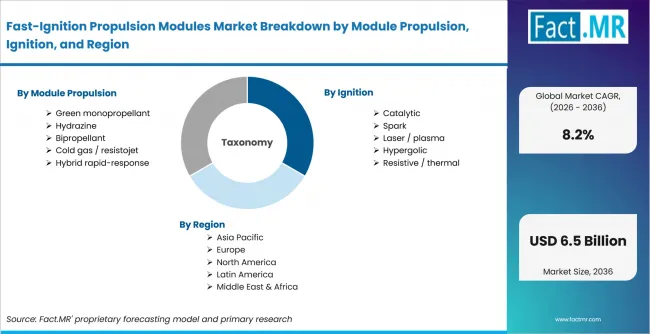
Fast Ignition Propulsion Modules Market Breakdown By Module Propulsion, Ignition, And Region | Source: Fact.MR
| Attribute | Details |
|---|---|
| Quantitative Units | USD billion |
| Market Definition | Integrated spacecraft propulsion modules designed for short command-to-thrust response and repeated maneuvering, and the scope includes chemical, electric, cold-gas, and hybrid module architectures used after launch. |
| Module Propulsion | Green monopropellant; Hydrazine; Bipropellant; Cold gas / resistojet; Hybrid rapid-response |
| Ignition | Catalytic; Spark; Laser / plasma; Hypergolic; Resistive / thermal |
| Response | <25 ms; 25-75 ms; 76-150 ms; 151-300 ms; >300 ms |
| Mission | Collision avoidance; Attitude control; Responsive orbit change; Deorbit; Defence maneuver |
| Regions Covered | North America; Latin America; Western Europe; Eastern Europe; East Asia; South Asia & Pacific; Middle East & Africa |
| Countries Covered | United States; United Kingdom; Germany; Japan; France |
| Key Companies Profiled | Safran; ArianeGroup; Busek; SITAEL; Moog; L3Harris |
| Forecast Period | 2026 to 2036 |
| Approach | Hybrid top-down and bottom-up approach using spacecraft program activity; propulsion portfolio review; mission-function demand; country investment; qualification activity; and supplier validation. |
Source: Fact.MR analysis. Updated Oct 6, 2026
How is the market segmented?
-
By Module Propulsion:
- Green monopropellant
- Hydrazine
- Bipropellant
- Cold gas / resistojet
- Hybrid rapid-response
-
By Ignition:
- Catalytic
- Spark
- Laser / plasma
- Hypergolic
- Resistive / thermal
-
By Response:
- <25 ms
- 25-75 ms
- 76-150 ms
- 151-300 ms
- >300 ms
-
By Mission:
- Collision avoidance
- Attitude control
- Responsive orbit change
- Deorbit
- Defence maneuver
-
By Region:
- North America
- Latin America
- Western Europe
- Eastern Europe
- East Asia
- South Asia & Pacific
- Middle East & Africa
Frequently Asked Questions
How big is the fast-ignition propulsion modules market in 2026?
What is the CAGR of the fast-ignition propulsion modules market from 2026 to 2036?
Which module propulsion segment leads the market?
Which ignition segment leads the market?
Which response class leads the market?
Which mission leads the market?
Who are the leading companies in the market?
Who worked on this report


Preview the report firsthand - request a free sample
Free SampleGet the brochure for pricing and purchase details
Download PDF