- Market Value (2025): USD 498.4 Mn
- Estimated Value (2026): USD 542.8 Mn
- Forecast Value (2036): USD 1273.2 Mn
- CAGR (2026-2036): 8.9%
What is the Enhanced Flight Vision Systems Market forecast to be worth by 2036?
USD 542.8 million in 2026 to USD 1,273.2 million by 2036 at an 8.9% CAGR.
- According to Fact.MR estimates, the enhanced flight vision systems market was valued at USD 498.4 million in 2025.
- Market value is projected to rise from USD 542.8 million in 2026 to USD 1,273.2 million by 2036.
- The market is projected to grow at a 8.9% CAGR from 2026 to 2036 as aircraft operators seek better visibility, improved situational awareness, and support for approved low-visibility operations.
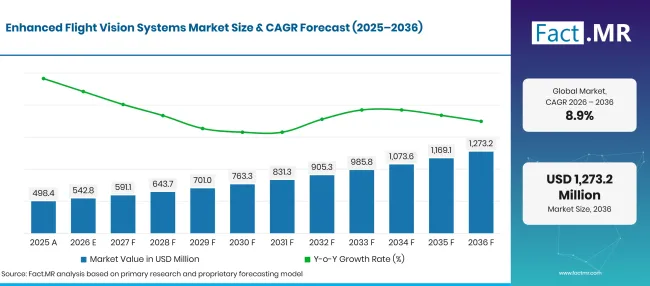
Enhanced Flight Vision Systems Market Forecast Global | Source: Fact.MR
| Year | Basis | Market Value (USD million) |
|---|---|---|
| 2025 | Actual | 498.4 |
| 2026 | Estimate | 542.8 |
| 2036 | Forecast | 1,273.2 |
| CAGR 2026 to 2036 | Forecast period | 8.9% |
Source: Fact.MR analysis. Updated Nov 2, 2026
What are the defining numbers behind Enhanced Flight Vision Systems Market growth?
USD 730.4 million absolute opportunity between 2026 and 2036.
- Demand Drivers in the Market
- Low-visibility flight operations: Airlines and business aviation operators need technologies that help pilots identify visual references during approaches in fog, darkness, and other challenging conditions. The Federal Aviation Administration (FAA) maintains dedicated regulations and guidance for enhanced flight vision system operations, including the requirements for approved use during instrument approaches [1].
- Advances in infrared imaging and cockpit displays: Manufacturers are integrating multispectral sensors, infrared cameras, and head-up displays to provide pilots with a clearer view of the external environment. Collins Aerospace's EVS-3600, for example, uses short-wave infrared, long-wave infrared, and visible-light imaging to support visibility during critical flight phases [2]
- Growing emphasis on operational safety and situational awareness: Aviation operators are evaluating enhanced vision and combined vision technologies to improve awareness of runways, terrain, and obstacles. Elbit Systems' ClearVision EFVS combines real-time enhanced vision with synthetic vision and flight guidance information [3]
- Key Segments Analyzed
- By Component: Display Systems will account for 38.5% of the market in 2026, reflecting the importance of presenting sensor imagery and flight guidance clearly within the pilot's field of view.
- By Technology: Infrared technology leads with a 42.7% share in 2026, supported by its ability to provide useful visual information in darkness and reduced-visibility conditions.
- By Platform: Commercial Aviation holds a 39.8% share in 2026, driven by demand for improved flight-deck visibility across commercial aircraft operations.
- By Application: Navigation captures a 36.4% share in 2026, as enhanced vision technologies support visual orientation and the identification of relevant external references during flight operations.
- Analyst Opinion at Fact.MR
- Shambhu Nath Jha, Principal Consultant at Fact.MR, states, “Enhanced flight vision systems are gaining relevance as aircraft operators look for better visibility and situational awareness during critical phases of flight. Suppliers that combine reliable sensor performance with practical cockpit integration and the required certification support are better positioned to address commercial and business aviation requirements.”
- Strategic Implications
- Manufacturers should demonstrate sensor performance under relevant lighting and weather conditions and document compatibility with approved aircraft configurations.
- Avionics integrators need to prioritize clear display presentation, reliable sensor fusion, and compatibility with existing flight guidance equipment.
- Aircraft operators can evaluate installation costs, pilot training requirements, maintenance needs, and the operational benefits available under applicable approvals.
- Technology developers must improve infrared imaging, synthetic vision integration, and obstacle identification while maintaining compliance with aviation certification requirements.
Germany is set to record a 7.3% CAGR through 2036. Brazil is set to post an 11.0% CAGR, followed by the USA at 9.3%. The UK is estimated to advance at 11.5%, while Japan is forecast at 8.4%.
How does the Enhanced Flight Vision Systems Market break down by segment?
Fact.MR finds that Display Systems leads Component at 38.5%; Infrared leads Technology at 42.7%; Commercial Aviation leads Platform at 39.8%; and Navigation leads Application at 36.4%.
Which Component dominates?
Display Systems is projected to account for 38.5% of the market in 2026.
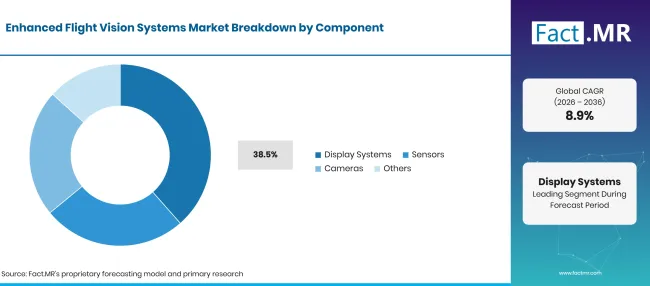
Enhanced Flight Vision Systems Market Breakdown Component | Source: Fact.MR
| Component | Share (2026) |
|---|---|
| Display Systems (Leading segment) | 38.5% |
| Other segments combined | 61.5%* |
| Total | 100.0% |
Source: Fact.MR analysis. Updated Nov 2, 2026
Display systems present sensor imagery, flight symbology, and guidance information in a format that pilots can interpret during demanding flight phases. Head-up displays are particularly relevant because they allow pilots to view critical flight information while maintaining an outward field of view. Sensors and cameras provide the underlying imagery, while other components support image processing, integration, and system operation.
What leads the Technology segment?
Infrared is projected to account for 42.7% of the market in 2026.
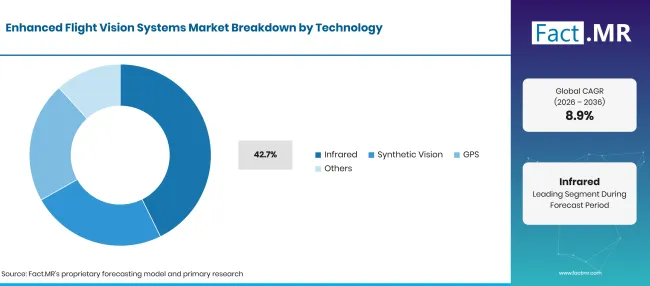
Enhanced Flight Vision Systems Market Breakdown Technology | Source: Fact.MR
| Technology | Share (2026) |
|---|---|
| Infrared (Leading segment) | 42.7% |
| Other segments combined | 57.3%* |
| Total | 100.0% |
Source: Fact.MR analysis. Updated Nov 2, 2026
Infrared technology helps pilots identify external visual references when natural visibility is limited by darkness, fog, or other atmospheric conditions. Infrared cameras can capture thermal information that is not readily apparent to the naked eye. Synthetic vision uses terrain, obstacle, and airport databases to generate a computer-rendered view, while GPS supports aircraft positioning and navigation rather than directly providing enhanced optical imagery. These technologies can complement one another in integrated cockpit systems.
How does Platform shape demand?
Commercial Aviation is likely to account for a 39.8% share in 2026.
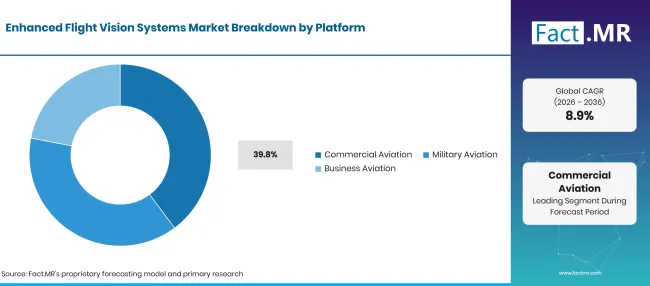
Enhanced Flight Vision Systems Market Breakdown Platform | Source: Fact.MR
| Platform | Share (2026) |
|---|---|
| Commercial Aviation (Leading segment) | 39.8% |
| Other segments combined | 60.2%* |
| Total | 100.0% |
Source: Fact.MR analysis. Updated Nov 2, 2026
Commercial aviation operators evaluate enhanced vision systems for their potential to improve flight-deck awareness during approach and landing. Business aviation represents another relevant platform because operators may prioritize advanced avionics, retrofit opportunities, and access to airports under challenging weather conditions. Military aviation has different mission requirements, including night operations and specialized situational awareness. Platform selection depends on aircraft configuration, operating conditions, certification, and budget.
What leads the Application segment?
Navigation is projected to account for 36.4% of the market in 2026.
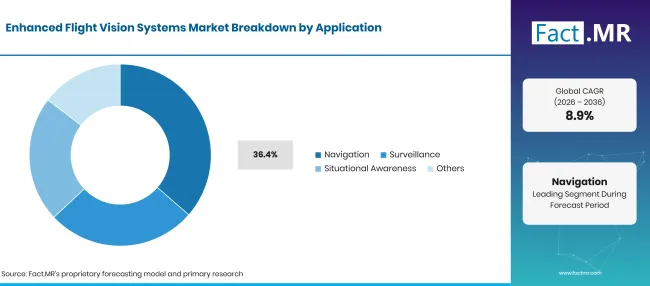
Enhanced Flight Vision Systems Market Breakdown Application | Source: Fact.MR
| Application | Share (2026) |
|---|---|
| Navigation (Leading segment) | 36.4% |
| Other segments combined | 63.6%* |
| Total | 100.0% |
Source: Fact.MR analysis. Updated Nov 2, 2026
Navigation-related applications use enhanced flight information to help pilots understand their position relative to terrain, runways, and other visual references. Surveillance applications focus on observing the external environment, while situational awareness combines relevant flight, terrain, and sensor information to support pilot decision-making. The categories may overlap in integrated avionics suites, so the segmentation should be interpreted according to the market's defined classification.
What is accelerating Enhanced Flight Vision Systems Market adoption, and what is holding it back?
Improved low-visibility operations and advances in multispectral imaging support adoption, while certification, integration costs, and aircraft-specific requirements can slow deployment.
Drivers Impact Analysis
| DRIVER | Approx. % IMPACT ON CAGR | GEOGRAPHIC RELEVANCE | IMPACT TIMELINE |
|---|---|---|---|
| Demand for improved low-visibility operations | +1.2% | Global | Medium term (2–4 years) |
| Advances in infrared and multispectral sensors | +1.0% | North America, Europe | Medium term (2–4 years) |
| Cockpit modernization and avionics upgrades | +0.8% | Global | Medium term (2–4 years) |
| Integration of enhanced and synthetic vision | +0.7% | Global | Long term (≥ 4 years) |
| Commercial and business aircraft upgrades | +0.6% | North America, Europe, Asia | Long term (≥ 4 years) |
Source: Fact.MR analysis. Updated Nov 2, 2026
Opportunity Impact Analysis
| OPPORTUNITY | Approx. % IMPACT ON CAGR | GEOGRAPHIC RELEVANCE | IMPACT TIMELINE |
|---|---|---|---|
| Retrofit installations across existing fleets | +0.9% | North America, Europe | Medium term (2–4 years) |
| Wearable head-up display solutions | +0.7% | Global | Medium term (2–4 years) |
| Multispectral camera improvements | +0.6% | Global | Long term (≥ 4 years) |
| Combined vision system integration | +0.5% | Global | Medium term (2–4 years) |
Source: Fact.MR analysis. Updated Nov 2, 2026
Restraints Impact Analysis
| RESTRAINT | Approx. % IMPACT ON CAGR | GEOGRAPHIC RELEVANCE | IMPACT TIMELINE |
|---|---|---|---|
| Aircraft installation and certification costs | -0.9% | Global | Short term (≤ 2 years) |
| Integration with existing avionics | -0.7% | Global | Medium term (2–4 years) |
| Pilot training and operational approval requirements | -0.6% | Global | Medium term (2–4 years) |
| Compatibility across different aircraft platforms | -0.5% | Global | Long term (≥ 4 years) |
Source: Fact.MR analysis. Updated Nov 2, 2026
Which countries are scaling the Enhanced Flight Vision Systems Market through 2036?
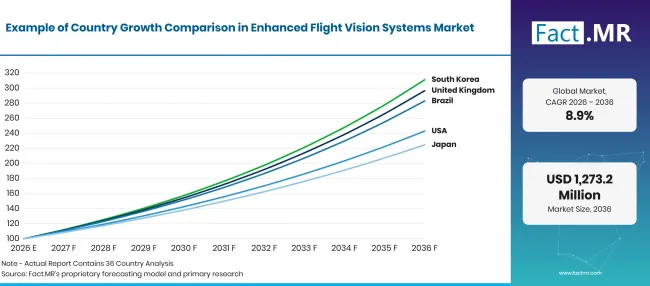
Enhanced Flight Vision Systems Market Growth Index | Source: Fact.MR
| Country | CAGR (2026–2036) |
|---|---|
| Germany | 7.3% |
| Brazil | 11.0% |
| USA | 9.3% |
| UK | 11.5% |
| Japan | 8.4% |
Source: Fact.MR analysis. Updated Nov 2, 2026
What supports Germany adoption?
7.3% CAGR, driven by demand for advanced avionics, cockpit modernization.
Germany's opportunity is linked to its established aerospace engineering base, aircraft avionics capabilities, and demand for advanced flight-deck equipment. Adoption will depend on aircraft modernization programs, the availability of compatible systems, and the operational requirements of airlines and business aircraft operators. European aviation rules define the conditions under which approved enhanced flight vision systems may be used for low-visibility operations [4].
How is Brazil developing enhanced flight vision systems adoption?
11.0% CAGR, supported by commercial aviation activity and business aircraft operations
Brazil's aviation opportunity is associated with its commercial aircraft operations, business aviation activity, and requirements for dependable operations across diverse weather and airport conditions. Enhanced vision technology may support pilot awareness during approaches in reduced visibility. Adoption depends on aircraft compatibility, certification requirements, operator investment decisions, and the benefits available from approved installations.
What supports United States adoption?
9.3% CAGR, shaped by its established avionics industry and cockpit modernization initiatives
The United States benefits from an established aviation electronics industry and a regulatory framework for enhanced flight vision system operations. The FAA provides guidance on EFVS equipment approval, operational authorizations, and pilot requirements. These provisions give aircraft operators a defined framework for evaluating approved systems and their operational benefits.
How is the United Kingdom building adoption?
11.5% CAGR, led by demand for advanced cockpit technologies and business aviation upgrades
The United Kingdom's opportunity is linked to commercial aviation, business aircraft operations, and demand for cockpit technologies that support situational awareness during challenging approaches. Operators must assess whether an installation meets applicable airworthiness and operational requirements. The potential for adoption depends on fleet modernization priorities, retrofit economics, and the availability of approved equipment.
What supports Japan adoption?
8.4% CAGR, backed by aviation technology development, flight-deck modernization and demand for enhanced pilot visibility during nighttime operations and reduced-visibility approaches.
Japan's opportunity is associated with commercial aviation, aircraft technology development, and continued investment in flight-deck capabilities. Enhanced vision systems may improve the presentation of external visual references during darkness and reduced visibility. Wider deployment will depend on aircraft program requirements, system integration, certification, and operator assessments of the benefits relative to installation and maintenance costs.
Who leads the Enhanced Flight Vision Systems Market?
Fact.MR profiles Collins Aerospace, Elbit Systems Ltd., Universal Avionics Systems Corporation, Honeywell International Inc., and Thales Group across the enhanced vision, flight-deck display, and related avionics value chain.
Collins Aerospace offers the EVS-3600 enhanced vision system, which combines short-wave infrared, long-wave infrared, and visible-light imaging. Its vision systems portfolio also includes synthetic and combined vision technologies. Elbit Systems Ltd. actively develops its ClearVision EFVS family, integrating enhanced vision, synthetic vision, flight guidance symbology, and head-up display technology. Its portfolio includes the SKYLENS wearable display. Universal Avionics Systems Corporation offers ClearVision EFVS and multispectral EVS cameras, including the EVS-5000 and EVS-4000. Its systems support integration with fixed and wearable displays and are designed for use during takeoff, approach, and landing [5].
Honeywell International Inc. participates in the related flight-deck technology market through its head-up displays, Primus Epic avionics, and synthetic vision capabilities. Thales Group develops aviation cockpit displays and pilot-viewing technologies, including its Scorpion helmet-mounted display for military aircraft. This supports its relevance to the wider vision-display ecosystem, although the cited product evidence does not establish Scorpion as a civil EFVS product [6].
Competitive differentiation depends on sensor performance, display technology, aircraft integration, regulatory approvals, and support throughout the installed system's service life. Companies with dedicated EFVS products should be distinguished from suppliers whose participation is primarily through related cockpit displays, synthetic vision, or military pilot-viewing systems.
Which companies are the key providers?
Key companies include Collins Aerospace; Elbit Systems Ltd.; Universal Avionics Systems Corporation; Honeywell International Inc.; and Thales Group.
- Collins Aerospace
- Elbit Systems Ltd.
- Universal Avionics Systems Corporation
- Honeywell International Inc.
- Thales Group
Bibliography
- [1] Federal Aviation Administration. (2026, July 21). Enhanced Flight Vision Systems (EFVS).
- [2] Collins Aerospace. (n.d.). Vision systems.
- [3] Elbit Systems. (n.d.). ClearVision™.
- [4] European Union Aviation Safety Agency. (2026, March 27). Easy Access Rules for Air Operations: Revision 24, March 2026.
- [5] Universal Avionics. (n.d.). Enhanced Flight Vision Systems (EFVS).
- [6] Thales Group. (n.d.). Scorpion for fighter aircraft.
This Report Answers
- The report describes how enhanced flight vision systems support aviation operations in reduced-visibility conditions.
- Component analysis examines display systems, sensors, cameras, and other supporting equipment.
- Technology analysis compares infrared, synthetic vision, GPS, and other technologies within the segmentation.
- Country analysis discusses Germany, Brazil, the USA, the UK, and Japan alongside the growth estimates.
- The competitive overview profiles five selected suppliers across dedicated EFVS products and related cockpit vision technologies.
- Application analysis separates navigation, surveillance, and situational awareness.
What does the Enhanced Flight Vision Systems Market cover?
The market covers aviation systems that use real-time sensor imagery to improve the pilot's view of the external environment. These systems can combine infrared or visible-light cameras with flight guidance information and cockpit displays. Depending on system design and certification, they may support improved awareness during approach, landing, taxiing, and other critical flight phases.
What is included in the scope?
Included products comprise enhanced flight vision systems, associated imaging sensors and cameras, display equipment, and relevant system components.
The scope also considers technologies that integrate enhanced vision with synthetic vision and flight guidance. Applications cover navigation, surveillance, and situational awareness across commercial, military, and business aviation platforms.
What is excluded from the scope?
The analysis excludes standalone consumer imaging products unrelated to aircraft operations, general-purpose cameras without aviation application, and unrelated ground-based surveillance equipment.
Aircraft components without a relevant connection to enhanced flight vision are outside the defined market. General synthetic vision or head-up display products are not automatically counted as dedicated EFVS products unless they form part of the applicable market definition.
How Was the Analysis Built?
The analysis draws on 120+ sources, 35+ company portfolios, 25+ countries, and more than 20 industry interviews.
- Primary Research: Primary research includes discussions with manufacturers, avionics suppliers, aircraft operators, system integrators, distributors, and aviation specialists. These conversations examine priorities, installation requirements, certification pathways, operating conditions, and adoption barriers.
- Desk Research: Desk research covers aviation regulations, government publications, company product pages, technical documentation, public announcements, and industry information. Sources used for product verification and regulatory context are documented in the bibliography.
- Market Sizing and Forecasting: Market estimates combine the market values, growth, segment shares, country forecasts, technology adoption patterns, aircraft modernization requirements, and barriers to market expansion. The 2025 valuation is derived from the 2026 estimate and CAGR.
- Data Validation and Update Cycle: Findings are checked against company product information and regulatory documentation. Competitive profiles distinguish manufacturers with directly identified EFVS products from suppliers with adjacent avionics and display capabilities.
Segmentation
What is the report's scope and coverage?
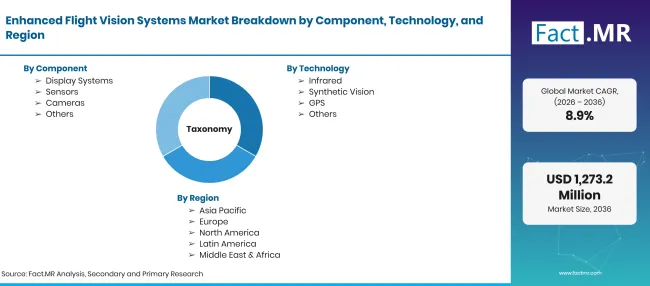
Enhanced Flight Vision Systems Market Taxonomy | Source: Fact.MR
| Attribute | Details |
|---|---|
| Quantitative Units | USD million |
| Market Definition | The Enhanced Flight Vision Systems Market covers aircraft-based systems that use sensors, particularly infrared and other imaging technologies, to provide pilots with an enhanced view of external conditions during low-visibility operations. |
| Component | Display Systems; Sensors; Cameras; Others |
| Technology | Infrared; Synthetic Vision; GPS; Others |
| Platform | Commercial Aviation; Military Aviation; Business Aviation |
| Application | Navigation; Surveillance; Situational Awareness; Others |
| Regions Covered | North America; Latin America; Western Europe; Eastern Europe; East Asia; South Asia & Pacific; Middle East & Africa |
| Countries Covered | Germany; Brazil; USA; UK; Japan |
| Companies Profiled | Collins Aerospace; Elbit Systems Ltd.; Universal Avionics Systems Corporation; Honeywell International Inc.; Thales Group |
| Forecast Period | 2026 to 2036 |
| Approach | Market segmentation and scenario-based analysis supported by regulatory documents and company product information |
Source: Fact.MR analysis. Updated Nov 2, 2026
How is the market segmented?
-
By Component
- Display Systems
- Sensors
- Cameras
- Others
-
By Technology
- Infrared
- Synthetic Vision
- GPS
- Others
-
By Platform
- Commercial Aviation
- Military Aviation
- Business Aviation
-
By Application
- Navigation
- Surveillance
- Situational Awareness
- Others
-
By Region
- North America
- Latin America
- Western Europe
- Eastern Europe
- East Asia
- South Asia & Pacific
- Middle East & Africa
Frequently Asked Questions
How big is the Enhanced Flight Vision Systems Market in 2026?
What is the CAGR from 2026 to 2036?
Which component has the largest share?
Which technology leads the market?
Which platform has the largest share?
Which country has the highest CAGR?
Which companies are covered?
Who worked on this report


Preview the report firsthand - request a free sample
Free SampleGet the brochure for pricing and purchase details
Download PDF