- Market Value (2025): USD 2.61 Bn
- Estimated Value (2026): USD 2.79 Bn
- Forecast Value (2036): USD 5.35 Bn
- CAGR (2026-2036): 6.7%
What is the Airport Runway Safety Systems Market forecast to be worth by 2036?
USD 2.79 billion in 2026 to USD 5.35 billion by 2036 at a 6.7% CAGR.
- According to Fact.MR estimates, the airport runway safety systems market was valued at USD 2.61 billion in 2025.
- Market value is projected to rise from USD 2.79 billion in 2026 to USD 5.35 billion by 2036.
- The market is projected to grow at a 6.7% CAGR from 2026 to 2036 as airports invest in runway surveillance and automated safety solutions.
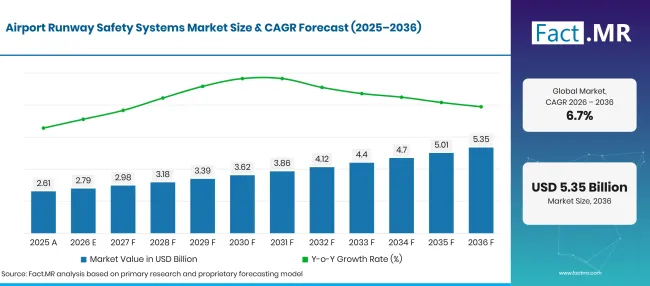
Airport Runway Safety Systems Market Forecast Global | Source: Fact.MR
| Year | Basis | Market Value (USD billion) |
|---|---|---|
| 2025 | Actual | 2.61 |
| 2026 | Estimate | 2.79 |
| 2036 | Forecast | 5.35 |
| CAGR 2026 to 2036 | Forecast period | 6.7% |
Source: Fact.MR analysis. Updated Nov 2, 2026
What are the defining numbers behind Airport Runway Safety Systems Market growth?
USD 2.6 billion absolute opportunity between 2026 and 2036.
- Demand Drivers in the Market
- Airport operators are giving greater attention to runway incursion prevention. The Federal Aviation Administration's Runway Status Lights system uses surveillance information to activate visual warnings when runway conditions indicate a potential conflict. The FAA reports that the system is operational at 20 U.S. airports [1].[1]
- Airport authorities are investing in advanced surface movement guidance and control systems to improve the monitoring of aircraft and ground vehicle movements. EUROCONTROL identifies surveillance and safety-support functions as important parts of A-SMGCS deployments [2].
- Airport modernization creates demand for connected runway lighting and monitoring infrastructure. Integrating surveillance inputs with visual alerts can help controllers and pilots respond to potentially unsafe runway conditions.
- Low-visibility operations increase the value of reliable surface surveillance. Radar and other sensor technologies can help monitor aircraft and vehicle movements when direct visual observation is limited.
- Key Segments Analyzed
- By Component, Hardware will account for 42.6% of the market in 2026, reflecting the requirement for radar, cameras, sensors, lighting equipment, and control infrastructure.
- By Application, Commercial Airports leads with 73.2% of the market in 2026 because of their higher volume of aircraft and ground vehicle movements.
- By Technology, Radar will hold 38.9% of the market in 2026, supported by its role in surface movement surveillance.
- By End User, Airports will capture 58.4% of the market in 2026 as airport operators procure runway monitoring and safety infrastructure.
- Analyst Opinion at Fact.MR
- Shambhu Nath Jha, Principal Consultant at Fact.MR, states, “Airport operators are placing greater importance on systems that can identify runway conflicts and deliver timely warnings. Suppliers that combine reliable surveillance with automated alerts and effective integration support are likely to benefit as airports upgrade their safety infrastructure.”
- Strategic Implications
- Manufacturers need to focus on integrating surveillance sensors with automated alerting and runway lighting systems.
- Airport operators should assess compatibility with existing air traffic control and airfield infrastructure before selecting new safety platforms.
- Technology providers must improve the reliability of detection in low-visibility and high-traffic conditions.
- Suppliers can strengthen maintenance and integration services to support long-term system performance.
- Companies with military airport experience can address specialized requirements for surveillance and air traffic control.
Germany is set to record an 8.2% CAGR through 2036. Brazil is set to post 7.5%, followed by the USA at 6.8%. The UK is estimated to advance at 6.0%, while Japan is forecast at 5.3%.
How does the Airport Runway Safety Systems Market break down by segment?
In Fact.MR’s segmentation, Hardware leads Component at 42.6%; Commercial Airports leads Application at 73.2%; Radar leads Technology at 38.9%; and Airports leads End User at 58.4%.
Which Component dominates?
Hardware is projected to account for 42.6% of the market in 2026.
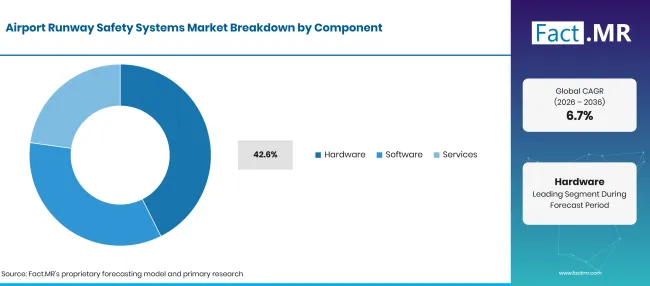
Airport Runway Safety Systems Market Breakdown Component | Source: Fact.MR
| Component | Share (2026) |
|---|---|
| Hardware (Leading segment) | 42.6% |
| Other segments combined | 57.4%* |
| Total | 100.0% |
Source: Fact.MR analysis. Updated Nov 2, 2026
Hardware includes surveillance radar and cameras alongside sensors, runway status lights and related control equipment. These products provide the physical infrastructure needed to detect aircraft and vehicle movements. Software processes surveillance information and supports alerts, while services cover installation and integration along with maintenance and technical support.
What leads the Application segment?
Commercial Airports is projected to account for 73.2% of the market in 2026.
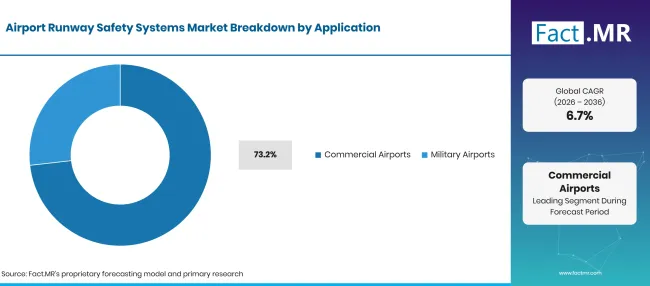
Airport Runway Safety Systems Market Breakdown Application | Source: Fact.MR
| Application | Share (2026) |
|---|---|
| Commercial Airports (Leading segment) | 73.2% |
| Other segments combined | 26.8%* |
| Total | 100.0% |
Source: Fact.MR analysis. Updated Nov 2, 2026
Commercial airports handle frequent aircraft movements alongside ground support vehicle activity. This creates a need for continuous runway monitoring and coordinated safety alerts. Military airports also require surveillance and runway protection, although procurement can involve specialized operational and security requirements.
How does Technology shape demand?
Radar is likely to account for a 38.9% share in 2026.
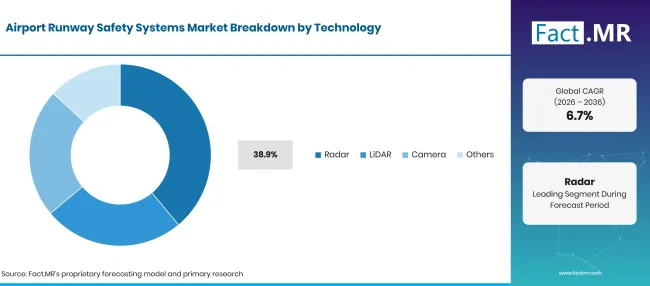
Airport Runway Safety Systems Market Breakdown Technology | Source: Fact.MR
| Technology | Share (2026) |
|---|---|
| Radar (Leading segment) | 38.9% |
| Other segments combined | 61.1%* |
| Total | 100.0% |
Source: Fact.MR analysis. Updated Nov 2, 2026
Radar supports surface movement monitoring by detecting and tracking aircraft and ground vehicles. It is particularly relevant where visibility is limited or where airport operators need continuous coverage across runway and taxiway areas. LiDAR and cameras provide additional sensing and visual monitoring capabilities. Other technologies can include multilateration and integrated sensor platforms.
Which End User accounts for the largest share?
Airports are set to account for a 58.4% share in 2026.
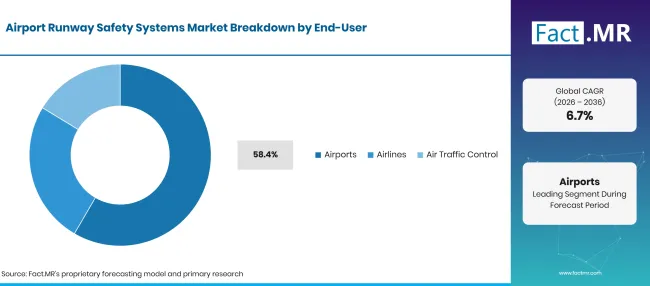
Airport Runway Safety Systems Market Breakdown End User | Source: Fact.MR
| End User | Share (2026) |
|---|---|
| Airports (Leading segment) | 58.4% |
| Other segments combined | 41.6%* |
| Total | 100.0% |
Source: Fact.MR analysis. Updated Nov 2, 2026
Airport operators procure runway safety systems to monitor aircraft movements and coordinate ground operations. They are also responsible for maintaining the airfield infrastructure used by pilots and controllers. Airlines benefit from improved runway awareness through airport-provided safety information and onboard advisory systems. Air traffic control organizations use surveillance and alerting platforms to manage aircraft and vehicle movements.
What is accelerating Airport Runway Safety Systems Market adoption, and what is holding it back?
Runway incursion prevention and airport modernization support demand, while high installation costs and integration complexity can slow adoption.
Drivers Impact Analysis
| DRIVER | (~) % IMPACT ON CAGR | GEOGRAPHIC RELEVANCE | IMPACT TIMELINE |
|---|---|---|---|
| Greater focus on runway incursion prevention | +1.0% | Global | Short term (≤ 2 years) |
| Airport surveillance modernization | +0.9% | Europe, North America, Asia | Medium term (2–4 years) |
| Expansion of automated runway alerts | +0.7% | Global | Medium term (2–4 years) |
| Low-visibility surface monitoring requirements | +0.5% | Global | Long term (≥ 4 years) |
| Integration of runway lighting and surveillance | +0.4% | Global | Medium term (2–4 years) |
Source: Fact.MR analysis. Updated Nov 2, 2026
Opportunity Impact Analysis
| OPPORTUNITY | (~) % IMPACT ON CAGR | GEOGRAPHIC RELEVANCE | IMPACT TIMELINE |
|---|---|---|---|
| A-SMGCS deployment and upgrades | +0.8% | Europe, Asia, Middle East | Medium term (2–4 years) |
| Automated runway status lighting | +0.7% | North America, Europe | Medium term (2–4 years) |
| Camera and sensor-based runway monitoring | +0.6% | Global | Short term (≤ 2 years) |
| Retrofit of existing airport infrastructure | +0.5% | Global | Long term (≥ 4 years) |
| Military airport surveillance upgrades | +0.4% | North America, Europe, Asia | Long term (≥ 4 years) |
Source: Fact.MR analysis. Updated Nov 2, 2026
Restraints Impact Analysis
| RESTRAINT | (~) % IMPACT ON CAGR | GEOGRAPHIC RELEVANCE | IMPACT TIMELINE |
|---|---|---|---|
| High initial system investment | -0.8% | Global | Short term (≤ 2 years) |
| Integration with legacy airport infrastructure | -0.7% | Global | Medium term (2–4 years) |
| Testing and operational validation requirements | -0.5% | Global | Medium term (2–4 years) |
| Maintenance and sensor calibration costs | -0.4% | Global | Long term (≥ 4 years) |
| Project approval timelines | -0.3% | Emerging markets | Medium term (2–4 years) |
Source: Fact.MR analysis. Updated Nov 2, 2026
Which countries are scaling the Airport Runway Safety Systems Market through 2036?
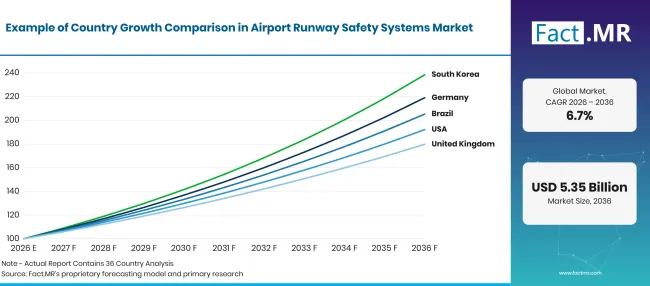
Airport Runway Safety Systems Market Growth Index | Source: Fact.MR
| Country | CAGR (2026–2036) |
|---|---|
| Germany | 8.2% |
| Brazil | 7.5% |
| USA | 6.8% |
| UK | 6.0% |
| Japan | 5.3% |
Source: Fact.MR analysis. Updated Nov 2, 2026
What supports Germany adoption?
8.2% CAGR, supported by airport safety initiatives and continued investment in air traffic management infrastructure.
Germany's airport network requires coordinated runway and surface movement management across commercial aviation operations. EUROCONTROL's 2025 monitoring data reported 70 runway incursions across the 15 German airports covered by its performance plan. This highlights the continued importance of runway monitoring and safety-management measures [3]. Airport operators may invest in surveillance and automated warning platforms to improve situational awareness.
How is Brazil developing runway safety systems adoption?
7.5% CAGR, driven by airport infrastructure development and modernization requirements.
Brazil's airport concession framework provides opportunities for investment in airport infrastructure and service improvements. ANAC identifies infrastructure development and airport service quality as important objectives of its concession program [4]. Modernization projects can create demand for runway surveillance and integrated airfield safety technologies.
What supports United States adoption?
6.8% CAGR, led by runway incursion prevention programs and deployment of automated safety technologies.
The U.S. market benefits from the FAA's continued focus on runway safety. Runway Status Lights provide automated visual warnings to pilots when surveillance information indicates a potential runway conflict. The FAA also continues to develop and deploy runway safety technologies through its broader runway safety portfolio [5]. These initiatives support demand for surveillance equipment and automated warning systems.
How is the United Kingdom building adoption?
6.0% CAGR, shaped by aviation safety management and airport operational requirements.
The UK Civil Aviation Authority identifies runway incursions and runway excursions as important aviation safety hazards. Its runway safety work encourages coordination among aerodromes, airlines, and air navigation service providers [6]. This focus can support investment in runway monitoring and safety alerting systems.
What supports Japan adoption?
5.3% CAGR, backed by automated runway warning infrastructure and airport safety modernization.
Japan has introduced automated runway entrance lighting at several airports to warn pilots when runway movements create potential conflicts. The Ministry of Land, Infrastructure, Transport and Tourism has documented installations at airports including Naha, Tokyo, New Chitose, Osaka, and Fukuoka [7]. Such deployments create opportunities for runway lighting control and surveillance integration.
Who leads the Airport Runway Safety Systems Market?
Fact.MR finds that Saab AB, Indra Sistemas S.A., ADB SAFEGATE, Thales Group, Frequentis AG, and Honeywell Technologies are profiled across airport surface surveillance and runway safety solutions.
Saab and Indra provide advanced surface movement guidance and control systems that support airport surveillance and safety alerts. ADB SAFEGATE supplies runway status lighting and airfield ground lighting solutions. Thales and Frequentis participate in airport air traffic management and A-SMGCS platforms. Honeywell has airport safety and runway advisory capabilities. Varec and L3Harris are relevant to specific runway hazard detection and airport radar applications.
Commercial competition depends on surveillance coverage and the ability to integrate detection with timely warnings. Airport operators also consider reliability and compatibility with existing control infrastructure. Suppliers with strong installation and lifecycle support capabilities can strengthen their position in airport modernization projects.
Which companies are the key providers?
Key companies profiled include Saab AB; Indra Sistemas S.A.; ADB SAFEGATE; Thales Group; Frequentis AG; and Honeywell Technologies.
- Saab AB
- Indra Sistemas S.A.
- ADB SAFEGATE
- Thales Group
- Frequentis AG
- Honeywell Technologies
Bibliography
- [1] Federal Aviation Administration. (n.d.). Runway Status Lights
- [2] EUROCONTROL. (n.d.). Advanced surface movement guidance and control system (A-SMGCS)
- [3] EUROCONTROL. (2026). Annual Monitoring Report 2025 – Germany: Safety
- [4] Agência Nacional de Aviação Civil. (n.d.). Airport concessions
- [5] Federal Aviation Administration. (2025, March 19). FAA launches final initiative of runway safety portfolio
- [6] UK Civil Aviation Authority. (n.d.). Runway safety
- [7] Ministry of Land, Infrastructure, Transport and Tourism. (n.d.). JANS installs automated lighting system to prevent runway incursion
This Report Answers
- The report describes how airport runway safety systems are used to monitor runway activity and reduce operational hazards.
- Segment analysis compares hardware, software, and services alongside the specified application and technology categories.
- Country analysis discusses Germany, Brazil, USA, UK, and Japan alongside relevant aviation safety and airport infrastructure developments.
- The competitive overview profiles companies with identifiable runway safety, A-SMGCS, runway status lighting, and airport surveillance portfolios.
- Technology analysis compares radar, LiDAR, camera-based monitoring, and other surveillance approaches.
- The report evaluates opportunities arising from airport modernization and integration of runway surveillance with automated warning systems.
What does the Airport Runway Safety Systems Market cover?
The market covers airport-side hardware, software, and services used to monitor runway activity and reduce runway incursions and related operational hazards. It includes surface movement radar and other surveillance equipment alongside runway status lights and integrated alerting platforms. The analysis also covers installation and maintenance services associated with these systems.
What is included in the scope?
Included products and services cover runway surveillance and monitoring equipment, radar-based detection, LiDAR and camera-based technologies, runway status lighting, safety alerting software, and related system integration. The market includes solutions deployed at commercial and military airports. Airport-side A-SMGCS and runway safety platforms are included where they perform the specified monitoring or alerting functions.
What is excluded from the scope?
The analysis excludes general airport infrastructure that does not directly support runway monitoring or runway safety. Conventional aircraft navigation equipment without a defined runway safety function is outside the scope. General air traffic management software without runway surveillance or safety alerting functionality is also excluded. Standalone airport construction and unrelated airfield equipment are not counted as runway safety system revenue.
How Was the Analysis Built?
The analysis draws on 120+ sources, 35+ company portfolios, 25+ countries, and more than 20 industry interviews.
- Primary Research: Primary research includes discussions with airport technology suppliers, system integrators, airport operators, air traffic management specialists, distributors, and subject-matter experts. These conversations examine priorities, integration requirements, operational challenges, maintenance needs, and adoption barriers.
- Desk Research: Desk research covers aviation authority publications, airport safety regulations, government infrastructure programs, company product portfolios, technical documents, industry associations, and other authoritative sources. Sources used in the analysis are documented in the bibliography.
- Market Sizing and Forecasting: Market estimates combine the market baseline with demand indicators, segment shares, company participation, country-level growth, airport modernization activity, technology adoption, and barriers to market expansion.
- Data Validation and Update Cycle: Findings are validated by comparing company product information with aviation safety publications and public-sector infrastructure developments. Regular updates review new product deployments, airport contracts, partnerships, system upgrades, and changes in commercial adoption.
Segmentation
What is the report’s scope and coverage?
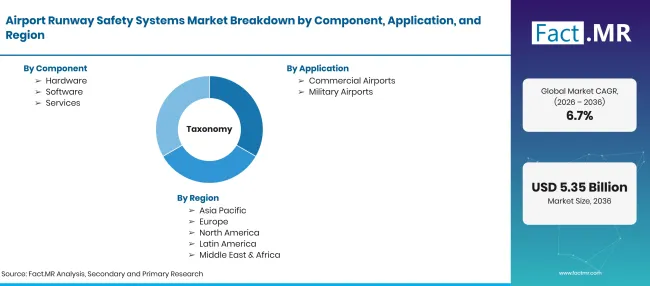
Airport Runway Safety Systems Market Taxonomy | Source: Fact.MR
| Attribute | Details |
|---|---|
| Quantitative Units | USD billion |
| Market Definition | The airport runway safety systems market comprises hardware, software and associated services designed to monitor runway conditions and movements while improving operational safety at airports. |
| Component | Hardware; Software; Services |
| Application | Commercial Airports; Military Airports |
| Technology | Radar; LiDAR; Camera; Others |
| End User | Airports; Airlines; Air Traffic Control |
| Regions Covered | North America; Latin America; Western Europe; Eastern Europe; East Asia; South Asia & Pacific; Middle East & Africa |
| Countries Covered | Germany; Brazil; USA; UK; Japan |
| Companies Profiled | Saab AB; Indra Sistemas S.A.; ADB SAFEGATE; Thales Group; Frequentis AG; Honeywell Technologies |
| Forecast Period | 2026 to 2036 |
| Approach | Market segmentation and scenario-based analysis supported by aviation safety publications and company product portfolios |
Source: Fact.MR analysis. Updated Nov 2, 2026
How is the market segmented?
-
By Component
- Hardware
- Software
- Services
-
By Application
- Commercial Airports
- Military Airports
-
By Technology
- Radar
- LiDAR
- Camera
- Others
-
By End User
- Airports
- Airlines
- Air Traffic Control
-
By Region
- North America
- Latin America
- Western Europe
- Eastern Europe
- East Asia
- South Asia & Pacific
- Middle East & Africa
Frequently Asked Questions
How big is the airport runway safety systems market in 2026?
What is the CAGR from 2026 to 2036?
Which component has the largest share?
Which application leads the market?
Which technology has the largest share?
Which end user leads the market?
Which countries are covered?
Which companies are covered?
Who worked on this report


Preview the report firsthand - request a free sample
Free SampleGet the brochure for pricing and purchase details
Download PDF