
- Market Value (2025): USD 4.1 Bn
- Estimated Value (2026): USD 4.33 Bn
- Forecast Value (2036): USD 7.75 Bn
- CAGR (2026-2036): 6.0%
Fire Sensors and Detectors Market Forecast and Outlook 2026 to 2036
According to the Fact.MR analysis, the fire sensor and detector market USD 4.1 billion in 2025 and is projected to grow from USD 4.33 billion in 2026 to USD 7.75 billion by 2036. Demand for fire sensors and detectors is likely to grow at a CAGR of 6.0% over the forecast period.
Demand for fire sensors and detectors is rising as building codes, insurers and owners require early detection in homes, offices, factories and energy sites. The key players are offering smoke, heat, gas and flame detectors using photoelectric, thermal, electrochemical and multi-criteria sensing, with conventional, addressable and wireless connections.
Key Takeaways from the Fire Sensors and Detectors Market
- Fire Sensors and Detectors Market Value (2025): USD 4.1 billion
- Fire Sensors and Detectors Market Value (2026): USD 4.33 billion
- Fire Sensors and Detectors Market Forecast Value (2036): USD 7.75 billion
- Fire Sensors and Detectors Market Forecast CAGR (2026-2036): 6.0%
- Leading Detector Type: Smoke detectors (44.6%)
- Key Market Participants: Honeywell, Johnson Controls, Siemens, Robert Bosch, Carrier Global (Kidde)
- Key Growth Countries: India, China, South Korea, United States, Germany
New construction, retrofits in older buildings and stricter requirements for early warning in industrial and data-center sites are expected to support steady demand, with connected and multi-sensor devices gaining share. Demand for advanced fire detection and early-warning devices is expected to strengthen as new construction, building renovations and data-centre investments increase the need for reliable fire-protection systems. India's Ministry of Electronics and Information Technology reported that installed data-centre capacity reached 1.57 GW by August 2026, compared with 375 MW in 2020, reflecting rapid expansion of digital infrastructure. Additionally, India's Ministry of Home Affairs reported 7,054 fire accidents and 6,891 associated deaths during 2023, highlighting the importance of effective fire detection and prevention. These developments support opportunities for connected smoke detectors, heat sensors and multi-sensor alarm systems across commercial buildings, industrial facilities and data centres.
Fire Sensors and Detectors Market
| Metric | Value |
|---|---|
| Estimated Value in (2026) | USD 4.33 billion |
| Forecast Value in (2036) | USD 7.75 billion |
| Forecast CAGR (2026 to 2036) | 6.0% |
Source: Fact.MR analysis.
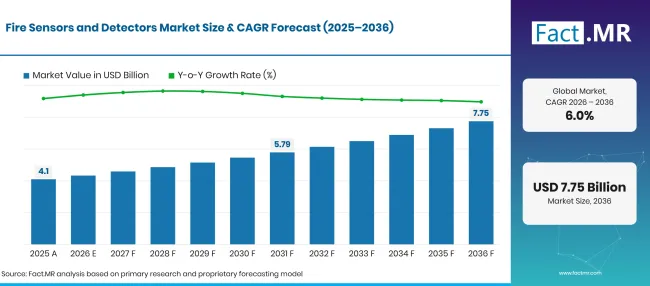
Fire Sensors And Detectors Market Forecast Global 1 | Source: Fact.MR
Category
| Category | Segments |
|---|---|
| Detector Type | Smoke detectors, Heat detectors, Gas detectors, Flame detectors, Multi-sensor detectors |
| Sensing Technology | Photoelectric, Thermal, Electrochemical and semiconductor gas, Multi-criteria and video-based, Ultraviolet and infrared optical |
| Connectivity | Addressable, Conventional, Wireless, Stand-alone alarms |
| End Use | Residential, Commercial buildings, Industrial, oil and gas, Healthcare and education, Transport and marine |
| Region | India; China; South Korea; United States; Germany |
Source: Fact.MR analysis.
Segmental Analysis
What is driving smoke detector sales as the largest detector type segment?
Fire Sensors And Detectors Market Breakdown Detector Type 1 | Source: Fact.MR
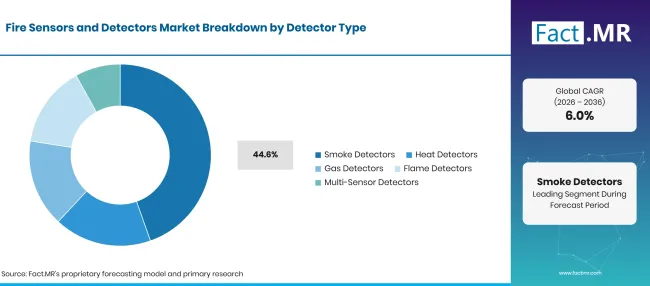
Demand for smoke detectors accounts for 44.6% of 2026 market revenue, about USD 1.93 billion, making them the leading detector type. Residential fire-protection requirements, commercial building regulations and periodic alarm replacement sustain purchasing volumes. According to the US Fire Administration, the United States recorded an estimated 343,000 residential building fires in 2024, with cooking responsible for 46.7% of incidents. These fire risks reinforce the need for early-warning systems across homes and buildings. Low installation costs, broad applicability and recurring replacement requirements continue to support smoke detector sales.
Which technical advantages are supporting photoelectric sensing technology adoption?
Fire Sensors And Detectors Market Breakdown Sensing Technology 1 | Source: Fact.MR
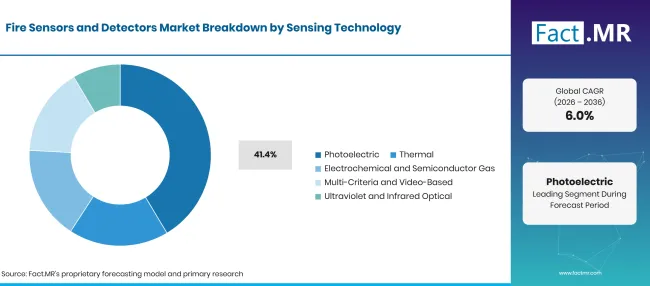
Sales of photoelectric fire-sensing devices are estimated to represent 41.4% of 2026 market revenue, about USD 1.79 billion. Their ability to detect visible smoke particles makes them particularly suitable for identifying smoldering fires. The US Occupational Safety and Health Administration explains that photoelectric detectors respond quickly when smoke particles scatter light toward the sensor. However, the US Fire Administration recommends using both photoelectric and ionization alarms, or dual-sensor alternatives, because each detects different fire characteristics. This established safety guidance supports demand for reliable sensing technologies across residential and commercial installations.
How are addressable fire alarm systems gaining ground in commercial installations?
Fire Sensors And Detectors Market Breakdown Connectivity 1 | Source: Fact.MR
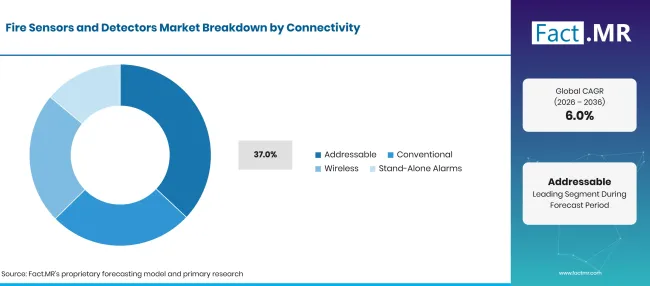
Demand for addressable fire detection systems holds 37.0% of 2026 market revenue, about USD 1.60 billion. Their ability to identify individual activated devices helps facility operators locate fire incidents and manage complex building networks. Government procurement provides evidence of institutional adoption: the Reserve Bank of India awarded a ₹64.19 lakh contract in September 2026 for the installation, testing and commissioning of an intelligent analog addressable fire alarm system at its College of Agricultural Banking in Pune. Such institutional projects support sales of addressable panels, detectors and integrated monitoring equipment.
What is sustaining residential demand for fire sensors and detectors?
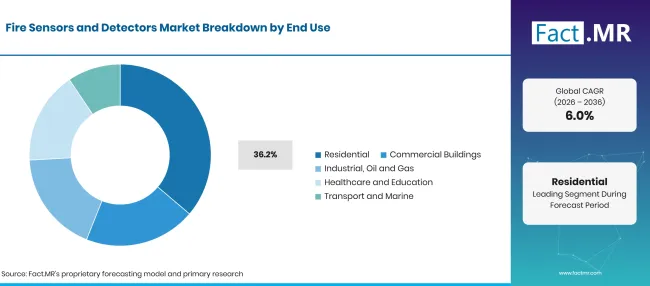
Fire Sensors And Detectors Market Breakdown End Use 1 | Source: Fact.MR
Residential installations account for 36.2% of 2026 market revenue, about USD 1.57 billion, supported by household fire-protection requirements and replacement purchases. The US Census Bureau estimated that the country had 149.81 million housing units in the third quarter of 2026, representing a substantial installation base for residential smoke alarms. Additionally, the UK's 2024–25 English Housing Survey, published in 2026, found that 93% of households reported having at least one working smoke alarm. New housing construction, safety compliance and periodic detector replacement continue to generate residential purchasing opportunities.
Fire Sensors and Detectors Market-Drivers, Restraints & Trends
Drivers: Growing Building Safety Requirements and Fire Prevention Investments
Demand for fire sensors and detectors is strengthening as residential construction, commercial development and industrial infrastructure expansion increase the need for reliable fire-protection systems. India's Ministry of Housing and Urban Affairs reported in August 2026 that more than 1 crore houses had been completed and delivered under PMAY-Urban and PMAY-U 2.0, out of 1.25 crore sanctioned houses. Additionally, the Ministry of Home Affairs reported 7,054 fire accidents and 6,891 associated deaths during 2023 in its February 2026 parliamentary response. These figures highlight the scale of building development and the continuing importance of fire prevention, early-warning systems and detector replacement across residential and commercial properties.
Restraints: Construction Cyclicality, False Alarms and Cost-Sensitive Procurement
Sales of fire sensors and detectors can be constrained by fluctuations in construction activity, installation expenses and price competition in residential and commercial building projects. False alarms and unnecessary system activations can also create operational disruption, encouraging some occupants or facility operators to disregard alerts or disable poorly maintained devices. India's Ministry of Home Affairs clarified in February 2026 that fire services remain a State subject and that the Central Government does not centrally maintain comprehensive fire-incident and building-audit data. This decentralized regulatory structure can create differences in inspection practices and enforcement across states. Consequently, manufacturers face challenges in achieving uniform adoption, particularly among smaller property owners and budget-conscious facilities.
Opportunity: Expansion of Connected and Wireless Fire Detection Systems
Adoption of connected and wireless fire detection systems is creating opportunities for manufacturers offering remote monitoring, automated notifications and easier installation in existing buildings. India's Department for Promotion of Industry and Internal Trade initiated a 2026 stakeholder consultation on a draft Quality Control Order covering nine fire detection and alarm system standards. These include IS/ISO 7240-25 for components using radio transmission paths, alongside standards for flame detectors, smoke detectors and input/output devices. The proposed framework highlights the growing importance of wireless detection technologies and standardized equipment performance. If implemented, applicable quality requirements could encourage investment in compliant products, creating opportunities for manufacturers supplying connected detectors and retrofit-friendly alarm systems.
Trend: Increasing Adoption of Multi-Criteria and Video-Based Fire Detection
Adoption of multi-criteria and video-based fire detection technologies is gaining importance in complex industrial, commercial and infrastructure environments where rapid identification of fire conditions is essential. India's 2026 draft fire detection and alarm systems Quality Control Order includes nine product standards, covering carbon monoxide and heat combination detectors, smoke and carbon monoxide combination detectors, point-type flame detectors and video fire detectors. It also references smoke-detection equipment for ducts and components using radio transmission paths. This regulatory development reflects increasing attention to different detection technologies and system configurations. Such developments create opportunities for manufacturers to supply integrated sensing platforms that improve detection coverage and support more sophisticated fire-monitoring requirements.
Fire Sensors and Detectors Market Analysis by Key Country
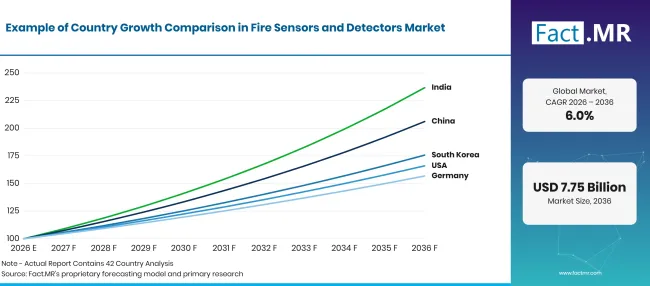
Fire Sensors And Detectors Market Growth Index 1 | Source: Fact.MR
| Country | CAGR (2026-2036) |
|---|---|
| India | 9.0% |
| China | 7.5% |
| South Korea | 5.8% |
| United States | 5.2% |
| Germany | 4.6% |
Source: Fact.MR analysis.
What is accelerating demand for fire sensors and detectors in India?
Demand for fire sensors and detectors in India is projected to increase at a 9.0% CAGR through 2036, the fastest among the five profiled countries.
Expanding residential construction, commercial infrastructure and stricter attention to building fire safety are supporting procurement of smoke, heat and multi-sensor detection systems. India's Ministry of Home Affairs reported 7,054 fire accidents and 6,891 deaths during 2023 in its February 2026 parliamentary response. Additionally, the National Building Code 2016 specifies fire detection, suppression and evacuation provisions for different building occupancies, supporting demand for compliant detection installations across new and existing properties.
Which developments are strengthening China's fire detection equipment market?
Sales of fire sensors and detectors in China are forecast to grow at a 7.5% CAGR through 2036, exceeding the global rate of 6.0%.
Extensive high-rise construction, industrial facilities and continued fire-safety enforcement support demand for automated detection and alarm systems. China's Ministry of Emergency Management reported in April 2026 that fire incidents declined by 7.6% in 2025, while fire-related deaths decreased by 9.5%. The ministry also highlighted the concentration of fire risks in residential buildings, rural areas and smaller commercial premises. These findings reinforce the importance of early-warning equipment, building inspections and improved fire-prevention infrastructure.
How is South Korea's building-safety environment influencing detector adoption?
Adoption of fire sensors and detectors in South Korea is expected to rise at a 5.8% CAGR through 2036, below the global rate of 6.0%.
Dense apartment developments, industrial facilities and stricter fire-prevention practices sustain demand for smoke alarms, heat detectors and integrated fire-monitoring systems. South Korea's National Fire Agency reported 415,044 fire-safety management target facilities in 2026, compared with 407,965 in 2025, representing a 1.74% increase. This expanding base of monitored facilities creates opportunities for detector installation, replacement and maintenance, particularly in residential complexes, commercial buildings and industrial properties requiring continuous fire-safety management.
What is maintaining demand for residential and commercial fire detection systems in the United States?
Demand for fire sensors and detectors in the United States is projected to grow at a 5.2% CAGR through 2036, below the global rate of 6.0%.
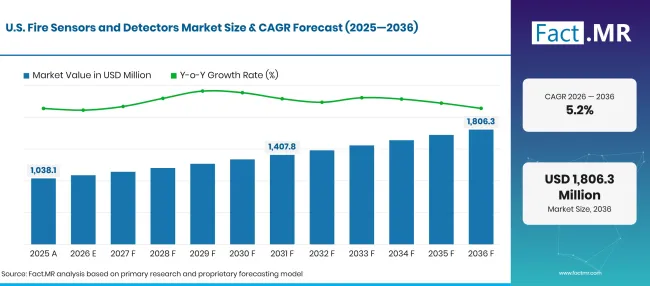
Fire Sensors And Detectors Market Forecast Usa 1 | Source: Fact.MR
Residential smoke-alarm requirements, commercial building protection and replacement of ageing detection equipment support recurring procurement. According to the US Fire Administration's government statistics available in 2026, the country recorded an estimated 343,000 residential building fires in 2024. Cooking accounted for 46.7% of residential building fires, while electrical malfunctions represented 7.7%. These figures reinforce the importance of early smoke and heat detection across homes, apartments and commercial properties.
Which factors are keeping Germany's fire detection market steady despite slower growth?
Sales of fire sensors and detectors in Germany are anticipated to expand at a 4.6% CAGR through 2036, the slowest among the five profiled countries.
Strict building-safety requirements, industrial protection standards and demand for certified detection equipment sustain purchases across residential and commercial properties. Germany's Federal Statistical Office (Destatis), in data published in February 2026, recorded 149,748 building permits in 2025, covering 238,063 planned dwellings, compared with 145,010 permits in 2024. This construction activity supports opportunities for smoke detectors, heat sensors and integrated alarm installations, while renovation and replacement requirements provide additional demand beyond new buildings.
About The Report
- Fire Sensors and Detectors Market Forecast and Outlook 2026 to 2036
- Fire Sensors and Detectors Market
- Category
- Segmental Analysis
- Fire Sensors and Detectors Market-Drivers, Restraints & Trends
- Fire Sensors and Detectors Market Analysis by Key Country
- Competitive Landscape for Fire Sensors and Detectors Market
Bibliography
- Department for Promotion of Industry and Internal Trade. (2026, June). Request for stakeholder’s comments on draft quality control orders [PDF].
- Destatis. (2026, February). Building permits. Federal Statistical Office of Germany.
- Honeywell. (2026, November 10). Honeywell Technologies unveils new portfolio of intelligent fire and life safety innovations to improve detection, monitoring and incident response [Press release].
- Johnson Controls. (2026, August 24). Johnson Controls launches next generation fire safety [Press release].
- Ministry of Emergency Management. (2026, April 27). Fire safety review. Government of the People’s Republic of China.
- Ministry of Home Affairs. (2026, February 10). Fire accidents and fire safety [PDF]. Government of India.
- Ministry of Housing and Urban Affairs. (2026, August 9). PMAY Urban progress. Press Information Bureau.
- Ministry of Electronics and Information Technology. (2026, August). Status of data centres in India. Press Information Bureau.
- MSA Safety. (2026, July 9). MSA Safety completes acquisition of Autronica Fire and Security [Press release].
- National Fire Agency. (2026). 2026 fire prevention statistics [PDF]. Government of the Republic of Korea.
- Siemens. (2026, March 27). Siemens unveils next gen fire safety protection, paving way for autonomous buildings [Press release].
- Siemens. (2026, June 22). Siemens at NFPA 2026: Advancing fire protection through innovation [Press release].
- U.S. Fire Administration. (n.d.). Fire statistics. Federal Emergency Management Agency.
Segmentation
Competitive Landscape for Fire Sensors and Detectors Market
The fire sensor and detector market is relatively concentrated, with Honeywell, Johnson Controls, Siemens, Robert Bosch and Carrier Global (Kidde) together hold about 70% of 2026 revenue, based on Fact.MR estimates. Competition centers on detection reliability, false-alarm performance, certification, system integration and installer relationships. Large building-technology groups lead in commercial systems, while consumer brands lead in stand-alone alarms.
Recent Developments
- In November 2026, Honeywell introduced System Sensor Distinguish, an AI-enabled fire detector technology designed to differentiate actual fire signatures from steam, dust, mist and other airborne particles. The innovation aims to reduce nuisance alarms while maintaining early smoke detection.
- In March 2026, Siemens launched its next-generation Sinteso Nova and Cerberus Nova fire detectors featuring cloud connectivity, continuous self-testing, remote diagnostics and predictive maintenance. Multi-wavelength optical and dual thermal sensing technologies help minimize false alarms across commercial and industrial facilities.
- In June 2026, Siemens introduced ASD+ aspirating smoke detection in the United States with UL certification. Designed for data centres, warehouses and lithium-ion battery storage facilities, the technology provides early fire warning through continuous air sampling and advanced smoke detection.
- In August 2026, Johnson Controls launched Simplex Incident Manager and Autocall Fire Site Administrator. The platforms provide centralized fire monitoring, support up to 250,000 devices and connect up to 687 fire alarm control units, strengthening emergency response capabilities in complex facilities.
- In July 2026, MSA Safety completed its approximately USD 555 million acquisition of Autronica Fire and Security, a Norwegian provider of fire detection, gas detection and alarm systems. Autronica generated approximately USD 160 million in 2025 revenue, expanding MSA's fire and gas safety portfolio.
Key Players in Fire Sensors and Detectors Market
Key companies operating in the market include Honeywell, Johnson Controls, Siemens, Robert Bosch, and Carrier Global (Kidde).
- Honeywell
- Johnson Controls
- Siemens
- Robert Bosch
- Carrier Global (Kidde)
Scope of Report
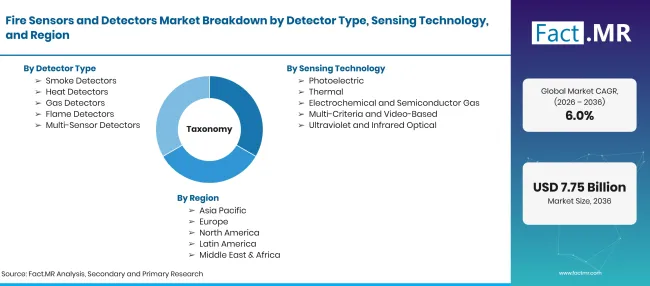
Fire Sensors And Detectors Market Taxonomy 1 | Source: Fact.MR
| Items | Values |
|---|---|
| Quantitative Units (2026) | USD 4.33 Billion |
| Detector Type | Smoke detectors, Heat detectors, Gas detectors, Flame detectors, Multi-sensor detectors |
| Sensing Technology | Photoelectric, Thermal, Electrochemical and semiconductor gas, Multi-criteria and video-based, Ultraviolet and infrared optical |
| Connectivity | Addressable, Conventional, Wireless, Stand-alone alarms |
| End Use | Residential, Commercial buildings, Industrial, oil and gas, Healthcare and education, Transport and marine |
| Regions Covered | North America, Latin America, Europe, Asia Pacific, Middle East & Africa |
| Countries Covered | India, China, South Korea, United States, Germany, and other countries |
| Key Companies Profiled | Honeywell, Johnson Controls, Siemens, Robert Bosch, Carrier Global (Kidde) |
| Additional Attributes | Dollar revenue in the Fire Sensors and Detectors Market is segmented by detector type, sensing technology, connectivity and end use and region. |
Source: Fact.MR analysis.
Fire Sensors and Detectors Market by Segments
-
Detector Type
- Smoke detectors
- Heat detectors
- Gas detectors
- Flame detectors
- Multi-sensor detectors
-
Sensing Technology
- Photoelectric
- Thermal
- Electrochemical and semiconductor gas
- Multi-criteria and video-based
- Ultraviolet and infrared optical
-
Connectivity
- Addressable
- Conventional
- Wireless
- Stand-alone alarms
-
End Use
- Residential
- Commercial buildings
- Industrial, oil and gas
- Healthcare and education
- Transport and marine
-
Region:
- North America
- United States
- Canada
- Mexico
- Europe
- Germany
- United Kingdom
- France
- Italy
- Spain
- Rest of Europe
- Asia Pacific
- China
- India
- Japan
- South Korea
- Australia and New Zealand
- Rest of Asia Pacific
- Latin America
- Brazil
- Argentina
- Rest of Latin America
- Middle East & Africa
- GCC Countries
- South Africa
- Rest of Middle East & Africa
- North America
Table of Contents
Key Takeaways
- Market Size and CAGR
- Top Growth Driver
- Fastest Growing Segment
- Leading Region
- Key Companies
- Emerging Opportunities

