
- Market Value (2025): USD 317.3 Mn
- Estimated Value (2026): USD 350.0 Mn
- Forecast Value (2036): USD 932.9 Mn
- CAGR (2026-2036): 10.3%
Ruggedized Edge Computing Nodes Market Forecast and Outlook 2026 to 2036
The ruggedized edge computing nodes market reached a derived estimate of USD 317.3 million in 2025. The market is anticipated to expand from USD 350.0 million in 2026 to USD 932.9 million by 2036, registering a CAGR of 10.3% during the forecast period.
Growing use of AI at factory floors, transport networks and remote infrastructure is bringing computing closer to operating equipment. These locations require compact systems that withstand vibration, temperature swings and power fluctuations. In October 2025, Advantech introduced its MIC-780 fanless industrial PC with Intel Core Ultra processors, integrated NPU capabilities and MIL-STD-810G rugged design for industrial edge AI applications. Such product developments highlight the shift towards reliable, on-site processing and create fresh opportunities for ruggedized edge computing nodes.
Key Takeaways from the Ruggedized Edge Computing Nodes Market
- Sales of ruggedized edge computing nodes stood at USD 317.3 million in 2025
- Ruggedized Edge Computing Nodes Market Value (2026): USD 350.0 million
- Ruggedized Edge Computing Nodes Market Forecast Value (2036): USD 932.9 million
- Ruggedized Edge Computing Nodes Market Forecast CAGR (2026-2036): 10.3%
- Leading Product Type: Edge server node (25.3%)
- Key Market Participants: Advantech, Siemens, Dell Technologies, HPE, Lenovo, Kontron
- Key Growth Regions: Singapore, South Korea, United States, Germany, Japan
In March 2026, NXP announced robotics solutions developed with NVIDIA for sensor fusion, machine vision and precision motor control, highlighting the growing role of real-time edge intelligence. This transition is opening new opportunities for ruggedized computing platforms across industrial markets. As AI moves into factory robots, vehicles and industrial equipment, more processing is taking place close to the machines rather than in remote data centres. This shift calls for compact computing systems that deliver fast responses while operating in demanding environments.
Ruggedized Edge Computing Nodes Market
| Metric | Value |
|---|---|
| Estimated Value (2025) | USD 317.3 million |
| Market Value (2026) | USD 350.0 million |
| Forecast Value (2036) | USD 932.9 million |
| Forecast CAGR (2026 to 2036) | 10.3% |
Source: Fact.MR analysis. Updated Nov 25, 2026
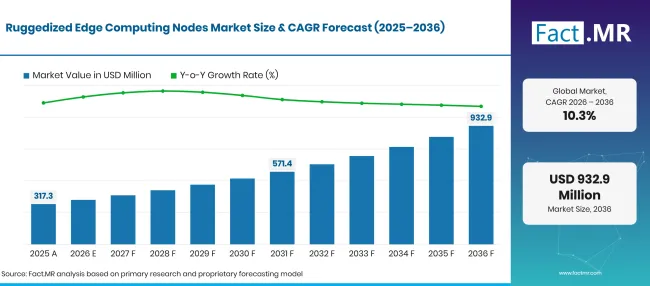
Ruggedized Edge Computing Nodes Forecast Global | Source: Fact.MR
Category
| Category | Segments |
|---|---|
| Product Type | Edge server node, Rugged modular compute, ARM industrial edge node, Fanless x86 edge node, GPU AI-capable edge node |
| Component Format | Rugged standalone, Board module, Pluggable assembly, Discrete, Embedded subsystem |
| Performance Class | Specialty and rugged, High speed, High precision, Basic, Mainstream industrial |
| End Use | Automotive, Industrial automation, Telecom and data center, Electronics, Aerospace and defense |
| Region | Singapore; South Korea; United States; Germany; Japan |
Source: Fact.MR analysis. Updated Nov 25, 2026
Segmental Analysis
Why do edge server nodes lead product demand in the Ruggedized Edge Computing Nodes Market?
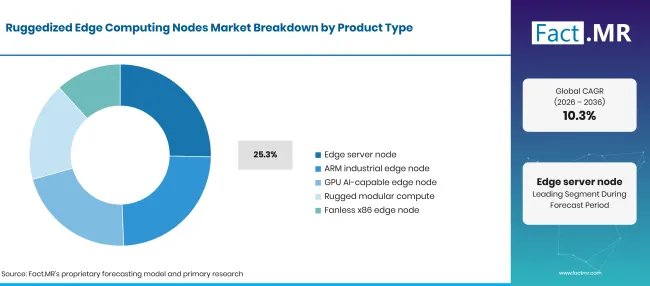
Ruggedized Edge Computing Nodes Breakdown Product Type | Source: Fact.MR
Edge server nodes capture 25.3% of market revenue in 2026, reaching USD 88.6 million. Their appeal lies in handling several computing tasks at industrial sites without routing every workload to a central data centre. In May 2026, SNUC introduced its extremeEDGE EE-8700 single-node server with AMD EPYC 9005 processors and a compact 2U chassis for deployment beyond conventional server rooms. Embedded computers and gateways are also gaining traction as factories expand machine-level automation and real-time monitoring.
How is the rugged standalone format leading demand in the Ruggedized Edge Computing Nodes Market?
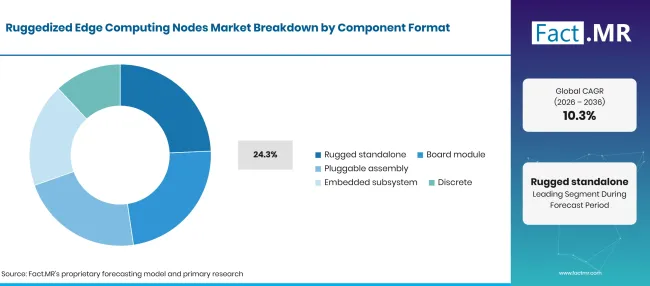
Ruggedized Edge Computing Nodes Breakdown Component Format | Source: Fact.MR
Rugged standalone systems generate 24.3% of market revenue in 2026, equivalent to USD 85.1 million. Their self-contained construction simplifies installation at outdoor facilities, transport networks and industrial sites where rack infrastructure is impractical. Axiomtek introduced its IPC980 IP67-rated industrial system in May 2026, featuring a sealed fanless enclosure, rugged M12 connectors and front-access I/O. Modular and embedded formats are gaining ground too, particularly where operators require customised installations and space-efficient computing.
Why does the specialty and rugged class lead performance demand in the Ruggedized Edge Computing Nodes Market?
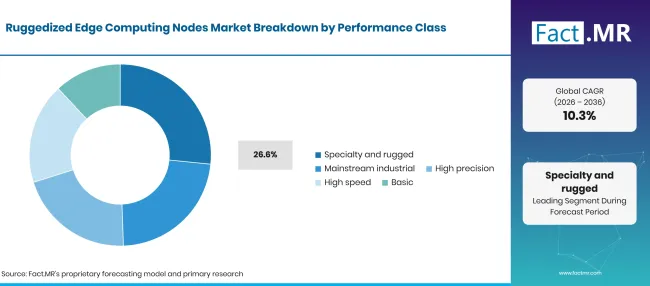
Ruggedized Edge Computing Nodes Breakdown Performance Class | Source: Fact.MR
Specialty and rugged systems generate 26.6% of market revenue in 2026, reaching USD 93.1 million. Railways, defence operations, mining sites and marine facilities require computers that withstand severe vibration, moisture and temperature fluctuations. In June 2026, Spectra Defense Technologies launched its XSR Spire mission computer with IP67 protection and Intel Xeon-W Gen11 processing for ground vehicles, aircraft and maritime platforms. Standard industrial systems are also gaining interest as manufacturers automate production lines and upgrade plant monitoring infrastructure.
How is automotive leading end-use demand in the Ruggedized Edge Computing Nodes Market?
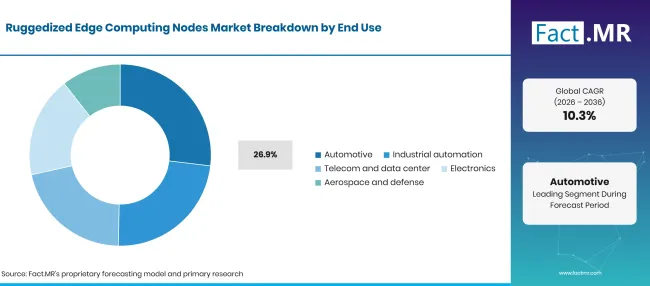
Ruggedized Edge Computing Nodes Breakdown End Use | Source: Fact.MR
Automotive generates 26.9% of market revenue in 2026, equivalent to USD 94.2 million. Connected vehicles, autonomous driving trials and in-vehicle analytics require dependable computing close to sensors and control systems. In November 2025, Eurotech introduced its DynaCOR 40-14 automotive-certified edge computer with optional NVIDIA GPU acceleration for real-time processing in connected and autonomous vehicles. Industrial manufacturing and telecom applications are also expanding their use of rugged nodes for machine vision, network monitoring and automated operations.
Ruggedized Edge Computing Nodes Market-Drivers, Restraints & Trends
Drivers:
AI Investment Extends Computing Beyond Data Centres: AI adoption is creating opportunities for ruggedized edge computing nodes as factories, transport networks and remote facilities process more information locally. These environments require dependable computing without delays associated with cloud connectivity. TSMC reported in October 2026 that high-performance computing generated 68% of its third-quarter revenue, up from 57% a year earlier. Growing investment in AI infrastructure is strengthening the case for industrial computing closer to operating equipment.
Restraints:
Memory Shortages and Hardware Cost Pressure: Expensive memory, lengthy component procurement cycles and difficult field maintenance can discourage smaller industrial buyers. High-performance processors also increase cooling and power requirements in sealed enclosures. SK hynix reported in October 2026 that memory supply constraints could persist through 2030 as AI-related consumption outpaces production capacity. Such shortages create additional pricing and inventory risks for rugged computing manufacturers.
Trend: Industrial AI Moves Towards Local Processing:
Factories are adopting edge intelligence to analyse camera feeds, equipment conditions and production data without relying entirely on remote servers. This shift is increasing interest in rugged nodes with AI acceleration, high-speed memory and thermal-efficient designs. TSMC reported a 22% quarterly increase in high-performance computing revenue in Q3 2026. Wider industrial AI deployment creates opportunities for rugged computing infrastructure across manufacturing and logistics.
Trend: Convergence of Edge Computing and Industrial Connectivity:
Industrial operators are bringing networking and computing closer together to reduce communication delays and simplify factory infrastructure. Siemens expanded its private 5G infrastructure into the United States and seven additional countries in April 2026, while adding edge runtime capabilities to its 5G routers. Wider adoption of private 5G and real-time industrial networks creates room for ruggedized edge computing nodes across connected factories, utilities and transport infrastructure.
Ruggedized Edge Computing Nodes Market by Analysis by Key Country
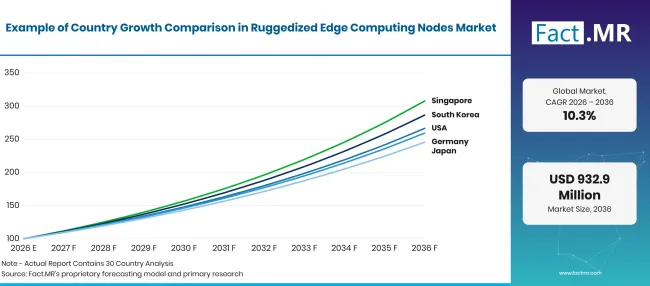
Ruggedized Edge Computing Nodes Growth Index | Source: Fact.MR
| Country | CAGR (2026-2036) |
|---|---|
| Singapore | 11.9% |
| South Korea | 11.1% |
| United States | 10.3% |
| Germany | 10.0% |
| Japan | 9.4% |
Source: Fact.MR analysis. Updated Nov 25, 2026
What is driving ruggedized edge computing nodes demand in Singapore?
Singapore's 11.9% CAGR reflects its growing role in advanced manufacturing, semiconductor production and connected industrial infrastructure.
In October 2025, the Singapore Economic Development Board reported that the country secured S$14.2 billion in fixed asset investment commitments in 2024, with electronics among the key investment sectors. Expansion of automated production facilities and data-intensive operations is creating opportunities for rugged computing systems that perform reliably near industrial equipment.
How are automation and chips supporting ruggedized edge computing nodes sales in South Korea?
Semiconductor manufacturing and smart factory investment are strengthening South Korea's prospects, with the market advancing at an 11.1% CAGR.
In October 2025, the South Korean government announced plans to invest KRW 1.2 trillion in AI transformation across manufacturing by 2030. Greater use of industrial robots, machine vision and automated production controls is increasing the requirement for dependable local computing infrastructure.
What is shaping ruggedized edge computing nodes demand in the United States?
A 10.3% CAGR is anticipated as American manufacturers modernize production facilities and bring AI-based inspection, automation and equipment monitoring closer to factory operations.
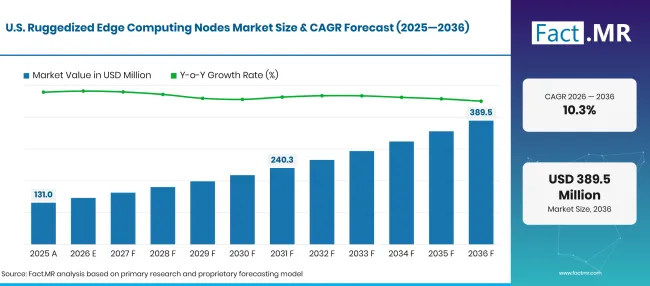
Ruggedized Edge Computing Nodes Forecast Usa | Source: Fact.MR
In September 2026, the National Institute of Standards and Technology awarded more than USD 30 million to 12 manufacturing support centres to accelerate adoption of AI, robotics and advanced manufacturing technologies. These investments are widening opportunities for rugged computing infrastructure across industrial facilities and critical infrastructure.
How is industrial AI shaping ruggedized edge computing nodes sales in Germany?
With a 10.0% CAGR, Germany benefits from its extensive industrial automation base and growing use of intelligent production systems.
Germany Trade & Invest reported in September 2025 that the country had 449 industrial robots per 10,000 manufacturing employees, the highest density in Europe. Automotive plants, machinery manufacturers and electronics facilities are creating opportunities for hardened computing platforms that support machine vision, predictive maintenance and real-time production control.
Why is growth slower for ruggedized edge computing nodes in Japan?
At a 9.4% CAGR, Japan's growth prospects are closely tied to robotics, factory digitalization and autonomous mobility.
In May 2026, METI selected research themes for manufacturing AI-readiness and robotics foundation models under its GENIAC initiative. This focus on bringing intelligence into physical operations is strengthening the case for dependable local computing. Automotive production, industrial robots and labour-saving automation are important sales channels for ruggedized nodes.
Competitive Landscape for Ruggedized Edge Computing Nodes Market
Competition in the ruggedized edge computing nodes market is intensifying as manufacturers move beyond conventional industrial PCs towards AI-ready computing platforms. Advantech is strengthening its position through NVIDIA-powered edge AI systems, GPU industrial PCs and embedded platforms for robotics, machine vision and transportation. In November 2026, it introduced the MIC-332S, a rugged CompactPCI Serial system delivering up to 275 TOPS of AI performance, with operating temperatures ranging from -25°C to 70°C.
Siemens differentiates itself through SIMATIC industrial PCs and its Industrial Edge ecosystem, which combines shop-floor hardware, application deployment and centralized device management. Kontron competes through embedded computing, railway-grade systems, industrial servers and secure edge software. Lenovo is expanding its ThinkEdge portfolio with fanless gateways and AI-capable industrial PCs, including the SE60n Gen2, which supports up to 97 TOPS of AI processing. Dell Technologies and HPE strengthen competition through enterprise server expertise and computing platforms designed for distributed and demanding environments.
Recent Developments
- On January 6, 2026, Advantech partnered with Intel to develop edge AI solutions using Intel Core Ultra Series 3 processors for industrial automation and intelligent computing applications.
- On February 25, 2026, Dell Technologies introduced the PowerEdge XR9700, a weather-resistant and liquid-cooled outdoor server designed for edge AI and Cloud RAN deployments in harsh environments.
- On April 30, 2026, HPE expanded its ProLiant edge portfolio with new ruggedized server platforms designed for AI workloads in manufacturing, telecommunications and national security environments.
- On February 23, 2026, Lenovo expanded its ThinkEdge portfolio with four new industrial computing systems, including the AI-ready SE30n Gen 2 and AI-powered SE60n Gen 2.
- On March 11, 2026, Kontron partnered with SiMa.ai to introduce the KBox A-151 EAI industrial edge platform, delivering more than 50 TOPS of AI processing performance.
Key Players in Ruggedized Edge Computing Nodes Market
Key companies operating in the market include Advantech, Siemens, Dell Technologies, HPE, Lenovo, and Kontron.
- Advantech
- Siemens
- Dell Technologies
- HPE
- Lenovo
- Kontron
Bibliography
- Advantech. (2025, October 17). Advantech launches MIC-780: The first fanless industrial box PC powered by Intel Core Ultra processors with integrated NPU.
- Advantech. (2026, October 29). Advantech reports 3Q26 EPS of NT$7.15 quarterly revenue and profit reach record highs.
- Advantech. (2026, November 9). Advantech MIC-332S: A rugged 3U CPCI-Serial edge AI inference system powered by NVIDIA Jetson AGX Orin.
- Advantech. (2026). 3Q26 earnings call transcript.
- Axiomtek. (2026, May 2). Axiomtek announces new compact, IP67-rated industrial system IPC980 for mission-critical applications.
- Curtiss-Wright Defense Solutions. (2026, August 18). Curtiss-Wright brings data center-class computing to the tactical edge.
- Dell Technologies. (2026, February 25). Dell PowerEdge XR9700 brings Cloud RAN and AI to harsh edge environments.
- Eurotech. (2025, November 27). Eurotech launches DynaCOR 40-14: Automotive-certified fanless edge AI computer for connected and autonomous vehicles intelligent operations.
- Germany Trade & Invest. (2025, September 29). Germany is Europe's leading robotics nation.
- Hewlett Packard Enterprise. (2026, April 30). HPE brings AI and mission-critical workloads to severe, ruggedized environments.
- Kontron. (2026, March 6). Kontron expands its defense rugged systems portfolio with the HARAKAN-F2-2.
- Lenovo. (2026, February 23). Lenovo unlocks data potential with next generation of AI-driven ThinkEdge solutions.
- Ministry of Economy, Trade and Industry. (2026, May 14). Selection of nine R&D themes related to making manufacturing and other data AI-ready and two R&D themes related to robotics foundation models under the GENIAC project.
- Ministry of Science and ICT. (2026, July 8). 2030 blueprint is unveiled for AI-driven manufacturing transformation.
- National Institute of Standards and Technology. (2026, September 15). NIST awards more than $30 million for MEP centers in 11 states and Puerto Rico.
- NXP Semiconductors. (2026, March 16). NXP delivers new innovations for advanced physical AI with NVIDIA.
- Siemens AG. (2026, April 1). Siemens expands its private 5G infrastructure to the United States and seven additional countries.
- Siemens AG. (n.d.). Industrial Edge devices.
- Singapore Economic Development Board. (2026). EDB year 2025 in review.
- SK hynix. (2026, October 28). SK hynix announces 3Q26 financial results.
Segmentation
Scope of Report
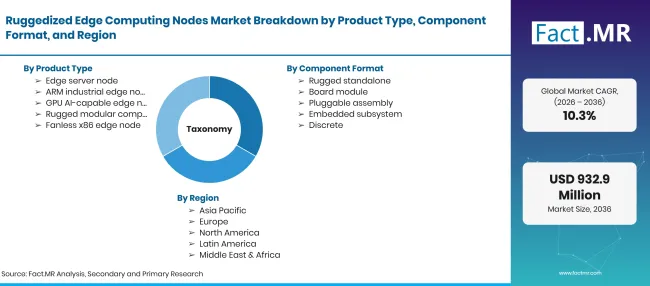
Ruggedized Edge Computing Nodes Taxonomy | Source: Fact.MR
| Items | Values |
|---|---|
| Quantitative Units (2026) | USD 350.0 Million |
| Product Type | Edge server node, Rugged modular compute, ARM industrial edge node, Fanless x86 edge node, GPU AI-capable edge node |
| Component Format | Rugged standalone, Board module, Pluggable assembly, Discrete, Embedded subsystem |
| Performance Class | Specialty and rugged, High speed, High precision, Basic, Mainstream industrial |
| End Use | Automotive, Industrial automation, Telecom and data center, Electronics, Aerospace and defense |
| Regions Covered | North America, Latin America, Europe, East Asia, South Asia and Pacific, Middle East & Africa |
| Countries Covered | Singapore, South Korea, United States, Germany, Japan, and other countries |
| Key Companies Profiled | Advantech, Siemens, Dell Technologies, HPE, Lenovo, Kontron |
| Additional Attributes | Dollar revenue in the Ruggedized Edge Computing Nodes Market is segmented by product type (edge server node, rugged modular compute, ARM industrial node, fanless x86 node, GPU AI-capable node), component format, performance class, end use and region. |
Source: Fact.MR analysis. Updated Nov 25, 2026
Ruggedized Edge Computing Nodes Market by Segments
-
Product Type
- Edge server node
- Rugged modular compute
- ARM industrial edge node
- Fanless x86 edge node
- GPU AI-capable edge node
-
Component Format
- Rugged standalone
- Board module
- Pluggable assembly
- Discrete
- Embedded subsystem
-
Performance Class
- Specialty and rugged
- High speed
- High precision
- Basic
- Mainstream industrial
-
End Use
- Automotive
- Industrial automation
- Telecom and data center
- Electronics
- Aerospace and defense
-
Region:
- North America
- United States
- Canada
- Mexico
- Europe
- Germany
- United Kingdom
- France
- Italy
- Spain
- Rest of Europe
- Asia Pacific
- China
- India
- Japan
- South Korea
- Australia
- Rest of Asia Pacific
- Latin America
- Brazil
- Mexico
- Argentina
- Rest of Latin America
- Middle East & Africa
- GCC Countries
- South Africa
- Rest of Middle East & Africa
- North America
Table of Contents
Key Takeaways
- Market Size and CAGR
- Top Growth Driver
- Fastest Growing Segment
- Leading Region
- Key Companies
- Emerging Opportunities

