
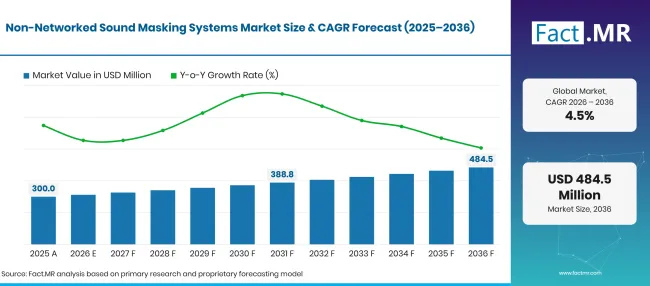
- Market Value (2025): USD 300.0 Mn
- Estimated Value (2026): USD 312.0 Mn
- Forecast Value (2036): USD 484.5 Mn
- CAGR (2026-2036): 4.5%
Non-Networked Sound Masking Systems Market Forecast and Outlook 2026 to 2036
The non-networked sound masking systems market is projected to grow from USD 312.0 million in 2026 to USD 484.5 million by 2036, registering a CAGR of 4.5% over the ten-year period. Demand is supported by the use of standalone sound masking equipment in commercial offices, healthcare facilities and other workplaces to improve speech privacy and reduce distractions from surrounding conversations.
Demand for non-networked sound masking systems is rising as offices, healthcare facilities and consultation rooms seek better speech privacy without complex network controls. Manufacturers are offering standalone systems that allow installers to adjust background sound levels according to room requirements. For example, in October 2025, Biamp included its Qt 100 single-zone sound masking control module in its updated product catalogue. The system supports locally controlled masking installations, making it suitable for workplaces requiring straightforward acoustic management.
Key Takeaways from Non-Networked Sound Masking Systems Market
- Sales of non-networked sound masking systems stood at USD 300.0 million in 2025
- Non-Networked Sound Masking Systems Market Value (2026): USD 312.0 million
- Non-Networked Sound Masking Systems Market Forecast Value (2036): USD 484.5 million
- Non-Networked Sound Masking Systems Market Forecast CAGR (2026-2036): 4.5%
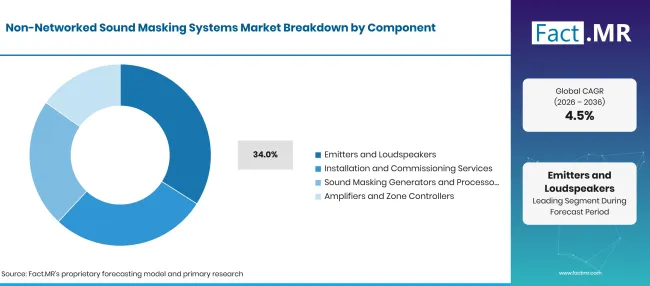
- Leading Component: Emitters and loudspeakers (34.0%)
- Key Market Participants: Biamp (Cambridge Sound Management), Lencore Acoustics, Soft dB, LogiSon Acoustic Network, AtlasIED
- Key Growth Countries: South Korea, Australia, Canada, United States, United Kingdom
In August 2025, Lencore Acoustics promoted its Sound Masking for All Projects Incentive Program to encourage audiovisual integrators to include speech privacy solutions in more commercial installations. Offices, healthcare facilities and professional service firms require background sound systems that reduce the intelligibility of nearby conversations. Lencore's Classic non-networked system provides local sound control, with plenum options and independent or central volume control.
Non-Networked Sound Masking Systems Market
| Metric | Value |
|---|---|
| Estimated Value in (2026) | USD 312.0 million |
| Forecast Value in (2036) | USD 484.5 million |
| Forecast CAGR (2026 to 2036) | 4.5% |
Source: Fact.MR analysis. Updated Nov 27, 2026
Non Networked Sound Masking Systems Market Forecast Global | Source: Fact.MR
Category
| Category | Segments |
|---|---|
| Component | Emitters and loudspeakers, Installation and commissioning services, Sound masking generators and processors, Amplifiers and zone controllers |
| Emitter Placement | Above-ceiling emitters, Direct-field open-ceiling emitters, In-wall and flush-mount emitters, Desktop and portable units |
| Application | Open-plan offices, Healthcare facilities, Government and legal buildings, Call centers and financial services, Hospitality and education |
| Sales Channel | Acoustic and AV integrators, Direct to building owners, Distributors, Online and retail |
| Country | South Korea; Australia; Canada; United States; United Kingdom |
Source: Fact.MR analysis. Updated Nov 27, 2026
Segmental Analysis
What makes emitters and loudspeakers the leading component segment in the Non-Networked Sound Masking Systems Market?
Non Networked Sound Masking Systems Market Breakdown Component | Source: Fact.MR
Emitters and loudspeakers hold a 34.0% revenue share in 2026, approximately USD 106.1 million. These components distribute background masking sound across designated workplace areas, helping reduce speech intelligibility between nearby occupants. Biamp offers Qt emitters for ceiling installations, while Lencore incorporates loudspeakers into its Classic standalone sound masking systems for commercial acoustic privacy applications.
Which factors support above-ceiling emitters as the largest emitter placement segment in the Non-Networked Sound Masking Systems Market?
Non Networked Sound Masking Systems Market Breakdown Emitter Placement | Source: Fact.MR
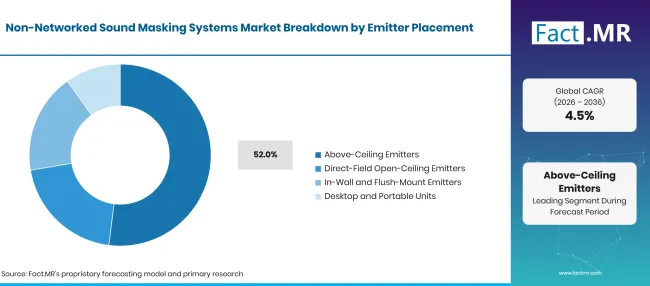
Above-ceiling emitters generate approximately USD 162.2 million in 2026, securing 52.0% of market revenue. Installed within ceiling plenums, these units distribute masking sound across occupied spaces without exposing equipment to room occupants. Lencore's Classic non-networked system offers plenum options for ceiling installations, making this arrangement suitable for offices with suspended ceilings and defined acoustic coverage requirements.
What makes open-plan offices the leading application segment in the Non-Networked Sound Masking Systems Market?
Non Networked Sound Masking Systems Market Breakdown Application | Source: Fact.MR
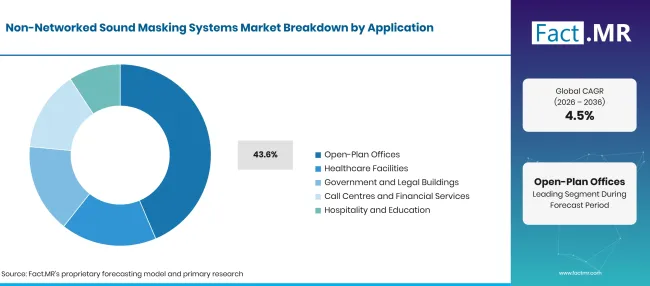
Open-plan offices contribute 43.6% of market revenue in 2026, approximately USD 136.0 million. Shared workstations and limited physical partitions increase the need for speech privacy and distraction control. Standalone sound masking equipment introduces consistent background sound to reduce conversation intelligibility across work areas. Local controls also suit offices requiring straightforward acoustic adjustments.
Which factors support acoustic and AV integrators as the largest sales channel segment in the Non-Networked Sound Masking Systems Market?
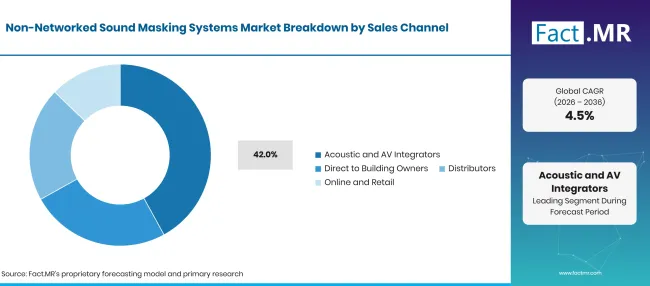
Non Networked Sound Masking Systems Market Breakdown Sales Channel | Source: Fact.MR
Acoustic and AV integrators lead sales channels with a 42.0% revenue share in 2026, approximately USD 131.0 million. These specialists assess room layouts, select suitable emitters and configure masking levels during installation. Lencore’s integrator incentive program, which credits integrators for quoting its sound masking projects, reflects their role in specifying acoustic privacy systems for offices and commercial buildings.
Non-Networked Sound Masking Systems Market: Drivers, Restraints & Trends
Drivers
Open-plan offices, healthcare reception areas and meeting rooms are encouraging the use of standalone sound masking systems to improve speech privacy. Locally controlled equipment allows facility managers to adjust background sound levels without centralized network management, supporting installations in smaller commercial spaces.
Restraints
Network-managed sound masking systems offer greater flexibility for controlling multiple acoustic zones, influencing purchasing decisions in larger buildings. Standalone installations also face budget constraints, varying occupant preferences and delays in office refurbishment projects.
Trend
Healthcare Privacy Applications: Healthcare facilities are using sound masking around reception desks, waiting areas and consultation rooms to reduce overheard conversations. HIPAA requires reasonable safeguards for patient information, while allowing facilities to select appropriate privacy measures.
Trend
Hybrid Office Redesign: Changes in shared workspaces and hybrid office layouts are creating opportunities for localized acoustic privacy solutions. Biamp offers single-zone Qt 100 controllers, while Lencore supplies non-networked Classic systems. These products suit offices requiring adjustable background sound across individual rooms and defined work areas.
Non-Networked Sound Masking Systems Market Analysis by Key Country
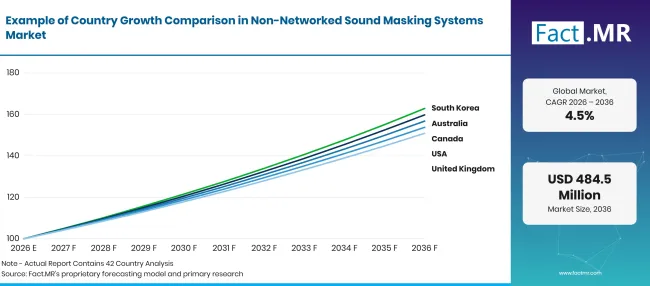
Non Networked Sound Masking Systems Market Growth Index | Source: Fact.MR
| Country | CAGR (2026-2036) |
|---|---|
| South Korea | 5.0% |
| Australia | 4.8% |
| Canada | 4.6% |
| United States | 4.4% |
| United Kingdom | 4.2% |
Source: Fact.MR analysis.
Why is South Korea the fastest-growing market for non-networked sound masking systems?
Demand for non-networked sound masking systems in South Korea is anticipated to increase at a 5.0% CAGR over the forecast period, the highest among the five countries.
Commercial offices, healthcare facilities and shared workplaces provide opportunities for locally controlled acoustic systems. South Korea's Ministry of Land, Infrastructure and Transport reported 7.44 million buildings nationwide in its September 2026 release. Office refurbishment and interior acoustic planning can encourage purchases of standalone masking equipment.
What is driving non-networked sound masking systems demand in Australia?
Sales of non-networked sound masking systems in Australia are anticipated to grow at a 4.8% CAGR over the next decade, exceeding the global rate of 4.5%.
Workplace acoustic requirements and commercial building projects support interest in localized sound masking installations. The Australian Bureau of Statistics reported non-residential building approvals worth AUD 7.96 billion in September 2026. Offices and healthcare facilities can incorporate standalone equipment during interior fit-outs and renovations.
What is shaping non-networked sound masking systems demand in Canada?
Demand for non-networked sound masking systems in Canada is anticipated to rise at a 4.6% CAGR over the ten-year outlook, slightly above the global rate of 4.5%.
Commercial offices, medical clinics and professional service facilities require acoustic arrangements that limit overheard conversations. Statistics Canada reported non-residential building construction investment of CAD 7.5 billion in September 2026. Building improvements and interior renovations provide opportunities for sound masking installations.
How is demand for non-networked sound masking systems developing in the United States?
Sales of non-networked sound masking systems in the United States are anticipated to expand at a 4.4% CAGR by 2036, compared with the global rate of 4.5%.
Open-plan offices, healthcare reception areas and consultation rooms create opportunities for speech privacy equipment. The HIPAA Privacy Rule, administered by the U.S. Department of Health and Human Services, requires reasonable safeguards for protected patient information. Biamp's Qt 100 provides single-zone sound masking for smaller installations.
Why is growth slower for non-networked sound masking systems in the United Kingdom?
Demand for non-networked sound masking systems in the United Kingdom is anticipated to grow at a 4.2% CAGR over the forecast period, below the global rate of 4.5%.
Office refurbishment, shared workspaces and professional consultation areas support purchases of acoustic privacy equipment. The Office for National Statistics reported that construction repair and maintenance activity grew by 0.5% in the third quarter of 2026 compared with the second quarter. Workplace renovation projects provide opportunities for standalone masking systems, particularly where building owners prefer straightforward installation, local controls and limited equipment complexity.
Competitive Landscape for Non-Networked Sound Masking Systems Market
Speech privacy requirements in offices, healthcare facilities and consultation rooms influence competition among sound masking equipment manufacturers. Biamp offers its Cambridge Qt 100 single-zone controller for locally managed installations, while Lencore Acoustics supplies Classic non-networked systems with adjustable sound levels. Soft dB supplies sound masking systems for commercial projects, including the Olympic Village in Cortina d’Ampezzo, and AtlasIED offers sound masking processors and speaker controllers for commercial applications.
Equipment selection depends on ceiling configuration, acoustic coverage, installation convenience and compatibility with existing audio systems. Manufacturers offering straightforward controls and technical assistance can serve smaller workplaces seeking speech privacy.
Recent Developments
- In August 2025, Lencore Acoustics promoted its Sound Masking for All Projects Incentive Program, which gives integrators equipment credit for future orders when they quote more Lencore sound masking projects.
- In February 2026, Soft dB reported installing sound masking systems in three buildings of the Olympic Village in Cortina d’Ampezzo for the Milano–Cortina 2026 Winter Olympic Games.
- In May 2026, AtlasIED introduced its Atmosphere AZP amplifier series with built-in sound masking functions, including onboard signal generation and Dante network connectivity.
Key Players in Non-Networked Sound Masking Systems Market
Key companies operating in the market include Biamp (Cambridge Sound Management), Lencore Acoustics, Soft dB, LogiSon Acoustic Network, and AtlasIED.
- Biamp (Cambridge Sound Management)
- Lencore Acoustics
- Soft dB
- LogiSon Acoustic Network
- AtlasIED
Bibliography
- AtlasIED. (2026, May 20). AtlasIED announces Atmosphere AZP amplifiers.
- AtlasIED. (n.d.). ASP-MG24 sound masking processor / speaker controller.
- Australian Bureau of Statistics. (2026, November 2). Building approvals, Australia, September 2026.
- Biamp. (2025, October 27). Biamp announces asset acquisition of ClearOne intellectual property and brands.
- Biamp. (2025, October). Sound masking product catalog.
- Lencore Acoustics Corp. (2025, August 14). Clients don’t always know what they need: Why sound masking should be in every project.
- Ministry of Land, Infrastructure and Transport, Republic of Korea. (2026, September 30). Nationwide building stock reaches 7,438,642 buildings and 4.375 billion m².
- MyTechDecisions. (n.d.). Open office space: Lencore Classic non-networked sound masking system.
- Office for National Statistics. (2026, November 12). Construction output in Great Britain: September 2026, new orders and Construction Output Price Indices, July to September 2026.
- Soft dB. (2026, February 10). Sound masking at the Olympic Village in Cortina d’Ampezzo: A project built for the world.
- Statistics Canada. (2026, November 19). Investment in building construction, September 2026.
- U.S. Department of Health and Human Services. (2025). Summary of the HIPAA Privacy Rule.
- U.S. Department of Health and Human Services. (2026). Standards for privacy of individually identifiable health information.
- Office for National Statistics. (2026, October 23). Construction statistics, Great Britain: 2025.
Segmentation
Scope of Report
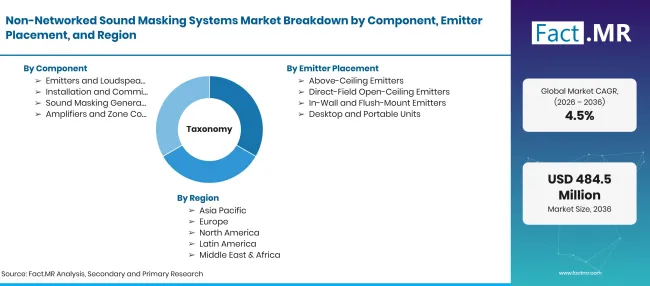
Non Networked Sound Masking Systems Market Taxonomy | Source: Fact.MR
| Items | Values |
|---|---|
| Quantitative Units (2026) | USD 312.0 Million |
| Component | Emitters and loudspeakers, Installation and commissioning services, Sound masking generators and processors, Amplifiers and zone controllers |
| Emitter Placement | Above-ceiling emitters, Direct-field open-ceiling emitters, In-wall and flush-mount emitters, Desktop and portable units |
| Application | Open-plan offices, Healthcare facilities, Government and legal buildings, Call centers and financial services, Hospitality and education |
| Sales Channel | Acoustic and AV integrators, Direct to building owners, Distributors, Online and retail |
| Regions Covered | North America, Latin America, Europe, Asia Pacific, Middle East & Africa |
| Countries Covered | South Korea, Australia, Canada, United States, United Kingdom, and other countries |
| Key Companies Profiled | Biamp (Cambridge Sound Management), Lencore Acoustics, Soft dB, LogiSon Acoustic Network, AtlasIED |
| Additional Attributes | Dollar revenue in the Non-Networked Sound Masking Systems Market is segmented by component, emitter placement, application and sales channel and region. |
Source: Fact.MR analysis. Updated Nov 27, 2026
Non-Networked Sound Masking Systems Market by Segments
-
Component
- Emitters and loudspeakers
- Installation and commissioning services
- Sound masking generators and processors
- Amplifiers and zone controllers
-
Emitter Placement
- Above-ceiling emitters
- Direct-field open-ceiling emitters
- In-wall and flush-mount emitters
- Desktop and portable units
-
Application
- Open-plan offices
- Healthcare facilities
- Government and legal buildings
- Call centers and financial services
- Hospitality and education
-
Sales Channel
- Acoustic and AV integrators
- Direct to building owners
- Distributors
- Online and retail
-
Region:
- North America
- United States
- Canada
- Mexico
- Europe
- Germany
- United Kingdom
- France
- Italy
- Spain
- Rest of Europe
- Asia Pacific
- China
- India
- Japan
- South Korea
- Australia and New Zealand
- Rest of Asia Pacific
- Latin America
- Brazil
- Argentina
- Rest of Latin America
- Middle East & Africa
- GCC Countries
- South Africa
- Rest of Middle East & Africa
- North America
Table of Contents
Key Takeaways
- Market Size and CAGR
- Top Growth Driver
- Fastest Growing Segment
- Leading Region
- Key Companies
- Emerging Opportunities

