
- Market Value (2025): USD 8.2 Bn
- Estimated Value (2026): USD 8.77 Bn
- Forecast Value (2036): USD 17.6 Bn
- CAGR (2026-2036): 7.2%
Interface Electronics Market Forecast and Outlook 2026 to 2036
According to the Fact.MR analysis, the interface electronics market crossed a valuation of USD 8.2 billion in 2025 and is projected to grow from USD 8.77 billion in 2026 to USD 17.6 billion by 2036. Demand for interface electronics is likely to grow at a CAGR of 7.2% over the forecast period.
Demand for interface electronics is rising as consumer, automotive, industrial and data-center designs need chips that move data between processors, sensors, displays and networks. The key players are offering serial and bus transceivers, isolation and signal-conditioning devices, USB and bridge chips, and display and video interfaces for standards from I2C to PCIe.
Key Takeaways from the Interface Electronics Market
- Interface Electronics Market Value (2025): USD 8.2 billion
- Interface Electronics Market Value (2026): USD 8.77 billion
- Interface Electronics Market Forecast Value (2036): USD 17.6 billion
- Interface Electronics Market Forecast CAGR (2026-2036): 7.2%
- Leading Product: Serial and bus transceivers (40.1%)
- Key Market Participants: Texas Instruments, Analog Devices, NXP Semiconductors, Infineon Technologies, STMicroelectronics
- Key Growth Countries: India, China, Taiwan, South Korea, United States
Demand for interface electronics is expected to strengthen as connected vehicles, industrial automation, AI servers and high-resolution display systems require faster and more reliable data transmission. India's Ministry of Electronics and Information Technology reported that electronics production reached ₹13.11 lakh crore in FY 2025–26, registering 15.8% annual growth. The Ministry of Electronics and IT also reported that installed data-centre capacity reached approximately 1,575 MW by August 2026, while 38,231 GPUs were onboarded under the national AI compute capacity framework by March 2026. Additionally, the government approved 12 semiconductor projects involving investments exceeding ₹1.64 lakh crore by July 2026. These developments support demand for interface controllers, isolated interfaces and high-speed connectivity components across automotive, computing and industrial applications.
Interface Electronics Market
| Metric | Value |
|---|---|
| Estimated Value in (2026) | USD 8.77 billion |
| Forecast Value in (2036) | USD 17.6 billion |
| Forecast CAGR (2026 to 2036) | 7.2% |
Source: Fact.MR analysis.
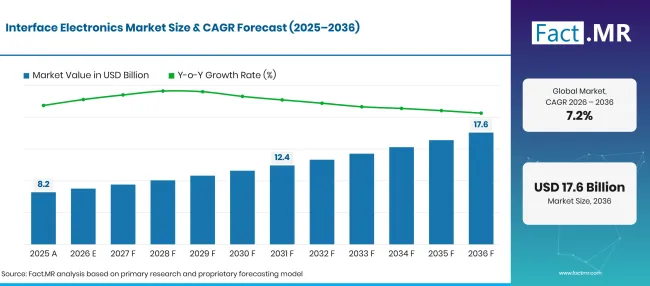
Interface Electronics Market Forecast Global | Source: Fact.MR
Category
| Category | Segments |
|---|---|
| Product | Serial and bus transceivers, Signal conditioning and isolation devices, USB and connectivity bridge devices, Display and video interface devices, Level translators and port expanders |
| Interface Standard | I2C, SPI and UART, USB, Ethernet and PHY, PCIe and high-speed serial, CAN, LIN and FlexRay |
| Data Rate | 10 Mbps to 1 Gbps, Below 10 Mbps, 1 to 10 Gbps, Above 10 Gbps |
| End Use | Consumer electronics, Automotive, Industrial, Telecom and data centre, Computing |
| Region | India; China; Taiwan; South Korea; United States |
Source: Fact.MR analysis.
Segmental Analysis
What is driving demand for serial and bus transceivers in the Interface Electronics Market?
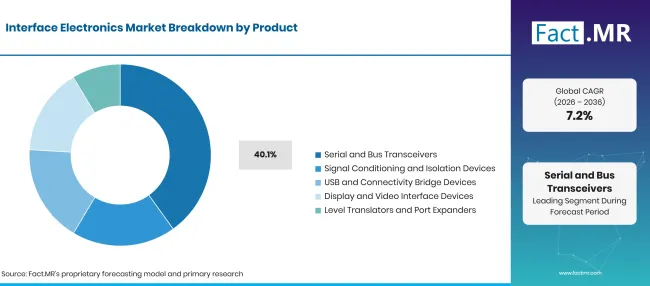
Interface Electronics Market Breakdown Product | Source: Fact.MR
Demand for serial and bus transceivers is increasing as automotive electronics, industrial controllers and connected devices require reliable communication between electronic components. This segment accounts for 40.1% of market revenue in 2026, about USD 3.52 billion. India's Ministry of Electronics and Information Technology reported that electronics production reached ₹13.11 lakh crore in FY 2025–26, registering 15.8% annual growth. Additionally, the Electronics Components Manufacturing Scheme had approved 106 projects involving investments of ₹69,548 crore by August 2026. Expanding component manufacturing and embedded electronics production create opportunities for transceivers supporting CAN, RS-485 and other communication interfaces.
Which developments are supporting adoption of I2C, SPI and UART interface standards?
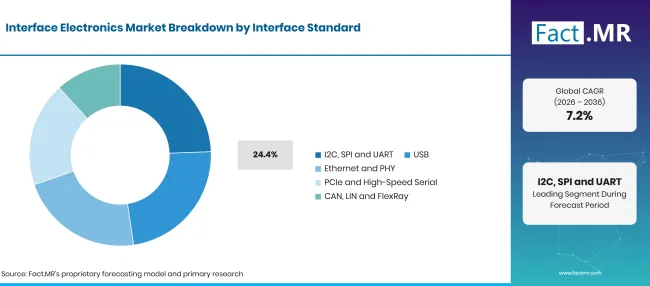
Interface Electronics Market Breakdown Interface Standard | Source: Fact.MR
Adoption of I2C, SPI and UART interfaces is supported by increasing electronics production and the expansion of domestic component manufacturing. This interface standard segment accounts for 24.4% of market revenue in 2026, about USD 2.14 billion. According to the Ministry of Electronics and Information Technology, the Electronics Components Manufacturing Scheme had approved 106 projects across 15 states by August 2026, covering 30 electronic product categories. The scheme's allocation was also increased to ₹40,000 crore under the Union Budget 2026–27. These investments strengthen the embedded electronics ecosystem, supporting demand for communication interfaces connecting microcontrollers, sensors, memory and peripheral devices.
How is demand developing for interface electronics across the 10 Mbps to 1 Gbps data rate range?
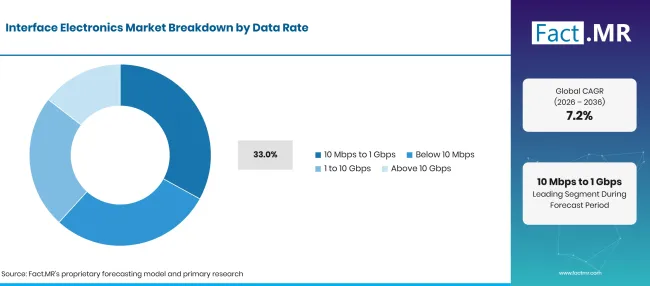
Interface Electronics Market Breakdown Data Rate | Source: Fact.MR
Demand for interface electronics operating between 10 Mbps and 1 Gbps is benefiting from expanding computing infrastructure, industrial connectivity and electronics manufacturing. This data rate segment accounts for 33.0% of market revenue in 2026, about USD 2.89 billion. India's Economic Survey 2025–26 reported that installed data-centre capacity reached approximately 1,280 MW by June 2025, supported by increasing cloud computing, artificial intelligence, IoT and 5G adoption. Capacity was projected to reach around 4 GW by 2030. These developments support opportunities for Ethernet transceivers, USB interfaces and other connectivity components used in computing and industrial applications.
What is strengthening sales of interface electronics in consumer electronics applications?
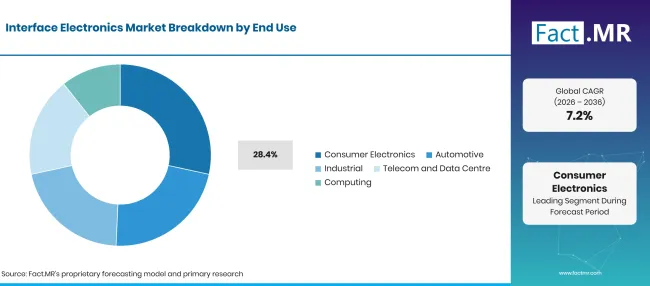
Interface Electronics Market Breakdown End Use | Source: Fact.MR
Sales of interface electronics in consumer electronics are supported by rising smartphone manufacturing, connected devices and domestic electronics production. The consumer electronics segment accounts for 28.4% of market revenue in 2026, about USD 2.49 billion. India's Ministry of Electronics and Information Technology reported that mobile phone production reached ₹6.27 lakh crore in FY 2025–26, while mobile phone exports amounted to ₹2.59 lakh crore. Overall electronics production increased by 15.8% to ₹13.11 lakh crore during the same financial year. Higher manufacturing volumes support demand for interface controllers, display connectivity components and data-transfer devices across smartphones, televisions and other consumer electronic products.
Interface Electronics Market-Drivers, Restraints & Trends
Drivers: Growing Electronics Manufacturing and Connected Devices
Demand for interface electronics is increasing as connected vehicles, industrial equipment and consumer devices incorporate more sensors, displays and processors requiring reliable data communication. India's Ministry of Electronics and Information Technology reported that electronics production reached ₹13.11 lakh crore in FY 2025–26, representing 15.8% annual growth. Electronics exports also increased to ₹4.24 lakh crore. Additionally, the government approved 118 projects under the Electronics Components Manufacturing Scheme by November 2026, involving expected investments of ₹77,051 crore. Expanding domestic electronics manufacturing supports demand for interface controllers, bus transceivers and communication components across automotive and industrial applications.
Restraints: Semiconductor Supply Dependence and Component Costs
Sales of interface electronics remain exposed to semiconductor supply fluctuations, component pricing pressures and competition from integrated system-on-chip solutions. India's Ministry of Electronics and Information Technology identified printed circuit boards, camera modules, display modules and connectors among the components requiring stronger domestic manufacturing capabilities under the Electronics Components Manufacturing Scheme. By November 2026, the government had approved 118 projects across 34 product categories to strengthen domestic supply chains and reduce import dependence. These initiatives highlight existing supply-chain gaps and the investment required to improve local component availability. Price competition in mature interface standards can further constrain margins for manufacturers.
Opportunity: High-Speed Serial Links
Adoption of high-speed interface electronics is gaining momentum as AI servers, cloud computing and advanced display systems require faster data transmission. India's Ministry of Electronics and IT reported that installed data-centre capacity reached approximately 1,575 MW in August 2026, compared with 375 MW in 2020. The IndiaAI Mission also expanded shared computing infrastructure to more than 45,000 GPUs by June 2026. These developments create opportunities for manufacturers of high-speed serial transceivers, signal-conditioning devices, retimers, bridges and physical-layer interface components. Growing AI workloads and data-centre investments are expected to strengthen demand for advanced connectivity solutions.
Trend: Increasing Demand for Isolation and Functional Safety
Adoption of isolated interface electronics is increasing as electric vehicles, industrial automation systems and power-management equipment require reliable communication across electrically separated circuits. India's Ministry of Heavy Industries reported that electric-vehicle adoption reached 8.26% of total vehicle registrations in FY 2025–26, compared with 0.08% in FY 2015–16. Furthermore, approximately 26.59 lakh electric vehicles had been sold under the PM E-DRIVE scheme as of June 30, 2026. The expansion of electric mobility creates opportunities for isolated CAN, RS-485 and gate-driver interface technologies used in battery management, charging infrastructure and power electronics.
Competitive Landscape for Interface Electronics Market
The interface electronics market is moderately concentrated, with Texas Instruments, Analog Devices, NXP Semiconductors, Infineon Technologies and STMicroelectronics together hold about 48% of 2026 revenue, based on Fact.MR estimates. Competition centers on speed, robustness, isolation performance, automotive qualification and long-term supply. Large analog and mixed-signal semiconductor groups lead, with specialist bridge and display-interface makers competing in specific standards.
Recent Developments
- In February 2026, Texas Instruments announced a definitive agreement to acquire Silicon Labs for approximately USD 7.5 billion in an all-cash transaction. The acquisition is intended to expand TI's embedded wireless connectivity portfolio by adding approximately 1,200 products supporting multiple wireless standards and protocols. The transaction is expected to close in the first half of 2027, subject to regulatory and shareholder approvals.
- In March 2026, TI introduced two new microcontroller families, MSPM0G5187 and AM13E23019, integrating its TinyEngine neural processing unit (NPU). The products target edge AI applications, including industrial automation, appliances, robotics and connected devices. The company stated that the integrated NPU can deliver up to 90 times lower latency and more than 120 times lower energy utilization per inference compared with similar MCUs without an accelerator.
- In January 2026, TI introduced new automotive analog and embedded-processing technologies, including high-performance computing SoCs supporting up to 1,200 TOPS, an eight-by-eight 4D imaging radar transceiver and 10BASE-T1S Ethernet PHY technology. These products support advanced driver-assistance systems, automotive networking and autonomous driving applications.
- In September 2026, Analog Devices announced a definitive agreement to acquire Alif Semiconductor for USD 1.35 billion in an all-cash transaction. The acquisition adds AI-native fusion processors to ADI's portfolio, strengthening its capabilities in embedded processing, intelligent sensing and edge AI. The combined technologies are intended to support industrial automation, robotics, healthcare, energy and connected-device applications.
- In July 2026, ADI completed its acquisition of Empower Semiconductor, following the agreement announced on 19 May 2026 for USD 1.5 billion. The acquisition strengthens its power-management portfolio with integrated voltage regulator and silicon capacitor technologies designed for high-density AI computing systems. The expanded portfolio supports efficient power delivery for advanced processors and data-center infrastructure.
- In August 2026, NXP introduced its MCX A5 microcontroller family to simplify secure industrial connectivity. The new products expand NXP's industrial embedded-processing portfolio, supporting connected equipment and industrial communication applications. The development strengthens its position in microcontrollers and connectivity solutions used in industrial interface systems.
- In July 2026, NXP announced a single-chip radio and AI/ML-enabled audio solution designed to simplify automotive infotainment system development. The product combines radio and intelligent audio capabilities to support connected vehicle platforms, helping manufacturers reduce system complexity and integrate advanced in-vehicle entertainment functionality.
- In August 2026, Infineon announced the acquisition of Bengaluru-based C2i Semiconductors to strengthen its AI data-center power-management capabilities. C2i specializes in software-defined multiphase controllers and smart power stages, particularly for vertical power delivery and substrate-integrated voltage regulators. The acquisition expands Infineon's engineering and innovation capabilities in India and strengthens its position in advanced power-management solutions.
- In February 2026, Infineon announced an agreement to acquire the non-optical analog and mixed-signal sensor portfolio of ams OSRAM for €570 million. The acquired business was expected to generate approximately €230 million in revenue, with around 230 employees joining Infineon's Sensors and RF business unit. The transaction is intended to expand its sensor portfolio across automotive, industrial and medical applications.
- In February 2026, STMicroelectronics completed its acquisition of NXP Semiconductors' MEMS sensors business following regulatory approvals. Originally announced in July 2025, the transaction strengthens ST's automotive safety and industrial sensor capabilities. The company initially expected the acquired business to contribute revenue in the mid-USD 40 million range during the first quarter of 2026.
- In June 2026, STMicroelectronics introduced the ST54M secure mobile chip featuring hardware acceleration for post-quantum cryptography. The single-die solution is designed for smartphones and connected personal electronics, supporting advanced security, authentication and connected-service applications. This development expands ST's secure semiconductor portfolio for next-generation connected devices.
Key Players in Interface Electronics Market
Key companies operating in the market include Texas Instruments, Analog Devices, NXP Semiconductors, Infineon Technologies, and STMicroelectronics.
- Texas Instruments
- Analog Devices
- NXP Semiconductors
- Infineon Technologies
- STMicroelectronics
Interface Electronics Market Analysis by Key Country
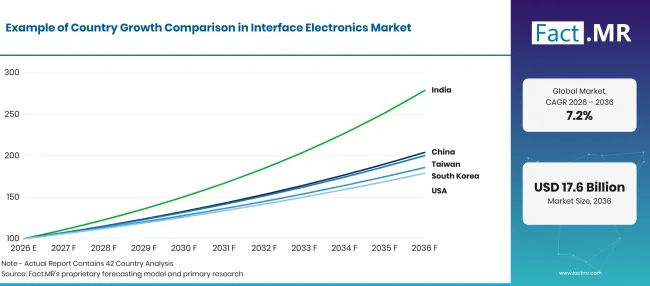
Interface Electronics Market Growth Index | Source: Fact.MR
| Country | CAGR (2026-2036) |
|---|---|
| India | 10.8% |
| China | 7.4% |
| Taiwan | 7.2% |
| South Korea | 6.4% |
| United States | 6.0% |
Source: Fact.MR analysis.
What is accelerating demand for interface electronics in India?
Demand for interface electronics in India is projected to rise at a 10.8% CAGR through 2036, the fastest among the five profiled countries.
Expanding electronics manufacturing, semiconductor investments and increasing domestic component production are strengthening sales opportunities for interface chips used in smartphones, computers, automotive electronics and industrial systems. According to the Government of India's November 2026 update, electronics production reached ₹13.11 lakh crore in FY 2025–26, increasing 15.8% year-on-year, while electronics exports reached ₹4.24 lakh crore. This expanding manufacturing and export base supports greater adoption of interface components across locally manufactured electronic products.
Which manufacturing developments are sustaining interface electronics sales in China?
Sales of interface electronics in China are forecast to grow at a 7.4% CAGR through 2036, exceeding the global growth rate of 7.2%.
The country's extensive electronics manufacturing ecosystem and rising semiconductor output support demand for display drivers, data-transfer interfaces and connectivity components. China's Ministry of Industry and Information Technology reported that integrated circuit production reached 442.8 billion units [analyst to confirm against MIIT release] during January–September 2026, representing 23.3% year-on-year growth. Electronic component production increased 14.7% to 7.1 trillion units during the same period. These manufacturing gains strengthen component procurement requirements across computing, telecommunications, automotive and consumer electronics applications.
How are semiconductor and ICT export gains influencing interface electronics demand in Taiwan?
Demand for interface electronics in Taiwan is expected to expand at a 7.2% CAGR through 2036, matching the global market growth rate.
Strong semiconductor manufacturing, advanced computing infrastructure and display production support sales of high-speed interface chips and electronic components. Taiwan's Ministry of Finance reported that exports of information, communication and audiovisual products reached USD 47.60 billion in October 2026, increasing 72.9% year-on-year. Exports of electronic product components reached USD 32.68 billion, increasing 61.4%. These export gains demonstrate the strength of Taiwan's electronics supply chain and support continued procurement of interface components for computing, networking and display applications.
What is supporting continued adoption of interface electronics in South Korea?
Adoption of interface electronics in South Korea is projected to increase at a 6.4% CAGR through 2036, below the global rate of 7.2%.
Demand remains supported by semiconductor manufacturing, memory production, display technologies and advanced computing applications. South Korea's Ministry of Trade, Industry and Resources reported that semiconductor exports reached USD 56.44 billion in October 2026, increasing 259.4% year-on-year. Computer exports also increased 496.6% to USD 5.85 billion, reflecting stronger server infrastructure investment and demand for server storage products. These developments strengthen sales opportunities for interface devices used in memory systems, high-speed data transmission and electronic equipment.
Which industry developments are maintaining interface electronics demand in the United States?
Demand for interface electronics in the United States is forecast to increase at a 6.0% CAGR through 2036, the slowest among the five profiled countries.
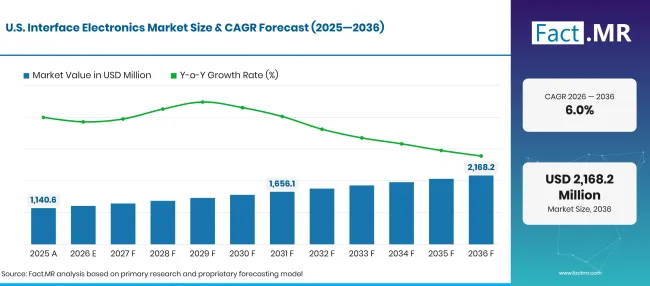
Interface Electronics Market Forecast Usa | Source: Fact.MR
However, semiconductor exports, data-center investments and automotive electronics continue to support component procurement. According to the US Census Bureau, semiconductor exports reached USD 56.82 billion during January–August 2026, compared with USD 45.19 billion in the corresponding 2025 period. Computer exports also reached USD 43.03 billion during the same eight-month period, compared with USD 29.38 billion a year earlier. These gains support continued demand for interface components across computing, networking, industrial electronics and automotive systems.
Bibliography
- Government of India, Ministry of Finance. (2026). Economic survey 2025–26 [PDF].
- Ministry of Electronics and Information Technology. (2026, March). Data centre capacity and AI compute infrastructure. Press Information Bureau.
- Ministry of Electronics and Information Technology. (2026). Electronics Components Manufacturing Scheme: Building India’s electronics backbone. Press Information Bureau.
- Ministry of Electronics and Information Technology. (2026). Electronics Components Manufacturing Scheme: Progress so far. Press Information Bureau.
- Ministry of Electronics and Information Technology. (2026). Government highlights rapid expansion of data centre capacity to support India’s growing digital and AI infrastructure. Press Information Bureau.
- Ministry of Electronics and Information Technology. (2026). India’s electronics boost. Press Information Bureau.
- Ministry of Electronics and Information Technology. (2026). IndiaAI Mission: Sovereign AI computing capacity at scale. Press Information Bureau.
- Ministry of Electronics and Information Technology. (2026, July 29). Production linked incentive schemes strengthen India’s electronics manufacturing ecosystem, boosting domestic production, exports and value addition. Press Information Bureau.
- Ministry of Electronics and Information Technology. (2026). Semiconductor manufacturing progress and approved projects. Press Information Bureau.
- Ministry of Electronics and Information Technology. (2026). Union Minister launches Semicon 2.0 web application portal and announces approved applicants under ECMS. Press Information Bureau.
- Ministry of Heavy Industries. (2026). Electric vehicle adoption and progress under government schemes. Press Information Bureau.
Segmentation
Scope of Report
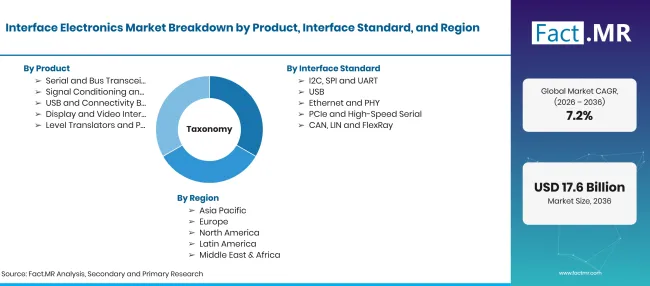
Interface Electronics Market Taxonomy | Source: Fact.MR
| Items | Values |
|---|---|
| Quantitative Units (2026) | USD 8.77 Billion |
| Product | Serial and bus transceivers, Signal conditioning and isolation devices, USB and connectivity bridge devices, Display and video interface devices, Level translators and port expanders |
| Interface Standard | I2C, SPI and UART, USB, Ethernet and PHY, PCIe and high-speed serial, CAN, LIN and FlexRay |
| Data Rate | 10 Mbps to 1 Gbps, Below 10 Mbps, 1 to 10 Gbps, Above 10 Gbps |
| End Use | Consumer electronics, Automotive, Industrial, Telecom and data centre, Computing |
| Regions Covered | North America, Latin America, Europe, Asia Pacific, Middle East & Africa |
| Countries Covered | India, China, Taiwan, South Korea, United States, and other countries |
| Key Companies Profiled | Texas Instruments, Analog Devices, NXP Semiconductors, Infineon Technologies, STMicroelectronics |
| Additional Attributes | Dollar revenue in the Interface Electronics Market is segmented by product, interface standard, data rate and end use and region. |
Source: Fact.MR analysis.
Interface Electronics Market by Segments
-
Product
- Serial and bus transceivers
- Signal conditioning and isolation devices
- USB and connectivity bridge devices
- Display and video interface devices
- Level translators and port expanders
-
Interface Standard
- I2C, SPI and UART
- USB
- Ethernet and PHY
- PCIe and high-speed serial
- CAN, LIN and FlexRay
-
Data Rate
- 10 Mbps to 1 Gbps
- Below 10 Mbps
- 1 to 10 Gbps
- Above 10 Gbps
-
End Use
- Consumer electronics
- Automotive
- Industrial
- Telecom and data centre
- Computing
-
Region:
- North America
- United States
- Canada
- Mexico
- Europe
- Germany
- United Kingdom
- France
- Italy
- Spain
- Rest of Europe
- Asia Pacific
- China
- India
- Japan
- South Korea
- Australia and New Zealand
- Taiwan
- Rest of Asia Pacific
- Latin America
- Brazil
- Argentina
- Rest of Latin America
- Middle East & Africa
- GCC Countries
- South Africa
- Rest of Middle East & Africa
- North America
Table of Contents
Key Takeaways
- Market Size and CAGR
- Top Growth Driver
- Fastest Growing Segment
- Leading Region
- Key Companies
- Emerging Opportunities

