
- Market Value (2025): USD 360.0 Mn
- Estimated Value (2026): USD 410.4 Mn
- Forecast Value (2036): USD 1393.1 Mn
- CAGR (2026-2036): 13.0%
Shelf-mounted Robots Market Forecast and Outlook 2026 to 2036
The global shelf-mounted robots market reached a derived estimate of USD 360.0 million in 2025 and USD 410.4 million in 2026. The market is projected to reach USD 1,393.1 million by 2036, expanding at a CAGR of 13.0% during the 2026 to 2036 forecast period.
Shelf-mounted robots are gaining traction as warehouses and retail outlets seek to automate picking without sacrificing valuable floor space. Their ability to retrieve stored items and handle repetitive movements makes them useful in compact settings. ABB’s IRB 6730S and IRB 6750S are designed for mounting at height, where they can work alongside floor-mounted robots in industrial applications. Large distribution centres into smaller spaces where accurate item handling and efficient shelf access matter.
Key Takeaways from the Shelf-mounted Robots Market
- Shelf-mounted Robots Market Value (2025): USD 360.0 million (Derived estimate)
- Shelf-mounted Robots Market Value (2026): USD 410.4 million
- Shelf-mounted Robots Market Forecast Value (2036): USD 1,393.1 million
- Shelf-mounted Robots Market Forecast CAGR (2026 to 2036): 13.0%
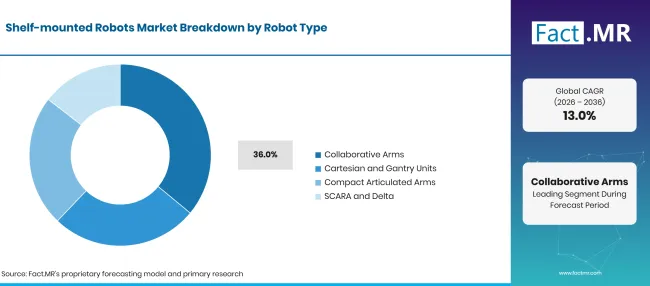
- Leading Robot Type: Collaborative arms (36.0%)
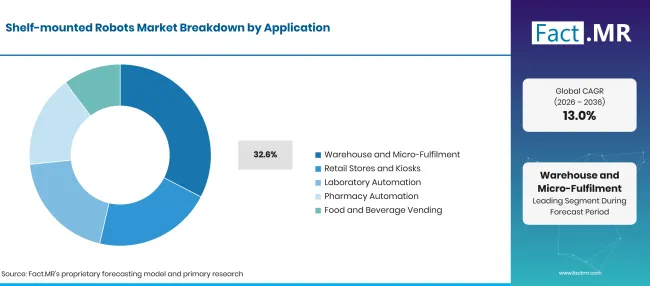
- Leading Application: Warehouse and micro-fulfilment (32.6%)
- Leading End User: Logistics and e-commerce (36.9%)
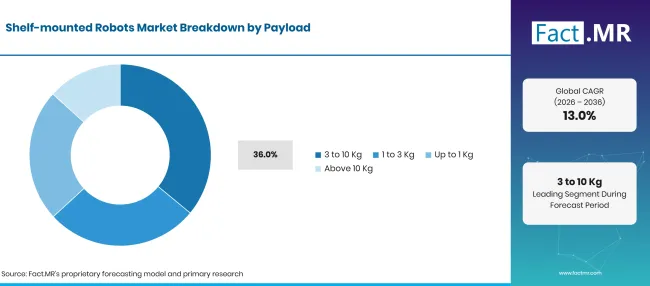
- Leading Payload Capacity: 3 to 10 kg (36.0%)
- Key Market Participants: ABB Ltd., FANUC Corporation, KUKA AG, Yaskawa Electric Corporation, Mitsubishi Electric Corporation, Kawasaki Heavy Industries, DENSO Corporation, Omron Corporation, Universal Robots A/S, Epson Robots
- Key Growth Countries: China, South Korea, United States, France, United Kingdom
Labor constraints and the rapid expansion of e-commerce are encouraging warehouses to adopt compact robotic systems that improve picking speed without requiring additional floor space. A 2025 warehouse operations survey found that e-commerce fulfillment adoption rose to 44% of respondents, while micro-fulfillment at retail locations increased to 22%, up from 9% in 2024. Rising investment in automation and the need to handle smaller, frequent orders are creating fresh opportunities for shelf-mounted robots through 2036.
Shelf-mounted Robots Market
| Metric | Value |
|---|---|
| Market Value (2025) | USD 363.2 million (Derived estimate) |
| Market Value (2026) | USD 410.4 million |
| Forecast Value (2036) | USD 1,393.1 million |
| CAGR (2026 to 2036) | 13.0% |
Source: Fact.MR analysis. Updated Nov 26, 2026
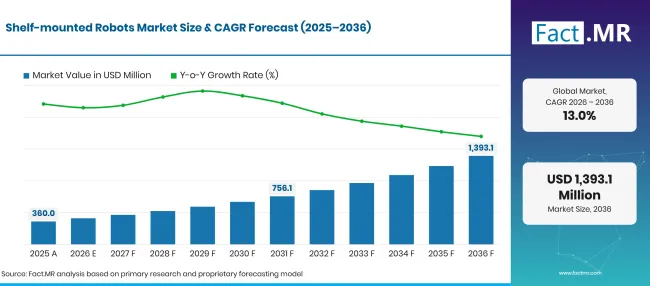
Shelf Mounted Robots Market Forecast Global | Source: Fact.MR
Category
| Category | Segments |
|---|---|
| Robot Type | Collaborative arms, Cartesian and gantry units, Compact articulated arms, SCARA and delta |
| Payload | 3 to 10 kg, 1 to 3 kg, Up to 1 kg, Above 10 kg |
| Application | Warehouse and micro-fulfilment, Retail stores and kiosks, Laboratory automation, Pharmacy automation, Food and beverage vending |
| End User | Logistics and e-commerce, Retail and food service, Healthcare and life sciences, Electronics manufacturing |
| Region | China; South Korea; United States; France; United Kingdom |
Source: Fact.MR analysis. Updated Nov 26, 2026
Segmental Analysis
What makes collaborative arms the leading robot type segment in the Shelf-mounted Robots Market?
Shelf Mounted Robots Market Breakdown Robot Type | Source: Fact.MR
Collaborative arms capture 36.0% of market revenue in 2026, equivalent to USD 147.7 million. Their compact construction, straightforward programming and ability to operate near workers make them practical for shelf-level picking and replenishment. SCARA and delta robots are also gaining traction in applications requiring faster, repetitive movements and consistent pick-and-place accuracy.
Which factors support 3 to 10 kg as the largest payload segment in the Shelf-mounted Robots Market?
Shelf Mounted Robots Market Breakdown Payload | Source: Fact.MR
The 3 to 10 kg payload category captures 36.0% of revenue in 2026, equivalent to USD 147.7 million. This range suits everyday shelf-handling activities involving packaged goods, small parcels, laboratory containers and retail inventory. It also allows operators to balance lifting capacity with reach and installation space. Comau's MyCo collaborative robot family spans payload capacities from 3 kg to 15 kg. This range demonstrates the availability of compact robotic arms for different shelf-handling requirements. Higher-payload systems are also finding opportunities in bulk handling and heavier warehouse replenishment tasks.
What makes warehouse and micro-fulfilment the leading application segment in the Shelf-mounted Robots Market?
Shelf Mounted Robots Market Breakdown Application | Source: Fact.MR
Warehouse and micro-fulfilment applications capture 32.6% of revenue in 2026, equivalent to USD 133.8 million. Growing online order volumes and pressure to shorten picking cycles are encouraging operators to automate storage and retrieval activities in space-constrained facilities. In November 2025, Linde Material Handling and ROSSMANN announced the advancement of robotic case picking, using a multi-axis arm to retrieve individual packages from warehouse racks. Retail replenishment and laboratory automation are also gaining ground as operators seek more accurate handling of smaller inventories.
Which factors support logistics and e-commerce as the largest end user segment in the Shelf-mounted Robots Market?
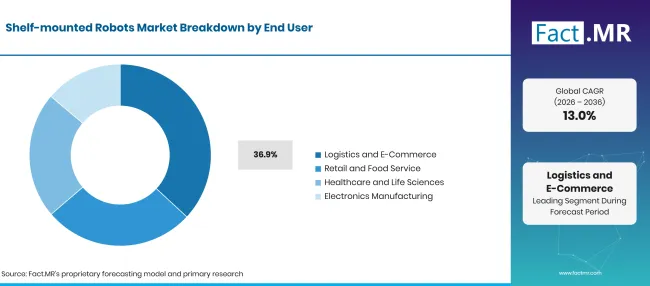
Shelf Mounted Robots Market Breakdown End User | Source: Fact.MR
Logistics and e-commerce capture 36.9% of market revenue in 2026, equivalent to USD 151.4 million. High order volumes and frequent picking cycles make these operators attractive users of shelf-mounted automation. A NITI Aayog report published in 2025 placed India's online B2C logistics volume at 8–9 billion shipments in FY 2025, covering e-commerce and hyperlocal services. This expanding distribution network creates room for compact robotic picking systems. Healthcare facilities are also exploring shelf-level automation for medicine retrieval, while electronics retailers are adopting precision handling for smaller components.
Shelf-mounted Robots Market-Drivers, Restraints & Trends
Driver
E-commerce Growth and the Push for Faster Order Fulfilment: China is becoming an important market for shelf-mounted robots as online retailers and logistics companies handle increasingly large shipment volumes. The National Bureau of Statistics reported that online retail sales grew 8.6% in 2025, reaching RMB 15,972.2 billion, while express delivery volume climbed to 199 billion parcels. This combination is increasing pressure on warehouses to pick, sort and replenish goods faster. Compact robotic systems offer a practical way to improve shelf access and order handling without expanding existing facilities.
Restraint
High Installation Costs and Difficulties with Mixed-Item Handling: The cost of introducing shelf-mounted robots goes beyond purchasing the robotic arm. Businesses also face expenses for mounting structures, sensors, machine vision, software integration and ongoing maintenance. Handling products with irregular shapes, delicate packaging or inconsistent dimensions adds another layer of complexity. Smaller warehouses, pharmacies and laboratories may struggle to justify these investments when order volumes fluctuate.
Trend
AI Vision Is Making Shelf-Level Picking More Flexible: Robots are becoming better at handling products that differ in size, shape and packaging, reducing the need to configure every picking task separately. AI vision and adaptive grasping are particularly useful in pharmacies and mixed-inventory retail facilities. In March 2026, Beijing's Haidian District reported the commercial deployment of Galbot at a pharmacy. The system handles inventory checks, restocking and medicine retrieval within a standard 70-square-metre store. Such applications are expanding expectations for automated shelf handling beyond conventional warehouses.
Trend
Compact Automation Opens New Retail and Fulfilment Applications: Smaller stores, neighbourhood pharmacies and urban fulfilment centres offer an attractive opportunity for shelf-mounted robots. Leasing and Robotics-as-a-Service arrangements could further widen adoption by reducing the initial financial commitment and allowing businesses to scale installations gradually. China's September 2025 report on Galbot's retail warehouse deployment noted that the system had operated for more than 150 days and expanded to over ten stores across Beijing. This progress illustrates the commercial potential of compact robotic installations in retail environments with limited floor space
Shelf-mounted Robots Market Analysis by Key Country
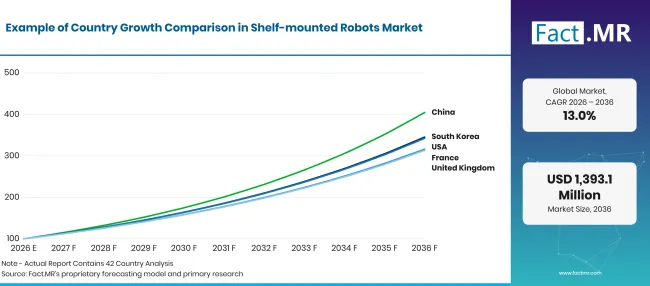
Shelf Mounted Robots Market Growth Index | Source: Fact.MR
| Country | CAGR (2026-2036) |
|---|---|
| China | 15.0% |
| South Korea | 13.2% |
| United States | 13.1% |
| France | 12.2% |
| United Kingdom | 12.1% |
Source: Fact.MR analysis. Updated Nov 26, 2026
Why is China the fastest-growing market for shelf-mounted robots?
China's strong manufacturing base and rapid adoption of intelligent automation make it a promising market for shelf-mounted robots. The National Bureau of Statistics reported that industrial robot production reached 773,000 units in 2025, increasing 28.0% year on year. The country's expanding electronics and automotive production creates opportunities for automated component retrieval, storage and replenishment.
Sales growth is likely to benefit from investments in smart factories and the growing use of AI-enabled equipment across industrial facilities. Rising pressure to improve factory throughput is also encouraging manufacturers to automate repetitive material-handling activities.
How is demand for shelf-mounted robots developing in South Korea?
South Korea's established robotics ecosystem is creating favourable conditions for wider use of compact robotic systems. On October 1, 2025, the Ministry of Trade, Industry and Resources reported that its AI Factory initiative had crossed 100 pilot projects, with a target of 500 by 2030. Manufacturing automation across electronics, automotive and logistics facilities is strengthening interest in robotic picking and material handling.
Further sales opportunities are emerging from investments in smart production lines and AI-integrated warehouse operations. The country's advanced semiconductor industry also creates scope for precise handling of components and materials in organised storage environments.
What is driving shelf-mounted robots demand in United States?
A large e-commerce sector is encouraging US warehouse operators to improve picking capacity and shorten order processing times. The US Census Bureau reported that retail e-commerce sales reached USD 1,233.7 billion in 2025, a 5.4% increase over 2024.
This expansion is creating opportunities for shelf-mounted robots in fulfilment centres where repetitive retrieval tasks consume considerable labour. Sales are likely to gain momentum as logistics companies invest in compact automation to manage growing shipment volumes and improve inventory accuracy. The expansion of same-day and next-day delivery networks is adding further pressure to optimise storage and retrieval operations.
What is shaping shelf-mounted robots demand in France?
France is strengthening its domestic robotics capabilities through industrial modernisation and public investment in advanced automation. On June 18, 2026, the French government announced 31 new projects under France 2030, involving 60 companies and research laboratories, with more than EUR 135 million in productive investment.
The programme includes warehouse automation and intelligent robotic systems. These initiatives are creating opportunities for shelf-mounted robots as manufacturers and logistics operators look to improve storage efficiency and reduce repetitive manual handling. Greater attention to domestic manufacturing competitiveness is likely to encourage businesses to modernise existing production and distribution facilities.
Why is growth slower for shelf-mounted robots in United Kingdom?
The UK's expanding online retail activity is increasing pressure on distribution centres to process orders quickly while making better use of available storage space. The Office for National Statistics reported that internet sales represented 27.5% of total retail sales in 2025, compared with 27.1% in 2024.
This strong online retail penetration is encouraging investment in automated picking and inventory movement. Shelf-mounted robot sales could gain from fulfilment centre upgrades, particularly among third-party logistics providers and omnichannel retailers seeking greater warehouse productivity. Labour availability challenges and the need to maintain delivery speed are further encouraging retailers to explore compact robotic installations.
Competitive Landscape for Shelf-mounted Robots Market
FANUC, Universal Robots, ABB, Yaskawa and Techman Robot collectively account for an estimated 57% of 2026 market revenue. Competition centres on payload capacity, reach, programming simplicity, vision software, safety and integrator support. Established industrial and collaborative robot makers lead, while newer firms compete with application-specific shelf and picking systems.
Recent Developments
- On June 24, 2025, ABB launched three industrial robots, IRB 6730S, IRB 6750S and IRB 6760, expanding its portfolio of high-performance automation systems. The IRB 6730S and IRB 6750S are shelf-mounted robots with payload capacities of up to 350 kg.
- On May 20, 2026, FANUC announced a collaboration with Google to develop AI-powered robotic systems using Gemini Enterprise, enabling robots to understand human instructions and perform manufacturing tasks with greater autonomy.
- On December 1, 2025, Yaskawa Electric signed a memorandum of understanding with SoftBank to advance the practical implementation of Physical AI by combining AI robotics with communication technologies.
- On November 27, 2025, Kawasaki Heavy Industries launched the RS025S, a new small- to medium-sized general-purpose industrial robot, expanding its robotics portfolio for manufacturing applications.
- On January 16, 2026, Mitsubishi Electric acquired a stake in ADT Technology Service (Suzhou) following a collaboration agreement, strengthening its factory automation software capabilities in China.
Key Players in Shelf-mounted Robots Market
Key companies operating in the market include ABB Ltd., Yaskawa Electric Corporation, FANUC Corporation, Kawasaki Heavy Industries, Ltd., Mitsubishi Electric Corporation, DENSO Corporation, Seiko Epson Corporation, Stäubli International AG, Nachi-Fujikoshi Corp., and Shibaura Machine Co., Ltd.
- ABB Ltd.
- Yaskawa Electric Corporation
- FANUC Corporation
- Kawasaki Heavy Industries, Ltd.
- Mitsubishi Electric Corporation
- DENSO Corporation
- Seiko Epson Corporation
- Stäubli International AG
- Nachi-Fujikoshi Corp.
- Shibaura Machine Co., Ltd.
Bibliography
- Beijing Haidian District Government. (2025, September 1). The world's first regularly operating commercial humanoid robot retail warehouse successfully established in Haidian.
- Beijing Haidian District Market Supervision Administration. (2025, September 12). Robot as a store employee selling medical devices: Haidian presents another embodied intelligence retail application.
- Beijing Haidian District Government. (2026, March 19). First of its kind in China: Certified robot goes to work at a Haidian pharmacy.
- Federal Statistical Office of Germany. (n.d.). Production index in industry.
- Ministry of Economy, Finance and Industrial and Digital Sovereignty. (2026, June 18). France 2030: 31 new projects to accelerate the emergence of a leading French industry in sovereign robotics and drones.
- Ministry of Trade, Industry and Resources. (2025, October 1). Korea ramps up AI factories to lead global manufacturing by 2030.
- National Bureau of Statistics of China. (2026, January 20). Industrial production operation in December 2025.
- National Bureau of Statistics of China. (2026, January 20). Total retail sales of consumer goods in December 2025.
- National Bureau of Statistics of China. (2026, February 28). Statistical communiqué of the People's Republic of China on the 2025 national economic and social development.
- Office for National Statistics. (2026, November 20). Internet sales as a percentage of total retail sales (ratio) (%).
- U.S. Census Bureau. (2026, March 10). Quarterly retail e-commerce sales: Fourth quarter 2025.
Segmentation
Scope of Report
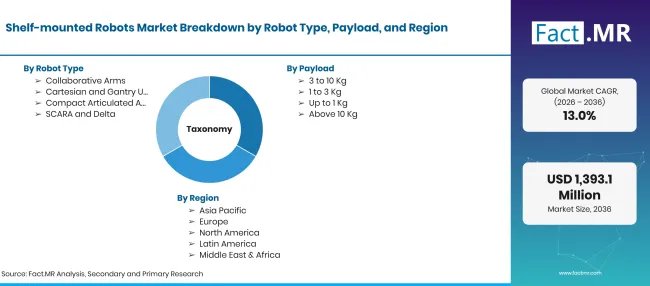
Shelf Mounted Robots Market Taxonomy | Source: Fact.MR
| Items | Values |
|---|---|
| Quantitative Units (2026) | USD 410.4 Million |
| Robot Type | Collaborative arms, Cartesian and gantry units, Compact articulated arms, SCARA and delta |
| Payload | 3 to 10 kg, 1 to 3 kg, Up to 1 kg, Above 10 kg |
| Application | Warehouse and micro-fulfilment, Retail stores and kiosks, Laboratory automation, Pharmacy automation, Food and beverage vending |
| End User | Logistics and e-commerce, Retail and food service, Healthcare and life sciences, Electronics manufacturing |
| Regions Covered | North America, Latin America, Europe, Asia Pacific, Middle East & Africa |
| Countries Covered | China, South Korea, United States, France, United Kingdom, and other countries |
| Key Companies Profiled | FANUC, Universal Robots, ABB, Yaskawa, Techman Robot |
| Additional Attributes | Dollar revenue in the Shelf-mounted Robots Market is segmented by robot type, payload, application and end user and region. |
Source: Fact.MR analysis. Updated Nov 26, 2026
Shelf-mounted Robots Market by Segments
-
Robot Type
- Collaborative arms
- Cartesian and gantry units
- Compact articulated arms
- SCARA and delta
-
Payload
- 3 to 10 kg
- 1 to 3 kg
- Up to 1 kg
- Above 10 kg
-
Application
- Warehouse and micro-fulfilment
- Retail stores and kiosks
- Laboratory automation
- Pharmacy automation
- Food and beverage vending
-
End User
- Logistics and e-commerce
- Retail and food service
- Healthcare and life sciences
- Electronics manufacturing
-
Region:
- North America
- United States
- Canada
- Mexico
- Europe
- Germany
- United Kingdom
- France
- Italy
- Spain
- Rest of Europe
- Asia Pacific
- China
- India
- Japan
- South Korea
- Australia and New Zealand
- Rest of Asia Pacific
- Latin America
- Brazil
- Argentina
- Rest of Latin America
- Middle East & Africa
- GCC Countries
- South Africa
- Rest of Middle East & Africa
- North America
Table of Contents
Key Takeaways
- Market Size and CAGR
- Top Growth Driver
- Fastest Growing Segment
- Leading Region
- Key Companies
- Emerging Opportunities

